Posted on Leave a comment

The Legend of Dopamine: Zelda, me, and ADHD

Back in 2017, at the spritely age of 27 years old, I couldn’t wait to get the Nintendo Switch and a new Zelda game. What I didn’t realise at the time was that I likely had ADHD, and oh how I wish I could go back and shake the younger version of me. 

If I had stopped to think about it for a few seconds, I might have known, but sadly my ADHD often means I can’t stop to contemplate things very much. Classic really. In my twenties, I was acutely aware of my anxiety. I also knew I was a bit hyper sometimes, but I just put that down to the fact that I’m an enthusiastic person. However, during my twenties, I knew people who are autistic and neurodivergent, and the last thing I wanted to do was take up space.

There are many things that are key to my initial realisation that I have ADHD. Countless abandoned projects, intense hyper fixations, a rollercoaster of acute concentration mixed with a brain that can feel dizzy and disorientated. I also struggle with books, long films, and a lot of games that lack immediacy. I think this is why I gravitate towards Nintendo games, because when I press the jump button, Mario jumps… instantly.

I’m a huge Zelda fan, and I’m lucky enough to say that I got to play and enjoy several titles alongside their original releases, such as Ocarina of Time, Wind Waker, Twilight Princess, and Skyward Sword. Breath of the Wild’s launch is still so special, however, as the drastic transformation of the series’ gameplay and style remains shocking to this day. It also represents everything I love about videogames but often struggle to articulate.
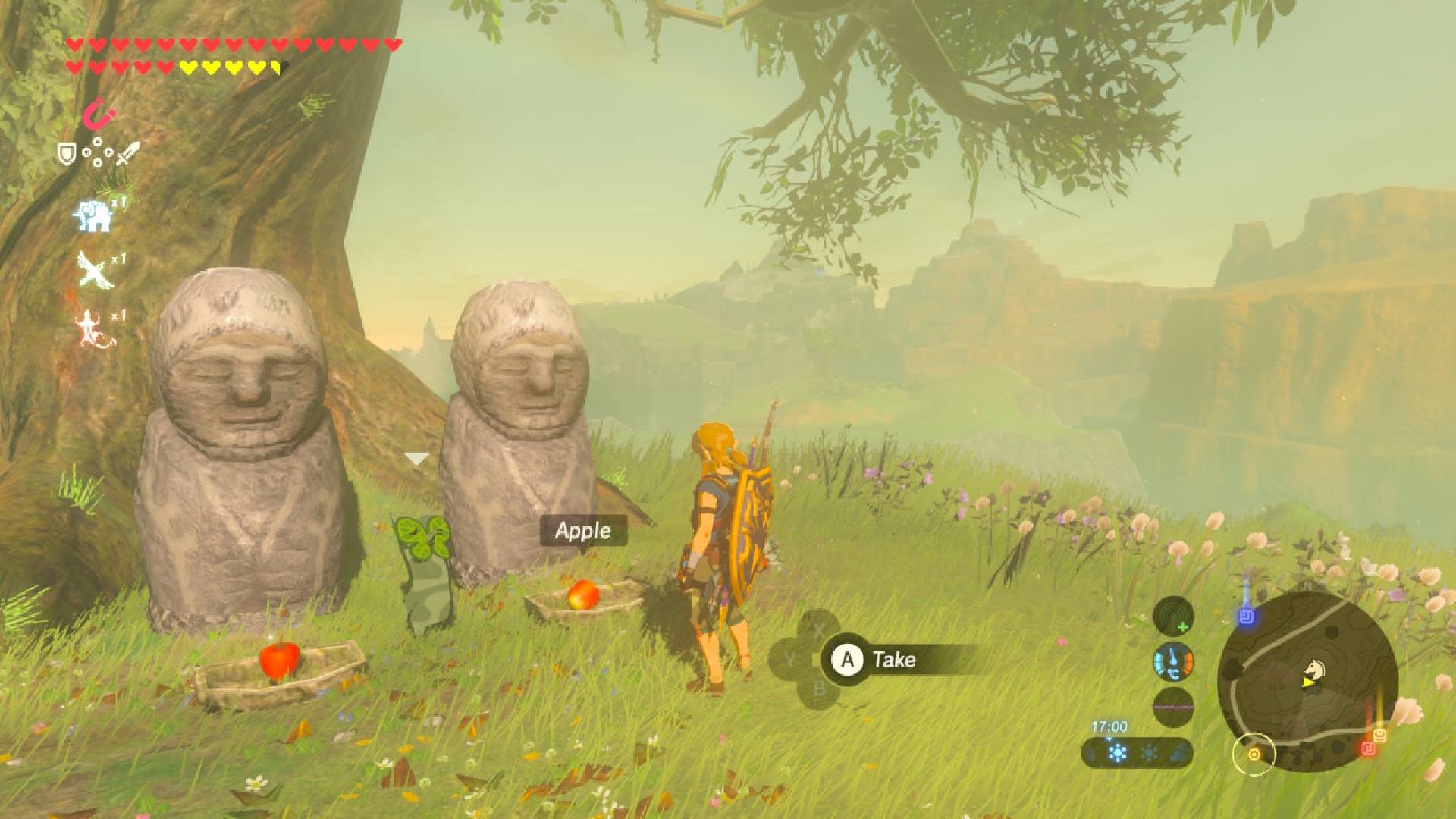
Zelda Tears of the Kingdom ADHD: Link stands in front of a korok puzzle

Before becoming a journalist, I was terrible for getting stuck in a game and only coming back months, if not years, later. One wrong turn in a dungeon, and I was so disorientated I could never go back. One too many deaths at the hand of a boss, and I threw in the towel. If I lost an hour or two of progress, I was probably never coming back.

The Legend of Zelda: Breath of the Wild didn’t entirely help me realise I have ADHD, but it helps me explain so many things about my brain, what appeals to it, and what keeps me coming back. I have well over 600 hours across multiple saves in Breath of the Wild, and it’s a world I am happy to just occupy, aimlessly wander, and jump from point of interest to point of interest.

I think Breath of the Wild is a fantastic game for people with ADHD, and there are a few reasons why. First is the aforementioned immediacy. If I press jump, Link jumps. If I want to go somewhere, I can go there. If I see something interesting, you can bet I can find it, and almost every single time, the game rewards me for doing so. The Hyrule of Breath of the Wild is densely populated not just with things to do, but visual cues that point you towards them.
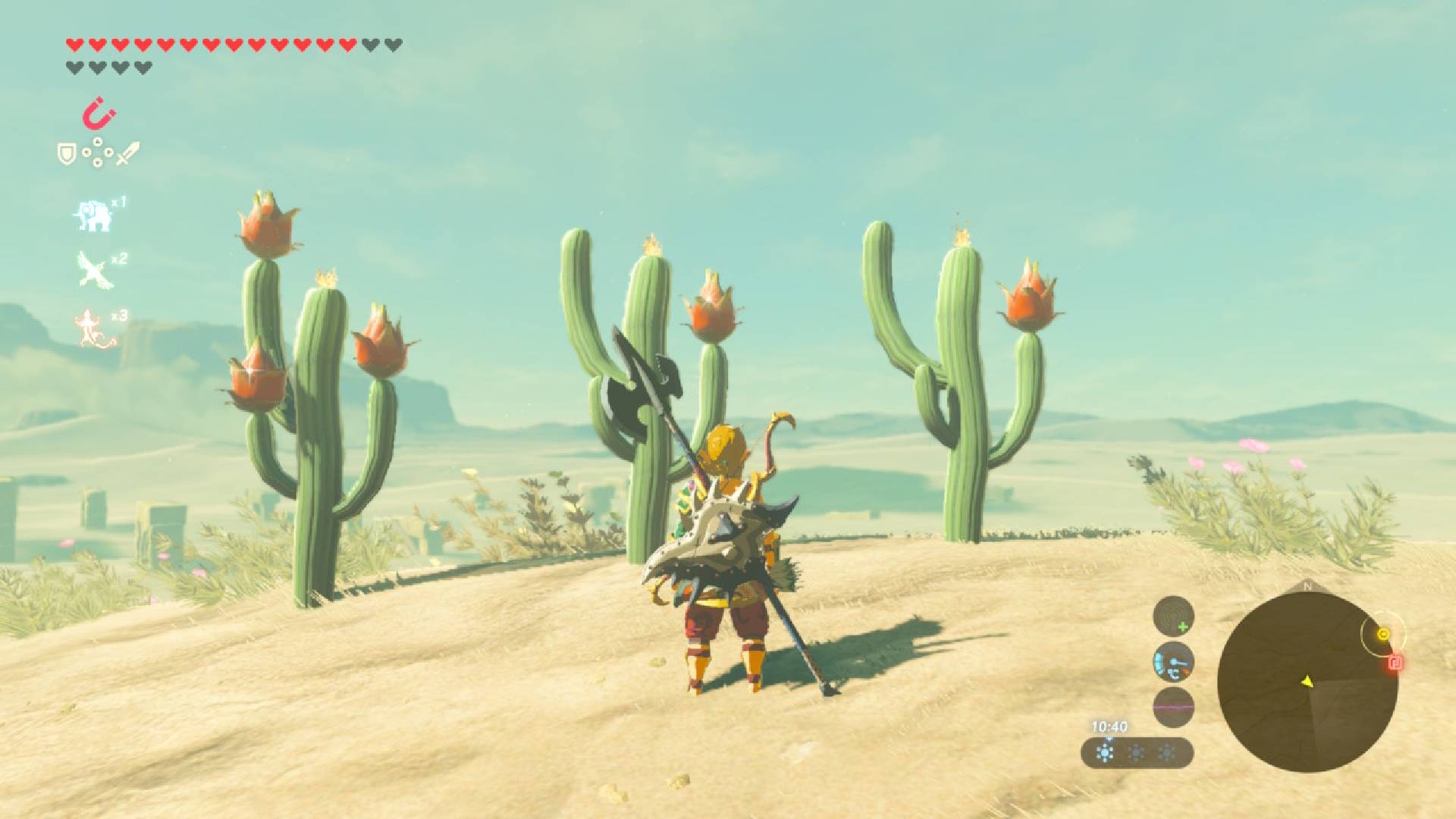
Zelda Tears of the Kingdom ADHD: Link stands in front of three trees with different styles of fruit

The most crucial of these points of interest are two things, shrines and koroks. They stand out distinctly in the overworld, and both give you a quantifiable reward for solving their puzzles. In essence, all of the Hyrule map is the dungeon, and shrines and koroks represent puzzles in every square inch instead of individual rooms. The shrines are the macro puzzles, and the koroks are the micro puzzles.

They’re both fun and satisfying to solve in their own right, but the fact they’re both visually appealing is essential. Spotting the bright glow of a shrine is still so fun, and it’s just as present in Tears of the Kingdom. But the koroks are the star of the show here, littering the world with visually distinct oddities that always catch the eye.

As you wander around Hyrule, you might see three trees in a row. They all have very similar displays of fruit, except for a single apple out of place. How strange. So to satisfy the symmetry-loving part of your brain you knock down the odd apple, and low and behold, up pops the leafy critter as you have just solved a korok puzzle.
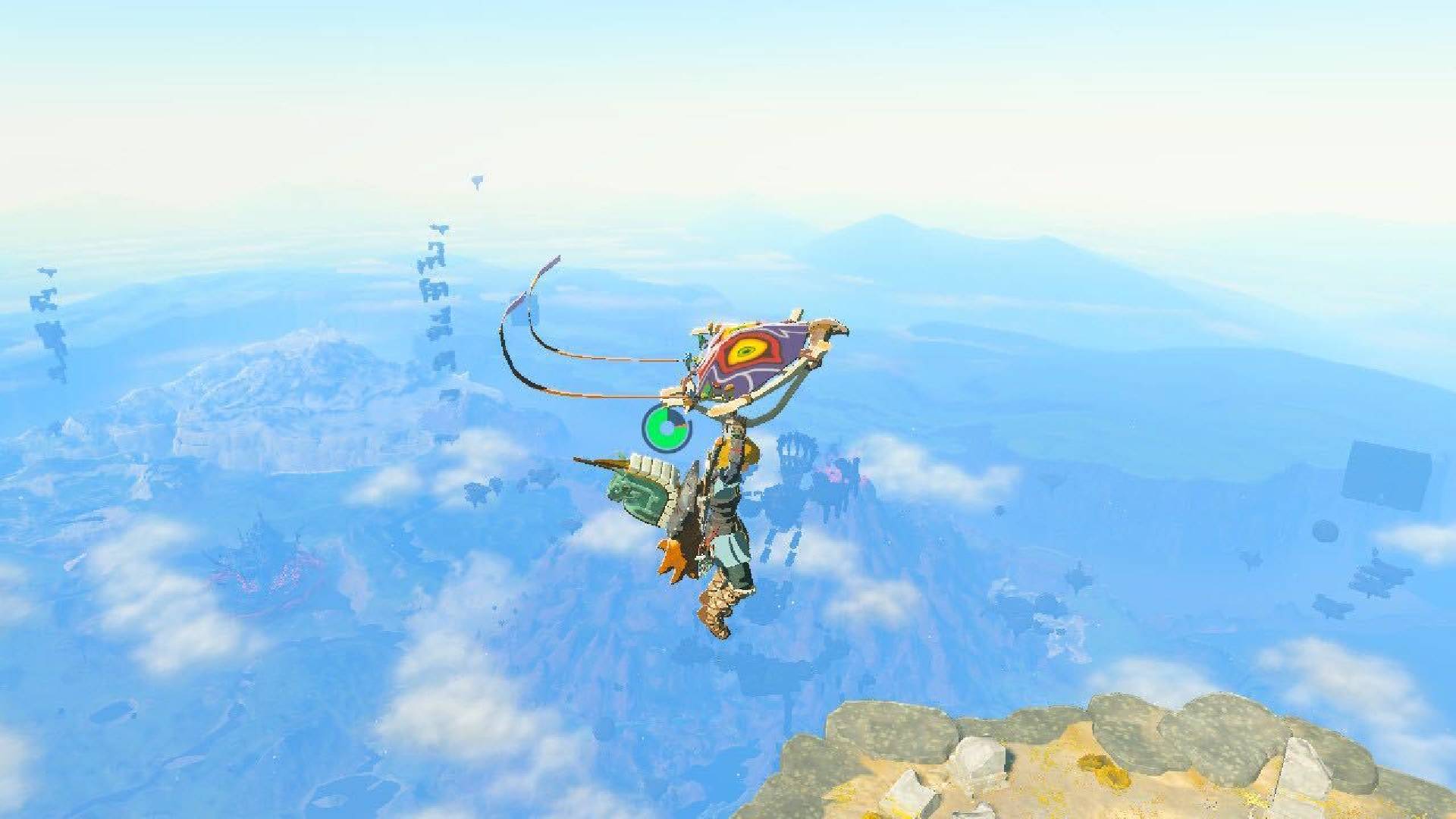
Zelda Tears of the Kingdom ADHD: Link glides onto a sky island

There are so many of these puzzles, like circles consisting of rocks with a single one missing, begging you to complete the circle. There are rings of leaves floating on bodies of water, with a suspiciously positioned spot just above that looks perfect for diving. There are rows of statues, all holding offerings of apples, except for one, and you know exactly what’s bound to happen if you drop an apple into that empty space.

If you’re familiar with the viral TikTok of a person watching someone put blocks into the wrong-shaped holes, you know the exact opposite of this feeling. There’s such a rush of dopamine when you create order out of disorder, when you finally bring together two separated elements, much like when completing a line in Tetris.

Breath of the Wild is essentially a million tiny tasks, but while other videogames gate these off with blocks to progression or singular solutions to puzzles, Breath of the Wild begs for you to solve these small puzzles any way that works, and in any order. You can walk in a straight line in any direction in Breath of the Wild and come across puzzles to solve, shrines to complete, and enemies to defeat. And it’s never, ever, the wrong thing to do.
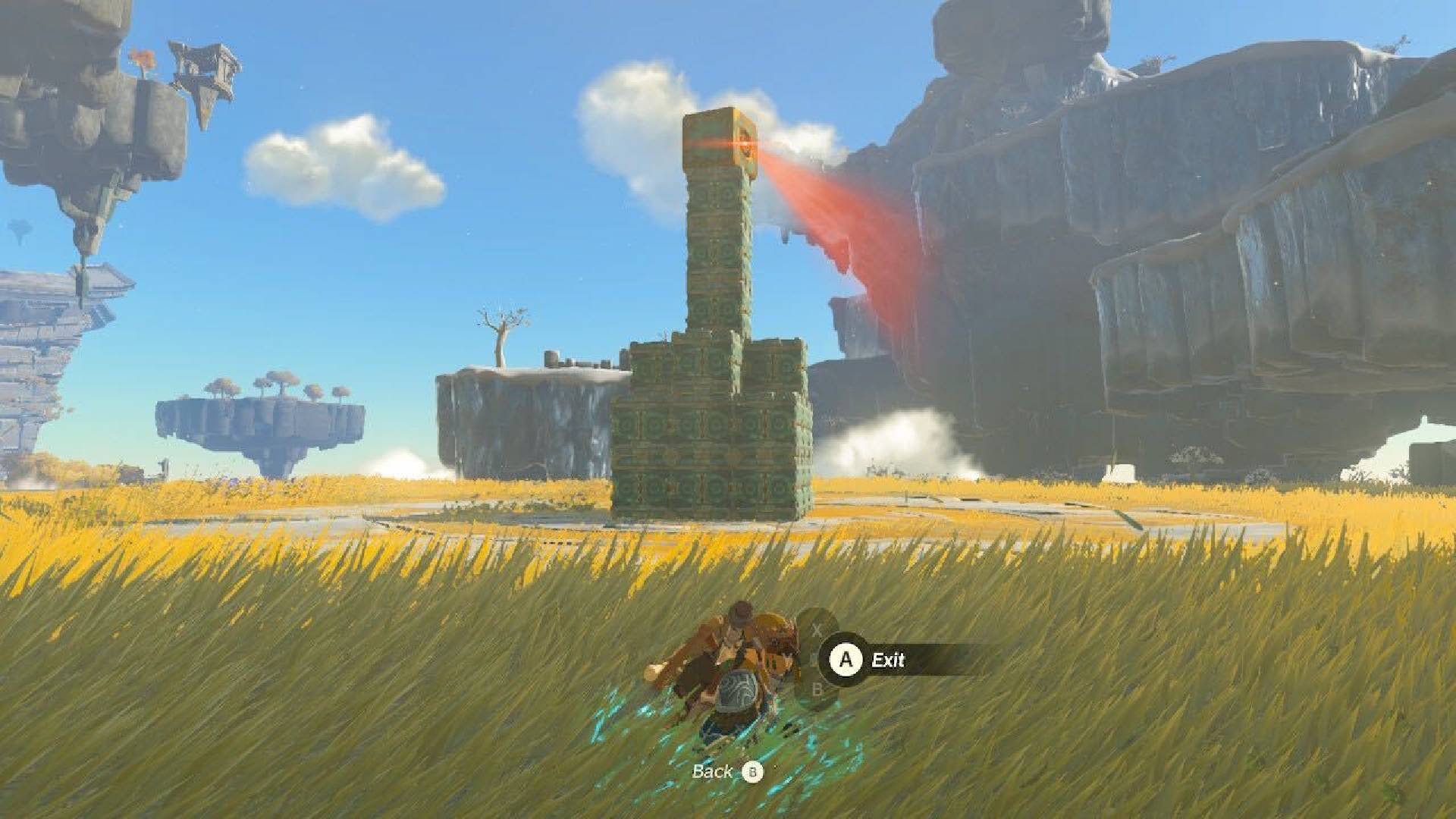
Zelda Tears of the Kingdom ADHD: Link pokes out of the ground and sees a Flux Construct

I’ve fallen in love with games before, and I often can force myself to play games I describe as anti-ADHD. While the agonising pace of a title like Red Dead Redemption 2 is too much for me, I managed to get through the mental blockades in Animal Crossing: New Horizons created by the obtuse nature of terraforming.

Perhaps it’s because Animal Crossing still allows you to quickly do small tasks in between other larger ones, whereas in RDR2, I feel like I’m following a script, and I can only do it as quickly as the game wants me to. Either way, I can play any game, really, but I only fall completely in love with games that work alongside my brain.

This is how I know Breath of the Wild is the perfect ADHD game for me. Instead of ominous and obtuse large tasks, I have an easy-to-solve pile of small tasks all along the way, offering dopamine with every solution. I don’t have to wait for hours for resolution or essential story development, every moment actively involves me, it makes me think, and rewards me.

I remember those early days in 2017, when my housemates and I had Breath of the Wild up on a projector, playing it for hours at a time, endlessly entertained and constantly curious. My housemate jokingly referred to it as “mash A – the game”, and he was incredibly right. Much like the many korok puzzles and the many shrines, there’s also always something to pick up, whether it’s plants, resources like wood, or drops from enemies. And crucially, it’s immediate.
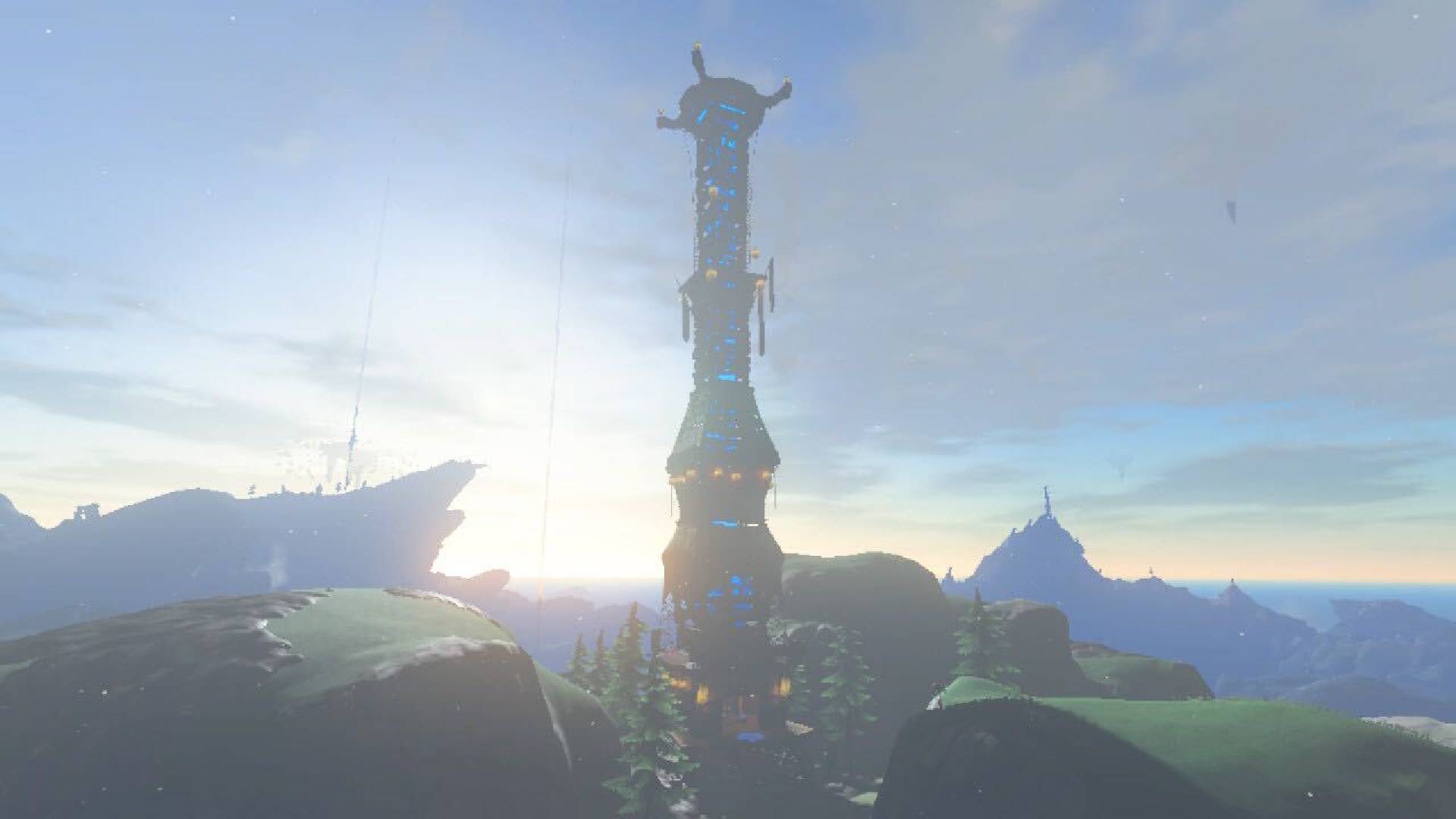
Zelda Tears of the Kingdom ADHD: A tower sticks out of the landscape

Everything about Breath of the Wild works with my brain, nothing gets in the way, and that’s how I could still gladly sink another 600 hours into it. Now, this is where I’m both delighted and terrified. You remember how I said Breath of the Wild is the perfect ADHD game? Well, scratch that, because Tears of the Kingdom is the perfect ADHD game.

I’m one week and nearly twenty hours into my latest Hyrule adventure, and already I’m seeing smart amendments to the few blockades that Breath of the Wild offers to progress. The shrines are back and even more visually appealing, just teasing you from across the map with their green swirling lights and asking to be explored.
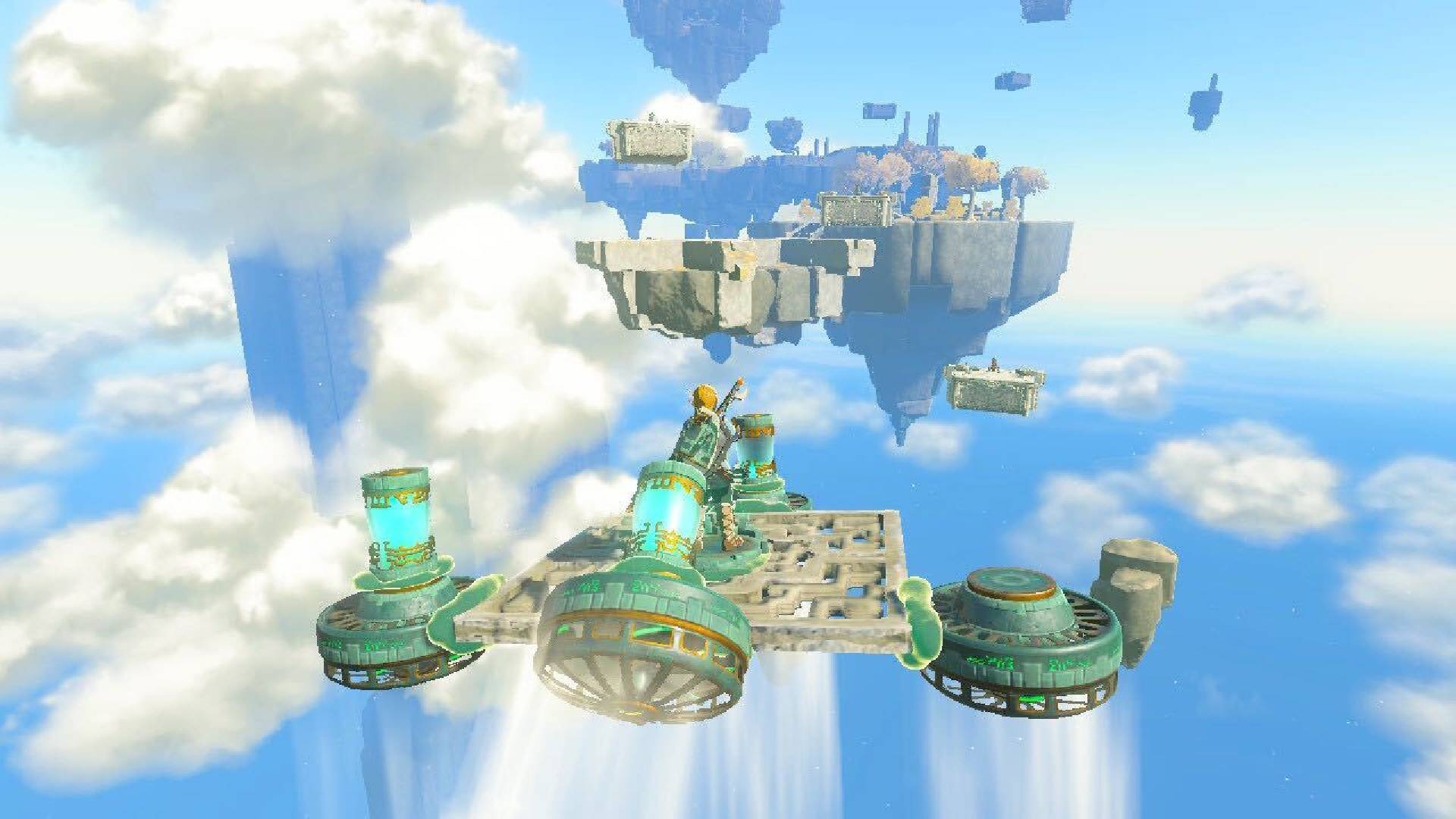
Zelda Tears of the Kingdom ADHD: Link rides a craft through the sky

Except now they aren’t contained to the ground, and neither is Link. That curiosity is rewarded threefold, with new things to spot, pin, and explore on the ground, in the sky, and even below the surface. I’m a magpie, and the sky islands are shiny coins, dazzling me with their secrets as my mind aches to discover what each new floating area holds.

One of my only issues with Breath of the Wild is the amount of rain and having to genuinely just wait for several real minutes for the weather to pass just so Link can explore again. However, Tears of the Kingdom isn’t just about climbing, it’s also about vertical exploration, and the height offered by the skyward propulsion of the towers or the many zany Zonai devices is so, so, satisfying.
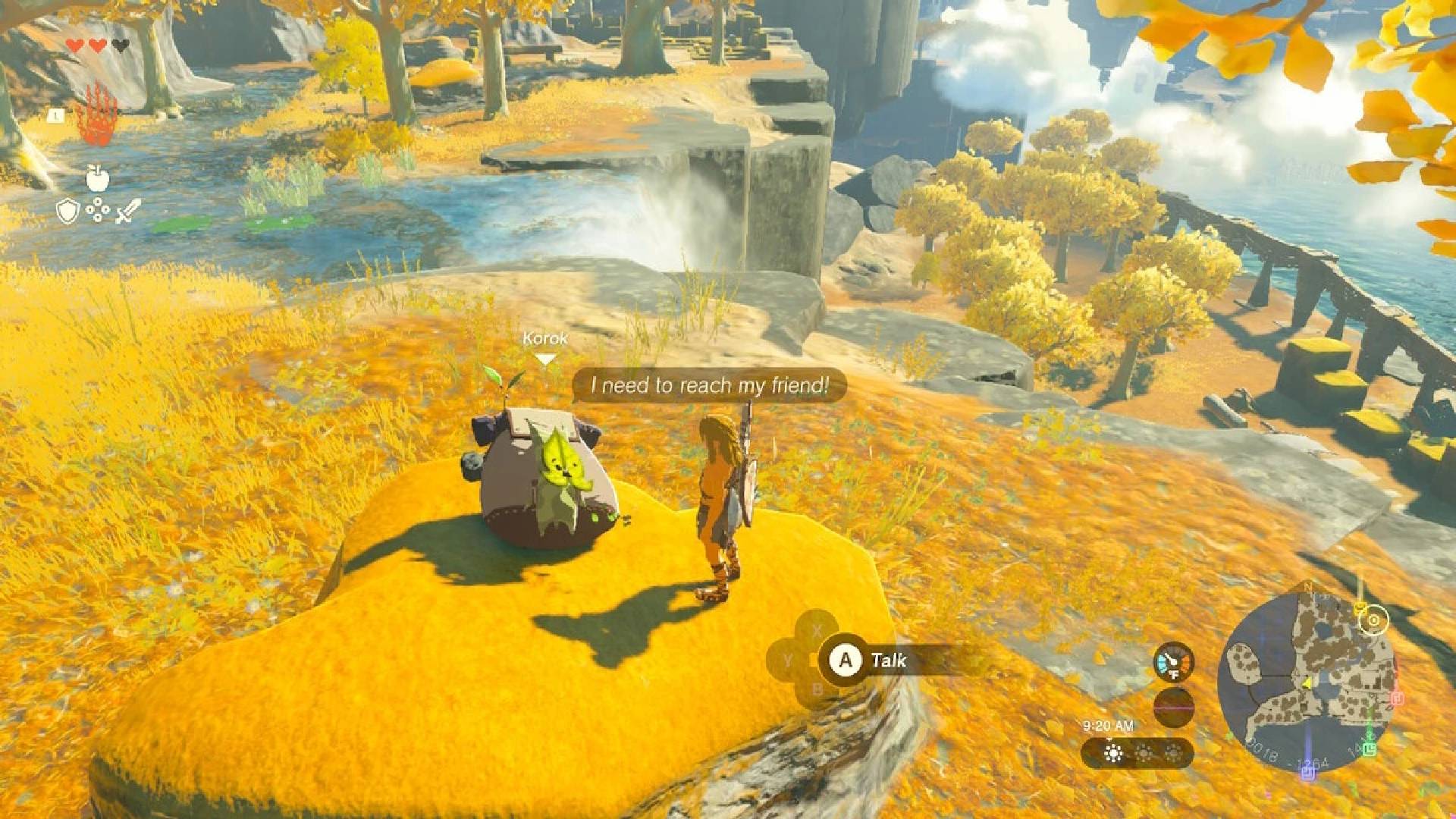
Zelda Tears of the Kingdom ADHD: Link stands in front of a Korok who wants to meet their friend

No more is my curiosity restricted to the land and beholden to the rain gods. I can go anywhere, and I mean anywhere. Tears of the Kingdom wants you to explore every inch of the sky, the depths, and it happily rewards you for doing so. I find myself spotting mesmerizingly high islands, using Zonai balloons and fire emitters to slowly float up there, and every time being rewarded with something special.

The final two improvements go hand in hand, and I can see myself losing years of my life to them. My favourite element of Breath of the Wild is the koroks, and my favourite new element of Tears of the Kingdom is the ability to create vehicles with Zonai devices, only limited by your imagination.

So, you had better believe that I’m in love with the latest korok puzzle, where you must reunite two little korok friends separated over large distances. I’m going to be making cars, planes, and flying death machines to reunite my leafy friends for the next few years.
YouTube Thumbnail

I can’t say yet if Tears of the Kingdom is set to help me realise something new about myself, but I’m immensely happy that Breath of the Wild did. Six years and one ADHD diagnosis, later I have steps in place to help me, and crucially I know exactly what my brain likes and what it doesn’t like. I thought I had found perfection, but it just might be trumped, as Tears of the Kingdom offers all the immediacy, curiosity, and constant rewards that make the dopamine in my brain go brrrr… and then some. I’ll see you in another 600 hours.
Posted on Leave a comment

The BotW recipe book

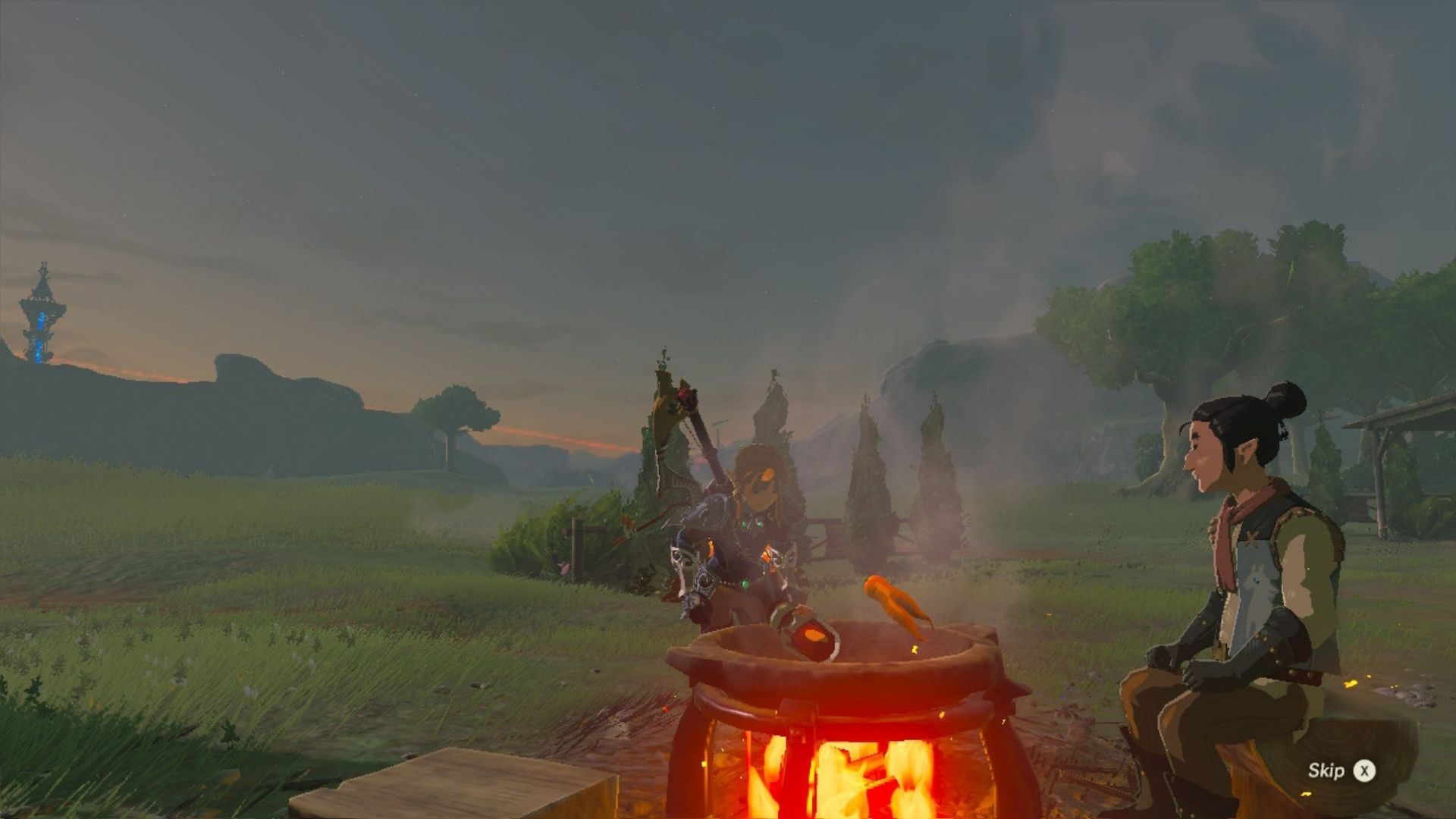
BotW recipes are one of the more playful additions to the reinvented Zelda formula. Alongside the crafting system, this offers many, many concoctions for you to discover. It’s very rare that you get given recipes, so finding them by trial and error is key to creating culinary masterpieces. Of course, some players would like to have a recipe book, and that’s what we’ve made here. Every single BotW recipe for every tasty meal.

So, bookmark this page and check back here every time Link’s tummy starts rumbling. Once you’ve had your fill, check out our BotW amiibo guide to get some in-game freebies, or our Zelda BotW map rundown to make sure you actually know where you’re going. If you need a refresher on the stars of the game, check out our BotW Zelda and BotW Link, then head over to our Zelda: Tears of the Kingdom review to embark on a new adventure.

BotW recipe book

Here you can find all the dishes you could every need in BotW:

How do you cook BotW recipes?

Cooking in Breath of the Wild is simple, but not tutorialised. First, you need to find a cooking pot. If it doesn’t have a lit fire beneath it, use some sort of flame to light it (or drop some flint on the wood and use a metal weapon to light it). Once the fire’s lit, it’s time to get cooking.

A picture of Link cooking a BotW recipe.

Go into your inventory and choose the ingredients you want and make sure you get Link to hold them. You can hold up to five items. Once you’re holding them, exit the menu and drop them into the cooking pot. Et voila, you’re now on your way to making countless culinary creations. Bon appetit!

Every BotW recipe

Here are all the BotW recipes. Any ingredient that is non-descript (e.g. vegetable, mushroom, seafood etc.) means that you can use any type of that ingredient. Well, what are you waiting for? Get cooking.

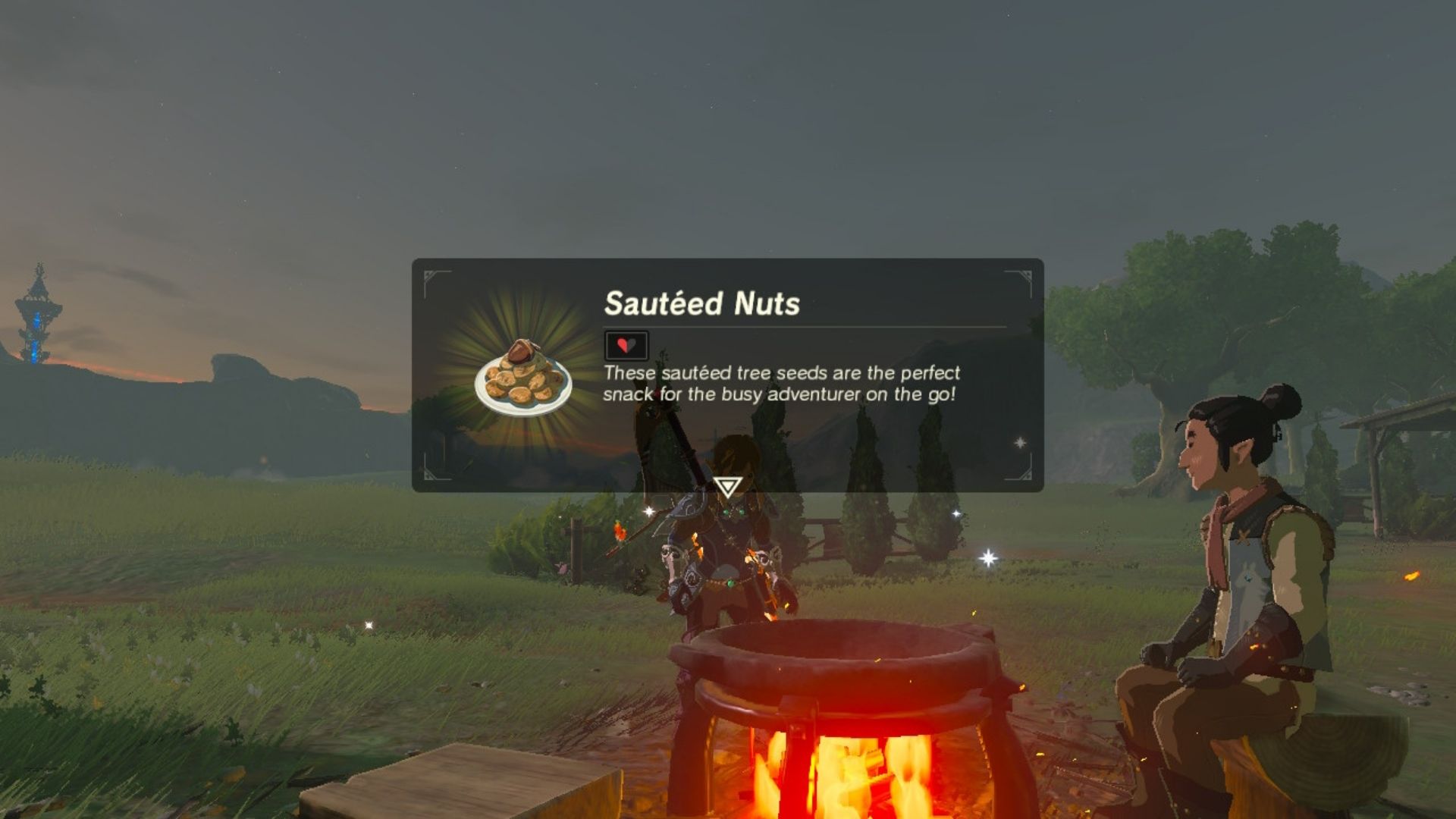
A picture of the BotW recipe for sauteed nuts.

Vegan BotW recipes

Ever wanted to roleplay as an eco-conscious Link? Well, here are all the BotW recipes that don’t harm any animals.

  • Copious fried wild greens – four different vegetables
  • Copious mushroom skewers – four different mushrooms
  • Curry rice – Hylian rice, Goron spice
  • Fragrant mushroom sauté – mushroom, Goron spice
  • Fried wild greens – vegetable
  • Fruit and mushroom mix – fruit, mushroom
  • Herb sauté – vegetable, Goron spice
  • Mushroom rice balls – mushroom, Hylian rice
  • Mushroom skewer – mushroom
  • Rock-hard food – gems or wood
  • Salt-grilled greens – vegetable, rock salt
  • Salt-grilled mushrooms – mushroom, rock salt
  • Sautéed nuts – acorn or Chickaloo tree nut
  • Spicy sautéed peppers – spicy pepper
  • Steamed fruit – fruit, vegetable
  • Steamed mushrooms – mushroom, vegetable
  • Vegetable curry – carrot or pumpkin, Goron spice, Hylian rice
  • Veggie rice balls – vegetable, Hylian rice
  • Wheat bread – rock salt, Tabantha wheat

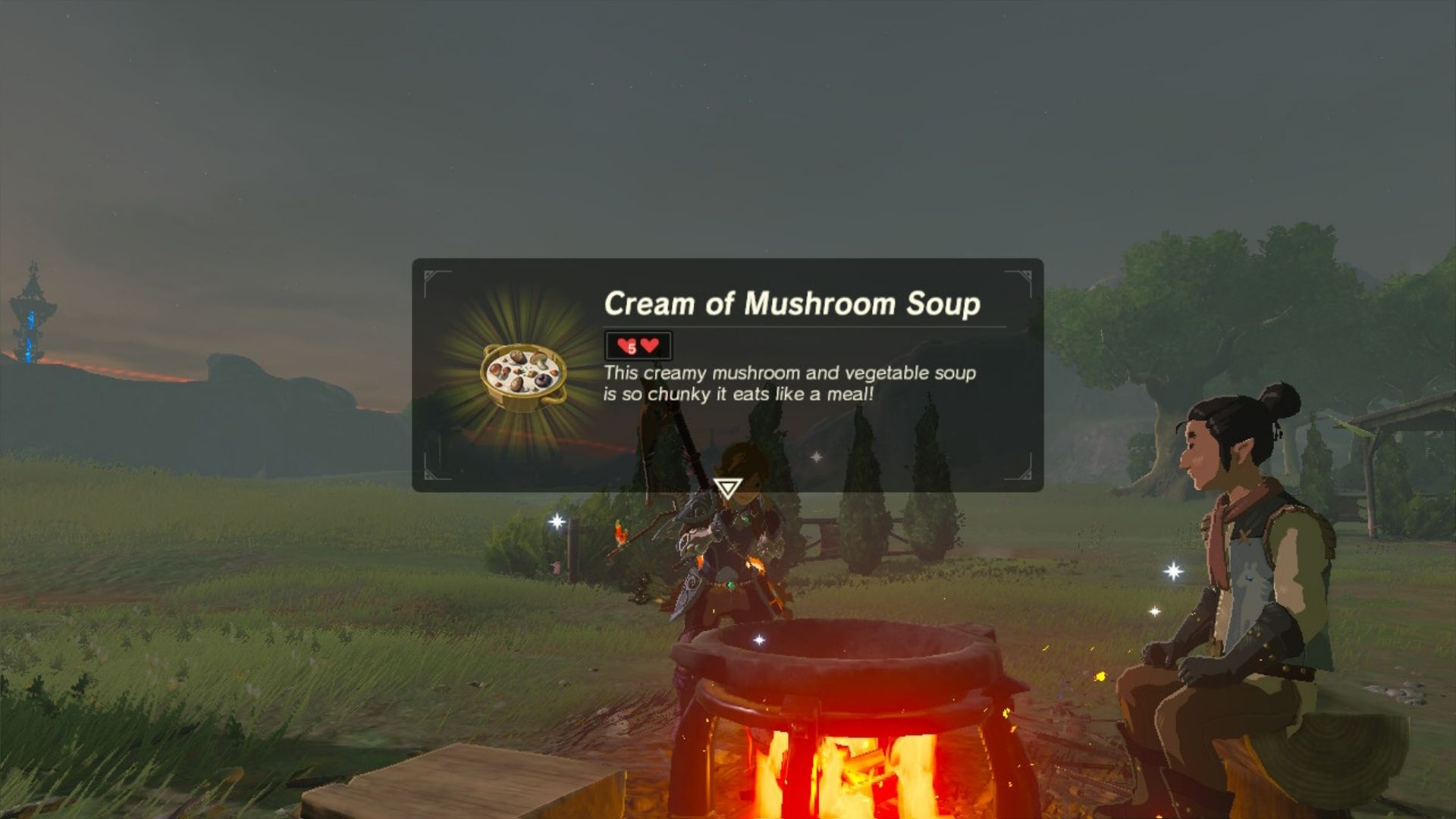
A picture of the BotW recipe for cream of mushroom soup.

Vegetarian BotW recipes

If you can’t do without eggs and milk, not to worry. You can also be a veggie in Breath of the Wild with this wide array of recipes.

  • Carrot stew – carrot, goat butter, fresh milk, Tabantha wheat
  • Cream of mushroom soup – mushroom, vegetable, fresh milk, rock salt
  • Cream of vegetable soup – vegetable, fresh milk, rock salt
  • Creamy heart soup – radish, hydromelon, voltfruit, fresh milk
  • Curry pilaf – Hylian rice, goat butter, Goron spice
  • Glazed mushrooms – mushroom, courser bee honey
  • Glazed veggies – vegetable, courser bee honey
  • Mushroom omelette – mushroom, bird egg, goat butter, rock salt
  • Mushroom risotto – mushroom, goat butter, Hylian rice, rock salt
  • Pumpkin stew – fortified pumpkin, goat butter, fresh milk, Tabantha wheat
  • Vegetable omelette – vegetable, bird egg, goat butter, rock salt
  • Vegetable risotto – carrot or pumpkin, goat butter, Hylian rice, rock salt
  • Veggie cream soup – pumpkin or carrot, fresh milk, rock salt

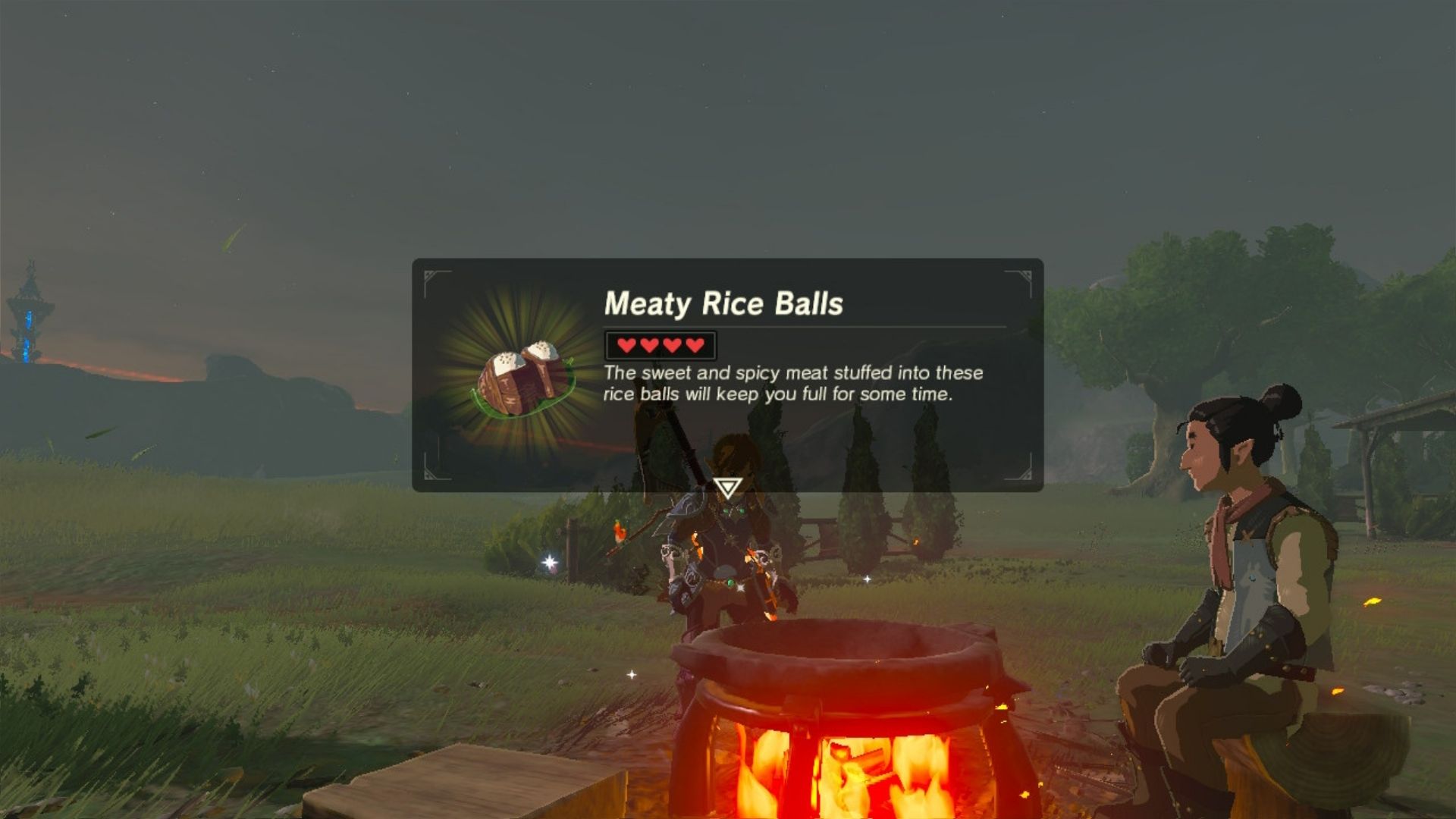
A picture of the BotW recipe for meaty rice balls.

Meat BotW recipes

You may see Link as a hardy young man trying to save the world. He can’t be picky with his dietary requirements, right? Well, here’s the list for all you meat lovers out there.

  • Copious meat skewers – four different raw meats
  • Creamy meat soup – raw meat, herb, fresh milk, rock salt
  • Glazed meat – meat, courser bee honey
  • Gourmet meat curry – raw gourmet meat, Hylian rice, Goron spice
  • Gourmet meat stew – raw gourmet meat, goat butter, fresh milk, Tabantha wheat
  • Gourmet meat and rice bowl – raw gourmet meat or raw whole bird, Hylian rice, rock salt
  • Gourmet meat and seafood fry – raw gourmet meat or raw bird thigh, any fish
  • Gourmet spiced meat skewer – raw gourmet meat or raw whole bird, Goron spice
  • Meat curry – raw meat, hylian rice, Goron spice
  • Meat pie – raw meat, Tabantha wheat, goat butter, rock salt
  • Meat skewer – raw meat
  • Meat stew – raw meat, goat butter, fresh milk, Tabantha wheat
  • Meat and mushroom skewer – raw meat, mushroom
  • Meat and rice bowl – raw meat or raw bird drumstick, Hylian rice, rock salt
  • Meat and seafood fry – raw meat or raw bird drumstick, fish
  • Meat-stuffed pumpkin – raw meat, fortified pumpkin
  • Meaty rice balls – raw meat, Hylian rice
  • Prime meat curry – raw prime meat, Hylian rice, Goron spice
  • Prime meat stew – raw prime meat, goat butter, fresh milk, Tabantha wheat
  • Prime meat and rice bowl – raw bird thigh, Hylian rice, Goron spice
  • Prime meat and seafood fry – raw prime meat or raw bird thigh, fish
  • Prime spiced meat skewer – raw prime meat or raw bird thigh, Goron spice
  • Salt-grilled gourmet meat – raw gourmet meat or raw whole bird, rock salt
  • Salt-grilled meat – raw meat or raw bird drumstick, rock salt
  • Salt-grilled prime meat – raw prime meat or raw bird thigh, rock salt
  • Spiced meat skewer – raw meat or raw bird drumstick, Goron spice
  • Spicy pepper steak – meat, spicy pepper
  • Steamed meat – meat, vegetable

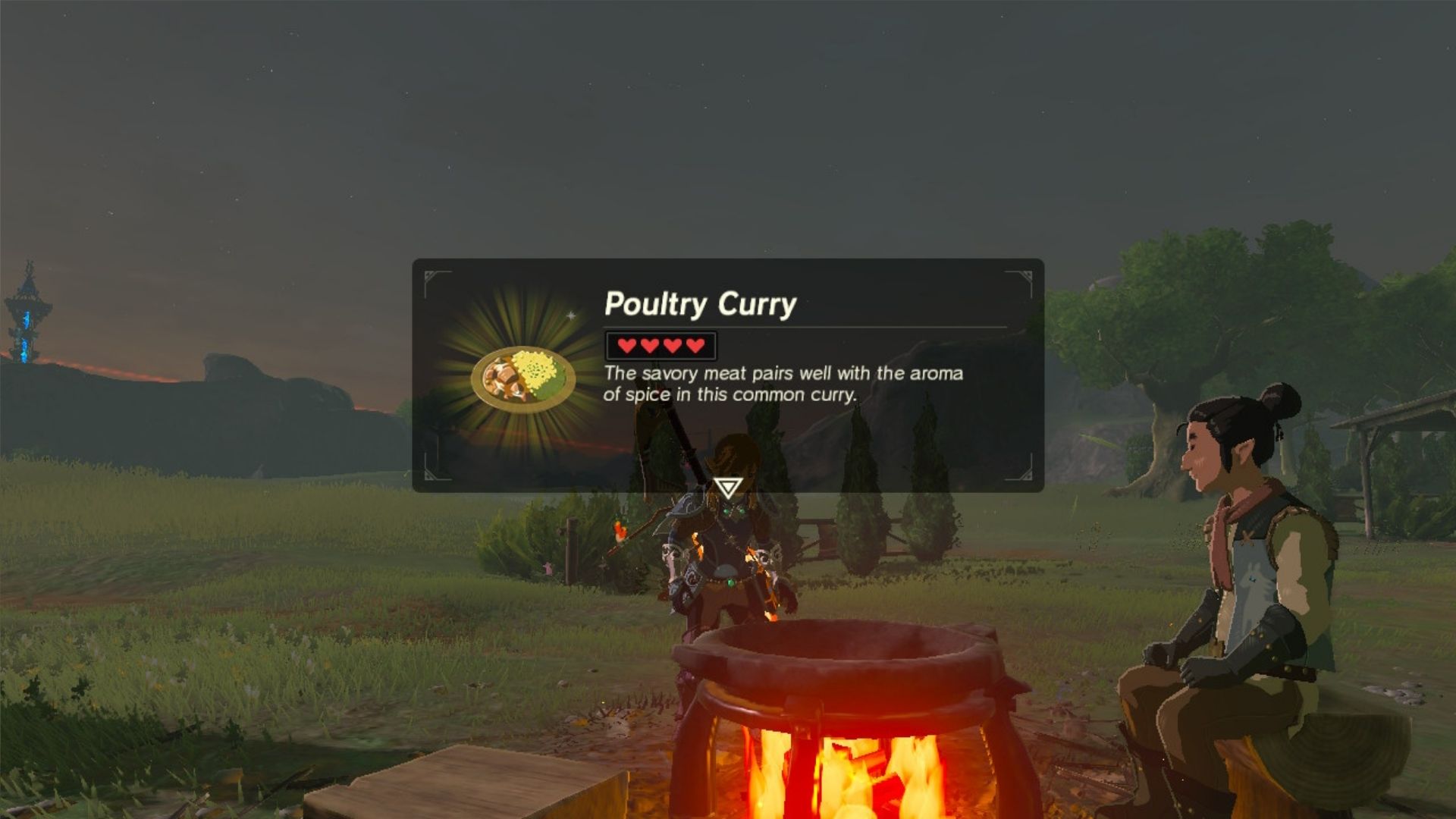
A picture of the BotW recipe for poultry curry.

Poultry BotW recipes

A more delicate flavour than the meat above, here are all the poultry BotW recipes.

  • Gourmet poultry curry – raw whole bird, Hylian rice, Goron spice
  • Gourmet poultry pilaf – raw whole bird, bird egg, goat butter, Hylian rice
  • Poultry curry – raw bird drumstick, Goron spice, Hylian rice
  • Poultry pilaf – raw bird drumstick, bird egg, goat butter, Hylian rice
  • Prime poultry curry – raw bird thigh, Hylian rice, Goron spice
  • Prime poultry pilaf – raw bird thigh, bird egg, goat butter, Hylian rice

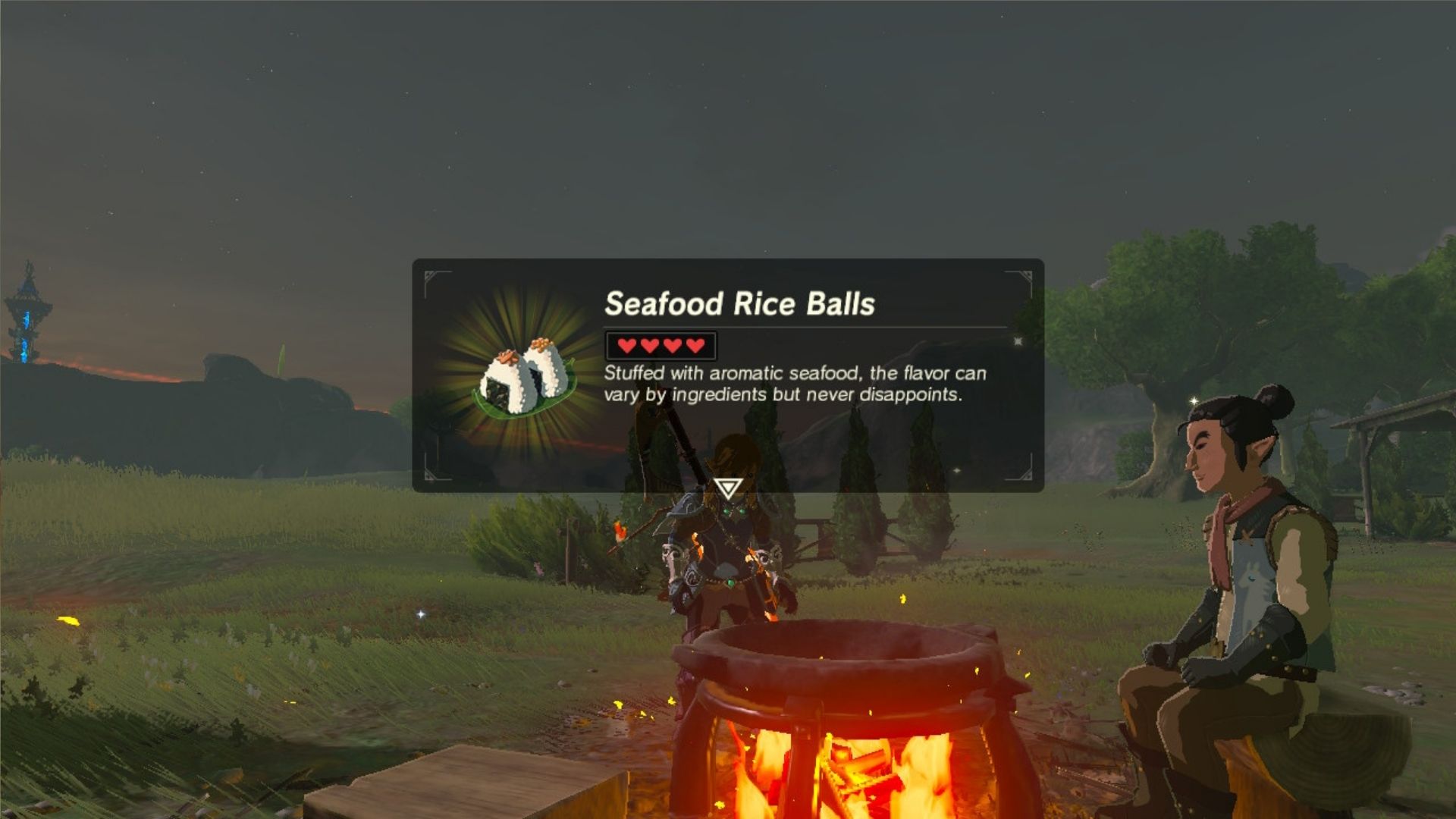
A picture of the BotW recipe for seafood rice balls.

Seafood BotW recipes

Link is a fine swimmer, and great at riding boats with that big leaf he has. Surely he’s a fan of seafood?

  • Clam chowder – hearty blueshell snail, goat butter, fresh milk, Tabantha wheat
  • Copious seafood skewers – four different fish
  • Crab omelette with rice – crab, bird egg, rock salt, Hylian rice
  • Crab risotto – crab, rock salt, Hylian rice, goat butter
  • Crab stir-fry – crab, Goron spice
  • Creamy seafood soup – seafood, herb, rock salt, fresh milk
  • Fish pie – seafood, rock salt, goat butter, Tabantha wheat
  • Fish and mushroom skewer – fish, mushroom
  • Glazed seafood – seafood, courser bee honey
  • Porgy meunière – porgy, goat butter, Tabantha wheat
  • Salmon meunière – hearty salmon, rock salt, Hylian rice, goat butter
  • Salmon risotto – hearty salmon, rock salt, Hylian rice, goat butter
  • Salt-grilled crab – crab, rock salt
  • Salt-grilled fish – fish, rock salt
  • Seafood curry – porgy or hearty blueshell snail, Hylian rice, Goron spice
  • Seafood fried rice – porgy or hearty blueshell snail, Hylian rice, rock salt
  • Seafood meunière – seafood, goat butter, Tabantha wheat
  • Seafood paella – porgy, hearty blueshell snail, rock salt, goat butter, Hylian rice
  • Seafood rice balls – fish, Hylian rice
  • Seafood skewer – crab or snail
  • Spicy pepper seafood – fish, spicy pepper
  • Steamed fish – fish, vegetable

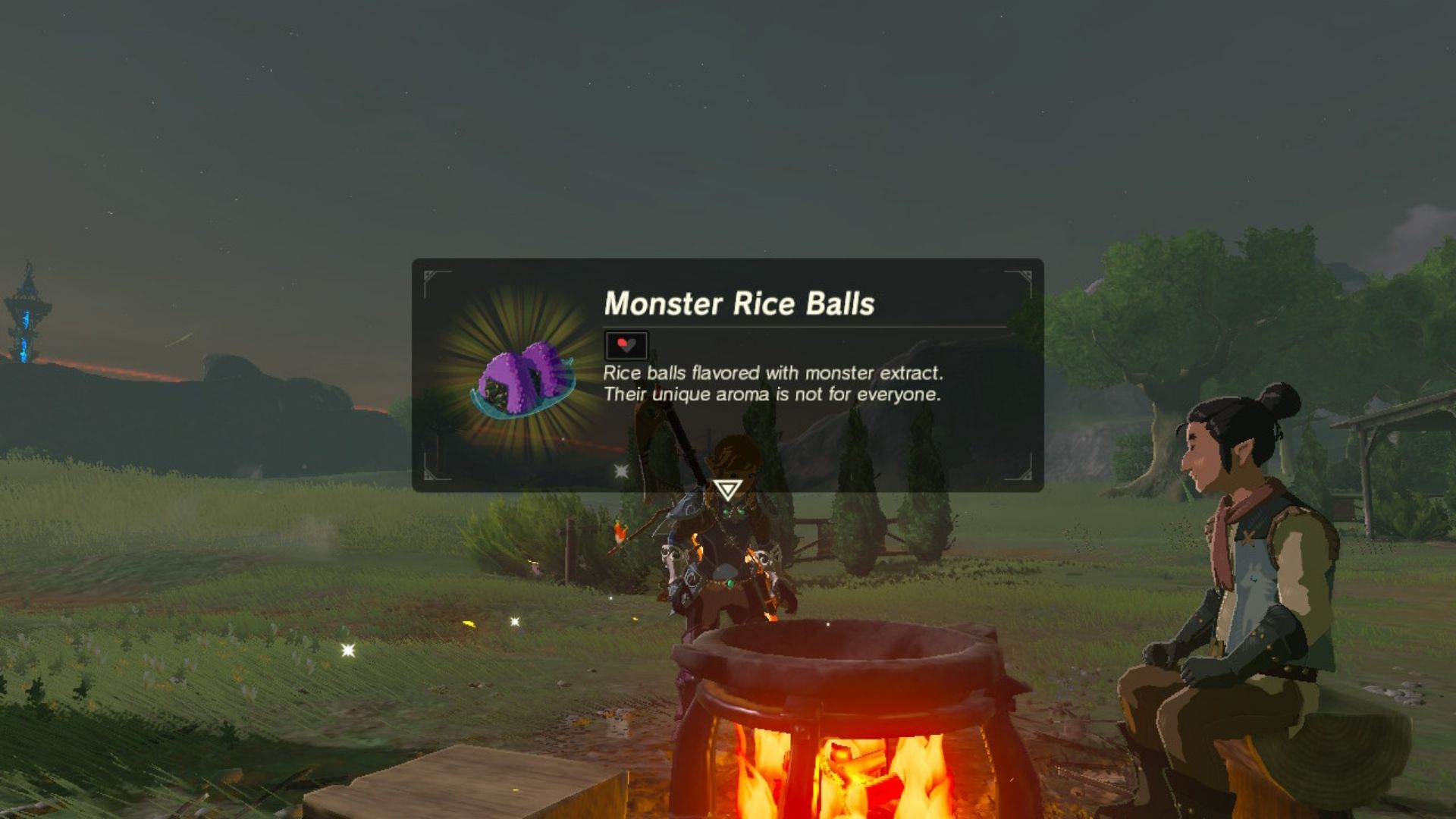
A picture of the BotW recipe for monster rice balls.

Monster BotW recipes

If you’re looking to explore Link’s darker side, here are all the monster-based BotW recipes. He has to take what he can get, right?

  • Dubious food – monster parts or other non-edible items
  • Monster cake – monster extract, cane sugar, goat butter, Tabantha wheat
  • Monster curry – monster extract, Goron spice, Hylian rice
  • Monster rice balls – monster extract, Hylian rice, rock salt
  • Monster soup – monster extract, goat butter, fresh milk, Tabantha wheat
  • Monster stew – monster extract, meat, seafood

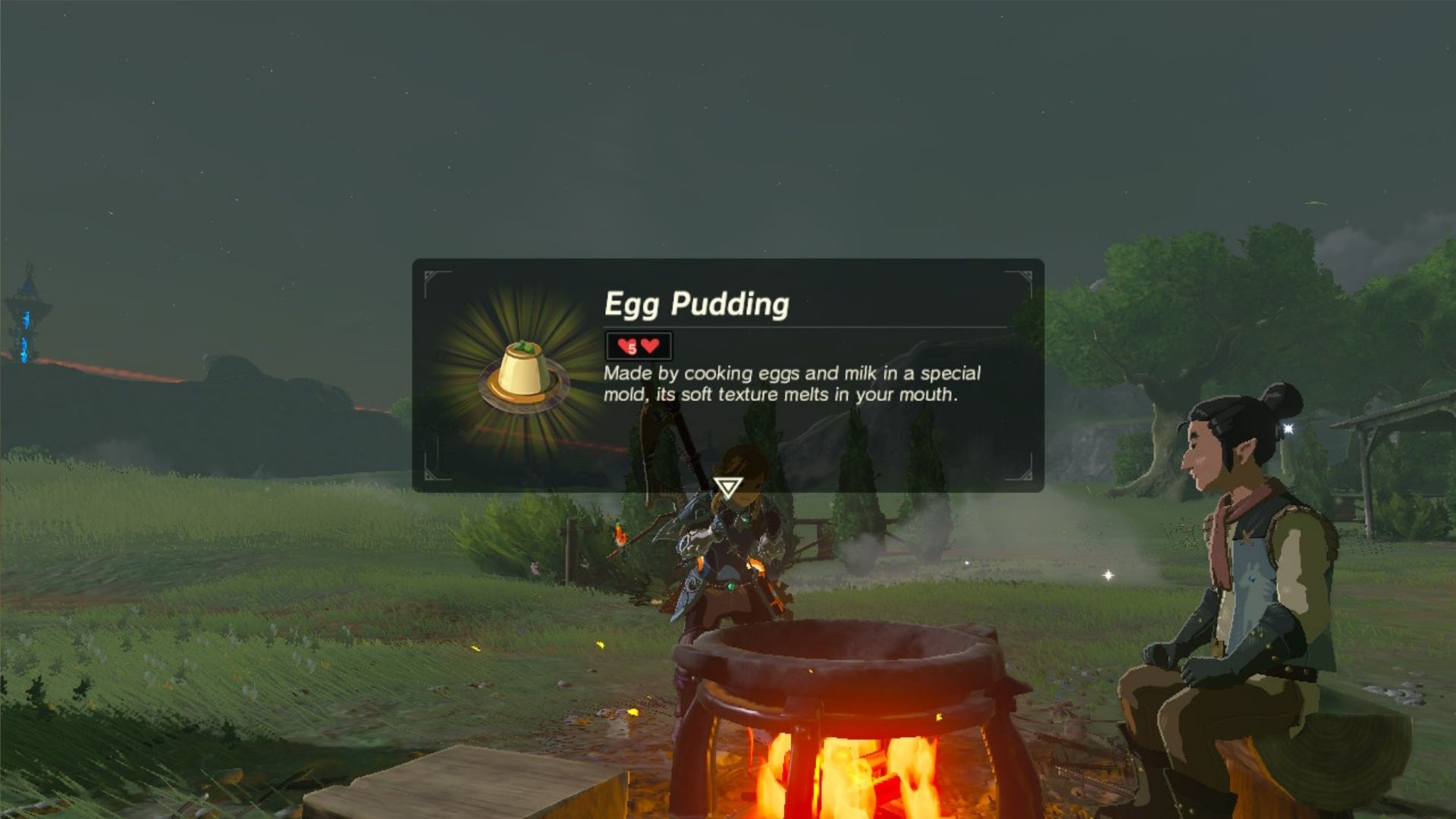
A picture of the BotW recipe for egg pudding.

Desert BotW recipes

Everyone deserves a treat every now and then. Ruin Link’s diet with these lovely sweet treats.

  • Apple pie – apple, goat butter, cane sugar, Tabantha wheat
  • Carrot cake – carrot, goat butter, cane sugar, Tabantha wheat
  • Copious simmered fruit – four different fruit
  • Egg tart – bird egg, goat butter, Tabantha wheat, cane sugar
  • Egg pudding – bird egg, fresh milk, cane sugar
  • Energising honey candy – courser bee honey
  • Energising honey crepe – courser bee honey, Tabantha wheat, bird egg, cane sugar, fresh milk
  • Fried bananas – mighty bananas, cane sugar, Tabantha wheat
  • Fruit cake – apple or wildberry, fruit, cane sugar, Tabantha wheat
  • Fruit pie – fruit, goat butter, cane sugar, Tabantha wheat
  • Honeyed apple – apple, courser bee honey
  • Honeyed fruits – fruit, courser bee honey
  • Hot buttered apple – apple, goat butter
  • Nut cake – acorn or Chikaloo tree nut, goat butter, cane sugar, Tabantha wheat
  • Plain crepe – Tabantha wheat, bird egg, cane sugar, fresh milk
  • Pumpkin pie – fortified pumpkin, goat butter, cane sugar, Tabantha wheat
  • Simmered fruit – fruit
  • Wildberry crepe – wildberry, bird egg, cane sugar, fresh milk, Tabantha wheat

Drink BotW recipes

One stiff drink for Link. Well, he’s underage, so no booze. But still, it’s got a fairy in it. That’s got to make him feel a little wavey, right?

  • Fairy tonic – fairy

Whoa, that’s a lot of BotW recipes. You’re ready to explore Hyrule with a full belly thanks to our BotW recipe book. If you need more Zelda magic, we’ve got a Skyward Sword amiibo guide to get you started in this classic Wii adventure.

Posted on Leave a comment

The Legend of Zelda: Tears of the Kingdom preview breakdown

We’re absolutely champing at the bit for any information on the upcoming sequel to Breath of the Wild, as The Legend of Zelda: Tears of the Kingdom is now tantalisingly close. So close in fact, that several outlets recently played the title at Tears of the Kingdom previews, and are spilling a few key details in the process. So, we’re putting together several of these previews and going over some of the details you might miss.

Before we para-sail into the rest of this guide, we’ve got more great pieces of content than Hyrule has shrines, so be sure to check it all out. We’ve got articles covering Zelda: Tears of the Kingdom fusion, Zelda: Tears of the Kingdom enemies, Zelda: Tears of the Kingdom trailer breakdown, Zelda Tears of the Kingdom: Zonai, and much more.

Let’s take a closer look at everything revealed in the Zelda: Tears of the Kingdom previews.

Zelda: Tears of the Kingdom previews

First up, we’re gathering up some of the most informative previews all in one place, so you can easily watch them all right here.

IGN

YouTube Thumbnail

Nintendo Life

YouTube Thumbnail

GameXplain

YouTube Thumbnail

Good Vibes Gaming

YouTube Thumbnail

Zeltik

YouTube Thumbnail

New Zelda: Tears of the Kingdom preview information

We’re busy pouring over every single second of new footage on Tears of the Kingdom and are picking several key new details we’ve spotted, that you otherwise might have missed. You can find them all below.

  • The Travel Medallion returns from Breath of the Wild’s DLC, and serves exactly the same purpose. This customisable fast travel warp point means Link can return to sky islands with ease
  • Link makes exciting new creations by using the Ultrahand ability and items known as Zonai parts. A fun new gacha-like sphere drops new parts when Link brings it a Zonai charge which the new enemy known as Zonai constructs drop when killed
  • Footage reveals that those blue vials at Link’s hip are to be charged for a battery meter, which powers your Zonai creations. We don’t know how to increase this battery charge yet, but footage reveals Link with different amounts, so he must gain more somehow
  • There’s a second map now with the addition of the sky map. This new addition helps Link chart the land high above Hyrule, and keep track of the many different sky islands. Though we’re not sure how we reveal the map just yet, or if it’s like the Shiekah Tower mechanic from the original Breath of the Wild
  • When Link picks up a weapon with a full inventory, you’re now given the option to drop a weapon immediately. In Breath of the Wild the game forces you to go back into your inventory before opening the chest again, so this is a huge timesaver
  • We now have a recipe book, so Link remembers meals he cooks, and presumably can cook them again if he has the ingredients. Another simple change that saves a lot of time
  • You can now throw any item, much like tossing weapons in Breath of the Wild. Alongside the elemental items such as the various chu chu jellies, this means Link can unleash an attack without wasting any weapons
  • The new Ascend feature not only allows Link to travel through solid objects from below and peer out into the world above, but it also freezes time. This means if Link uses ascend in a cave, but uncovers an enemy camp high up above, you can choose to quickly dip back down and save your skin
  • Link’s new abilities such as Fuse and Ultrahand are selectable with a radial dial, much like choosing weapons in Skyward Sword. This is much easier than the menu from Breath of the Wild, plus, footage reveals at least two additional slots for abilities, so there is more to discover in the full game

Alright, folks, that’s all we have on the Zelda Tears of the Kingdom previews for now. We hope you find this helpful, and if you’re just as excited as us to finally revisit the land of Hyrule, be sure to check out our Zelda Tears of the Kingdom pre-order guide next.

Posted on Leave a comment

Zelda Tears of the Kingdom – Zonai explained

Being such a humongous game, Nintendo’s Switch title The Legend of Zelda: Breath of the Wild is full of mysteries, many still unsolved to this day (keeping many a YouTube creator in business). As we hurtle towards the imminent release of BotW’s sequel, one particular mystery is unfolding, so we’re going over everything we know in our Zelda Tears of the Kingdom Zonai explained guide.

Before we magnesis your eyes down to the rest of the guide, be sure to check out our Hyrule compendium of content on The Legend of Zelda games, new and old. We have articles on the best Zelda games, Wind Waker Switch, Twilight Princess Switch, Tears of the Kingdom pre-orders, Zelda Lego, Zelda wallpapers, Breath of the Wild wallpaper, and plenty more Links for you to explore.

Alright, explorers, let’s gallop on the back of Epona into our Zelda Tears of the Kingdom Zonai explained guide.

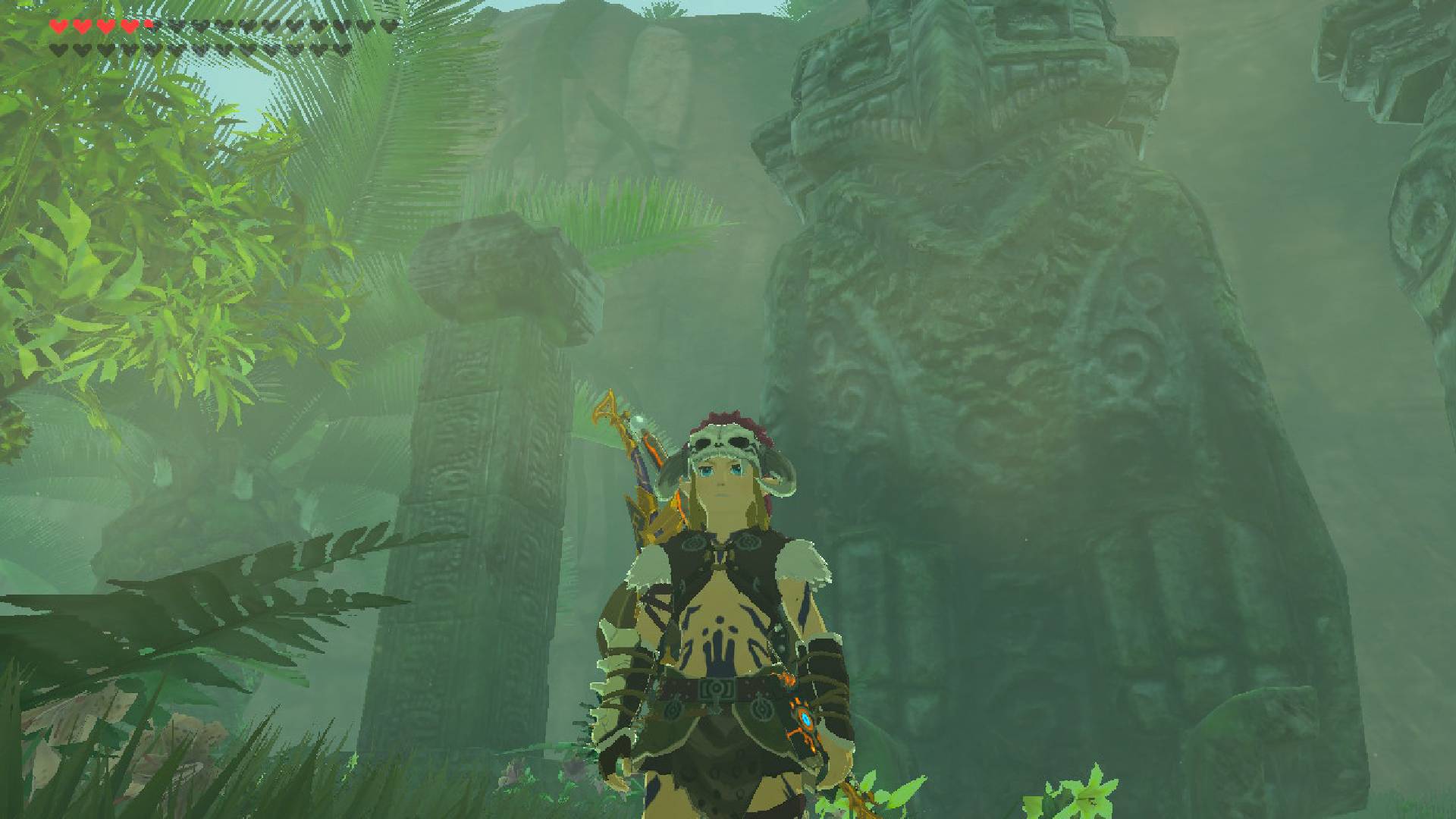
Zelda Tears of the Kingdom Zonai explained: Link stands in front of a Zonai structure wearing the barbarian armour

Who are the Zelda Tears of the Kingdom Zonai?

Alluded to heavily in The Legend of Zelda: Breath of the Wild, the Zonai tribe are an ancient civilisation, already wiped out during the time of Breath of the Wild. Though the people are long gone, evidence of the tribe exists thanks to the Zonai ruins, as well as buildings and ruins based on their notable dragon sigil dotted around the map.

While there’s not much in the way of direct references to the Zonai, several items and locations include descriptions of the ancient race. Players find the three pieces of the Barbarian armour set at the centre of each of the three labyrinths, hinting that the tribe built these giant constructs. The description for each armour piece mentions “an ancient warlike tribe from the Faron region,” while each armour piece also increases attack. From this, it’s likely the Zonai were warriors, kitted out in armour similar to the Barbarian set.

Zelda Tears of the Kingdom Zonai explained: ruins show a Zonai structure, based on a dragon

The Zonai crest depicts a water dragon, and many of the Zonai ruins in the Faron region feature a similar water dragon. Etching in the ruins also depict a triforce symbol, suggesting the Zonai have a connection to it, and possibly are able to wield magic. The race also has a strong connection to animals, with each triangle of the triforce associated with an animal. Dragons represent courage, owls for wisdom, and boards for power.

Are the Zelda Tears of the Kingdom Zonai associated with the Shiekah?

Both from their location, as well as text descriptions within The Legend of Zelda: Breath of the Wild, it’s likely the Zonai and the Shiekah are two completely different tribes, but they had access to both the triforce and magic, however through different means.

While there isn’t much connecting the two, we know the Shiekah built the shrines, and it’s hinted the Zonai built the three labyrinths to test warrior’s strength. The fact that each labyrinth contains a shrine hints towards the two tribes working together, so it’s entirely possible the two races worked together to fight Calamity Ganon many centuries ago.

Zelda Tears of the Kingdom Zonai explained: Link attacks an enemy with a shield that has a dragon head attached to it

Is Link using Zonai technology in Zelda Tears of the Kingdom?

In the trailers released for The Legend of Zelda: Tears of the Kingdom, we see Link and Zelda exploring underground caverns with columns and statues matching the style of the Zonai. One trailer shows Link using a shield with a dragon head attacked, similar to the dragon head that symbolises the Zonai tribe.

YouTube Thumbnail

The most recent Zelda Tears of the Kingdom stream gives fans an extended look at the title, and Link fights an enemy known as a soldier construct. The enemy drops an item called a Zonai charge, which looks similar to some of the later technology we see powering fans, wheels, and other traversal methods. Link’s new fuse ability and the technology he uses to create methods of transport all seem directly tied to the ancient Zonai technology.

Zelda Tears of the Kingdom Zonai explained: Link battles a Zonai soldier construct

When did the Zelda Tears of the Kingdom Zonai exist?

It doesn’t explicitly state within The Legend of the Zelda: Breath of the WIld the era that the Zonai belong to. However, descriptions of the Zonai in The Legend of Zelda: Breath of the Wild Master Works (Creating a Champion in the West) state that “it’s rumoured that these people disappeared suddenly thousands of years ago.”

Zelda Tears of the Kingdom Zonai explained: A breath of the Wild map shows the Faron region

Where are the Zelda Tears of the Kingdom Zonai ruins?

The Zonai ruins and many of the statues bearing the Zonai sigil and markings are all located in the Faron region of The Legend of Zelda: Breath of the Wild. However, it is heavily suggested that the Zonai also built the three labyrinths found throughout the game, suggesting that the Zonai travelled all over Zonai, despite calling the Faron region their home.

Trailers for The Legend of Zelda: Tears of the Kingdom show many underground caverns with statues and wall etchings using Zonai iconography, possibly hinting that the Zonai tribe actually used underground caverns to travel across Hyrule, explaining why they have technology spread across the land, while only seeming to exist within one region. The Barbarian armour hints that they are a fearsome warrior race, so it is believable that they travel underneath the Hyrule we know, tackling large monsters and paving their own roads across the map of Hyrule.

YouTube Thumbnail

Alright, folks, that’s all we have for our Zelda Tears of the Kingdom Zonai explained guide for now folks, but we are updating this guide as more information becomes available, especially as we approach the Tears of the Kingdom release date. For even more great Zelda content, be sure to read our guides covering the Zelda BotW map and BotW amiibo.

Posted on Leave a comment

Can I play GTA V mobile?

There’s no doubt that GTA V is a juggernaut in the modern gaming world. In the near decade since its release, it has managed to maintain cultural relevance due to its freedom of exploration, unique servers, and custom mods – and it doesn’t look like it’s dying off any time soon. As such, it seems baffling that we’re yet to see an official GTA V mobile port, but with our help, you can still get your dose of crime-fuelled action on the go.

If you’re still on the hunt for more GTA fun, check out our GTA cheats guide, or our findings on the possibility of a GTA V Nintendo Switch port – we only hope that it would run better than the GTA Remastered Trilogy.

Is there an official GTA V mobile port?

While many GTA games have made their way to mobile, Rockstar hasn’t released a GTA V mobile port, mostly due to the sheer size of the game. GTA V has been out for nearly a decade at this point, and it still doesn’t look like we’re getting an official mobile port any time soon.

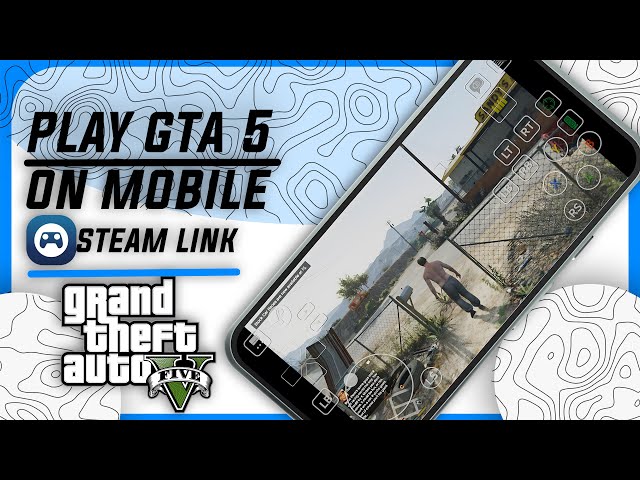
However, you can play GTA V on mobile either by streaming it through Steam Link, or unofficial APKs. We recommend using caution when considering unofficial APKs, especially as many of the GTA V APKs are only available through unfamiliar sites, and therefore may host viruses or malware.

YouTube Thumbnail

How to play GTA V mobile via Steam Link

As mentioned above, the safest way to play GTA V mobile is through Steam Link. This works on both Android and iOS but requires you to have a copy of GTA V on Steam and installed on your PC. You also need to download the official Steam Link app on your mobile device. Most medium-range to high-range mobiles can run GTA V through this method with no technical issues, but you need a fast and stable internet connection with low ping to run the game smoothly on your phone.

Of course, before you go purchasing a copy of GTA V on Steam, you should make sure that your PC can handle it. Check out the GTA V system requirements and test whether your pc can run it over on PC Game Benchmark. After purchasing and installing GTA V on your PC, you need to create a GTA profile and run the game.

So, once you’ve got all that set up, follow these steps to play GTA V on mobile.

  • Download the Steam Link app on Google Play or the App Store
  • Open both the Steam Link app and the Steam client on your PC
  • In the Steam PC client, go to the ‘Steam’ tab and hit ‘settings’
  • In the settings window, go to ‘remote play’ and tick the ‘enable remote play’ checkbox
  • Hit the ‘pair steam link’ button below the list of devices
  • The Steam Link app on your phone should scan for your PC, then provide a four-digit PIN
  • Enter the PIN into the ‘authorise device’ textbox that pops up on your Steam PC client and hit ‘ok’
  • After that, your device’s name should show up in the Steam PC client’s remote play window
  • Wait for your Steam Link app to test the network connection, then hit ‘ok’
  • Hit the ‘start playing’ button to access your Steam library on your phone
  • Launch GTA V

And there you go! If you’re having trouble and would like a visual guide to help you through the steps above, check out the embedded video from Android 9 Hacks. We also recommend that you use a controller when playing GTA V on mobile, as the touchscreen controls can be a bit cumbersome.

That’s all we’ve got on GTA V mobile for now. Of course, we’ll be sure to keep you in the loop if Rockstar ever sets its sights on an official Grand Theft Auto V mobile port but, in the meantime, head over to our list of the best games like GTA on mobile and Switch for more crime spree shenanigans. Or, if you’re looking to expand your GTA experience, check out our sister site PCGN’s epic guide to the best GTA 5 RP servers.
Posted on Leave a comment

There’s a Bayonetta Origins demo hidden in Bayonetta 3

If you’re hoping to uncover the secrets of the Witch with No Memories, then we bet you’re as pumped as we are to find out that Nintendo has hidden a playable Bayonetta Origins demo in Bayonetta 3. Ever since we caught our first glimpse of the trailer during The Game Awards 2022, we’ve all been enchanted by the idea that we’ll soon be able to dive into the stunning world of Bayonetta Origins: Cereza and the Lost Demon.

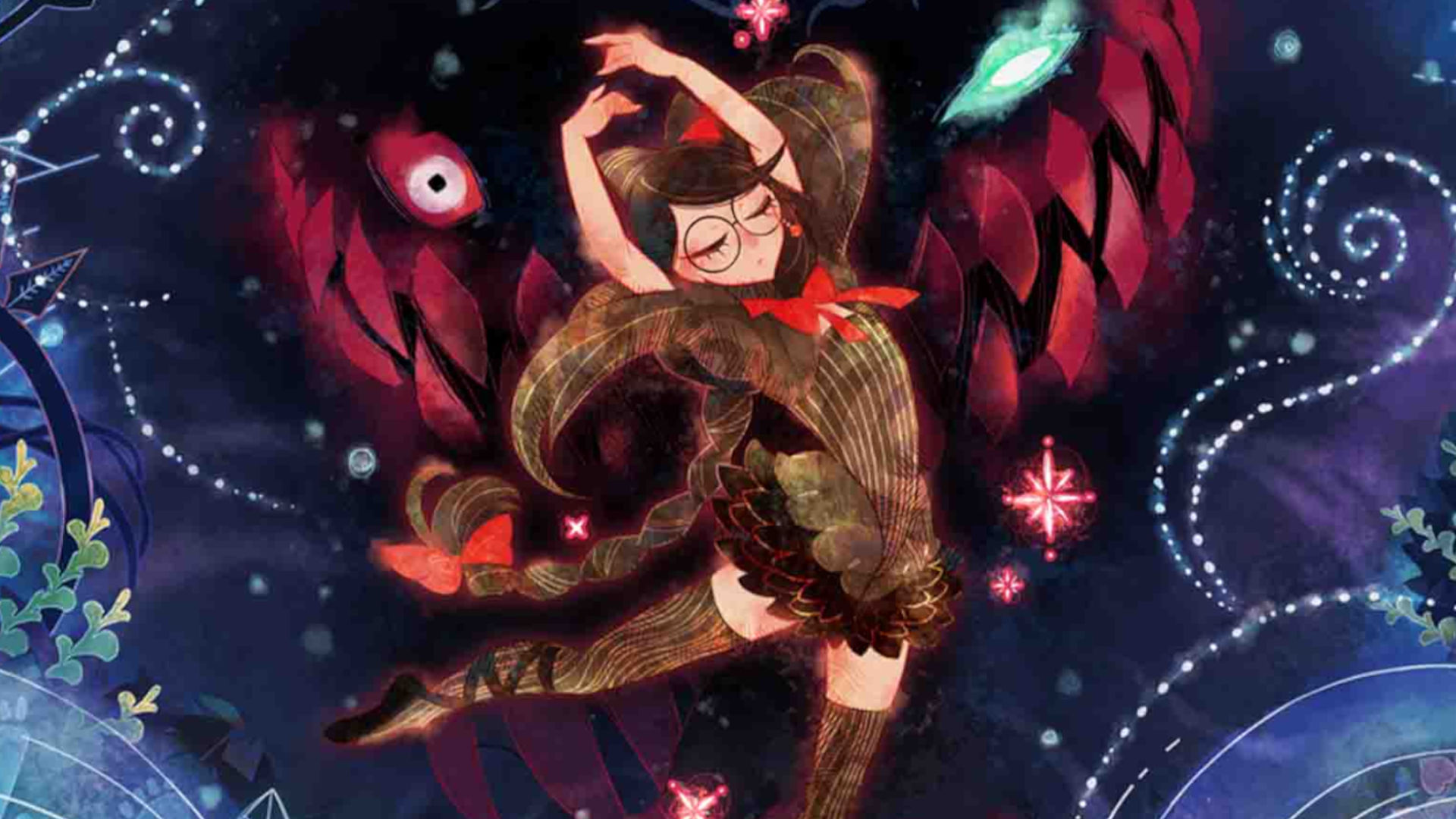
This gorgeous, illustrative action adventure game invites you to take a peek into the past, challenging enemies and picking apart puzzles as you unravel the tale of Cereza’s journey into the forbidden Avalon Forest, long before she became the Bayonetta we know today. While the Bayonetta Origins release date isn’t too far off, we’re sure many of you are itching for a witching time and can’t wait to lose yourself in those cell-shaded, storybook pages of the past.

Luckily, Nintendo has revealed a real treat for Bayonetta fans everywhere. In a recent Tweet, Nintendo of Europe highlights that there is a playable Bayonetta Origins Teaser in Bayonetta 3, giving you a taste of what’s to come months in advance.

If you own a copy of Bayonetta 3 on Nintendo Switch and want to try out the new Bayonetta Origins teaser today, follow these simple steps.
  • Ensure you’ve installed the latest software update for Bayonetta 3 on your Nintendo Switch
  • Progress through the game until you have access to ‘The Gates of Hell’ shop
  • Purchase the Old Picture Book to unlock the playable teaser
  • Access the Bayonetta Origins demo from the chapter select screen
  • Enjoy a tantalising taste of what’s to come! Or, we suppose, what has been…

If you’ve not picked up Bayonetta 3 and this isn’t enough to convince you, then be sure to check out our Bayonetta 3 review. We’ve also got lists of the best Switch adventure games and the best Switch RPGs to keep you busy in the meantime.
Posted on Leave a comment

The witch is back… again, with Bayonetta Origins for Nintendo Switch

They say Bayonetta games are like buses. You wait years and years for one to come along, and then two come along at once! Bayonetta 3 is still so fresh in our Switch’s we can smell the plastic wrapping, but Nintendo and Platinum Games have announced a new entry in the series, so when is the Bayonetta Origins release date?

A cel-shaded action adventure that explores Bayonetta’s early years as Cereza, gamers can now explore the Umbra Witch’s childhood with this cute new title. Taking on a top-down camera angle and introducing an adorable demon friend to tag along with the witch, this certainly looks like a new take on Bayo, and we can’t wait to see more.

The ending for Bayonetta 3 (no spoilers) hints towards the future of Bayonetta, it’s certainly interesting that we’ll get more details about the witch’s childhood in this cute title. How well will the brutal gameplay transfer over? We’re not sure yet, but if you want to know why we’re so excited to see what PlatinumGames does next, be sure to check out our Bayonetta 3 review.

Take a look at the reveal trailer for Bayonetta Origins below to get a sneaky peak at what this new action game has in store.

YouTube Thumbnail

When is the Bayonetta Origins release date?

This isn’t another Bayonetta 3 folks! Geoff revealed at The Game Awards, that Bayonetta Origins: Cereza and the Lost Demon releases on March 17, 2023, so eager action fans don’t have long to wait to see the Umbra Witch again.

Phew! This was a surprise, if you’re excited for another thrilling title and want to play something soon, be sure to check out our guide to the best Nintendo Switch games next.

Posted on Leave a comment

Danganronpa 2 characters

The narrative of Danganronpa 2: Goodbye Despair wouldn’t be anywhere near as impactful if it weren’t for the wide and varied cast of Danganronpa 2 characters that propel it. From a psycho-theraputic bear to a perverted chef, the iconic individuals at the heart of this treacherous tale are truly intriguing. So let’s take a look at each and every one of them, along with their ultimate titles and general personalities.

If you want to get familiar with students from Hope’s Peak Academy’s other classes, check out our Danganronpa characters and Danganronpa V3 characters guides. We also have an extensive Danganronpa sprites gallery, and guides to the best Danganronpa wallpapers and Danganronpa figures.

Danganronpa 2 characters

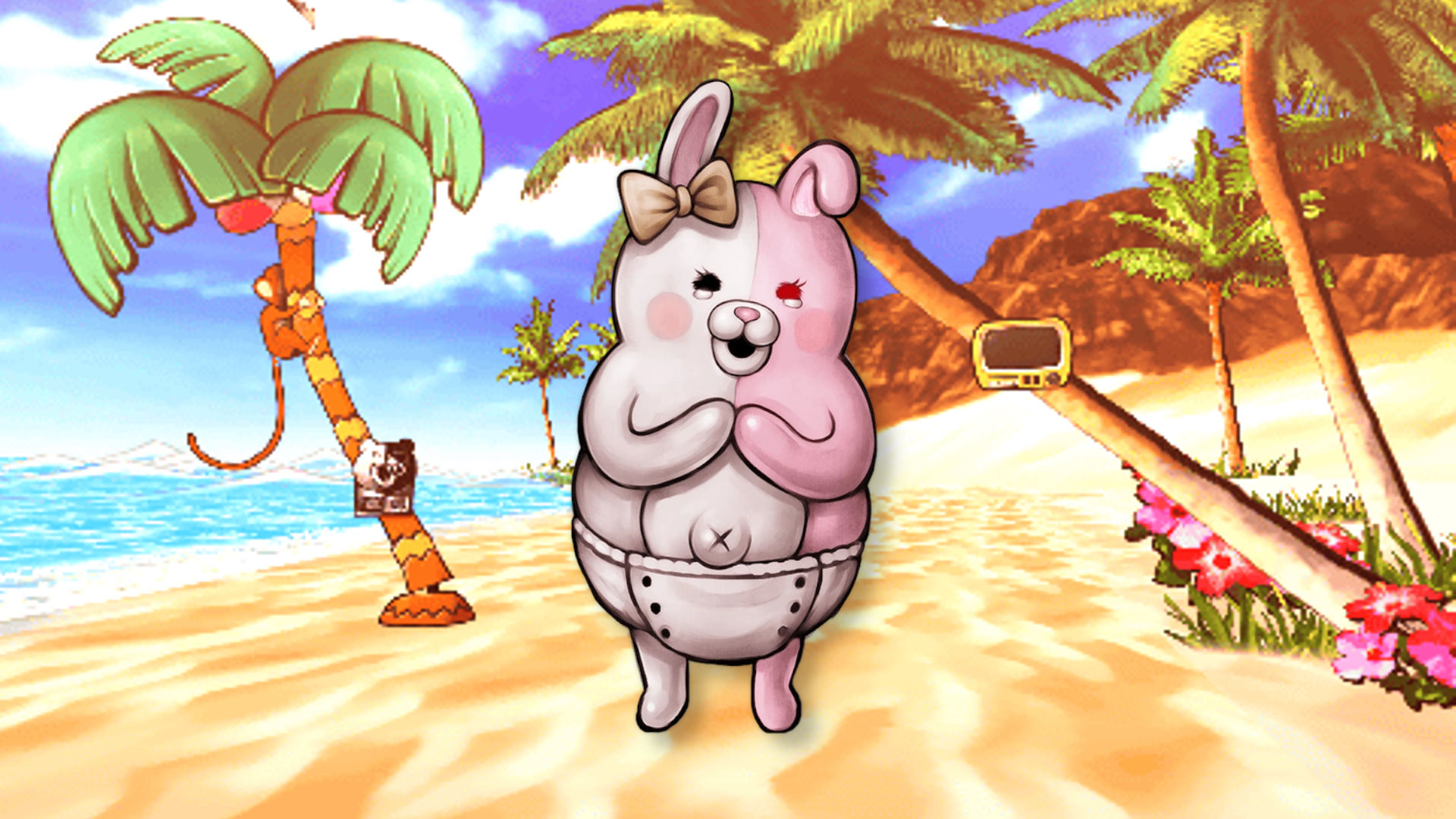
Danganronpa 2 character Usami

Danganronpa Monomi (Usami)

A rabbit magical girl and the lead teacher of Danganronpa 2: Goodby Despair’s school trip, Usami was originally created using Ultimate Programmer Chihiro Fujisaki’s research in A.I. programming. Designed as a part of a psycho-theraputic virtual reality rehabilitation program, she was intended to help those who have experienced trauma. She’s gentle and kind-hearted, but often can be quite naive and easily tricked. Her sole purpose is to encourage love, friendship, and good manners.

However, as she set about her task helping students, a virus infected the virtual Neo World Program island where she worked, allowing Monokuma to enter the simulation. Monokuma used the virus to overpower her and strip her magical abilities, changing her appearance to resemble him, and renaming her Monomi. After this, the students begin to distrust her, and Monokuma forces her to sit back and watch the chaos unfold.

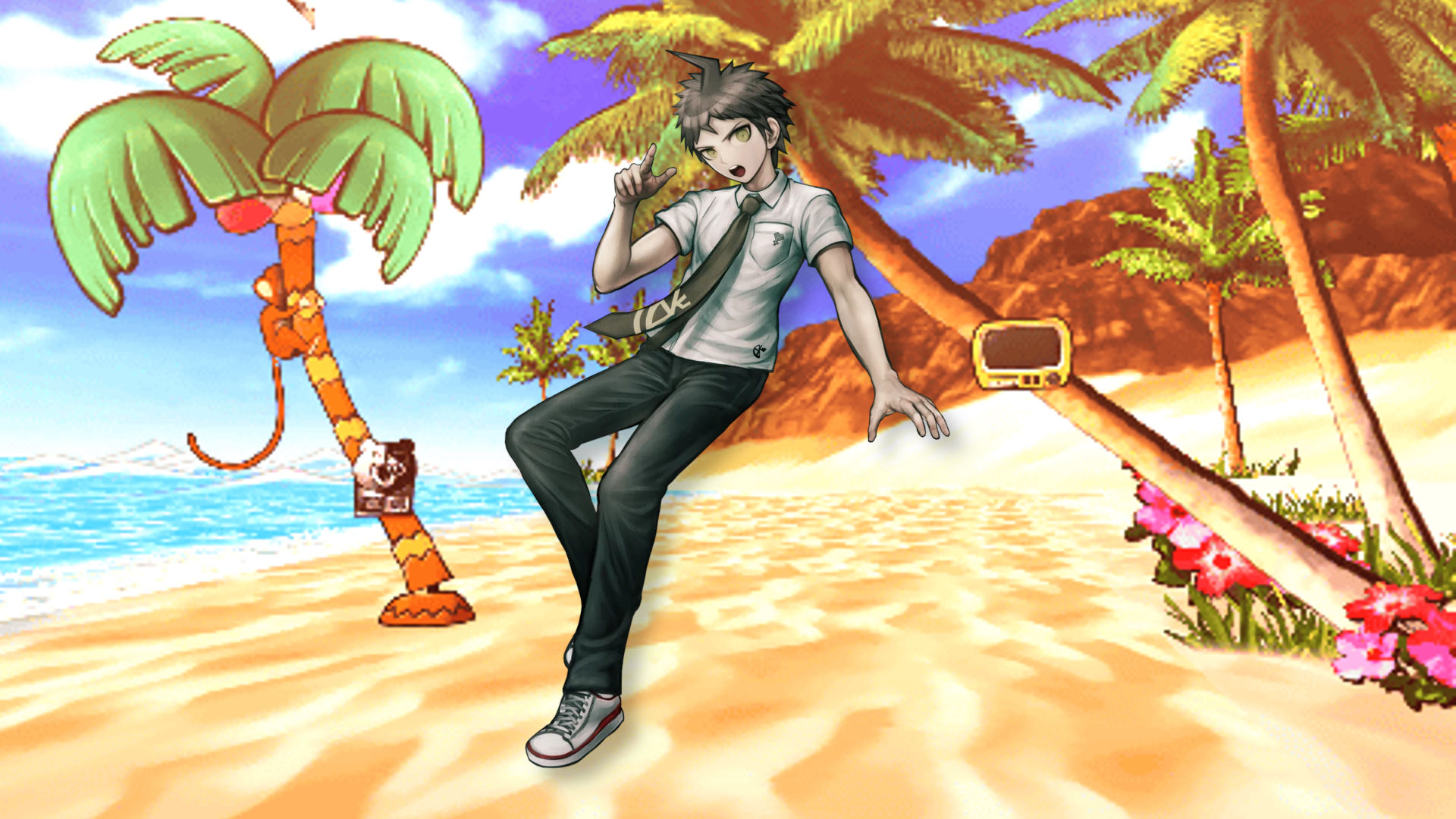
Danganronpa 2 character Hajime Hinata

Danganronpa Hajime Hinata

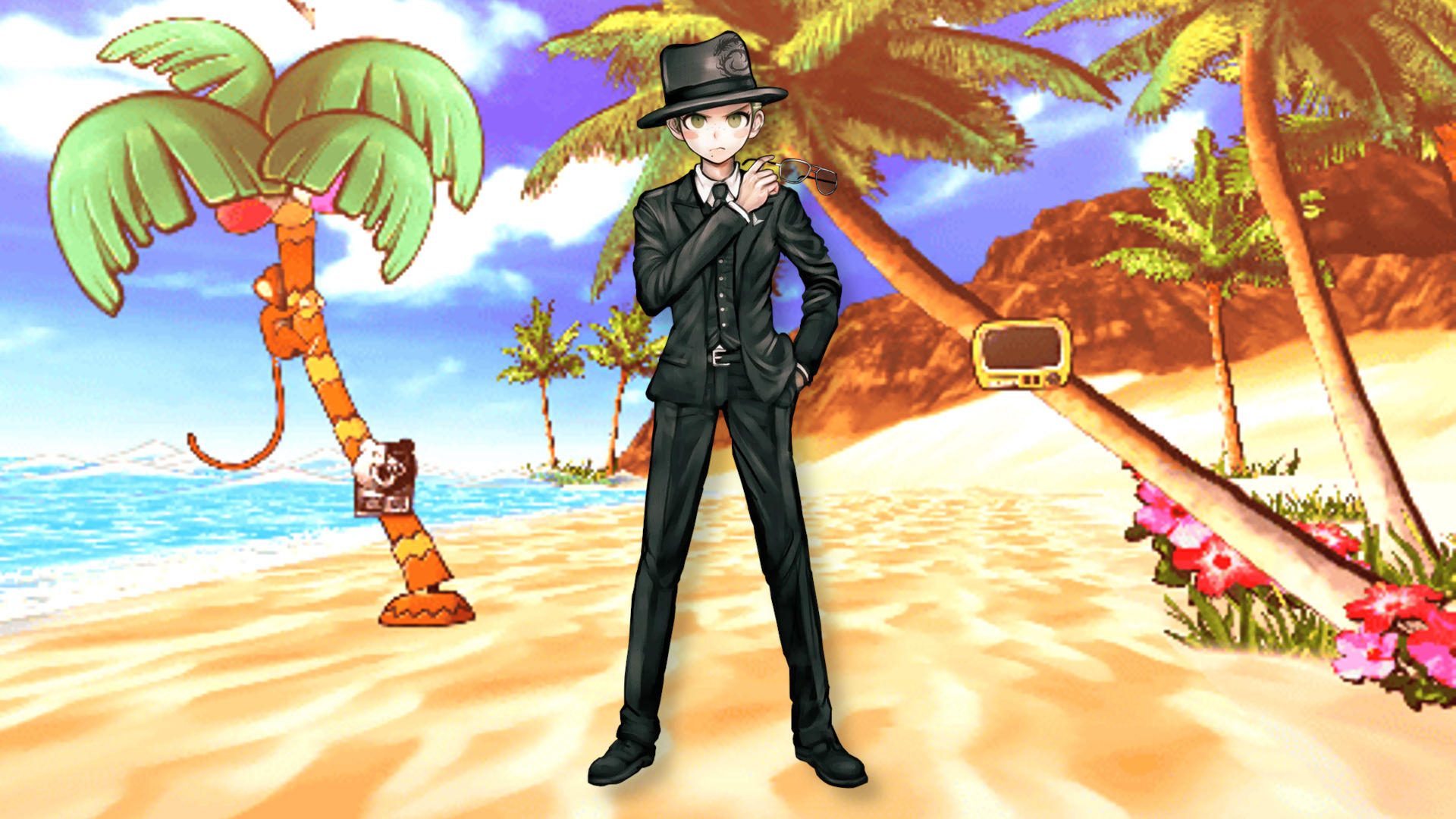
A student of Hope’s Peak Academy’s Class 77-B, Hajime Hinata is a realist with a sceptical personality, and as such is often prone to worrying more than his peers. He’s logical and comes across as both serious and quite cynical, but he still manages to get along and joke with his fellow classmates. Hajima grew up dreaming of attending Hope’s Peak Academy, aspiring to become something bigger than himself, but can’t remember his ‘Ultimate’ title. As such, he’s known as Ultimate ???.

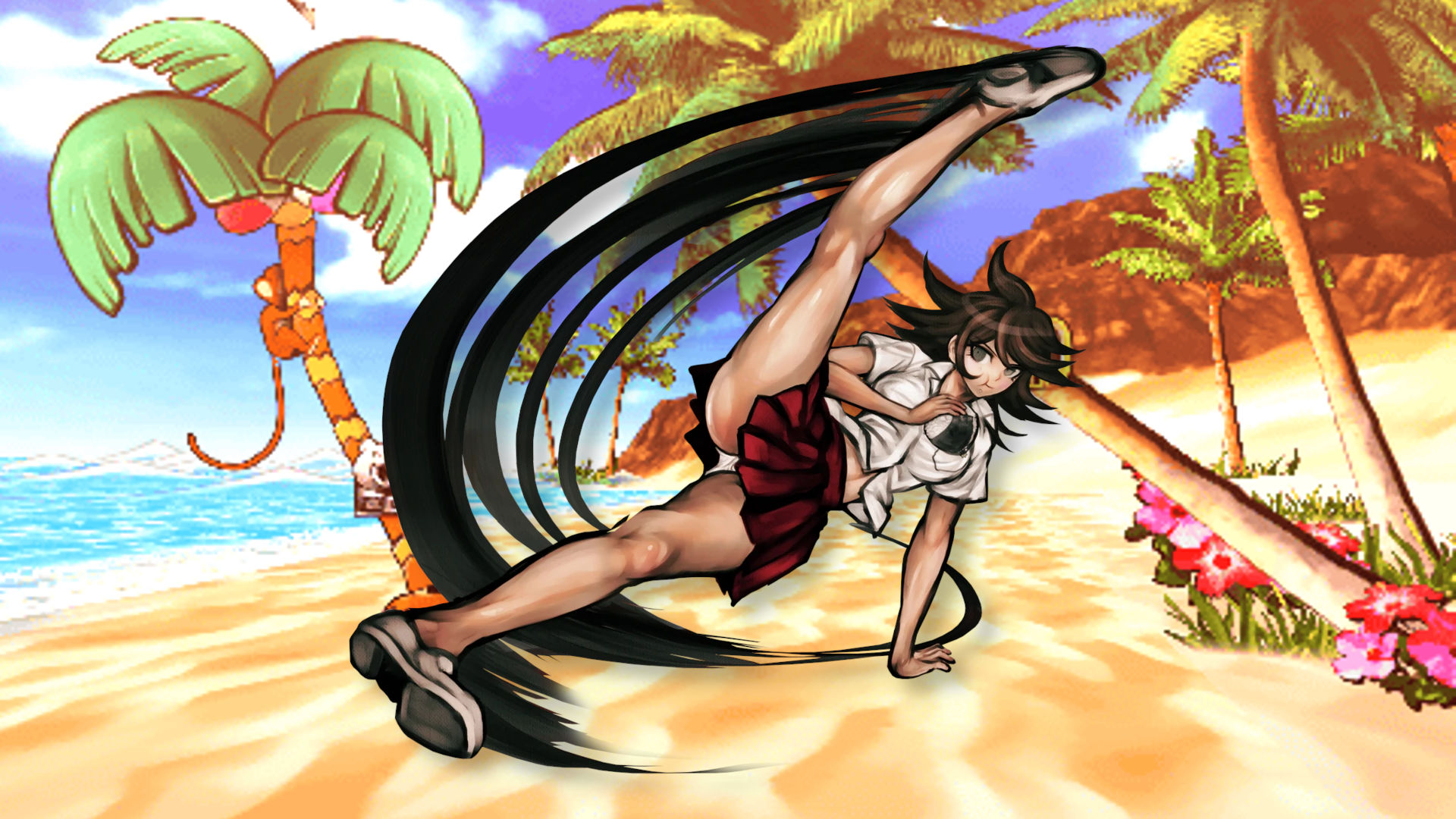
Danganronpa 2 character Akane Owari

Danganronpa Akane Owari

The Ultimate Gymnast of Hope’s Peak Academy’s Class 77-B, Akane Owari is a fiery young lady that loves a good, old fashioned fistfight. Always eager for a challenge, she respects those who are physically strong and seems to believe that most problems can be solved with a punch.

Danganronpa 2 character Ultimate Imposter

Danganronpa The Ultimate Imposter

The Ultimate Imposter is a student of Hope’s Peak Academy’s Class 77-B who most notably imitates Byakuya Togami, the Ultimate Affluent Progeny from Danganronpa: Trigger Happy Havoc. Their true personality is tough to pin down, as they spend most of their time impersonating others. However, in brief moments of vulnerability, they are shown to be polite and mild-mannered, with a generally kind and caring personality and a severe lack of self-esteem.

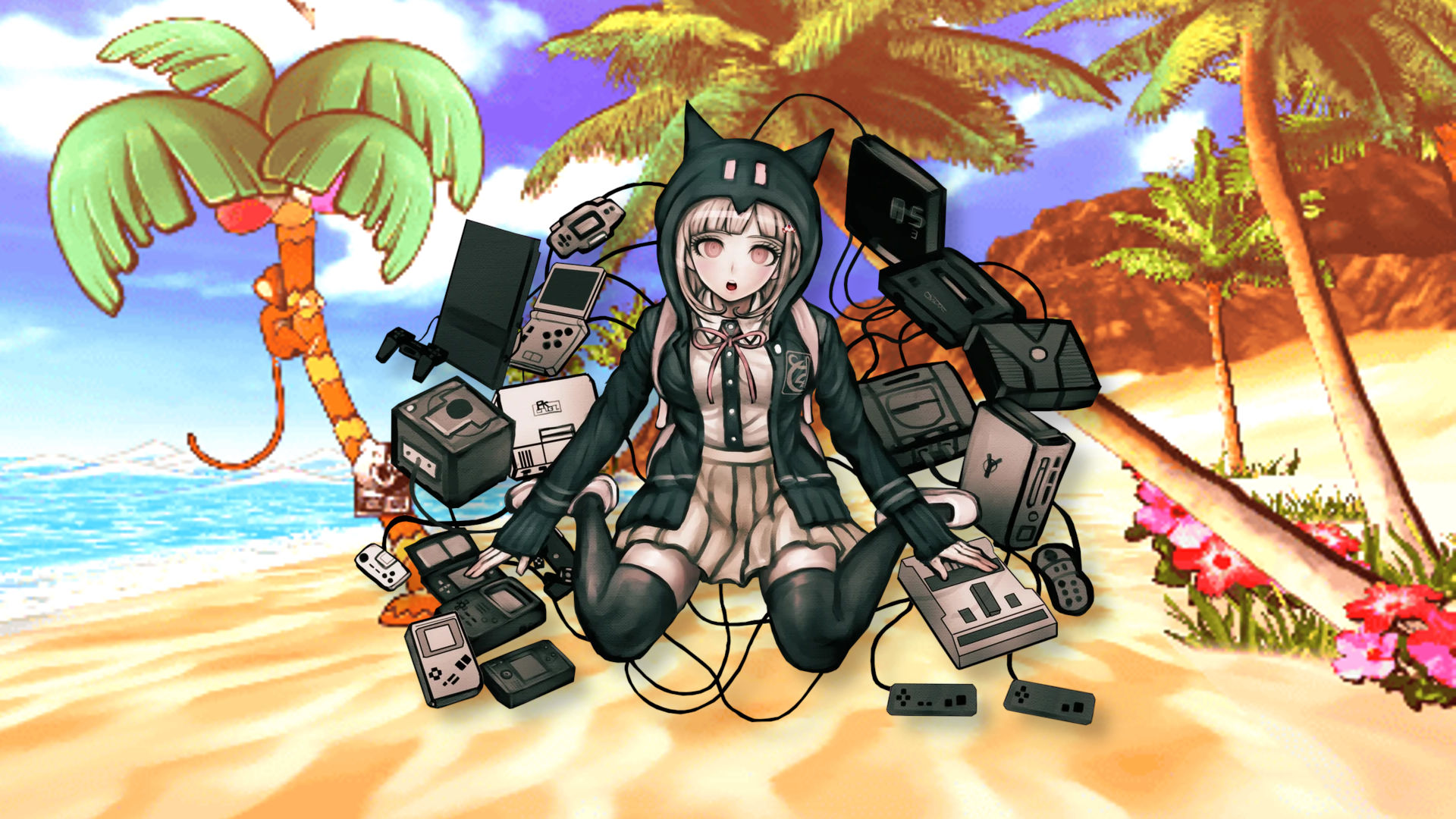
Danganronpa 2 character Chiaki Nanami

Danganronpa Chiaki Nanami

Chiaki Nanami is the Ultimate Gamer of Hope’s Peak Academy’s Class 77-B. As her title suggests, she’s extremely passionate about all forms of videogames and becomes quite animated when talking about them. Outside of this, she’s quite quiet and often sleepy, and has been known to doze off while standing up, even occasionally forgetting to breathe when absorbed in a game.

Danganronpa 2 character Fuyuhiko Kuzuryu

Danganronpa Fuyuhiko Kuzuryu

Fuyuhiko Kuzuryu holds the title of the Ultimate Yakuza in Hope’s Peak Academy’s Class 77-B due to his shady Yakuza ties. He initially comes across as rude and stand-ofish towards his peers, claiming that he doesn’t plan on pretending to make friends with anyone else on the island and wouldn’t hesitate to kill others if required. However, after an incident later in the game, he realises his mistakes and becomes more sociable and less prone to insulting others – though he’s still pretty short-tempered and impulsive.

Danganronpa 2 character Gundham Tanaka

Danganronpa Gundham Tanaka

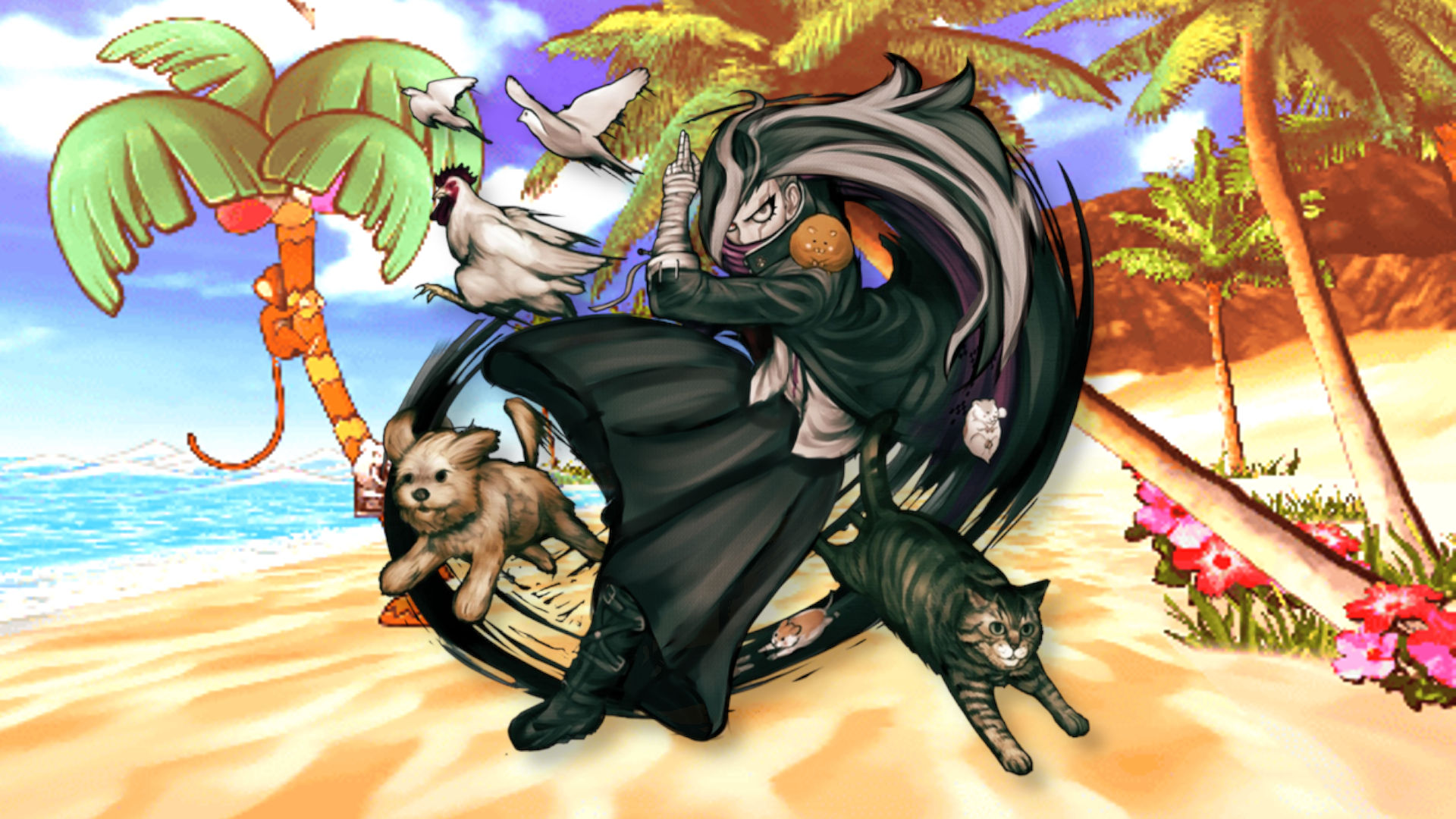
The Ultimate Breeder of Hope’s Peak Academy’s Class 77-B, Gundham Tanaka is not the most sympathetic when it comes to humans, but has a deep compassion and love for animals. Despite declaring himself as a ‘Supreme Overlord of Ice’ and his animals as ‘evil minions’, he reveals himself to be quite insecure, claiming that anything that can talk will ‘eventually betray you’.

Danganronpa 2 character Hiyoko Saionji

Danganronpa Hiyoko Saionji

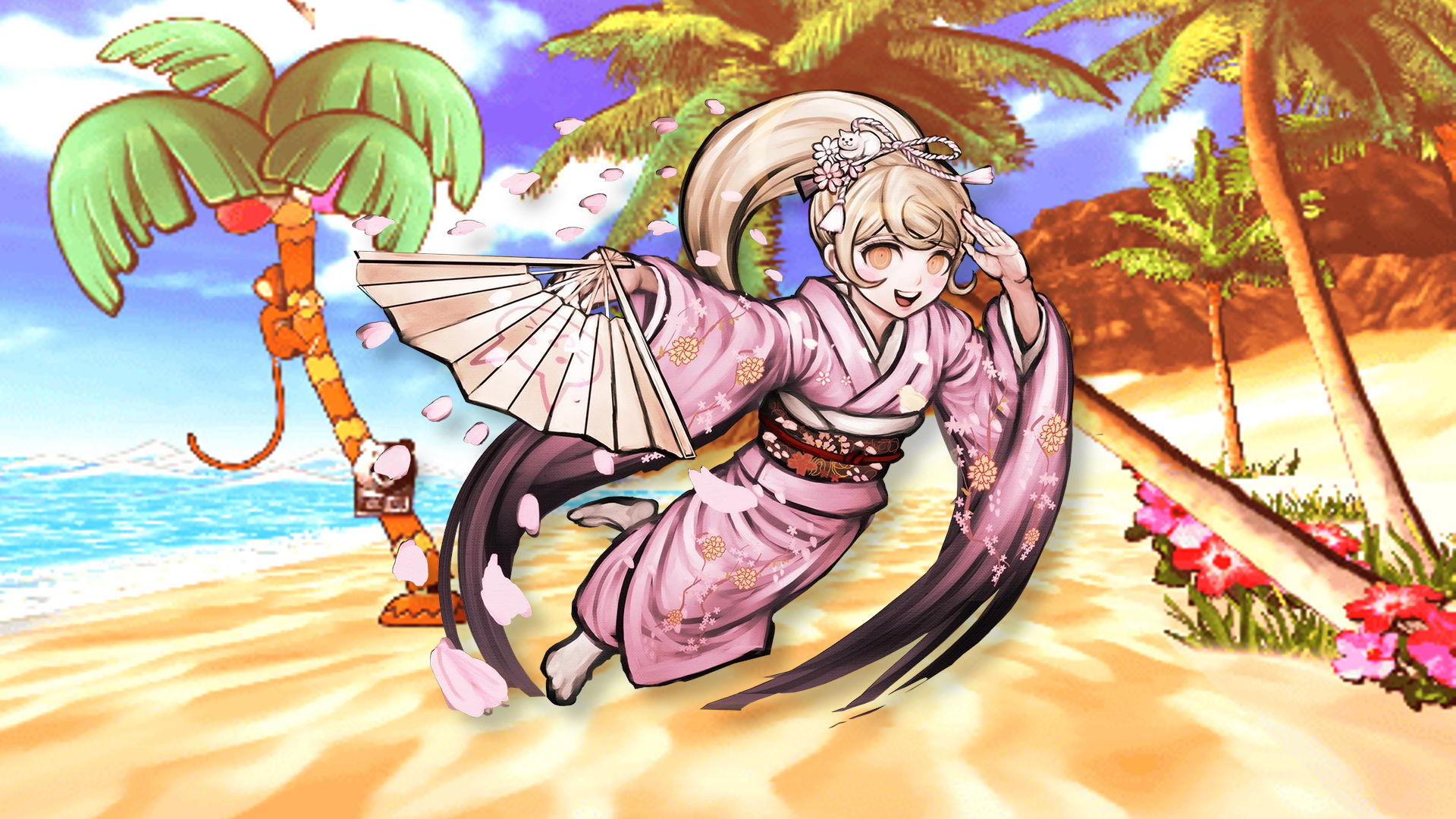
Hiyoko Sanji is Hope’s Peak Academy’s Ultimate Traditional Dancer of Class 77-B. She may appear cute and childlike, but she quickly reveals herself to be cruel and malicious, finding sadistic enjoyment in killing flowers, small animals, and insects. She has a high sense of superiority, often easily manipulating people to do her bidding, and having tantrums if she doesn’t get her way. Hiyoko comes from a traditionalist family and has grown to love Japanese culture and traditions dearly, and often insults and degrades other cultures in comparison.

Danganronpa 2 character Ibuki Mioda

Danganronpa Ibuki Mioda

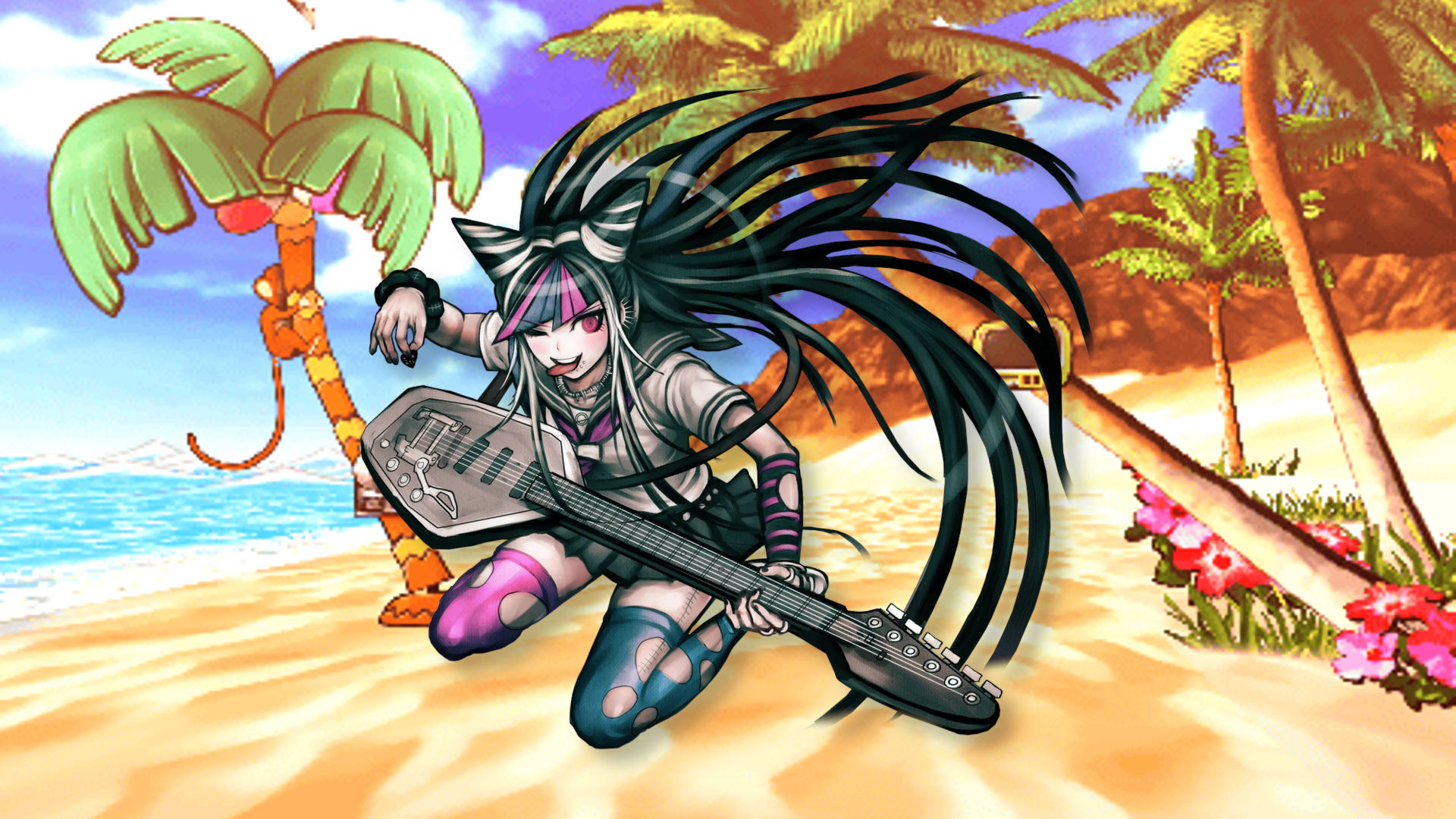
The Ultimate Musician of Hope’s Peak Academy’s Class 77-B, Ibuki Mioda is a bold and upbeat rockstar with an outgoing personality. She’s quirky and energetic, with a passion for talking and going off on bizarre, unrelated tangents. She’s also very forgetful, and often has to write memos to help her remember things. Ibuki is also a tremendous flirt who admires pretty girls, but appears to have no interest in getting into a relationship. And, despite her occasional insensitivity towards other people, she also shows herself to be very wise and contemplative on occasion.

Danganronpa 2 character Kazuichi Soda

Danganronpa Kazuichi Soda

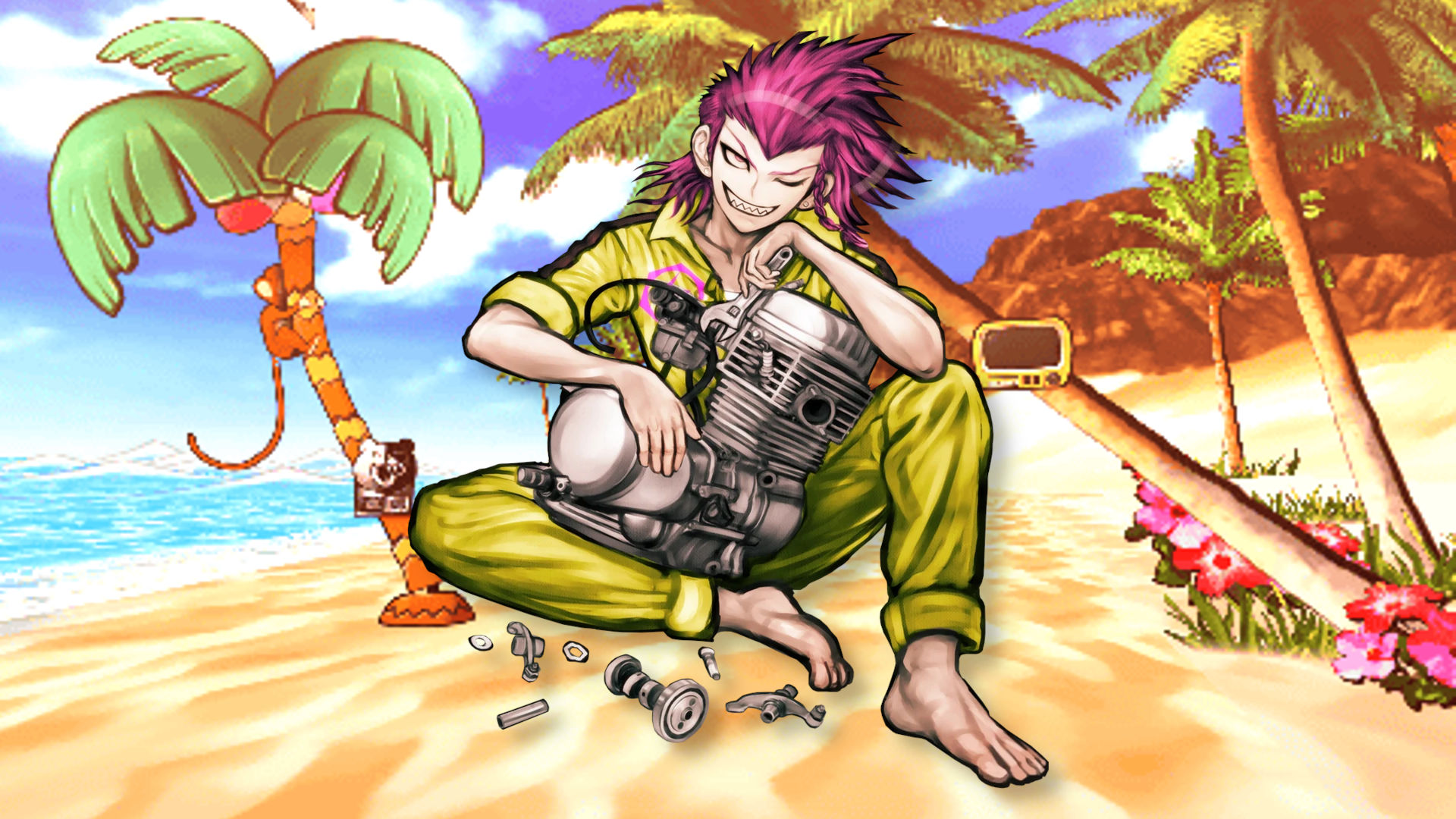
Taking the title of Class 77-B’s Ultimate Mechanic at Hope’s Peak Academy, Kazuichi Soda carries around a wrench almost everywhere he goes, tinkering and attempting to repair any broken items he comes across. He’s a bad liar and has no verbal filter, often blurting his thoughts without a second thought, and appears to have low self-esteem and some trust issues. Throughout the game he displays an intense, borderline perverted crush on Sonia However, this appears to be a shallow attraction more than anything else.

Danganronpa 2 character Mahiru

Danganronpa Mahiru Koizumi

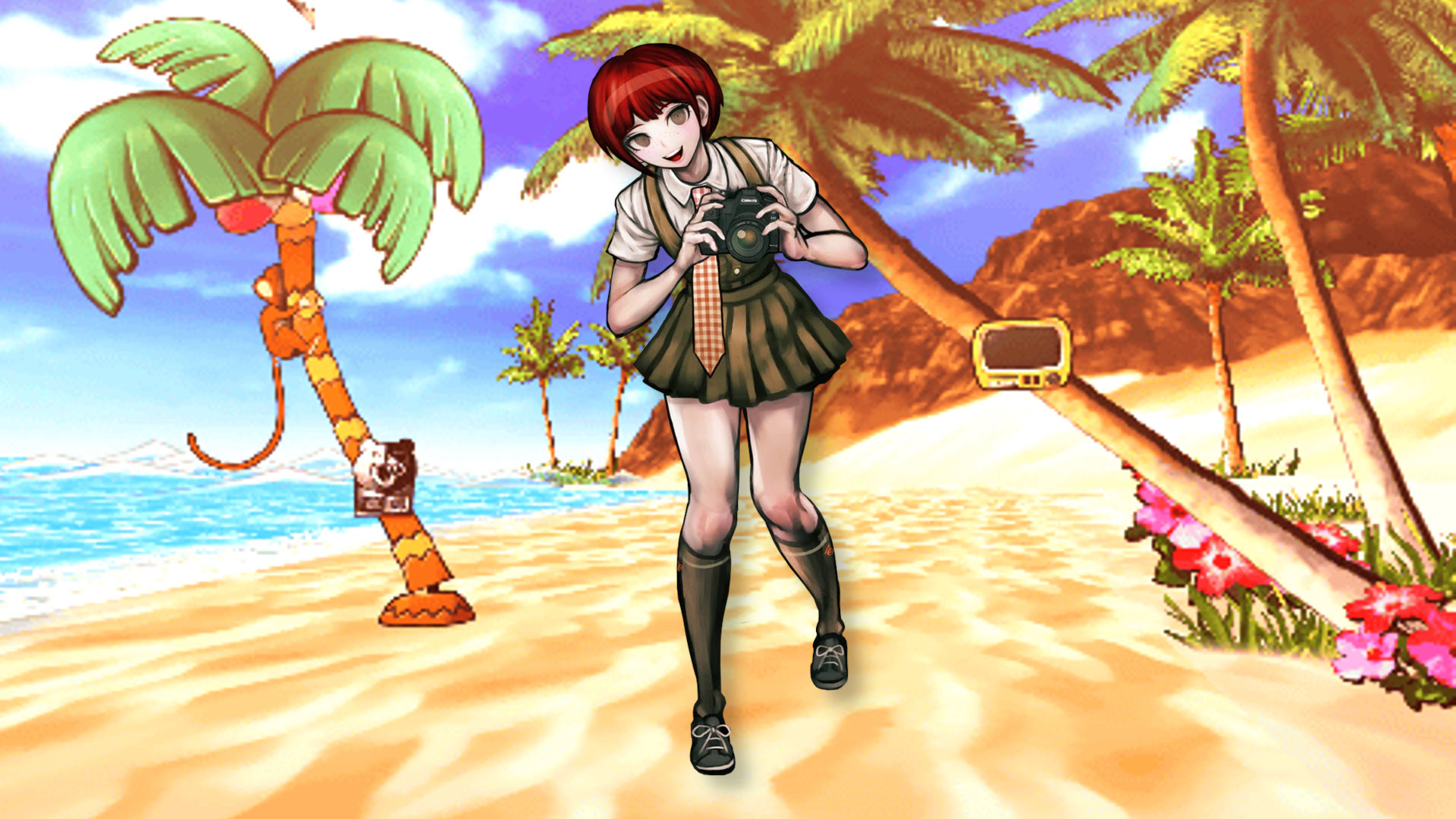
Mahiru Koizumi is the Ultimate Photographer of Hope’s Peak Academy’s Class 77-B, who compares her work to that of her mother – a famous war photographer whose work often led to her absence from Mahiru’s life. Mahiru’s father wasn’t cut out for parenthood either, and much of the household responsibilities and cleaning were left to her from a young age, leading her to become a very mature and responsible individual. She’s pretty optimistic and outgoing, and very kind to others, leading to her taking almost a motherly role among some of her peers, but she also has her own insecurities and self-esteem issues.

Danganronpa 2 character Mikan Tsumiki

Danganronpa Mikan Tsumiki

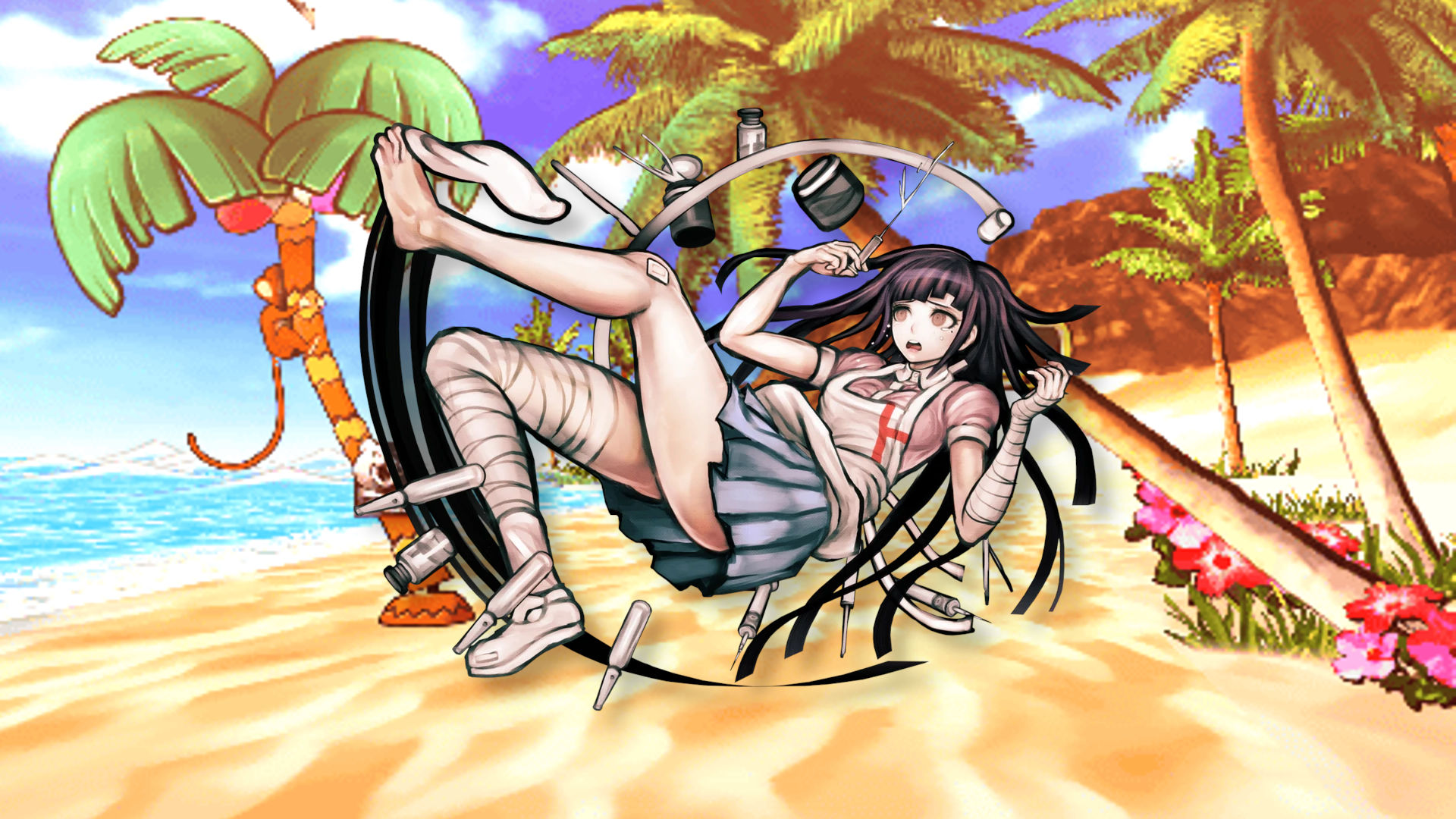
Having been consistently bullied and abused throughout her life, Mikan Tsumiki is an extremely meek and timid young woman, often breaking down in tears, apologising, and stuttering with little provocation. However, when taking on work associated with her role as Hope’s Peak Academy’s Ultimate Nurse of Class 77-B, she becomes far more confident, showing her extensive knowledge of healthcare.

Danganronpa 2 character Nagito Komaeda

Danganronpa Nagito Komaeda

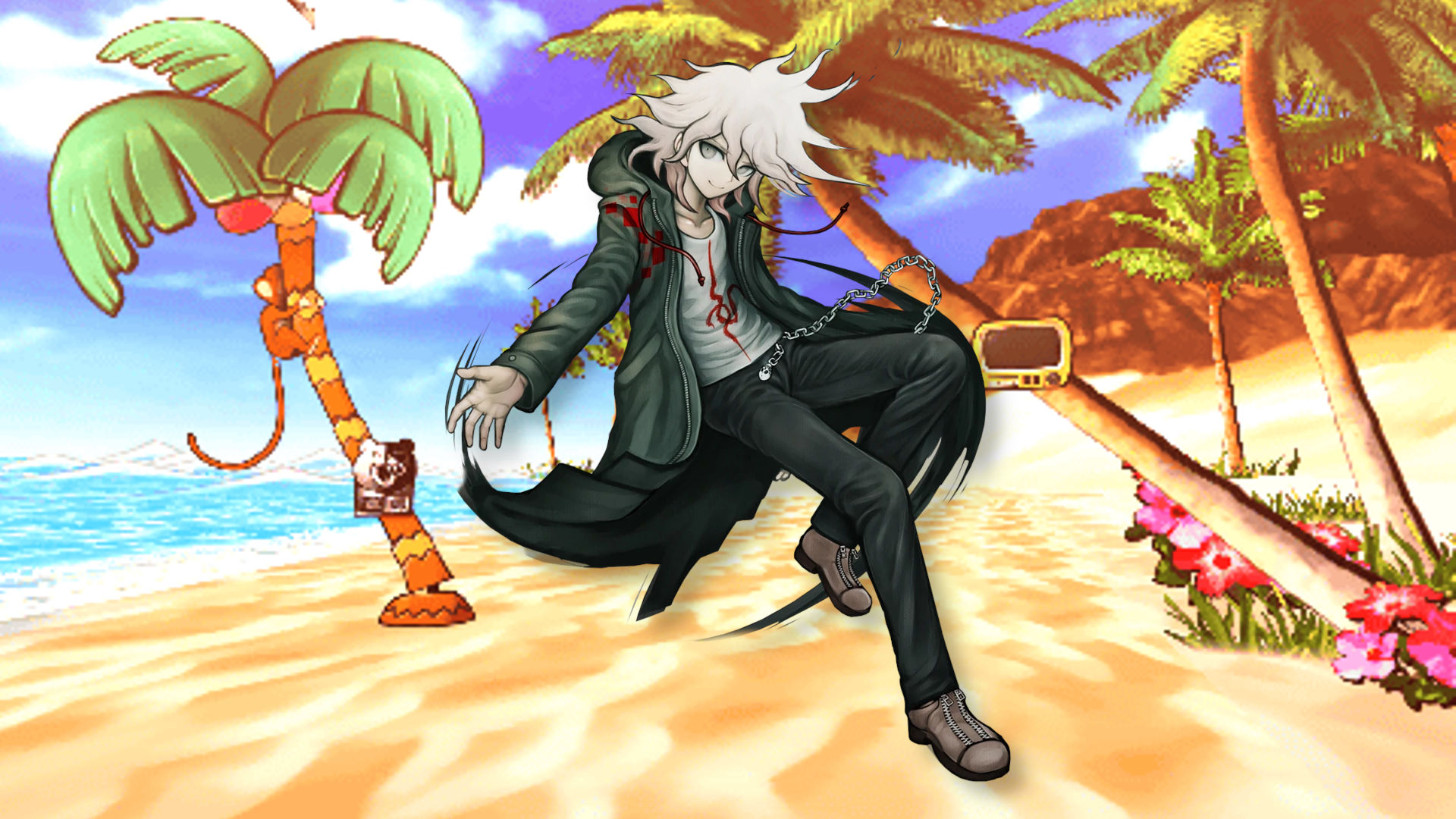
Hope’s Peak Academy’s Ultimate Lucky Student of Class 77-B, Nagito Komaeda is a polite and easy-going young man who often acts as mediator during team conflicts. He’s very caring and friendly, but also reveals a level of insecurity, often taking on a submissive and self-deprecating attitude.

Danganronpa 2 character Nekomaru Nidai

Danganronpa Nekomaru Nidai

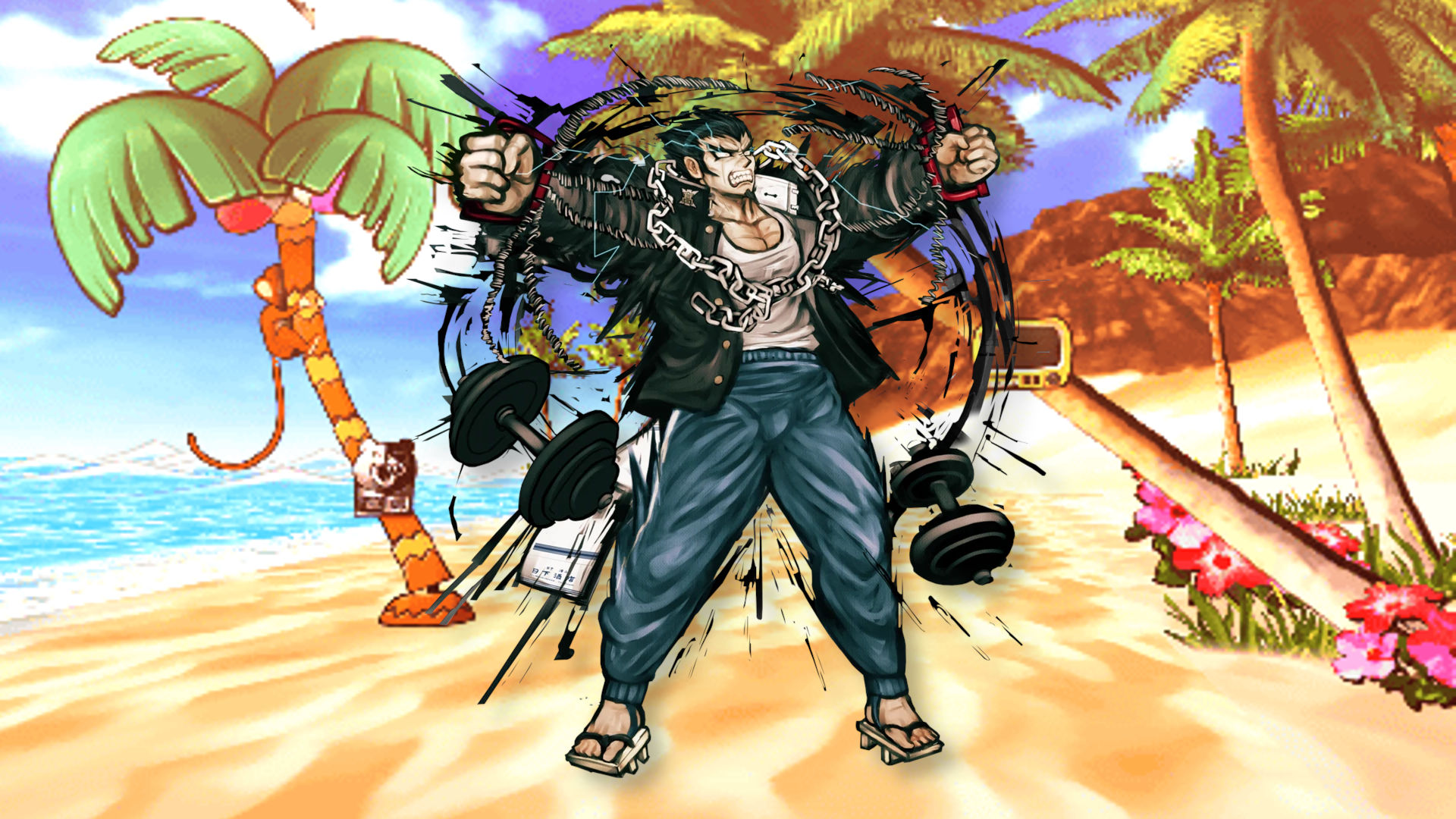
Making a name for himself by training athletes to top-notch standards, Nekomaru Nidai is the Ultimate Team Manager of Hope’s Peak Academy’s Class 77-B. He takes pride in his title as he highlights that no athlete could make it to the top without a manager’s help.

Having advanced talents in baseball, figure skating, tennis, and more, he’s certainly got the room to put his money where his mouth is, and his rigorous training techniques and unbeatable sports massages have helped many climb the leaderboards in their sport of choice. As expected of a man with his talents, Nekomaru is a boisterous, passionate, and vigorous student.

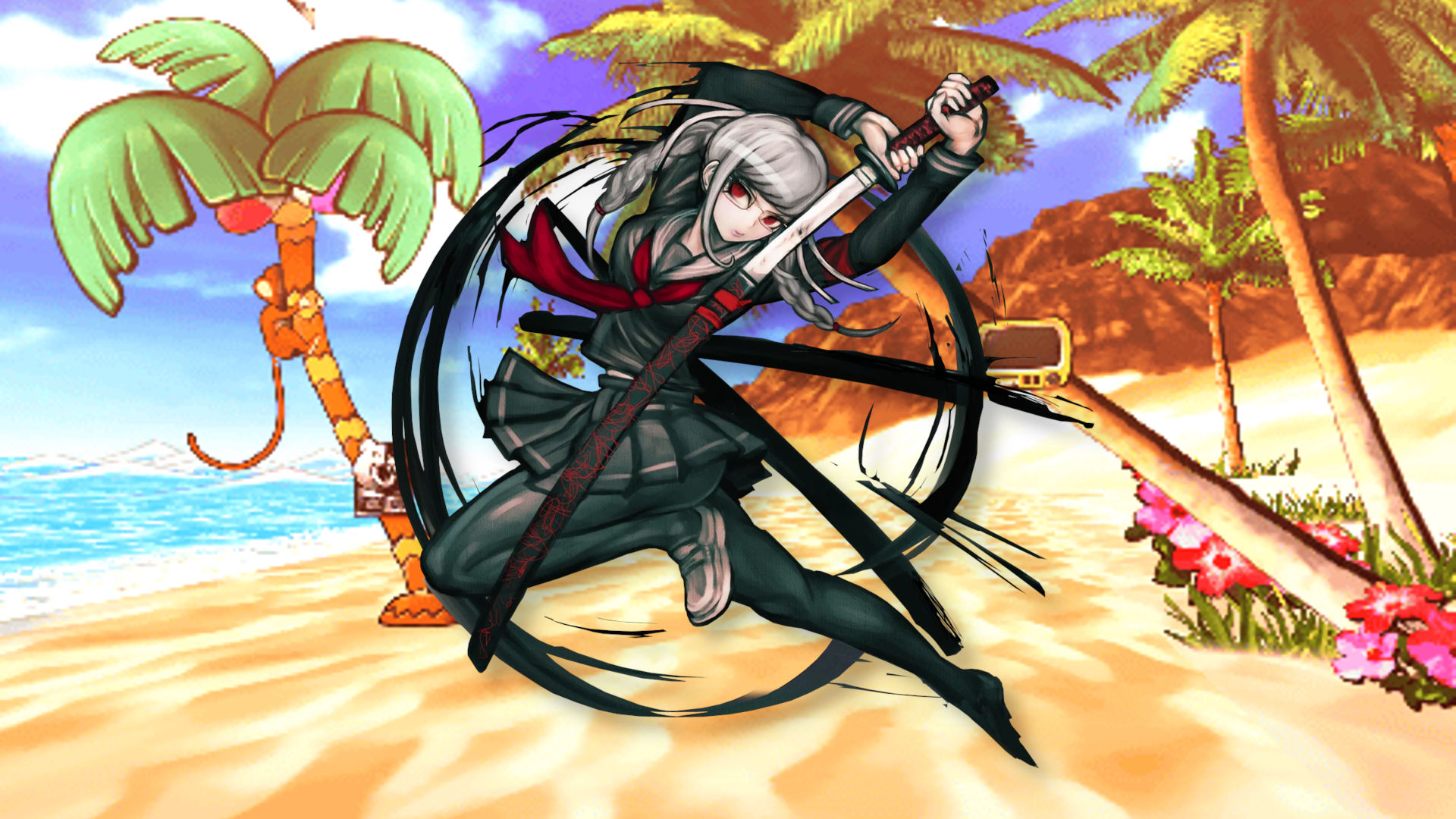
Danganronpa 2 character Peko Pekoyama

Danganronpa Peko Pekoyama

The sharp Ultimate Swordsman of Hope’s Peak Academy’s Class 77-B, Peko Pekoyama was raised as a ‘tool’ for the Kuzuryu clan, and as such sees herself as more of a weapon than a human. She’s quite stoic, and can come across as both intimidating and highly serious, though she is never impolite or antisocial. She’s quite reserved and rarely shows emotion, though she has a kind heart and clearly cares deeply about her fellow students.

Danganronpa 2 character Sonia Nevermind

Danganronpa Sonia Nevermind

As is expected of Hope’s Peak Academy’s Ultimate Princess of Class 77-B, Sonia Nevermind is a polite and regal young woman with a great interest in Japanese culture. She’s kind-hearted and thoughtful, and, due to her title and sheltered former life, she finds commonplace items and ordinary tasks intriguing.

She’s a foreigner, resulting in occasionally stumbling over figures of speech, slang, and colloquialisms, and sometimes unnerves her peers with her morbid fascination with serial killers and the occult. Her upbringing has resulted in her being somewhat ditzy and naive, but she proves herself to be very intelligent and capable of complex political analysis.

Danganronpa 2 character Teruteru Hanamura

Danganronpa Teruteru Hanamura

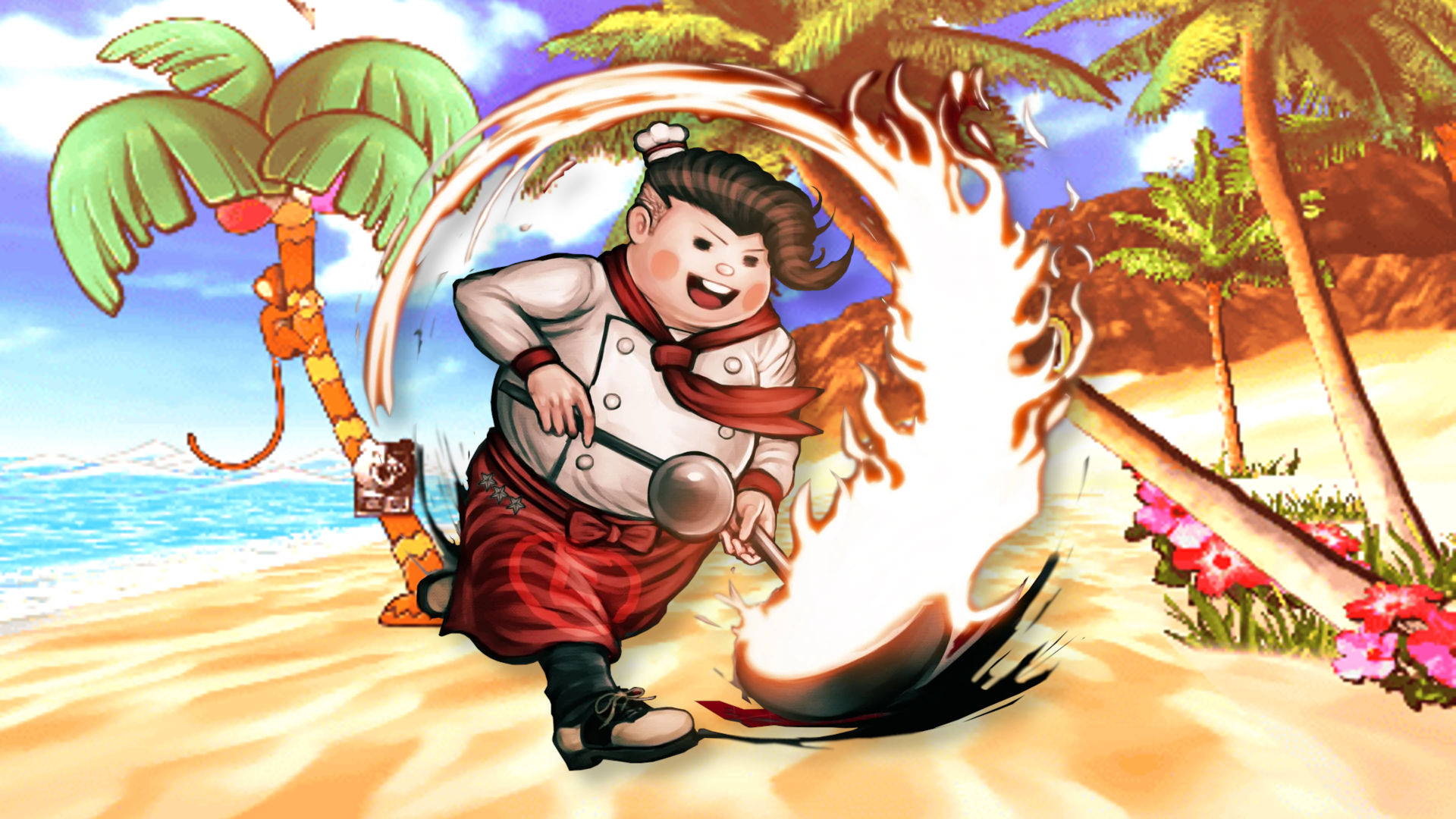
Teruteru Hanamura is the Ultimate Cook of Hope’s Peak Acadmey’s Class 77-B, and, as such, is a very talented and prideful chef. However, when he’s not cooking up food, he’s cooking up trouble with his lewd comments and flirtatious mannerisms.

He’s almost always hitting on someone, regardless of whether they’re male or female, and is known to take his behaviour far beyond innuendo – often touching people without their consent, and even drugging people’s food. His crude, hyper-sexual nature often makes his peers feel very uncomfortable around him, though he can be generally kind and compassionate outside of his inappropriate behaviour.

And there you have it – every major Danganronpa 2 character. If you’re on the hunt for a new titillating tale to lose yourself in, check out our list of the best visual novel games on mobile and Switch.

Posted on Leave a comment

Danganronpa games

If you’re hoping to dive into some murder mystery mayhem, Spike Chunsoft’s series of Danganronpa games are right up your alley. However, with three main games, several spin-offs, and different collections to get through, it can be tricky to know where to start. In this guide, we go over each of the games with a brief synopsis, their initial release date, and their place in the cannon. We’ve also included a quick guide to all the Danganronpa games in order, so you can dive into despair without missing a beat.

To familiarise yourself with your classmates, be sure to check out our Danganronpa characters guide. Or, if you’re on the hunt for more mystery mayhem and titillating tales, take a look at our top picks for the best mystery games and the best visual novel games on mobile and Switch.

Danganronpa games

Mainline Danganronpa games

Danganronpa: Trigger Happy Havoc

Initially seeing a PSP release in Japan in 2010, Danganronpa: Trigger Happy Havoc is the first title in the Danganronpa series. Garnering an iconic status, it has since arrived on multiple platforms in all regions.

Danganronpa: Trigger Happy Havoc is a visual novel based around Class 78th of the prestigious Hope’s Peak Academy. Originally lauded as a home to Japan’s best and brightest high school students, Hope’s Peak Academy is plunged into despair as student Makoto Naegi and his classmates find themselves locked in the school, playing a sick game at the whim of a sadistic bear called Monokuma. Pitting the students against each other, Monokuma promises freedom to anyone who can kill one of their peers and get away with it.

You take the role of Makoto Naegi as you attempt to survive the vicious killing game and uncover the secrets behind Monokuma’s true identity and motives. Explore the academy and progress through the story, as you get to know your classmates’ histories, desires, and aspirations, all while you investigate murders, and pin down culprits.

Danganronpa 2: Goodbye Despair

Following on from the first title’s popularity, Danganronpa 2: Goodbye Despair is a direct sequel to Trigger Happy Havoc. It first came out on the PSP in Japan in 2012, and takes place shortly after the events of Trigger Happy Havoc and Danganronpa Another Episode: Ultra Despair Girls.

You step into the shoes of Hajime Hinata, who has just enrolled into Hope’s Peak Academy. Upon entering the building he’s overcome with fatigue, then wakes up to find himself in front of a classroom full of his peers. Locked inside, the students are met by Usami, a pink, magical girl bunny, who reveals that they are in fact on a paradisal island, and they must befriend each other to gain Hope Fragments and nurture their hope.

However, just as they’re adapting to the peaceful island life, disaster strikes. Monokuma is back, and the students must participate in the next generation of the killing game if they wish to survive.

Danganronpa 2: Goodbye Despair follows a very similar gameplay loop to the first, with the main differences being that you can walk around the island as Hajime in 2D, and the class trial segments boast new features such as the nonstop debate mechanic and fresh minigames.

Danganronpa V3: Killing Harmony

Danganronpa V3: Killing Harmony is the third major instalment in the series, landing on PS4 and PS Vita in Japan early 2017, then dropping on PS4, PS Vita, and PC in the West later that year.

Dubbed ‘the biggest, most exhilarating episode yet’, Killing Harmony is set in a ‘psycho-cool’ environment and revolves around 16 new characters who are, once again, kidnapped and imprisoned in a school. With lives on the line, you must dive into a high-stakes, fast-paced investigation, uncovering the mysteries behind brutal murders and condemning your new friends to death.

With the Danganronpa 3: The End of Hope’s Peak High School anime closing the Hope’s Peak Academy arc, Danganronpa V3: Killing Harmony is the first game to take place in a new school with a completely fresh cast of characters. However, the gameplay remains relatively similar to the previous titles, with the same loop and linear paths, this time embellished with some new gameplay elements.

Split into the same three major gameplay types you should be familiar with by now, you take control of the protagonist from a first-person perspective, exploring the school at your leisure between character interactions, investigations, and class trials.

Spin-off Danganronpa games

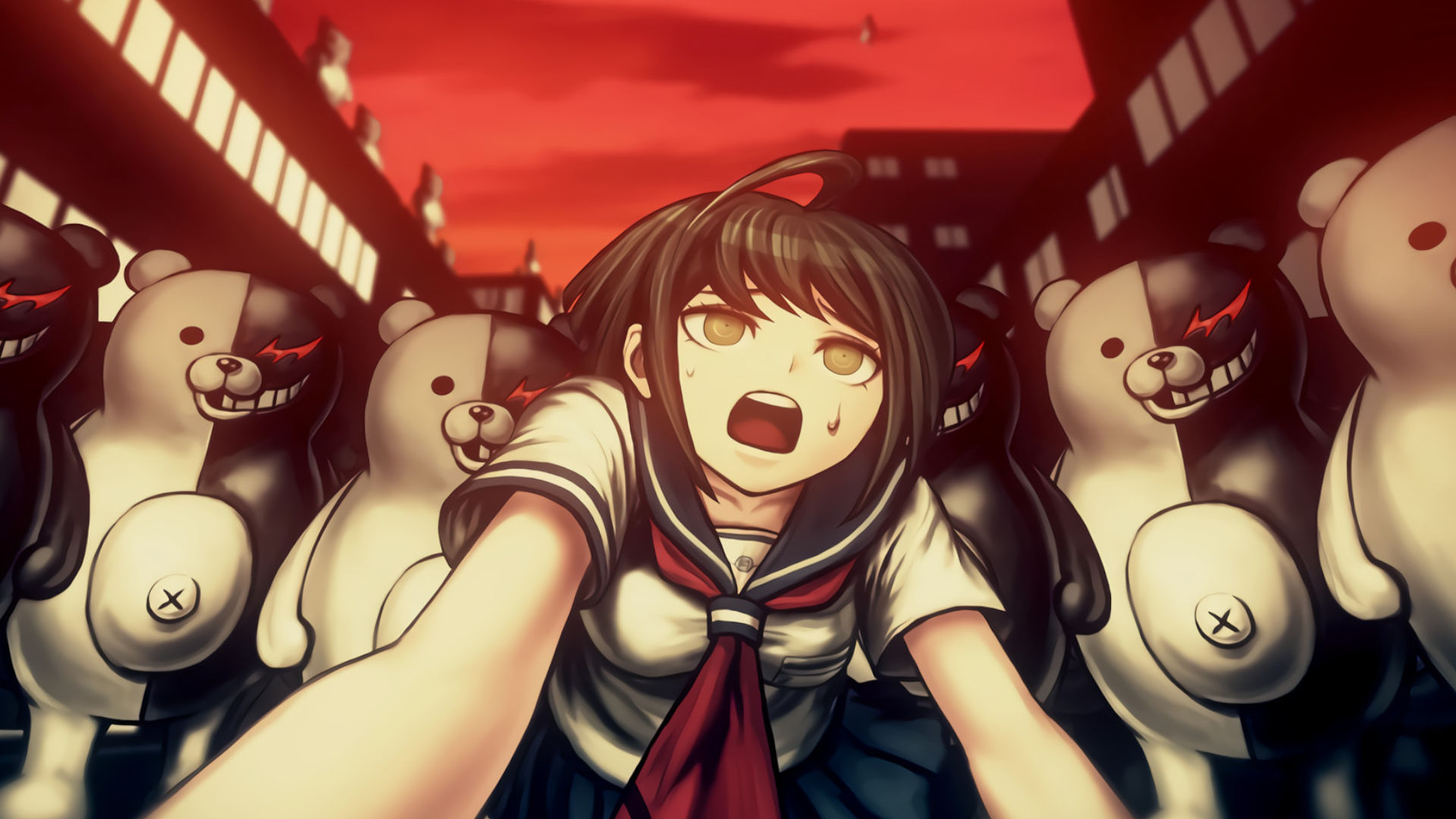
Danganronpa games - a character surrounded by Monokuma units in Danganronpa Another Episode: Ultra Despair Girls

Danganronpa Another Episode: Ultra Despair Girls

Danganronpa Another Episode: Ultra Despair Girls is a spin-off game set between the events of Danganronpa: Trigger Happy Havoc and Danganronpa 2: Goodbye Despair. Published in Japan by Spike Chunsoft in 2014 and seeing a western release in 2015, it’s the first game to break the tried-and-tested visual novel format.

Instead, it’s a third-person adventure shooter game in which you take control of Komaru Naegi, Makoto Naegi’s younger sister, as you attempt to survive in a chaotic city overrun by Monokuma Units. With the help of your partner, Toko Fukawa, you must take control of the Hacking Gun to escape the crafty Monokuma Kids and unveil the secrets of the city.

Danganronpa S: Ultimate Summer Camp

Dropping as a part of the Danganronpa 10th Anniversary celebration, Danganronpa S: Ultimate Summer Camp is an extended version of Danganronpa V3: Killing Hamony’s Ultimate Talent Development Plan minigame.

An RPG board game featuring a lineup of characters from all of the previous titles, Ultimate Summer Camp tasks you with exploring Jabberwock Island, collecting Hope Fragments, and developing your characters. Battle enemies to earn money, upgrade your equipment, defeat bosses, and unlock new islands in this alternate, non-killing tropical paradise.

Danganronpa game collections and remasters

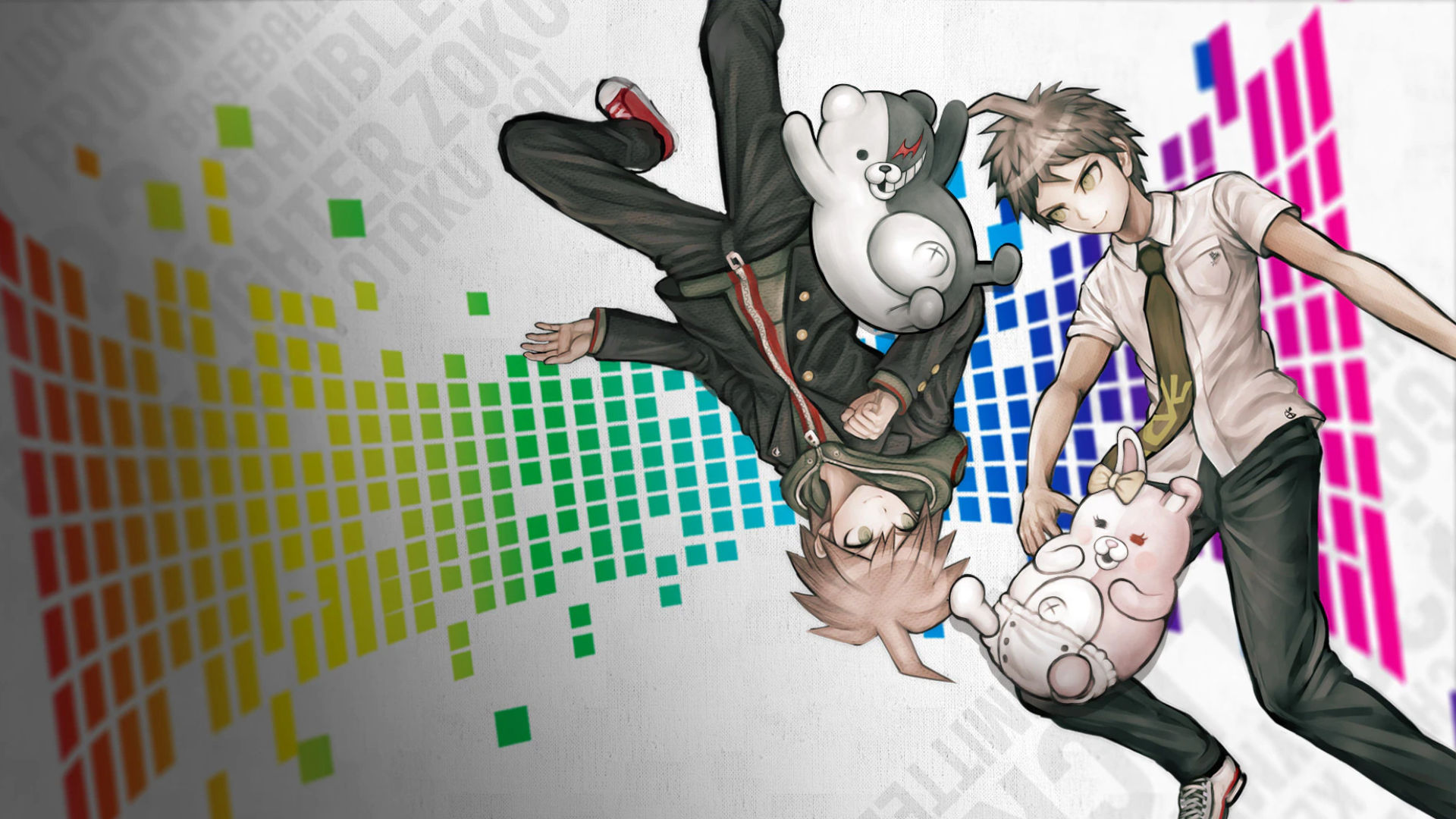
Danganronpa games - official art from Danganronpa 1.2 Reload featuring two characters with Monokuma and Monomi

Danganronpa 1.2 Reload

A collection of the first and second games with several new features, Danganronpa 1.2 Reload initially came out on Playstation Vita in Japan in 2013. In 2017, NIS published the game in North America and Europe on Playstation 4, then re-released it on the Playstation 5 through backwards compatibility.

YouTube Thumbnail

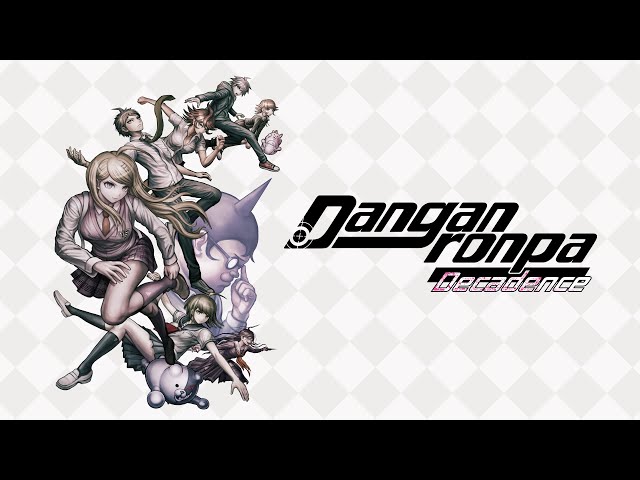
Danganronpa Decadence

In celebration of the Danganronpa 10th Anniversary in 2021, Spike Chunsoft (and Numskull Games in Europe) released Danganronpa Decadence, a remastered collection for Nintendo Switch. It includes the Anniversary Edition remasters of all the mainline games, Danganronpa: Trigger Happy Havoc, Danganronpa 2: Goodbye Despair, and Danganronpa V3: Killing Harmony. Additionally, it also features Danganronpa S: Ultimate Summercamp as a standalone experience. Indulge in a decade of despair with either the exclusive, physical-only bundle, or you can purchase the games individually from the Nintendo eshop.

Danganronpa games in order

Working out how to play the Danganronpa games in order can be a little tricky, but we’ve got you covered. Note that, chronologically, Another Episode: Ultra Despair Girls falls between Trigger Happy Havoc and Goodbye Despair. However, Ultra Despair Girls contains spoilers for Goodbye Despair, so we recommend playing it third.

  • Danganronpa: Trigger Happy Havoc
  • Danganronpa 2: Goodbye Despair
  • Danganronpa Another Episode: Ultra Despair Girls
  • Danganronpa V3: Killing Harmony
  • Danganronpa S: Ultimate Summer Camp

And with that, our class on the iconic Danganronpa games comes to a close. If you’re feeling spooked after all those thrills, chills, and kills, make sure to use our iPhone flashlight guide when you go to the bathroom tonight. Or, you can head over to our Zoom download guide to phone a friend and make sure they aren’t trapped at Hope’s Peak Academy.

Posted on Leave a comment

Pokémon Go Umbreon guide – how to evolve, counter, and use

Years before Pokémon Go, all the way back in Pokémon Gold and Silver, it was pretty hype to see the series change so much from Red and Blue, and the addition of ‘cool’ sounding types like dark and steel made me feel cool too, despite being 12. Game Freak also took the smart move of using an existing Pokémon and giving them a fantastic dark-type evolution, showing that this game isn’t for kids anymore.

Obviously, it was still a kid’s game, but I can’t tell you how enamoured I was after staying up late and evolving a faithful Eevee into the new, mysterious, and awesome Umbreon. The dark-type creature looks incredible, and the fact you had to evolve it at night only made it cooler. Well, if you want to add the best Eeveelution (backed up by our article entirely on how awesome Umbreon is) to your team, our Pokémon Go Umbreon guide is here to help.

We think you’ll love this guide, but when you’re done, be sure to check back on our many other articles covering Pokémon Go, including our fairy Pokémon guide, dragon Pokémon guide, flying Pokémon guide, and our Pokémon Go Genesect guide.

Let’s dive into our Pokemon Go Umbreon guide.

Pokémon Go Umbreon

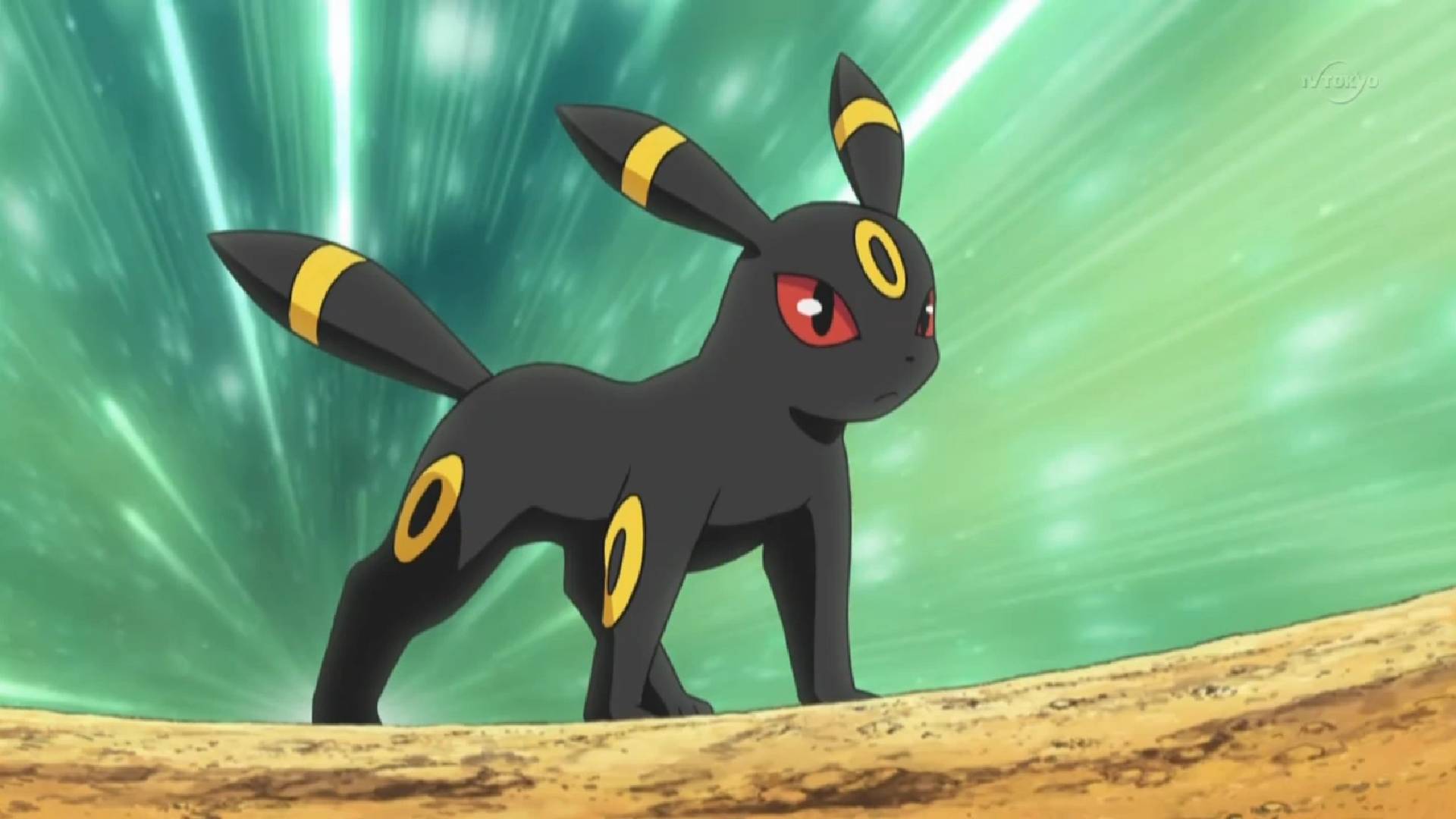
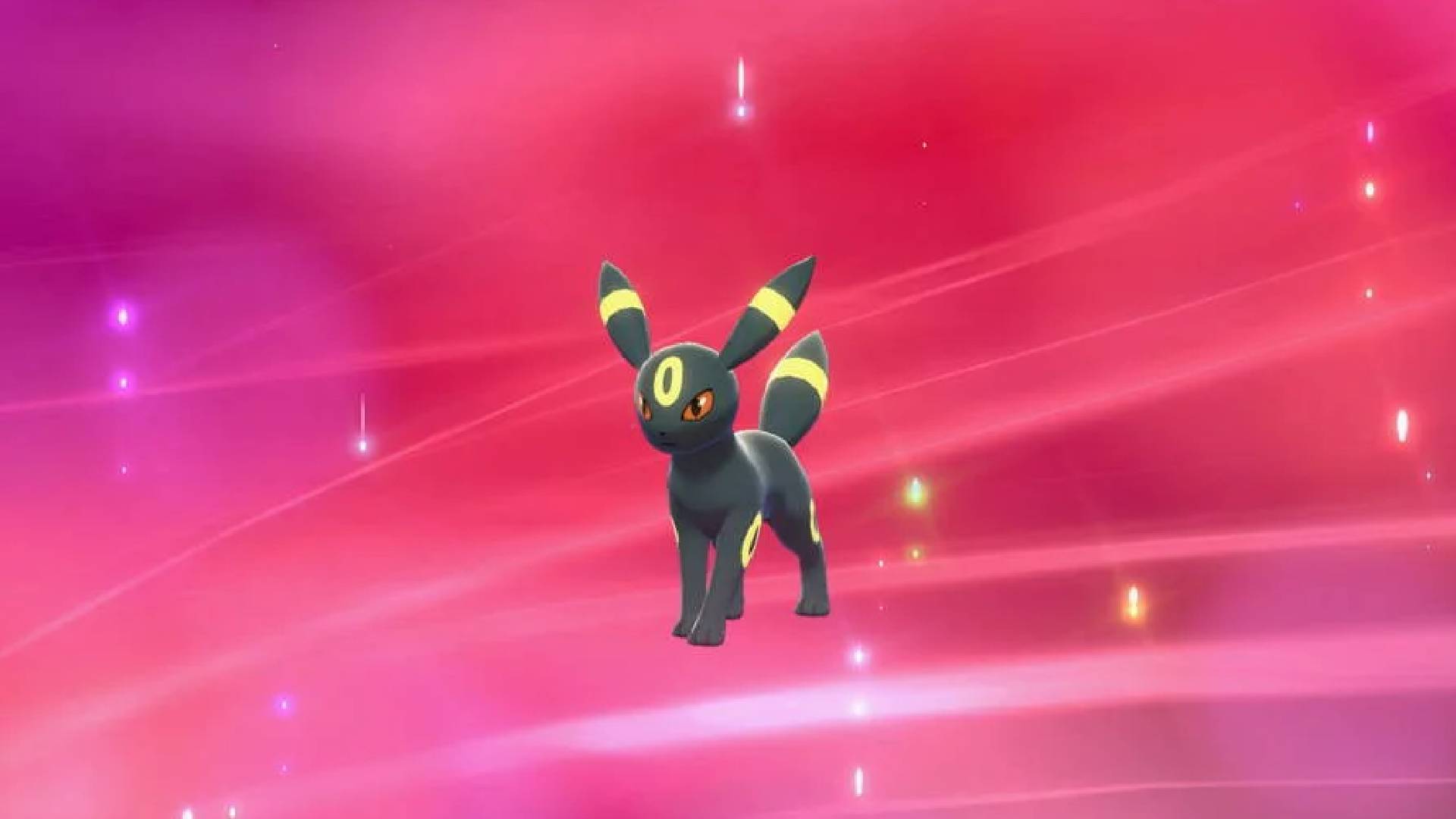
Pokemon Go Umbreon: Key art shows the dark Pokemon Umbreon

What is Pokémon Go Umbreon?

Number 197 in the Pokedex, Umbreon is one of the many different evolutions of Eevee, and it originates from the Johto region in Pokémon Gold and Silver on the Gameboy. One of the very first dark Pokémon introduced, this new type helped to balance out the powerful psychic type. Known as the moonlight Pokémon, the cat-like Umbreon can only evolve from Eevee at night when exposed to moonlight, and when it trusts the trainer enough through friendship.

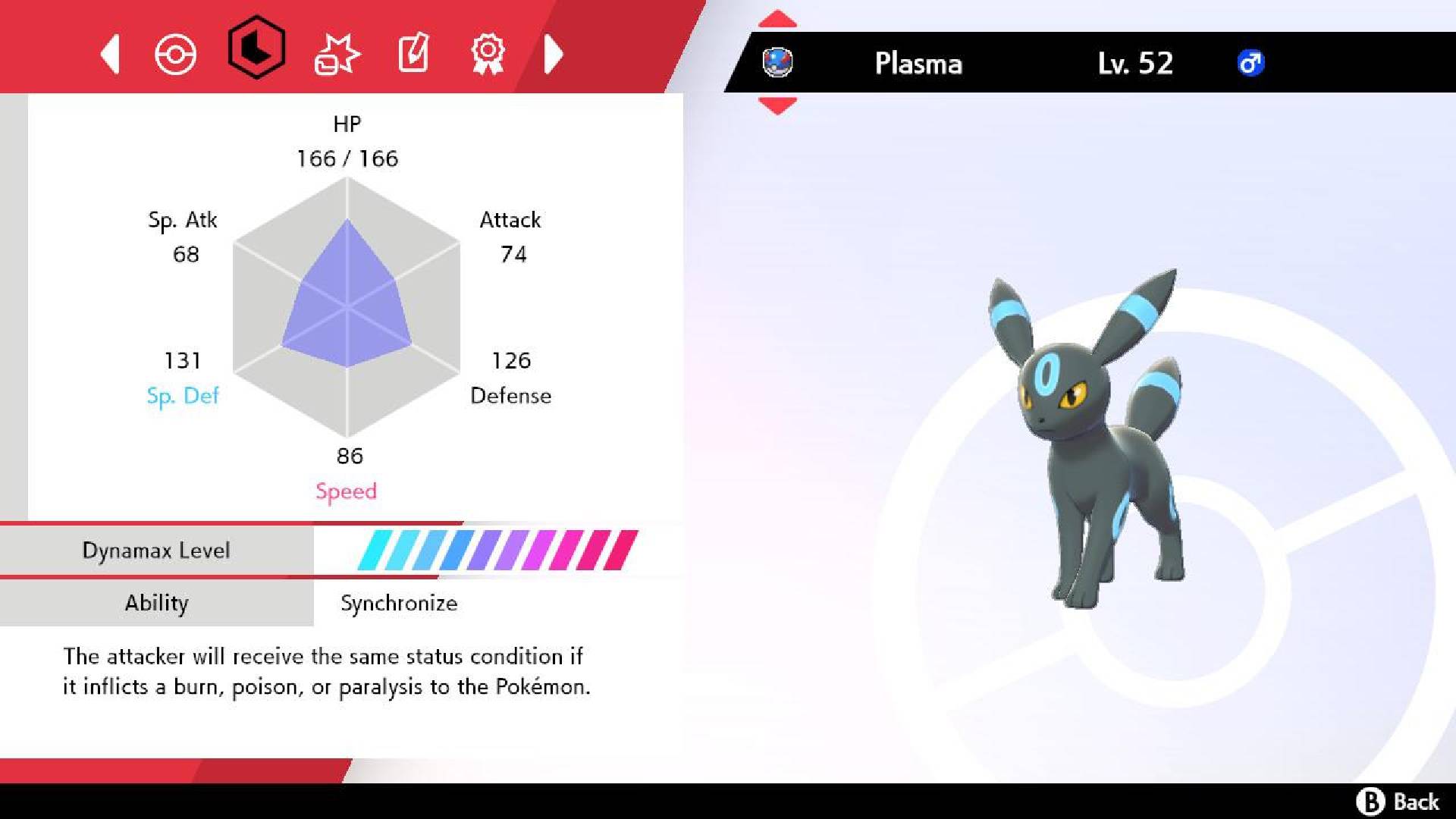
Pokemon Go Umbreon: Key art shows the dark Pokemon Umbreon

How do I evolve Eevee into Pokémon Go Umbreon?

There are two ways to evolve an Eevee into Umbreon, but one of them only works once. First, like all other Eevee evolutions, there’s a specific name you can call the Pokémon to choose to turn it into one of the many evolutions. For Umbreon, that name is Tamao, and once you evolve an Eevee this way, you have to use the second method for any subsequent evolutions.

The second way to evolve an Eevee into an Umbreon is to make the Eevee your buddy and then walk at least 10km, earning two candies for your effort. Then you get the chance to evolve Eevee, but to nab yourself an Umbreon you must evolve the Pokémon at night.

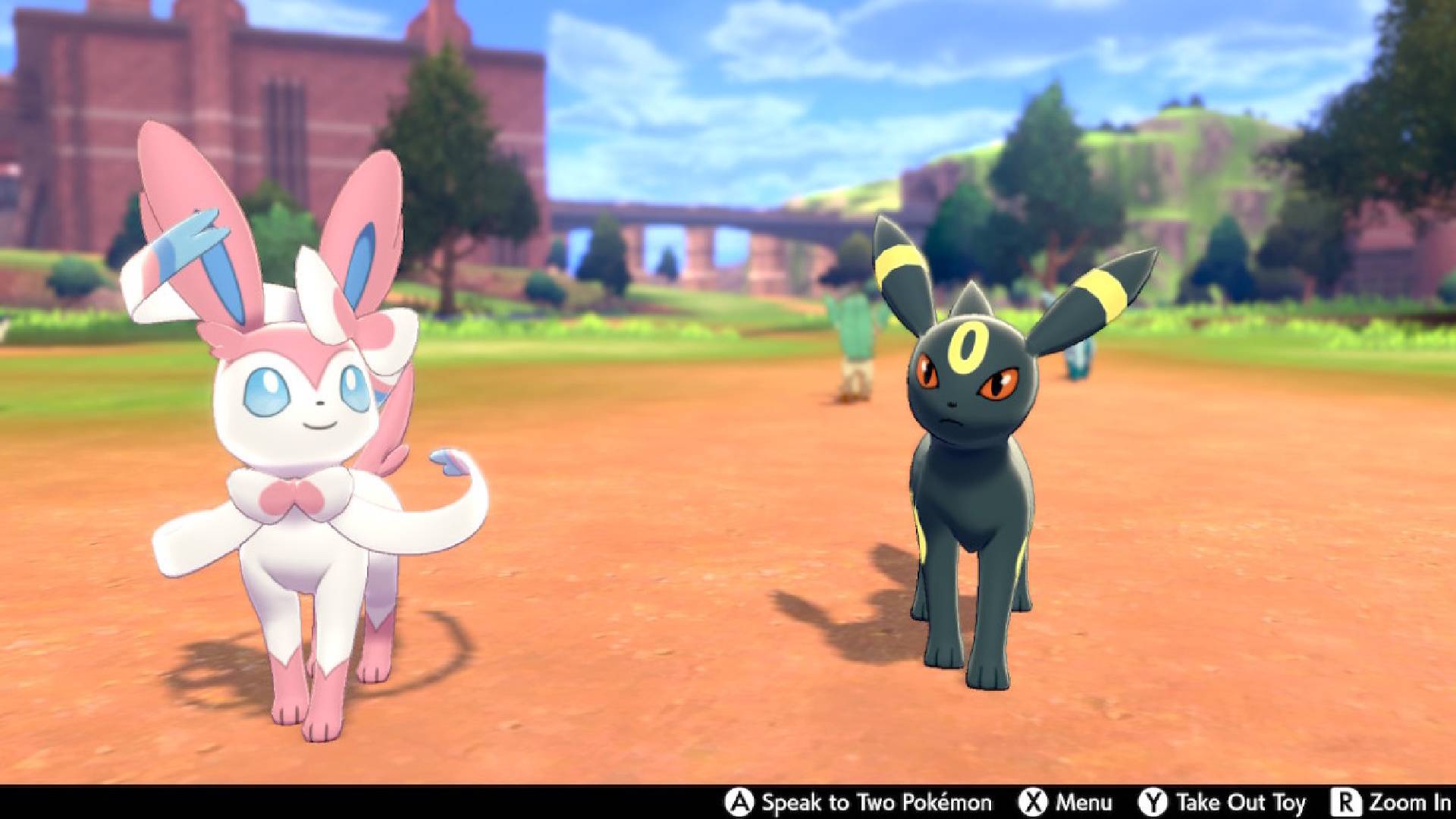
Pokemon Go Umbreon: Key art shows the dark Pokemon Umbreon

What are Pokémon Go Umbreon’s stats?

Umbreon’s stats  Result
Base attack 126
Base defence  240
Base stamina  216
Max CP – level 15  916
Max CP – level 20  1221
Max CP – level 30  1832
Max CP – level 40  2137
Base capture rate  12.5%
Base flee rate  5%

Weaknesses

  • Fighting x2
  • Bug x2
  • Fairy x2

Resistances

  • Ghost x0.5
  • Dark x0.5

Immunities

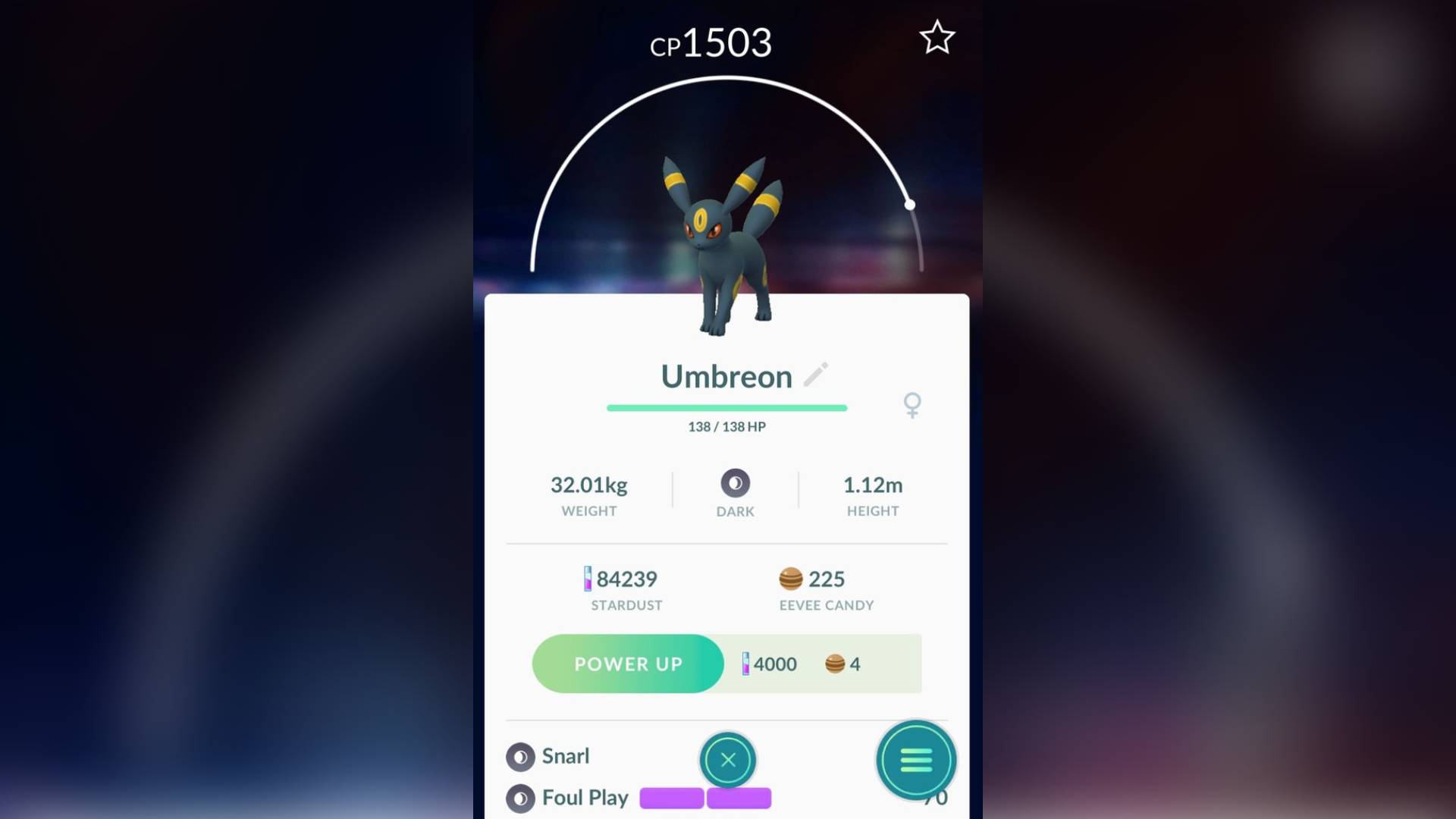
Pokemon Go Umbreon: Key art shows the dark Pokemon Umbreon

What are Pokémon Go Umbreon’s moves?

Quick move

  • Feint attack (dark)
  • Snarl (dark)

Charged move

  • Dark pulse (dark)
  • Foul play (dark)
  • Last resort (normal)
  • Psychic (psychic)

How do I use Pokémon Go Umbreon?

While it can be tempting to run an Umbreon with psychic for your charged move, you miss out on STAB damage, so outside of a few specific instances, it’s best to have your Umbreon use snarl and foul play, and treat it as a nuisance for ghost Pokémon and psychic Pokémon alike. Below is a list of Pokémon that Umbreon is effective against.

  • Gengar
  • Dusknoir
  • Slowking (galarian)
  • Victini
  • Hoopa (confined)
  • Lunala
  • Marowak (alolan)
  • Metagross
  • Jirachi

Pokemon Go Umbreon: Key art shows the dark Pokemon Umbreon

How do I counter Pokémon Go Umbreon?

As a pure dark-type, sadly there are quite a lot of good counters to Umbreon, especially from bug Pokémon and fighting Pokémon. Below is a list of Pokémon that are effective counters to Umbreon.

  • Lucario
  • Conkeldurr
  • Terrakion
  • Pheromosa
  • Volcarona
  • Blaziken
  • Zapdos (galarian)
  • Breloom
  • Heracross
  • Buzzwole

There we are folks, you’re no longer in the dark, thanks to our guide on the amazing evolution of Eevee known as Umbreon. If you love Pokémon Go and want even more great guides, be sure to check out our article covering Pokémon Go Deoxys next.