By Malcolm Owen Thursday, December 19, 2019, 01:14 pm PT (04:14 pm ET)
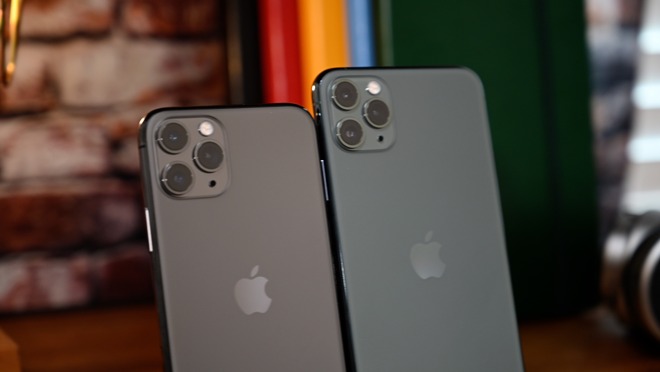
The iPhone complies with U.S. standards for RF exposure, the FCC has confirmed after performing a battery of tests on the smartphone. Regulators promised to evaluate Apple’s handset following an August report by the Chicago Tribune claiming that the model breaches consumer safety rules.
A cellphone tower collection.
In August, it was claimed by independent testing conducted by the Chicago Tribune that there was an issue with the iPhone 7 and iPhone 8, with regards to radio frequency broadcasts. Performed by the RF Exposure Lab, the tests showed iPhone 7 exceeded the amount of exposure the FCC permits devices to expose to a user, by a considerable margin.
The retest, conducted by the FCC, included a mix of devices supplied by Apple and Samsung, as well as others purchased by the FCC. Testing was performed between Aug. 30 and Sept. 23.
All of the devices tested at the FCC’s own lab — not a contractor — were under the maximum legal limit of 1.6 watts per kilogram or less, over 1 gram of tissue that is absorbing the most signal. The legal limit is derived from a safe limit, which is about 50 times higher.
Test results, via the FCC
The previous testing commissioned by the newspaper measured levels between 2.5 watts per kilogram and 2.81 watts per kilogram, far above the legal limit for exposure.
At the time of the original test, Apple took issue with the results and in a statement said the results “were inaccurate due to the test setup not being in accordance with procedures necessary to properly assess the iPhone models.” Apple added that “all models are fully certified by the FCC and counterparts in other countries where iPhones are sold, with Apple further proclaiming “we are in compliance and meet all applicable exposure guidelines and limits.”
By Christine McKee Saturday, December 14, 2019, 11:39 am PT (02:39 pm ET)
Amazon is running a holiday sale on Twelve South accessories for Apple products, with bonus savings on a variety of cases, chargers and stands for Apple AirPods, iPhones, iPads, MacBooks, iMacs and Apple Watches.
Save money on stocking stuffers
Amazon, as part of its 12 Days of Deals holiday promotion, is discounting Twelve South accessories for your favorite Apple products, including AirPods.
With savings of up to 69% off and most items scheduled to arrive before Christmas, now is the time to pick up fun stocking stuffers and gifts for the Apple fan in your life.
AirPods accessories
Apple Watch accessories
iPhone accessories
MacBook accessories
iPad Pro accessories
USB-C Hub
iMac accessories
Additional Apple deals
AppleInsider and Apple authorized resellers are also running additional exclusive savings on Apple hardware for the holidays that will not only deliver the lowest prices on many of the items, but also throw in bonus deals on AppleCare, software and more. These offers are as follows:
China, the world’s largest smartphone market, has been nothing short of a moving target for Apple. A salvo shots fired by top analysts this week only evidences one thing: the only near-term certainty with Apple and China may be more uncertainty.
Apple store in Hangzhou, China.
Credit Suisse issued a cautionary note on Apple’s iPhone performance in greater China early Thursday morning. In the note, seen by AppleInsider, analyst Matthew Cabral said that checks showed a more than 35% yearly decline in Chinese iPhone shipments in November — trailing far behind a broader Chinese smartphone market that has remained relatively flat over the same period.
In presenting the data, Cabral acknowledged the challenging year-over-year compare Apple faced given vast differences in the timing of its iPhone launches over the past two years and similarly cautioned clients about reading too much into potentially “volatile” monthly data.
Nonetheless, the November drop was the second straight double-digit decline in Chinese iPhone shipments, he said, following on the heels of a 10.3% yearly decline for October. That would imply a more than 7% overall decline in Chinese iPhone shipments since the launch of Apple’s iPhone 11 family, Cabral added, explaining that mix shift towards the lower-priced “iPhone 11” model amongst most the region and a significantly discounted Renminbi may only intensify Apple’s struggles.
Cabral’s note caused a stir amongst AAPL investors who, also fearing potential complications from a looming tariff deadline, sent shares sliding over 1.5% before reversing course on upbeat trade comments tweeted by President Trump a couple of hours later.
“While early indicators of demand on the iPhone 11 cycle were consistently better-than-expected, sustained softness in China (is an incremental concern, particularly given the increasingly easy [year-over-year] compares,” Cabral wrote. “At this stage, we’re hesitant to extrapolate weak Chinese data points broadly across Apple’s global footprint given our view that structural factors are at play (we see aggressive local competition and a narrower ecosystem advantage in China) and build plans remain largely unchanged, per our Asia team.”
Credit Suisse maintained its “Neutral” rating on AAPL shares with a $221 price target. The firm’s views on Chinese iPhone sales almost immediately came under scrutiny from rivals, with Evercore ISI analyst Amit Daryanani reiterating his firm’s newly established $305 price target and “Outperform” rating. He issued a note to clients urging them to “look past the [Chinese] iPhone noise and focus on several upside catalysts” that he believes will help the iPhone maker post a solid beat to earnings for its current December quarter.
“We think investors appear to be reacting to data-points related to China’s MIIT smartphone data that shows a decline in the month of November,” Daryanani said. He stressed the tough year-over-year compare that Cabal had originally alluded to while presenting his bearish Phone call — the fact that iPhone XR was launched in November 2018, while the iPhone 11 was released in September 2019.
When normalized over three months, Daryanani believes recent Chinese iPhone data “points to a trendline that’s actually up slightly at 3% year-over-year. The Evercore analyst issued a note to clients just one day earlier raising his target on AAPL shares to $305 from $275, vouching his opposing view that iPhone 11 sales will actually surprise to the upside this quarter, outperforming relatively low expectations due in part to $50 price cut between the iPhone XR to the iPhone 11 that “has been particularly well received in China.”
With a population of roughly 1.4 Billion, China and its smartphone market remain a massive, yet thus far elusive target for Apple and international smartphone vendors. Though it has outsold rival Samsung, Apple has only managed to muster up a single-digit share of the overall Chinese smartphone sales. The company is dwarfed by local rivals such as Huawei, Xiaomi, Vivo, and Oppo, who combine to control over 80% of the market.
In a move atypical for the company, Apple earlier this year admitted to overshooting the Chinese market with the iPhone XR and issued a revenue guidance warning, which ultimately saw sales in the region slip nearly 5% year-over-year.
“While we anticipated some challenges in key emerging markets, we did not foresee the magnitude of the economic deceleration, particularly in Greater China,” Apple CEO Tim Cook said at the time. “In fact, most of our revenue shortfall to our guidance, and over 100 percent of our year-over-year worldwide revenue decline, occurred in Greater China across iPhone, Mac, and iPad.”
Cook added that “while macroeconomic challenges in some markets were a key contributor to this trend, we believe there are other factors broadly impacting our iPhone performance, including consumers adapting to a world with fewer carrier subsidies, US dollar strength-related price increases, and some customers taking advantage of significantly reduced pricing for iPhone battery replacements.”
Though Apple may be making strides towards more attractively priced smartphones with the iPhone XR, its struggles to stem the bleeding and remain relevant in emerging markets could not be more relevant at a time where the company’s greatest prospects for revenue growth arguably lie within those same countries. According to a recent Bank of America global smartphone forecast released earlier this week, Apple lost share during the third quarter of the year in every key emerging and major market except for the US, including losses in China, India, and Latin America.
The firm’s Global Research division cited Strategy Analytics data in estimating that Apple currently maintains 12% of the global smartphone market, but just a wavering 5% share in China that’s expected face continued pressure over the next several years.
Just how much of Apple’s near term growth opportunity remains tied to China and its booming smartphone market is likely to remain a hotly contested debate. Of all the analysts who provide coverage of Apple, Morgan Stanley’s Katy Huberty has arguably had her finger closest to pulse when it comes to expectations in China.
“We caution extrapolating China iPhone Data points,” she said Friday, in an apparent jab Credit Suisse’s call. She reiterated her firm’s “Overweight” rating and $296 price target on Apple shares but shared nothing further.
The next time we expect to hear from Apple on how it’s faring in China will be late January 2020, when the company reports results of its current, first fiscal quarter of the new year.
At the close of trading on Friday, Apple stock closed at $275.15, a new all-time high. Notably, the Chinese government and President Trump announced that they agreed in principle for a “phase one” deal to hopefully wind down the trade war. Tariffs expected to commence on December 15 on a wide array of Apple products will not be implemented, and a 15% tariff placed on September 1 will be halved “in phases.”
Despite mounting risks in mainland China, Bank of America Securities upped its price target another 7% on shares of Apple this week, saying the international roll out of 5G should help the company sustain consistent sales of over 200M iPhones over the next few years.
In a report issued to clients on Wednesday, Bank of America Securities analyst Wamsi Mohan said the push amongst carriers and customers to upgrade to 5G networks and — and an iPhone 12 with 5G connectivity — in poised to increase and sustain iPhones shipments beyond the 200 million unit mark through 2022.
But unlike the iPhone 6 and iPhone 6 Plus “major cycle,” where shipments moved from 169 million in 2014 to 231 million in 2015 before shrinking to 212 million in 2016, the analyst believes iPhone maker’s 5G cycle will yield “smoother,” more consistent sales of iPhones the 36-month period.
“The launch will likely will come with added cost and higher price,” Mohan said. “Thus, we take a slightly more measured view of 5G as a catalyst and expect a steadier multiyear upgrade cycle.”
He’s currently modeling for Apple to ship 202 million iPhones in 2020, rising to 223.5 million in 2021 and 220 million in 2022.
While benefiting from 5G hype, it is suggested Apple won’t actually be racking up that many sales of 5G-enabled iPhones in its first year on the market, with only 20 million — or roughly 10% of its global iPhone shipments — being 5G capable. Still, that’s a huge increase over Mohan’s previous forecast of just 10 million 5G iPhone shipments in 2020. He partly attributed the increase to Apple’s settlement with Qualcomm, which he said “clearly suggests that Apple wants to have 5G capability ready to compete against Samsung and other vendors.”
Practically all of Apple’s 20 million 5G iPhone shipments during 2020 are expected to be clustered into the final few months of the year, and will amount to roughly 30% of the 60 to 70 million new iPhones that are expected to be sold in the back half of the year. Mohan sees this number rising over time, ultimately topping out at around 70% of all units by 2024.
Part of the analyst’s thesis is that Apple is taking “a long-term view” on 5G with its purchase of Intel’s smartphone modem business, paving the way for a second source of modems alongside Qualcomm’s version. He added that industry checks suggest Apple iPhone 5G launch could have a “staggered launch across regions and SKUs,” with the presumably more expensive 5G model being more readily available in some developed or more valuable markets than others. As such, he told clients he’s taking a “slightly more measured view of 5G” and expects a “steadier multiyear upgrade cycle” to match.
There will also be some considerable variation between markets, with the United States likely to be the main powerhouse for 5G sales. Mohan reckons Apple will capture 36% of the US 5G market in 2020 with domestic sales of 5 million units, ultimately growing its share to 40-50% “in the long term.”
The same cannot be said about China, which is predicted to be a poor market for Apple’s 5G ambitions. With a relatively late start behind local rival Huawei and main competitor Samsung, Apple could gain more than 15% of the 5G market, but Mohan thinks Apple may see a small decline over the years into 2024.
The growth of 5G penetration in China across all smartphone vendors is also thought to be generally slower than that of 4G from 3G, due to the cancellation of handset subsidies by carriers. While 4G penetration in 2014 was 44% in China for all device producers, 5G is expected to only achieve 35% penetration in 2020.
Bank of America Securities raised its pricing target on shares of AAPL to $290 from $270, saying its new target is based on a 17X multiple of estimated earnings for the 2021 calendar year of $17.40.
“We believe a multiple at the high end of the historical range is justified given a large cash balance and opportunity to diversify into new end markets, increasing mix and diversity of services, and a cyclically low point in iPhone sales,” Mohan said.
The firm’s newly proposed target is also based on a mix of two possible scenarios: one where hardware has “low-single-digit” revenue growth and Services growth in the high teens, and another where hardware revenue is flat and Services revenue growth decelerates to the mid-teens level.
Regardless of the pairing, the inferred result is a stabilization of the hardware business, while Services are used as the main driver for overall revenue growth.
By AppleInsider Staff Wednesday, December 11, 2019, 02:16 pm PT (05:16 pm ET)
New York’s Metro Transportation Authority continued a planned rollout of its Apple Pay Express Transit-compatible One Metro New York, or OMNY, system on Wednesday, expanding support to the busy hub at 34th St.-Penn Station.
A total of 96 OMNY readers at 18 turnstile arrays serving the A, C, E and 1, 2, 3 subway lines now accept Apple Pay and touchless payment solutions from American Express, Discover, Mastercard and Visa. Google Pay, Samsung Pay and Fitbit Pay are also accepted.
With OMNY, riders simply tap their compatible contactless card or device like iPhone and Apple Watch on an active turnstile to payment point to enter subway stations or MTA-run buses. Additionally, support for Express Transit means iPhone and Apple Watch users can conduct touchless terminal transactions without unlocking or waking their device.
By the end of December, OMNY is slated to go live at 85 subway stations across NYC, all MTA-operated buses on Staten Island and two Staten Island Railway stations. A wide rollout to all subway stations and MTA buses is planned for completion by the end of 2020.
“Today is yet another momentous occasion in the continued rollout of OMNY, the MTA’s game-changing contactless fare payment system,” said Andy Byford, president, NYC Transit. “Penn Station is one of the system’s busiest subway stations and will allow hundreds of thousands of commuters the opportunity to tap and ride using a device or contactless card of their own choosing, including customers arriving on the Long Island Rail Road, New Jersey Transit, and Amtrak, who connect with the subway system here at Penn Station. Chase, Visa and other partners have done an immense amount of work to help spread the word about OMNY and we’re thankful for their support.”
Apple Pay with Express Transit mode first debuted at a handful of NYC subway stations and buses in May. For now, OMNY offers a flat-fare, pay-per-ride option, though alternative fare products like passes are expected for availability in 2020.
By Malcolm Owen Tuesday, November 26, 2019, 12:09 pm PT (03:09 pm ET)
Apple’s Smart Battery Case for the iPhone 11 has a slightly refined design to add the dedicated camera button, x-ray images of the case reveals, with the accessory including an extra circuit board to add extra hardware controls to the smartphone.
[via iFixit and Creative Electron]
Apple launched a new set of Smart Battery Cases for the iPhone 11, iPhone 11 Pro, and iPhone 11 Pro Max on November 20, with the accessory updated with a larger camera cutout and a new camera button while maintaining the well-known battery hump design. Chiefly, the case is to protect the iPhone while also offering up to 50% more battery life, but this generation introduces the camera button for the first time.
A series of x-rays hosted by iFixit and performed by Creative Electron shows there are a few internal changes to the Smart Battery Case to accommodate the new button, both to position it and to connect it to the iPhone.
A small circuit board is embedded inside the case between the two battery cells and the Lightning port. The board is used as the conduit for connections of other components, including the induction charging coil and the batteries via wires, while a thin flexible circuit runs to the button.
The addition of a button is an interesting choice for Apple, as previously users had the ability to use the volume buttons to trigger the shutter instead of tapping the display. However, the orientation of the camera in relation to the volume button, which would be on the bottom edge if the iPhone is held in a typical landscape fashion, makes it harder to press, and can occasionally cause unwary users to press the power button by mistake.
Aside from being ideally located for taking a photo with the right index finger firing the shutter, the new button is also slightly recessed, minimizing the chance of it being pressed while in a pocket or bag.
Apple has dropped its annual update to the Smart Battery Case to support the latest crop of iPhones, but this time it wasn’t just the camera cutout that changed —Apple also integrated a hardware shutter button.
Apple’s updated Smart Battery Case
More battery life for your iPhone
Made from the elastomer as Apple’s silicone case, the Smart Battery Case has a soft, but grippy external texture. The inside is lined with microfiber to coddle your iPhone and prevent scratches and soften inadvertent drops.
Apple’s iPhone 11 Smart Battery Case is lined with microfiber and connects via Lightning
To adorn the case, the top, flexible portion bends backward where the iPhone can be slid into place into the hardened lower portion. At the bottom of the case is a Lightning connector that fits perfectly into the bottom of the iPhone.
This differs from some third-party battery cases such as that from Mophie that connects to your iPhone wirelessly rather than through the Lightning connector.
This is a large differentiator that many don’t realize. When a case such as the Mophie Access is turned on and starts to charge the phone, the phone thinks it is connected to stable, wall power and not a mobile case. That causes more power-intensive tasks to kick in.
With Apple developing the case, phone, and software, it is able to properly optimize all three to get the most battery life possible. When the case is connected, the phone understands that it is a battery case and not wall power so it holds off on power-intensive tasks.
That’s why Apple is able to get a good amount of battery life out of such a compact case. Apple says users should expect up to 50% longer battery life when using the Smart Battery Case with their iPhone 11, iPhone 11 Pro, or iPhone 11 Pro Max. That’s excellent considering the already stellar battery life the iPhone 11 line achieves.
A Lightning port is on the bottom of the Smart Battery Case
There have been a few battery cases in the past that connected over Lightning instead of just wirelessly charging the phone, but in doing so they prevent any data from working over the port due to strict MFi restrictions. Apple doesn’t have these hurdles and allows you to use the Lightning port as normal —including utilizing CarPlay or Lightning headphones.
The Apple Smart Battery Case charges also over Qi
Of course, the case can also be charged wirelessly on a Qi charging pad or fast-charged with a USB-C to Lightning cable. Battery life can be ascertained any time charging commences, or by heading into the Battery widget of Notification Center. Or, ask Siri.
New functionality
What is most notable this time around, is Apple has also added a new dedicated hardware camera button. This new button will not only launch the camera app whenever pressed but also acts as a shutter button.
The new dedicated camera button on the Smart Battery Case
In our testing, it is quite a bit faster than waking the phone and using Haptic Touch (or a swipe) to enable the camera. Precious moments saved could be crucial to catching your precious moment.
The button is well-positioned so that when the phone is held horizontally with the cameras on the top, the shutter button is just below your right index finger —as it would be on a traditional point-and-shoot camera.
Should you buy it?
iPhone 11 Pro Smart Battery Case in black
This year, iPhones have the longest rated battery lives to date. This makes the prospect of a dedicated battery case a tougher sell than in years past.
That’s why Apple needed to go further with the addition of the camera button. To some, it may come off as a non-consequential addition, but for many —likely the same ones who saw the camera on the iPhone 11 line as a worthwhile reason to upgrade —it will be a well-received update.
If you find yourself regularly needing additional battery life to make it through the day or through a weekend, Apple’s own Smart Battery Case is the best available.
Pros
Well-optimized battery and software
Up to an additional 50% battery life
Durable design
Dedicated camera button
Strong iOS integration
Full Lightning port access
Cons
Expensive
Silicone is the only exterior material option
Limited colorways
Rating: 4 out of 5
Where to buy
You can grab the new Apple Smart Battery Case for the iPhone 11, iPhone 11 Pro, and iPhone 11 Pro Max now from B&H Photo in pink sand, black, or white.
We got to check out some truly one-of-a-kind wireless earbuds that feature all-day battery life to see if they’re a must add to our collection.
Tiger & Rose have created a pair of wireless Bluetooth earbuds for those with a wild side. They’re panther-shaped, boast touch controls, and feature Bluetooth 5 for superior connectivity and stability. For all-day listeners, they also get an impressive 30 hours of playtime with the included charging case.
If you’re interested in finding out how they performed, here’s how we felt they held up in our time with them.
Style & features
The creators bill the Tiger & Rose earbuds as “the most stylish truly wireless earbuds,” and I’d have to agree that they’re definitely high on the list. They describe them as having a panther design, though I’d say they look startlingly similar to my college alma mater’s mascot.
Either way, the design of the Tiger & Rose earbuds is unlike anything I’ve seen, and since wearing them in public a few times, people have taken quite a bit of notice. I’ve gotten a lot of compliments from people who actually did ask if they were Penn State related —which they’re not.
In terms of features, the Tiger & Rose earbuds have simple touch controls that make them convenient for times when grabbing your phone simply isn’t going to be possible.
Tapping once on the front of the earbud will play or pause your music. A double tap on the left earbud will advance to the next song, while a double tap on the right will switch to the previous one —it’s notable that this is opposite of most other earbuds. A long press will activate Siri
In the event that you get phone call, a quick tap will answer it, while a long press will send it to voicemail.
As of right now, the current model of Tiger & Rose earbuds do not feature any volume control features.
It’s also worth mentioning that the Tiger & Rose earbuds comes in a charging case that can be charged wirelessly on any QI-compatible charging mat, or via USB-C. They feature 6 hours of play-time, with the case allowing you to charge them roughly five full times, for roughly 30 hours of play time before the case will need to be recharged. Both the earbuds and the case take about an hour and a half to charge fully if completely depleted.
Comfort & wear
As far as how comfortable these earbuds are, I was actually pretty surprised. They’re light weight, which means they don’t put any undue strain on my ears, even after long wear sessions. These earbuds are actually comfortable—considerably more comfortable than several other pair that I own. They also sit securely in the ear with the added benefit of a soft, silicone ear hooks. While I haven’t taken them to the gym yet, I’d imagine that they’d manage just fine on even fairly rigorous workouts.
There is a downside, though—because these earbuds sit so far outside of the ear canal, they are extremely easy to accidentally bump. If you’ve got long hair, you’ll probably knock one out if you try to pull your hair back. If you pull on a hood or pull a shirt over your head, you’ll probably snag an earbud, which I’ve learned can be somewhat painful. Since I’ve been wearing them for a bit over a week now, I’ve trained myself to be a bit more careful, but I still do accidentally snag or bump them.
Sound & performance
I found that pairing the Tiger & Rose earbuds was easy, it’s automatic and starts from the minute you open the case. They paired easily with both my iPhone 11 and my Mac mini.
The sound quality is about what you’d expect from a pair of mid-range headphones. I wasn’t blown away by the audio quality, but it wasn’t terrible. It seems to lack bass, which gives it somewhat of a less-full sound. Fortunately, the sound is still quite clear, meaning that it worked especially well for listening to podcasts.
Overall
The Tiger & Rose earbuds is a solid set of earbuds that are remarkably comfortable to wear, though the sound quality could be a little better. Overall, I think that if you’re in the market for something like this, it’s purely to catch the attention of others.
Where to buy
While not ready for public release yet, you can pre-order your own set of Tiger & Rose earbuds from Tiger & Rose’s Indiegogo. They come in white, black, rose gold, speckled, and Tiffany Blue, feature a pre-launch price of $59 (and are expected to retail at $129,) and are expected to ship in January of 2020.
By William Gallagher Monday, November 18, 2019, 12:05 pm PT (03:05 pm ET)
The bolt-on lens manufacturer Olloclip has released a new range of protective cases and one-piece clip lenses for Apple’s latest iPhones, bringing them a new macro feature plus extra stability.
One of the new Olloclip lenses clipped to an iPhone
Long-time makers of extra lenses for the AppleiPhone and other smartphones, Olloclip has now updated its range to fit the new iPhone 11, iPhone 11 Pro and iPhone 11 Pro Max. These lenses clip on to the phone and provided extra photography and video features such as a macro zoom for what the company describes as like using a “digital microscope.”
“With the arrival of the iPhone 11 series and Samsung’s new S series, Olloclip is proud to continue innovating exciting solutions for mobile photographers who just want to shoot on their phones,” said CEO Jim Weisz.
“Olloclip’s unique unibody clips make attachment to the phone a breeze, and our precise engineering ensures that whatever lens is being used fits perfectly every time,” he continued.
Olloclip lenses on iPhone 11, iPhone 11 Pro and iPhone 11 Pro Max
The company is selling two new types of case for each of the 2019 model iPhones. There’s a Classic Case which is clear with a black rim, and a Charcoal one with a darker finish. Both cost $39.99 direct from the maker.
The lenses are being sold both in kit collections and individually. On their own, lenses come in one of ten types from telephoto to ultrawide, and costing from $39.99 to $119.99. Users have to also buy a clip in order to add any of the lenses to their phones, and that retails for $29.99.
One of the new Olloclip protective cases for iPhone
This clip is a new design especially for the iPhone 11, iPhone 11 Pro and iPhone 11 Pro Max. The company says that it is redesigning its clip for the iPhone 7, and iPhone 7 Plus, iPhone 8 and iPhone 8 Plus. The reworked clip will let owners use the new lenses from some time in December.
Olloclip also says that it will be offering a series of three lens kits, although currently only the ElitePack and Macro ProPack are available on its site.
The former includes the new clip plus the macro lens and telephoto one for $129. The latter, the Macro ProPack, features a choice of clip plus all five macro lenses in a custom case for $199.99.
The third option is to be an Olloclip StartPack. For $79.99, it includes the telephoto lens, a Superwide Start lens and an Ultrawide Start Lens.
Most recently, Olloclip introduced a Pro and Intro version of its clip-on lenses and AppleInsider has previously recommended Olloclip for iPhone X as the best budget lens system.
Apple’s iPhone 11, iPhone 11 Pro, and iPhone 11 Pro Max were released just over a month ago. Here’s what all three of Apple’s newest iPhones are really like after intensive, daily, real-world use.
iPhone 11 Pro & iPhone 11 Pro Max
If you go by the specifications, or by what Apple championed at the launch of the new iPhones, you’ll know one of the biggest internal changes to the new phones is meant to be their performance. Running on the A13 Bionic, it is true that on paper there are serious performance gains from the iPhone XS line of 2018 to the 2019 iPhone 11 line. All three of the new phones come with the A13 Bionic and so have the same level of performance.
For now, however, the benefits are largely unnoticeable. The iPhone XR, iPhone XS, and iPhone XS Max never really felt slow, so after spending a month with the new iPhones, we truly did not see much of a difference in our day-to-day use.
We were, though, working with the beta of iOS 13 on our iPhone XS Max so we were used to the features, and the speed, of that operating system. So our perception is that the move to the 11 line wasn’t that big a jump in performance but you may notice more depending on which phone or iOS you’re coming from.
It would have been great to visibly see tremendous performance improvements, but we’re not disappointed that we haven’t. The performance of the iPhone 11, iPhone 11 Pro and iPhone 11 Pro Max is very good right now —and we will see the differences later.
That’s because Apple designs iPhones to have long lifespans. What is shipping now with an A13 Bionic processor isn’t supposed to be an overnight improvement on the last model. Instead, it’s meant to be an improvement that we feel several years down the line when features and apps get more power-intensive and exploit the A13 Bionic more.
If we can’t say that the new 2019 iPhones are dramatically faster than the 2018 ones, we can certainly say that they are going to last longer as viable, up to date phones because of this new internal improvement.
If you had an iPhone XR then you already know what Haptic Touch feels like, but for those coming from an iPhone XS or iPhone XS Max, it’s gong to feel limited in comparison. It causes us plenty of frustration each day but we know that we must get used to it as it won’t be going back.
It’s true, though, that if everyone had loved and used 3D Touch, we might still have it. So, again, you may not feel the omission quite as strongly as we do.
All Haptic Touch replaces 3D Touch on the new iPhones
They looked absolutely great and as we watched movies —and Apple TV+ —we saw a big improvement on HDR or Dolby Vision content. It is bright, vivid, and at times amazingly bright. For movie and TV lovers, this is huge.
Watching John Wick in Dolby Vision on an iPhone 11 Pro
Outside of watching movies and TV, though, we otherwise didn’t notice too much of a difference in the display. It felt and looked just like it did on the iPhone X, iPhone XS, and iPhone XS Max.
The cameras
We seem to have spent the month qualifying our first impressions. The OLED displays are great, but only when you’re watching video. The performance improvement is true, but not noticeable in regular use.
Where we were blown away —and, crucially, continue to be —was with the cameras. These new shooters were better than we expected, and we have not become inured to them with use.
An example of an ultra-wide shot on the iPhone 11 Pro
First, that ultra-wide lens. Intellectually, we understood what it could do as soon as Apple announced it, but that’s just not the same thing as having it in your hands and using it every day.
The ultra-wide lens is incredibly useful, far more than we had expected. That is greatly to do with how well the lens works, but Apple also nailed it with how they implemented using the feature in iOS 13’s Camera app. That app gives you the ability to see what was going on outside the frame when shooting with the standard wide lens.
Consequently, we’d be going to take a picture, see the Camera app’s display of what’s outside the frame, and realise that the wider view was what we needed for this particular epic shot like the one above.
You won’t use ultra-wide for every photo you take. These shots of ours are well stylized and simply aren’t right for every situation, but enough to be regularly used by us since getting the new phones.
An example of a night mode shot from the iPhone 11 Pro
Night mode was also handy, and again there is a huge difference between being told what it does and getting to see it in action yourself.
We’d take pictures in low-light situations expecting a certain outcome based on our previous iPhone usage. But we’d notice the iPhone 11 taking a few moments to capture and we’d see the night mode icon. When checking the image, it would be sharp, bright, and a departure from our old iPhone XS Max.
The shots are genuinely good and quite impressive. The above shot was taken with just a small amount of hallway light and yet the dogs —even the black one —came out with a lot of detail. More images have been hitting our camera roll since the addition of night mode.
We just have to train ourselves to try to get shots that we used to assume wouldn’t be possible.
A month in
Upgrading to a new iPhone is not a casual decision, not when they are expensive devices to buy. Nonetheless, we haven’t had one second where we regretted or even questioned updating to the iPhone 11 line.
That could have been true solely for the big elements like the ultra-wide lens and the Night Mode, because those were what we noticed and kept on noticing over and over again during the past month. Yet we did also appreciate many other small details.
Placing the phone on a wireless charger is faster, for instance, which means we don’t have to stare at the plate for a few seconds to ensure it’s working.
Then the 3D audio is impressive-sounding when using iPhone’s speakers. And the feel of the matte backs on the Pro and Pro Max feels and looks much better than the glossy ones of before.
Apple says that the iPhone 11, iPhone 11 Pro and iPhone 11 Pro Max are the best iPhones yet. A month in, we don’t disagree at all.
Pros: Super Retina XDR display (on iPhone 11 Pro and iPhone 11 Pro Max) is superb for watching video The ultra-wide lens is not a gimmick or an occasionally useful extra, it’s a boon to photography Night Mode works tremendously and changes when we can take photos
Cons: While the performance specifications are better, we don’t see the difference in regular use yet. That’s going to take some time but they do mean that these iPhones will last longer than last year’s.
Score: 4.5 out of 5
How to save on Apple’s iPhone 11
iPhone 11 Pro and iPhone 11 Pro Max
Wireless carriers are offering a variety of incentives, from trade-in bonuses to deals when you switch providers. Here’s a sampling of the current iPhone 11 promotions:
AT&T Wireless: Get up to $700 in bill credits with trade-in on a qualifying smartphone. Port-in and new line required. $500 in bill credits when you add a line without a port-in. Unlimited plan required.
Verizon Wireless: Switch to Verizon Wireless and get up to $700 with trade on Unlimited plan, plus free Echo Dot and Amazon Smart Plug.
Sprint: Lease the new iPhone 11 for just $11 per month. Or Lease an iPhone 11, 11 Pro or 11 Pro Max and get a second iPhone 11 on Sprint via bill credits. See site for T&C.
T-Mobile: Get $580 off Apple’s iPhone 11 when you switch and trade in an eligible iPhone.
Walmart: Save up to $100 on the iPhone 11. Offer valid only on purchase with installment plan.
Visible: Get up to a $200 Prepaid Mastercard Virtual Account when you buy an iPhone 11 and bring your phone number to Visible. Plus get 0% financing, no money down, no upgrade fees, and free overnight shipping for well-qualified customers.