Posted on Leave a comment

Azure: Our AI Platform

How Azure is powering the future of AI

AI is helping organizations solve some of today’s toughest challenges, and businesses are seeking a partner to streamline adoption and rapidly apply intelligence across workloads to improve operations and drive efficiencies.

Since 2016, Microsoft has committed to building Azure into an AI supercomputer for the world, serving as the foundation of our vision to democratize AI as a platform. Through our initial investment and collaboration, Microsoft and OpenAI pushed the frontier of cloud supercomputing technology, announcing our first top-5 supercomputer in 2020 and subsequently constructing multiple AI supercomputing systems at massive scale. OpenAI has used this infrastructure to train its breakthrough models, which are now deployed in Azure to power category-defining AI products like GitHub Copilot, DALL·E 2 and ChatGPT. Today, this Azure infrastructure optimized for large language model training is available via Azure AI supercomputing capabilities in the cloud, This resource provides the combination of GPUs, networking hardware and virtualization software required to deliver the compute needed to power the next wave of AI innovation. Teams across Microsoft and Azure customers around the world are also using this global infrastructure to fine-tune the large AI models for specific use cases from more helpful chatbots to more accurate auto-generating captions. The unique ability of Azure’s AI optimized infrastructure to scale up and scale out makes it ideal for many of today’s AI workloads from AI model training to inference.

Microsoft’s AI platform, Azure AI, has a unique position with best-in-class, enterprise-scale, trusted solutions. Azure AI is the most comprehensive, open and trusted AI platform for the enterprise. Our approach to AI is built on a strong foundation of deep research and we offer customers the same proven Azure AI capabilities that power Xbox, HoloLens, Bing, Teams, and Microsoft 365 to developers and customers, empowering them to achieve more. It’s why Azure AI is used by over 85% of Fortune 100 companies today. Organizations large and small are deploying Azure AI solutions because they can achieve more at scale more easily, with the proper enterprise-level and responsible AI protections from Azure. We’ve designed Azure AI to enable developers, data scientists of all skill levels and even business users to quickly build, deploy and manage intelligent cloud-native apps so the power of AI can be utilized across an organization.

Azure AI helps empower every person in any organization to achieve more with productive, enterprise-scale, secure solutions:

  • Azure Applied AI Services offers specialized AI services to help customers use AI services more easily for time-consuming tasks, including document processing, metric monitoring, enterprise search, video analysis, chat bots and more.
  • Azure Cognitive Services is a comprehensive family of customizable cognitive APIs for vision, speech, language, and decision making.
  • Azure Machine Learning is an end-to-end platform for building, training, and deploying machine learning models at scale, while helping organizations understand, protect, and control data, models and processes.

In Azure, we offer the best tools across the machine learning lifecycle from data preparation to model management. Data scientists and machine learning engineers can use Azure Machine Learning to build, train, deploy and operate large-scale AI models at scale. We’re also scaling AI innovation through Azure OpenAI Service, Azure Cognitive Service for Language and Azure Cognitive Service for Speech — to help developers accelerate time-to-value using pre-built models as well as with customizable models to design AI applications specific to their organizations. With Azure OpenAI Service our goal is to blend the power of OpenAI’s models with the promise of enterprise-grade security, compliance, responsible AI and global availability across regions that developers expect from Microsoft Azure.

Industry partners including Meta, AMD, Hugging Face and OpenAI are choosing Azure to enable AI innovation, while customers including H&R Block, CarMax, Beiersdorf, PwC and Progressive Insurance are using Azure AI to reimagine customer experiences, remove friction in business-critical processes to help end-users and employees focus their time and energy on valuable work.

Posted on Leave a comment

AI Research

How Microsoft Research is advancing the state of the art in AI

For 30 years, Microsoft Research (MSR) has been at the forefront of advancing the foundations of computing and translating new scientific understanding into innovative technologies to create value for Microsoft customers and broad benefit to society. MSR has been a pioneer, delivering cutting-edge AI breakthroughs in vision, speech, language, decision making and machine learning, including conversational speech recognition, machine translation, image captioning, and common-sense question answering, and we translate these breakthroughs into products to help Microsoft customers. We’re not inventing for the sake of inventing, we are focused on how the AI systems of today can help people solve real-world challenges.

More recent efforts have focused on developing large-scale models that can process information in increasingly sophisticated ways while also becoming more natural and intuitive to use. Advances in deep learning, coupled with internet-scale datasets and Microsoft Azure’s increasingly powerful AI supercomputing resources, have made it possible to create AI models that perform a broad range of tasks across many different applications.

Microsoft researchers have been working on these problems for years, developing expertise in areas like parallel computation that allows people to more quickly train machine learning models at unprecedented scale. That’s led to innovations like DeepSpeed, an open-source, deep learning optimization library for distributed training that was developed by Microsoft Research and now is used by the broader computing community and ONNX Runtime, which gives high-performance inference support for large Transformer-based models, helping to optimize cost and latency.

We also know we can’t do this work alone, which is why we work across disciplines and geographies; innovate with universities, institutions and companies like OpenAI, Meta, AMD and Hugging Face, an AI community; and contribute to the open-source community to push the industry forward.

Our world-class research community, combined with advancements in deep learning, massive training data, powerful Azure computing infrastructure, dedication to responsibility and partnerships with industry leaders drive our AI evolution.

Research to product

  • Microsoft researchers in 2018 were the first to reach a significant milestone in translation, translating news articles from Chinese to English on a commonly used test set. As soon as the team achieved that historic research milestone, they began adapting the model to work in Microsoft Translator, an Azure Cognitive Service that translates a wide variety of texts ranging from historical research documents to travel websites and production manuals.
  • In June 2019, Microsoft researchers were the first to develop a machine learning model that surpassed previous benchmarks on the General Language Understanding Evaluation (GLUE) benchmark, which measures mastery of nine different language understanding tasks ranging from sentiment analysis to text similarity and question answering. Bing’s experts incorporated core principles from that research into their own machine learning model, which helped to improve answers and caption generation.
  • In 2020, Microsoft researchers built an AI system that can generate accurate image captions. The new model was made available to customers via the Azure Cognitive Services Computer Vision offering, part of Azure AI, enabling developers to use this capability to improve accessibility in their own services. It was also incorporated into Seeing AI and rolled out to Microsoft Word and Outlook for Windows and Mac, and PowerPoint for Windows, Mac and web.
  • In 2022, Microsoft researchers developed a new class of AI models called Z-code, boosting even more accuracy in Translator, an Azure Cognitive Service. Microsoft’s Z-code models consistently improved translation quality over current production models, according to common industry metrics.
Posted on Leave a comment

With Microsoft Security Copilot, we’re combining advanced AI models with domain- and task-specific data, context, and skills to empower every defender and transform every aspect of SOC productivity.

LinkedIn and 3rd parties use essential and non-essential cookies to provide, secure, analyze and improve our Services, and to show you relevant ads (including professional and job ads) on and off LinkedIn. Learn more in our Cookie Policy.

Select Accept to consent or Reject to decline non-essential cookies for this use. You can update your choices at any time in your settings.

Posted on Leave a comment

Introducing the new Microsoft Teams

Today, we embark on the next chapter of the Microsoft Teams story with the public preview of the new Microsoft Teams app for Windows.

From its inception in 2017, our vision for Teams has always been to bring together all your communication and collaboration tools in one place, from chat and meetings to apps and files. Whether used for work, school, or life, over 280 million people rely on Teams every month to stay productive and connected with colleagues, partners, customers, friends, and family. Teams has also enabled amazing innovation from third-party independent software vendors (ISVs), corporate developers, and system integrators—resulting in over 1,900 apps in the store as well as over 100,000 custom apps that integrate seamlessly with the Teams platform. These applications, when combined with a broad ecosystem of Teams certified devices and rooms, help you stay productive and in the flow of work.

We have been listening to your feedback which has culminated in a reimagining of Teams from the ground up. The new app is built on a foundation of speed, performance, flexibility, and intelligence—delivering up to two times faster performance while using 50 percent less memory so you can save time and collaborate more efficiently. We have also streamlined the user experience so that it is simpler to use and easier to find everything in one place. These enhancements also provide the foundation for game-changing new AI-powered experiences, such as Copilot for Microsoft Teams, announced earlier this month.1

While we have already been making a steady stream of improvements in the existing Teams apps, the biggest breakthroughs will only be available with new Teams. Below is a summary of the most significant areas of improvement but you can deep dive into the full list in our Tech Community blog.

The new Microsoft Teams: Faster, simpler, more flexible, and smarter

Faster. Our North Star for new Teams is to make it twice as fast while using half the system resources. To achieve this, we have made a ground-up investment to overhaul the platform to optimize the data, network, chat, and video architecture for speed and performance. We are by no means done optimizing the performance of new Teams, but we have already seen very promising data even from the public preview build rolling out today. We have worked with the independent benchmarking firm GigaOm to quantify some of the performance gains, which reports that both app launch and join meeting are already twice as fast, and memory consumption has decreased by half when testing the new Teams preview compared with classic Teams.2

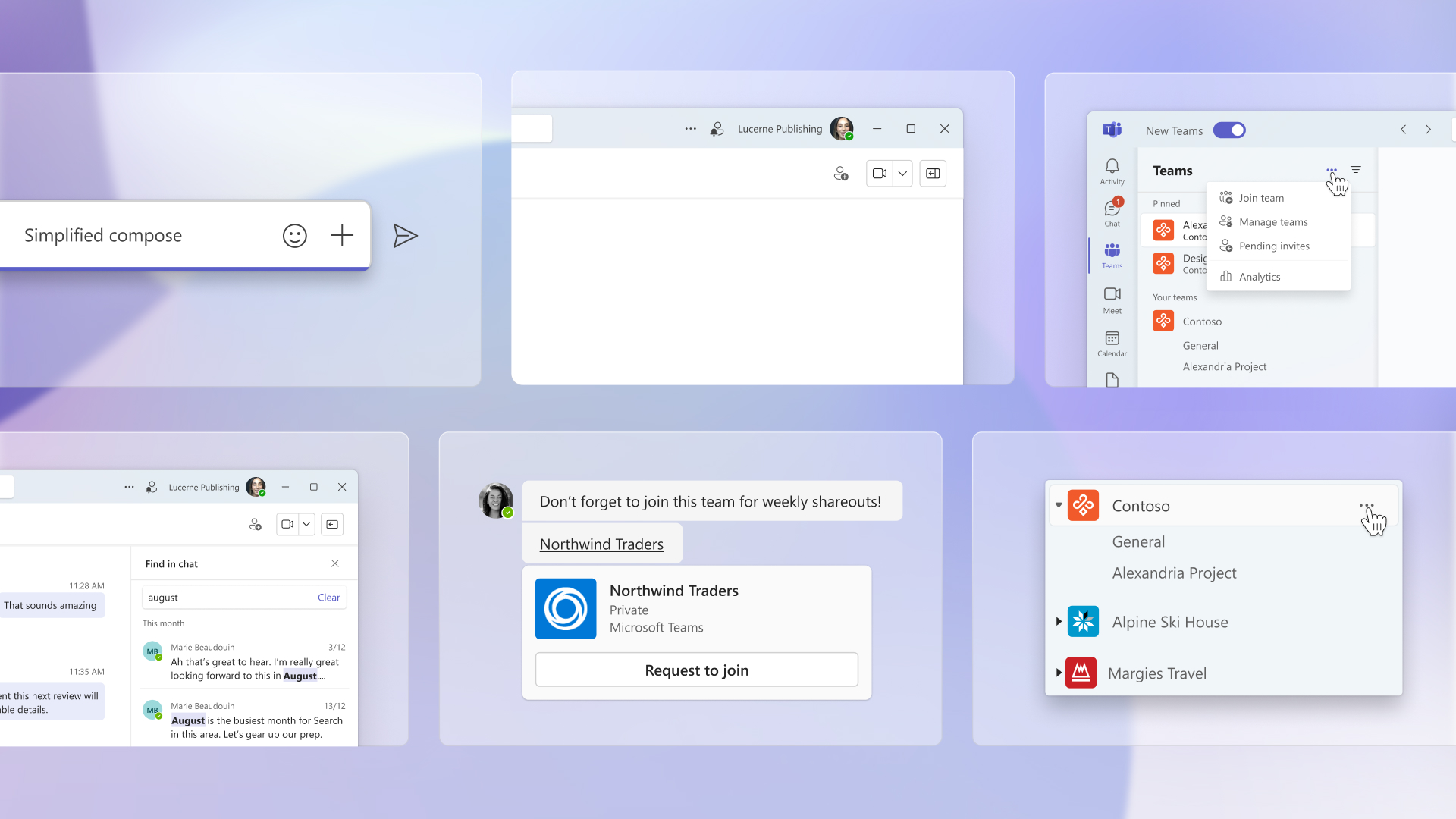
Simpler. We are always looking for ways to provide a simpler yet feature-rich experience for our diverse and growing user base. That’s why we are excited to roll out enhancements to the core Teams experience that will make it easier for you to stay on top of your notifications, search for information, manage your messages, and organize your channels—all with fewer clicks. For more information on the design journey of new Teams, take a look at this blog post from Microsoft Design.

Collage of usability improvements in new Microsoft Teams app.

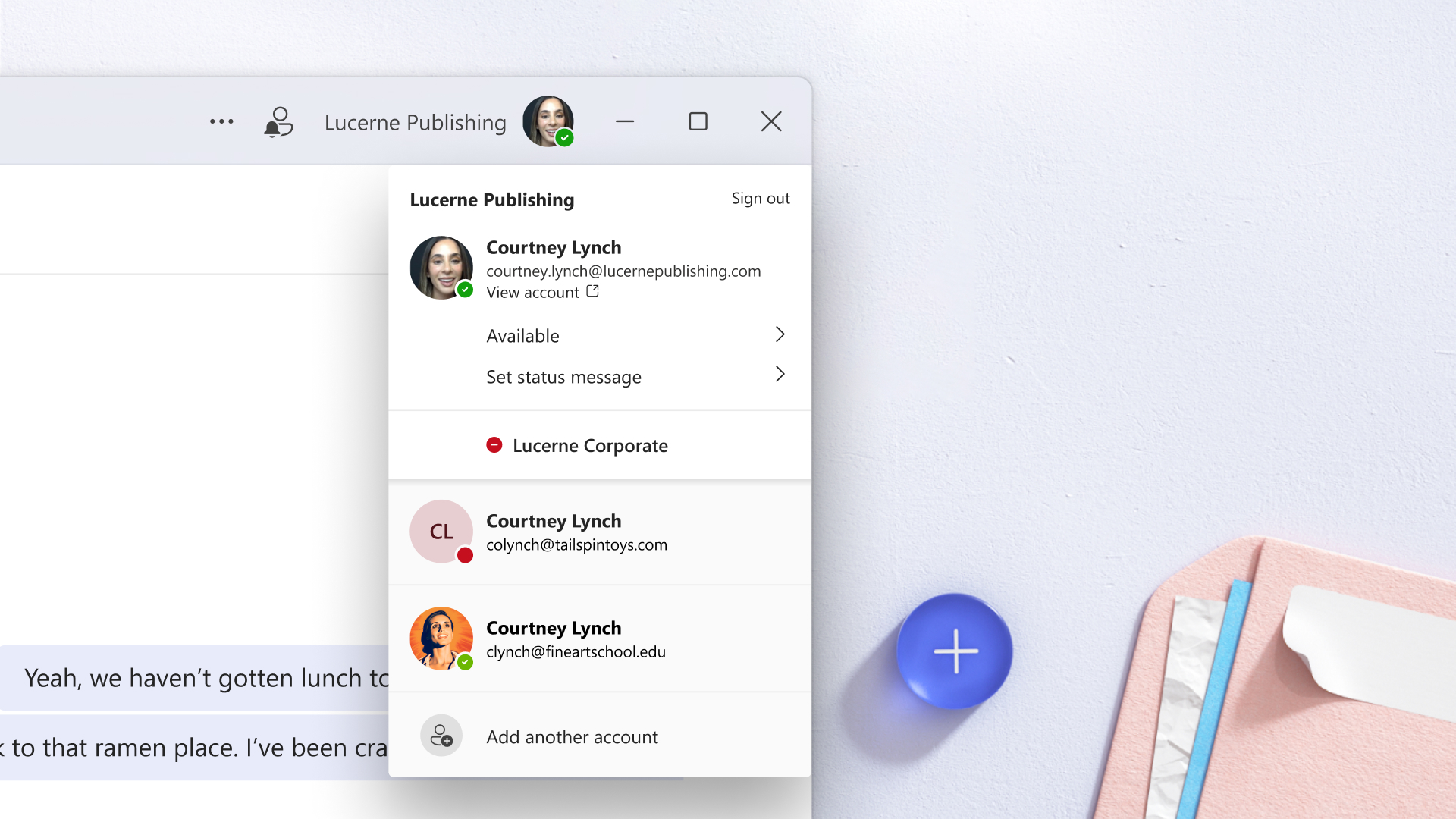
More flexible. We know that many of our customers have organizations that span multiple tenants and accounts. That’s why we have made a major investment in our support for these scenarios. We have improved our authentication model, synchronization, and notification systems to provide a seamless and consistent experience. For example, many customers need to collaborate with people across organizational boundaries, which sometimes means they use Teams across multiple tenants or accounts. Instead of logging in and out of different tenants and accounts, you can now stay signed in across them all—receiving notifications no matter which one you are currently using.

A drop-down panel within the new Microsoft Teams app showing multiple tenants and accounts.

Smarter. The new Teams will be the foundation for next-generation AI experiences, including those we’ve previously announced, such as intelligent recap and Copilot for Microsoft Teams. We will use AI to take the work out of working together by getting you up to speed on what happened before you joined a meeting or chat and answering your questions all in the flow of the discussion. We’re only just beginning to see the potential of AI inside of Teams, and we will have lots more to share in the future.

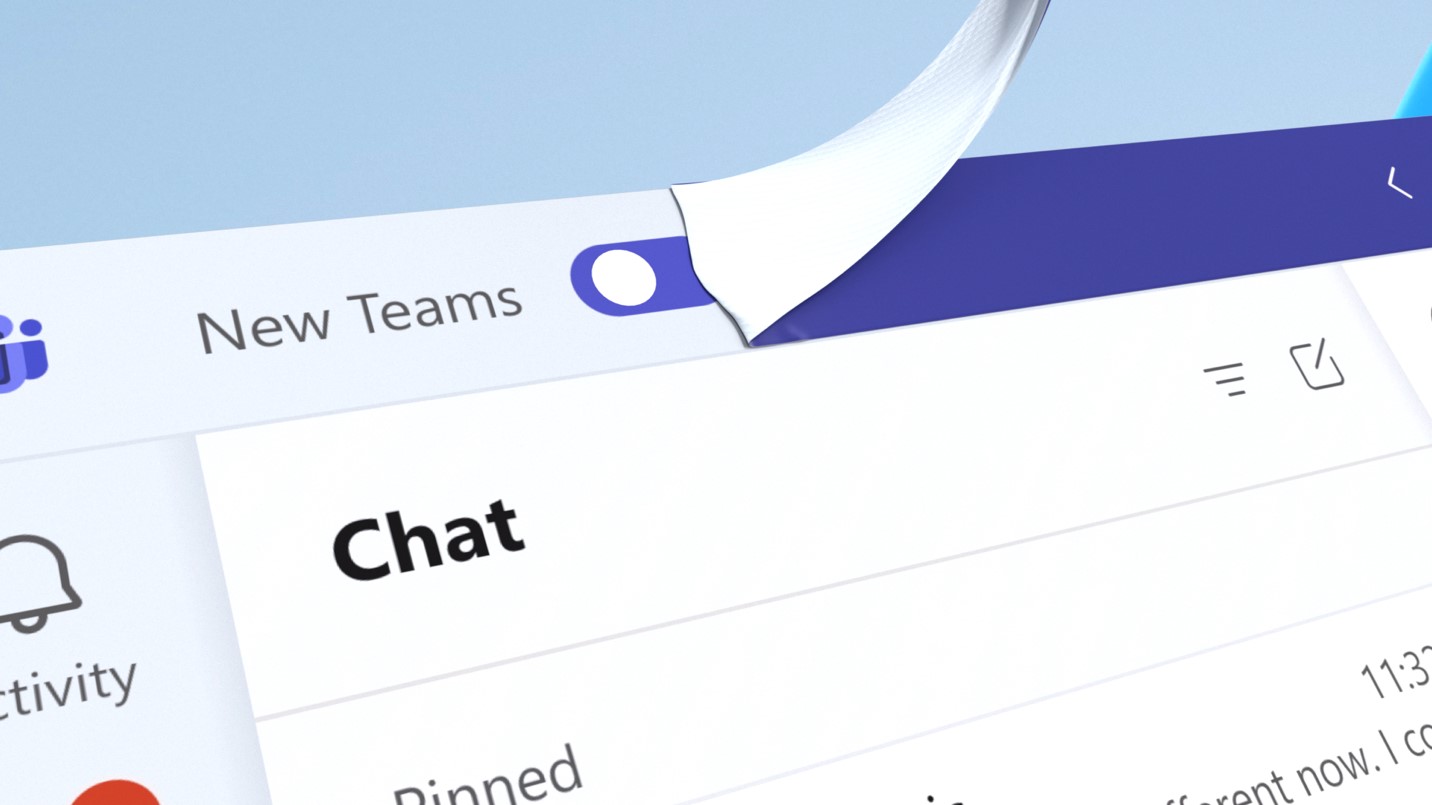
We are targeting the general availability of new Teams later this year in 2023. In the meantime, we encourage our commercial customers using Windows to try the public preview, which is rolling out starting today. We intend to extend the preview release to a broader set of customers, including those using Macs later this year. While users in our Public Preview program will have access to new Teams right away, our broader set of commercial customers will need an admin to first opt-in, after which users will see a simple toggle to switch to the new Teams. You’ll also be able to switch back to classic Teams at any time.

The Teams app showing the new Teams toggle switch and the Classic Teams user experience being peeled away.

Get started today

Today marks the new era of Microsoft Teams, and we are just getting started. As the world continues to evolve, Teams is here to be your modern workplace. For a sneak peek of all the new experiences we are building on new Teams, watch the video below.

While new Teams is a big leap forward in the Teams journey, it’s not the only thing we are announcing today. For a deep dive into the 50-plus additional new features coming to Teams, be sure to check out this Tech Community blog post which summarizes all the announcements we are making this week at Enterprise Connect.

Thank you for using Teams—we are thrilled to introduce the faster, simpler, and more flexible app starting today. I would encourage you to try it out and share your thoughts with us. We look forward to hearing from you and helping you get the most out of Teams.

If you’re an admin, learn how to enable the new Teams today.


1Introducing Microsoft 365 Copilot—A whole new way to work, Colette Stallbaumer, Microsoft 365 Blog. March 16, 2023.

Posted on Leave a comment

GitHub Copilot is the first at-scale AI developer tool, and today we’re going further—bringing the power of Copilot past the editor into every aspect of the developer experience.

In recent months, the rise of generative AI models has triggered widespread recognition that the age of AI has begun. But until now, generative AI has largely benefited the individual. That’s changing today, as we widely release GitHub Copilot for Business to every team, organization and enterprise. 🤖 Already, Copilot is helping developers write code 55% faster, with developers reporting feeling 75% more fulfilled (aka happier!). Imagine the benefits of putting GitHub Copilot in the hands of 100-, 1,000-, or even 10,000-person development teams. For an organization, developers fixing bugs faster means your product and supply chain is more secure. Developers manually writing less boilerplate over and over again means your teams are more productive and focused. Developers being able to learn and onboard new technologies means they can deliver better solutions for your customers. Ultimately, Copilot for Business gives developers the ability to build for tomorrow instead of spending all their time bogged down with the problems of today. Empowering developers with the power of AI is how every organization can win the future. There is so much more to come from us on this front soon. 🚀 Read more in the official blog below. https://lnkd.in/eyKwKJkh

Posted on Leave a comment

The Nasdaq Entrepreneurial Center and Microsoft announce collaboration

Support from Microsoft’s Entrepreneurship for Positive Impact program will expand the Nasdaq Entrepreneurial Center’s educational sustainability programming for entrepreneurs

March 21, 2023, San Francisco, CA – The Nasdaq Entrepreneurial Center, a non-profit committed to growing inclusion and access for entrepreneurs worldwide, today announced a new collaboration with Microsoft Entrepreneurship for Positive Impact, which supports entrepreneurs working to solve our world’s most pressing challenges by providing access to technology, expertise, visibility and connections. Together they will expand educational programming and resources available to the Center’s global community.

This work will support a range of the Center’s bootcamps, classes, and mentorship-focused programming, including its signature Milestone Makers program, a free 12-week incubator-style program launched in 2016 to provide a cohort of early- to mid-stage entrepreneurs with individualized tracks of business mentoring, coaching, training, and resources.

Synergistically, Microsoft’s Entrepreneurship for Positive Impact and the Center’s Milestone Makers program each already focus on supporting entrepreneurs working towards the United Nations’ 17 Sustainable Development Goals (SDGs) for urgent collective action.

“Supporting underrepresented entrepreneurs has a multiplier effect on all communities, and doubly so when you’re supporting underrepresented entrepreneurs who are championing Sustainable Development Goals,” said Nicola Corzine, Executive Director of the Nasdaq Entrepreneurial Center. “We applaud Microsoft for leveraging their platform to drive purpose-driven social enterprises and for their collaboration with us.”

Jean-Philippe Courtois, Executive Vice President and President, National Transformation Partnerships at Microsoft, stated, “Through Entrepreneurship for Positive Impact, we are working to make Microsoft the most trusted technology partner for Positive Impact Entrepreneurs, helping entrepreneurs scale and accelerate their social impact. We know that when the world does well, we do well. By using our platform, ecosystem and scale, we aim to unleash social tech innovation with our customers, partners and beyond. Positive Impact Entrepreneurs have so much to bring to the table for businesses. This work with the Nasdaq Entrepreneurial Center opens a whole new community of Positive Impact Entrepreneurs for us to support and help drive digital transformation for the common good.”

About the Nasdaq Entrepreneurial Center:

The Nasdaq Entrepreneurial Center is a non-profit committed to growing inclusion and access for entrepreneurs worldwide. The Center meets the real time needs of entrepreneurs through educational programming and then shares its learnings with policy-leaders, capital allocators and academic institutions. For more information please visit: http://thecenter.nasdaq.org/

About Microsoft Entrepreneurship for Positive Impact:

Microsoft Entrepreneurship for Positive Impact helps entrepreneurs to scale their businesses and accelerate their impact. Recognizing that digitalization is key to scale, Microsoft acts as a trusted technology partner for positive impact entrepreneurs. The Entrepreneurship for Positive Impact program provides access to dedicated mentors, community activities, and workshops as well as a Founders Hub with personalized technical tools and business resources for positive impact startups. Leveraging our network of local partners around the world, we have created a global ecosystem that drives digital transformation for the benefit of all, including our customers. https://www.microsoft.com/socialentrepreneurship

About Microsoft:

Microsoft (Nasdaq “MSFT” @microsoft) enables digital transformation for the era of an intelligent cloud and an intelligent edge. Its mission is to empower every person and every organization on the planet to achieve more.

For more information, press only: 

Microsoft Media Relations, WE Communications for Microsoft, (425) 638-7777, [email protected]

Posted on Leave a comment

With Microsoft 365 Copilot, we’re giving people more agency and making technology more accessible with advanced AI and the most universal interface: natural language.

In recent months, the rise of generative AI models has triggered widespread recognition that the age of AI has begun. But until now, generative AI has largely benefited the individual. That’s changing today, as we widely release GitHub Copilot for Business to every team, organization and enterprise. 🤖 Already, Copilot is helping developers write code 55% faster, with developers reporting feeling 75% more fulfilled (aka happier!). Imagine the benefits of putting GitHub Copilot in the hands of 100-, 1,000-, or even 10,000-person development teams. For an organization, developers fixing bugs faster means your product and supply chain is more secure. Developers manually writing less boilerplate over and over again means your teams are more productive and focused. Developers being able to learn and onboard new technologies means they can deliver better solutions for your customers. Ultimately, Copilot for Business gives developers the ability to build for tomorrow instead of spending all their time bogged down with the problems of today. Empowering developers with the power of AI is how every organization can win the future. There is so much more to come from us on this front soon. 🚀 Read more in the official blog below. https://lnkd.in/eyKwKJkh

Posted on Leave a comment

Microsoft announces partnership with cloud gaming provider Boosteroid to bring more games to more players around the world

Through a new 10-year agreement to support Boosteroid’s leading Ukrainian software development team, Microsoft will bring Xbox PC games, as well as Activision Blizzard titles including “Call of Duty,” to the largest independent cloud gaming provider in the world

KYIV, Ukraine, and REDMOND, Wash. — March 14, 2023 — Microsoft Corp. and Boosteroid on Tuesday announced a 10-year agreement to bring Xbox PC games to Boosteroid’s cloud gaming platform. Boosteroid, which has its software development team in Ukraine, recently surpassed 4 million users globally and has become the largest independent cloud gaming provider in the world. The agreement will also enable Activision Blizzard PC titles to be streamed by Boosteroid customers after Microsoft’s acquisition of Activision Blizzard closes.

When combined with other partnerships recently announced by Microsoft, this means popular franchises such as “Call of Duty” will surpass more than 150 million additional players, and make games built by Xbox Game Studios, Bethesda and Activision Blizzard playable on multiple cloud gaming services and subscriptions.

“We believe in the power of games to bring people together. That’s why Xbox is committed to give everyone more ways to play their favorite games, across devices,” said Phil Spencer, CEO of Gaming, Microsoft. “Bringing Xbox PC games to Boosteroid members, including Activision Blizzard titles such as ‘Call of Duty’ once the deal closes, is yet another step in realizing that vision.”

“Boosteroid shares Microsoft’s vision of bringing games to as many people, places and platforms as possible. It has long been our goal to provide gamers with an opportunity to enjoy their favorite titles on any device close at hand,” said Ivan Shvaichenko, Boosteroid CEO. “Today’s announcement is yet another step in this direction. Also, with our development team based in Ukraine, we appreciate Microsoft’s ongoing commitment to Ukraine, and we will be working together on an initiative supporting our local game development community to invest further in the economic recovery of the country.”

Boosteroid has operated since 2017 and has its research and development operations in Ukraine, based mostly in Kyiv and Kharkiv. Despite having two offices in Kharkiv damaged by Russian missile attacks, the company has continued to innovate and grow during the past 13 months of war. Since the beginning of 2023 alone, it has announced new steps to bring added cloud-based gaming services to the Mac, Chromebooks, Android set-top boxes and LG TVs. It offers cloud game streaming through both browser-based and dedicated applications, including for Windows, Linux, Android, Android TV and the macOS.

“Microsoft partnering with Boosteroid is welcome news and further evidence of the company’s ongoing support for Ukraine,” said Mykhailo Fedorov, Ukraine’s Vice Prime Minister and Minister of Digital Transformation. “Boosteroid’s Ukrainian dev team has built a world-class streaming platform under the most challenging circumstances and demonstrates the ingenuity and creativity of our citizens and local game developers.”

In addition to Ukraine itself, Boosteroid now serves gamers in the United States, United Kingdom and countries across the European Union. It operates through data center operations located in six U.S. states, including Microsoft’s home state of Washington, as well as in the U.K., France, Italy, Spain, Sweden, Slovakia, Romania, Ukraine and Serbia.

The gaming community is a vibrant part of Ukraine’s software ecosystem. Microsoft recently added support for the Ukrainian language for the Xbox console dashboard, PC and mobile apps. In spring 2023, Microsoft will launch PC Game Pass in Ukraine.

“This partnership builds on the $430 million in technology and financial assistance we have provided Ukraine since Russia’s unlawful invasion, and it exemplifies the steps we will continue to take to support Ukraine’s 160,000 software developers,” said Brad Smith, Microsoft Vice Chair and President. “It also adds to our recent agreements with Nintendo and NVIDIA, making even more clear to regulators that our acquisition of Activision Blizzard will make ‘Call of Duty’ available on far more devices than before.”

About Boosteroid

Boosteroid is the largest global independent cloud gaming provider which enables one-click access to PC video games across devices and platforms. With Boosteroid users run games they own on almost any PC, laptop, smartphone or smart TV. Boosteroid provides a high-end remote gaming desktop where games are actually rendered and then streamed back to the user device over the Internet. For this, Boosteroid utilises custom hardware designed together with leading technology companies like ASUS and Intel. The GPU-infrastructure that Boosteroid owns is located across Europe in 12 data centers of the UK, France, Spain, Italy, Romania, Serbia, Sweden, Slovakia and Ukraine; and across the USA in 6 data centers of different states. Such a wide servers’ net allows Boosteroid to deliver low-latency cloud gaming to millions of users globally.

About Microsoft

Microsoft (Nasdaq “MSFT” @microsoft) enables digital transformation for the era of an intelligent cloud and an intelligent edge. Its mission is to empower every person and every organization on the planet to achieve more.

For more information, press only:

Microsoft Media Relations, WE Communications for Microsoft, +1 (425) 638-7777, [email protected]

Note to editors: For more information, news and perspectives from Microsoft, please visit the Microsoft News Center at http://news.microsoft.com. Web links, telephone numbers and titles were correct at time of publication but may have changed. For additional assistance, journalists and analysts may contact Microsoft’s Rapid Response Team or other appropriate contacts listed at https://news.microsoft.com/microsoft-public-relations-contacts.

Posted on Leave a comment

Happy International Women’s Day. Around the world, women past and present have made—and continue to make—critical contributions to drive technology, innovation, and our society forward.

In recent months, the rise of generative AI models has triggered widespread recognition that the age of AI has begun. But until now, generative AI has largely benefited the individual. That’s changing today, as we widely release GitHub Copilot for Business to every team, organization and enterprise. 🤖 Already, Copilot is helping developers write code 55% faster, with developers reporting feeling 75% more fulfilled (aka happier!). Imagine the benefits of putting GitHub Copilot in the hands of 100-, 1,000-, or even 10,000-person development teams. For an organization, developers fixing bugs faster means your product and supply chain is more secure. Developers manually writing less boilerplate over and over again means your teams are more productive and focused. Developers being able to learn and onboard new technologies means they can deliver better solutions for your customers. Ultimately, Copilot for Business gives developers the ability to build for tomorrow instead of spending all their time bogged down with the problems of today. Empowering developers with the power of AI is how every organization can win the future. There is so much more to come from us on this front soon. 🚀 Read more in the official blog below. https://lnkd.in/eyKwKJkh

Posted on Leave a comment

With Dynamics 365 Copilot—the world’s first AI Copilot for both CRM and ERP—we are transforming every business process and function with interactive, AI-powered collaboration

LinkedIn and 3rd parties use essential and non-essential cookies to provide, secure, analyze and improve our Services, and to show you relevant ads (including professional and job ads) on and off LinkedIn. Learn more in our Cookie Policy.

Select Accept to consent or Reject to decline non-essential cookies for this use. You can update your choices at any time in your settings.