[www.indiegala.com] SAVE OVER $100 on a collection of five mentally tantalizing ero-games. Stay healthy!
A NEW very positive FREEbie
[freebies.indiegala.com] Hand-Drawn Art, Original Story & Soundtrack, Unique Kung-Fu Gameplay, Narrative Choices, Exquisite Voiceover and more! Check out all the ongoing freebies here.[freebies.indiegala.com] https://youtu.be/XfqkmKKULGo
Quixel Bridge 2020 was recently released, the first major release since being acquired by Epic Games late last year. Quixel Bridge acts as a… well bridge, in between your 3D and texturing content and your games engines and tools of choice, with plugins for most applications including Blender, Max, Maya, Unreal Engine and even Unity. With the release of Quixel Bridge 2020, it is now completely free for everybody. Even if you don’t use Megascans, Quixel Bridge can be an excellent tool for organizing and managing your graphics content, especially now that a subscription is no longer required.
We’ve improved the 3D viewer to give you more accurate real-time PBR shaders, plus inertial rotation and zooming.
Additionally, we’ve also updated the Maya, Blender, and Cinema 4D integrations with new improvements and bug fixes. We have also finally introduced support for the Alembic file format, and you can start downloading and exporting .ABC files right away.
But most importantly, Bridge is now completely free for everyone, forever. A paid subscription is no longer needed simply to access, download or export your content at any time.
Free unlimited Megascans for use in Unreal
And finally, the entire Megascans library is now completely free for use within Unreal Engine. Just log in with your UE account and you are all set!
We’re beyond excited to offer the entire Megascans library, Bridge and Mixer completely free of charge. And, in combination with Unreal Engine, creating any world imaginable has never been more exciting!
Check out the video below to learn more about Quixel Bridge, including how to install and use Bridge with Blender and Unreal Engine 4.24.
Posted by: xSicKxBot - 03-06-2020, 09:12 AM - Forum: Windows
- No Replies
Microsoft Airband: An annual update on connecting rural America
Last year, a team of Amish-owned horses draggeda load up a ridgenear Essex, New York. It was anormal scenefor rural America – straight out of a Norman Rockwell painting – except that they were bearing telecommunications equipment to connect the local community to the internet.
Essexis barely 12miles across the lake from Burlington, Vermont, but broadband is scarce.In our increasingly digital and interconnected world, broadband is as important as electricity or water. Rural communities without broadband face higher unemployment rates and see fewer educational and economic opportunities.For the woman overseeing the horses, Beth Schiller, CEO of CvWireless LLC,this is a solvable problem. Together with Microsoft’s Airband Initiative, she’s bringing connectivity to her community.
In the summer of 2017, we launched the Microsoft Airband Initiative, which brings broadband connectivity to people living in underserved rural areas. To eliminate the rural broadband gap, we bring together private–sector capital investment in new technologies and rural broadband deployments with public–sector financial and regulatory support. We set an ambitious goal: to provide access to broadband to three million people in unserved rural areas of the United Statesby July 4, 2022. At two and a half years since launch, we are at the halfway point of the time we gave ourselves to meet this goal andwe feel good about the steady progress we’ve made and how much we have learned.But one thing we have learned is that the problem is even bigger than we imagined.
The broadband gap is wide but solvable
Beth’s horse-borne approach to connectivity may be unique, but the problem is not: According to the Federal Communications Commission’s (FCC)2019 broadband report, more than 21 million people in America, nearly 17 million of whomlive in rural communities, don’t have access to broadband.
A recent study by BroadbandNow found that the number of unserved people is nearly double the current reported amount and more than 42 million Americans do not have access to broadband–especially in rural areas.Ourown data shows that some 157.3 million people in the U.S. do not use the internet at broadband speeds. And while we are making progress and the reported number is down by six million people from last year,that’s still more than the populations of our eight biggest states – California, Texas, Florida, New York, Pennsylvania, Illinois, Ohio and Georgia – combined.More must be done.
As we’ve said from the start of the initiative, without accurate data we cannot fully understand the broadband gap. You cannot solve a problem youdon’t understand.More accurate data will help deploy broadband in the places its needed. Because the government makes many funding decisions based on federal data, communities that lack broadband – but,according to FCC data,have access to broadband – have less access to resources needed to actually secure broadband connectivity. This iscertainly a Catch-22, but it can be solved. We’re encouragedthat the FCC has adopted new policies that should result in broadband providers reporting more accurate data and that Congress has worked on legislation to improve the FCC’s broadband data. It’s imperative that these policy changesare quickly and fully implemented so that people without broadband will get access to it.
Steady progress to close the broadband gap
But the country can’t wait on perfect data. We’re moving full steam ahead in the areas where we know we can help and making steady progress against our 3-million-person goal. We’re now in 25 states and one territory, and staging pilot programs in two additional states. We’ve already reached a total of 633,000 previously unserved people, up from 24,000 people in 2018, and as our partners’ network deployments accelerate over the coming months, we will be reaching many more.
We haven’t made this progress alone. We have made it through building partnerships throughout the United States, learning more about local solutions that will close the broadband gap. Partners such as Wisper Internet will work to bring broadband access to almost 1 million people in rural unserved areas in Arkansas, Illinois, Indiana, Kansas, Missouri and Oklahoma. In Kentucky, Illinois, Indiana and Ohio, our partner Watch Communications will bring high-speed internet access to more than 860,000 people living in unserved rural areas. Our partnerships also bring connectivity to historically underserved communities, including those residing on tribal lands. Sacred Wind Communications will help approximately 47,000 people on and off Navajo lands in New Mexico reap the benefits that come with access to the internet. Moreover, we have forged strategic partnerships with American Tower Corporation, Tilson, and Zayo Group over the last year that will further bring down the end-to-end network deployment costs for rural ISPs. We have also established a broad-based Airband ISP Program that provides ISPs in 47 states plus Washington D.C. and Puerto Rico with access to critical assets, helping them connect rural communities.
There’s good news about the cost of connectivity. The price of TV white spaces devices (TVWS) – a new connectivity technology that’s particularly useful in rural areas where laying cable simply isn’t an option – continues to drop. In the last year, the cost of customer equipment has plummeted by 50%, all while achievable speeds have increased tenfold.
At the same time, we’re pleased to see our partners in government make important, steady progress to enable these new technologies. We applaud Chairman Pai and the FCC for their vote last week to propose positive and necessary changes to TVWS regulations. Reducing red tape will enable ISPs to accelerate their progress in rural broadband deployment and help bridge the digital divide in rural America. We are also pleased that the FCC has announced plans to make up to $20 billion available in Rural Digital Opportunity funding to help ISPs bring high-speed broadband access to high-cost unserved rural areas. At the state level, we’re pleased that several state governments have created their own funding programs to support new broadband infrastructure, including Illinois, Indiana, Virginia and South Dakota.
What comes after connectivity?
As we’ve connected communities across the country, we’ve kept asking ourselves a central, key question: What comes after connectivity?
Broadband connections aren’t a panacea for all that ails rural America. Simply plugging in an ethernet cable doesn’t create jobs, increase farmers’ yields or provide a veteran with healthcare. Rural communities need resources beyond infrastructure to rebuild and lift themselves up. That’s why much of our work goes well beyond connectivity.
From education, agriculture, veterans to healthcare, we are working with local and national organizations to take the next step. For example, we are partnering with the U.S. Department of Veterans Affairs (VA) to support their telehealth initiative. We are working with Airband partners to offer discounted broadband service to veterans as well as provide vital digital skills and employability training. Our work on Airband is enabling other Microsoft efforts – such as our TechSpark program, digital skills initiatives and even environmental sustainability – to flourish in areas we’d never be able to reach otherwise.
Take for example, agriculture. The family farm is the embodiment of rural America. Unfortunately, many American farmers have struggled in recent years, whether because of policy, extreme weather events and climate change, or falling crop prices. Farmers need help, and many have turned to new technologies to compete in the global marketplace. Our FarmBeats platform is one such technology that can give farmers a real-time view of their land using ground-based sensors and “internet of things” technology to track everything from soil temperature to pH levels to moisture data. This can create a modern “Farmers’ Almanac” to chart out the farm’s future, helping farmers predict what they should plant and where, increase yields, better utilize fertilizer and irrigate more efficiently. But a farm that lacks access to high-speed internet will be left in the past, unable to use these new technologies. That’s where Airband comes in: connecting rural communities to transformative technologies.
The effort to electrify rural America in the 1930s enabled new technologies to transform those areas, empowering farms, ranches and other rural places and improving quality of life and economic opportunity. Now, nearly 90 years later, broadband can similarly provide the infrastructure to lift up rural America, but we’re losing the race against time. While our investments and those of our partners are taking seed and we are beginning to see advances, technological progress doesn’t wait. If we don’t move faster, rural America will be left further behind. We can’t let that happen.
Numskull Games Is Bringing Holy Potatoes! Compendium To Switch This May
Numskull Games has announced that it is publishing Holy Potatoes! Compendium on the Nintendo Switch this May.
A collection of three titles originally released in digital form only, Holy Potatoes! Compendium is yet another physical release to add to your groaning shelves, and is made up of the following titles:
Holy Potatoes! What the Hell?! is a wacky, hell-themed cooking management sim where you take on the role of a chef in an afterlife populated by potatoes (naturally). Sort the potato sinners into cooking stations to extract sinfully delicious ingredients, cook up incredible potato-based recipes, and appease the gods in your Pantheon by serving them savoury spud dishes!
Holy Potatoes! We’re in Space?! is a bonkers space exploration game where you manage your very own spaceship, craft hundreds of weapons and explore the vastness of a veggie-filled universe. Use a host of weird weapons to turn the tide of battle in the tactical, turn-based combat. Warning: veggie puns galore.
Holy Potatoes! A Weapon Shop?! is a crazy simulation game where you manage your very own weapon shop and expand its business across an incredible potato world. Use your potatosmiths to forge more than 200 different weapons, sell them to more than 10 potato heroes, and even adopt a potato dog! (Yes, you read correctly, A. POTATO. DOG.)
The game will be available in a Standard Edition and Collector’s Badge Edition. Will you be picking this one up?
Please note that some links on this page are affiliate links, which means if you click them and make a purchase we may receive a small percentage of the sale. Please read our FTC Disclosure for more information.
Niantic Brings Paid Special Research Story To March’s Pokémon GO Community Day
To say Pokémon GO has been a financial success for all parties involved would be something of an understatement. Since launching back in 2016 it’s done pretty well for itself, with 2019 being the game’s most successful year yet. In-game player spending pulled in nearly $900 million for makers Niantic last year, stimulated through various new updates and features coming throughout the year. It seems that the developer is keen to experiment further with new ways to monetise the hit game and its latest strategy is through a paid exclusive Special Research story tied into the game’s monthly Community Days.
According to Pokémon.com, the March Community Day event will introduce an extra exclusive Research story for the price of $1 (or the equivalent in your local coinage). Here’s the relevant passage in full:
This month, there’s also a new twist to the Community Day experience. A Community Day–exclusive Special Research story titled Investigating Illusions can be unlocked in your game for $1 USD (or the equivalent in your local currency). Complete it to earn 13,000 Stardust, a Poffin, a Rocket Radar, and other rewards. Stay tuned for when tickets go live!
The normal Community Days features (a featured Pokémon that appears in much greater numbers over a three-hour period and can be evolved to obtain an exclusive move) remain unchanged, so this is in addition to the usual three-hour lures and 3x Catch XP bonuses.
Niantic has been experimenting recently with other features such as weekly Spotlight Hours and Mystery Bonus Hours, but now it’s looking to tap into the hugely popular Community Day crowd. It remains to be seen whether this is a new monthly feature or a one-off experiment, but the company only needs a tiny percentage of the hordes we see roaming the streets and parks near where we live on a monthly basis to throw down a dollar to see a very tidy return indeed.
Will you be partaking of this exclusive Special Research story during the next Pokémon GO Community Day? Let us know your thoughts below.
Posted by: xSicKxBot - 03-06-2020, 09:12 AM - Forum: Lounge
- No Replies
3 Fantastic Games Will Be Free At Epic Next Week
The Epic Games Store hasn't slowed down in its offering of one or two free games each week, a practice that began in late 2018 and has continued into 2020. This year, Epic has upped that number on select weeks, giving away three free games for its users, and next week is bringing another trio of freebies. Plus, this week's free games, Offworld Trading Company and Gonner, are available now. To claim Epic's weekly free games, you just need a free Epic account, and they'll be yours to keep afterward.
Starting next Thursday, March 12, Epic users can claim Anodyne 2: Return to Dust, A Short Hike, and Mutazione. Anodyne 2 is a puzzle-exploration game set in a 3D dream-like world. You'll also encounter surreal 2D dungeons that you enter by shrinking inside characters' bodies, with the aim of saving the world from a dangerous Nano Dust.
A Short Hike is a short, wholesome game about climbing up a mountain while meeting other hikers, discovering hidden treasure, and enjoying the nature around you along the way. It's a calming game with a lovely soundtrack, and at its core is the central theme that kindness is rewarded. We wrote about both Anodyne 2 and A Short Hike as two of 2019's best indie games--check out our impressions for more details.
Create an account or log in an already existing one and permanently add the games on your account. Alternatively you can redeem them from the Epic Launcher on the games' giveaway page.
Posted by: xSicKxBot - 03-05-2020, 08:08 PM - Forum: Windows
- No Replies
Our commitment to customers during COVID-19
With COVID-19 continuing to impact people and countries around the world, teams everywhere are moving to remote work. Earlier this week, I posted a letter from Lily Zheng, our colleague in Shanghai, detailing her team’s experience using Microsoft Teams to work from home during the outbreak. Lily’s team is one of many. Here at Microsoft in the Puget Sound, we’re encouraging our teams to work from home as much as possible, as are many organizations in this region. And we expect this trend to continue across the world. At Microsoft, our top priority is the health and safety of employees, customers, partners, and communities. By making Teams available to as many people as possible, we aim to support public health and safety by keeping teams connected while they work apart.
As we have read through your responses to Lily’s letter, it has become clear that there are two big questions on your minds. First, how can people access the free Teams offerings that Lily referenced? Second, what is our plan for avoiding service interruptions during times of increased usage? Below, you’ll find detailed answers to both. And over the next few days we’ll be sharing more tips, updates, and information related to remote work here. So check back often.
Making Teams available for everyone
Teams is a part of Office 365. If your organization is licensed for Office 365, you already have it. But we want to make sure everyone has access to it during this time. Here are some simple ways to get Teams right away.
Individuals
If you want to get started with Teams, we can get you up and running right away.
If you have an email address through work or school, sign in using this link. We’ll get you into Teams in no time.
If you’re using an email address like Gmail or Outlook, you can sign up for the freemium version of Teams by following this link.
IT professionals
The self-service links above work great for individuals, but if you’re an IT professional who wants to roll out Teams centrally, here’s what to do.
If you work for a business that isn’t currently licensed for Teams, we’ve got you covered with a free Office 365 E1 offer for six months. Contact your Microsoft partner or sales representative to get started today. (Note: the same offer is available in the Government Cloud, but not available in GCC High and the Department of Defense.)
If you work in education and want to set up teachers, students, and administrators on Teams, use Office 365 A1. This free version of Office 365 is available to all educational institutions. Sign up by following this link.
Keeping Teams up and running
You and your team depend on our tools to stay connected and get work done. We take that responsibility seriously, and we have a plan in place to make sure services stay up and running during impactful events like this. Our business continuity plan anticipates three types of impacts to the core aspects of the service:
Systems: When there’s a sudden increase in usage, like the surge we recently saw in China.
Location: When there’s an unexpected event that is location-specific, such as an earthquake or a powerful storm.
People: When there’s an event that may impact the team maintaining the system, like the COVID-19 outbreak in the Puget Sound area.
We’ve recently tested service continuity during a usage spike in China. Since January 31, we’ve seen a 500 percent increase in Teams meetings, calling, and conferences there, and a 200 percent increase in Teams usage on mobile devices. Despite this usage increase, service has been fluid there throughout the outbreak. Our approach to delivering a highly available and resilient service centers on the following things.
Active/Active design: In Microsoft 365, we are driving towards having all services architected and operated in an active/active design which increases resiliency. This means that there are always multiple instances of a service running that can respond to user requests and that they are hosted in geographically dispersed datacenters. All user traffic comes in through the Microsoft Front Door service and is automatically routed to the optimally located instance of the service and around any service failures to prevent or reduce impact to our customers.
Reduce incident scope: We seek to avoid incidents in the first place, but when they do happen, we strive to limit the scope of all incidents by having multiple instances of each service partitioned off from each other. In addition, we’re continuously driving improvements in monitoring through automation, enabling faster incident detection and response.
Fault isolation: Just as the services are designed and operated in an active/active fashion and are partitioned off from each other to prevent a failure in one from affecting another, the code base of the service is developed using similar partitioning principles called fault isolation. Fault isolation measures are incremental protections made within the code base itself. These measures help prevent an issue in one area from cascading into other areas of operation. You can read more about how we do this, along with all the details of our service continuity plan, in this document.
Adjusting to remote work can be a challenge. We get it, and we are here to provide the tools, tips, and information you need to help you and your team meet that challenge. We’re inspired by the agility and ingenuity that impacted schools, hospitals, and businesses have shown throughout COVID-19, and we are committed to helping organizations everywhere stay connected and productive during this difficult time.
FAQs
Q. What happens when an individual signs in with work or school credentials? A. If the individual is licensed for Teams, they will be logged into the product. If the individual is not licensed for Teams, they will be logged into the product and automatically receive a free license of Teams that is valid through January 2021. This includes video meetings for up to 250 participants and Live Events for up to 10,000, recording and screen sharing, along with chat and collaboration. Details for IT.
Q. What does the freemium version of Teams include? A. This version gives you unlimited chat, built-in group and one-on-one audio or video calling, 10 GB of team file storage, and 2 GB of personal file storage per user. You also get real-time collaboration with the Office apps for web, including Word, Excel, PowerPoint, and OneNote. There is no end date. Details here.
Q. Is there a user limit in the freemium version? A. Beginning March 10, we are rolling out updates to the free version of Teams that will lift restrictions on user limits.
Q. Can I schedule meetings in the freemium version? A. In the future, we will make it possible for users to schedule meetings. In the meantime, you can conduct impromptu video meetings and calls.
Q. How can IT admins access Teams for Education? A. Teams has always been free to students and education professionals as a part of the Office 365 A1 offer. Access it here.
Q. Do you have any tips for working from home? A. Lola Jacobson, one of our senior technical writers, posted a few basic tips last week. And we updated the Support remote workers using Microsoft Teams page on docs.Microsoft.com yesterday. We have more content on the way, so stay tuned.
80’s Overdrive Is Speeding Onto Switch, If This Cheeky Tease Is To Be Believed
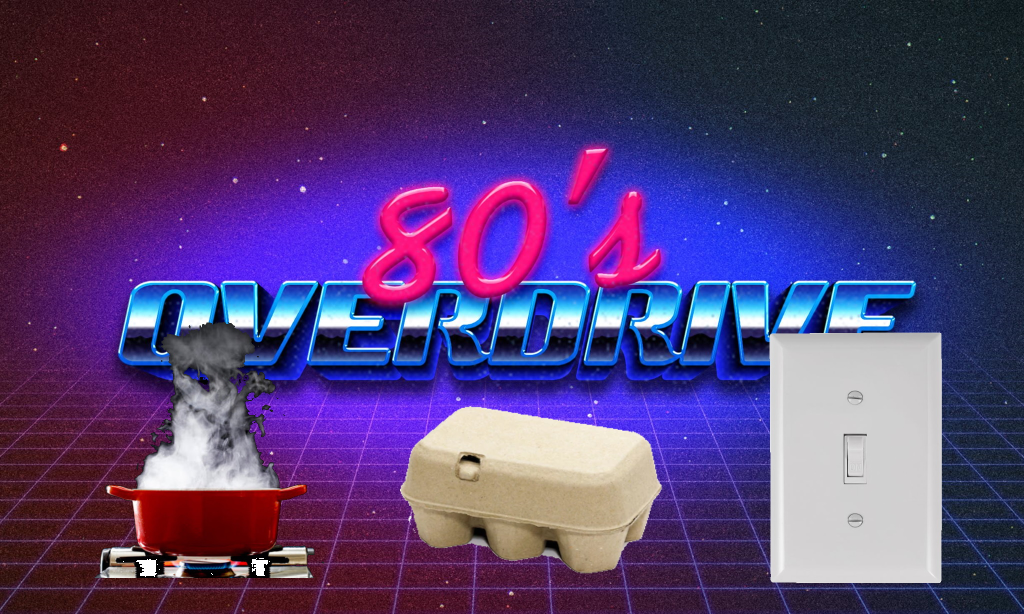
When we first started this site way back when, we never expected to find out about new games coming to Nintendo platforms via hastily-put-together images of everyday objects, yethere we are.
Insane Code, the development team behind arcade racer 80’s Overdrive (their strange contraction, not ours), appears to have revealed that the game is making its way to Switch. The image below was posted to the studio’s Facebook page, seemingly showing off a pot full of steam for Steam, a box of eggs for Xbox, and a light switch for Switch.
80’s Overdrive really nails the presentation side of things with its eye-catching 2D visuals, superb 3D effect and pumping soundtrack. It also controls well and the Career Mode is challenging enough to keep you glued to your 3DS for quite some time. The Out Run-style Time Attack mode and the Level Editor extend the lifespan of this title further, but the occasionally cheap difficulty level has an annoying habit of ruining your race as well as your mood.
Would you be happy to see this one appear on Switch? Let us know if you tried it out on 3DS with a comment below.