Steel Division 2 is a historically-accurate WW2 real-time strategy game set on the Eastern Front. Features 1:1-scale turn-based army management and real-time tactical battles with thousands of men at your order.
Making A Game Alone: The Mental And Emotional Costs
Game development is a risky endeavor. Between designing, programming, QA testing, and all the other steps involved, you can spend years working on the same project. There's no guarantee that what you'll make will be well-received when it's released and, even if it is, a lack of exposure could still spell financial loss. There's a lot of pressure to succeed, and failing to meet expectations might mean there's not enough money for a next time.
And yet, despite this pressure, there are some people out there who choose to shoulder this burden alone. There are over a dozen success stories of indie developers who forged ahead with little to no outside help, managing to achieve both wide-spread critical acclaim for their work and earn enough money to make a living. It's not a very common occurrence though, and asking those who've managed to do it reveals plenty of reasons as to why that could be the case. Developing a game can already be a fairly mentally and emotionally taxing process, and doing it solo without a support system can exacerbate the stress and feelings of self-doubt. Some appreciate this challenge, but others do not.
Jonathan Blow, Derek Yu, Lucas Pope, and Joakim Sandberg each has a history of going it solo in developing at least one indie game that caught traction and went on to be both a critical and financial success. Blow is commonly cited for inspiring the indie game boom that started in late 2008 with Braid, before going on to design the critically acclaimed 2016 puzzle game The Witness. Yu's initial open-source Spelunky is also a part of that pre-2010 indie boom, and Yu is now working on its sequel, Spelunky 2. Pope made a name for himself in 2013 with Papers, Please and then went on to wow the industry again with 2018's Return of the Obra Dinn. Sandberg delivered the well-received metroidvania-inspired Iconoclasts in 2018.
Each of the four, as it turns out, express similar experiences of the emotional and mental toll associated with developing a game solo. Pope and Yu had more positive things to say about the process, while both Blow and Sandberg expressed more instances of pressure and stress that accompanied the development of their respective breakout hits Braid and Iconoclasts.
"[You] get mowed under by the sheer amount of stuff there is to do to finish a game," Blow said when asked about the hardships he had to overcome to finish Braid. "And so, you have to believe that you will be able to finish eventually, which sometimes is hard to believe… If you start believing it's too much to ever do, and your motivation starts falling, then you get less done every day. And then [you believe] there might be too much to do because your rate of progress toward the goal is not so good. And when you see that, you might get upset about that or depressed about that, and then it gets worse… There just is something fundamentally, mentally hard about working on a game where you're the main person.
"[It's] actually easier in a bigger company," Blow continued. "Because I think you can rest a little bit and you can at least, even if not everybody else is working hard, you at least feel like other people are doing something and that you're allowed to relax a little bit and the whole thing won't collapse. Whereas, if it's your project and without you it won't go forward, then it's very easy to feel like it's just going to die at any minute and that you don't have the luxury of relaxing when you need to relax. And it's just a bad combination."
Blow's primary motivation for using Super Mario Bros. as inspiration for Braid is that Nintendo's game is simple and thus fairly easy to emulate. "3D games are a lot of work," he said. "I told myself, 'Look, I've done all these technical projects that were super ambitious, and I never finished them. So let's make a project that is technically as easy as we can make it, but put all the effort into the design because the design seems more finishable." Both Yu and Pope similarly went as simple as they could right from the start. "Yeah, I started small and I just kind of kept the scope to something that I could really do by myself," Yu said.
All four developers endorse some level of personal restriction at the outset of making a game. On the surface, this can look counterproductive, but it ensures the game is completed in a reasonable time frame--which, in the long run, can curb a lot of the pressure and self-imposed stress to finish. It's something Blow, Yu, and Pope learned through their experiences prior to their major breakout hits, as all three were members of game development teams before going it alone with Braid, Spelunky, and Papers, Please respectively. As a counterexample, Sandberg placed few restrictions upon himself when he started on Iconoclasts in 2010 (when he was in his early 20s) and the game continued to evolve and grow more complex for years, ultimately releasing when he was in his 30s and more appreciative of the wisdom found in self-imposed restrictions.
"You just have more people, and as a result, more people are struggling."
Despite the process allowing him to produce one of the more well-known indie gems of 2018, Sandberg hopes that no one ever emulates what he did. "People shouldn't follow in my footsteps," he said. "Working this hard solo and giving all their life, essentially, all their time to a project and ignoring everything else… Being that antisocial and not interacting with people enough depletes tetralin in your brain--it creates depression. If you do it for that long you're going to get depression, regardless if you have genes for it. You need to actually take weekends off, you need to not let friends disappear, you definitely need to be able to support yourself because you shouldn't go into debt making a game--which I luckily didn't."
"I kept telling myself, 'When the game is done, I can get a life again,'" Sandberg continued. "Instead I kind of collapsed afterward. Yeah, it was entirely my own fault for pushing myself that hard, but it's easy to fall into that trap. You keep saying, 'As soon as this is done, it's going to be great.' Then your body realizes that you worked a little too hard."
Sandberg also had to break into an indie game landscape that looks very different than how it was a decade prior. None of the four believe the industry is heading towards some indie game apocalypse that will see the market implode on itself, but they agree the space has been saturated with a lot more titles in recent years--making it far more difficult for individual indie creators to find their audience and thrive. It's a problem that wasn't as nearly as big back in 2008. "You just have more people, and as a result, more people are struggling," Yu said. "I could certainly see from the perspective of people who are trying to enter the space and struggling, it does feel like there's an indie-pocalypse and they've got to work extra hard to be seen, and I do feel some of that pressure myself. And even though I know I have a leg up just having some visibility and being in this industry for a while now, everything still feels a little tenuous, even for me."
To be noticed and garner some level of critical and financial success, your best bet is name recognition from a previous success. "For someone who's just starting out?" Blow said, "I don't know, because you know, the biggest problem is just getting attention for your game. How do I get players to care that we released this game? I have that problem less than a lot of people simply because I'm already established."
"But then again, if I had made a bunch of smaller games, maybe no one would've noticed them. I wouldn't have been able to financially support myself. You can never guess."
Without the name recognition, you need to find a well-known publisher, such as Trinket Studios' Battle Chef Brigade with publisher Adult Swim, or build something that creatively explores a theme in a way that hasn't been done much (or at all) before, like Matt Makes Games' Celeste. Regardless of which strategy you go for, both are far more achievable--and thus less stressful to aspire for--when working within a team. As Sandberg can attest, you can do it alone, but it will probably take you much longer and likely lead to hours of crunch. Not ideal if you want to maintain a healthy work-life balance.
Even Pope, who enjoyed his time working on both Papers, Please (which took him nine months) and Return of the Obra Dinn (which took him five years), admits that crunch is just a part of his process now as a solo developer. "I crunched for thousands of hours on Obra Dinn but it was all self-imposed and in the end, I'm happy with how the game turned out," he said. "I consider long grinds and moments of intense crunch a necessary part of my game development process."
Blow, Pope, Yu, and Sandberg don't hate game design. They wouldn't still be doing it if that was the case. But the pressure to make something that people are willing to spend money on (while maintaining the original vision they're proud of) can make the process more stressful than they like.
"Some days I sit and think, 'How many games could I have made instead of Iconoclasts,'" Sandberg said. "But then again, if I had made a bunch of smaller games, maybe no one would've noticed them. I wouldn't have been able to financially support myself. You can never guess." On this topic, Yu said, "I think if you're making a commercial product, it's a lot easier to work on a team to shoulder that burden a little bit… Once money becomes involved, it's not just that it changes your expectations, you know it's going to change everybody's expectations. Because people are going to have to spend money on it and you know that reviewers are going to take it more seriously. You're thinking about Metacritic. All kinds of stuff come into play that don't when you're working on freeware."
As it stands, in today's indie scene, it doesn't seem very probable you'll create an indie breakout hit when you're still operating solo.
Since their breakout hits, Blow and Yu have returned to working as part of a team, though they maintain control over the overall design of their games. "Having more people just really helps," Blow said. "The Witness is a way bigger and more complex game than Braid, and part of the reason that could happen is that we had other people building the engine and making the art. If it had been mostly me, it just would not have been possible to make a game that big." Yu is currently working with BlitWorks--the studio responsible for porting Spelunky to PSN--to develop Spelunky 2. Blow and Yu's transition back to working with others is becoming a more widespread standard in recent years, as more indie developers see that a team can stave off some of the stressors that are predominantly associated with indie game development. When Eric Barone decided to put his newest project on hold to work on more updates for Stardew Valley, for example, he wrote in a blog post that he would be hiring help to "take some of the workload off," and Undertale's Toby Fox has explicitly stated he will only make the follow-up chapters to Deltarune: Chapter 1 once he's put a team together because continuing to make the game on his own is "actually impossible."
This makes Pope and Sandberg, who have continued to operate solo after their breakout hits, part of a dwindling breed. Though Pope has found success with his follow-up to Papers, Please--Return of the Obra Dinn was met with widespread success and is one of our top 10 games of 2018--he still had to scale back in terms of visuals and number of gameplay mechanics. Though, he admits he does "personally enjoy" the challenge of scaling back a game's scope far enough so that he can make it himself. Sandberg has adopted a similar approach for his next game, making a plan for something that's manageable as opposed to trying to design something that's as big as he can make it. "I don't hate the idea of [making a game] alone, but I have to start properly," Sandberg said. "I'm going to prototype [my new game] and see what happens. It's going to be an action game and smaller [than Iconoclasts], something that I can do alone and add onto later if need be. Which means, no story. The story is what makes a game huge."
As it stands, in today's indie scene, it doesn't seem very probable you'll create an indie breakout hit when you're still operating solo. Trying to do so certainly seems emotionally and mentally unhealthy as well, as there's a good amount of crunch you have to deal with on your own. Which isn't to say it's an impossible task, but if you're planning on following in the mainstream successes of popular indie games such as Dead Cells, Outlast, Into the Breach, Hollow Knight, Doki Doki Literature Club, and Gone Home, then recruiting a well-structured team (or at least finding a good partner) seems to be a far more practical course of action.
Super Mario Battle Royale Game Receives Takedown Notice From Nintendo
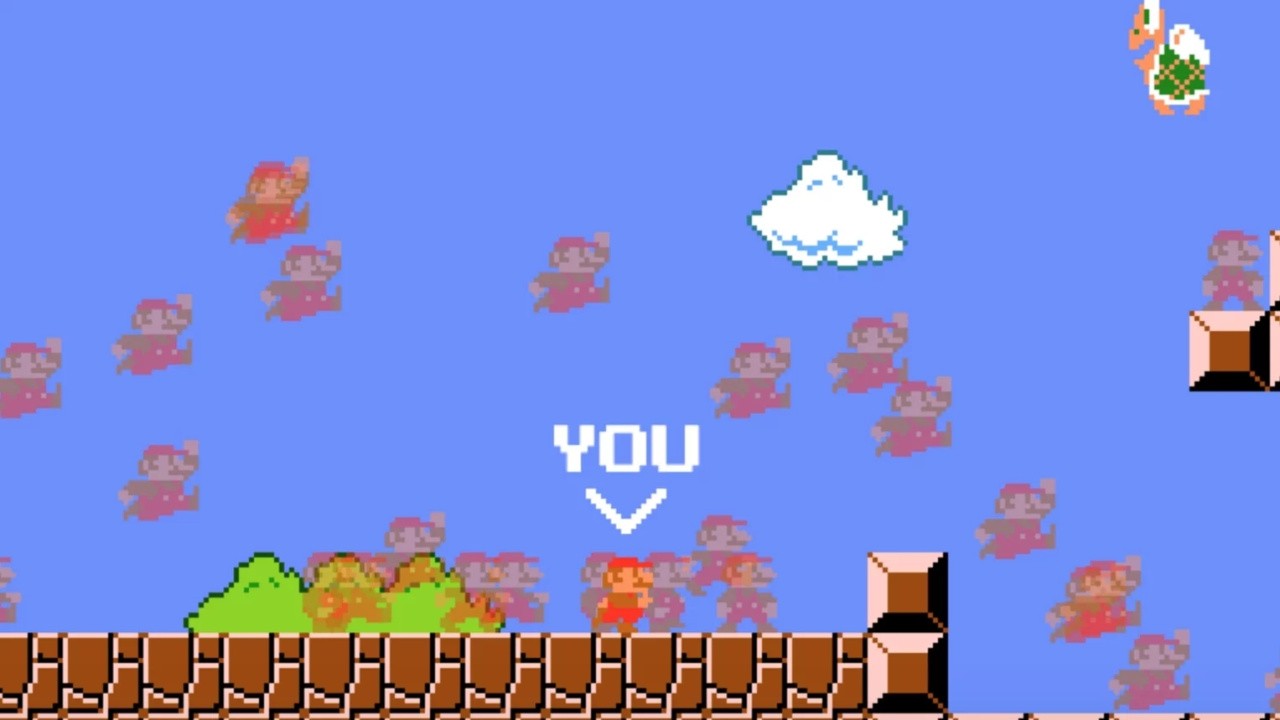
Earlier this week, we found out about a free-to-play fan-made ‘Mario Royale’ online game, allowing roughly 75 players to jump into a single level at the same time and race to the flagpole.
Obviously, we’ve seen Nintendo take swift action against projects that ‘borrow’ assets and code in the past, and sure enough, the creator of this Mario-themed battle royale creation has now received a takedown message from the video game giant.
In response to this, Mario has been swapped out for a custom-made avatar and some slight adjustments have been made to the existing enemies, power-ups, backgrounds and environmental objects on display. The trademark Mario Bros. sound effects are also reportedly gone and the game is now appropriately-named DMCA Royale.
According to Gaming Reinvented, the game still looks a little too similar to the source material and unsurprisingly has the same “level design and basic mechanics” as it. For more information about this fan-made battle royale, read our existing article.
Are you at all surprised to hear Nintendo has taken action against this Super Mario Battle Royale? Did you play this when it was still a Mario-themed game? Tell us below.
Once thought lost to the mists of time, fearsome Dragons now soar the skies of Elsweyr, leaving scorched ruin in their wake. In The Elder Scrolls Online: Elsweyr, you must discover the dark purpose behind their rampage in a new epic story and prevent the destruction of the Khajiiti homeland. Take heart, for these scaled monstrosities are not invincible, and with the right planning, tactics, and tools they can be brought to the ground and even killed. Coordination and skill are key to overcoming the Dragons, but if you succeed, you'll reap rewards not found anywhere else in Nirn. Beware the skies, walker.
You are Miriam, an orphan scarred by an alchemist curse which slowly crystallizes your skin. You must battle your way through a demon-filled castle summoned by Gebel, your old friend whose body has become more crystal than flesh.
* Exploration: Bloodstained's story unfolds as you explore Gebel's hellish castle; a sprawling structure that features a variety of locations. As you explore the massive castle you'll find warp gates that will allow you to travel quickly without having to backtrack too much.
* RPG Elements: It's not an Igavania without leveling, and Bloodstained will be no exception. In addition to the classic elements everyones come to expect, enemies in Bloodstained will drop a wide variety of items, materials, and magi-crystals necessary to create the items that will get you safely through Gebels castle.
* Crafting: As you explore, fight enemies, and complete quests you will gain experience and become more powerful, acquiring a variety of weapons along the way. Enemies will also drop materials you can use to craft new weapons and abilities using Miriam's training in alchemy.
Dream Daddy Arrives On The Switch eShop At The Start Of Next Month
A few weeks ago, Game Grumps revealed it would bring its popular title Dream Daddy: A Dad Dating Simulator to the Switch and mobile devices in the “very” near future.
The estimated release date of 2nd July has now appeared on the North American eShop. It will set you back $14.99 and is expected to take up 2.7GB of space. We’ve also got an official confirmation from the Twitter account:
The Switch version is expected to be the same as existing releases, where you create your own Dad, date dads, unlock multiple endings and play Dad-themed mini and microgames. Read the Steam description and view the trailer below:
You and your daughter have just moved into the sleepy seaside town of Maple Bay only to discover that everyone in your neighborhood is a single, dateable Dad! Will you go out with Teacher Dad? Goth Dad? Bad Dad? Or any of the other cool Dads in this game? With minigames, sidequests, and a variety of paths and endings, Dream Daddy: A Dad Dating Simulator is this year’s most anticipated Dad-based game.
Will you be downloading this one on release? Tell us in the comments.
Are you using multiple monitors with your Linux workstation? Seeing many things at once might be beneficial. But there are often much more windows in our workflows than physical monitors — and that’s a good thing, because seeing too many things at once might be distracting. So being able to switch what we see on individual monitors seems crucial.
Let’s talk about i3 — a popular tiling window manager that works great with multiple monitors. And there is one handy feature that many other window managers don’t have — the ability to switch workspaces on individual monitors independently.
Quick introduction to i3
The Fedora Magazine has already covered i3 about three years ago. And it was one of the most popular articles ever published! Even though that’s not always the case, i3 is pretty stable and that article is still very accurate today. So — not to repeat ourselves too much — this article only covers the very minimum to get i3 up and running, and you’re welcome to go ahead and read it if you’re new to i3 and want to learn more about the basics.
To install i3 on your system, run the following command:
$ sudo dnf install i3
When that’s done, log out, and on the log in screen choose i3 as your window manager and log back in again.
When you run i3 for the first time, you’ll be asked if you wish to proceed with automatic configuration — answer yes here. After that, you’ll be asked to choose a “mod key”. If you’re not sure here, just accept the default which sets you Windows/Super key as the mod key. You’ll use this key for mostly all the shortcuts within the window manager.
At this point, you should see a little bar at the bottom and an empty screen. Let’s have a look at some of the basic shortcuts.
Open a terminal using:
$mod + enter
Switch to a second workspace using:
$mod + 2
Open firefox in two steps, first by:
$mod + d
… and then by typing “firefox” and pressing enter.
Move it to the first workspace by:
$mod + shift + 1
… and switch to the first workspace by:
$mod + 1
At this point, you’ll see a terminal and a firefox window side by side. To close a window, press:
$mod + shift + q
There are more shortcuts, but these should give you the minimum to get started with i3.
Ah! And to exit i3 (to log out) press:
$mod + shift + e
… and then confirm using your mouse at the top-right corner.
Getting multiple screens to work
Now that we have i3 up and running, let’s put all those screens to work!
To do that, we’ll need to use the command line as i3 is very lightweight and doesn’t have gui to manage additional screens. But don’t worry if that sounds difficult — it’s actually quite starighforward!
The command we’ll use is called xrandr. If you don’t have xrandr on your system, install it by running:
$ sudo dnf install xrandr
When that’s installed, let’s just go ahead and run it:
$ xrandr
The output lists all the available outputs, and also indicated which have a screen attached to them (a monitor connedted with a cable) by showing supported resolutions. Good news is that we don’t need to really care about the specific resolutions to make the them work.
This specific example shows a primary screen of a laptop (named eDP1), and a second monitor connected to the HDMI-2 output, physically positionned right of the laptop. To turn it on, run the following command:
$ xrandr --output HDMI-2 --auto --right-of eDP1
And that’s it! Your screen is now active.
Second screen active. The commands shown on this screenshot are slightly different than in the article, as they set a smaller resolution to make the screenshots more readable.
Managing workspaces on multiple screens
Switching workspaces and creating new ones on multiple screens is very similar to having just one screen. New workspaces get created on the screen that’s currently active — the one that has your mouse cursor on it.
So, to switch to a specific workspace (or to create a new one in case it doesn’t exist), press:
$mod + NUMBER
And you can switch workspaces on individual monitors independently!
Workspace 2 on the left screen, workspace 4 on the right screen. Left screen switched to workspace 3, right screen still showing workspace 4. Right screen switched to workspace 4, left screen still showing workspace 3.
Moving workspaces between monitors
The same way we can move windows to differnet workspaces by the following command:
$mod + shift + NUMBER
… we can move workspaces to different screens as well. However, there is no default shortcut for this action — so we have to create it first.
To create a custom shortcut, you’ll need to open the configuration file in a text editor of your choice (this article uses vim):
$ vim ~/.config/i3/config
And add the following lines to the very bottom of the configuration file:
# Moving workspaces between screens
bindsym $mod+p move workspace to output right
Save, close, and to reload and apply the configuration, press:
$mod + shift + r
Now you’ll be able to move your active workspace to the second monitor by:
$mod + p
Workspace 2 with Firefox on the left screen Workspace 2 with Firefox moved to the second screen
And that’s it! Enjoy your new multi-monitor experience, and to learn more about i3, you’re welcome to read the previous article about i3 on the Fedora Magazine, or consult the official i3 documentation.
Review: GigSky, an eSIM service for iPhone XS, XS Max, and XR
GigSky is a mobile cell service provider with a history of catering to Apple users, providing service in more than 190 countries. When they announced their eSIM for iPhone XS, iPhone XS Max, and iPhone XR, AppleInsider gave it a shot.
You may not have heard of GigSky, but they aren’t new; they’ve been around since 2010. In 2015, the firm began offering support for the Apple SIM for iPads, a SIM Apple provides which lets you select providers from within iOS.
From the very beginning, they’ve placed an emphasis on providing service for international travelers, and the eSIM offering fits right in that niche.
A SIM card contains the SIM chip, essentially a very small computer that is programmed with all the carrier’s settings to enable phone service. With most modern phones, you have to insert a SIM to activate mobile phone service.
The eSIM, or embedded SIM, is that same functionality as a programmable computer built into the iPhone.
The advantage of doing this is that it saves space in the phone: you don’t need to have physical space for the physical card, you don’t need the contacts inside to receive it, you don’t need the ejector mechanism, which means Apple can use that interior space for something else.
With the 2019 iPhones, excluding the dual-SIM model for China, it’s possible to set up a mobile phone data provider directlyfrom an app, such as the one provided by GigSky.
How it works
When Apple announced eSIM functionality, they mentioned using a QR code to set it up. In GigSky’s case, you download the GigSky app and are guided through choosing a plan.
GigSky has a range of four plans covering time, data and cost ranges
GigSky has data plans starting from 300MB (1 day, $10), and rising through 500MB, 1GB, 2GB (15 days, $15, $20, $30 respectively), and up to 5GB (30 days, $50.) After selecting the plan, the destination needs to be chosen from the long list of countries. For this review, Las Vegas was selected as the location.
Las Vegas is a difficult city for mobile data. The tall buildings of the strip negatively affect signal, and the increased number of people for conventions place huge demands on the cell towers, especially when tech conferences are in town.
In years’ past, we’ve used Verizon reasonably well, AT&T with poor results, and T-Mobile with mixed results, seemingly depending on how high up a building we were.
It’s not clear which providers GigSky uses in the US, or which providers they use in any of the 190 countries. We asked for this information, but had not received answers at time of publication. This was important to us, because if our regular carrier was Verizon, and they’re using Verizon’s towers, then it provides limited benefit to add as a secondary data provider.
After selecting a data plan, you give the eSIM a nickname, or can delete it if you need to, because perhaps you selected the incorrect plan or wrong country.
Payment for the plan was easy, but the steps that followed were a little more complicated, because you have to leave the GigSky app and be prompted to add the cellular plan within some screens that the iPhone displays. GigSky offers some screen images to help guide you through the process.
You add the plan to your phone, and have to give it a label, as well as changing any further settings, such as selecting it as a data-only plan.
Setting up GigSky is relatively easy
After doing this, reviewing the plan will show that the credits are active, and the signal strength bar will have a second line of bars below it indicating an additional plan is in use.
Using Control Center shows both signal bars with the names of the services, and indicators for whether they’re primary or secondary. In Settings > Cellular, it’s easy to change which service is primary or secondary, and it’s possible to set one service as primary for voice, and the other as primary for data.
Completing the iOS setup to get GigSky’s eSIM connected
When the screen is locked, you also get the carrier labels, although the labels are on the left side of the screen with the signal strength bars on the right side of the screen.
The lock screen and control center display both service’s signal strength
Speedtest.net’s app shows the GigSky eSIM tested at 74.21 Mbps, with AT&T detected as the nearest site to speed test through. The app also thought the provider was Zayo. As Zayo has 12.3 million miles of fiber according to their Web site, it’s possible that GigSky eventually routed back to Zayo’s backbone.
The different kinds of results from Speedtest.net. The slow result was my default Verizon Wireless service.
Testing Verizon Wireless against GigSky was revealing: download speeds were 10.4 Mbps. Even testing GigSky with different destinations offered better results than Verizon’s 10.4 Mbps. The worst GigSky result scored on the iPhone XS Max used for testing was 40.2 Mbps.
It’s important to note that this may not be similar to your experience if you don’t live or travel in Las Vegas or the Mid-Atlantic region of the US, but we are encouraged that GigSky partnered with competent carriers.
What we thought of it
Set up was easy, as at no time did we feel confused or lost, although we did take a minute to read all the steps, where normally we might have just tapped through. Even where setup is mildly complex (the handoff between GigSky and Apple), they do attempt to make it easy by providing the necessary information before hand.
Speeds are fast, at least in the areas we tested: Eastern USA and Las Vegas. We never felt like we were without signal in either region.
GigSky is probably the easiest method for having local data service, especially over the old ways of finding a cell phone store, buying a pay-go SIM, and having to figure out how to top up.
The use of the eSIM in general makes this easy, and doing it through an app is even easier. The downside we predict with international travel would be the fact that you need to have some sort of data connection to buy GigSky data in the first place, in which case users abroad have to find someplace with Wi-Fi long enough to set it all up.
The notion of buying 5GB for $50 is fine, but the notion of that being time-limited is lousy, and a real shame. If you buy 5GB for $50 and the unused portion expires, it’s fair to feel a little cheated. We understand this is how data is priced among carriers, but it’s a disappointment that there isn’t a carrier willing to change this.
Posted by: xSicKxBot - 06-24-2019, 08:31 AM - Forum: Lounge
- No Replies
Blog: Consoles are resilient for now, but cloud gaming poses new challenges
The following blog post, unless otherwise noted, was written by a member of Gamasutras community. The thoughts and opinions expressed are those of the writer and not Gamasutra or its parent company.
Senior Analyst Matthew Bailey shares insights from Ovum’s latest Game Console Device Forecast – analyzing key trends shaping the future of the home game console market, and assessing the opportunities on offer for telcos, hardware manufacturers, OTT platform owners, game developers, and publishers as the next generation of video gaming emerges and evolves.
Game consoles, and their manufacturers, are on the precipice of significant change
The emergence of new connected devices such as media streamers and smart TVs, the (re)emergence of device-agnostic cloud gaming platforms and technology such as Google’s Stadia, and the growth of mobile gaming are threatening their relevance to gamers, software developers, and publishers as well as the broader media and entertainment market.
The game console market is currently at a crossroads: Sony’s and Microsoft’s eighth-generation consoles are coming to the end of their lifecycle, with replacements expected in 2020. Meanwhile, Nintendo is seeing success with its Switch console, which straddles the line between home and handheld consoles, meaning that it competes with both home consoles and smartphones.
Competition between the three incumbents is also set against the looming threat (or opportunity) of cloud gaming, which will eventually eliminate the need for dedicated consoles and usher in new competition from global tech giants such as Google and Amazon, in addition to other smaller vendors. However, Ovum believes that this will not be the case over the next five years, when console sales and installed bases will remain strong despite declining penetration in some mature markets.
Source: Ovum Game Console Device Forecast Report: 2019-24
Cloud gaming will be the next battleground for manufacturers, tech giants and OTT players as console penetration falls
2013 marked the launch of the current eighth generation of video game consoles, with the release of Microsoft’s Xbox One and Sony’s PlayStation 4. The latter emerged as the clear leader in terms of sales, nearing the 100 million mark this year. The Nintendo Switch, released in March 2017, further boosted consumer interest in console gaming. According to Ovum’s latest game console forecast, there were 260 million consoles in people’s homes globally at end-2018. Growth, however, is set to slow down substantially – reaching only 300 million in 2024. The longer-term prospect is less than promising: Ovum predicts that global console hardware unit sales will effectively halve between 2018 and 2030.
Source: Ovum Game Console Device Forecast Report: 2019–24
Faced with a gloomy long-term outlook for consoles, Microsoft, Sony, and – to a lesser extent – Nintendo are making bold moves in cloud gaming. They aim not only to mitigate the looming threat and maintain their market dominance in the traditional gaming segment, but to reach a much wider audience. Sony has offered game streaming as part of its PlayStation Now service since 2014; Microsoft’s own xCloud service is expected to launch this October; and Nintendo has dipped its toes in cloud gaming by offering Resident Evil 7: Cloud Version on Switch in Japan in late 2018. However, cloud gaming launches by OTT giants with strong cloud computing infrastructure, such as Google and Amazon, will create new competition.
What should console makers and game developers do next?
Console manufacturers must prepare for a cloud-first, post-console market. This will be easier for Microsoft, with its significant cloud technology and infrastructure. While Sony already runs its own cloud gaming service, it will, along with Nintendo, struggle much more against OTT giants in this area. Manufacturers’ biggest strengths are their gaming brands: partnering with other prominent cloud-technology vendors (including Microsoft, as Sony has already done), network operators, and even other smart TV, smartphone, and tablet manufacturers would provide the scale, technology, and brand equity to compete.
Games, meanwhile, should be designed with cloud gaming in mind. Games that rely on “twitch” reflexes, such as competitive online multiplayer first-person shooters, will be more impacted by latency brought in by game streaming, making slower-paced, single-player experiences a better option at this stage. Meanwhile, game progression systems and save states must be designed to withstand server disconnections to avoid frustrating game experiences.
Publishers and developers should also embrace new partnership opportunities. Rethinking how games are sold is going to be essential – cloud gaming’s business model remains a big point of contention/pain point. Cloud gaming also means that tech giants and prominent telcos will become viable partners over the coming years, in addition to the three main console platforms. However, publishers need to account for the economics of the all-you-can-eat nature of any new subscription platforms that emerge.
Ovum is a market-leading data, research, and consulting business focused on helping digital service providers, technology companies, and enterprise decision-makers thrive in the connected digital economy.
Through our 150 analysts worldwide, we offer expert analysis and strategic insight across the IT, telecoms, and media industries.
Ovum is part of Informa Tech, a B2B Information Services business serving the Technology, Media, and Telecommunications sector. The Informa group is listed on the London Stock Exchange.







 Source: Ovum Game Console Device Forecast Report: 2019–24
