| Welcome, Guest |
You have to register before you can post on our site.
|
| Online Users |
There are currently 993 online users.
» 0 Member(s) | 988 Guest(s)
Applebot, Baidu, Bing, Google, Yandex
|
|
|
| PC - Dead Cells |
|
Posted by: xSicKxBot - 08-06-2018, 10:06 PM - Forum: New Game Releases
- No Replies
|
 |
Dead Cells
Dead Cells is a rogue-lite, metroidvania action-platformer. You'll explore a sprawling, ever-changing castle... assuming you?re able to fight your way past its keepers in 2D souls-lite combat. No checkpoints. Kill, die, learn, repeat. Publisher: Motion Twin Release Date: Aug 07, 2018
|

|
|
| News - Superman Star Wants To Play Geralt In Witcher TV Series |
|
Posted by: xSicKxBot - 08-06-2018, 10:06 PM - Forum: Lounge
- No Replies
|
|
Superman Star Wants To Play Geralt In Witcher TV Series
With Mission Impossible: Fallout currently conquering the box office, Henry Cavill has found a second blockbuster role alongside playing Superman. Cavill is currently promoting Fallout, in which he plays CIA assassin August Walker, and was asked about other roles he would like to play. The answer was Geralt in the upcoming adaptation of The Witcher. The Witcher is currently in development at Netflix, and Cavill made it clear that he would love to be involved. "The Witcher 3. I just replayed all the way through," he said, when asked by IGN about other projects he would like to be involved in. "Love that game. Really good game." Cavill was then asked specifically about playing the lead character of Geralt in Netflix's adaptation. "Absolutely," he said. "Yeah, that would be an amazing role." The show was announced by Netflix in May, and is based on the eight-part novel series written by Andrzej Sapkowski, on which the games are also based. Sapkowski is set to work on the English language drama series as a creative consultant. Showrunner Lauren S. Hissrich recently stated that the first season will consist of eight episodes, and that the show was likely to premiere in 2020. "We're moving quickly ahead with everything--like, my head is spinning around Exorcist-style, except with enthusiasm, not evil possession--but one thing is certain: quality comes before speed," she said. A Polish TV series based on The Witcher aired in 2002, but that has been the only adaptation of the franchise for TV so far. A Witcher movie with some big-name talent behind it was was announced for 2017, but that never happened. As for the Witcher game series, the newest instalment was 2015's The Witcher 3: Wild Hunt. No new projects in the series have been announced, and developer CD Projekt Red is now working on the much-anticipated Cyberpunk 2077.
|
|
|
|
| Microsoft - 10 new features for going Back to School with Microsoft Teams |
|
Posted by: xSicKxBot - 08-06-2018, 10:06 PM - Forum: Windows
- No Replies
|
|
10 new features for going Back to School with Microsoft Teams
 Microsoft Education gets to do something pretty incredible every day: work with educators across the world to create engaging classroom experiences. At the heart of our products is the brilliance that teachers and students always bring to the table.
So, for Back to School 2018, we’re returning some of that infectious learning energy with some very exciting updates in Microsoft Teams for Education. Thanks in huge part to the tireless work and feedback of teachers and students across the world, #MicrosoftEDU is thrilled to announce 10 fresh new features in Teams for the upcoming school year (and beyond ?).
And don’t forget, teachers and students can get started with Teams for free as part of Office 365 Education.
1. Rubric grading now available
Introducing an all-new way to increase transparency in assessment:
[embedded content]
Giving educators the tools to provide great feedback means everything to us. So, when it comes to rubric grading, we listened to how important it was to you – and made it happen. Rubric grading is now available to every educator! Built directly into Teams for Education, rubric grading helps increase assignment transparency for students and allows you to give more meaningful feedback.
These feedback mechanisms not only help students learn and improve their work, but they’re also a consistent and transparent way for teachers to grade. Now, inside of Teams, you can customize your grading criteria with your own rubric to enable skills-based grading of your assignments.
2. Mobile Assignments experience
We know mobile is huge for our students and teachers, so we’ve made a meaningful update to our iOS and Android apps designed to save students and teachers time. You can now access all your assignments directly when you launch the app and see a simplified list of upcoming tasks across all your classes. Students can work on their assignments directly on their phones and turn in.
Teachers can also create new assignments right from our apps, so it doesn’t matter if you’re on the bus or working from home. You can always keep your students up-to-date and on-schedule.
3. Archiving teams
If you’ve been using Teams for a while, you probably have some older teams piling up from the previous school year that you’d like to get out of the way. Instead of deleting the team altogether, you can now archive the team (essentially placing it in a frozen read-only state). This way, you can go back and reference what you covered last year any time you want. Learn how.
4. Reuse assignments – again (and again and again)
 We love hearing from teachers that create assignments for their classes every day. And we know teachers using Teams have been creating millions of assignments. In doing this, they are fully building out their learning activities with instructions, attachments, and customization to share with their students. We love hearing from teachers that create assignments for their classes every day. And we know teachers using Teams have been creating millions of assignments. In doing this, they are fully building out their learning activities with instructions, attachments, and customization to share with their students.
Well, wouldn’t it be great if you could reuse these assignments over and over (and over and over) again? It would, which is why we’re so excited to introduce the ability to reuse assignments from current or archived Class Teams.
5. All-new Flipgrid app

Microsoft Teams has caught a serious case of #FlipgridFever (and the only prescription is more Flipgrid).
Just a couple days ago our friends took the stage at #FlipgridLIVE and announced the latest and greatest new features to create the perfect space for your students to share their brilliance. Check out the colorful, powerful, and emoji-ful ? Grids + Topics! Plus: see how you can unleash creativity with the new Flipgrid Recorder + Player.
We are truly #BetterTogether with the Flipgrid community. All these new features are built directly into your class, staff or PLC teams – you just need to add the Flipgrid app. Since Flipgrid joined Microsoft Education, we’ve made Flipgrid completely free for every educator and student in the world! Try it out today.
6. New Class and Staff Notebook Tab App
To help save teachers more time when using OneNote Class and Staff Notebooks inside Microsoft Teams, we’re releasing a few key updates. Teachers will enjoy the new and improved Class and Staff Notebook settings directly inside Microsoft Teams – just select “Manage Notebooks” in the tab menu. Plus, we’ve improved the Class Notebook toolbar and added a new Staff Notebook toolbar, specifically for staff teams. In addition, page distribution is now fully supported in the Teams desktop app!
7. Cloud recording
From faculty meetings to online office hours, built-in video meetings in Teams make collaboration easy, powered by Microsoft Stream. Ever wanted to record that meeting or online lecture? Now you can provide one-click meeting recordings with automatic transcription and timecoding, which also displays captions and lets team members search within the conversation, and play back all or part of the meeting.
8. Dark Mode

It’s easy on the eyes, and dark to the core. Dark mode is a dramatic new look that helps you focus on your schoolwork. Choose what’s best for you: the familiar light appearance, the new dark mode, or even high-contrast mode.
9. Immersive Reader in Teams messages (coming soon)

Teachers have been blown away by the power Immersive Reader has in helping to build confidence for emerging readers and for those who struggle to read grade-level texts. We’re thrilled to be bringing the Immersive Reader experience to Teams! Once Immersive Reader is added in the next few weeks, you will be able to use it with any message in Teams.
10. Forms in Assignments
Assignments in Teams is about to get a new best friend: Microsoft Forms. Later this month, we’re launching the Assignments + Forms integration, giving you the power to seamlessly distribute assessments through your Assignments app – then use Forms reporting for auto-grading, feedback, and scores.
Extra credit: Email digest for guardians/parents (coming soon)
Soon, guardians will be able to stay up-to-date with their student’s progress. The new guardian email digest provides a quick look of the previous week’s assignment progress (detailing the missing or completed work), plus the upcoming week’s assignments.

Woohoo! The love for Teams continues. We have even more announcements coming this fall, so be sure to follow @MicrosoftTeams, @MicrosoftEDU, or reach out with questions to me directly @justinchando! ?
Get started with Teams today, free for students and teachers.
|
|
|
|
| Mobile - New Football Manager Entry Releases this November |
|
Posted by: xSicKxBot - 08-06-2018, 10:06 PM - Forum: New Game Releases
- No Replies
|
|
New Football Manager Entry Releases this November

Football fans, rejoice! The next iteration of Sports Interactive’s Football Manager series has been announced. Football Manager 2019 will be launching on PC, MacOS Android and iOS on November 2nd.
[embedded content]
As with Football Manager 2018, the mobile version of Football Manager 2019 will come in two flavours:
- Football Manager Touch 2019 will be a direct port of the PC game, and only works on tablets. It costs more (FM Touch 18 goes for $19.99 at full price), and has higher spec requirements, but is essentially the PC game on your tablet.
- Football Manager Mobile 2019 will be a slim lined/adapted version of the full game for mobile. It’ll be iOS Universal and work on phones generally, have lower spec requirements and will be priced in-line with other premium mobile experiences. FM Mobile 18 is $8.99 at full price.
There’re quite a few changes coming in FM 2019 – for the first time there will be licensed German DFL teams, for one thing, and they’ll be talking about more concrete game changes towards the end of September.
We have yet to get around to actually reviewing 2018’s FM Mobile and FM Touch releases, so we’ll try and plug those gaps as soon as possible.
|
|
|
|
| News - New Overwatch Skins Debut For Summer Games 2018 |
|
Posted by: xSicKxBot - 08-06-2018, 02:26 PM - Forum: Lounge
- No Replies
|
|
New Overwatch Skins Debut For Summer Games 2018
D.Va's mech and Reindhart's armor are finally getting the Overwatch Summer Games treatment with brand new legendary skins. The refreshing blue paint job on the mech is complimented by a cute floral outfit on its pilot. Reinhardt, meanwhile, is geared up and ready to hit the field. D.Va's signature pink "MEKA" has now taken on a more tropical appearance, sprinkled with light blue hibiscus flower designs and white and magenta accents. D.Va herself is much more casual than her traditional uniform, with her long brown hair tossed in a bun, heart sunglasses, pink rashguard and shorts, and coordinating blue life jacket. You can see her new Waverider skin preview below.
Back on land, Reindhart's Gridironhardt skin is decked out in pads instead of armor. Instead of wiping out the front lines with a shield, this legendary skin will let you barrel through the enemy with a tackle. Check out his skin preview below.
Overwatch's Summer Games event is back for its third year on August 9. Lucioball will return this year and the arena will be headed to Busnan, South Korea. Amazon and Twitch Prime members can also pick up new freebies until September 3 in celebration of the games. For even more Overwatch news, be sure to head on over to our Overwatch hub.
|
|
|
|
| Systemd Timers: Three Use Cases |
|
Posted by: xSicKxBot - 08-06-2018, 02:26 PM - Forum: Linux, FreeBSD, and Unix types
- No Replies
|
|
Systemd Timers: Three Use Cases

In this systemd tutorial series, we have already talked about systemd timer units to some degree, but, before moving on to the sockets, let’s look at three examples that illustrate how you can best leverage these units.
Simple cron-like behavior
This is something I have to do: collect popcon data from Debian every week, preferably at the same time so I can see how the downloads for certain applications evolve. This is the typical thing you can have a cron job do, but a systemd timer can do it too:
# cron-like popcon.timer [Unit] Description= Says when to download and process popcons [Timer] OnCalendar= Thu *-*-* 05:32:07 Unit= popcon.service [Install] WantedBy= basic.target
The actual popcon.service runs a regular wget job, so nothing special. What is new in here is the OnCalendar= directive. This is what lets you set a service to run on a certain date at a certain time. In this case, Thu means “run on Thursdays” and the *-*-* means “the exact date, month and year don’t matter“, which translates to “run on Thursday, regardless of the date, month or year“.
Then you have the time you want to run the service. I chose at about 5:30 am CEST, which is when the server is not very busy.
If the server is down and misses the weekly deadline, you can also work an anacron-like functionality into the same timer:
# popcon.timer with anacron-like functionality [Unit] Description=Says when to download and process popcons [Timer] Unit=popcon.service OnCalendar=Thu *-*-* 05:32:07
Persistent=true [Install] WantedBy=basic.target
When you set the Persistent= directive to true, it tells systemd to run the service immediately after booting if the server was down when it was supposed to run. This means that if the machine was down, say for maintenance, in the early hours of Thursday, as soon as it is booted again, popcon.service will be run immediately and then it will go back to the routine of running the service every Thursday at 5:32 am.
So far, so straightforward.
Delayed execution
But let’s kick thing up a notch and “improve” the systemd-based surveillance system. Remember that the system started taking pictures the moment you plugged in a camera. Suppose you don’t want pictures of your face while you install the camera. You will want to delay the start up of the picture-taking service by a minute or two so you can plug in the camera and move out of frame.
To do this; first change the Udev rule so it points to a timer:
ACTION=="add", SUBSYSTEM=="video4linux", ATTRS{idVendor}=="03f0", ATTRS{idProduct}=="e207", TAG+="systemd", ENV{SYSTEMD_WANTS}="picchanged.timer", SYMLINK+="mywebcam", MODE="0666"
The timer looks like this:
# picchanged.timer [Unit] Description= Runs picchanged 1 minute after the camera is plugged in [Timer] OnActiveSec= 1 m
Unit= picchanged.path [Install]
WantedBy= basic.target
The Udev rule gets triggered when you plug the camera in and it calls the timer. The timer waits for one minute after it starts (OnActiveSec= 1 m) and then runs picchanged.path, which monitors to see if the master image changes. The picchanged.path is also in charge of pulling in the webcam.service, the service that actually takes the picture.
Start and stop Minetest server at a certain time every day
In the final example, let’s say you have decided to delegate parenting to systemd. I mean, systemd seems to be already taking over most of your life anyway. Why not embrace the inevitable?
So you have your Minetest service set up for your kids. You also want to give some semblance of caring about their education and upbringing and have them do homework and chores. What you want to do is make sure Minetest is only available for a limited time (say from 5 pm to 7 pm) every evening.
This is different from “starting a service at certain time” in that, writing a timer to start the service at 5 pm is easy…:
# minetest.timer [Unit]
Description= Runs the minetest.service at 5pm everyday [Timer]
OnCalendar= *-*-* 17:00:00 Unit= minetest.service [Install]
WantedBy= basic.target
… But writing a counterpart timer that shuts down a service at a certain time needs a bigger dose of lateral thinking.
Let’s start with the obvious — the timer:
# stopminetest.timer [Unit]
Description= Stops the minetest.service at 7 pm everyday [Timer]
OnCalendar= *-*-* 19:05:00 Unit= stopminetest.service [Install]
WantedBy= basic.target
The tricky part is how to tell stopminetest.service to actually, you know, stop the Minetest. There is no way to pass the PID of the Minetest server from minetest.service. and there are no obvious commands in systemd’s unit vocabulary to stop or disable a running service.
The trick is to use systemd’s Conflicts= directive. The Conflicts= directive is similar to systemd’s Wants= directive, in that it does exactly the opposite. If you have Wants=a.service in a unit called b.service, when it starts, b.service will run a.service if it is not running already. Likewise, if you have a line that reads Conflicts= a.service in your b.service unit, as soon as b.service starts, systemd will stop a.service.
This was created for when two services could clash when trying to take control of the same resource simultaneously, say when two services needed to access your printer at the same time. By putting a Conflicts= in your preferred service, you could make sure it would override the least important one.
You are going to use Conflicts= a bit differently, however. You will use Conflicts= to close down cleanly the minetest.service:
# stopminetest.service [Unit]

Description= Closes down the Minetest service

Conflicts= minetest.service [Service]

Type= oneshot

ExecStart= /bin/echo "Closing down minetest.service"
The stopminetest.service doesn’t do much at all. Indeed, it could do nothing at all, but just because it contins that Conflicts= line in there, when it is started, systemd will close down minetest.service.
There is one last wrinkle in your perfect Minetest set up: What happens if you are late home from work, it is past the time when the server should be up but playtime is not over? The Persistent= directive (see above) that runs a service if it has missed its start time is no good here, because if you switch the server on, say at 11 am, it would start Minetest and that is not what you want. What you really want is a way to make sure that systemd will only start Minetest between the hours of 5 and 7 in the evening:
# minetest.timer [Unit]

Description= Runs the minetest.service every minute between the hours of 5pm and 7pm [Timer]

OnCalendar= *-*-* 17..19:*:00

Unit= minetest.service [Install]

WantedBy= basic.target
The line OnCalendar= *-*-* 17..19:*:00 is interesting for two reasons: (1) 17..19 is not a point in time, but a period of time, in this case the period of time between the times of 17 and 19; and (2) the * in the minute field indicates that the service must be run every minute. Hence, you would read this as “run the minetest.service every minute between 5 and 7 pm“.
There is still one catch, though: once the minetest.service is up and running, you want minetest.timer to stop trying to run it again and again. You can do that by including a Conflicts= directive into minetest.service:
# minetest.service [Unit]

Description= Runs Minetest server

Conflicts= minetest.timer [Service]

Type= simple

User= <your user name> ExecStart= /usr/bin/minetest --server ExecStop= /bin/kill -2 $MAINPID [Install]

WantedBy= multi-user.targe
The Conflicts= directive shown above makes sure minetest.timer is stopped as soon as the minetest.service is successfully started.
Now enable and start minetest.timer:
systemctl enable minetest.timer

systemctl start minetest.timer
And, if you boot the server at, say, 6 o’clock, minetest.timer will start up and, as the time falls between 5 and 7, minetest.timer will try and start minetest.service every minute. But, as soon as minetest.service is running, systemd will stop minetest.timer because it “conflicts” with minetest.service, thus avoiding the timer from trying to start the service over and over when it is already running.
It is a bit counterintuitive that you use the service to kill the timer that started it up in the first place, but it works.
Conclusion
You probably think that there are better ways of doing all of the above. I have heard the term “overengineered” in regard to these articles, especially when using systemd timers instead of cron.
But, the purpose of this series of articles is not to provide the best solution to any particular problem. The aim is to show solutions that use systemd units as much as possible, even to a ridiculous length. The aim is to showcase plenty of examples of how the different types of units and the directives they contain can be leveraged. It is up to you, the reader, to find the real practical applications for all of this.
Be that as it may, there is still one more thing to go: next time, we’ll be looking at sockets and targets, and then we’ll be done with systemd units.
Learn more about Linux through the free “Introduction to Linux” course from The Linux Foundation and edX.
|
|
|
|
| XONE - Gene Rain |
|
Posted by: xSicKxBot - 08-06-2018, 06:27 AM - Forum: New Game Releases
- No Replies
|
|
Gene Rain
Gene Rain is a 3D third-person shooter game that follows the story of New Humans. Employing a linear storytelling narrative and next-gen metal art style, it offers an adventure into a never-before-seen world. Publisher: Deeli network Release Date: Jul 31, 2018
|
|
|
|
| News - Infinity War Director Details Spider-Man's Final Scene |
|
Posted by: xSicKxBot - 08-06-2018, 06:27 AM - Forum: Lounge
- No Replies
|
|
Infinity War Director Details Spider-Man's Final Scene
One of the toughest moments to watch in the Marvel Cinematic Universe films comes from the tail end of Avengers: Infinity War. It consisted of numerous, shocking scenes the audience wasn't prepared for, but in the audio commentary for the digital release, fans learned a bit more about Spider-Man's final, heartbreaking scene. Warning: Avengers: Infinity War spoilers ahead. After collecting all of the Infinity Stones, Thanos snaps his fingers and half of the sentient life in the universe dissolves into dust. One of the tougher moments to watch was Spider-Man fading away, which took a lot longer to happen than any other heroes. Originally, that wasn't the case as we learned in the audio commentary. "If I remember correctly, it was, 'I don't feel so good,' Tony looked at him, he said, 'I'm sorry,' and disappeared," director Joe Russo said. "And then on the day, we kept driving to put more and more emotion into it, and just went up to Tom [Holland] and said, 'You don't want to go. You're a child. And you're using your strength as Spider-Man to fight this.' And then that was the performance that came out." Spider-Man lasted the longest on screen before fading away, showing that he has the most fight in him, even though he's the youngest superhero in the movie. Holland's performance is extremely powerful at the end of the film, and it's one of the most memorable scenes. You can hear the audio commentary for yourself if you pick up a digital copy of Infinity War, which is on sale now. The movie will come to 4K, Blu-Ray, and DVD on Tuesday, August 14, and it's filled with special features. Here's what we learned from the home release.
|
|
|
|
| News - New Unity report suggests 67% of indies plan to self-publish |
|
Posted by: xSicKxBot - 08-06-2018, 06:27 AM - Forum: Lounge
- No Replies
|
|
New Unity report suggests 67% of indies plan to self-publish
 This year Unity polled the leads of 1,445 independent game studios, including some that don’t use the Unity game engine, to try and capture a snapshot of the state of indie game dev by exploring things like studio size, project type, favored marketing platforms, monetization plans, and more.
While the survey sample included teams of many sizes (from 2-50 people), respondents tended to be on the smaller side: 78 percent of the studios polled employ less than 10 developers, with 59 percent only employing 2-5 people, including freelancers and contractors.
Overall, 46 percent of teams rent or own an office space but 45 percent offer employees the option to work remotely. Unity notes that younger studios and those with smaller teams tend to favor remote work, with 84 percent of companies on board with remote work employing only two to five employees.
Meanwhile, only 25 percent of studios under 6 months old own or rent an office space. The majority, 64 percent, instead opt to work remotely while 61 percent of studios over 2 years old own or rent an office.
Looking at projects being developed, 72 percent of devs list PC as the target platform of their primary project, ahead of 57 percent for mobile, 29 percent for console, 24 percent for VR, and 16 percent for AR. Unity goes on to note that there was naturally some overlap between PC- and console-targeting devs; of those that chose PC for their platform of choice, nearly 38 percent said they were also going for a console release.
67 percent of surveyed teams plan to self-publish their primary project, with 81 percent of those self-publishing devs having 10 or fewer employees and 63 percent employing 5 or less. The majority of devs, 53 percent, plan to monetize their games through a ‘premium’ one-time-payment model, while 36 percent instead plan to adopt a freemium model.

The full report offers a deeper look into many of these topics, including breakdowns of the different disciplines that make up indie studios and how those teams approach budgeting and keeping the lights on.
|
|
|
|
| News - Blog: What men and women consider hardcore gaming are not the same |
|
Posted by: xSicKxBot - 08-06-2018, 06:27 AM - Forum: Lounge
- No Replies
|
|
Blog: What men and women consider hardcore gaming are not the same
 The following blog post, unless otherwise noted, was written by a member of Gamasutras community.
The thoughts and opinions expressed are those of the writer and not Gamasutra or its parent company.
In our talk at GDC 2018, we explored what gamer motivations would look like if we defined “casual/core/hardcore” gamers using different assumptions—e.g., by self-identification with labels vs. by gaming frequency vs. by specific game titles they play. In this blog post, we’ll focus on the slice by self-identification with labels, but we’re hoping to cover at least one additional slice in a future post.
Data From the Gamer Motivation Profile
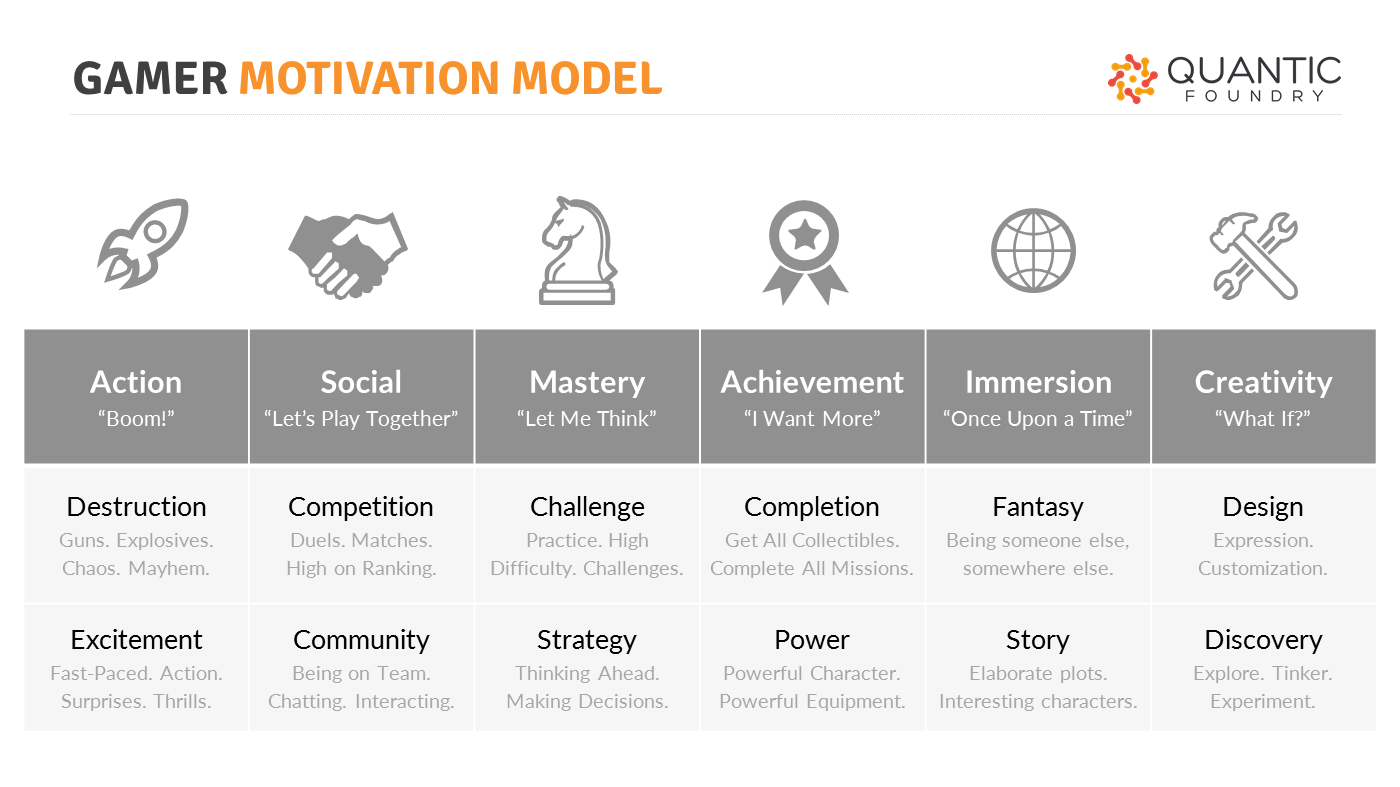
At Quantic Foundry, our Gamer Motivation Profile allows gamers to take a 5-minute survey to get a personalized report of their gaming motivations, and see how they compare with other gamers. Over 350,000 gamers worldwide have taken this survey. The 12 motivations that are measured in our model were identified via statistical analysis of how gaming motivations cluster together. You can get a more detailed description of our gamer sample here.
How We Asked Gamers About Their Gamer Type
In the survey, here’s how we asked gamers about their self-identification with gamer type labels:

Note that there isn’t a standardized definition of these terms in the gaming community, and without some guidelines around what these terms mean, the results would have been difficult to interpret. This was the rationale behind providing a loose definition that blended frequency with dedication for each label. We’re definitely not claiming these are the only possible definitions, or that our definitions are great, but it provides a working foundation from which to make sense of the findings.
In our full dataset, 68% identify as core, 21% as hardcore, and the remaining 10% as casual. 79% identify as male, 19% identify as female, and the remaining ~1.5% identify as non-binary/other.
Hardcore Gamers are looking for Fast-Paced, Skill-Based Challenges
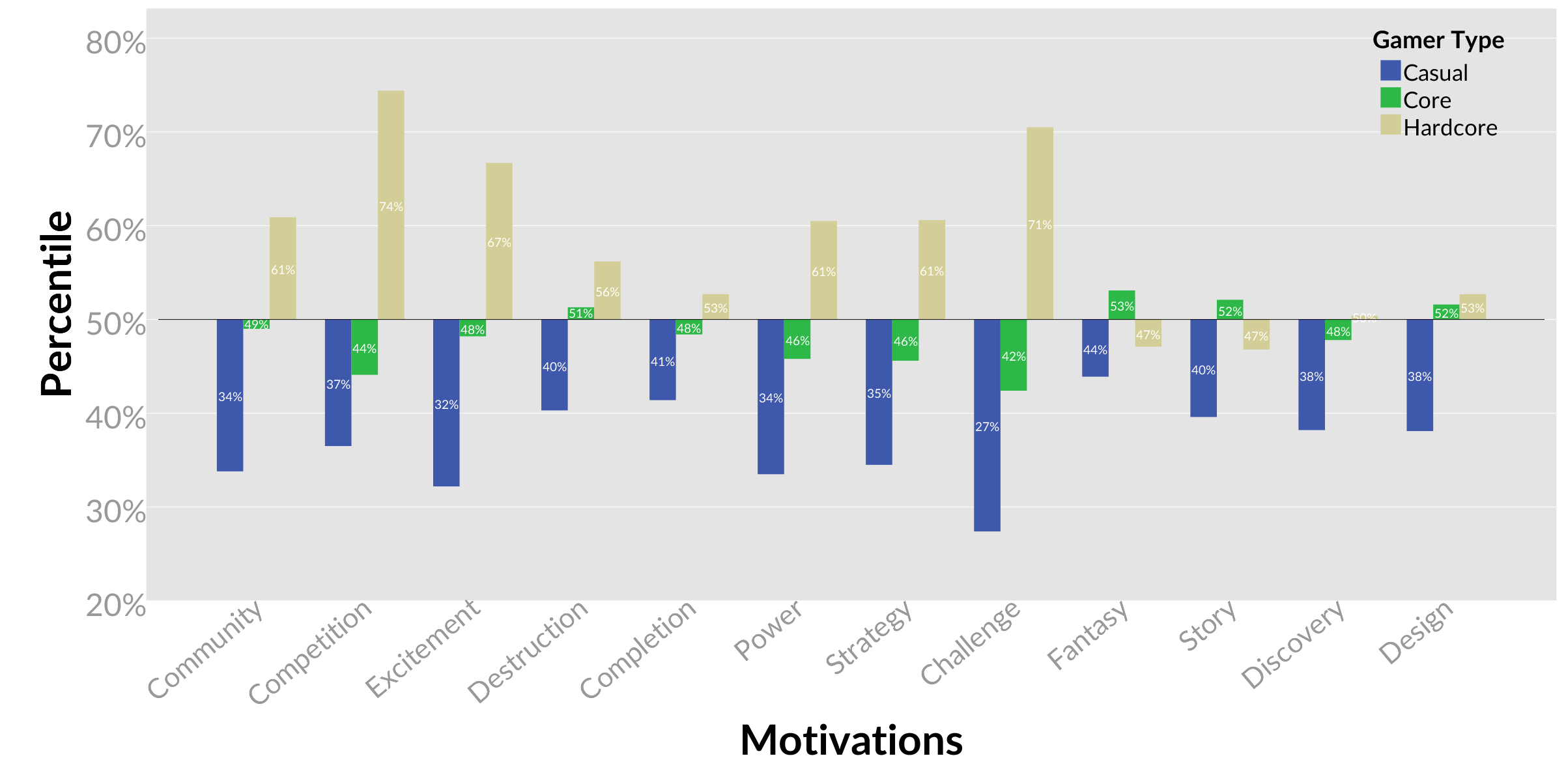
In this chart below, the y-axis is showing the percentile rank of each motivation. That 50th-%tile line represents the average among the 350,000+ gamers who have completed the Gamer Motivation Profile. So for example, the 74th-%tile in Competition among Hardcore gamers means that the average Hardcore gamer scores higher on Competition than 74% of the gamers in the full data set.

Hardcore gamers are most different from Casual gamers in terms of Competition (duels, matches, leaderboard rankings), Challenge (practice, skill improvement, high difficulty), and Excitement (fast-paced, thrills, surprises)—they are looking for fast-paced, skill-based matches against other players. Casual gamers, on the other hand, are looking for calm, non-adversarial games that are easy to learn and play.
Appeal of Completion and Fantasy are Most Consistent Across Gamer Types
Completion (collecting collectibles, completing all the missions) and Fantasy (being someone else, somewhere else) vary the least among the gamer types. In this sense, these two motivations are orthogonal to what is considered Casual vs. Hardcore. Or put another way, these are the things that both Casual and Hardcore gamers can often agree upon, which is something we don’t usually consider because we tend to focus on how different Casual gamers must be from Hardcore gamers.
And it also provides a basic recipe for how to enable coexistence. You create a common area based on task-completion in a moderately-immersive world, and then you provide separate optional lanes for fast-paced, competitive content and calm, solo content. Note how this model is very much the route that most MMOs have taken.
Playing a Game Seriously Means Different Things to Men and Women
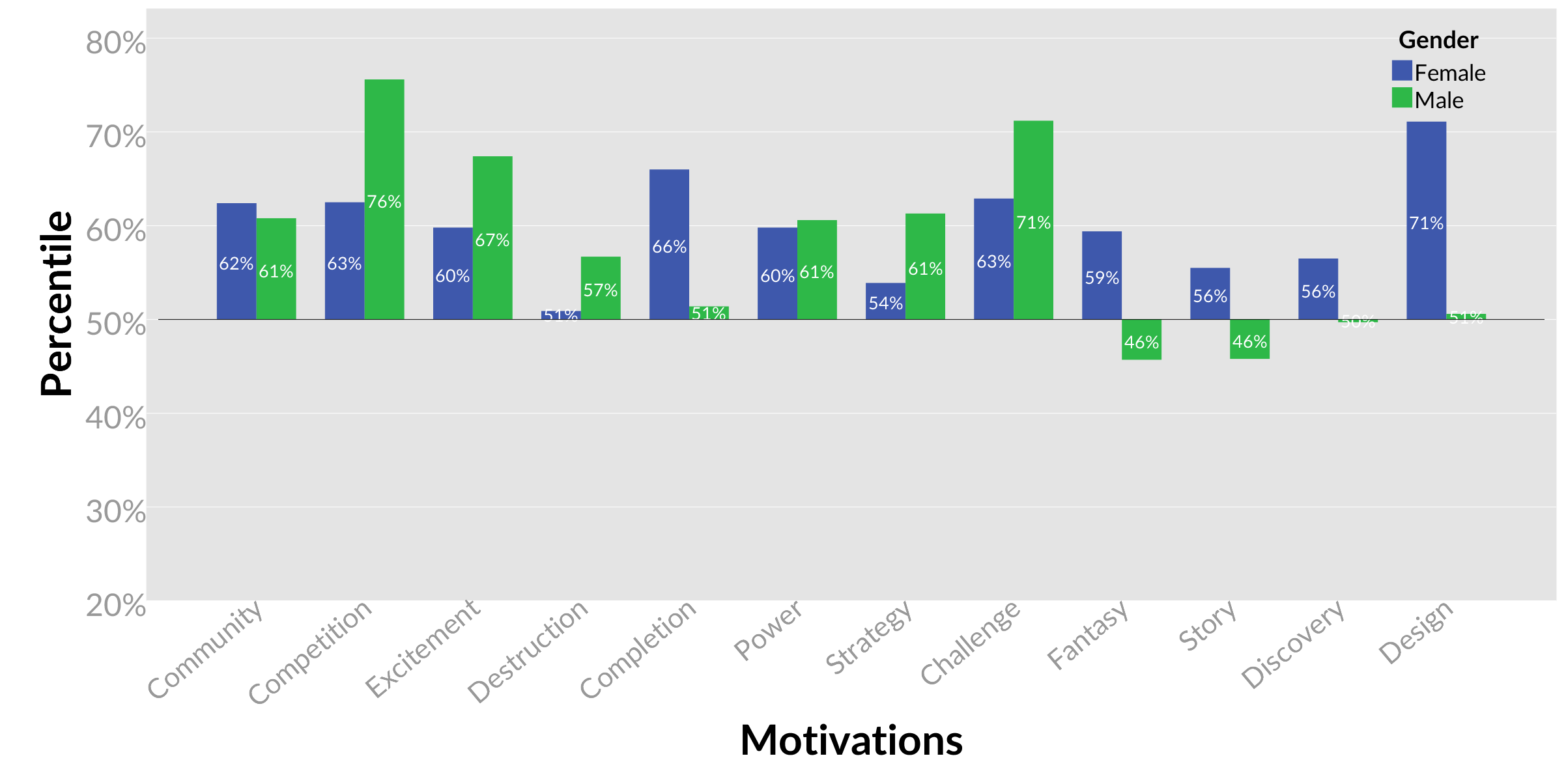
When we focus on just the Hardcore gamers (10% of female gamers and 24% of male gamers in our sample) and break down the data by gender, we see that the overall emphasis on Competition/Challenge/Excitement is driven by the male gamers—these 3 motivations are the primary drivers among male Hardcore gamers. Female Hardcore gamers, while scoring above average in these 3 motivations are more strongly driven by Design (expressing individuality, customization) and Completion.

So for men, playing a game seriously means being able to beat other players at it. For women, playing a game seriously is more likely to mean having completed and done everything there is to do in a game, and to leave traces of your personal flair in the game while doing it. For Hardcore female gamers, playing a game seriously is more akin to patiently creating and curating a work of art. And it’s a powerfully evocative alternative to how we typically conceptualize what a “hardcore gamer” is.
Is Hardcore Breadth or Depth?
This gender comparison between Hardcore and Casual gamers also highlights the difference in coverage of different motivations: Male Hardcore gamers are below average in Fantasy (being someone else, somewhere else) and Story (elaborate plot and interesting characters), whereas female Hardcore gamers are consistently above average across all gaming motivations.
Thus, for men, being Hardcore is more about specializing into competitive gaming, whereas for women, being Hardcore is more about developing a broad interest in all aspects of gaming.
For Men, Casual Means Blowing Things Up
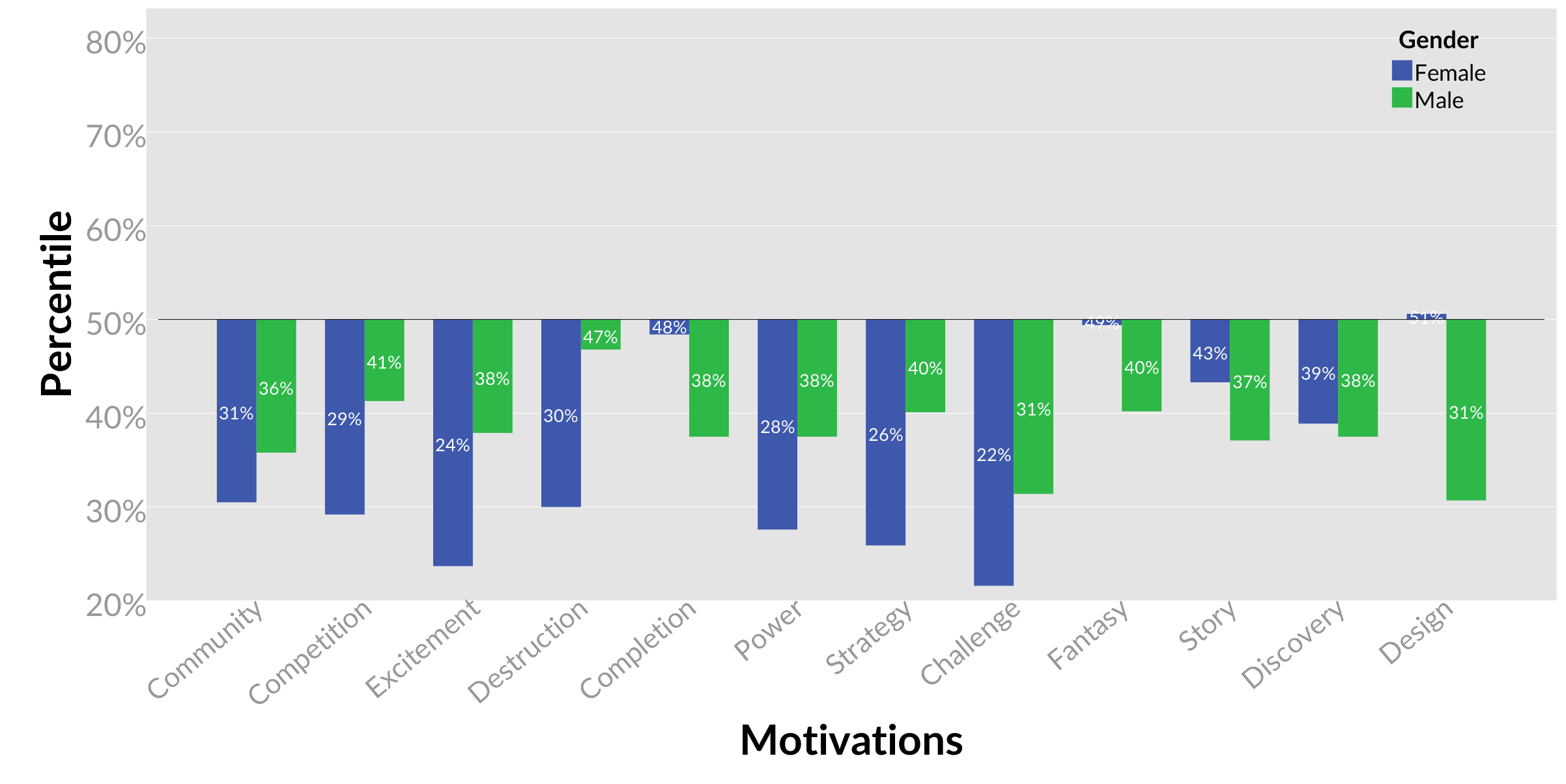
Let’s flip this around and look only at Casual gamers (21% of female gamers and 9% of male gamers in our sample). Gamers who identify as Casual are less enthusiastic about every gaming motivation across the board. So this is why almost all the bars are below the median line.

Casual male gamers score highest on Destruction (guns, explosives, chaos). For them, casual gaming means blowing things up and leaving behind a trail of chaos and mayhem. Note how the things important to Hardcore male gamers—Competition, Challenge, and Excitement—are now deemphasized among Casual male gamers.
For women on the other hand, casual gaming looks a lot like the markers for Hardcore female gamers. We see Design and Completion along with Fantasy. Casual female gamers like being teleported to another world with task completion and customization opportunities.
Many Potential Lenses
Our goal in this post was not to define what “Casual/Core/Hardcore” mean—that’s a much bigger discussion around the intersection of gamer preferences and game mechanics/complexity. We were more interested in exploring what “hardcore” and “playing seriously” means for gamers who ascribe to different gamer type labels (as one of many possible ways of slicing the data).
The two main takeaways are that 1) Hardcore female gamers have different motivational drivers than Hardcore male gamers, and 2) Hardcore is more about breadth for female gamers and more about specialization for male gamers.
The gaming community tends to define Hardcore using the male gamer lens, so there’s inevitably a tautologous conclusion that male gamers are more likely to be Hardcore. But this leads to distortions in making sense of actual gaming behavior. For example, in a study of 7,000+ EverQuest 2 players that my colleagues and I conducted, we found that female MMO gamers spent more hours playing per week and were less likely to consider quitting. But ironically, it was precisely the most frequent and loyal gamers who got stereotyped as being “casuals”.
What’s clear is that we need to be constantly exploring different lenses for understanding player categories and identifying potential fault-lines between our assumptions and gamer data.
Check Out Our Blog
Check out our blog for more data-driven articles on video game and board game audiences and their gaming motivations.
|
|
|
|
|
|
|