Posted by: xSicKxBot - 07-18-2018, 06:13 AM - Forum: Lounge
- No Replies
Solstice of Heroes
“This is our finest hour. Ever victorious against the enemies of humanity. Ever triumphant in our home, and around the system. Now the City wants to honor us. Who are we to deny them?”
—Ikora Rey
It was a day that was supposed to be a celebration of our past glories. The anniversary of Six Fronts — the victory that united the City and gave us the Vanguard. Guardians donned ceremonial armor to commemorate the event, and gathered for a rousing speech by the Speaker. Then everything came apart when the Red Legion struck.
The Tower fell. The City was lost. Thousands of lives were lost with it. It was our lowest point since the Collapse. But humanity is not so easily extinguished.
We fought back. We recovered our lost Light. With the awakening of the Traveler, we faced our conqueror and prevailed. We reclaimed our home. We entered a new Golden Age.
That was almost a year ago.
Now, humanity is once again victorious: against the overwhelming might of Ghaul and the Red Legion; against Panoptes and the infinite threat of the Vex; against Xol and the unfathomable hordes of the Hive. More than ever, the City is grateful for their seemingly invincible Guardian protectors. And more than ever, humanity wants to show that gratitude.
Solstice of Heroes begins on Tuesday, July 31. This event is held in the Tower, and allows the inhabitants of the City to celebrate and thank Guardians for bravely defending them. During this time of celebration, Guardians will once again don the now-broken ceremonial armor from the day the City was lost to the Red Legion. They do this for many reasons: to remind themselves of what it’s like to not be invincible; to challenge themselves and thus inspire the City even more; and to eventually reforge that broken gear into something stronger… just as humanity has been broken and reforged over and over again for hundreds of years.
Guardians will meditate on their journey through the Red War and take on additional challenges in those memories. They will marvel at the resurgence of the Traveler, as the elements themselves flare into existence during their adventures. And they’ll do it all while humanity celebrates their past, present, and future.
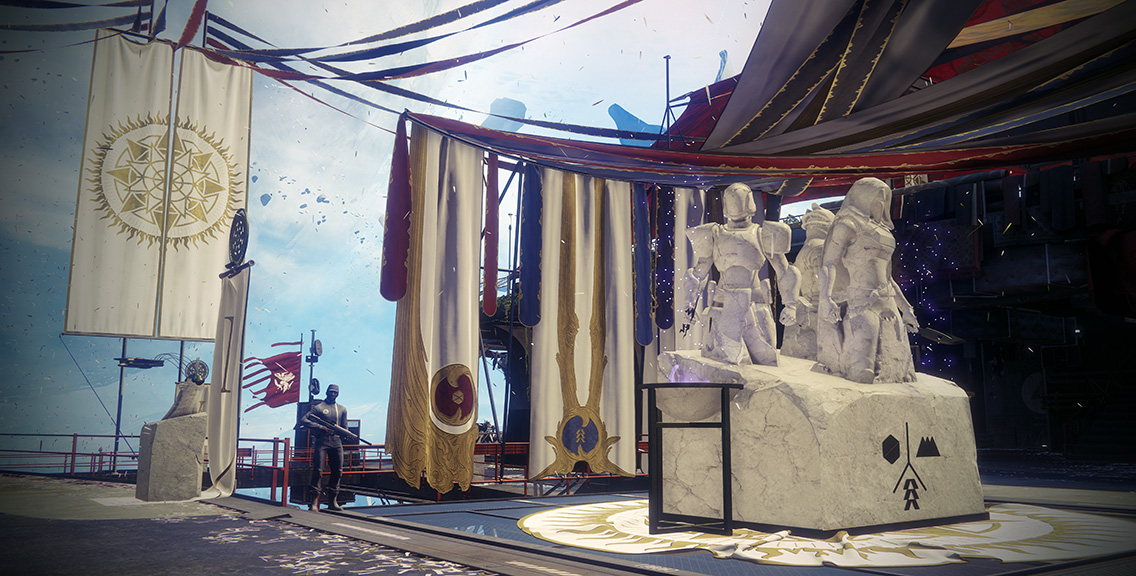
Ikora Rey is the Tower’s representative for the Solstice of Heroes event. She’ll direct you to the center of the Tower, where the City has erected the Statue of Heroes as the focal point for the event. The statue will track your Moments of Triumph progress, and grant you the Solstice of Heroes event armor that you will begin upgrading.
New Armor to Upgrade
After you visit the Statue of Heroes, you will receive an uncommon “Scorched” armor set at Power 240. On each armor piece is a series of objectives that you will need to complete to upgrade the armor. Once you have completed the objectives, return to the Statue of Heroes to upgrade to the next set.
After you upgrade your Shattered set, you’ll receive the “Rekindled” set at Power 340 — with a new list of objectives. Once you complete those objectives, your reward is the “Resplendent” Armor Set at Power 400. One final group of objectives to complete, and you’ll unlock the Masterwork version of the armor set.
If you love the way the Shattered or Rekindled sets look, and would rather show those off, we’ve got you covered. Each Resplendent Armor Set offers the previous versions as ornaments, so you can pick and choose how each piece looks.
Redux Missions
One of the ways you’ll upgrade your armor during the event is through Redux Missions. We have hand selected 5 story missions and given them some slight alterations. Each mission can be accessed in the Tower by finding its statue. Here are the five missions for the event:
I – Homecoming
II – Spark
III – Payback
IV – 1AU
V – Chosen
Moments of Triumph
Many of you have already begun completing your Moments of Triumph, currently being tracked on Bungie.net. The final five Triumphs will become available at the beginning of the Solstice Heroes event, and can be tracked in-game. Your Triumphs will be tracked by in-game bounties that are obtained at the Statue of Heroes. As you complete and turn in those Bounties, you’ll unlock rewards that can be redeemed at the Statue.
Extras
There’s also the Solstice Engram available from Tess Everis. You can earn three per account by completing the event Milestone on each of your characters. No matter what activity you play in Destiny 2 during Solstice of Heroes, you’ll receive one Solstice Engram in addition to the Bright Engram you earn for leveling up.
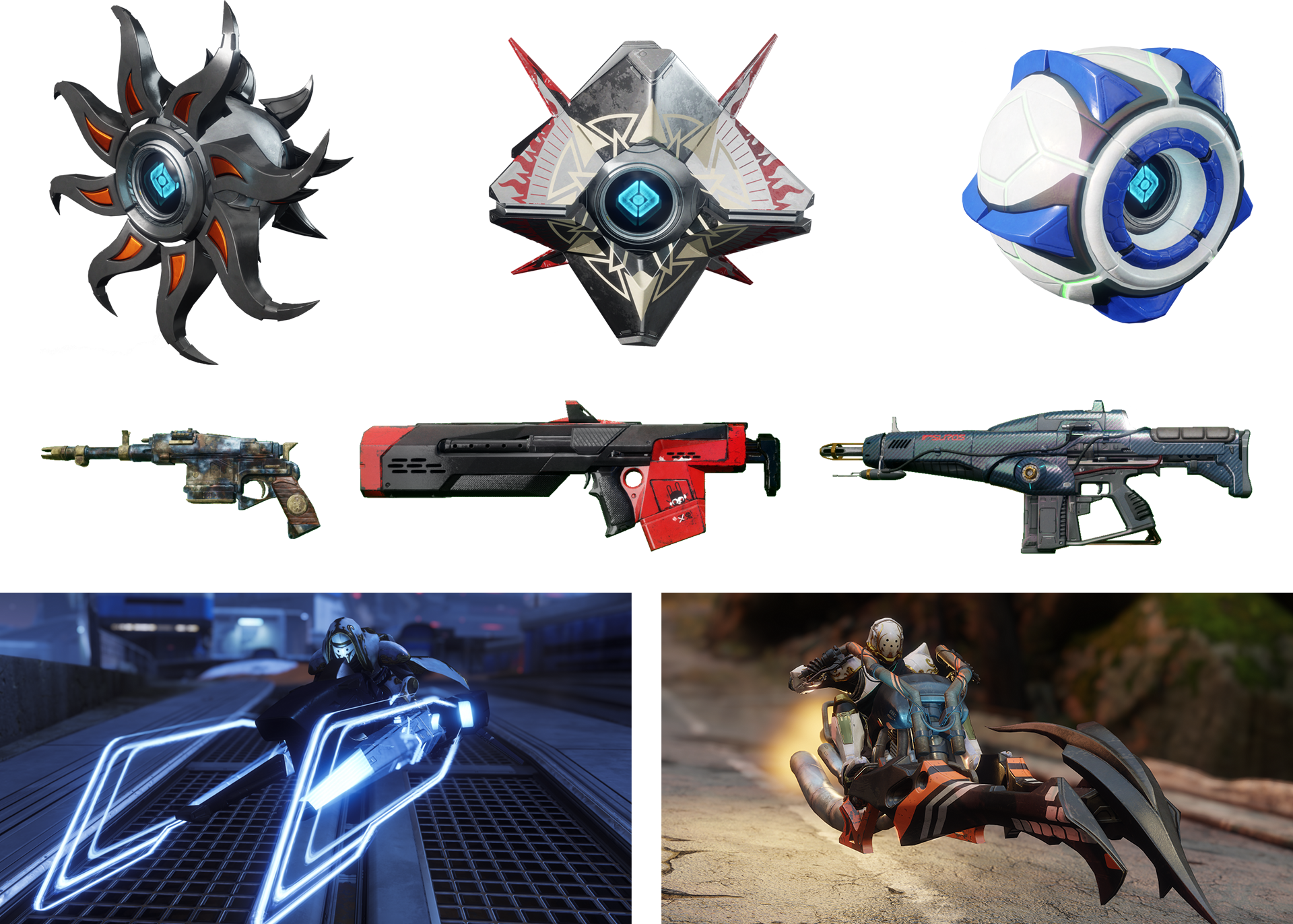
Here’s a look at some of the rewards that will drop from the Solstice Engram:
Armor Glows also come from the Solstice Engram. These can be applied to any version of the Solstice of Heroes armor sets, to provide Guardians with an enhanced look. Armor Glows are unlocked permanently, like ornaments, and they shine brightest when your subclass element aligns with the element of the Glow.
Developer Insights
In preparation for the Solstice of Heroes event, the July Update for Destiny 2 kicks off for all Destiny 2 players on July 17, 2018. This update introduces 6v6 Quickplay for the Crucible, Iron Banner upgrades, Exotic Armor tuning, new Exotic Catalysts, Prestige Raid Lairs, Vanguard and Crucible Bounties, the Moments of Triumph event with 400 Power gear, and more.
If you’re looking to get a head start on your Moments of Triumph before Solstice of Heroes goes live on July 31, 2018, make sure to check out the Moments of Triumph Guide, which can be found here.
$175 Overwatch Hanzo Statue Now Available For Pre-Order
Blizzard's latest addition to its line of premium Overwatch statutes is Hanzo, the bow-wielding assassin. The first wave of Hanzo statues is scheduled to ship sometime before the end of Q4 2018, but it's not cheap. You can pre-order it now for $175 (limit 10 per customer).
But that price tag begins to make sense when you look at the close-up photos Blizzard has released. This 13-inch statue is hand-painted with intricate detail. It features the nimble archer nocking an arrow into his bow, with his scarf billowing behind him.
Hanzo isn't the first $175 statue Blizzard has made available to Overwatch fans. Similarly sized Tracer, Genji, Widowmaker, and Reaper statues are available now, and a Mercy statue is scheduled to release by the end of Q4 this year.
Nor is $175 the only price point for Overwatch collectibles on the Blizzard Gear Store. You can buy Overwatch Figma figures for $80 each, Nendoroids for $50, or Funko Pops for $10 (the D.Va Funko Pop is "super-sized" and costs $25). If you're looking to unload even more money, you can go all out and buy a 20-inch D.Va statue for $450. There's also an assortment of Overwatch shirts, leggings, and scarves available.
In other recent Overwatch news, Blizzard raised $12.7 million for breast cancer research by selling a pink Mercy skin and a special t-shirt. Disney and Blizzard have also struck a deal to broadcast the Overwatch League playoffs on Disney channels, like ESPN and Disney XD.
Following Apple’s release of a fourth macOS Mojave developer beta, the company on Tuesday pushed out a third evaluation version of the upcoming Mac operating system to members of its public beta program.
The third macOS Mojave public beta is identical to the latest developer version, which includes few major changes save for compatibility with Apple’s latest MacBook Pro hardware.
Apple’s forthcoming Mac operating system incorporates a number of user interface enhancements and productivity tools designed to better take advantage of underlying software technology. An updated Quick Look, for example, provides direct access to photo and video editing tools, as well as Markup capabilities.
Related Finder upgrades include customizable, contextual Quick Actions that save users time on common tasks like resizing images, adding passwords to documents and creating a PDF file from multiple photos.
A new Stacks feature clears up desktop space by automatically grouping files, folders and other documents into stacks, while the screenshots mechanism has been enhanced to more efficiently process images and video captures.
Expanding on existing Continuity tools, Continuity Camera lets users take a photo on an iPhone and insert the image directly into a macOS app like Pages or Keynote. Also revamped is the Mac App Store, which borrows heavily from the successfully redesigned iOS App Store.
[embedded content]
Apple will in a future version of macOS enable developers to port iOS apps into versions that run on macOS. Initially, however, the company is testing the technology with first party apps like News, Stocks, Voice Memos and Home, the latter of which allows users to control their HomeKit accessories from a Mac.
Users who wish to take part in the beta testing process can sign up for access through the Apple Beta Software Program webpage, which also offers downloads for upcoming iOS 12 and tvOS 12 builds.
We’re on a power trip and no-one can stop us. First we told you what the best Board Games were, then we dared to dream of what the best turn-based strategy games might be. Now we’re here to conquer a new genre – card games (although not counting CCG/TCG types).
Below are a wide variety of excellent examples which aren’t simply trying to be another Hearthstone. Some have excellent single player campaigns with persistent upgrades and unlocks, or customizable decks. Others skew towards the heavily-instanced, unique-runs roguelike approach, and then there’s digital adaptations of many of the excellent deck-building or other types of card games that exist. Between these extremes, there’s something for everyone.
A game of hot potato with a nitroglycerine-infused feline escalates until every player save one has met their maker. Fiery kitty death and simple humor belie a take-that game which puts everyone immediately at each other’s throats. Hostility and sabotage are the name of the game, because each player has only one life to live, and one defuse card to keep that hairball from becoming a fireball.
The game is a childish, cartoonish pastiche of obvious joke made too hard too often, but despite the unapologetic unrefined everything, it remains one of the best guilty mindless pleasures around. If you ever need a reason to froth at the mouth and fling spittle at your fellow humans over fictionally threatening cats, look no further: Exploding Kittens is simply an excuse to have a good time, a cheeky pretext. Irksome, shameless and perfect it its base way.
With Guild of Dungeoneering you come for the game, stay for the jokes. The sing-song plot is doled out over each of the game’s regions and challenges, and while the class system isn’t strictly balanced, the overall arc of the regions is. A single play session will eat up a bit of concentration and a bit more of time, sometimes even the better part of an hour in the later stages, but even the basic encounters feel fresh, engaging and vital to ultimate success. Diverting but finite in its appeal, the Guild of Dungeoneering is not a calling for all gamers but is a welcome and refreshing quest whose expansions add more flair and mechanics to extend the main storyline.
Developer: Arnold Rauers Platforms: iOS, Android Price: 2.99, free
Card Thief: Get in, get rich, get out. The story of a heist plays out with endless variety, thanks to Card Thief’s intermingling systems of light and shadow, directionality and position. These systems are intuitively taught through appealing sound and visual design, and the game rewards deeper understanding of the basics and their complex interactions by giving the player more finicky toys to play with. In short, an unstinting challenge to sink your teeth into, with a razor-sharp core idea enlivened by a pastel of special effects and alternate thieves.
The characters are idiosyncratic, the game-within-a-game conceit a little cheeky but still refreshing, the consistent tone humor-ish, deadpan. Beating certain keystone characters unlocks their signature, ultra-powerful cards whose effects even jive with that character’s personality. In other words, there is a correspondence between writing, characterization and deck archetypes between. Never quite a rollicking good time or agonizing head-scratcher, the deckbuilding and collecting (yes, there are boosters, no nothing is truly ultra-rare) of Card City Nights makes for an easily enjoyed and easily binged experience.
Good ole’ Reiner Knizia can always be relied on for some arithmetic fun. His success and sheer number of gaming hits with staying power can partly be attributed to a creative knack, but it also comes down to a large and prolific output, along with thorough playtesting. Players finance archaeological expeditions, building stacks of colors with cards numbered two to ten. Each of the five colorful expedition must have cards played in ascending value, with skpping permitted. So playing a tenner to start would doom an expedition, because at the game’s end any expedition is worth the sum of its cards, minus twenty, multiplied by the presence of any extra finance cards ($$$). Simple, right? The other half of the game is the push-and-pull with players drawing and playing cards one at a time, sometimes opting to discard cards into a common area rather than play them. Boring to explain, easy to play. Tense and fulfilling to win.
Frost stands out from the other members of this list on two fronts. Firstly, for its palette, which is as frigid as monochrome as you’d expect. Secondly, because its gameplay is survival-based, not just thematically but actually. Gathering supplies, fending off nasties and keeping the elements at bay take every possible trick the cards will give you. Better performance will net you better tools, but unlike other games, Frost’s best rewards are a sense of security and temporary respite. In other words, the game won’t see you chasing exhilarating high score or excitement, but rather staving off the undesirable. Loss aversion, the fear of breaking a fragile equilibrium, the game daring you to take only appropriate risks when the phrase is a hollow oxymoron. The game rewards you with the chance to keep playing, keep exploring its stark dangers and bag of tricks.
Developer: White Wizard Games Platforms: iOS, Android Price: Free, with content parcelled out as IAP ($4.99 for the full set)
Star Realms marries the level of expansion and customization of a TCG with the bite-sized crunchy decision-making of a deckbuilder. Its combat elements and faction-specific combos make for a serious nostalgia trip for those looking to revisit memory lane without first collecting, collating and crafting a custom deck just for the occasion. Star Realms’ many expansions, rapid-fire gameplay and clear iconography make it a compelling addition to the game enthusiast’s roster and an easy must-have.
In the happier sessions, Meteorfall ends with a successful final showdown against the aptly-named Uberlich. Working backwards from that ultimate battle to the four starting characters is much more challenging than the squidy art and breezy interface might suggest. Its fight-or-flight decisions and journeying remind me of FTL transported to a fantasy setting, with cards. Okay, so the likeness is weak, but the juxtaposition of richness and minimalism are what really matters here. Seriously, Meteorfall is a wolf in cartoon clothing.
Perhaps the quintessential engine-building card game, Race for the Galaxy is one of the more aged members within this best-of list, debuting originally in 2007. Its longitudinal sense of strategy and complex combos quickly made it a favorite amongst players. Along with this hefty strategic challenge, the unique simultaneous action selection mechanic enlivened the game with some bluffing. Barring the official release of Dominion for mobile, Race for the Galaxy represents a classic, yet innovative take on a victory-point race. The app runs like a dream and offers stiff competition and solid multiplayer.
Developer: Devolver Digital Platforms: iOS, Android Price: $2.99
Alright, it’s true: the cards in Reigns: Her Majesty only combine to create game paths and branching outcomes later on, but this sequel to the swipe-to-rule-them-all motherload of simple-yet-satisfying game, Reigns, deserves to be on this list because it has mastered what every good card game needs: flashpoint moments. The bite-sized binary decisions, served one-by-one in Reigns, amass weight, consequence and difficulty, not merely because of narrative investment but also because of a chain of causality. Much ado about something anyone who’s tried the game already knows, or more importantly, has already felt.
Hall of Fame
We’re keeping the list pretty tight at the moment, but there’s way more than ten excellent card games to celebrate, with more on the way all the time. Every now and then we’ll rotate games out for other games, but we don’t want those past greats to be forgotten. Below is a list of previous members of this list, lest we forget:
Calculords
Pathfinder Adventures
Solitairica
Flipflop Solitaire
What would your list of the best (non-CCG) card games look like? Let us know in the comments!
Xen Project Hypervisor Power Management: Suspend-to-RAM on Arm Architectures
About a year ago, we started a project to lay the foundation for full-scale power management for applications involving the Xen Project Hypervisor on Arm architectures. We intend to make Xen on Arm’s power management the open source reference design for other Arm hypervisors in need of power management capabilities.
Looking at Previous Examples for Initial Approach
We looked at the older ACPI-based power management for Xen on x86, which features CPU idling (cpu-idle), CPU frequency scaling (cpu-freq), and suspend-to-RAM. We also looked at the PSCI platform management and pass-through capabilities of Xen on Arm, which already existed, but did not have any power management support. We decided to take a different path compared to x86 because we could not rely on ACPI for Arm, which is not widespread in the Arm embedded community. Xen on Arm already used PSCI for booting secondary CPUs, system shutdown, restart and other miscellaneous platform functions; thus, we decided to follow the trend, and base our implementation on PSCI.
Among the typical power management features, such as cpu-idle, cpu-freq, suspend-to-RAM, hibernate and others, we concluded that suspend-to-RAM would be the one best suited for our initial targets, systems-on-chips (SoCs). Most SoCs allow the CPU voltage domain to be completely powered off while the processor subsystem is suspended, and the state preserved in the RAM self-refresh mode, thereby significantly cutting the power consumption, often down to just tens of milliwatts.
Our Design Approach
Our solution provides a framework that is well suited for embedded applications. In our suspend-to-RAM approach, each unprivileged guest is given a chance to suspend on its own and to configure its own wake-up devices. At the same time, the privileged guest (Dom0) is considered to be a decision maker for the whole system: it can trigger the suspend of Xen, regardless of the states of the unprivileged guests.
These two features allow for different Xen embedded configurations and use-cases. They make it possible to freeze an unprivileged guest due to an ongoing suspend procedure, or to inform it about the suspend intent, giving it a chance to cooperate and suspend itself. These features are the foundation for higher level coordination mechanisms and use-case specific policies.
Solution Support
Our solution relies on the PSCI interface to allow guests to suspend themselves, and to enable the hypervisor to suspend the physical system. It further makes use of EEMI to enable guest notifications when the suspend-to-RAM procedure is initiated. EEMI stands for Embedded Energy Management Interface, and it is used to communicate with the power management controller on Xilinx devices. On the Xilinx Zynq UltraScale+ MPSoC we were able to suspend the whole application subsystem with Linux and Xen and put the MPSoC into its deep-sleep state, where it consumes only 35 mW. Resuming from this state is triggered by a wake-up interrupt that can be owned by either Dom0 or an unprivileged guest.
After the successful implementation of suspend-to-ram, the logical next step is to introduce CPU frequency scaling and CPU idling based on the aggregate load and performance requirements of all VMs.
While an individual VM may be aware of its own performance need, its utilization level, and the resulting CPU load, this information only applies to the virtual CPUs assigned to the guest. Since the VMs are not aware of the virtual to physical CPU mappings, while also lacking awareness of all the other VMs and their performance needs, a VM is not in a position to make suitable decisions regarding the power and performance states of the SoC.
The hypervisor, on the other hand, is scheduling the virtual CPUs and needs to be aware of their utilization of the physical CPUs. Having this visibility, the hypervisor is well suited to make power management decisions concerning the frequency and idle states of the physical CPUs. In our vision, the hypervisor scheduler will become energy aware and allocate energy consumption slots to guests, rather than time slots.
Currently, our work is focused on testing the new Xen suspend-to-RAM feature on Xilinx Zynq UltraScale+ MPSoC. We are calling the Xen Project developers to join the Xen power management activity and implement and test the new feature on other Arm architectures, so we accelerate the upstreaming effort and the accompanying cleanup.
Authors
Mirela Grujic, Principal Engineer at AGGIOS
Davorin Mista, VP Engineering and Co-Founder at AGGIOS
Stefano Stabellini, Principal Engineer at Xilinx and Xen Project Maintainer
Lightning fast and action packed, Rifter is the love child of Dust Force, Bionic Commando and Hotline Miami, mixed with acrobatics and parcour. Run and gun and swing and dash in this neon-colored platformer.
Amazon Prime Day 2018: Get Extra Five Bucks On Gift Cards
Amazon Prime Day is upon us, offering deep discounts for all the good boys and girls who also happen to be Amazon Prime subscribers. If you're eyeing some bargain prices to treat yourself, you may want to take advantage of a little bonus offer that effectively stacks a tiny discount atop a discount.
Purchasing at least $25 in Amazon gift cards with a promo code will get you $5 in Amazon credit. That means you could purchase and redeem your own gift card and claim the credit for yourself, or just get a little extra from a gift for someone else. Note that the credit is only promised to appear within two days, which could put it well past the Prime Day sales period, so don't wait to claim the $5 code before making your Prime Day purchases. Plus be sure to enter the promo code in the link above.
Of course, to make any Prime Day purchase you need to be a Prime member. If you aren't a member, sign up for a free trial to take advantage of the discounts. Prime Day ends the evening of Tuesday, July 17, and some deals are only available for a limited time. Check out our roundups of the best bargains below.
In today’s technology arena, open source is pervasive. The 2018 Open Source Jobs Report found that hiring open source talent is a priority for 83 percent of hiring managers, and half are looking for candidates holding certifications. And yet, 87 percent of hiring managers also cite difficulty in finding the right open source skills and expertise. This article is the second in a weekly series on the growing importance of open source certification.
In the first article, we focused on why certification matters now more than ever. Here, we’ll focus on the kinds of certifications that are making a difference, and what is involved in completing necessary training and passing the performance-based exams that lead to certification, with tips from Clyde Seepersad, General Manager of Training and Certification at The Linux Foundation.
Performance-based exams
So, what are the details on getting certified and what are the differences between major types of certification? Most types of open source credentials and certification that you can obtain are performance-based. In many cases, trainees are required to demonstrate their skills directly from the command line.
“You’re going to be asked to do something live on the system, and then at the end, we’re going to evaluate that system to see if you were successful in accomplishing the task,” said Seepersad. This approach obviously differs from multiple choice exams and other tests where candidate answers are put in front of you. Often, certification programs involve online self-paced courses, so you can learn at your own speed, but the exams can be tough and require demonstration of expertise. That’s part of why the certifications that they lead to are valuable.
Certification options
Many people are familiar with the certifications offered by The Linux Foundation, including the Linux Foundation Certified System Administrator (LFCS) and Linux Foundation Certified Engineer (LFCE) certifications. The Linux Foundation intentionally maintains separation between its training and certification programs and uses an independent proctoring solution to monitor candidates. It also requires that all certifications be renewed every two years, which gives potential employers confidence that skills are current and have been recently demonstrated.
“Note that there are no prerequisites,” Seepersad said. “What that means is that if you’re an experienced Linux engineer, and you think the LFCE, the certified engineer credential, is the right one for you…, you’re allowed to do what we call ‘challenge the exams.’ If you think you’re ready for the LFCE, you can sign up for the LFCE without having to have gone through and taken and passed the LFCS.”
Seepersad noted that the LFCS credential is great for people starting their careers, and the LFCE credential is valuable for many people who have experience with Linux such as volunteer experience, and now want to demonstrate the breadth and depth of their skills for employers. He also said that the LFCS and LFCE coursework prepares trainees to work with various Linux distributions. Other certification options, such as the Kubernetes Fundamentals and Essentials of OpenStack Administration courses and exams, have also made a difference for many people, as cloud adoption has increased around the world.
Seepersad added that certification can make a difference if you are seeking a promotion. “Being able show that you’re over the bar in terms of certification at the engineer level can be a great way to get yourself into the consideration set for that next promotion,” he said.
Tips for Success
In terms of practical advice for taking an exam, Seepersad offered a number of tips:
Set the date, and don’t procrastinate.
Look through the online exam descriptions and get any training needed to be able to show fluency with the required skill sets.
Practice on a live Linux system. This can involve downloading a free terminal emulator or other software and actually performing tasks that you will be tested on.
Seepersad also noted some common mistakes that people make when taking their exams. These include spending too long on a small set of questions, wasting too much time looking through documentation and reference tools, and applying changes without testing them in the work environment.
With open source certification playing an increasingly important role in securing a rewarding career, stay tuned for more certification details in this article series, including how to prepare for certification.
MOTHERGUNSHIP mixes bullet-hell intensity with the shooting, customization, and traversal of the first-person genre. Fight your way through the alien fleets, facing randomized enemy and level mayhem as you clear rooms and take out some of the biggest bosses seen in the FPS genre.