The 209th GalaQuiz will be LIVE soon, win up to $50 in GalaCredit!
[www.indiegala.com] The GalaQuiz will take place in less than 15 minutes from this announcement Today's GalaQuiz[www.indiegala.com] hints are up. The theme will be Star Trek. Live Long and Prosper.
Posted by: xSicKxBot - 10-01-2020, 06:23 AM - Forum: Windows
- No Replies
5 key learnings from Sept. 23 Education Transformation Summit
On September 23, Microsoft Education held our third Education Transformation Summit, where education leaders shared best practices from the acceleration of digital learning due to the global pandemic.
To facilitate this conversation, we brought together 200 education system leaders in two Microsoft Teams live sessions to reflect on progress and talk about their goals and vision for the future. Invited panelists came from across the globe—from Finland to the Philippines, from Canada to Costa Rica.
Though each leader’s perspective was unique and based on their specific experience, we’ve identified five key factors that are universally relevant.
Visions for digital transformation at scale should be grounded in a unified technology strategy
Ensuring all learners have access to appropriate devices and learning platforms is priority number one
Integrating technology with pedagogy enables social-emotional learning and student well-being
Supporting teachers with professional development is key to success
Data security and privacy are critical as education becomes increasingly digital
The disruption of education by COVID-19 can be seen as a catalyst, an invitation not to simply strive to minimize the negative effects of the change, but to improve education models for the future. One of the biggest hurdles for leaders with this goal has been balancing short-term decisions with making longer-term sustainable investments that will impact how students and teachers learn using technology for years to come.
When wrapping up the panel discussions, Microsoft Vice President of Education Barbara Holzapfel said, “It’s clear that with continued public-private partnership, education systems around the world will continue to advance the goal of creating personalized, equitable learning enabled by the intentional integration of pedagogy and technology.”
With leaders such as all of those who joined the events as contributors and participants working toward these goals, the transformation of education around the world is underway.
Read on below for a more in-depth recap of the key points, with quotes and examples from the contributors and panelists.
The Education Transformation Summit
Microsoft VP Education, Barbara Holzapfel, moderates the AM session panel discussion
This year, the back-to-school season has been unlike any other year. For students, teachers, parents, and education system leaders, getting used to the new normal in a COVID-19 world is an enormous challenge. At the same time, we’ve seen incredible creativity—and speed—in deploying remote and hybrid learning. Here are some of the key learnings from the contributors and panelists who joined us for the Fall 2020 Education Transformation Summit.
1. Visions for digital transformation at scale should be grounded in a unified technology strategy
Education institutions that already had a strong focus on long-term digital transformation have been more resilient during COVID-19, as they have accelerated existing projects and driven wider adoption rather than having to start from scratch.
A major factor in the strategy is the mindset of the project, according to Anthony Salcito, Vice President for Education at Microsoft. “It’s super critical that the constituents are bought in to the vision. And we need a vision that’s more sustainable and longer term than just purchasing and deploying the technology,” he said.
Emily Bell, Chief Information Officer for Georgia’s Fulton County School District in the US, illustrated how her district engaged in a consultation strategy to bring everyone along. “We surveyed parents and asked them what they liked and what they don’t like. We had families with children in multiple schools, and they complained that there were too many software tools to learn. So, we moved to standardized approaches and offered a menu of applications including Office 365 and Teams for schools to use. Since then, we surveyed parents and 80 percent told us they were satisfied with our technology. The remaining 20 percent just wanted their kids back in school,” she said.
At the same time, some education systems are thinking about how to simplify technology provisions for teachers and schools by providing services centrally.
“We implemented Teams nationally and created more than one million accounts in two weeks. We created a call center to help,” said Paula Villalta Olivares, Vice Minister of Institutional Planning and Regional Coordination at the Ministry of Public Education of Costa Rica.
Unified approaches like these take the burden off local IT admin staff to support teachers, students, and parents in using the platform, rather than having to set up a platform in each individual school.
Microsoft VP, Education Barbara Holzapfel speaks with UNESCO Director Borhene Chakroun
2. Ensuring all learners have access to appropriate devices and learning platforms is priority number one
The need to move learning online quickly highlighted existing challenges, such as access and equity, and any plan for future success includes striving to level the field for all students. As Borhene Chakroun, UNESCO Director, Division for Policies and Lifelong Learning Systems, stated during the panel discussion, “The master principle is leaving no one behind. COVID-19 has increased the divides that existed prior to the crisis. We need to be focused on inclusiveness, equity, and reaching out to the most disadvantaged.”
Access to dedicated and reliable devices is an issue in many areas, and there are many different approaches to getting devices in the hands of learners.
Gaby Rowe, Founding Principal at GROW Associates, noted that as the state of Texas worked to provide devices to students, the communities that were hardest hit by the virus were also those that were the most under-resourced. “As we started Operation Connectivity, there was a real focus on how we ensure that as we get devices out there and we provide connectivity, that we’re really making sure it goes into the neighborhoods, the households, the students’ hands, the schools, and the teachers who need it the most”
Nicole Dezen, Microsoft Vice President of Device Partner Sales, in the opening fireside chat with Anthony Salcito, mentioned this challenge as well. “We have seen a flurry of buying, but we are still seeing a lot of institutions still struggling to get devices needed by students and faculty to support their needs.”
Microsoft VP, Education Anthony Salcito chats with Nicole Dezen, Microsoft VP, Device Partner Sales
Keith Kruger, CEO of the US-based Consortium for School Networking who represents CIOs from more than 1,000 school districts, highlighted the importance of careful consideration of the total cost of ownership, and noted that oftentimes, a cheaper device is more expensive in the long run if it isn’t the right device for the student.
3. Integrating technology with pedagogy enables social-emotional learning and student well-being
Student well-being has always been important, but it has become an even stronger focus during times of crisis. Our research for the whitepaper “Emotion and Cognition in the Age of AI” demonstrated that educators believe positive emotions are critical for academic success, that they are important in developing communication skills, and that technology, when used correctly and integrated into quality pedagogy, can support traditional knowledge acquisition and the development of social and emotional skills.
“We prioritized social and emotional needs and interaction. One of the biggest challenges was supporting students close to dropping out during the remote period,” said Dr. Marjo Kyllonen, Head of Development Service Unit, Helsinki Education Division. “The importance of personalized learning and digital platforms, and how they can be beneficial for the learners, really increased.”
Meanwhile in Costa Rica, the strategy was to drive students’ independent learning.
“We created autonomous learning guides for students. Every day students received activities to do at home,” said Melania Brenes Monge, PhD. Academic Vice Minister at the Ministry of Public Education of Costa Rica.
And in Canada, Jordan Tinney, Superintendent of Schools and CEO of Surrey Schools, uses Power BI to create a dashboard where educators can track and visualize different categories of student information related to student well-being. These results help educators map the needs of students in schools throughout the district, and respond by taking actions such as reaching out to parents and implementing additional after-school activities.
4. Supporting teachers with professional development opportunities is key to success
Even prior to the pandemic, a majority of teachers surveyed for our Staff of 2030whitepaper said that they expected the use of technology in the classroom to increase. However, only 38 percent of them felt that their training had prepared them to use digital tools for learning. Now that so much of teaching and learning is online, investment in teacher professional development is a key indicator of success.
“Pedagogical understand[ing] of learning, and how to do it from a distance was important for our teachers,” said Kyllonen. “We have regular discussions with teachers about the pedagogical model, what are the skills needed for the future, and how does our pedagogy reinforce their acquisition,” she continued.
The government of the Philippines has undertaken a massive initiative to bring electrical power and internet connectivity to schools that have been without it, and along with providing access, teacher training on new technology is a top priority.
Alain Pascua, Undersecretary for Administration, Department of Education at the Republic of the Philippines shared, “What we have been doing for the past few days and from past few months is the massive training of all our public school teachers in terms of open innovation and resources in terms also in the use of the learning management system.”
In Costa Rica, more professional development was required to quickly shift to digital platforms.
“It just confirmed what we already knew—PD needs to be relevant, current, novel. We want teachers to have the chance to change their teaching practices into more effective learning procedures, and we are expecting evidenced transformation of their teaching activities,” said Vice Minister Melania Brenes Mong.
5. Data security and privacy is critical as education becomes increasingly digital
The increasing amount of digital education in systems around the world generates a huge opportunity for leaders and teachers to get more insight into learning, but needs to be handled in ethical and appropriate ways.
“It’s important to start with data privacy and security,” said Chakroun. “We need to shift from classical Education Management Information Systems to a new generation that are integrated with Learning Management Systems to make more up-to-date and effective reporting on learning.”
In Finland, their AI and data strategy is strongly student centered.
“Our focus is always on good pedagogies. So the aim is that every student can achieve his or her own potential, and that we can have a transparent process using a variety of data collection points from teachers, from students, from platforms and so on. Our goal and objective is to promote the ideal learning process with automated learning design to help make learning transparent, and thus deeper and better,” said Kyllonen.
Microsoft Education would like to thank the leaders and contributors who took part in the summit. Their wisdom and experience generated some incredibly insightful observations, provided actionable information for attendees, and made our third Education Transformation Summit a valuable event.
Video: A Look At Some Of The Rarest Nintendo Consoles
When you consider the sheer number of limited edition consoles the company has released over the years, it’s hardly surprising that plenty of Nintendo machines both old and new are deemed to be incredibly rare. That doesn’t stop them from being super-interesting, though, as this new video proves.
The video comes from video game researcher and archiver Liam Robertson, as part of his Game History Secrets show found on DidYouKnowGaming?. Several rare Nintendo consoles are shown off, including a special Nintendo DS with Super Mario 64 DS artwork, a rare Advance Wars DS only given out to press, and more – including a fascinating story surrounding a Miyamoto signature that was believed to be just “a smudge”.
It’s well worth a watch if you’re into this sort of thing and, if you’re interested, the video was created in partnership with Console Variations – a great website for tracking down all the weird and wonderful variants of Nintendo consoles.
Here’s a look at that special Super Mario 64 DS console…
How many of these Nintendo systems have you heard about before? Any that are completely new to you? Let us know in the comments below.
Posted by: xSicKxBot - 10-01-2020, 06:23 AM - Forum: Lounge
- No Replies
Netflix's The Sandman: Here's Who Plays Dream In The Adaptation - Report
On the heels of author Neil Gaiman announcing on Twitter that the adaptation of his landmark DC Comics series The Sandman will "begin shooting in 3 weeks, lockdowns permitting," Collider is reporting that Tom Sturridge (Velvet Buzzsaw, Mary Shelley) will have a starring role as main character Dream.
Gaiman has infamously maintained for years and years that The Sandman would not be adapted until production techniques caught up with capturing the series surreal story and immense scope, so every development nailing down how this is becoming a reality brings about lots of excitement for what's in store. Serendipitiously, the 11-episode Netflix adaptation has received extra time to polish scripts due to the coronavirus-caused delays.
Production was set for earlier this year, but was delayed due to COVID-19. During August's DC FanDome event, Gaiman gave a rare update on the series: "We've taken advantage of [the COVID-19] pause button just to try and get the scripts as close to perfect as possible… Right now, as the universal pause button is starting to come off, we are starting to cast again, we are starting--I'm getting these inspiring and wonderful emails with production designs, with places that I've only ever seen in the comics before now being rendered in 3D, and I'm being asked to comment on it, and that's amazing."
How to Remove Duplicates From a Python List While Preserving Order?
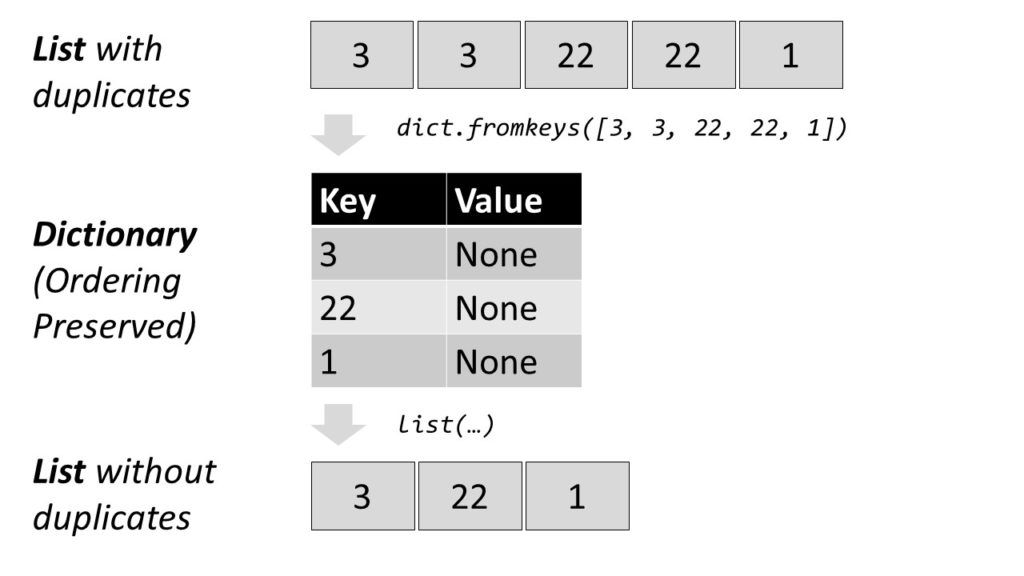
To remove duplicates from a Python list while preserving the order of the elements, use the code list(dict.fromkeys(list)) that goes through two phases: (1) Convert the list to a dict using the dict.fromkeys() function with the list elements as keys and None as dict values. (2) Convert the dictionary back to a list using the list() constructor. As dictionaries preserve the order of the keys, the list ordering is preserved.
Problem: How to remove duplicates from a Python list while keeping the order of the list elements preserved?
You may find this question a little awkward. What has removing duplicates to do with preserving the order of the elements? The reason is simple: a well-known and efficient way to remove duplicates from a list is to convert the list to a set—which is duplicated-free—and converting it back to a list. Here’s what you may find everywhere:
The back-and-forth conversion list(set(lst)) removes all duplicates from the list. However, it doesn’t preserve the order of the elements. In the example, the string 'Alice' now appears before the integer 42.
So, how to remove duplicates while preserving the order of the elements?
The most Pythonic and blazingly fast approach is to use a dictionary:
The dict.fromkeys() method creates a new dictionary using the elements from an iterable as the keys. Python dictionary keys are unique by default so converting our list into a dictionary will remove duplicates automatically. Once this has been done with our initial list, converting the dictionary back results in the duplicate-free list.
This is the most Pythonic way to remove duplicates from a Python list while preserving the order.
Is this method fast? Like sets, dictionaries use hash tables, which means they are extremely fast.
Do you want to develop the skills of a well-rounded Python professional—while getting paid in the process? Become a Python freelancer and order your book Leaving the Rat Race with Python on Amazon (Kindle/Print)!
Do Python Dictionaries Preserve the Ordering of the Keys?
Surprisingly, the dictionary keys in Python preserve the order of the elements. So, yes, the order of the elements is preserved. (source)
Countless online resources like this argue that the order of dictionary keys is not preserved. They assume that the underlying implementation of the dictionary key iterables uses sets—and sets are well-known to be agnostic to the ordering of elements. But this assumption is wrong. The built-in Python dictionary implementation in cPython preserves the order.
You see that the order of elements is preserved so when converting it back, the original ordering of the list elements is still preserved:
print(list(dic))

# ['Alice', 'Bob', 1, 2, 3]
However, you cannot rely on it because any Python implementation could, theoretically, decide not to preserve the order (notice the “COULD” here is 100% theoretical and does not apply to the default cPython implementation).
If you need to be certain that the order is preserved, you can use the ordered dictionary library. In cPython, this is just a wrapper for the default dict implementation.
Removing Duplicates From Ordered Lists For Older Versions
Dictionaries only became ordered in all Python implementations when Python 3.7 was released (this was also an implementation detail of CPython 3.6).
So, if you’re using an older version of Python, you will need to import the OrderedDict class from the collections package in the standard library instead:
from collections import OrderedDict lst = [1, 1, 9, 1, 9, 6, 9, 7] result = list(OrderedDict.fromkeys(lst))
The output is the following duplicate-free list with the order of the elements preserved:
print(result) # [1, 9, 6, 7]
Interactive Code Shell
Let’s try this method in our interactive Python shell:
Exercise: Run the code. Does it work?
You can find more ways to remove duplicates while preserving the order in this detailed blog article:
To become successful in coding, you need to get out there and solve real problems for real people. That’s how you can become a six-figure earner easily. And that’s how you polish the skills you really need in practice. After all, what’s the use of learning theory that nobody ever needs?
Practice projects is how you sharpen your saw in coding!
Do you want to become a code master by focusing on practical code projects that actually earn you money and solve problems for people?
Then become a Python freelance developer! It’s the best way of approaching the task of improving your Python skills—even if you are a complete beginner.
Open World RPG 9th Dawn III: Shadow Of Erthil Launches On Switch Next Week
“Huge” 2D open-world RPG 9th Dawn III: Shadow of Erthil is gearing up for a release on Switch and other platforms next week. It’ll launch on 6th October.
The game is described as a collect-a-thon dungeon crawler “packed full of adventure”, with more than 270 unique monsters to discover as you explore. You’ll also find treasure, loot, more than 300 weapons, and a whopping 550 armour types and accessories. Here’s some PR:
“In 9th Dawn III: Shadow of Erthil, you can improve your character to become the ultimate warrior: Unlock spells and abilities, fine-tune your attributes and skills – and level up your crafting abilities in cooking, weapon smithing, spellcrafting, and more. You can also recruit monsters to fight alongside you – taking care of them and improving their combat skills. Finally, you can also unlock a mysterious companion to fight alongside you …
Need a break? You can put your adventuring on hold and take a breather by enjoying Fyue– a robust card game played throughout the game world with 180 collectible cards. Help the townsfolk raise the prosperity of their villages by embarking on sidequests ranging from silly to ‘Wut?'”
Want more? Here’s a feature list:
– Huge seamless open world full of dungeons, crypts, forts, and villages. – Enormous amounts of loot, collectibles, and customizable gear. – Fyued – an in-depth card game with 180 collectible cards to collect from NPCs. – Monster collecting and leveling-up mechanics; 10+ monsters per character can be used to fight alongside you! – Full orchestral soundtrack. – Craft to create and customize weapons/armor, go fishing and make food, collect gems to create epic jewelry – and much more!
If you’re interested in giving this one a go, you’ll find it available on the eShop for $15.99 when it lands next week.
Feel free to share your thoughts on this one in the comments below. Are you tempted?
Hacked Animal Crossing Items Apparently Removed By Fall Update
Animal Crossing: New Horizons finally received its fall patch today, and while most players are excited to plant pumpkins and dress up in fancy Halloween costumes, it also had an unfortunate side effect that has left many of the game's die-hard fans upset. Some players updated their game only to find that their hacked items have faded away, ruining the carefully-constructed aesthetic of their island.
As with previous Animal Crossing games, intrepid players have used external devices and exploits to get their hands on items buried in New Horizons' code that are unobtainable by other means. (Some players even specialize in visiting other islands and giving out these unauthorized items simply for fun.) These items include star fragment trees and the beloved Harv's fence, which was perceived by the community as an ideal fall decoration. Now, Harv's fence has slipped away, gone like tears in rain.
To be clear, this doesn't affect all of the hacked items in New Horizons. However, Nintendo has definitely sent a message to the game's fanbase: Have fun within the dotted lines, please. Some players are also reporting problems with the game's confusing poster system and its associated catalog, and it's not yet clear if this is intended behavior. Considering Nintendo has just announced that it's bringing back Animal Crossing Amiibo cards, which allow players to collect posters, it's probably yet another crackdown to prevent player cooperation.
The currently free animation tool Cascadeur (previously covered in more detail here) for Windows and Linux, just released a new beta update, Cascadeur 2020.2.
Key new features of the 2020.2b release include:
Quick Rigging tool for humanoid models – you can now create a simple humanoid rig much faster and with less hassle
Simplified Ballistics edit menu and new Ballistic ghosts options – you can now see ghosts of all the ballistic trajectories or only the selected one, but the ballistics in your old scenes will need to be created again
Improved Interval Edit mode – now with Linear and Bezier options
Notification of a new version inside the program – as soon as the new version of Cascadeur becomes available, you will see the announcement directly in the program
Several minor bug fixes and improvements
You can learn more about this new release, including seeing the new Quick Rigging tools in action, in the video below. For more details on creating animations in Cascadeur, be sure to check out this earlier video.
Posted by: xSicKxBot - 09-30-2020, 05:14 PM - Forum: Windows
- No Replies
Helping 10 million learners and counting
Six months ago, we found ourselves facing a global pandemic that threatened to take thousands of lives and majorly disrupt our global economy. And in a short period of time, many of those fears became reality and continue to impact the lives and jobs of millions around the world.
Our number one goal was – and still is – to help those who became unemployed or under-employed due to the pandemic, get the skills they need to find and land their next job. With a quarter of a billion people suddenly without a job, setting up the unemployed with the skills and tools they need became our top priority.
Today, I’m excited to share an update on the program’s progress. And the news is good! As part of the initiative, Microsoft, LinkedIn, and GitHub have collectively reached more than 10 million learners around the globe. Read Ryan’s full post on LinkedIn.