Create an account


Welcome, Guest
You have to register before you can post on our site.

Username
  

Password


Search Forums

(Advanced Search)

Forum Statistics
» Members: 20,205
» Latest member: dylansirois12
» Forum threads: 21,713
» Forum posts: 22,605

Full Statistics

Online Users
There are currently 663 online users.
» 0 Member(s) | 658 Guest(s)
Applebot, Baidu, Bing, Google, Yandex

 
  News - Review: PGA Tour 2K21 – A Good Starting Point For Golf Fans On Switch
Posted by: xSicKxBot - 08-31-2020, 12:22 AM - Forum: Nintendo Discussion - No Replies

Review: PGA Tour 2K21 – A Good Starting Point For Golf Fans On Switch


There hasn’t been an official PGA Tour golf game on a Nintendo system since Tiger Woods PGA Tour 12 chipped onto the Wii nine years ago. With Tiger’s shine dimming over the years and EA seemingly ending its PGA Tour series in 2015 with an underwhelming Rory McIlroy game, that didn’t look like it was going to change any time soon.

Now, though, 2K Sports has picked up the PGA licence, and – just like it did with NBA and WWE, with admittedly mixed results – it’s brought the series to Switch with PGA Tour 2K21. And you know something, it’s not a bad start. Don’t be swayed by the glamour of the 2K branding, though; what we have here is essentially the fourth game in The Golf Club series by Canadian developer HB Studios. 2K took over publishing duties for the last game, The Golf Club 2019 Featuring PGA Tour, and now it’s back with a revamped title to help it fully fit in with the rest of 2K’s sporting output.


PGA Tour 2K21 marks the first time the series has been released on the Switch, however, and given that HB has had to technically downgrade its game to be playable on Nintendo’s system, the results aren’t too shabby. It’s certainly the most realistic looking golf game on the Switch, although when your competition includes Golf Story and What the Golf?, we suppose ‘most realistic’ is a prize it gets purely for existing.

This realism is best realised in the 15 official courses available to you. From the likes of TPC Sawgrass and TPC Twin Cities to the Copperhead Course and the Atlantic Beach Country Club, each course has been accurately recreated with state-of-the-art scanning technology, and it shows. We hope you’ve got a thing for American courses, though, because all 15 of them are based in the US; if you’re a fan of the St Andrews Old Course, Royal County Down or Muirfield, you’re out of luck. As far as this game is concerned, golf only happens in America and your craving for Scottish or Irish courses will have to be fed by downloading fan-made replicas created with the included course designer.


The main meat of PGA Tour 2K21 is its career mode, where you create your own golfer and compete against the best of the rest in an attempt to win the FedEx Cup. You can choose to be dropped straight into a PGA Tour season if that’s what you came for, but if you prefer the feeling of earning it you can start off at the Korn Ferry Tour – the developmental tour for pros who haven’t reached PGA Tour level yet – and try to win your place among the big boys that way. And we do mean boys: although you can create a woman golfer there’s no LPGA licence here, meaning you’ll have to compete against the men (something that would no doubt cause heart attacks for some old duffers in private clubs to this day).

The control system is explained in a brief tutorial (which can be replayed whenever you like) and can take a little getting used to. Rather than the old-school ‘three button press’ method you may be used to in older golf games, PGA Tour 2K21 is all about the right stick, and nothing else. After lining up your shot with the left stick, you pull the right stick back to start your backswing, then push it forward for the downswing.

The quality of your shot obviously depends on how straight you pushed the stick, but the game also takes into account how quickly you moved the stick. Too quickly and it’ll hook to the left, too slowly and it’ll slice to the right. It can be tricky to get this timing nailed down, and you may have a frustrating first few hours lining up perfectly good shots, only for them to end up in the rough or a bunker because you were concentrating so much on moving the stick straight up that you did it too slowly.


If you’re playing on the Pro difficulty, which is the only control system supported in online play, you have to take even more things into account. The wind, the angle of your lie and your elevation all come into play, and you’ll have to consider how all of them will ultimately affect your shot. You may be placing your aim cursor smack dab in the middle of the fairway, but if it’s blowing a gale and you’re in the rough, you may have to move the cursor away from your intended target to compensate.

For some hardened gamers, this is a challenge they’ll be happy to take on. If the idea of starting off at the Korn Ferry Tour and languishing in mid-table spots while you get used to the controls and slowly improve is something that sounds rewarding to you, then you can absolutely do that and you’ll have a good time. For anyone else who craves the simplicity of the older Tiger Woods games, however, there are a bunch of assists that can be turned on to make the process of hitting the ball a lot less daunting.

You can remove the downswing timing if you like, meaning you only need to concentrate on hitting straight shots without also having to worry about whether you’re moving the stick at the right speed. You can also let the game take the likes of wind, lie and elevation into account for you in advance and display a predicted arc showing you the likely path and landing point of your ball. It may not be above-board in the eyes of golf sim purists, but if your sports game tastes lie more on the arcade-style side you can fire through a round in no time like this.


While the WWE series took almost no time at all to fit into 2K’s now-standard process of focusing its career mode heavily on grinding and microtransactions, PGA Tour 2K21 feels oddly unlike a typical 2K Sports release. Your player has no stats to level up, no skills to unlock and while they can earn currency it can only be spent on different outfits: if you find a specific shirt, hat, pair of glasses, etc that you like, you only need to play a couple of rounds to afford it and then you really don’t have to even worry about earning anything else.

Meanwhile, the levelling up system regularly rewards you with other items of clothing and new clubs: the latter are the only way you can change your stats, but it’s not like you’re severely weakened at the start of the game, like you are in the NBA 2K series. As a result, even though you can actually spend real-life money to get more in-game currency, there’s practically zero reason to do so and the game never coerces you to do it. It’s refreshingly happy to just let you get on with things.

The fact it doesn’t feel like a 2K game does have its negatives too, mind you. The NBA and WWE games have fun career modes with a proper plot that plays out through cutscenes and cameo appearances from other pros, but there’s nothing like that here; you simply take on a series of events in an attempt to get better. The most interesting deviation you’ll get is the occasional option to choose a pro to be your ‘rival’ but that doesn’t really amount to much. We’d love an actual story mode in the next game.


There are other issues too, mostly of a technical kind. The course designer present in other versions of the game is here and fully featured, which is massively welcome, but the whole thing slows to such a crawl that it’s an exercise in patience: while we appreciate HB Studios’ efforts in making sure the Switch version isn’t missing any features, this one is maybe a bit too much for the Switch to handle.

Annoying, too, is the fact that almost every time we turned on the game (even if the Switch had been in sleep mode and we were resuming a round we’d already started) a screen came up asking us to agree to let 2K Account have access to our Nintendo Account profile. Even though we agreed to it every time, it kept coming up. More annoyingly, Nintendo sent us an automated email confirming this every time we did it. Oy.

On the course itself, you may quickly realise that the Switch version doesn’t actually have any spectators. From the entry-level tournaments all the way up to the FedEx Cup, you’re basically playing on an empty course with nobody around. Granted, that may be considered realistic at this exact moment in time, but given that the PS4 and Xbox One versions do include crowds we’re relatively sure that ‘pandemic era presentation’ wasn’t supposed to be an official feature of the Switch game.


We also encountered an odd bug while we were on the green. Suddenly everything went completely black except the sky and UI, meaning we had to blindly putt into a hole we couldn’t see. This only happened a couple of times, but the fact it happened more than once suggests it wasn’t a freak one-off. Nitpickers will also point out flickering shadows and the like during certain replay angles, but these don’t detract too much from what’s usually a decent looking game.

Speaking of replays, those are the only times you’ll get to see the officially licensed pro golfers in this game. Despite the fact that PGA Tour 2K21 has Justin Thomas on the box and boasts the likenesses of 11 other pros like Ian Poulter, Sergio Garcia and Jim Furyk, you can’t actually play as them in any of the game’s modes, which may be a bit of a disappointment to anyone buying the game with that purpose in mind.

Instead, you only ever see them when you’re playing in the career mode; every now and then your round is interrupted as the game switches to a highlight of one of the pros elsewhere on the course pulling off a big putt while the commentators coo over how great they are. It’s just like watching golf on TV, or it would be if you had to sit watching a loading screen for 20 seconds every time the show cut away to someone else. It disrupts your game so much that you’ll eventually turn these highlights off, essentially removing the pros from the game too (other than seeing their name on the leaderboards).


There’s still work to be done here, then, and with any luck a few years from now we’ll be singing the praises about PGA Tour 2K24’s in-depth story mode directed by Francis Ford Coppola, with a soundtrack curated exclusively by Jay-Z and more microtransactions than you can shake your PayPal password at. Hmmm, actually, maybe less is more in this case.


https://www.sickgaming.net/blog/2020/08/...on-switch/

Print this item

  News - Fortnite's Season 4 Marvel Costumes Have Special Easter Eggs
Posted by: xSicKxBot - 08-31-2020, 12:22 AM - Forum: Lounge - No Replies

Fortnite's Season 4 Marvel Costumes Have Special Easter Eggs

Fortnite: Chapter 2's Season 4 costumes have some entertaining Easter eggs for players to uncover. Mjolnir, Thor's magical hammer, can only be wielded by skins that it deems worthy. The hammer will transform into a boring pickaxe if you hold the hammer as someone else besides Thor or Captain America.

The hammer became a big part of Season 4 after it created a crater in the map last season. Players had to visit the crater while wearing the Thor skin in order to unlock it. Thor's not the only one that can hold it--Captain America deemed himself worthy in both the comic books and franchise of blockbuster movies by picking the hammer up.

Other costumes have special accessories and Easter eggs as well, but they are limited to the specific Season 4 battle pass skins. Some players are disappointed; they wish they could use the special Marvel back blings and pickaxes with any costume.

Continue Reading at GameSpot

https://www.gamespot.com/articles/fortni...01-10abi2f

Print this item

  (Indie Deal) Milestone & Alawar Sales
Posted by: xSicKxBot - 08-30-2020, 10:08 PM - Forum: Deals or Specials - No Replies

Milestone & Alawar Sales

Milestone Publisher Sale
[www.indiegala.com]
Alawar Entertainment Publisher Sale, up to -90%
[www.indiegala.com]

Stay Inside, Stay Safe and Enjoy Good Games.
Check out IndieGala on Twitter, YouTube & Facebook[www.facebook.com]


https://steamcommunity.com/groups/indieg...7753038767

Print this item

  Xbox Wire - Xbox Insider Release Notes – Alpha (2008.200820-0000)
Posted by: xSicKxBot - 08-30-2020, 07:05 PM - Forum: Xbox Discussion - No Replies

Xbox Insider Release Notes – Alpha (2008.200820-0000)

Hey Xbox Insiders! We have a new Xbox One update preview coming to the Alpha ring. It’s important we note that some updates made in these preview OS builds include background improvements that ensure a quality and stable build for Xbox One.

We continue to post these release notes, even when the noticeable changes to the UI are minimal, so you’re aware when updates are coming to your device. Details can be found below!

Xbox Insider Release Notes

System Update Details:


  • OS version released: RS_XBOX_RELEASE_2008\
  • Available: 6 p.m. PT – August 20, 2020
  • Mandatory: 3 a.m. PT – August 21, 2020

New Features and Experiences


We have exciting news! Alpha users can expect something new coming to their Xbox One update preview.

Privacy and Data Collection

  • For a limited time, users within in Preview Alpha will be able to adjust their optional data collection setting
    • Users will need to navigate to Settings>General>Online safety and family>Privacy & online safety>Data collection and will have the option to change the option.
    • Note: This experience will only be for a limited time and users who wish to continue receiving Preview updates after this period will need to have the setting enabled.

Fixes Implemented


Thanks to the hard work of Xbox engineers, we are happy to announce the following fixes have been implemented for this build:

System

  • Various system performance and stability fixes.
  • Various updates to properly reflect local languages across the console
    • Note: Users participating in Preview may see “odd” text across the console, for more information go here.

Known Issues


We understand some issues have been listed in previous Xbox Insider Release Notes. These items aren’t being ignored, but it will take Xbox engineers more time to find a solution.

We’re still tracking these known issues:


Audio

  • Users who have Dolby Atmos enabled and console display settings set to 120hz with 36 bits per pixel (12-bit) are experiencing loss of Dolby Atmos audio in some situations.
    • Workaround: Disable 120hz or set Video Fidelity to 30 bits per pixel (10-bit) or lower.
  • Some users have reported that Dolby Atmos for Headphones audio setting changes when the console is rebooted/updated.
    • Note: If you attempt to set the audio to Dolby Atmos for Headphones and see a message advising you to launch the Dolby Access App, please file feedback before launching the app.

Game DVR

  • Some users have reported that clips are being recorded without audio. We are aware and investigating.
    • Note: When reporting the issue, please be sure to include details about what resolution, length, and game you were trying to record.

Guide

  • Some users have reported that the audio mixer cannot be used to adjust chat/game audio levels.

My Games & Apps

  • Users have reported seeing black tiles instead of game artwork when browsing their collection.
    • Note: We are still investigating the issue, please report the issue again from the console if you have done so with a prior update and are still seeing this behavior.
  • Some titles in collection may appear with a “trial” tag incorrectly in collection.

New Store Experience

  • Some titles may display a “Not currently available” message on the product page and will be unavailable to purchase
    • Note: Users can use the Microsoft Store on the web or Windows to complete purchases for these items.
  • Users will not be able to use the “gifting” option for both Xbox 360 and original Xbox titles at this time.
  • Users will not be able to use the “Build a bundle” functionality at this time
    • Workaround: Create the bundle via the Microsoft Store on the web or Windows.
  • Xbox Design Lab customization is not currently supported.
    • Workaround: Use the Microsoft Store on the web or Windows to purchase.

Profile Color

  • Sometimes users may encounter the incorrect Profile color when powering on the console.

Make sure to use Report a problem to keep us informed of your issue. We may not be able to respond to everyone, but the data we’ll gather is crucial to finding a resolution.

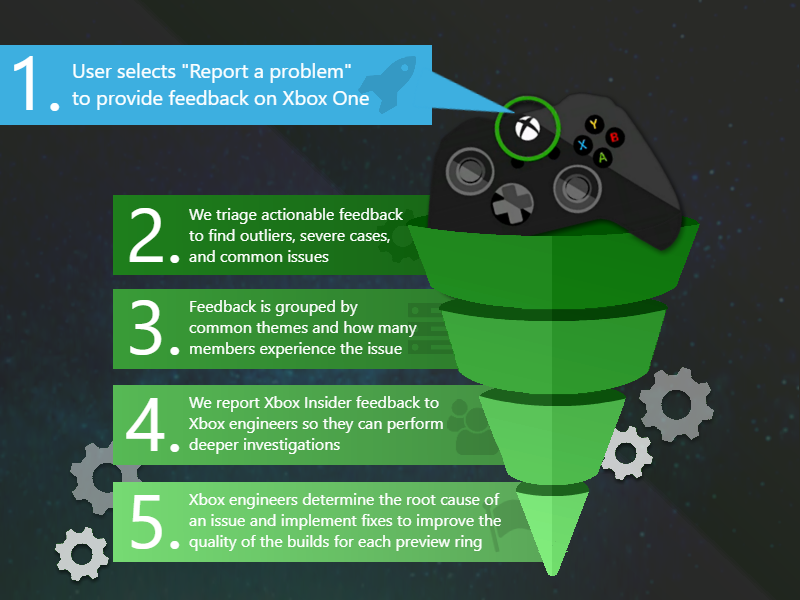
What Happens to Your Feedback

How to Get Xbox Insider Support


If you’re an Xbox Insider looking for support, please reach out to the community subreddit. Official Xbox staff, moderators, and fellow Xbox Insiders are there to help with your concerns.

When posting to the subreddit, please look through most recent posts to see if your issue has already been posted or addressed. We always recommend adding to threads with the same issue before posting a brand new one. This helps us support you the best we can! Don’t forget to use “Report a problem” before posting—the information shared in both places helps us understand your issue better.

Thank you to every Xbox Insider in the subreddit today. We love that it has become such a friendly and community-driven hub of conversation and support.

For more information regarding the Xbox Insider Program follow us on Twitter. Keep an eye on future Xbox Insider Release Notes for more information regarding your Xbox One Update Preview ring!


https://www.sickgaming.net/blog/2020/08/...0820-0000/

Print this item

  News - Get a job: Evil Empire is hiring a Senior Technical Developer
Posted by: xSicKxBot - 08-30-2020, 07:05 PM - Forum: Lounge - No Replies

Get a job: Evil Empire is hiring a Senior Technical Developer

The Gamasutra Job Board is the most diverse, active and established board of its kind for the video game industry!

Here is just one of the many, many positions being advertised right now.

Location: Bordeaux, France

Evil Empire, the new team working on Motion Twin’s smash hit Dead Cells among other ambitious projects, is looking for a Senior Technical Developer with experience working on console platform, engine optimisation and tooling.

As our independent studio grows and new projects kick off, we’ll need key people to help take our games to the next level and navigate the complexity of working with large game platforms, meeting demanding technical requirements and shipping rigorously tested games.

Being a little bit crazy about video games is also handy.

Your responsibilities would include:

  • Integration of the game on new platforms, whether it’s next gen consoles or new and unproven technologies.

  • Integration of relevant SDKs and necessary backend elements that make up the complete package of a game release.

  • Graphics and sound drivers for new platforms when necessary.

  • Engine optimisation and working with the rest of the team to get our games up and running on most anything with a CPU.

  • Tool development and workflow streamlining in conjunction with team leads in order to help the rest of the team do their jobs in the best possible circumstances.

Your profile:

  • You should have at least 5+ years of experience in the games industry with a few shipped games to your name in technical and support programming roles.

  • Experience porting games to console targets managing QA cycles and feedback and generally getting through certification with most of your hair intact.

  • Good working knowledge of low level programming languages (C/C++).

  • Recent experience with modern graphics rendering libraries and best practices.

  • Rigorous, you’re a technical programmer, nothing should get past you, you’re detail orientated and like splitting hairs about the most efficient way to write every line.

  • Excellent written and oral communication skills. You’ll be reading and writing documentation in English all day everyday, you may also have to explain what you’re reading to less senior devs.

  • Ability to analyse problems and discuss them with colleagues, proposing solutions that can be executed as a team.

Bonus points:

  • Experience and working knowledge of Vulkan, SPIR-V and PulseAudio.

  • Experience running dev ops for games you’ve deployed.

  • English (at least B2).

  • Previous work experience in both indie and AAA studios.

Contract: 

  • 38 – 45k per year, depending on experience and profile. More for a star.

  • Full time (CDI) at 35 hours per week.

  • Based in our office in Bordeaux, though work from home and necessary precautions are in place during the COVID19 crisis.

  • Financial and logistical help with relocation (basically we take care of it all).

  • Fringe benefits include; restaurant cheques, as much junk food fruit and good stuff as you can eat, flexible working hours, access to any books and professional development resources as you want and more.

About us:

Evil Empire is a new studio formed by a few ex-Motion Twin people with the intention of creating more Dead Cells and using this as a stepping stone towards making our own games. We work in the same open space as Motion Twin and regularly beat them in Nerf wars and Smash.

The name of our studio is a dig at some of the shadier aspects of the game industry and, if you have a sense of humour, a signal that we’re all about being the exact opposite (and, unfortunately, people didn’t like my “Cat Nap studio” name suggestion – which really says something about their poor taste).

If you’re working at Evil Empire you will NEVER crunch (it’s nuts that this has to be said), you will have excellent health cover, five weeks paid leave, subsidized meals, flexibility with work time, free fruits and other noms and of course as much coffee as you can drink.

We also do regular trips to some of the most legendary gaming events in the world, including excursions to National Parks and other such shenanigans (team building right?), so there’s plenty of opportunities for motivated people to get out and see the world. Well, at least, we were doing this before Covid happened, and plan to do it again if events are ever a thing in the future…

Bordeaux is an awesome city as it’s big enough to have plenty to do, but small enough that you can walk across it in half an hour. Beautiful 19th century architecture and more restaurants than you can poke a stick are a big plus. You’re also 45 minutes drive from the beach and 3 hours from the ski slopes. Access to a very well connected airport and a 2 hour train ride to Paris mean you’re never far away from anything.

Interested? Apply now.

Whether you’re just starting out, looking for something new, or just seeing what’s out there, the Gamasutra Job Board is the place where game developers move ahead in their careers.

Gamasutra’s Job Board is the most diverse, most active, and most established board of its kind in the video game industry, serving companies of all sizes, from indie to triple-A.

Looking for a new job? Get started here. Are you a recruiter looking for talent? Post jobs here.


https://www.sickgaming.net/blog/2020/08/...developer/

Print this item

  News - Don’t Miss: Insomniac Games’ Ratchet & Clank (2016) postmortem
Posted by: xSicKxBot - 08-30-2020, 07:05 PM - Forum: Lounge - No Replies

Don’t Miss: Insomniac Games’ Ratchet & Clank (2016) postmortem

Shaun McCabe is the game director for Ratchet & Clank (PS4), and the production director at Insomniac Games’ studio in Durham, North Carolina.  Chad Dezern is the Creative Director for Ratchet & Clank (PS4), and the studio director of the North Carolina location. The two also co-directed Ratchet & Clank: All 4 One (2011), Ratchet & Clank: Full Frontal Assault (2012), Ratchet & Clank: Into the Nexus (2013).

***

Sure, it seems obvious now. Of course there should be a Ratchet & Clank game to tie in with the major motion picture. But Ratchet & Clank for the PlayStation 4—designed as a killer one-two punch alongside the film, the ultimate version of an origin story—didn’t always seem like such a great idea.

Of course, we were thrilled when we heard that the film was a go. We’ve long felt that Ratchet, Clank, Qwark, and their Solana galaxy milieu had all of the action, humor, pathos, and just plain
. . . bigness . . . to populate a feature. Or six. Hey, it’s a big universe.

But the prospect of making a film tie-in was especially daunting.

First, we had the legacy of the series to consider. This one needed to be a major step forward, but it also needed to retain the soul of the original game. We had 10 Ratchet games under our belts at that point, across the full spectrum: story-driven single player epics. Single player/competitive multiplayer hybrids. Couch co-op. Experiments in form. Experiments in scale. We’ve had universal successes and noble failures. The most recent title, Ratchet & Clank: Into the Nexus, was mostly well received, earning the backhanded compliment/upbeat critique “it was too short, we wanted more.” Okay. We’ll need to make sure the eleventh one is suitably epic.

“We needed to make a big game that blew away our previous efforts. It needed to sync up with the just-getting-started film. And we needed to ship it in 10 months to line up with the movie release.”

Second, there was the prospect of syncing up with film production. What did co-development of a game and film really mean? A lot of variables, that’s what. Sure, the film is based on the original game, and pulls some models from our asset libraries. But the script was in flux (rightly so, it was just getting started). And early conversations pointed to a major cleanup of the backstory, a rework of the character lineup, and the introduction new locations. How would we work out a game macro around that?

And finally, there was our second oldest arch-nemesis, time itself*. We needed to release the game day-in with the film, and time—that grumpy, no-good jerk—was unforgiving. We curled up in fetal positions and hid under our desks for a while.

But ultimately, we uncurled ourselves and climbed up on top of our desks because we love making Ratchet & Clank games. And so do a lot of other people at Insomniac. Even after 16 years, there is tremendous interest and excitement in the series. We all grew up doodling robots, reading science fiction, and watching Star Wars, Back to the Future, and Ghostbusters; it’s safe to say that we were deeply affected by the sense of wonder and fun in that particular strain of summer movie sci-fi.

So, we needed to make a big game that blew away our previous efforts. It needed to sync up with the just-getting-started film. And we needed to ship it in 10 months to line up with the movie release. **

Okay. We’ll stop whining. We love Ratchet & Clank. Sign us up.

*Our oldest arch-nemesis is a man named Paxton Crowlers. 
**This changed, thank goodness.

Within the first 30 seconds of our first conversation about Ratchet & Clank on the PlayStation 4, we knew that we didn’t want to make a remaster or an up-res.

We wanted to apply everything that we’ve learned over the past 15 years. The original game is very much a platformer first and a shooter second. Shooting used a hero-facing mechanic that made it pretty difficult to aim; consequently, there were slower rates of fire, lower ammo counts, and fewer enemies. The weapons that are now the hallmark of the series felt more like gadgets that blew stuff up. Modern third-person shooters are more refined, with a seamless integration of camera and reticle. We felt like it was our sworn duty to modernize the controls, to design the game around a fun and fluid shooting mechanic–but that meant a rework of every weapon, enemy, and setup in the game. It meant effectively rebuilding everything.

Yet we couldn’t imagine a take on Ratchet & Clank that didn’t include hoverboarding on planet Rilgar, infiltrating the Ion Turret on Batalia, or swimming underwater at the Pokitaru resort. We wanted to keep most of the original planets intact, to hit the nostalgia button for our fans and to keep our production time manageable.

We ended up building a new game on top of the original foundation. We started with the main story beats. We chose Ratchet’s home planet on Veldin, Aleero City on planet Kerwan, Drek’s Warbot factory on Quartu, and Drek’s Deplanetizer orbiting weapon as our main locations. These would be shared between the game and film, so we reworked each layout from top to bottom (in the case of Veldin and Aleero City) or designed the location from scratch (in the case of Quartu and the Deplanetizer).

These became our narrative tent poles, matched as closely as possible with the film. Our longtime SCEA producer Greg Phillips was invaluable here; he’s a bottomless well of Ratchet & Clank knowledge.

With the big story points established, we created the gadget-driven progression scheme that opens up new planets. We pulled heavily from the original game. But we gave ourselves permission to diverge. We like the open world planets that started showing up in later games, and we like the jetpack mechanic that we developed for Ratchet & Clank: Into the Nexus. So we expanded planet Gaspar with a huge new jetpack area. The film has an action set-piece ship combat sequence in Aleero City. So we added that, too. We threw a boss battle into the Blarg Research Station because we don’t know when to stop.

After we established the macro design, we realized that we could get a leg up if we used some of the original layouts. So we enlisted help to extract our PS2 level data and import it into our engine (no easy feat, thanks to questionable archival practices; see “what went wrong”). When designers and environment artists moved on to the project, they started with perfect 1:1 replicas of all of the locators and instances from the original. That sped up normally time-consuming design iterations. We spent our bandwidth scripting encounters and polishing enemy setups for the new control scheme instead of grappling with fundamental layout issues.

All told, the final game included modern controls, two new planets, three extensively reworked planets, eight returning planets, a new weapon arsenal, new Clank gameplay, new space combat, new boss battles, and a new weapon arsenal, all wrapped in a structure that matches the film and also represents our best attempt at capturing the soul of the original game.

The film is based on Ratchet’s origin story from the PlayStation 2 game. Ratchet is a Lombax orphan mechanic. Clank is a robot factory defect. The two meet when Clank’s escape pod crash-lands on Ratchet’s adopted home planet.

But the story diverges after that. The film tells a story that is more character-driven and accessible than the (admittedly somewhat rambling) original game—Ratchet is nicer to Clank. Clank’s origin story is easier to understand. There are more secondary characters and fewer planets.

The new game’s macro needed a dramatic revision to match. It had to stand on its own. But it also had to line up perfectly with the film’s re-telling of the story. We couldn’t have mismatched writing, plot points, or visuals.

“Insomniac concept artists were lead visual designers for both the film and game, so visual consistency was baked into the new characters. Still, we didn’t expect to use any film assets at first. We were pleasantly surprised when the pipeline flowed both ways.”

Fortunately, Rainmaker was a great partner. We had access to the earliest scripts and dailies. We had a sense of where the story was headed. Longtime series director Brian Allgeier and series writer TJ Fixman are experts at crafting game narratives that match mechanic progression.

And they had a great idea: why not tell the game story from Captain Qwark’s point of view? That freed us up; now we could take a more involved look at the action on the surface of each planet. We could follow the film, but we weren’t bound to every scene. We could focus on making the pacing feel right for the game.

We shared more than a story—sharing models turned out to be a win, too. Insomniac concept artists Greg Baldwin and Dave Guertin were lead visual designers for both the film and game, so visual consistency was baked into the new characters. Still, we didn’t expect to use any film assets at first. We were pleasantly surprised when the pipeline flowed both ways.

We sent several massive hard drives to Rainmaker, containing every concept image, model, texture, and animation from the PS3 era—a treasure trove of characters, enemies, vehicles, and weapons. We didn’t know if we’d ever see them again. But soon, we received renders back for evaluation. Hey! Clank looks really good—shiny and smooth. And remember that low-poly background hovercar? Here it is again, presented with lovingly polished shaders and film-ready detail, ready for its big-screen debut.

Still, we were big cynics. “Sure, these look nice, but we’ll never be able to use film models in the game,” we surmised. “They’ll need so much optimization, we’ll be better off starting from scratch.”

But we convinced ourselves to try it. We opened a test model up in Maya, and it was like peering into that briefcase from Pulp Fiction.

The models were very, very close to what we’d need for the PlayStation 4—they were clean, quad-based, and in line with our density target. Sure, they needed some work. Textures needed uv space allocation, shaders needed to be authored for our engine, characters needed to be re-rigged for our tools. But getting these character models—this close to going into the game, without the usual concept-to-z-brush-to-maya-to-engine pipeline—was a big efficiency. We had our full stable of main characters ready to go before the end of preproduction.

The game-to-film-to-game pipeline didn’t stop there. We had the surreal experience of sending off environment concept images, seeing location renders from the film, grabbing film background models and dropping them in the game, then matching the whole thing up with shaders, lighting, and post effects. This has to be the first hardware generation that this is possible, and it’s glorious. Welcome to the utopian future!


Nefarious Mech

A compressed schedule, a new platform and our first cross-studio collaboration – any single one of these challenges suggested we were in for challenging production. And yet, Ratchet & Clank PS4 turned out to be among the smoothest productions in Insomniac history. Eerily smooth. We still expect to wake up and discover that it was all a dream…

The compressed schedule limited the number of new features we could add to our engine. So instead of the usual laundry list of engine requests we compile at the start of a project, Ratchet & Clank PS4 had only a couple: “PS4 support” and, well, “fur rendering” (cuz Ratchet). And while this meant a number of “wants” had to wait for the future, it also meant avoiding the sort of large-scale changes that end up slowing down production.

We also benefited from global code sharing practices. In our old engine, Insomniac was simply not good about sharing code between franchises. For example, the Ratchet & Clank and Resistance titles are known for their weapons. The underlying code, however, was really different. So while we were achieving the user-facing goal of innovative weapons, we weren’t being efficient about it.

Moving into our new engine, our gameplay and engine leads instituted code-sharing policies that aimed to share as much code as possible between projects. We now regularly percolate shared gameplay and engine systems through all projects. And we encourage programmers to pursue “shared” solutions whenever possible. The result was a huge efficiency boost without detracting from the player experience; both Fuse and Sunset Overdrive continued the Insomniac tradition of innovative weapons without paying such a big cost.

By the time Ratchet & Clank for Playstation 4 kicked off, we had a lot to draw from – hero, controls, weapons and other core systems were already in place. This allowed us to get up and running on the PC in a matter of days – perhaps the fastest start for any Insomniac project. This early momentum continued through preproduction. In just a few weeks, we created an in-engine proof-of-concept that in a short vignette demonstrated the promise of Ratchet & Clank on the Playstation 4 (hint: it’s hidden in the game and includes a gardening bot). And we wrapped up a 3-month preproduction by delivering a fully-playable proof-of-concept featuring an updated version of Metropolis.

In the end, doing less and sharing more enabled us to establish a solid foundation and build momentum that sustained us throughout the entire project.


ClankBots

We knew that Ratchet & Clank would be the first console game for many kids. If all goes well, we thought, it’ll be a formative memory—the beginning of a lifetime of healthy game playing habits.

We took this responsibility seriously. SCEA’s well-appointed usability test lab and its excellent staff were a godsend; we tested the game early and often with 7-9 year olds, even during pre-production. Our first test used greybox geometry to make sure that we were on the right track with the new Clank gameplay. We were encouraged to see that kids could articulate solutions to the puzzles, even if they didn’t understand all of the component pieces. We didn’t need to make the puzzles any easier, we just needed to clean up some of our messaging.

Later tests revealed that very young players tended to ignore the right analog stick; they didn’t quite grasp the benefit of moving the camera, and weren’t quite coordinated enough to move two sticks at once. So we designed levels with as few sharp turns as possible. And we created a casual control mode that allowed for movement with the d-pad. This broadened our potential audience, with no negative consequences for the other difficulty modes.

Usability tests are not for the faint of heart, and Ratchet & Clank’s tests had their fair share of head-scratching mistakes and hair-pulling difficulty spikes. Overall, though, it was inspiring to watch even the youngest players play the game. They couldn’t stop talking about it, even when we begged them to stay quiet to avoid skewing test results. By our later tests, the kid groups finished with play times similar to seasoned adult gamers: proof that our difficulty tuning worked.


Constructobot

Insomniac is comprised of two locations: one in Burbank, CA and one in Durham, NC. Both are lousy with Ratchet & Clank experts.

On both coasts, there are animators familiar with every nuance of Ratchet’s moveset. Designers with a deep understanding of enemy swarmer behaviors. Programmers well-versed in crate destruction physics. Environment artists deeply imprinted with the visual style tenets of the series. Brian Hastings—credited with the original “an alien travels from planet-to-planet” pitch- resides in Burbank. Dave Guertin—credited with Ratchet’s original character design—resides in Durham. We wanted to work with a dream team of all of these people.

By working cross-country, with a development team that spanned studios in almost exactly equal numbers, we tapped into the full power of our collective knowledge. Further, this allowed us to run an efficiently staffed production. We started with a small team in NC during preproduction, grew to a larger size during production, then rolled off most developers and polished with a small team. The headcount chart was a project manager’s dream.

But as it turned out, it was a bit of a nightmare for everyone else.

We’re not being glib here. We have to list this in both categories. It was the single biggest win for the project, but it was also the single biggest source of pain.

Why? Because culture.

We thrive on “face time” at Insomniac. When Insomniacs talk about breakthrough moments, they almost always involve a small, multidisciplinary group gathered around a monitor to solve a problem. We use tools like email, IM and yes, even the telephone, when it makes sense. But we ultimately thrive on informal, in-person “collisions” – that’s when we do our best work.

Ratchet & Clank for the Playstation 4 wasn’t our first foray into remote collaboration. Over the years, we’ve supported offsite employees and contractors. And a handful of Insomniacs in our Durham, NC studio worked directly on Sunset Overdrive, primarily developed in Burbank, CA. Ratchet & Clank, however, was a whole new level of remote collaboration.

Going into production, our goal was to support “bi-coastal breakthroughs”, taking what’s worked so well for us over the years and splitting it across studios.

We tried cross-studio, multidisciplinary strike teams. We bought HD cameras for every team member and strongly encouraged video chat over IM or email. And we established on-site leads in each studio so folks had daily in-person contact with their manager.

Some things, like the HD cameras, were a big win; the “face time” helped foster unity on a team many of whom had never met each other in person before. Today, video chat is the tool of choice for inter-office communication at Insomniac.

The cross-studio strike teams, on the other handed, proved more challenging. Despite everyone’s best intentions, iteration time slowed down thanks to time zone differences and communication overhead. The impromptu brainstorm meetings that are the backbone of our work became formal and rigid. In the end, we reorganized the teams so most members of a feature group were on-site together. Our next cross-studio collaboration, Edge of Nowhere, we adopted the “same-site strike team” approach whenever possible and saw a big improvement over our initial approach on Ratchet.

Finally, on the leadership side, we discovered that our flat hierarchy and reliance on individual empowerment doesn’t always work for remote development. So one of the first things we did on Edge of Nowhere was creative a “team structure” document aimed at giving people a clearer sense of the decision-making hierarchy and to whom they should go when issues came up.

As the saying goes, “culture eats strategy for breakfast” – we have to be careful in our effort to foster “bi-coastal breakthroughs”. Again, because culture. But we also know that with talented Insomniacs around the world and amazing opportunities on the horizon, we’d be foolish to stop trying.

You’d think we’d value our own work. But sometimes, we move from project to project so quickly that we forget to label and store everything. If I had a time machine, I’d send myself a nasty letter—“give everything a descriptive name and archive it, you idiot!”

“You’d think we’d value our own work. But sometimes, we move from project to project so quickly that we forget to label and store everything. If I had a time machine, I’d send myself a nasty letter—’give everything a descriptive name and archive it, you idiot!'”

We simply don’t have access to our source files from the PS2 era. Back then, we had a numbers-only naming convention, with number-to-name directories scribbled in private notebooks. We used a home brewed asset management system that we can no longer access. And our directory structure was a free-for-all, with source files frequently hidden away on local directories.

(You’re probably aghast, but that’s not the worst of it. We also used Hot Wheels as an asset control system. Seriously—if you wanted to check out a level, you’d grab the corresponding Hot Wheel to signal that it was yours for editing. Level 6 was the 1968 Beatnik Bandit. I always liked that one. Wait, maybe that system was pretty cool).

Anyway, our PS3 era assets are more accessible—we used Perforce at that point, finally—but still plagued by questionable naming practices and haphazard structure. Finding things usually involves messaging the person who made it, which makes asset wrangling the domain of the few people who remember that sort of thing. Thanks goodness for Greg Baldwin and his encyclopedic knowledge of the character and weapon lineup.

Luckily, the PlayStation 3 R&C Collection proved to be our saving grace. Idol Minds went through the painful process of extracting our assets from the PS2 master disc for the collection. We realized early on that we could use those libraries. So we enlisted support from technology consulting firm Tin Giant to extract data from the collection and convert it to our engine formats. Amusingly (to us, anyway) the assets retained metadata from the PS2, so we got to revisit our asset numbering system and remember our fledgling development practices.

We’re now a lot better at naming assets, maintaining clean directories, and keeping our data accessible, by the way. We learned the hard way.


Agents of Dor

Here’s another one for the depressingly thick “mistakes we make every single time” file.

We’re really bad at scheduling cinematics.

We think we know how long they’ll take. We base our estimates on the script—one minute per page is a good rule of thumb—plus some lessons learned over the years about dialogue-heavy scenes vs. event-driven scenes. We go back and forth to make the script manageable. We try to leave some buffer. It’s never enough.

We always forget to take ambition into account. We’re never satisfied with just the story cutscenes, just the basics. We want elegant transitions between every gameplay segment. We want NPCs to have more fluidity and expression than we initially planned. We want Ratchet and Clank to jump seamlessly into their new Galactic Ranger ship, and then we want the ship to fly to the stars on a custom path authored for that specific level. If we don’t have even one of those things, we get very sad and everyone pouts.

Keyframed animation is a big part of the appeal of the series, and squash and stretch takes time. Our animators tend to love the work, so they push themselves hard against an unforgiving schedule. Thank goodness the work is fun, because there sure is a lot of it.

That’s no excuse. We need to get better at scheduling this stuff. We’re applying a multi-pronged solution: we’re now creating animatics for connective cutscenes at the early greybox phase, just as we’re wiring up the game. We use the animatics to understand what we’re getting ourselves into, with a more rigorous review process that takes character numbers, blocking complexity, and shot composition into account. We derive the schedule from feedback from the animators based on that visualization.

We’ll inevitably find scenes that weren’t obviously necessary until we played through the game from start to finish. That’s just the nature of it. So we’ll keep building in that buffer to save us from ourselves.

We like to start projects with a small preproduction team, grow for production and then roll people off as we hit Alpha, Beta and then Gold. The extra time on Ratchet & Clank PS4, however, really threw a wrench into the gears (knew we’d do that at least once, right?).

“We had only two programmers, and, for the last few months, only one designer.”

We had the opportunity to extend development by several months. But most of the production team needed to roll onto other projects based on our original Gold and besides, we didn’t have the headroom in the budget to accommodate a significant increase in labor.

In order to make it work, we rolled the majority of people off at our original Gold (which became Alpha) and finished the game with a small polish team.

This is awesome because at a certain point, you can just get more done with fewer people (our project manager would certainly agree). But it also meant that we had to take the work of an entire, full-scope Ratchet & Clank game and spread it among just a handful of people. We had only two programmers responsible and for the last few months, only one designer.

Our tiny postproduction team were champions. They took on a monster of a challenge and delivered as polished a Ratchet & Clank experience as we’ve ever done. In the future, however, we’d like to stick to a gradual rolloff that scales the team size with the work remaining.


Big Al

We take pride in our ability to hit our dates and finish strong. So while the prospect of delivering the gold master in ten months seemed a little crazy, it was also the sort of crazy that an Insomniac could get into.

We soon learned, however, that film release dates are far more fluid than those of games. Release windows mean everything to a film’s success. And given the competitive nature of the market, there’s little incentive for distributors to lock down dates too early.

For us, this meant more stops and starts than we’re used to. We’d be geared up for a strong finish only to learn that the finish line had been moved back. And while the extra time would ease some of the pressure, it was also a bit of a letdown.

Don’t get us wrong, we’re thrilled to have had the extra time and know that it made a difference to the end product. But we also learned that extra time can be as emotionally draining as not enough time.

The Universe is vast and mysterious


Pool Shark

At this moment, we have no idea. We’re walking around with VR headsets strapped to our faces.

But we’re delighted by the reaction to the game, amazed and humbled that there’s still an appetite for Lombax and robot adventures after three console generations. For all of our initial hand wringing, we’re proud of it. The lessons we learned during development helped us improve our cross-studio coordination, plan our cinematics with more detail, and move through production cycles more gracefully.

So who knows?

What we do know is that Ratchet & Clank games are incredibly fun to make. There is intense passion at Insomniac for the universe and its characters. There are stories to tell, weapons to design, creatures to sculpt, planets to explore. And most significantly, there is a team of talented people here who have come through time and again to deliver games that are full of life and ambition. Above all, that’s why the series endures.



https://www.sickgaming.net/blog/2020/08/...ostmortem/

Print this item

  News - Review: A Short Hike – A Landmark Game For All Ages
Posted by: xSicKxBot - 08-30-2020, 04:43 PM - Forum: Nintendo Discussion - No Replies

Review: A Short Hike – A Landmark Game For All Ages


Why do we play games? Exploration would seem to be the watchword, the catalyst for every element of the most diverse and interesting form of entertainment there is. It doesn’t matter what you’re exploring; all that matters is that it’s happening. In the most traditional sense, you’re exploring an unfamiliar, possibly mystical locale. On a less narrative level, you’re exploring your own ability, your skill. You’re exploring the tactics of your opponent. Exploring the art funnelled into a game by its talented creators. That’s what gaming is; exploration.

Forgive the pretentious first paragraph, there. Some games inspire such reflection on what this (alleged) art form is all about. What we get out of gaming, fundamentally, regardless of the myriad genres, platforms, styles, budgets, controls. Whatever that elusive, universal experience is, A Short Hike has it. In spades.

You play as Claire, a little bird (or birb, to use the parlance of the internet) on holiday in a place called Hawk Peak. In a quest to find a mobile phone signal, she must reach higher ground. So you do. But just like life, there are plenty of distractions on the way. Hawk Peak is a small, contained, compact place but it’s rich with things to do, all of which are refreshingly organic in their presentation.


Climbing the mountain itself is the primary goal of A Short Hike, portrayed as a semi-isometric 3D platformer of sorts where your objective of reaching the summit is hindered by Claire’s lack of flight ability and energy, a resource increased by finding or buying Golden Feathers – each one allowing you to perform an additional jump in the air, as well as climb up sheer surfaces for longer. Think Breath of the Wild’s stamina system, but more concise.

En route to acquiring said feathers, though, are the distractions we mentioned. Fellow hikers, holiday-goers and natives mill around the island, going about their business. Chatting with them elicits breezy, likeable dialogue that’s neither bogged down with exposition nor so quirky is obfuscates crucial information. You’ll be able to meet (and race against) marathon runners, grab a fishing rod, take in a quick game of volleyball, trade a kid’s toy shovel for a real one (and dig up coins and treasure chests with it)… every action contributes marvellously towards your overall goals.

You’ll come up against walls in your progress as you play – often literally, a wall you’re not able to climb – but, brilliantly, your options on how to circumvent this are completely free and open. Even in the early game you’re able to explore a sizeable chunk of the island; that first Golden Feather at the visitor’s centre is signposted to some extent, but we went off exploring beforehand, managing to find some seashells, dig up some treasure and even stumble across a Feather that made us feel like we’d broken the game, only – of course – its discovery was entirely within the game’s parameters. That’s another thing A Short Hike excels at: making you feel like you’re pushing at its limits. Getting one over on it. Even when, of course, you’re not.


As you ascend higher and higher, you’ll find new twists and tweaks to the established controls and systems, gameplay variation without the frustration of a brand new mechanic at the eleventh hour. The difficulty increases, but while the terrain is hostile the game certainly isn’t; yes, you can tumble down the mountain and lose progress (it’ll never take you long to get back to where you were), but in the process of doing so you may find yourself in a new area full of stuff to see and do, or even just an old area from a new angle. A sudden reminder that, hey, you can make that jump now. Or if you climb back up even halfway, you can glide to that previously-unreachable seashell… and that gives you enough to take back to the kid who wanted them… but on the way there, you’ll realise you didn’t win that race yet… but in passing, you’ve acquired enough coins for another Feather, which means you can get back up the mountain quicker and easier… which… (and so on).

It’s that sort of game – a constantly giving, rewarding little box of joys. And when you finally make it to the top of the mountain and witness the game’s denouement, you’ll find the entire mountain, the climb, the struggle all thrown into a new perspective, both in terms of its narrative and, well, the fact you’ve got to make your way back down now. Remember how Celeste’s mountain was a metaphor? A Short Hike’s is a little less on-the-nose; a game whose journey has whatever meaning and resonance you choose to pour into it. It’s a story as freeform as its gameplay, a perfect synergy of everything video games do well. And we haven’t even mentioned the beautiful, lo-fi pixellated polygonal graphics. Or the lilting, evocative soundtrack. When everything compliments everything else so brilliantly, you barely even notice them. That’s what it means to be a truly complete game.


Nonetheless, we’ll give them some time in the sun – A Short Hike is beautiful to look at it. It’s visually more complex than it seems, managing to marry its attractive and unique visuals with the similarly undulating box of treats that it’s portraying. The music, too, is extremely fitting – pastoral when it needs to be, triumphant when you earn that triumph. Naturally, the whole things at 60 frames per second, and the controls are smoother than butter.

If we had to dig for any real criticisms, we could argue that A Short Hike is too, well, short, but to do so would miss the point. Making a beeline for the summit and ignoring the wealth of wonderful distractions, secrets and easter eggs is forcing the game into a round hole when it’s very much a square peg. A straight shot to the summit will take you an hour, tops. But it’s a hike, not a sprint. Except for the optional sprint you can take part in, of course. Maybe, maybe the ability to switch our equipped tool with the shoulder buttons may have been cool, but the game never requires any kind of rapid flicking between your inventory, so it’s almost entirely moot.


A game where we need to really dig for anything at all to complain about. You love to see it.

Conclusion


A Short Hike is a fat-free experience from top to bottom – or should we say bottom to top? It’s the kind of game that makes us just sigh with happiness when we recall our time with it, and even having played it through to its ostensible conclusion multiple times, we know for a fact there are still things to see and do on that mountain. What we have here is something of an apotheosis – a milestone in indie games akin to Cave Story, or Spelunky. The very best bits of multiple game genres, stripped of all padding and bloat, mixed perfectly into a delicious video game stew that only gets richer and richer the more you play. An exploration in every sense of the word, A Short Hike is cute without being twee, challenging without being obnoxious, and emotional without being cloying. A landmark game for all ages. Don’t miss this one.


https://www.sickgaming.net/blog/2020/08/...-all-ages/

Print this item

  News - Marvel's Avengers: Here's How Gear And Cosmetics Work
Posted by: xSicKxBot - 08-30-2020, 04:43 PM - Forum: Lounge - No Replies

Marvel's Avengers: Here's How Gear And Cosmetics Work

Marvel's Avengers officially lands on September 4 for PC, PlayStation 4, Stadia, and Xbox One, and developer Crystal Dynamics has shared more details on how the games cosmetics, currencies, and Hero Challenge Cards will function.

Cosmetics

Players will be able to earn four types of cosmetics throughout Marvel's Avengers. Outfits are aesthetic-only costumes that feature no pay-to-win elements, emotes can be used to express the personalities of heroes, and takedowns allow for unique finishing animations on the battlefield. Nameplates show off your hero's stats and feature art that has been pulled from the vaults of Marvel history.

Vendors

Marvel's Avengers Roy The Vendor

To earn cosmetics and other gear, players will be able to visit one of several vendors who can be found in multiple locations in the game world. In addition to cosmetics, gear and rare resources can also be purchased with the Units currency and common resources. Players can find common, rare, and exotic resources in crates, dismantled artifacts, and as Faction Assignment rewards. Hero Challenge Card achievements and defeated enemies will also drop these rewards. These resources can then be spent at a Gear Vendor, whose inventory rotates through daily and weekly stock.

Continue Reading at GameSpot

https://www.gamespot.com/articles/marvel...01-10abi2f

Print this item

  [Tut] How To Ask Users For Input Until They Provide a Valid Input?
Posted by: xSicKxBot - 08-30-2020, 09:51 AM - Forum: Python - No Replies

How To Ask Users For Input Until They Provide a Valid Input?

To accept valid inputs from the user either use a While Loop With Custom Validations or use the PyInputPlus module to avoid tedious validation definitions. Some other methods may also fascinate you which have been discussed below.

Problem: Given a user input; accept the input only if it is valid otherwise ask the user to re-enter the input in the correct format.

Any user input must be validated before being processed, without proper validation of user input the code is most certainly going to have errors or bugs. The values that you want a user to enter and the values that they provide as an input can be completely different. For example, you want a user to enter their age as a positive valid numerical value, in this case, your code should not accept any invalid input like a negative number or words.

#note:  In Python 2.7, raw_input() is used to get a user input whereas in python 3 and above input() is used to get user input. input() always converts the user input into a string, so you need to typecast it into another data type if you want to use the input in another format.

Example:

age = int(input("What is your age: "))
if age >= 18: print("You are an Adult!")
else: print("You are not an Adult!")

Output:

What is your age: 25
You are an Adult!

However, the code does not work when the user enters invalid input. (This is what we want to avoid. Instead of an error, we want the user to re-enter a valid input.)

What is your age: twenty five
Traceback (most recent call last): File "C:/Users/Shubham-PC/PycharmProjects/pythonProject/main.py", line 1, in <module> age = int(input("What is your age: "))
ValueError: invalid literal for int() with base 10: 'twenty five'

Now that we have an overview of our problem, let us dive straight into the solutions.

Let’s get a quick overview of the first two solutions discussed in this article:

Method 1: Implement Input Validation Using While Loop And Exception Handling


The easiest solution is to accept user input in a while loop within a try statement and use continue when the user enters invalid input and break statement to come out of the loop once the user enters a valid or correct input value. 

Let us have a look at the following code to understand this concept:

Exercise: Run the code and try to break it by using wrong inputs. What happens?

Here’s the code to copy&paste:

while True: try: age = int(input("What is your age: ")) except ValueError: print("Please Enter a valid age.") continue else: if age > 0: break else: print("Age should be greater than 0!")
if age >= 18: print("You are an adult!")
else: print("You are not an adult!")

Output:

What is your age: twenty five
Please Enter a valid age.
What is your age: -25
Age should be greater than 0!
What is your age: 25
You are an adult!

Method 2: Using Python’s PyInputPlus module


Another way of managing user inputs is by using the PyInputPlus module which contains functions for accepting specific data inputs from the user like numbers, dates, email addresses, etc. You can read more about this module in the official documentation here.

Using the PyInputPlus module function we can ensure that the user input is valid because if a user enters invalid input, PyInputPlus will prompt the user to re-enter a valid input. Let us have a look at the code given below to get a better grip on the usage of PyInputPlus for validating user input.

Disclaimer: PyInputPlus is not a part of Python’s standard library. Thus you have to install it separately using Pip.

import pyinputplus as pyip # User is prompted to enter the age and the min argument ensures minimum age is 1
age = pyip.inputInt(prompt="Please enter your age: ", min=1)
if age >= 18: print("You are an Adult!")
else: print("You are not an Adult!")

Output:

Please enter your age: -1
Number must be at minimum 1.
Please enter your age: twenty five 'twenty five' is not an integer.
Please enter your age: 25
You are an Adult!

Method 3: Implementing Recursion


Another way of prompting the user to enter a valid input every time the user enters an invalid value is to make use of recursion. Recursion allows you to avoid the use of a loop. However, this method works fine most of the time unless the user enters the invalid data too many times. In that case, the code will terminate with a RuntimeError: maximum recursion depth exceeded.

def valid_input(): try: age = int(input("Enter your Age: ")) except ValueError: print("Please Enter a valid age. The Age must be a numerical value!") return valid_input() if age <= 0: print("Your Age must be a positive numerical value!") return valid_input() else: return age x = valid_input()
if x >= 18: print("You are an Adult!")
else: print("You are not an Adult!")

Output:

Enter your Age: -1
Your Age must be a positive numerical value!
Enter your Age: twenty five
Please Enter a valid age. The Age must be a numerical value!
Enter your Age: 25
You are an Adult!

Method 4: A Quick Hack Using Lambda Function


Though this method might not be the best in terms of code complexities, however, it might come in handy in situations where you want to use a function once and then throw it away after the purpose is served. Also, this method displays how long pieces of codes can be minimized, hence this method makes a worthy entry into the list of our proposed solutions.

valid = lambda age: (age.isdigit() and int(age) > 0 and ( (int(age) >= 18 and "You are an Adult!") or "You are not an Adult")) or \ valid(input( "Invalid input.Please make sure your Age is a valid numerical vaule!\nPlease enter your age: "))
print(valid(input("Please enter your age: ")))

Output:

Please enter your age: -1
Invalid input. Please make sure your Age is a valid numerical vaule!
Please enter your age: 0
Invalid input. Please make sure your Age is a valid numerical vaule!
Please enter your age: twenty five
Invalid input. Please make sure your Age is a valid numerical vaule!
Please enter your age: 25
You are an Adult!

Conclusion


Thus proper validation of user input is of utmost importance for a bug-free code and the methods suggested above might prove to be instrumental in achieving our cause. I prefer the use of PyInputPlus module since defining custom validations might get tedious in case of complex requirements. Also, the use of recursive methods must be avoided unless you are sure about your requirements since they require more memory space and often throw Stack Overflow Exceptions when operations are too large.

I hope you found this article helpful and it helps you to accept valid user inputs with ease. Stay tuned for more interesting stuff in the future!

Where to Go From Here?


Enough theory, let’s get some practice!

To become successful in coding, you need to get out there and solve real problems for real people. That’s how you can become a six-figure earner easily. And that’s how you polish the skills you really need in practice. After all, what’s the use of learning theory that nobody ever needs?

Practice projects is how you sharpen your saw in coding!

Do you want to become a code master by focusing on practical code projects that actually earn you money and solve problems for people?

Then become a Python freelance developer! It’s the best way of approaching the task of improving your Python skills—even if you are a complete beginner.

Join my free webinar “How to Build Your High-Income Skill Python” and watch how I grew my coding business online and how you can, too—from the comfort of your own home.

Join the free webinar now!


https://www.sickgaming.net/blog/2020/08/...lid-input/

Print this item

  (Indie Deal) Milestone & Alawar Sales
Posted by: xSicKxBot - 08-30-2020, 09:51 AM - Forum: Deals or Specials - No Replies

Milestone & Alawar Sales

Milestone Publisher Sale
[www.indiegala.com]
Alawar Entertainment Publisher Sale, up to -90%
[www.indiegala.com]

Stay Inside, Stay Safe and Enjoy Good Games.
Check out IndieGala on Twitter, YouTube & Facebook[www.facebook.com]


https://steamcommunity.com/groups/indieg...7753038767

Print this item

 
Latest Threads
(Xbox One) Vantage - Mod ...
Last Post: dylansirois12
2 hours ago
WoW Admin Panel (Probably...
Last Post: Berrybrave
6 hours ago
Black Ops (BO1, T5) DLC's...
Last Post: Prdzch
6 hours ago
(Indie Deal) Approaching ...
Last Post: xSicKxBot
9 hours ago
News - GDQ Cancels SNK St...
Last Post: xSicKxBot
9 hours ago
Redacted T6 Nightly Offli...
Last Post: Ber2128
Today, 01:40 AM
(Indie Deal) FREE Brocco,...
Last Post: xSicKxBot
Yesterday, 04:36 PM
(Free Game Key) Epic Game...
Last Post: xSicKxBot
Yesterday, 04:36 PM
News - The New PlayStatio...
Last Post: xSicKxBot
Yesterday, 04:36 PM
(Indie Deal) No Clean Sta...
Last Post: xSicKxBot
Yesterday, 12:15 AM

Forum software by © MyBB Theme © iAndrew 2016