Monster Hunter publisher Capcom reported Friday a year on year decline in annual sales, but a jump in profits for its full fiscal year.
The company said the past year is the seventh consecutive year of operating income growth and the fourth year in a row of record-high profits.
Sales for the fiscal year ended March 31 were 82 billion yen ($770 million), down 18 percent compared to the previous year, while operating income was up 26 percent to 23 billion yen.
The company attributed the profit increase to high-margin digital sales. Games including Monster Hunter World: Iceborne, and catalog sales of Resident Evil 2 and Devil May Cry 5 helped drive sales during the year. Capcom’s new pachislot game Shin Onimusha also experienced better than expected sales.
For the current fiscal year, Capcom expects net sales of 85 billion yen and operating income of 26 billion yen.
Blog: Understanding open world level design – Part 1
The following blog post, unless otherwise noted, was written by a member of Gamasutras community. The thoughts and opinions expressed are those of the writer and not Gamasutra or its parent company.
Open world games: They attract players with their promise of freedom and immersion and arouse the interest of publishers because of their business prospects.
These games feature a very specific characteristic: Their level design is more important than their game system. The vast majority of open world games offer very classic game mechanics and it is not they who seduce, it is the open world itself, hence the level design.
In most games, the design team first defines the core gameplay, then tackles the level design; the latter serving as a field of application for the game system. But in an open world game, the opposite is desirable: First, define the main characteristics of the open world, then select the most suitable game mechanisms.
Level design is one of my specialties and I had the chance to work on several open world games: The Black Death, Cabela’s African Adventures, Duck Dynasty, etc. The purpose of this 5-parts publication is to give good foundations to a studio that would engage in such a development but also to a publisher who would have to make editorial choices regarding an upcoming open world game.
The “why” must precede the “how”
When attacking reflections on the design of an open world game, there is a fundamental question that must be asked: Why? Why do we want an open world?
This question deserves a minimum of thoughts because the answer will have a major impact on the content of the open world and therefore, its game mechanics.
Schematically, there are three strategies for using level design in an open world game:
Strategy # 1, conquering players’ game time.
This strategy is at work in several Ubisoft franchises such as Far Cry, Ghost Recon and The Division. Its objective is to offer a huge lifespan to the game. It is achieved by increasing the number of quests, renewing the content of the open world constantly and supporting “farming” mechanisms. As a reminder, “farming” consists, in a game, to encourage players to collect or gain large amounts of resources so that they improve the attributes of their characters, their equipment, etc.
What are the benefits of this strategy?
• The longer players play a given game, the more chance there is of selling them additional content (DLC, cosmetic items, etc.). The latter has become a significant complement to the income generated by the sales of the game itself.
• A game that offers an “infinite” gaming experience is much less likely to fuel the second-hand market because players keep them. This is less the case with a game that offers a linear and limited playing experience, either by its scenario or by the number of levels it offers.
• When a game is played for a long time and its lifespan is fueled by additional, paid or free content, it remains present in the media and the minds of players. Its publisher can thus maintain the visibility of its intellectual property.
• Finally, it is easier to sell a game that offers a long life at a high price, as buyers feel that they are getting their money’s worth.
On the other hand, the systemic dimension of the game mechanisms can make the open world repetitive and weaken its gameplay. In addition, it is more difficult to integrate a convincing narrative into it.
I will come back in more detail in a later part on the game mechanisms and good practices in terms of level design for open world games seeking to implement such a strategy.
Strategy # 2, priority to immersion.
Red Dead Redemption 2 or the first titles in the Assassin’s Creed series are good examples of this strategy. It attracts players by transporting them to a universe that is credible and that interests them. The high level of credibility is obtained thanks to the attention to detail, the historical references and the behaviors of the NPCs (non-player characters) who populate these worlds. Finally, it is the choice of theme that makes these universes interesting: Florence in the Renaissance, America in the late 19th century, etc.
The advantages of this strategy are as follows:
• Its first strong point is the attractiveness of the chosen theme. Players interested in their themes become potential buyers.
• Another advantage is that this strategy facilitates the implementation of quality storytelling. Indeed, if the game world is credible, it is easier to build characters and scenarios that are also credible, two characteristics of good storytelling. The latter attracts some players and has shown that it can bring real added value to many games. As proof, the excellent The Last Of Us, which perfectly combines efficient gameplay and high-quality storytelling.
On the side of the weak points, this concern for details complicates the development, and therefore the cost of development. In addition, the need to make the game environment credible has an impact on the density of actions offered to the player but also on the evolution of skills, powers, and equipment of the character controlled by the players, thus running the risk of weakening the gameplay.
Strategy #3, the map is the challenge.
This strategy is at the heart of survival games such as The Long Dark, DayZ or The Forest. In most open world games, the map is mainly used to support quests. Apart from the farming of resources and some ambushes, the map has no gameplay function.
But in survival games, this is not the case. It’s the knowledge of the world around them that allows players to survive and even thrive. The players’ challenge consists, in part, in knowing how to get around and find the resources essential to their survival. The map is, therefore, a central component in the game system, not a simple decoration intended to link quests or action scenes.
This strategy offers several benefits:
• It offers more original and more complex gameplays than those found in other action games. In addition, this gameplay does not necessarily favor combat and can, therefore, seduce players tired by it or those who favor cooperative gaming experiences.
• The mechanisms of survival games can be complex. They offer a more hardcore positioning of the game. Indeed, the gameplay of this type of game requires mastery of many aspects of the game: Understanding the environment, the use of resources that are found, good survival and development strategies. In addition, any self-respecting survival game does not offer saves. When players’ character dies, they have to start over from the beginning. This brutal feature can be softened but remains at the heart of the gaming experience.
• Finally, this strategy is compatible with many game modes: Solo, co-op, etc.. Co-op modes are particularly interesting because they appeal to a majority of players of all skill levels.
But this strategy also has weaknesses. The mechanisms associated with this genre are complex and can put off the least seasoned players. They also tend to repeat themselves from game to game, weakening their attractiveness.
When the time comes to choose
Few games choose a unique strategy. Thus, DayZ focuses exclusively on strategy # 3 and The Witcher 3 develops strategy # 2 because it is above all an action-adventure game based on strong storytelling; the open world is relatively little exploited.
But many others build their gaming experience by combining these strategies. Red Dead Redemption 2 skillfully mixes strategies 1 and 2. The long Dark develops strategies # 2 and # 3 in an original way: By offering different game modes. The Survival mode offers a real gameplay of… survival while the Wintermute mode is built around a linear story while offering more “affordable” survival gameplay.
Mixing these three strategies to a different degree is a valid choice. When designing an open world game, the mistake one should not make is to add features without asking the question of the game experience one wants to create. Knowing the existence of these three strategies makes it possible to define, in a clear manner for the whole team, the pillars of the game and to make the right choices in terms of features.
In the next part…
Now that we have defined the use of our open world, we need to define how we are going to fill it to achieve this goal. In the second part of this column dedicated to the level design of open world games, I will touch on an essential aspect of these, the player’s progression mechanisms.
Review: SuperMash – A Fun Genre Mashup Idea Let Down By Poor Execution
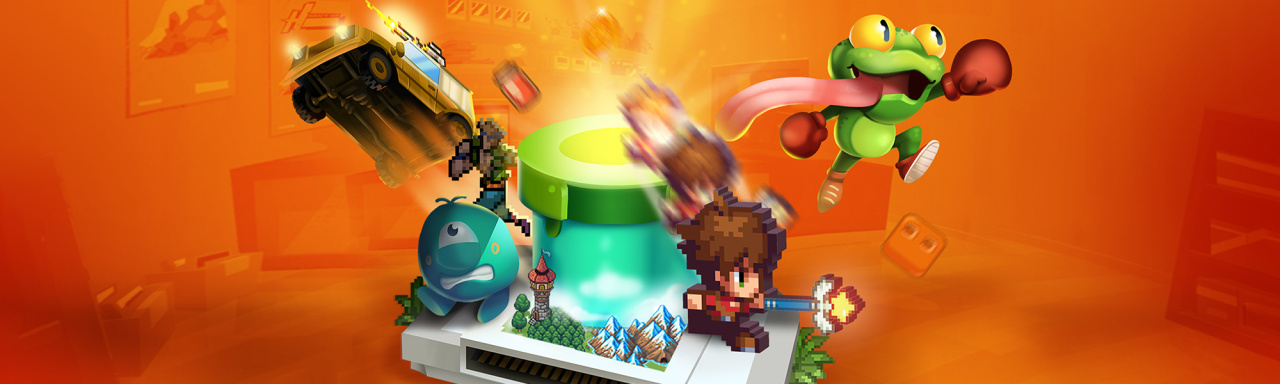
Genres are incredibly important. Not just in video games, either; whether you’re reading a book, watching a movie, or listening to some music, genres are vital in indicating what kind of experience you’re in for. SuperMash takes this idea and flips it on its head, giving you the freedom to take two distinct game genres and smash them together. It’s an enticing concept that’s hard to resist – particularly if you grew up in the ’80s – but ultimately its overall execution is incredibly shoddy, and failed to hold our interest for very long.
The game’s story is largely inconsequential, but does well to serve as the backdrop for the main gameplay. You play as a store assistant who, after giving a young boy his very own video game console at a garage sale, is rewarded in turn with what initially appears to be a box of old gaming junk. When the store is under threat of closure, the owner breaks out the box and discovers a never-before-seen console that takes two game cartridges at a time, thus creating a ‘mash’ of game genres. Personally, we’d be straight down to the auction house if we found a console like this, but there we go.
The rest of the story plays like a visual novel, with the video game store serving a hub area in which you can stroll around at your leisure. There are various points of interest, including a journal to view information on the game genres, and a tool in which you input a code to generate a specific game. You can also tap X at any point in the store to quickly jump into a randomly generated mash, if you wish. You might remember in the Indie World announcement that one of the devs showed off his favourite code and asked that you try it out when the game launches. All we can say is that it is, at least, one of the better games on offer.
There are six genres to choose from when mashing your games together: the Platformer is reminiscent of classic 2D platformers like Super Mario Bros.; the Shoot-Em Up creates a vertically scrolling screen with waves of enemies; the JRPG adds elements like turn-based battles and stats; the Action Adventure is basically The Legend of Zelda condensed down; the Stealth genre takes inspiration from early Metal Gear titles; finally, the Metrovania contains elements from Castlevania and Metroid games, as you’d expect.
Whichever genre you pick first will form the overall basis of the game you’re about to play. So for example, if you choose the Stealth genre and the Shoot-Em-Up, you’ll likely be placed in a military compound similar to Metal Gear, but the characters will be made up of assets from a shmup, with enemies scrolling down the screen as you explore. If you swap the order of the genres around, though, you’ll be placed in a vertically scrolling level, and there will be elements from a stealth game (including a cardboard box, because of course…).
You can choose how long your mash is going to be, along with its overall difficulty. In addition to this, the game makes liberal use of ‘dev cards’, which essentially form gameplay modifiers called ‘glitches’. These can make the games easier or harder depending on what the glitch consists of, and unfortunately you can’t turn these off entirely. Still, some are worth playing around with; we particularly enjoyed the glitch that causes the camera angle to tilt. The dev cards themselves are unlocked by either completing your gaming sessions, progressing through the story, or using in-game currency to purchase them.
It’s initially pretty fun to experiment with the various genres on offer to see what kind of game it spits out, but ultimately you’re not going to create anything worth revisiting more than a few times. The crux of the issue lies with the fact that the games are based, more or less, on classic titles known for their deliberately, carefully designed levels and gameplay. By taking these genres and making everything procedurally generated, nothing fits together as cohesively as you’d like (not to mention the fact that you’re inviting direct comparison with some of the best video games ever made). The initial novelty of seeing genres smashed together quickly fades as you run into problems like poor item placement, unbalanced difficulty, and actual glitches that completely break the experience.
Despite the glitches, however, the overall performance of the game is reasonably solid; the issues mentioned above are more from a design perspective as opposed to technical problems. Graphically, many of the assets are pretty decent, and the character design – while not unique – is commendable. The presentation as a whole is very welcoming, and it’s a real shame that it falls apart so quickly once the core ‘mashup’ gameplay kicks in. We had the most fun when we put together two of the same genres, and that says it all, really.
Conclusion
SuperMash is a great idea that feels squandered thanks to poor execution. The idea of mashing together different genres is a fun one, but the reality is that the resulting games are only mildly amusing at best, and infuriatingly broken at worst. Procedural generation certainly has its place in the industry, with many games using it to fine effect. Unfortunately, in the case of SuperMash the concept is so inelegantly and heavily implemented, we’d much rather sit down with a deliberately handcrafted game any day of the week.
Posted by: xSicKxBot - 05-11-2020, 08:28 AM - Forum: Lounge
- No Replies
Doom Eternal's First Big Update Sends Powered-Up Demons To Your Game
The first major update for Doom Eternal is on the way, and it's bringing a major feature that could change the course of a battle: Empowered Demons. Your in-game struggles could make another player's life even harder in the campaign mode, but there is a reward for beating one.
Empowered Demons will soon arrive to Doom Eternal in a free update. When a player is killed, the demon who killed them will be powered up and transported to a separate player's game. If this demon is killed, the player will get bonus health and ammunition, as well as experience for their overall Doom Eternal level. The campaign's later battles are already challenging, and this should take things to the next level.
Battlemode has also been tweaked, offering a death report feature so players can learn more about what went wrong in a match. There are also changes to the tutorial to make it easier to learn, and new anti-cheat features. Given the delicate difficulty balance necessary between the Slayer and the two demons, keeping things fair is essential.
Posted by: xSicKxBot - 05-11-2020, 05:08 AM - Forum: Python
- No Replies
Python List of Lists Group By – A Simple Illustrated Guide
This tutorial shows you how to group the inner lists of a Python list of lists by common element. There are three basic methods:
Group the inner lists together by common element.
Group the inner lists together by common element AND aggregating them (e.g. averaging).
Group the inner lists together by common element AND aggregating them (e.g. averaging) using the Pandas external library.
Before we explore these three options in more detail, let’s give you the quick solution first using the Pandas library in our interactive shell:
You can run this code in your browser. If you want to learn about the Pythonic alternatives or you need a few more explanations, then read on!
Method 1: Group List of Lists By Common Element in Dictionary
Problem: Given a list of lists. Group the elements by common element and store the result in a dictionary (key = common element).
Example: Say, you’ve got a database with multiple rows (the list of lists) where each row consists of three attributes: Name, Age, and Income. You want to group by Name and store the result in a dictionary. The dictionary keys are given by the Name attribute. The dictionary values are a list of rows that have this exact Name attribute.
Solution: Here’s the data and how you can group by a common attribute (e.g., Name).
# Database:

# row = [Name, Age, Income]

rows = [['Alice', 19, 45000], ['Bob', 18, 22000], ['Ann', 26, 88000], ['Alice', 33, 118000]] # Create a dictionary grouped by Name

d = {}

for row in rows: # Add name to dict if not exists if row[0] not in d: d[row[0]] = [] # Add all non-Name attributes as a new list d[row[0]].append(row[1:]) print(d)

# {'Alice': [[19, 45000], [33, 118000]],

# 'Bob': [[18, 22000]],

# 'Ann': [[26, 88000]]}
You can see that the result is a dictionary with one key per name ('Alice', 'Bob', and 'Ann'). Alice appears in two rows of the original database (list of lists). Thus, you associate two rows to her name—maintaining only the Age and Income attributes per row.
The strategy how you accomplish this is simple:
Create the empty dictionary.
Go over each row in the list of lists. The first value of the row list is the Name attribute.
Add the Name attribute row[0] to the dictionary if it doesn’t exist, yet—initializing the dictionary to the empty list. Now, you can be sure that the key exist in the dictionary.
Append the sublist slice[Age, Income] to the dictionary value so that this becomes a list of lists as well—one list per database row.
You’ve now grouped all database entries by a common attribute (=Name).
So far, so good. But what if you want to perform some aggregation on the grouped database rows?
Method 2: Group List of Lists By Common Element and Aggregate Grouped Elements
Problem: In the previous example, you’ve seen that each dictionary value is a list of lists because you store each row as a separate list. But what if you want to aggregate all grouped rows?
Example: The dictionary entry for the key 'Alice' may be [[19, 45000], [33, 118000]] but you want to average the age and income values: [(19+33)/2, (45000+118000)/2]. How do you do that?
Solution: The solution is simply to add one post-processing step after the above code to aggregate all attributes using the zip() function as follows. Note that this is the exact same code as before (without aggregation) with three lines added at the end to aggregate the list of lists for each grouped Name into a single average value.
# Database:

# row = [Name, Age, Income]

rows = [['Alice', 19, 45000], ['Bob', 18, 22000], ['Ann', 26, 88000], ['Alice', 33, 118000]] # Create a dictionary grouped by Name

d = {}

for row in rows: # Add name to dict if not exists if row[0] not in d: d[row[0]] = [] # Add all non-Name attributes as a new list d[row[0]].append(row[1:]) print(d)

# {'Alice': [[19, 45000], [33, 118000]],

# 'Bob': [[18, 22000]],

# 'Ann': [[26, 88000]]} # AGGREGATION FUNCTION:

for key in d: d[key] = [sum(x) / len(x) for x in zip(*d[key])] print(d)

# {'Alice': [26.0, 81500.0], 'Bob': [18.0, 22000.0], 'Ann': [26.0, 88000.0]}
In the code, you use the aggregation function sum(x) / len(x) to calculate the average value for each attribute of the grouped rows. But you can replace this part with your own aggregation function such as average, variance, length, minimum, maximum, etc.
Explanation:
You go over each key in the dictionary (the Name attribute) and aggregate the list of lists into a flat list of averaged attributes.
You zip the attributes together. For example, zip(*d['Alice']) becomes [[19, 33], [45000, 118000]] (conceptually).
You iterate over each list x of this list of lists in the list comprehension statement.
You aggregate the grouped attributes using your own custom function (e.g. sum(x) / len(x) to average the attribute values).
See what happens in this code snippet in this interactive memory visualization tool (by clicking “Next”):
Create a DataFrame object from the rows—think of it as an Excel spreadsheet in your code (with numbered rows and columns).
Call the groupby() function on your DataFrame. Use the column index [0] (which is the Name attribute) to group your data. This creates a DataFrameGroupBy object.
On the DataFrameGroupBy object call the mean() function or any other aggregator function you want.
The result is the “spreadsheet” with grouped Name attributes where multiple rows with the same Name attributes are averaged (element-wise).
Where to Go From Here?
Enough theory, let’s get some practice!
To become successful in coding, you need to get out there and solve real problems for real people. That’s how you can become a six-figure earner easily. And that’s how you polish the skills you really need in practice. After all, what’s the use of learning theory that nobody ever needs?
Practice projects is how you sharpen your saw in coding!
Do you want to become a code master by focusing on practical code projects that actually earn you money and solve problems for people?
Then become a Python freelance developer! It’s the best way of approaching the task of improving your Python skills—even if you are a complete beginner.
[www.indiegala.com] Get a BONUS Steam copy of Men of War: Assault Squad when spending a minimum of $8/€7/£6 in the IndieGala Store per basket (while stocks last). The following sales and deals end really soon, so don't miss your chance to get your favorite titles during this special promotional period.
Today Unity Technologies purchased the rights to the visual scripting solution Bolt 1 & 2 from Ludiq. The asset is already under the Unity name on the asset store and community and development efforts will be shift to Unity Montreal going forward.
Ludiq is proud to announce that its flagship visual scripting solution Bolt has been acquired by Unity Technologies. This acquisition will empower Unity developers worldwide with a production-ready visual authoring tool that helps artists, designers and programmers collaborate on their game or application. Thanks to Unity’s involvement, Bolt will benefit from a wealth of resources and experience in middleware development, while its users can continue to rely on the same level of quality support and trusted new releases they had come to expect.
As the lead developer of Bolt to this day, I am thrilled about the potential of putting this tool in the hands of more creators and allowing them to concretize their ideas in a visual way. Bolt started as a solo endeavor nearly four years ago, and over time, our team and community grew to welcome thousands of visual thinkers. Today, passing the torch to Unity means Bolt will enter an exciting new phase of its life. While letting go of a project you love is never easy, I have met the amazing people at Unity who will carry it forward and I am confident that Bolt is in the best of hands.
We are working closely with Unity Montreal to ensure a seamless transition. Support for Bolt 1 will continue uninterrupted and development of Bolt 2 is progressing on track. We want to make sure there are no sudden or unexpected changes for existing users. In the meantime, we want to address any question or concern you may have.
It is important to realize that Unity have just acquired Bolt, not the entire company for other technologies such as Peek. There are more details of the acquisition over on the Unity forums. With Bolt 2 currently in development and offered as a free upgrade by Ludiq, people are obviously concerned if this is still the case, rest assured it is.
Ludiq pledged to make Bolt 2 free for users of Bolt. Will Unity honor this pledge?
Yes. Bolt 2 will be free for current Bolt users as well as those who purchase Bolt on the Asset Store before 11:59:59 pm PST on May 31, 2020. Bolt users will receive an individual license for Bolt 2 when it becomes available.
You can learn more about the acquisition in the video below.
We get a first look at upcoming card battler Total War: Elysium
Creative Assembly has revealed gameplay footage for its card-battler, Total War: Elysium. The famed developer of the Total War series announced the game last year, at the same time as a partnership with NetEase, a prominent network and game services provider in China. The partnership is part of Creative Assembly’s plan to expand into the Chinese market.
Total War: Elysium is a historical deck builder, drawing famous generals and iconic figures into card-based battle. The game takes place in Elysium, a Civ-esque city drawing together the greatest military leaders from throughout history. We’ve seen some of these generals already, including Sun Ren and Cao Cao from the Three Kingdoms period, but others we haven’t seen before. One general wears what appears to be French regency dress, and another clad in furs and armour, could potentially be Boudica. All the heroes have individual abilities to give them a unique battle advantage.
Creative Assembly also announced a closed beta test for Elysium to go alongside the new reveal, which you can sign up for on the Total War: Elysium website. We don’t currently know when the beta will take place.
However, the trailer gives us an initial look at how the card-battler might play.
[embedded content]
Elysium is the first Total War game made for mobile since Total War Battles: Kingdom, a free-to-play town builder and RTS strategy game. What we’ve seen so far fits with the expectations of a deck builder, but what they do with the number and variety of generals is another matter. Could this be a Total War gacha? Who knows.
But sign up for the beta, and you’ll see for yourself. If you’re looking also for other deck builders on mobile, be sure to check out our list of the best mobile card games.
Mini Review: Fledgling Heroes – A Fun And Fleeting Flappy Bird-Alike
Cast your mind back to May 2013. Wherever you were, whatever you were doing, chances are that a certain mobile game called Flappy Bird entered your life at some point after its launch. Its insanely addictive nature and the ensuing mania ultimately resulted in its removal from mobile stores, but there’s no denying that its simple gameplay has influenced countless other tap-py titles in the time since. One of these is Fledgling Heroes, a game that takes the core concept of Flappy Bird and greatly expands on it to create an experience that youngsters in particular will absolutely love.
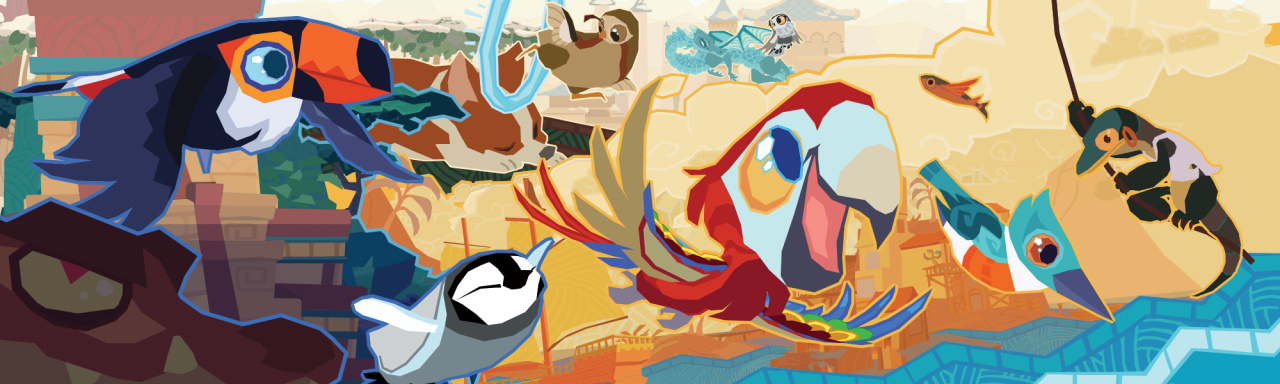
The game sees you take on the role of several feathered creatures, including Biscuit the parrot, Penny the penguin, and more. Each bird has its own method of traversal, so Biscuit, for example, is quite adept at flying, whereas Penny can shoot through water with ease. The levels themselves are tailored with this in mind; your chosen bird will automatically start moving through the environment from left to right, but you’ll need to tap ‘A’ to flap its wings in order to manoeuvre around objects and enemies. Initially, this felt like a complete copy of Flappy Bird, but after a while the game introduces more mechanics, such as boost points that fire you across the stage, and the ability to hold down ‘A’ to glide, giving you much more control over your altitude.
As well as coming across obstacles such as mines, sharks, jellyfish, and lizard pirates, you’ll also find golden feathers scattered throughout the stages. You’ll want to try and collect as many of these as you can, as they’re vital to unlocking levels further down the line. Each level also contains certain challenges which grant you with feathers upon completion, such as taking out a set amount of enemies, gliding for a minimum amount of time, and collecting coins. There’s a great deal of replay value here if you really want to find every collectible, and thankfully most of the levels are short enough that it never really feels like much of a chore.
In addition to the main game, you can also create your own levels and edit the look of your characters. The character editor is basic at best, and consists of simply filling in sections of their bodies with colour, but the level editor is much more robust. You can choose whether to create a basic level, an endless level, or a boss level, and adding assets can be done either with the touchscreen or the analogue stick. You can also, of course, browse a selection of levels created by other players, and much like Super Mario Maker 2, some of these are fiendishly difficult and make the main campaign look like a bit of a cakewalk.
With three main worlds to get through, Fledgling Heroes isn’t a very long game, but it is a lot of fun while it lasts. If you’re after a meatier experience, or even one that perhaps isn’t quite as cute as this, you might want to look elsewhere. For everyone else, Flappy Bird may well have struck gold when it was released 7 years ago, but Fledgling Heroes rises head and shoulders above it.
Nintendo Cracks Down On The Super Mario 64 PC Port
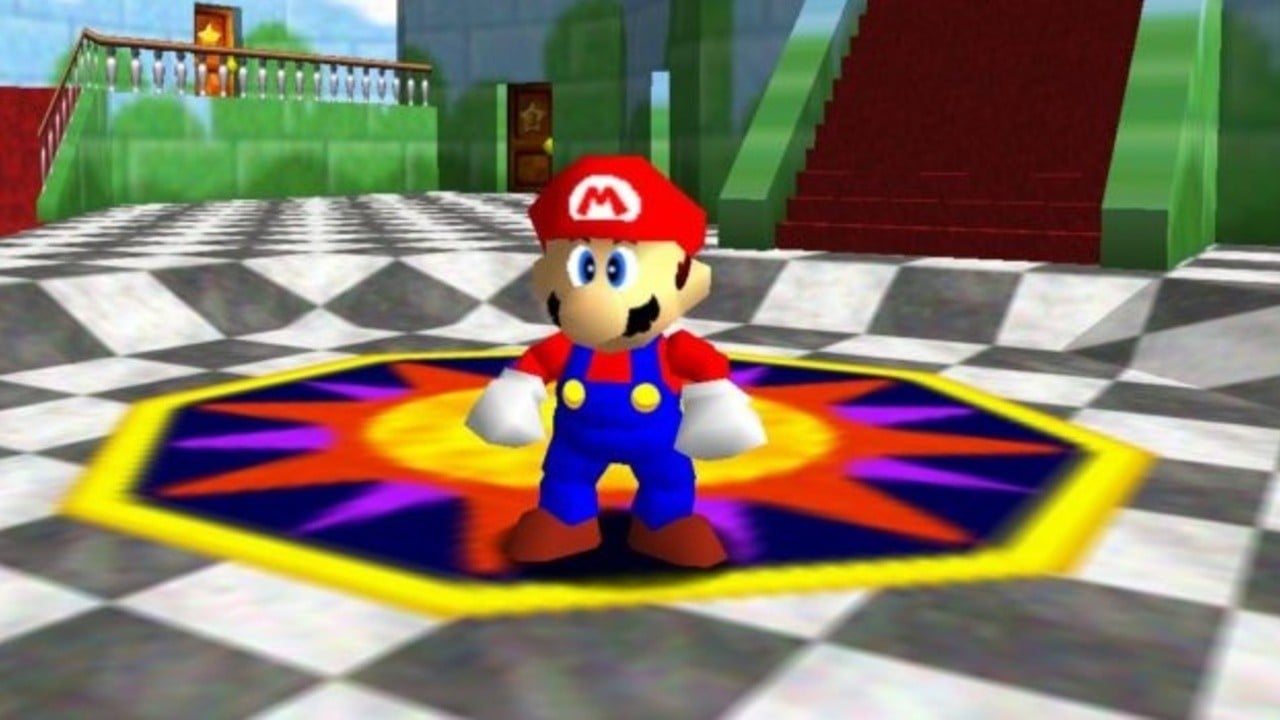
Nintendo’s legal eagles have reportedly begun targeting sites hosting compiled versions of the Super Mario 64 PC port which was made available on the internet last week.
According to a follow-up story by Torrent Freak, after the initial VGC report, links to download the executable version have started to disappear from various file-hosting websites.
The action – at least in part – has been taken by the US-based law firm, Wildwood Law Group LLC. The firm has supposedly worked with Nintendo in the past to “suppress the availability” of modding tools and related products.
TorrentFreak was able to get hold of one of the complaints filed with Google (via LumenDatabase). Here’s exactly what it said:
The copyrighted work is Nintendo’s Super Mario 64 video game, including the audio-visual work, software, and fictional character depictions covered by U.S. Copyright Reg. No. PA[REDACTED].
The reported file contains an unauthorized derivative work based on Nintendo’s copyrighted work.
Nintendo has also been targeting YouTube channels for uploading footage of the PC port – with many videos receiving copyright claims.
Despite the legal measures taken so far, there are still some cases where Nintendo’s law firm has filed complaints and had no luck getting download links removed. If we hear any more developments, we’ll be sure to let you know.