Guide: Every ACA Neo Geo Game On Nintendo Switch, Plus Our Top Picks
Much like Hamster’s Arcade Archives series, the company’s line of Neo Geo titles – which goes by the bespoke title ‘ACA NEOGEO’ to separate it from the rest – has been a regular fixture of the weekly Nintendo Switch eShop download lists. With over a hundred releases under the ACA banner, Hamster has done sterling work getting these games on Switch and into the hands of fans who may never have experienced them before.
SNK’s Neo Geo was a beautiful system that fused arcade and home console hardware, but at a cost. The significant financial outlay require for Neo Geo ownership meant it was out of reach of the average gamer back in the day. Fortunately, the games below will cost you a fraction of what they originally sold for and come with a multitude of presentation options to tailor the experience to your liking on Switch.
Below we’ve listed every ACA Neo Geo release available on Switch eShop to date and it will be updated as new titles are released. The games are displayed in alphabetical order, although you can go to our games database and sort by Release Date or User Rating. Please note that the Arcade Archive releases are NOT included here. Check out our separate guide for Arcade Archive games on Switch for more info on Hamster’s non-Neo Geo Switch gems.
And if this huge list is a tad overwhelming, you’ll find our picks of the best ACA Neo Geo games on Switch at the bottom. No prizes for guessing it contains a lot of fighters.
ACA Neo Geo Switch eShop releases – Complete list
Looking at that list and don’t know where to start? Then check out our picks of the best ACA NEOGEO games – in no particular order – to get you off on the right foot.
The best Switch ACA Neo Geo games…
Publisher: SNK / Developer: SNK
Release Date: 11th Nov 1999 (USA) / 11th May 2017 (UK/EU)
The first fighter in our picks of Switch’s finiest ACA Neo Geo offerings, and it certainly won’t be the last. Garou: Mark of the Wolves is a classic of the genre; the perfect fusion of depth and beauty that will appeal to hardened veterans of 2D fighters and button-mashing newbies alike. By 1999 the Neo Geo hardware was nearly a decade old and SNK’s mastery of it is in full evidence here. It’s one of very few games we’d recommend everybody buy, even those who actively dislike fighters (yes, apparently they exist). This game is just too pretty to miss. We could sit and watch animated gifs of Garou’s backgrounds for hours. Essential.
Publisher: SNK / Developer: Noise Factory
Release Date: 2001 (USA) / 5th Sep 2013 (UK/EU)
A side-scrolling beat ’em up in the classic mould, Sengoku 3 is a straightforward and satisfying example of a genre that needs little explaining to begin with. With plenty of variety and attacking options, it’s a fun blast whether you’re playing solo or you’ve enlisted a friend for the ride. We put it on our list of the best beat ’em ups on Switch, so its inclusion here should be no surprise.
Publisher: SNK / Developer: SNK
Release Date: 25th Nov 1998 (USA) / 6th Dec 2012 (UK/EU)
As with many of the best fighters, seemingly simple mechanics hide a lot of depth and The Last Blade 2 is a fine example. An extremely enjoyable game with fantastic presentation and a host of fighting modes to get stuck into, the balancing of the first entry is arguably better, although the sequel has more characters and options available. Whichever one you go for, you’ll be guaranteed a fine-looking fighter with plenty of personality, so you can’t really go wrong.
Publisher: SNK / Developer: Nazca Corp.
Release Date: 1996 (USA) / 9th May 2008 (UK/EU)
If you’re looking for an old-school shot of satisfying gameplay without endless options and upgrade systems and RPG-like progression, Metal Slug is the no-nonsense antidote to modern-day complications. It might feel a little too simplistic by modern standards, but there’s something about the purity of its approach which makes it an absolute blast and a lovely palette cleansers before diving into something more faceted on Switch. Nazca Corporation’s run-and-gun may have debuted in 1996, but it’s got the beating heart of an ’80s action icon (and a brain to match). Fabulous.
If you’re into King of Fighter games, you’ll find a whole bunch available on Switch. If we were pushed, The King of Fighters ’98 would probably be our pick of the bunch. It’s got a huge cast, the same tight, deep gameplay you’ve come to expect from SNK and is still regarded one of the best fighters ever made well over 20 years since release. Similarly to Garou, we’d buy it just to ogle its visual loveliness.
Publisher: Sunsoft
Release Date: 21st Nov 1996 (USA) / 3rd Mar 2017 (UK/EU)
You like fighters, right? If you’re reading this list we sure hope so. If you’re after something a little unusual, Waku Waku 7 serves up a 2D scrapper decidedly different from umpteen KoFs and Fatal Furies – a welcome break even given the quality of those series. This, too, is a sequel, to 1995’s underwhelming Galaxy Fight, but despite a small roster Sunsoft packed this game with spectacularly colourful cartoon visuals and a bunch of in-jokes and irreverent parodies to make it feel fresh and unique in a system library overflowing with quality games in this genre. This was the first game ACA Neo Geo game Hamster brought to Switch and a lovely breath of fresh air.
Publisher: SNK / Developer: Yumekobo
Release Date: 19th Feb 1998 (USA) / 2nd May 2017 (UK/EU)
There was a time when Blazing Star was beyond the reach of all but the most affluent gamer, but now anyone with a Switch can download and enjoy this brilliant shmup for the price of a (pricey) pint. The thrill of owning something that was once so inaccessible shouldn’t overshadow just how good this game is, though. The difficulty ramps right up towards the end, but if you’re a fan of shoot ’em ups, this is a treasure you won’t want to be without.
Publisher: Data East / Developer: Data East
Release Date: 1995 (USA) / 14th Jan 2011 (UK/EU)
What’s this? A Neo Geo game that isn’t a fighter? Yes, you might not have expected a puzzle game on this list but despite the shared genres of several entries here, Magical Drop III is a fantastic balloon-firing puzzler that you should definitely investigate. It mde our list of the best puzzle games on Switch and shows that there was more to the Neo Geo library than an endless parade of gorgeous 2D fighters. Puzzle fans should definitely check this out.
Publisher: SNK / Developer: Video System
Release Date: 1994 (USA) / 3rd Aug 2017 (UK/EU)
A vertical shooter (you know, for variety), Aero Fighters 2 is an easy recommendation thanks to its varied locales, multiple piloting options, large roster of enemies entertaining boss battles and multiple endings. Throw in 2-player and the usual Hi-Score and Caravan modes and what’s not to like? The sequel is also available, although with its fixed-pairings for 2-player mode we’d download Aero Fighters 2 first and go from there.
Publisher: SNK / Developer: SNK
Release Date: 28th Oct 1994 (USA) / 8th Aug 2008 (UK/EU)
Still one of the best fighters available on the console (and there are a fair few to choose from now, if the list above has whetted your appetite), Samurai Shodown II improved on the original with new fighters and tweaks and fine-tuning to the mechanics to accompany the already stonkingly lovely sprite work. This should be in your library, whether you life fighters or not. Yes, we realise that’s the third time we’ve recommended a fighting game to non-fighting fans. They’re just so purdy!
Ah, how we love that SNK artwork; all those grins and round chins! Thank you for scrolling to the very bottom. With so many games to choose from we’re just scratching the surface with the games above.Let us know which of Hamster’s ACA Neo Geo games you’ve most enjoyed–and which ones you’d avoid–with a cheeky comment below.
Posted by: xSicKxBot - 03-25-2020, 09:10 AM - Forum: Lounge
- No Replies
Borderlands 3 Next Level Cap Increase Will Give Big Boost To Late-Game Builds
Borderlands 3 is preparing for another level cap increase to come alongside the release of Guns, Love, and Tentacles. When the update hits on March 26 you can raise your Vault Hunter's max level to 57, an increase of four more points since it was last raised in February. And this particular increase could have a big impact on gameplay.
As noted on the Borderlands blog, the new level cap will allow you to select two capstone skills rather than the standard one. Those skills are among the most powerful in a Vault Hunter's arsenal, so being able to double-up opens a whole new array of possibilities. Gearbox says it anticipates this to come with a "huge surge of power for endgame players" and the ability to experiment with wild new build types.
The blog also reiterated that the game is on track to follow its spring 2020 roadmap, which includes Mayhem 2.0 in April. That will give Mayhem Mode a dedicated tab in your Echo Device so you can adjust it on the fly. There will be 10 Mayhem levels and 25 modifiers, and the higher your Mayhem level, the better loot will drop.
Time in isolation passes faster when playing Chronology
[freebies.indiegala.com] Chronology is a mind-bending mix of puzzle, platform and adventure where you defy time by manipulating the past and the future, in order to fix the present.
The 164th GalaQuiz will be LIVE soon, win up to $50 in GalaCredit!
[www.indiegala.com] The GalaQuiz will take place in less than 10 minutes from this announcement Today's GalaQuiz[www.indiegala.com] hints are up. The theme will be History #2 Redux.
Devolver Digital’s Pikuniku Is Just 99 Cents On The Switch eShop Right Now
Update: The same title is also available on the UK eShop for just £0.89. Other regions also appear to be running the same discount.
Original article: If Drawful 2 for 9 cents wasn’t your kind of game, perhaps you would be more interested in Devolver Digital’s absurdly wonderful puzzle-exploration game, Pikuniku.
At the moment, it’s available on the Switch eShop in North America for just 99 cents. Here’s the official Twitter announcement:
If you haven’t played this game, or don’t already own it, it was released last year in January. and supports a cooperative two-player mode. The game drops you into a colourful world, but not everything is quite as happy as it may seem. You’ll be required to help peculiar characters overcome struggles, and uncover a deep state conspiracy.
For more information about it, you can read our review where we gave it eight out of ten stars.
Will you be adding this to your Switch digital library? Tell us down below.
Goosebumps The Game For Switch Is Another Code-Only Physical Release
Ever since the Switch arrived on the scene, a number of publishers have been releasing physical games with a code inside the box and not much else. If you’re in it just for the case, that’s fine, but it also means an internet connection is still required and when servers eventually go offline, there’s no way to download the game.
Despite multiple publishers receiving scathing criticism for this practice, the trend seemingly continues. According to the UK online retailer ShopTo, the cover of the upcoming European physical release Goosebumps The Game displays a ‘Download Code Only’ warning. Squint and you might be able to see it below, else view the website directly.
One of the higher-profile titles that was scheduled to receive this same treatment was Obsidian Entertainment’s The Outer Worlds. Fortunately, when the game was delayed in February, the publisher Private Division changed its mind and said it would be releasing the physical version on a game cartridge.
ShopTo says the hard copy of Goosebumps The Game is due out next month on 10th April. The digital release is already available on the Switch eShop.
Posted by: xSicKxBot - 03-25-2020, 12:08 AM - Forum: Lounge
- No Replies
DC's Wonder Woman 1984 Release Delayed Due To Coronavirus Outbreak
The coronavirus (COVID-19) outbreak has led to the postponement of numerous big movie releases over the past few weeks. Most of the films that have been affected are those that were set for spring or early summer releases, such as A Quiet Place: Part 2, F9: The Fast Saga, No Time To Die, and Black Widow. But it has now been announced that DC's Wonder Woman 1984, which was due to be released in June, has also had its release moved back.
Wonder Woman 1984 will now hit US theaters on August 14 instead of June 4. The news was announced on Twitter by star Gal Gadot, who said "In these dark and scary times, I am looking forward to a brighter future ahead." Check it out below:
In these dark and scary times, I am looking forward to a brighter future ahead. Where we can share the power of cinema together again. Excited to redate our WW84 film to August 14, 2020. I hope everyone is safe. Sending my love to you all. ❤️ pic.twitter.com/nzPUM7uQ1n
The delay follows rumors last week that Warner was considering releasing the movie straight to streaming, something the studio was quick to deny. In a statement, Warner Bros. Pictures Group chairman Toby Emmerich said, "When we greenlit Wonder Woman 1984, it was with every intention to be viewed on the big screen and are excited to announce that Warner Bros. Pictures will be bringing the film to theatres on August 14. We hope the world will be in a safer and healthier place by then."
Updates For Animal Crossing: New Horizons May Be Postponed
Coronavirus has already delayed certain video game releases and updates, and as much as Nintendo is pushing onwards with its own projects, there’s a real chance some of its future releases and planned content may be postponed.
Speaking to The Washington Post recently (thanks for the heads up, GoNintendo), Animal Crossing: New Horizons director Aya Kyogoku reiterated how the team in Japan was dealing as best as it could with the current hurdles, and development on post-launch content was still going. In saying this, the team still has to be flexible:
We’re not sure if we have to shift anything, but I think we have to be flexible.
Producer Hisashi Nogami added how the wellbeing of the team was obviously the top priority right now:
In terms of the development team, I do have to think about their health and well-being as well.
The first free update for New Horizons (Version 1.1.0) has already been released. It allows players to celebrate Bunny Day with a special event in April.
Just last week, Super Smash Bros. Ultimate director Masahiro Sakurai said there was a “high probability” of DLC fighter development not proceeding as scheduled due to COVID-19. He was even scheduled to give a presentation to a publisher, but the key parties were unable to meetup.
How would you feel about the post-launch content for Animal Crossing: New Horizons potentially be delayed? Tell us below.
Plague Inc. Developer Donates $250,000 To Fight Coronavirus
Plague Inc. developer Ndemic Creations' game simulates what might happen in the event of an unstoppable pandemic, but the company is now doing its part to stop one. Ndemic announced this week that it donated $250,000 in order to fight the ongoing coronavirus (COVID-19) outbreak.
The donation was made to the Coalition of Epidemic Preparedness Innovations as well as the World Health Organization's COVID-19 Solidarity Response Fund. The former is dedicated to developing and financing vaccines to treating new infectious disease, while the latter is focused on preventing, detecting, and treating COVID-19 worldwide.
"Eight years ago, I never imagined the real world would come to resemble a game of Plague Inc., or that so many players would be using Plague Inc. to help them get through an actual pandemic," the game's creator James Vaughan said in the announcement. "We are proud to be able to help support the vital work of the WHO and CEPI as they work towards finding a vaccine for COVID-19."
This tutorial shows you everything you need to know to help you master the essential count() method of the most fundamental container data type in the Python programming language.
Definition and Usage:
The list.count(x) method counts the number of occurrences of the element x in the list.
Syntax: You can call this method on each list object in Python. Here’s the syntax:
list.count(value)
Arguments:
Argument
Description
value
Counts the number of occurrences of value in list. A value appears in the list if the == operator returns True.
Return value: The method list.count(value) returns an integer value set to the number of times the argument value appears in the list. If the value does not appear in the list, the return value is 0.
Python List Count Values
Python List Count Duplicates
Python List Count Unique Values and Strings
Python List Count All Elements
Python List Count Lambda
Python List Count With Condition
Python List Count If
Python List Count Greater Than
Python List Count Smaller Than
Python List Count Regex
Python List Count Matches
Python List Count Wildcard
Python List Count Not Working
Python List Count Runtime Complexity
Python List Reference Count
Python List Count to Dict
Python List Count Tuples
Python List Count Zero / Non-Zero
Python List Count and Sort
Python List Count Slow
Python List Count Group By
Python List Count vs Len
Python List reverse() Time Complexity
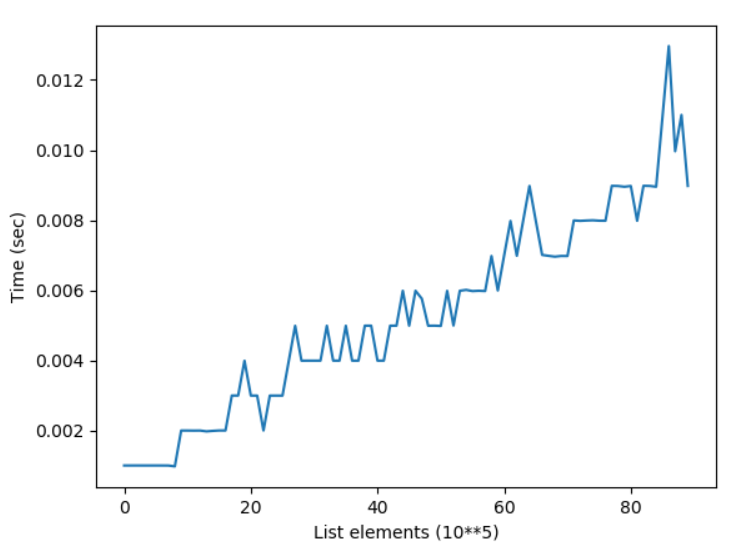
The time complexity of the reverse() operation is O(n) for a list with n elements. The standard Python implementation cPython “touches” all elements in the original list to move them to another position. Thus, the time complexity is linear in the number of list elements.
You can see a plot of the time complexity of the reverse() method for growing list size here:
The figure shows how the elapsed time of reversing lists with growing number of elements grows linear to the number of elements.
If you’re interested in the code I used to generate this plot with Matplotlib, this is it:
import matplotlib.pyplot as plt

import time y = []

for i in [100000 * j for j in range(10,100)]: lst = list(range(i)) t0 = time.time() x = lst.reverse() t1 = time.time() y.append(t1-t0) plt.plot(y)

plt.xlabel("List elements (10**5)")

plt.ylabel("Time (sec)")

plt.show()
Python List reverse() In Place
If you call the list.reverse() method on any list object in Python, it reverses the list elements of this particular list object. You say that the reverse method happens in place.
This is a common mistake of many Python beginners. They assume that the reverse() method creates a new list with the elements in reversed order. This is not the case: the reverse() method modifies only the existing list object.
In the example, you only reversed the existing list lst. But you didn’t create a new list!
Python List reverse() None
The return value of the list.reverse() method is None. Why? Because the method reverses the list in place. This means that no new list is created. Instead, the method modifies the old list object.
You’ve seen an example of this in the previous section.
Python List Reverse List Without reverse()
You can also reverse a list without using the reverse() method. Let’s have a look at the following table that shows all reverse() alternatives:
Method
Description
lst.reverse()
Reverses the order of the elements of list lstin place.
list(reversed(lst))
The built-in reversed(lst) method creates a new list object with reversed list elements.
lst[::-1]
Slicing with negative indexing is the most concise way of reversing the order of a list. It creates a new list object.
[lst[i] for i in range(len(lst)-1,-1,-1)]
Just for fun—one-liner solution to reverse a list using list comprehension and the negative range function.
There is a fifth solution using recursion. But it’s highly inefficient and you shouldn’t use it in practice. If you want to learn about it anyways, read on. But don’t tell me you haven’t been warned!
Python List Reverse Recursive
You can create a recursive function to reverse any list. I’ll give you the code first and explain it later:
Phew! Quite some information to digest! But that’s not all. If you’ve understood all of the above, you also need to understand recursion. That’s too much to teach in a single paragraph so I’d send you over to my blog article about recursion.
I’ll say only that much: to understand recursion, you first need to understand recursion!
To reverse the list lst, you simply use slicing operation lst[::-1] with default start and stop indices (not given) and negative step size -1 (given).
There’s only one case where you shouldn’t use slicing to reverse the list and this is if you don’t want to create a new list. In this case, stick to the lst.reverse() method which reverses the list in place.
Here’s an example of slicing to reverse a given list:
To partially reverse a list lst, use slicing with negative step size: lst[start:stop:-1]. The start and stop values define the part of the list to be reversed and the step size -1 means that you go through the list in reversed order.
All of those slicing operations reversed a subsequence of the original list. Note that the start index must be larger or equal than the stop index because you traverse the list in negative order (well, if you don’t want to have an empty slice object).
Python List Reverse List Comprehension
You can reverse a list with Python’s powerful list comprehension method. (Although I cannot imagine a scenario where this would actually make sense.)
List comprehension is a compact way of creating lists. The simple formula is [ expression + context ].
Expression: What to do with each list element?
Context: What list elements to select? It consists of an arbitrary number of for and if statements.
For example, the expression [x for x in range(3)] creates the list [0, 1, 2].
Here’s how you’d use list comprehension to reverse a list:
[lst[i] for i in range(len(lst)-1,-1,-1)]
You go over all indices in negative order—starting with the last list index len(lst)-1 and ending in the first list index 0. Note that the stop index is not included in the index sequence so I used the value -1 as the stop index for the range() built-in function.
Python List reverse() vs reversed()
What’s the difference between the method list.reverse() and the built-in function reversed(list)?
list.reverse() modifies an existing list in place and reverses the order of elements in this list object. No new list object is created.
reversed(list) creates a new iterable object by reversing the order of elements of the original list.
So you should use the former if you don’t want to create a new list and the latter if you want to create a new iterable without modifying the existing list.
The output is not very intuitive but it only means that the reversed() function returns an iterable object.
Python List Deep Reverse
What if you want not only to reverse a list but running a deep reverse where all nested lists are also reversed in a recursive manner?
Here’s how you can do it:
def deep_reverse(lst): ''' Reverses a nested list in place''' # Reverse top-level list lst.reverse() # Recursively reverse all nested lists for element in lst: if isinstance(element, list): deep_reverse(element) lst = [1, 2, 3, [4, 5, 6]]

deep_reverse(lst)

print(lst)
This generates the output:
# OUTPUT: [[6, 5, 4], 3, 2, 1]
Not only the first-level list is reversed but also the second-level list. The code is loosely inspired from this article.
Python List Reverse Enumerate
The enumerate(list) built-in function returns a list of tuples with the first tuple value being the list index and the second tuple value being the list element.
You can reverse the order of enumerated tuples by stacking together the enumerate() function and the list.reverse() method as follows:
>>> for i, el in enumerate(list(reversed([1, 2, 3]))): print(i, el) 0 3

1 2

2 1
This way, you first reverse the list which creates an iterator. You then transform it into a list. The result can be enumerated.
If you want to reverse the order of the indices as well, simply switch the order of both functions:
>>> for i, el in reversed(list(enumerate([1, 2, 3]))): print(i, el) 2 3

1 2

0 1
By first enumerating, you calculate the indices based on the original list. Then you reverse them in the outer function.
Python List Reverse Iterator
The reversed(list) method returns an iterator, not a new list. This is different: an iterator is more efficient than a list. You can easily convert the iterator object into a list by using the list(...) built-in function.
Here’s an example:
>>> reversed([1, 2, 3])

<list_reverseiterator object at 0x0000021735E070B8>

>>> for i in reversed([1, 2, 3]): print(i) 3

2

1
The iterator object doesn’t look pretty in the shell but it’s a more efficient way to iterate over a sequence of values than using lists. Why? Because lists need to maintain all values in memory. Iterators don’t.
Python List Reverse Sort
Do you want to sort a list in descending order? Use the reverse=True argument of the sorted() method. Here’s an example:
Rather than just using positive list indices, you can use reverse indexing in Python lists, too. The negative integer index -1 accesses the last element. The negative integer index -2 accesses the second last element and so on. Here’s an example:
Do you want to iterate over a range of integer values in reverse order? Say, you want to iterate over the numbers from 10 to 0 in reverse order: 10, 9, 8, 7, 6, 5, 4, 3, 2, 1, 0. You can simply achieve this by specifying the start, stop, and step arguments of the range(start, stop, step) method:
>>> for i in range(10, -1, -1): print(i) 10

9

8

7

6

5

4

3

2

1

0
Note that the start argument is included in the range but the stop argument isn’t.
Python List reverse() Doesn’t Work
What if the reverse() method doesn’t work? Chances are that you assume the list.reverse() method has a return value—that is the reversed list. This is not the case! The list.reverse() method returns None because it reverses the list in place. It doesn’t return a new reversed list.
If you really want to have a new list with elements in reversed order, use the Python built-in reversed(list) method:
>>> print(list(reversed([1, 2, 3])))

[3, 2, 1]
The reversed() method reverses the list and returns the reversed list as an iterator object. You need to convert it to a list first before printing it to the shell (and receiving a meaningful output).
Python Reverse List NumPy
To reverse a NumPy array (or even a Python list), you can simply use slicing with negative step size a[::-1]. Here’s an example:
>>> import numpy as np

>>> a = np.array([1, 2, 3])

>>> a[::-1]

array([3, 2, 1])
Python List reverse() Thread Safe
Do you have a multiple threads that access your list at the same time? Then you need to be sure that the list operations (such as reverse()) are actually thread safe.
In other words: can you call the reverse() operation in two threads on the same list at the same time? (And can you be sure that the result is meaningful?)
The answer is yes (if you use the cPython implementation). The reason is Python’s global interpreter lock that ensures that a thread that’s currently working on it’s code will first finish its current basic Python operation as defined by the cPython implementation. Only if it terminates with this operation will the next thread be able to access the computational resource. This is ensured with a sophisticated locking scheme by the cPython implementation.
The only thing you need to know is that each basic operation in the cPython implementation is atomic. It’s executed wholly and at once before any other thread has the chance to run on the same virtual engine. Therefore, there are no race conditions. An example for such a race condition would be the following: the first thread reads a value from the list, the second threads overwrites the value, and the first thread overwrites the value again invalidating the second thread’s operation.
All cPython operations are thread-safe. But if you combine those operations into higher-level functions, those are not generally thread safe as they consist of many (possibly interleaving) operations.
Where to Go From Here?
The list.reverse() method reverses the order of the list elements.
If you keep struggling with those basic Python commands and you feel stuck in your learning progress, I’ve got something for you: Python One-Liners (Amazon Link).
In the book, I’ll give you a thorough overview of critical computer science topics such as machine learning, regular expression, data science, NumPy, and Python basics—all in a single line of Python code!
OFFICIAL BOOK DESCRIPTION:Python One-Liners will show readers how to perform useful tasks with one line of Python code. Following a brief Python refresher, the book covers essential advanced topics like slicing, list comprehension, broadcasting, lambda functions, algorithms, regular expressions, neural networks, logistic regression and more. Each of the 50 book sections introduces a problem to solve, walks the reader through the skills necessary to solve that problem, then provides a concise one-liner Python solution with a detailed explanation.

























 in GalaCredit!