The end of the year is a perfect time to look back on some of the Magazine’s most popular articles of 2019. One of the Fedora operating systems’s many strong points is its wide array of tools for system administrators. As your skills progress, you’ll find that the Fedora OS has even more to offer. And because Linux is the sysadmin’s best friend, you’ll always be in good company. In 2019, there were quite a few articles about sysadmin tools our readers enjoyed. Here’s a sampling.
Introducing Fedora CoreOS
If you follow modern IT topics, you know that containers are a hot topic — and containers mean Linux. This summer brought the first preview release of Fedora CoreOS. This new edition of Fedora can run containerized workloads. You can use it to deploy apps and services in a modern way.
To be a good sysadmin, you need to understand system startup and the boot process. From time to time, you’ll encounter software errors, configuration problems, or other issues that keep your system from starting normally. With the information in the article below, you can do some life-saving surgery on your system, and restore it to working order.
Although this article was published a few years ago, it continues to be one of the most popular. Apparently, we’re not the only people who sometimes get locked out of our own system! If this happens to you, and you need to reset the root password, the article below should do the trick.
This article is part of an entire series on systemd, the modern system and process manager in Fedora and other distributions. As you may know, systemd has sophisticated but easy to use methods to start up or shut own services in the right order. This article shows you how they work. That way you can apply the right options to unit files you create for systemd.
Fedora 30 introduced new ways to change the boot options for your kernel. This article from Laura Abbott on the Fedora kernel team explains the new Bootloader Spec (BLS). It also tells you how to use it to set options on your kernel for boot time.
Stay tuned to the Magazine for other upcoming “Best of 2019” categories. All of us at the Magazine hope you have a great end of year and holiday season.
Feature: The Most Jaw-Dropping Nintendo Switch Ports Of 2019
We’re all keenly aware that the Nintendo Switch isn’t as powerful as the Xbox One or PlayStation 4, but that hasn’t stopped it playing host to some incredible conversions throughout 2019. Some of these are ports which, when you really think about it, have absolutely no right whatsoever to be on a console that you can carry around in your rucksack. Developers have worked wonders to condense some of the most spectacular AAA experiences of recent memory onto what is, essentially, a portable gaming platform.
We think these achievements are worthy of praise, so we’ve compiled a list of our top 10 favourite Switch ports of 2019. You’ll find the list below, but we’d also like to hand out some honourable mentions to some of the other amazing ports we’ve seen this year. Downwell, while not technically impressive, plays best on Switch because you can rotate the screen vertically and use it with the Flip Grip accessory. NBA 2K20, despite having some questionable microtransactions, is an impressive technical achievement when you consider you’re getting the same game as your Xbox One and PS4-owning pals, while Return of the Obra Dinn is simply a remarkable video game full stop.
But enough of the also-rans; here are our 10 favourite Switch ports of the past 12 months.
Publisher: SEGA / Developer: M2
Release Date: 27th Jun 2019 (USA) / 27th Jun 2019 (UK/EU)
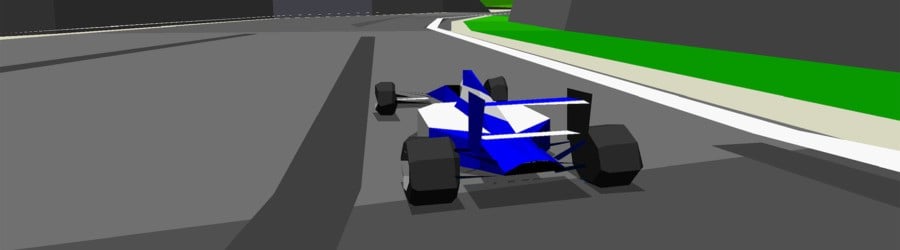
On paper, the concept of taking an arcade machine from 1992 and porting it to a modern-day console might not seem like a big deal, but Virtua Racing is a unique case; created with cutting-edge bespoke hardware in the early ’90s, it laid the foundations for pretty much every 3D racing game since that time, combining sharp visuals with Yu Suzuki’s trademark gameplay. This Switch port improves things by increasing the resolution and offering multiplayer options and is a dream come true for diehard Sega fans and arcade lovers. It’s incredible that we even got this port when you really stop and think about it; the team at M2 has worked wonders here.
Publisher: Skybound Games / Developer: Beamdog
Release Date: 15th Oct 2019 (USA) / 15th Oct 2019 (UK/EU)
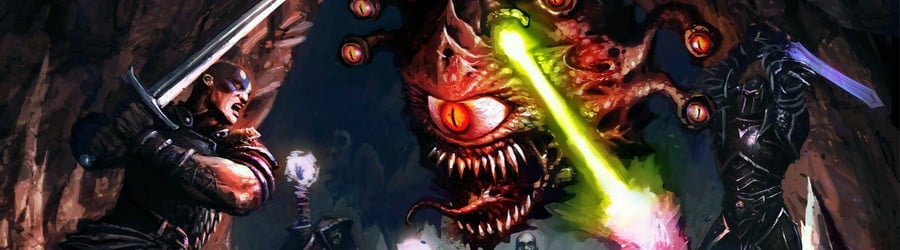
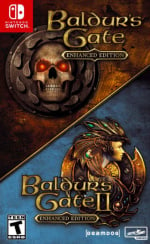
Baldur’s Gate and its sequel are two of the most acclaimed western-made RPGs of all time, and caused a considerable fuss when they were originally released. The fact that such epic, sprawling worlds can be contained on a portable console is nothing short of astounding, and the amount of gameplay on offer here is truly staggering. Sure, neither of these games push the envelope in technical terms, but the fact that they’ve been so perfectly ported to Switch is worthy of merit.
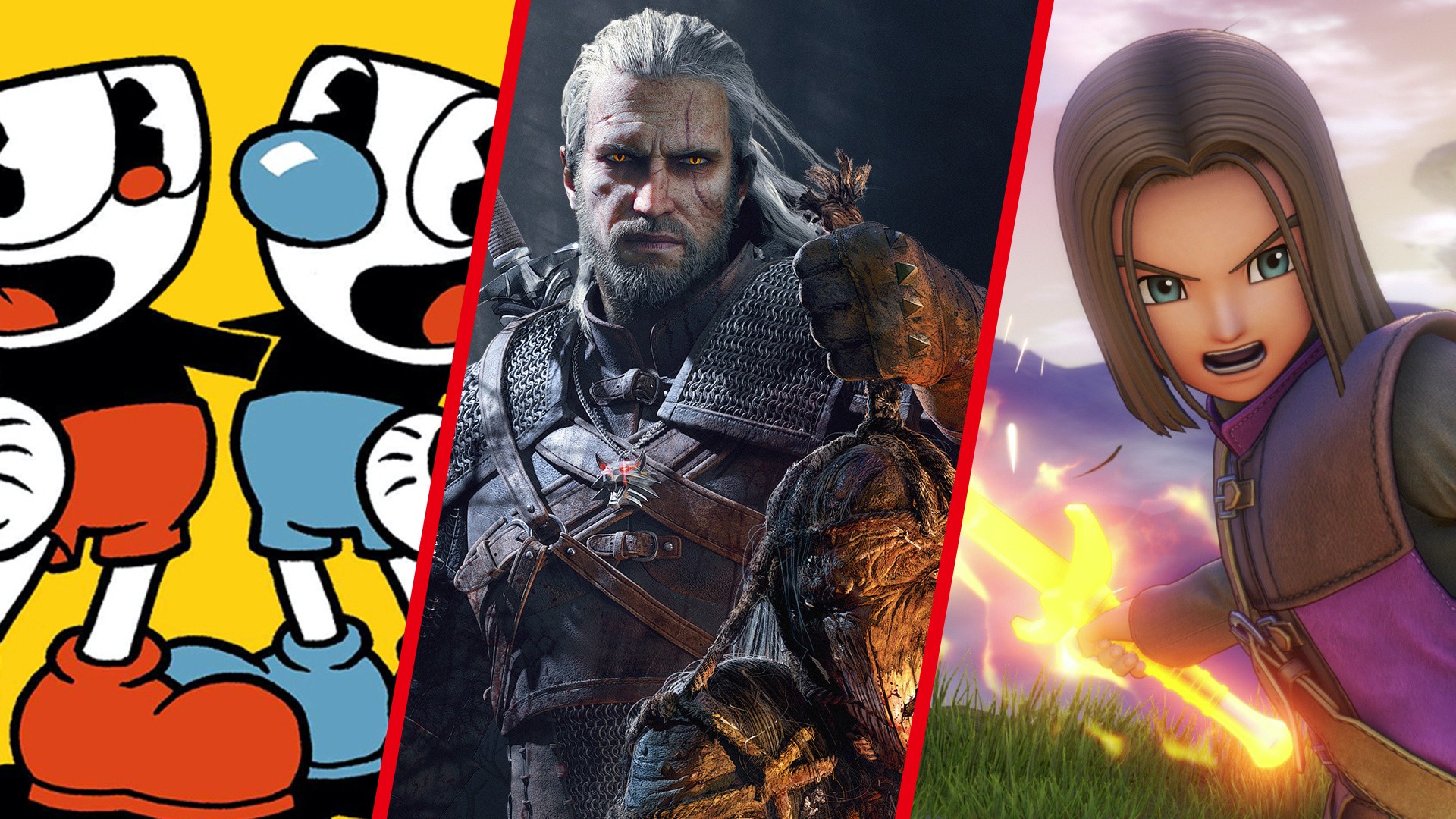
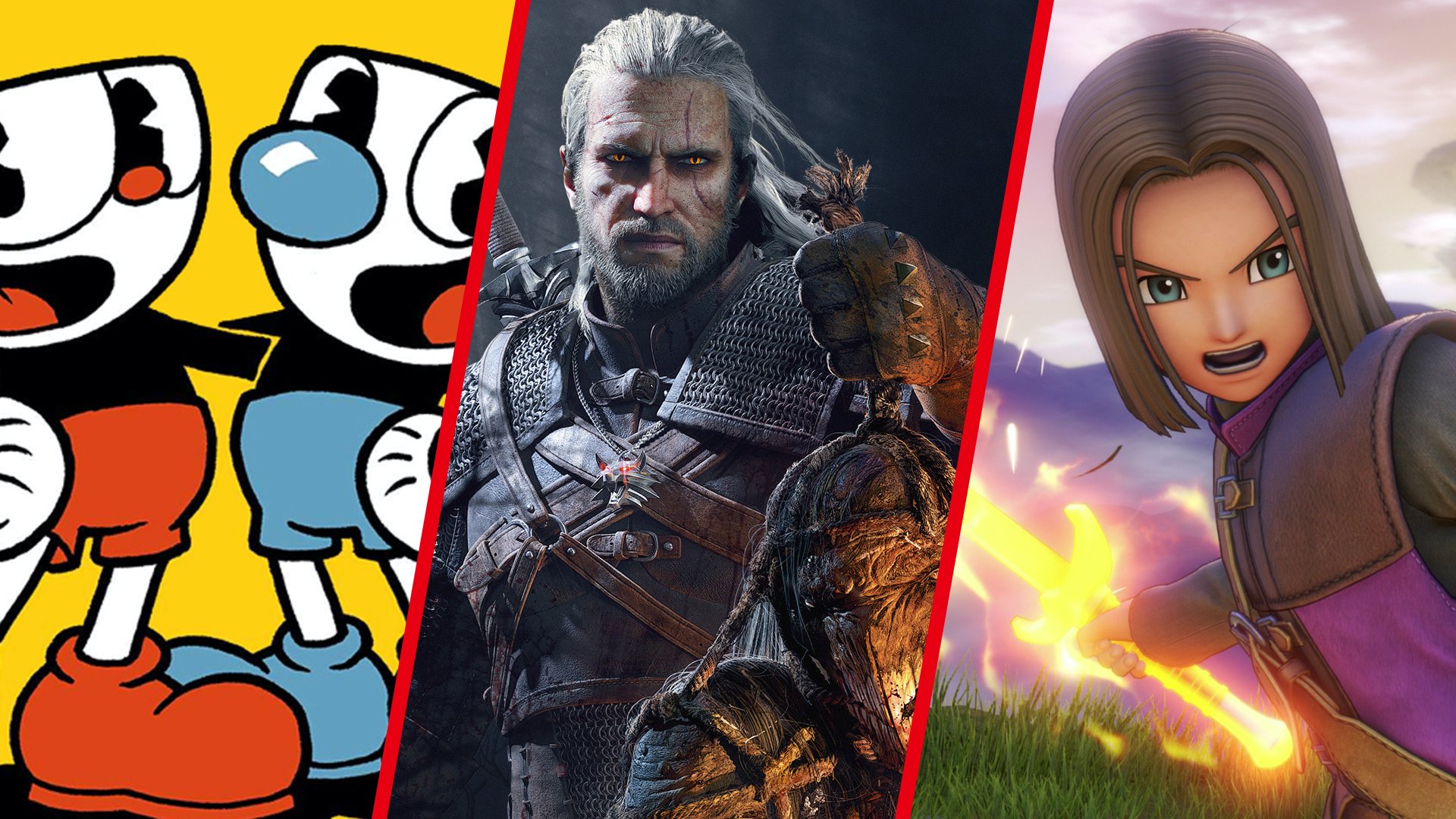
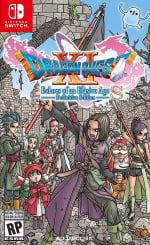
Switch owners had to wait a little longer for the next entry in the famous Dragon Quest series, but those additional months didn’t matter much when the final product arrived. This is a gorgeous RPG, bursting with content and home to a story which keeps you engaged right to the end. The visuals are stunning, too, and precious little has been lost in the transition to Switch. We also got the definitive edition of the game, making this the perfect way to experience this legendary title; after falling in love with the excellent Dragon Quest releases on the DS, this feels like the ideal way to keep the legend alive.
One of Microsoft’s big indie exclusives, Cuphead translates incredibly well to the Switch. When playing docked, there’s little difference between this and the Xbox One version – and that’s quite an achievement when you consider how much cool 2D stuff is going on in this title. However, it’s the ability to play on the move – as well as pull off those Joy-Con for two-player sessions on the road – that truly elevate this conversion. Cuphead is proof that some of the best titles in the market can be improved by being on Nintendo’s hybrid console.
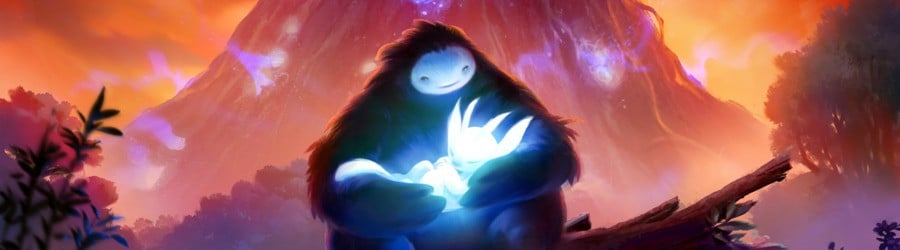
Another Xbox One exclusive on Switch, Ori and the Blind Forest is like a painting in motion; it’s effortlessly one of the most gorgeous platformers on any system, and combines this visual splendour with challenging but accessible game design. It’s also a pretty flawless conversion job, which means you’re not missing out by playing this on Switch compared to the Xbox original. Like Cuphead, Ori feels entirely at home on Nintendo’s hardware.
Publisher: Playful Entertainment Inc. / Developer: Playful Entertainment Inc.
Release Date: 8th Nov 2019 (USA) / 8th Nov 2019 (UK/EU)
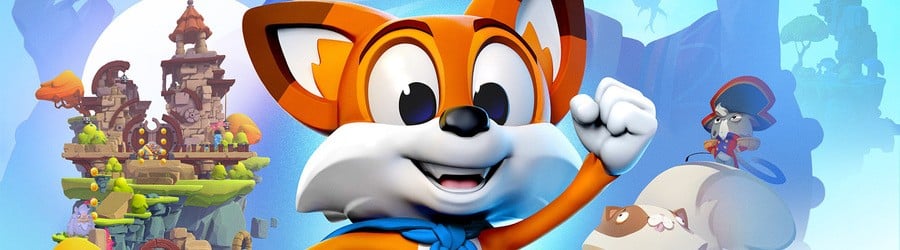
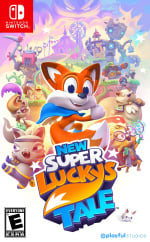
At first glance, Super Lucky’s Tale looks tailor-made for a Nintendo audience, so it’s rather surprising to learn that it began life on the Xbox One. New Super Lucky’s Tale takes the base game and enhances its dramatically, giving us a title that – while perhaps not quite in the same league as Mario’s best 3D adventures – is most definitely worthy of your attention if you’re a fan of the genre.
Please note that some links on this page are affiliate links, which means if you click them and make a purchase we may receive a small percentage of the sale which helps support the site. Please read our FTC Disclosure for more information.
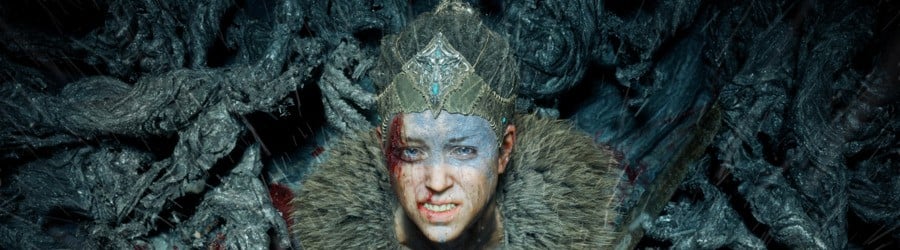
When it was announced that Ninja Theory’s ambitious psychological action title Hellblade was coming to Switch, there were serious doubts that the console was capable of doing it justice. On home consoles, Hellblade is a visual masterpiece, and it’s nothing short of remarkable that it has retained much of that visual fidelity on Nintendo’s system. A truly special technical feat, not to mention one of the most unique games of the past decade.
Thanks to its clever visual system which allows you to tinker with graphical settings to get the level of performance that suits you, GRID Autosport is comfortably one of the best ‘serious’ racers on the Switch. All of the previously-available DLC is included, too, making this a serious solid speed-fest for those who prefer real-world cars to cartoon-style karts. Developer Feral Interactive clearly has a special talent for making the Switch hardware truly sing.
Publisher: SEGA / Developer: Creative Assembly
Release Date: 5th Dec 2019 (USA) / 5th Dec 2019 (UK/EU)
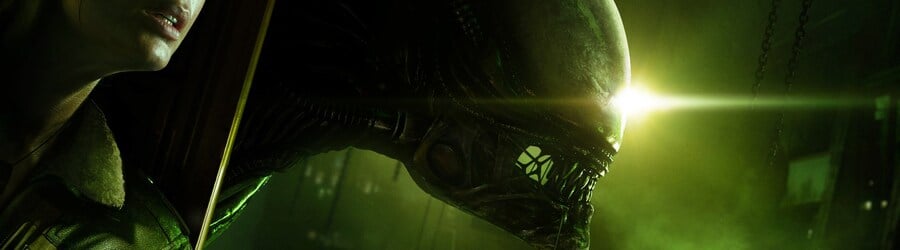
Another amazing port by Feral Interactive, Alien: Isolation takes Creative Assembly’s classic horror title and turns it into a game you can never truly escape from; trying to stay alive while an alien killer stalks you relentlessly is somehow made even more terrifying when you’re playing in portable mode with your headphones on. All of the DLC is bundled in, too, making this a fine conversion of one of the decade’s most nerve-wracking horror games.
Publisher: CD Projekt Red / Developer: CD Projekt Red
Release Date: 15th Oct 2019 (USA) / 15th Oct 2019 (UK/EU)
It was never really in doubt, right? Rumours that Witcher 3 was coming to Switch were met with derision earlier in the year; how could such a massive, technically demanding RPG possibly be crammed into a portable system? The announcement at E3 sent shockwaves through the industry, but few were prepared for the stunning quality of this port. Granted, concessions have been made to fit Witcher 3 onto Switch, but despite losing some of its visual impact, the game remains brilliantly playable and totally engrossing. Now, can Saber Interactive perform the same trick with Cyberpunk 2077? We can hope, right?
So there you have it, our 10 best Switch ports for 2019. Do you think we made the right call here? Did we get the order all wrong, or did we miss out a game that deserved a place? Tell us what you think with a comment below.
Posted by: xSicKxBot - 12-24-2019, 02:22 AM - Forum: Lounge
- No Replies
What Making Control Taught Remedy About Itself
Remedy Entertainment's Control is a game that's difficult to shake off. Its familiar yet otherworldly setting--and the larger universe around it--is so intricately crafted and so compelling that it takes up long-term residence in the mind. You want to know more about what's there, conceptualize things that aren't, and explore parallels to our own, very real world. Control is a masterclass in world-building and this, along with numerous other aspects of it, earned the game a spot in our best games of 2019 list.
Mikael Kasurinen, director of Control, is one of the architects of that world and, as a result, has a distinct vision for its future. Remedy has announced multiple pieces of downloadable content, which will build upon what the main game has established, but before the studio moves forward, we took the opportunity to reflect on what it achieved with Control.
Prior to The Game Awards, and the release of the Expeditions DLC, we talked to Kasurinen about what Remedy has learned about itself from developing Control, potential changes the studio could make to the experience, the aforementioned DLC, and the things that Mikael enjoys playing, watching, and reading.
Remedy, and you as someone who's worked super closely on the project, has been immersed in Control for so long. What's it like to finally come out of that shell and back to the real world?
It's always something that you take with mixed feelings. Being in that world, working on the game, there's this passion and drive that we have every day towards making it happen. This is the excitement of seeing things come alive, things happening. Every day brings something new and it's your lifeblood. And, as a person, I play games probably too much and I absolutely love gaming. So, it becomes this thing that you live for.
So, it is a bit ... with mixed feelings. When it's done you're happy that it's done. Shipping a game is the most important part. Every shipped game is a little miracle and once it's done, you walk away from it. Then you have this sense of detachment, almost, from everything else. You're reconnecting a bit and being able to walk away on what you did, and being comfortable with that and content. It's not always easy, because there's always this feeling like, "Oh, we could've still done that and that," and so on.
It's exciting. I think you know, the reception of Control has been spectacular. What makes me happy is that people get excited about the world that we've created. They see a world they want to be in and they're already asking about expansions and sequels and so on. That to me is the best possible result and it puts me in a great mood because I can feel like, "Right, we can continue from here. Let's see what happens next."
Remedy games are quite similar in a lot of regards. You effectively have fundamentals that you always bring from one game to the other. But looking back on something like Quantum Break, the response was mixed. Then you go away and almost scale down for Control and you get a very positive reception. What do you think, having filtered through both of those experiences now, you've learned from that about yourself and about Remedy?
I think the importance of courage. I think it's being ready to be bold with your ideas and not be afraid of whether there will be people that are going to hesitate with the things that you're creating, or even hate it. Or whether it will divide people; will it be controversial? Being able to work with that drive, and just simply not worry about it and believe that when you're creating [it] is more important to do something memorable. Something that people, once they step out from that experience, they felt something because it sticks with them, even haunts them. The only way for you to do that is to accept that there will be people that might not be into this game. And I think to me, speaking about Quantum Break, [it] was an interesting project. It had a goal of trying to be [more] towards the casual audience. And that meant that we had to be more careful with certain kinds of things, and making sure we don't alienate anybody. So, in another sense Quantum Break was us going as far, in my eyes, as we possibly could with storytelling. It had a TV show, it had, I think, almost one and a half hours of cinematics, so you could actually do a small movie from the cinematics of Quantum Break. And high-quality characters, one to one mapping of actors. We built a lot of new tech, had Hollywood actors, and so on. Fantastic talent.
But still, I've got to say the end results somehow felt... We achieved things we wanted to achieve, but still, it felt like there was nothing there that had a rough edge to it. Something that made you feel like, "Oh, what will they do now?" and something interesting that people get like, "Wow, what's happening there?" It was a bit grey in that sense--avoiding maybe too much of making statements.
And coming off from that, I think there's this urge to shake away from that. But I feel like there was a longer trend happening where we've done games that [use] American life in many ways--looking at Max Payne, Alan Wake, and even Quantum Break. All of them are like very American games, with American characters, and American stories. With Control, I felt it was important for us to shake loose of that and create a world that feels like a known world. It's more detached from that American life than we've shown in our games before, in a place of its own, and brings in a Finnish character to be more bold with that stuff, be ready to show who we are and what we get excited about. Bringing color, flavor, and being bold with that.
So that was like the biggest realization. That's not the right word even, but there's this revelation. Like, is it the right thing to try to make something that is not fundamentally who we are? And of course always when we do it, we do it through a lens, like with Max Payne it is these exaggerated elements coming together. Like film noir and John Woo, and comic book-style storytelling. It is always this enigmatic and in-depth dive into a stylized experience. Of course, we made it work for us, but Control was like, "No, let's do a world that is almost like inside of our head, this is the world that is tagging everything else and it's us, it's who we are."
Right. If you ask me 10 years from now to name a character from Quantum Break or Control, I'm more likely to remember Ahti than Jack Joyce. If those rough edges and bold risks are key to the secret sauce, does that mean that you'll try and maintain this kind of scale? Or do you feel you can still have that and extrapolate it onto a game that is the budget and the ambition of something like a Quantum Break?
That's a difficult question because I think every project is a rebirth of you going in and trying to detach yourself from what you did before, and orient yourself in a way that what you do will feel fresh. To me, when you look at Remedy, we've always done a new IP. Max Payne 2 is the only sequel that we've ever done. And it's interesting and it's a complex place that leads to those decisions. It's not always about creativity. It's also a business element that affects these decisions. But having said that, I think it's important to recognize that Control is us with a certain mindset, emotionally and how we're feeling at that time of creating this experience. I think it would be a mistake to try to mimic that later on. Instead, what we need to do is discover elements that get us excited about where we are today. And of course, if there are elements that we wanted, or let's say if we would do, someday, a sequel to Control, I wouldn't go at it in the way that's, "Oh, let's just, you know, refine and do the same game again." Emotion will be brought into a different and new place that does justice to what that franchise is about--it requires that. And it might be something very different, but people expect that if you would do a sequel.
Has the reception to Control now made you want to do more in that world, or do you feel like instead, the reception has given you the confidence to move on and make something new and take a bolder risk?
I'll be honest, it has strengthened my excitement of what could happen in the world of Control. We've opened the door a bit to what it can be, and to me the promise of that world is very exciting. I think there are elements [in the world] that we could take in many different directions, and that's what is so great about it. And it has this interesting blend of ideas and concepts that are familiar that we can anchor to. But then there are also versions of that world that can be totally different compared to what we see in the first game, and what's important to us.
I mean, I'm sure everybody already knows that there is this connection to the Alan Wake universe, right? I wouldn't even say, "Oh there's a Control universe," I would just say that there's a Remedy universe that is starting to emerge, and there is this shared lens into different experiences, but they are all part of the same thing. And that's what gets me excited. I feel like we are starting to establish something that is iconic and different and every time you go through one experience it feels like it's part of a bigger idea, a bigger world, a bigger concept, and it's larger than the sum of their parts.
I guess I have to ask the chicken and the egg question: What came first? Before Control, every interview with Remedy was, "Are you going to do Alan Wake 2?" And the studio kept saying, "Maybe when the time is right." And then Control came out and it's got these connections to Alan Wake. Was the plan always to figure out a universe or was it like, "Oh, we can connect this"?
I'll be honest, when we start concepting--me and Sam [Lake, creative director]--it was just the two of us sitting down and asking questions like, "What should we do next?" and on the table there are all kinds of different directions we can take. But what's crucial was we slap ourselves out from any kind of connections to our past. Right? We don't think about Alan Wake, we don't think about Max Payne, we don't think about Quantum Break. And that's essential if you want to build a new IP--that it can stand on its own legs. Right?
That has to come first. Then you can ask the question. You've discovered these opportunities as you start building the idea of what it is. "Okay, could it work that this is shared?" When that question was asked for the first time--and it didn't take long [for it to be asked]--it wasn't there in the beginning. And then when you start to see that connection, it's like, "Oh yeah, what would this mean?" You start to explore that and magically things are starting to fall in place and see this whole idea come together.
A part of the process is that, when you work in a creative industry, what you do is true to your life. When you play other games, watch movies, and watch TV shows, just like little nuggets of stuff get stored in your brain. Even sometimes subconsciously that we never realized and in the span of 50 years you have these little ideas and thoughts and so on. Every time you sit down and start conception, you tap into that. That's a box inside your head. I do like that.
Then you look at them and I've tried to connect them in a way that is unique and interesting and I wouldn't be surprised if Alan Wake was there in some form. When you stop to say, "Okay, let's talk about parallelism, let's talk about a strange phenomenon, let's talk about new weird," there's this feeling, this vibe that maybe has been established because we worked on Alan Wake before. Sorry, I'm getting very philosophical.
Please get philosophical.
It's a complex process and it's a delicate process as well. You have to recognize and detect, like what is the right direction to pursue. Sometimes it's also about detecting what not to pursue.
And as part of that, you've mapped out future, upcoming story-based content. How far in advance did you come up with that and, given how dense and connected the lore is? Is it constructed in a way where it will fit into that, or is it like we're taking the opportunity to explore the fact that this universe allows for strange other kinds of stories to be told and viewed? Can people expect this to be tonally the same or are you trying to swerve and do something that has the spirit of it a little different?
Okay, so I'm going to start with that. It's a bit early to talk about the expansion we're doing, but I'll give you this. [The expansions] definitely are a part of the experience that we established in Control. I mean, of course, but we expand it and we explore different directions that it could be taken to. Both expansions are actually thematically different--that's going to be interesting. I'm going to talk more about it later, but to me, again, it's about creating this strong palette of ideas and really focusing on pushing it as far as you possibly can, instead of going and repeating what already existed. It's a yes and no answer. It's like, yes there's the vibe and tone of Control, but you want to explore the edges of it to see where it can be taken. It has to start from the mother lode. It has to start from where it all began.
We're trying really hard to create a consistent world and we're really careful with the lore. We check it to make sure that it's complex and it's rich and so on, so it's not easy. I wouldn't be surprised if we find things where we pinned ourselves into a corner, but we'll figure it out once we step into that. The overall intent is to create a cohesive world even though it's strange and complex. We try our best to make sure that when we expand it, it's not something that we need to retrofit later on.
We don't want to change the truth of what it was. Instead, I think the attitude is to make sure that whatever we establish fits what we've got going in the future. [When it comes to expanding on] the core ideas, I established a creative brief for them earlier this year, to set up the things I want to do. I went through it with the leadership of the expansion team. It has its own dedicated team now working on it. Those thoughts have existed for a while, but the actual work started in September, roughly. The team had a bit of time off after shipping the game, and then a group of really talented, dedicated people came together and continued on the expansions.
What does Expeditions bring to the game from a narrative standpoint perspective?
That's the thing, like, you know every single thing that we're going to release for Control will be different. Expeditions will be different from The Foundation or AWE. They will bring different elements. Expeditions is a dive into pure gameplay. It's a very gameplay-oriented thing, and it will challenge the players in a new way that they haven't been challenged before.
Are there still secrets that are in the game that others haven't found? One thing specifically that fans are caught up on is the hidden message in Take Control.
Oh, I knew it! [Laughs] I knew you would ask about that. Some secrets in the game are yet to be discovered ... but they might not be discoverable yet.
Interesting.
Yes.
In terms of looking back at Control, is there anything that you wish you had done differently?
I'm very proud of our restrained take on how the player discovers and navigates through the world. We really like that you have to read the environment to be able to find things, and so on, which I felt like that was the direction almost like from day one; that we don't want to have to hand-hold the player and want to let them figure it out, so getting lost is okay.
But I do think the thing that we should have done a better job with is the checkpointing. It is something that we explored different directions with and we wanted it to be cohesive. We wanted it to feel like it's not random based on the situation. We wanted to be honest and consistent with it. That's the system that works for us in that concept we were building. Looking back, I think we could have taken a different approach with it that would have maybe worked better for more players. So, there's definitely room for improvement with many, many things in the game. That's maybe one thing that we get commented on.
The other one is the difficulty. I specifically said I don't want there to be a difficult choice for the player. I don't believe in the choice of like is it easy, medium, or hard? I think it's a non-choice-- you don't really know what you're going to get. I wanted to address it in a way that there are areas and hotlines and missions that thematically, some of them are easier than others. I'll admit there are tough moments there, but most people should be able to get through the main paths of the game. Then there are side missions that are extremely hard. We wanted to create the content in a way that the content that you saw was the definition of the difficulty. The problem of course is, how clear is that to the player as they enter this world? I still believe strongly in the direction that I don't think choosing a difficulty level is necessarily the right way to solve that problem. But I think it's something that we do need to do better in the future and we should strive to find a solution for it.
Do you plan to go back and do the nips and tucks that you feel are necessary? And do you worry that, in doing so, you might inadvertently change what the game is as a whole? It could be argued that there's something about that checkpoint system--good or bad--that fundamentally contributed to the Control experience.
Exactly. So there's definitely that desire to [do so]. I want as many people as possible--those who have even the slightest interest to play the game--to be able to play the game. Let me say that out loud right from the get-go, I mean everybody, like people with disabilities and so on. We're doing a lot of work trying to get everybody on board.
I wouldn't change any of the fundamentals anymore. What we created, we created, and let's stand by that and move on. Once we tackle that or return to that same moment next time we'll have learned a lot and I think be able to do a better job with those elements. Having said that, I do believe in player choice. When you look at the menu, there are a lot of things that you can turn on and off. Like for instance, if people don't like health bars, they can turn them off. I can see us getting set on options on that meta-game level, like we'll step out from the core experience to say, "Okay, you can actually adjust these things and it might make your life easier." In that way, I can see us adjusting the experience, but I wouldn't touch the heart of the game.
The world of Control has become beloved by a lot of people. Alan Wake and Quantum Break had tie-ins with novelizations and that kind of stuff. Is there a temptation to go down that path for Control? Do you want to tell stories in different ways outside of the video game medium? And if so, how do you balance that with overexposing it to people?
That's a great question. My heart is with video games always. I love doing them. I think that would be a good question for Sam Lake actually because he's really into transmedia. He's really into comic books, and books, and so on. I think we both have been able to see a way to express stories of the world of Control in those different mediums. There's definitely no reason why we couldn't do that.
But, what would make me a bit nervous though is that there is this danger of creating a picture of that world that breaks what we had initially. I'm getting a bit precious about the franchise here, but it's so carefully and delicately built and you don't want to break that if there's a novel out there that maybe goes in that direction that might compromise or undermine the main game. That [is] something that I don't want to happen. It would [have to be] be controlled--sorry for the pun--and done really carefully and with a sense of purpose. Like it has to actually serve something that makes the whole thing even better. Absolutely I would be all in for that stuff, but there needs to be this creative reason for it to exist.
I know exactly how you feel because Bloodborne is one of my favorite games of all time and I love that world. And then that comic book series came out and that preciousness that you speak about feeling, I remember also feeling it. And having read a few issues, it didn't really add anything...
Yeah. And I absolutely love Bloodborne. It's one of my all-time favorite games. And, again, the world as it is in that game is magical. It's so good. And I almost don't want to see anything else. I would never even touch those comic books because, again, yes, I almost feel nervous that it will break whatever I experienced when I was playing that game.
What else are you personally consuming and enjoying for fun?
Many people often ask, "What inspired you to do Control?" so I appreciate the question about what I enjoy.
So things that really click with me are, I love pop culture and I watch a lot of TV shows and so on, but there is this aspect of me where I'm starting to get tired of tropes that I can foresee. So there are a lot of TV shows which I don't even give them a chance, but then there are shows that absolutely blow me away. And there's actually a little bit of Control with Leftovers, an absolutely fantastic show. And it was done with this sense of realism but dealing with this phenomenon--2% of the population of Earth have disappeared. And it seems like that's not a lot, but then it has this deep, complex emotional consequence on the lives of different people. It's like when you nick an artery and then you can see the world fall apart. And it was great TV, great actors, and great stories, nuance, and the delicacy of how they dealt with the lives of those people--it was absolutely beautiful.
And the showrunner went on to do the new Watchman TV show, which is absolutely fantastic. It's so good. And it's so bold. It's not afraid of going in different directions and every episode surprises you and you're engaged. Even though it's jumping into a different time or a different place or it's in black and white, you're engaged. And that's just one example; I watched a lot of other shows but that stands out to me. If I had to pick, it's, yes, Leftovers and new Watchmen. Absolutely fantastic.
And then from games, there was something in Dark Souls that deeply affected me and it's hard to put into words but it's that ... boldness, that courage, that conviction to say, "Here's the world. You're in it and it's yours to discover." Nobody is telling you what to do. Nobody is even telling you who you are or why you are there. And it's a scary, unsettling moment. But then you feel like you can start to build up this courage like, "I'm going to start dealing with this," and you bring down your first enemies and you have a boss fight and then you win it. And that was the whole point of the beginning sequence: to give you that confidence to be able to start dealing with this world. And then you continue to do it and you get bolder and bolder and bolder.
There's something indescribable about that experience that I've never experienced in any other game. And it just dragged me in and I couldn't let go. I was obsessed with that game. And trust me, there were some fights I was almost gone mental and I had to stop playing and go outside. But I returned every single time. So it stands out to me as a truly exceptional game. I haven't tried Demon's Souls, which I'm ashamed of, but it's on an older platform. I never got to be able to...
It's phenomenal.
Yeah. That's what I hear, and maybe someday I'll get to play it.
Have you played Sekiro yet?
Yes. I started it, but it was...
It's brutal, isn't it?
Oh, yeah. It's even worse than Dark Souls. But it's still a work in progress for me.
That feeling that you mentioned where you overcome a challenge and you feel empowered, there's a moment in Sekiro that is as powerful. The confidence you get from that point on to deal with that world is unparalleled. You should absolutely stick with it.
I definitely will do. And Dark Souls III has one of the most beautiful boss fights I've ever had. It was the Dancer of the…
Boreal Valley.
Yes! I don't know what it is in that fight but it was beautiful and terrifying. It was slow and fast at the same time, which I still don't understand how that is possible. It felt like a dream and then sudden brutal violence. And it's, to me, one of my all-time favorites. And I talked with many people and many go, "Ah, ah, yeah. I don't know. It's fine." I don't know. For some reason, it sticks with me.
It's the ethereal quality of the Dancer, I think. There's an elegance in the way it moves and you almost get sucked into the majesty of it, you're hypnotized, and then it strikes at you and you're like, "Oh." It's so good at taking you off guard and then coming at you.
And there was something in the cloth physics, as well, it looked like it's underwater and, yeah, you get mesmerized by it. I never felt that in any kind of a boss fight that I ever had and that's what made it stand out to me. So emotionally and as a player as well, it was amazing.
I play tons of different games. I love Assassin's Creed. I love to jump into this historical world and I absolutely love it that Ubisoft is doubling down on, "Let's take this history of the real world" and they have their own interesting interpretation of that. You feel like you rediscover a world that you already knew of, so I love those games.
And I'm a big Destiny fan, as well. Raiding with friends is one of my favorite hobbies. Destiny is a... it's a unique one. I don't think there is a game like that out there. And I think many people are a bit unfair towards the game because they think, "Oh, it's just a looter-shooter," but it's a really complex, nuanced world with a lot of different elements. It has dragons, wizards, and it has sci-fi elements and it sounds silly initially but somehow they're able to bring it into a cohesive experience. And I think they're brilliant at what they're doing.
It's one of the first games where I stop and watch two- or three-hour YouTube videos diving into the lore of that world. And it is enchanting. It's like, "Wow. There's so much thought and attention to detail, and you see the connection points in the actual world. So much that stuff... Maybe like what From Software does, is the same thing. So you can see the same elements going on, that there is passion and a heart that they've put into that world. And I can see it and, as a game developer, I immensely appreciate it.
And especially because I feel like I'm personally a bit tired of games that go into this exposition mode. Like, "Let me tell you what is happening and explain everything to you." And then you don't have to think for yourself at all. And there are many games that do that. There's a certain kind of safety with that, I think. It's a comfort food for many people I'm sure, but to me I tune out or like I feel annoyed that I can't discover this myself. And that's a huge part of what I love about games.
Books! So one of the books that I recently discovered--it's an old book, but I loved the epicness of it--is Three-Body Problem. It's by a Chinese author Liu Cixin. Do you know what the three-body problem is?
No.
So it's this physical thing like, if you have two objects floating in space and so on, the other one will naturally rotate around the other and you can create really predictable physics models based on it. It will always continue in a way that anybody could do calculations and then predict what's going to happen next. If somebody slaps one of the things and then it goes away, everybody can say, "Okay. This was what happened." But if you add a third thing into that, it adds that chaos. Everything becomes unpredictable and it's almost impossible to say what's going to happen next, even by physics and calculation. And this book series explores this.
So that's a thematic core of what the book is about. It's sci-fi and it's a book about humankind discovering that there are aliens out there, that there's life in the universe. But it's realistic. It's epic. And it starts from Chinese Revolution in the '60s and it's an absolutely beautiful book. It dives into the psychology of human beings, what it means to live a life and so on. And then there are events that span through decades and generations. And it has psychological warfare basically between these two different sides. And it's just super interesting, very compelling, very different. And I don't know. If you love good hard-sci-fi, that's the one, that's your thing.
Very quickly before we have to wrap up, any favorite comic books?
Watchmen, again. And I absolutely love it. Sandman is fantastic. I gear towards graphic novels. I love the superhero stuff at Marvel and so there's a nice comfort thing there, but it's not necessarily a passion for me. So I go more into Sandman and Watchman and whatever Alan Moore did in the '80s and '90s, it's brilliant stuff.
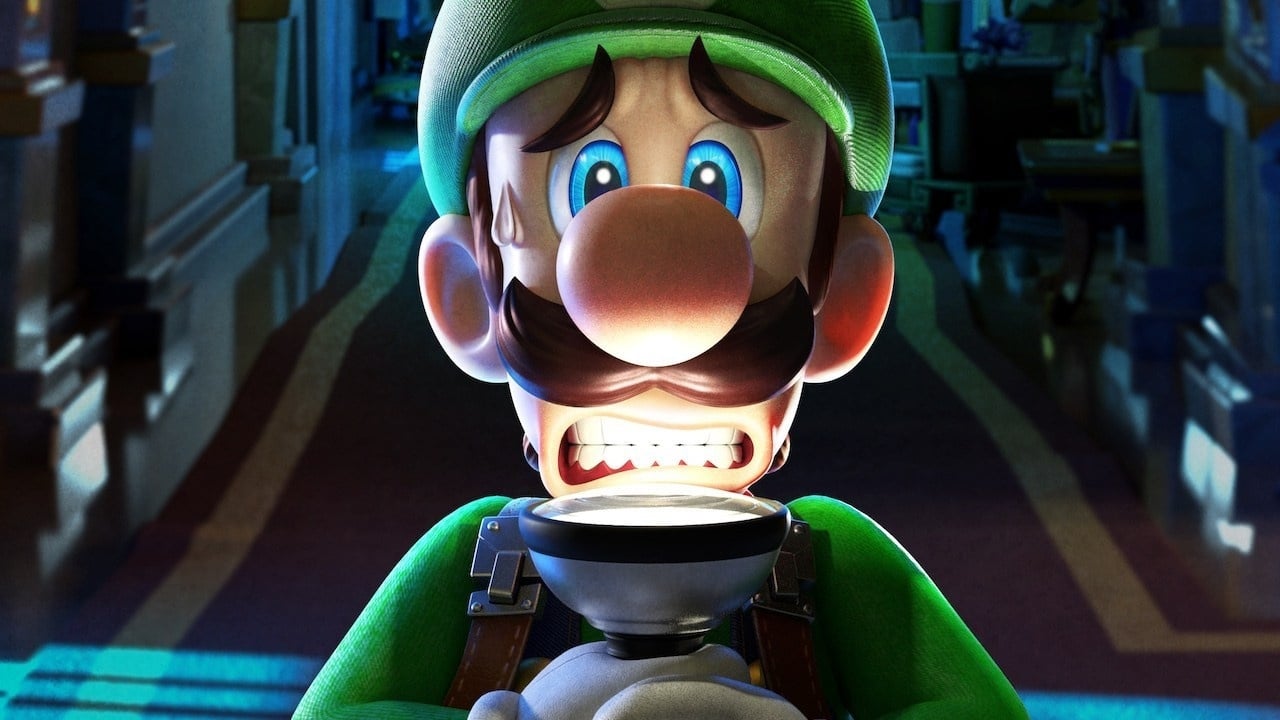
Luigi’s Mansion 3 Is Now Outselling Link’s Awakening In The UK
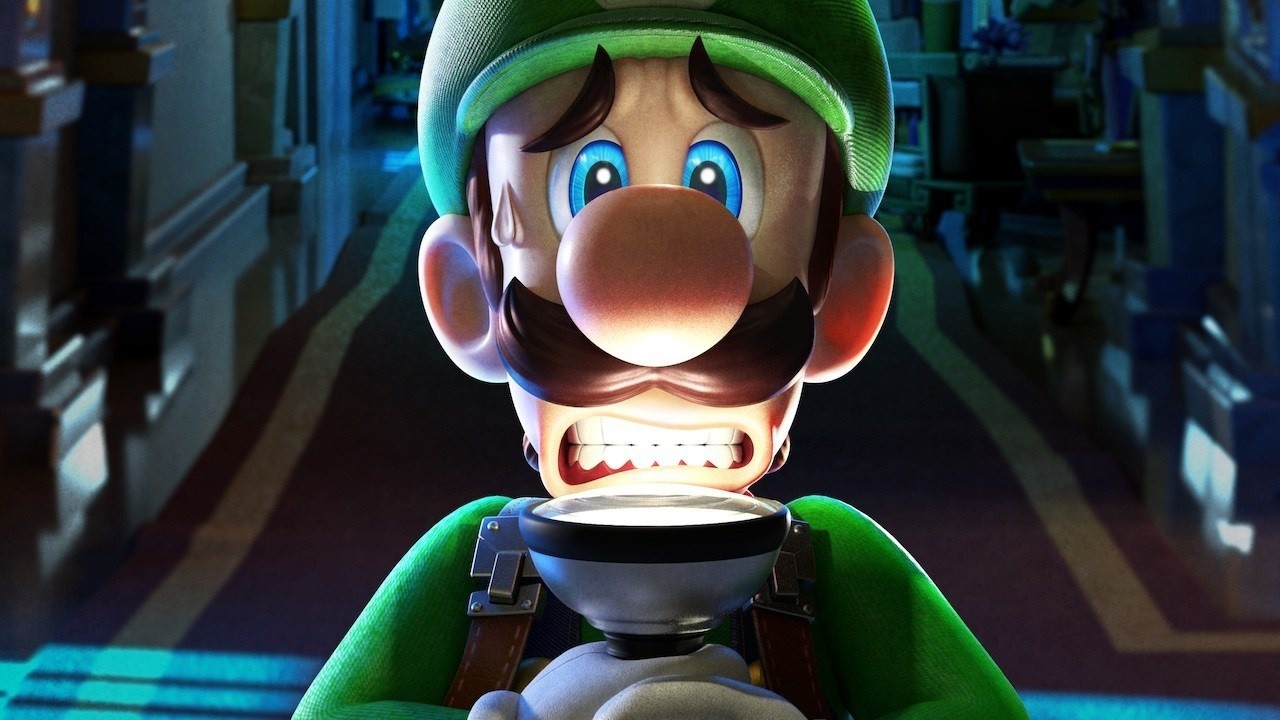
Luigi’s Mansion 3 was well-received by fans and critics alike when it was released in October, so how is it doing on the sales front? In the UK, Luigi’s third outing is performing quite impressively at the moment in the local game charts, even though it wasn’t able to claim the top spot when it was first released. According to GamesIndustry.biz, the Switch game’s sales are up by 49% week-on-week, and it’s jumped from seventh to fifth place.
As you might recall, Link’s Awakening when it arrived in Europe was the fastest-selling Switch game of 2019, shifting more than 430,000 units across this region. In saying this, it didn’t take long before Sword and Shield arrived and was recorded as the second-biggest Pokémon game launch in the UK ever and the biggest system exclusive of 2019.
This follows on from the news we heard in November about Luigi’s Mansion 3 becoming the best-selling entry in the series in the United States, outperforming the original Luigi’s Mansion game. Over in Japan, Luigi’s spooky outing sold 150,000 copies in its opening week, but only placed second on the charts.
Keep an eye out for the full rundown of the UK charts later today.
It’s time to celebrate the best games of 2019, so we decided to partner with Giant Bomb and CNET to give away three amazing prize bundles that come with a console and some cash so you can buy your favorite game of this year. Here are the prizes:
One grand prize: PS4 Pro 1TB Jet Black $400 + $60 Playstation Store Gift Card
One first prize: XBOX One S All Digital Edition $250 + $60 Xbox Gift Card
To sign up for the giveaway you have to make sure you read our official rules, accept the terms and conditions, and fill out the form below. You can get extra entries to increase your chances of winning by completing the actions available in the form, like subscribing to our YouTube channels.
If you are having trouble viewing the form on your mobile device, please click here.
We will be reaching out to the potential winners via email, so don’t forget to check your inbox around January 2. Be sure to check your junk mail, too.) Good luck, everyone!
This giveaway is neither sponsored nor endorsed by Nintendo, Sony or Microsoft.
Rising Tide, a content update that lays the blueprint to create the powerful Railjack battleship, is live now on Xbox One
Rising Tide is the first step to experiencing Warframe’s upcoming Empyrean update
Scouring the viable salvage from wreckage across the Origin system, Tenno must retrieve six components to build the Railjack
Every December is an incredibly busy time for Digital Extremes and Warframe players. This year is no exception. At The Game Awards last night, Digital Extremes announced Rising Tide, a content update that lays the blueprint to create the powerful Railjack battleship, is live now on Xbox One.
The War Begins with Rising Tide
For Xbox One players, Tenno (the player’s in-game name), Rising Tide is the first step to experiencing Warframe’s upcoming Empyrean update. It’s the key to all-out, team-based space combat. Players will have the means to research and build the Dry Dock, which begins as a hangar but evolves into a sanctuary. To start, it’s as simple as rallying together a clan and contributing resources to its construction.
Once players have assembled clan members, researched and assembled the Dry Dock, they’ll recruit the help of Cephalon Cy, a wry new ship A.I. who helps players craft their Railjack, who functions like Cephalon Ordis, but values mission protocol more than anything else. We think you’ll love them!
Scouring the viable salvage from wreckage across the Origin system, Tenno must retrieve six components to build the Railjack. If players have completed the cinematic quest The Second Dream, they can begin to forge a ship. They’ll build, hone and upgrade the Railjack, an ancient Orokin technology, to arm themselves in the new war against the Grineer — and the dark tide of enemies not too far behind them.
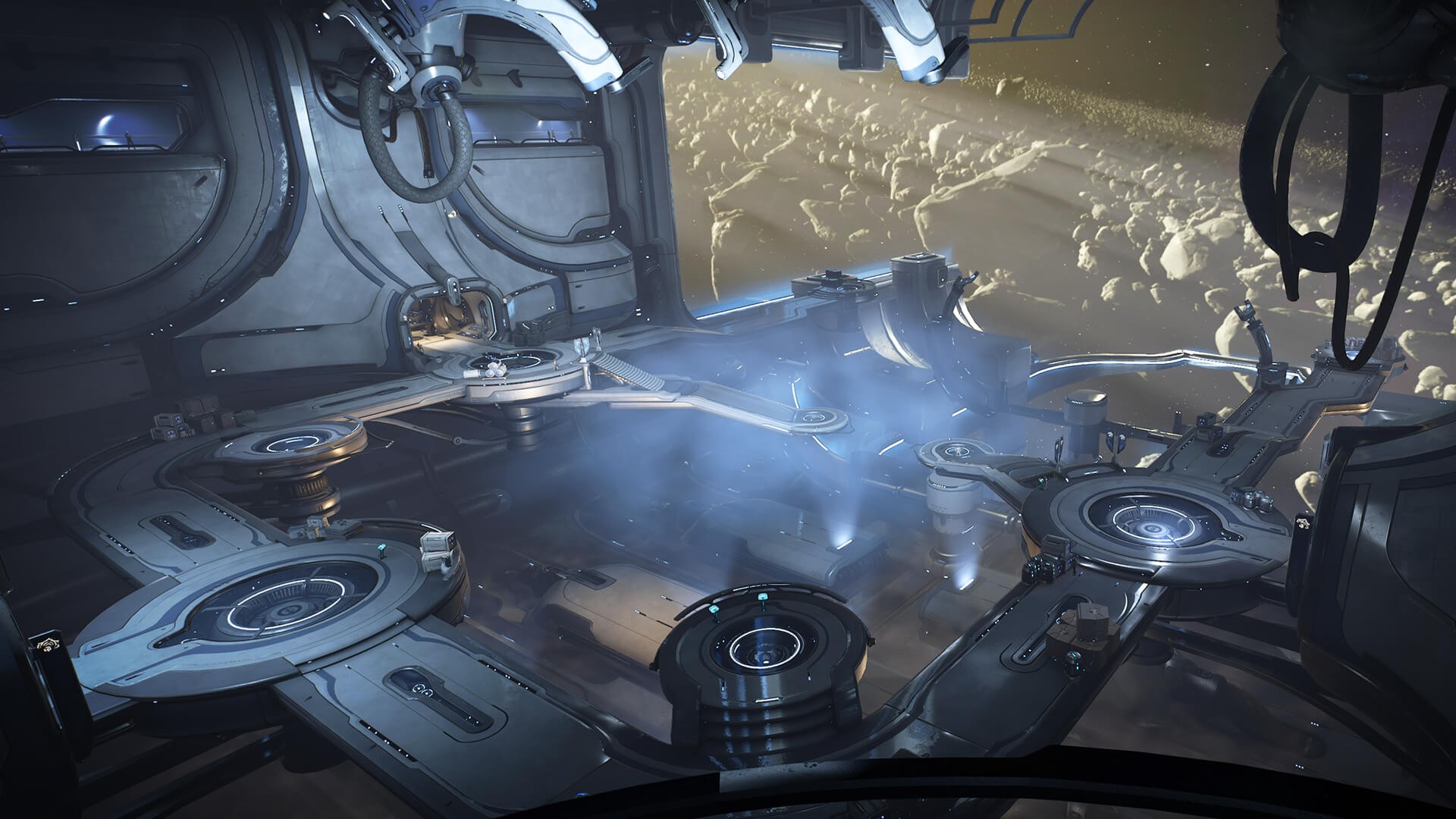
Cosmetically, Rising Tide delivers overhauled select visual aspects for the Liset, players’ personal landing craft, by adding in updated machines, enhanced lighting, and even a new “moonroof”, perfect for gazing at the Origin System’s starlight.
Rising Tide is essentially a warmup for Empyrean. A very necessary one. Once armed with a customized Railjack battleship, the Sigma Series Railjack, Tenno will be ready for the all new battleship gameplay of Empyrean, and coming soon to Xbox One.
Dominate Space in the Railjack
In Empyrean, Tenno will charge into four-player space battles against an unrelenting Grineer space force in all new missions. We hope Empyrean will see new and veteran players alike forging friendships and team skills, as they propel into this next-level cooperative experience.
Whether it’s by blasting opponent Cruise Ships with upgradeable firepower from the pilot seat or gunner positions or shooting like a bullet from the Archwing Cannon into enemy ships and commadering their vessels, Xbox Tenno are in for a shock to their senses. Empyrean combines the classic third-person combat that we all know and love with fast-paced, dynamic battleship combat. But it’s not just flying around shooting combat. Empyrean relies on players genuinely fulfilling roles and working together to complete missions.
Once they get the hang of the ship — there is a fun, easy Free Flight Mode for new players to get acquainted with its layout and functionality — players have a wealth of roles to play in combat. They can pilot the ship in and out of combat with cool special moves like “juking” or turning invisible; jump into the gunner chairs to tear up Grineer fighter ships; launch into space as solo Archwing vectors to take down or infiltrate larger enemy targets (like Cruise or Galleon ships); research and produce resources in the engineer room, or provide support by dousing fires and repairing hull damage. Players can even apply a single Warframe power to other players on the ship to provide more support or fight onboard enemies.
Empyrean will challenge even the toughest players to use all their greatest combined skills, experience and knowledge to rise up and face the biggest threat they have ever experienced in Warframe.
Panic will ship Playdate preview units to curious devs ahead of full launch
Publisher turned hardware maker Panic is adding another phase to the launch plan for its crank-bearing handheld the Playdate to give developers more time to toy with the device.
Panic calls the step the Playdate Developer Preview and now aims to sell developer preview units ahead of the Playdate’s full launch, giving a small slice of developers a bit of a jump on any Playdate-focused projects they’ve got in mind.
As noted in this month’s update, the preview units aren’t dev kits exactly, as the retail version of the Playdate can itself be used as a dev kit. These preview units however won’t include any games when they ship out, and will only be sold to a random selection of teams on Panic’s developer mailing lists (with some exceptions for special initiatives still under wraps).
Those in the program can then gain access to Playdate’s dev support forums and SDK. Beyond that, Panic lightly teases that it has more tools in the works to help those less familiar with the technical side of game development create for the Playdate, but hasn’t said much on that for the time being.
Panic announced the Playdate earlier this year, and expects to start taking preorders and shipping final units at some point in 2020. The small rectangular handheld looks somewhat similar to the two-buttons-and-a-d-pad devices that ushered in the earlier days of handheld systems, but with the noticeable addition of a physical crank along its right side as another input option.
At launch, the $149 device will include 12 games still shrouded in some level of secrecy, but will periodically see new, equally mysterious games downloaded directly to the device after its official launch.
Posted by: xSicKxBot - 12-23-2019, 09:01 AM - Forum: Lounge
- No Replies
Project xCloud Will Not Replace Microsoft's Next-Gen Console, Xbox Series X
Microsoft doesn't believe that cloud gaming is going to replace console or PC gaming, at least in the short term. So when designing both Project xCloud and Project Scarlett--which is now officially named Xbox Series X--the company built the two to work together, not as separate systems, for playing games. Just as Nintendo's Switch is a console that can be used to play on the go, Project xCloud allows Xbox owners users to play their games while away from their home setup.
"We're not trying to tell people that xCloud is going to replace their console or xCloud is going to replace gaming on a PC or replace gaming on a Switch or something like that," Xbox head Phil Spencer told GameSpot in an exclusive interview. "But we do think that ability for me to take my gaming experience with me--so that when I log in, all my friends are there, all my games are there, my saved games are there... my Achievements, [and] my library is with me--is pretty critical."
To that end, Project xCloud's platform is the same as the one for Xbox Series X--which Spencer says should make it easier for third-party developers to design their game and have it easily work for both the cloud service and the console so they "don't have to port to a new platform." If you build your game for Xbox Series X, it should work on mobile devices, computers, and other systems that support Project xCloud. "We literally show up to third-party publishers and we hand them a phone [with] their games running in xCloud," Spencer said. "They didn't have to do any work to make that happen."
Spencer points out that this is able to work because Xbox Series X and Project xCloud were designed around the same time as one another. This is different from the Xbox One, which was designed with the idea of implementing cloud support down the road. "[With] Scarlett, we started--at the beginning--saying, 'There's a world where [we] might actually put as many of these [consoles] in the cloud as we do in people's homes,'" Spencer said.
Xbox Series X is scheduled to release in 2020 during the holiday season, which is around the same time Sony will also be releasing its next-gen console, the PlayStation 5.
We are a pretty active crew. A lot of us have most of the buildings in GTA V.
Every now and then someone hosts a money lobby to help the other players out.
So if you NEED money BAD!?
Go ahead and join up while you can!
How to Create a Crew on Social Club
Question: How can I create my own Crew on Social Club? Answer: Here are the steps to create a Crew:
Maxon, the makers of the long running Cinema 4D 3d application have just announced a merger with Red Giant, a provider of tools for the VFX and post processing industry.
Details of the merger from the Maxon news release:
Portland, OR and Friedrichsdorf, Germany – December 17, 2019 – Maxon, the developers of professional 3D software solutions and Red Giant creators of unique tools for editors, VFX artists, and motion designers, today cooperatively announced that the two companies have reached a definitive agreement to merge under the media and entertainment division of Nemetschek Group to better serve the post production and content creation industries. The transaction is expected to close in January 2020, subject to regulatory approval and customary closing conditions.
Maxon and Red Giant are already well known and established in the digital content creation (DCC) industries, and share synergies in philosophy and long-term goals. Both companies have earned a peerless reputation for the quality and accessibility of products, and uncompromising commitment to service and support of the artistic community. Each company’s workforce features the industry expertise, organizational maturity, and executive experience needed to fully leverage this unique opportunity.
Maxon, best known for its flagship 3D product Cinema 4D, was formed in 1986 with a passion for providing extremely powerful, though exceptionally accessible 3D software solutions. Artists across the globe rely on Maxon products to create cutting-edge visuals. In April of this year, Maxon acquired Redshift, developer of the GPU-accelerated Redshift render engine.
Since 2002, Red Giant has built its brand through award-winning products such as Trapcode, Magic Bullet, Universe, PluralEyes and its line of innovative visual effects software. Their unique, industry-standard tools are staples in the fields of film, broadcast, and advertising. Red Giant has differentiated itself in the industry through its artist-driven approach to software creation and its popular training and award-winning short films.
The merger should have minimal impact on either companies customers. You can learn more about each company and the merger in the video below.