Australian ‘big four’ bank NAB adopts Apple Pay, Westpac lone holdout
By Mikey Campbell Monday, May 20, 2019, 06:29 pm PT (09:29 pm ET)
National Australia Bank (NAB) on Monday announced immediate support for Apple Pay, becoming the third of Australia’s “big four” banks to integrate with Apple’s payments platform after a failed boycott.
NAB announced the arrival of Apple Pay in a tweet posted to the bank’s official account.
“It’s here. NAB customers can now use Apple Pay. Just add your NAB Visa Card and start using Apple Pay wherever you can tap and pay. Apple Pay with NAB. Easy,” the tweet reads.
Along with the announcement, an accompanying link points to a comprehensive mini-site detailing the service. Customers are provided information regarding compatible devices, credit and debit cards and a quick setup guide for iPhone and Apple Watch.
Ironically, NAB touts Apple Pay’s security, a feature largely reliant on Apple’s tight control of the NFC hardware stack to which NAB and its collaborators sought to access through a collective boycott in 2016.
In a move designed to put banks in a better position to bargain with then-newcomer Apple, Australia’s Commonwealth Bank, National Australia Bank and Westpac Banking Corp, along with Bendigo and Adelaide Bank, filed a complaint with the Australian Competition and Consumer Commission seeking to negotiate access to Apple’s NFC technology. The banks initially sought to force Apple into integrating third-party mobile payments software with iPhone hardware and later requested direct access to iPhone’s NFC controller.
The banking bloc argued its stipulations would foster increased competition and consumer choice, as well as accelerated innovation and investment in the digital wallet space.
In March 2017, the ACCC denied permission to collectively bargain and boycott Apple, putting an end to the banks’ gambit.
With NAB on board, Westpac becomes the last of Australia’s “big four” banks to resist Apple Pay.
Australia and New Zealand banking group, which was not involved in the attempted forced negotiations, was the first major lender to offer Apple Pay in 2016. The Commonwealth Bank of Australia, Australia’s largest bank, rolled out support for the mobile payments solution late last year.
This KONAMI Castlevania Collection is designed to be a collection around the origins of the historic franchise.
Included is a unique eBook that has details provided by developers, artists and other inspired by the Castlevania legacy.
Released as part of the KONAMI 50th Anniversary celebration, now the best time to relive these timeless classics that helped define the platformer genre.
Game List:
Castlevania (1987/US, 1988/EU)
Enter At Your Own Risk! If you think it's scary on the outside, wait till you see the basement.
You're in for the longest night of your life. Ghosts, goblins, demons, wolves, bats creatures lurking around every corner. Better pick up a weapon or two, because when you finally meet the Count, you know he'll be going for the jugular.
Castlevania Simon's Quest1988/US, 1990/EU) NES
This title tells the tale of Simon's subsequent adventures following the events in Castlevania.
Unlike the previous installment, this one was developed as an action RPG. It maintains the action elements of its predecessor but mainly focuses on exploration and puzzle solving within a far more expansive game world.
Castlevania Dracula's Curse (1990/US, 1992/EU) NES
Led by the immortal Count Dracula, the greatest army of evil ever assembled is poised to bury mankind in a tomb of terror. Destroying His legions will be the supreme challenge for the mightiest warrior.
100 years before Simon Belmont's birth, Dracula is young at heart and it will take more than a stake to penetrate his evil. Luckily, you command the role of Trevor - Simon's forefather and the original vampire slayer.
Super Castlevania (1991/US, 1992/EU) SNES
A century of Transylvanian tranquility is about to come to a shocking end. Once again the mortifying screams of helpless villagers shake the ground as they shrink from new horrors unleashed by the Duke of Darkness, Count Dracula. And this time he has a tombstone with your name on it, Simon Belmont.
Castlevania The Adventure (1989/US, 1991/EU) GB
This is the first title in the series to be released on the Game Boy handheld game console.
The variety of power-ups available for the whip added depth to the strategy of the gameplay.
Castlevania Belmont's Revenge (1991/US, 1992/EU) GB
Fifteen years after vanquishing the evil Count Dracula, Christopher Belmont now faces a vampire swearing vengeance. Drac's back. And he's turned your son, Soleil Belmont, into a deadly demon to do his dirty deeds. To rescue him from the Count's clutches, you must first track him down through four creep packed castles.
Castlevania Bloodlines (1994) GEN
Unlike the medieval setting of the other titles, this installment takes place during World War I. It introduces new elements to the series, such as the ability to choose one of two characters when starting the game.
Huge bosses with dynamic, multi-jointed limbs that move erratically are just one of the many examples of the cutting-edge effects the game had for the time.
Kid Dracula (1990/Japan exclusive) NES
With its laugh-inducing content and world full of gags, this spinoff is unlike anything else in the series. Players take control of Dracula's son (or so he says...), Kid Dracula, as he goes on a hilarious adventure filled with laughs that also satisfies as a full-fledged action game.
From the developers of the Bit.Trip series comes the latest and greatest in bobcat-based gaming. Oinker P. Hamm is determined to capture every animal in the universe for his ?Amazootorium.? Bubsy, fearing mostly for himself, is just as determined to stop him. No matter who emerges victorious, there?s going to be a whole lot of yarn along the way.
Descenders is extreme downhill freeriding for the modern era, with procedurally generated worlds, and where mistakes have real consequences. Will you lead your team to glory and become the next legendary Descender?
Who Won The Iron Throne In Game Of Thrones' Finale?
After it all, it's come to this: the end of Game of Thrones. With the final episodes of Season 8, HBO's fantasy epic wrapped up the Last War with the destruction of the Lannisters, the torching of King's Landing, and the embrace of madness by a key protagonist. But as was evidenced by the fact that the conflict with the White Walkers wrapped up halfway through the season, there remained one core matter to resolve that has been central to the series: the titular game of thrones to decide who would sit on the Iron Throne and rule Westeros. Below, we're recapping the finale's ending, and specifically who ended up as ruler of Westeros--the prime motivation for many of the show's characters dating back to the very start.
Of course, one final warning: There are massive spoilers for the Game of Thrones finale beyond this point. Read on at your own risk.
The finale episode resolved the conflict between Daenerys Targaryen and the rest of Westeros after her turn in King's Landing, in which she used dragon fire to kill thousands even after the city had surrendered. Daenerys chose to rule Westeros through fear since she thought she'd never get the people's love. Turns out, that wasn't a great choice either, as it caused some of her most trusted allies to turn on her.
In the end, Jon Snow took matters into his own hands and killed Dany to stop her from becoming the Mad Queen. Drogon melted down the Iron Throne in his grief before bailing with Dany's body--so while there still needs to be a monarch, there's no longer an Iron Throne per se.
That left Jon as the last Targaryen in Westeros to rule, but assassinating a queen is something a lot of people frown upon in a ruler--to say nothing of the fact that Jon has repeatedly said he doesn't want to rule Westeros. The survivors of the war formed a council to democratically choose a new ruler, finally landing on someone who's highly qualified, if a little weird: Bran Stark.
With his powers of the Three-Eyed Raven, Bran is easily the wisest person in all of the Seven Kingdoms, and the fact that he has no desires at all anymore means he's a solid choice for a leader, if you're looking for someone who will make good decisions for all of a country's people. Where other rulers get petty, paranoid, or vindictive, Bran's general distance from other humans makes him pretty objective. As Tyrion dictated, from now on, there will be no succession for the throne based on heredity; instead, the lords and ladies of Westeros will choose a new leader by vote. Bran also created a strong small council of people who want to make the realm a better place, led by Tyrion Lannister as his Hand of the King. But they won't lead the North. As Sansa said, the North will now be an independent kingdom (of which Sansa is now queen). That leaves Bran to be the king of the Six Kingdoms.
So what about Jon and the other Starks? As a compromise with Grey Worm and the Starks, Jon was sent back to the Night's Watch and then went beyond the Wall with the Freefolk. Sansa Stark is Queen in the North, and Arya Stark departed Westeros to explore the world. Grey Worm and the Dothraki also departed the continent and were headed back to Essos to free more slaves. Daenerys might be gone, but she still left behind a powerful influence, one that should lead to a better world for her people on both continents. At least, that's the hope.
John Wick 3 Ending Explained: What The Heck Just Happened?
At the end of John Wick 2, with what looked like the entire city of New York about to take up arms against Keanu Reeves' titular hero, it seemed like the next chapter in the assassin's saga would have to wrap things up one way or another. We were pretty surprised, then, when John Wick Chapter 3: Parabellum concluded not with John's death or his triumph over the High Table, but basically where it began: with John Wick on the run, out of friends, the whole world against him. But was Winston's betrayal of John real, or is there more to it than that?
At the end of John Wick 2, Winston (Ian McShane) gave John an hour's head start. He was still on the assassin's side, despite the reality of John's affront against the High Table's laws when he spilled blood on Continental grounds. By John Wick 3's conclusion, Winston has fully turned on John, shooting him repeatedly and sending him careening over the edge of the Continental's roof. But are things really that black and white?
The Continental vs. The High Table
First off, let's talk about the conflict that served as John Wick 3's climax: the fight between the Continental (well, really John and Charon (Lance Reddick), since Winston mostly hid in a vault with John's dog), and the High Table's elite strike team. The High Table doesn't take lightly to being defied, and the hour Winston gave John at the end of 2 was enough to get the NY Continental manager in deep trouble with his overlords. They sent the Adjudicator (Asia Kate Dillon) to negotiate Winston's "retirement," and the High Table's Elder (Saïd Taghmaoui) sent John back to New York to kill Winston.
Obviously, the High Table's plans in this case didn't work out, largely thanks to the bond that Winston and John share after years of working together. Winston had no interest in stepping down, and John didn't really want to kill him. John may have gone through with it in order to survive, had Winston not offered him an alternative--teaming up to fight the High Table.
The Continental and John won the initial skirmish, but both sides knew this fight was just the beginning. When they met for a parley, Winston and the Adjudicator agreed to a ceasefire, under the shared revision that Winston had only risen up in the first place in order to prove his strength and devotion to the High Table. It was a simple show of force--at least, according to the version of events Winston and the Adjudicator settled on in the end.
Either way, that left one loose end: John Wick himself. Winston shoots John several times, seemingly taking the assassin by surprise, and John plummets off the Continental's roof.
If you take this scene at face value, it seems that Winston betrayed John in order to reaffirm his loyalty to the High Table. But that may not necessarily be the case. Throughout these movies, the friendship and trust between John and Winston have seemed genuine. When Winston said he'd rather be killed by a friend, he appeared to mean it.
Another Possibility
In light of that, there's another possibility: Winston was just doing what he had to in order to make it seem like he'd turned on John, while actually trying his best to ensure John walked away from the situation with his life. Winston shot John in the torso, where he knew John's magic bulletproof suit would prevent the bullets from killing him, and he may have even known that John would hit some obstacles on his way down, breaking his fall, if he hurtled off the roof in that exact place. Winston never looked over the edge to make sure John was dead, and he didn't seem too concerned about the fact that the boogeyman-assassin he'd just seemingly betrayed had apparently gotten up and walked away.
At the very end of the movie, Jason Mantzoukas's character (the Tick Tock Man, who we didn't get nearly enough of) finds John and takes him to the Bowery King (Laurence Fishburne), who apparently lived through his seven slashes. Like John, the Bowery King isn't looking so hot--but given both characters' current standing with the High Table, that's not the only thing the two now have in common.
Is there a real rebellion against the High Table brewing for the inevitable John Wick 4? Will Winston and John reconcile, or was that betrayal the last straw? We'll have to wait and see, but the foundation is certainly there for a fourth chapter in John Wick's saga.
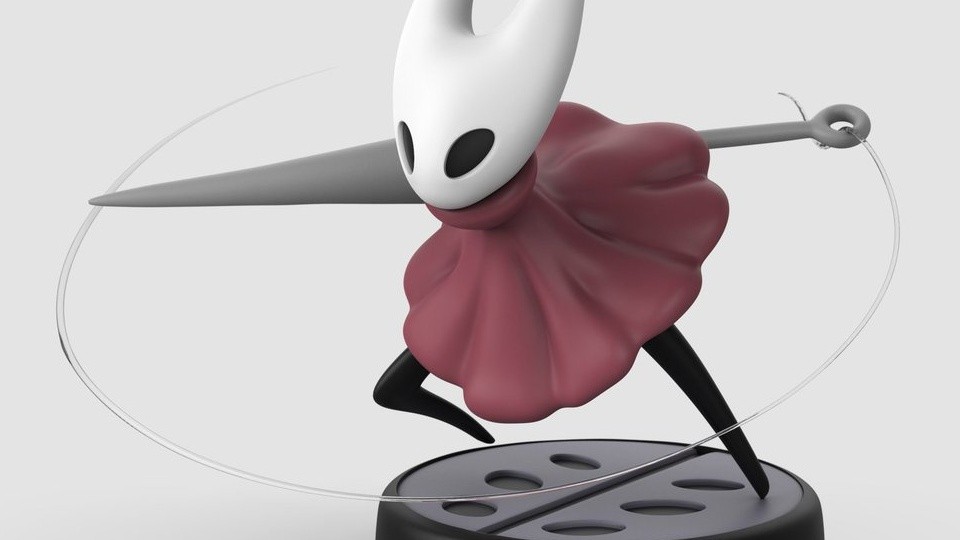
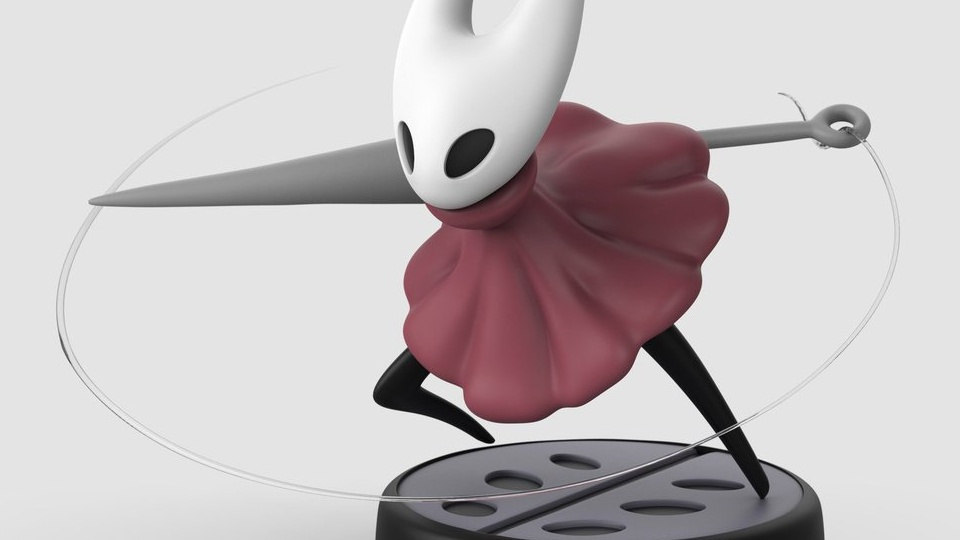
Random: These 3D Concepts Have Us Dreaming Of A Nindie amiibo Line
Nintendo’s amiibo line has been an absolute cash cow for the Japanese company since arriving alongside Super Smash Bros. for Wii U in 2014. To date, there are more than 170 amiibo available. While most of them are based on first-party Nintendo titles, there are a few exceptions such as Yacht Club’s Shovel Knight.
If you’ve always thought about what other notable Nindie characters would look like in amiibo form, a Madrid-based 3D modeler, sculptor and indie video game developer, who goes by the handle @JCirion3D over on Twitter, has been busy creating amiibo concepts for characters from games such as Hollow Knight, Cuphead and The Binding of Isaac. Take a look below:
The talented individual also ran a poll, asking followers what notable indie game they would like to see turned into an amiibo next. While Hollow Knight won, perhaps Dead Cells or Enter the Gungeon will receive the same treatment in the future.
Do you wish any of these amiibo were real? What other characters would you like to see transformed into amiibo? Tell us below.
Posted by: xSicKxBot - 05-20-2019, 01:59 PM - Forum: Windows
- No Replies
Video games: A unifying force for the world
My father, a chemical engineer, brought home our first computer, a Sinclair ZX81, which came out in 1981. We played games together and then later, we wrote games together.
Today, for many people around the world, gaming is the first entry point into technology, just like it was for me.
I believe in two fundamental truths about gaming:
First, gaming is for everyone. No one group “owns” gaming. Instead, whether you’re new to gaming or are a diehard e-sports fan, you are welcome to play and welcome to all the fun and skill-building that comes with gaming. In this way, when everyone can play, the entire world wins.
If you imagine gamers as predominantly men and specifically teen boys, think again. We are a 2.6 billion-person strong community of parents playing with our kids, adventurers exploring worlds together, teachers making math wondrous, grandmothers learning about their grandchildren through play, and soldiers connecting with their folks back home. Most gamers today are adults; nearly half are women.
Second, gaming must promote and protect the safety of all. Gaming must be a safe environment. Creating community is shared work, and protecting community is essential work, so, we all carry part of the payload of community safety – game industry and gamers alike.
This widespread embrace of gaming and its global communities have turned video games into the world’s leading cultural industry, bigger than movies or music. But it also comes at a time when digital life includes a growing toxic stew of hate speech, bigotry and misogyny.
No different from rock and roll, books and TV before them, video games are often dismissed or maligned as frivolous, fraught with violence or filled exclusively with hate-mongering. But gaming is uniquely designed for equality. We don’t just walk in someone’s shoes – we stand on equal footing, regardless of age, education, socioeconomics, race, religion, politics, gender, orientation, ethnicity, nationality, or ability. Gaming doesn’t just bring stereotype-defying gamers together; it unites us through our universal language of fun and answers our human need to play. Research has shown an effective way to battle polarization and prejudice is through relationships with people outside our own groups, known as intergroup contact theory. This is where gaming excels: forging unexpected friendships with people we might never meet in real life. Dr. Linda Tropp, a professor of psychology at University of Massachusetts Amherst, observes, “As an interactive form of entertainment, gaming environments have the potential to bring people together for collaborations across differences, and to build empathy and mutual understanding through play.”
By uniting as an industry, we can thoughtfully and deliberately continue building a safe and inclusive gaming environment for everyone. Microsoft, Team Xbox, and I are personally committing to this, beginning with the following principles and actions:
We commit to be vigilant, proactive, and swift. Our Xbox Safety team is nicknamed the “Defenders of Joy” because we will defend you in every humanly and technologically possible way, so gaming remains fun. We will identify potentials for abuse and misuse on our platform and will fix problems quickly. We are also intent on expanding the composition of our safety team so wide-ranging perspectives can help us identify future safety problems and solutions. Because hate and harassment have no place in gaming, we recently published a refreshed version of our Xbox Community Standards to communicate how each of us can keep gaming fun and safe for all and detail the consequences when any of us break these standards. A welcoming community is the key to a safe community, so our 150,000 Xbox Ambassadors – community leaders, stewards, and allies – will be engaged to embark on new community missions to help create an inviting and safe environment for all gamers. We will also continue to roll out new programs for the health of our entire gaming community.
We commit to empowering you to safeguard your gaming experience the way you want. We believe in equipping you with the tools to customize your gaming experience fit for your personal comfort level. This summer, we are empowering our official Club community managers with proactive content moderation features that will help create safe spaces for fans to discuss their favorite games. We plan to roll out new content moderation experiences to everyone on Xbox Live by the end of 2019. Creating a Child or Teen Account is the easiest way for parents and guardians to manage who their kids engage with as well as their family’s screen time, content and spending. While more than 26 million Child and Teen accounts have been created to-date, we will make it easier for parents and guardians new to console and PC gaming to discover and create Child or Teen accounts. This year, Microsoft Stores rolled out a series of family workshops to help parents understand the tools available to them on console and PC, and this summer we are launching Gaming Summer Camps offering young gamers new ways to explore life skills and practice healthy habits that can be used in gaming and everyday life. Additionally, we recently launched a new “For Everyone” destination on Xbox.com where parents, guardians and players can learn how we’re making gaming more fun for everyone with our new inclusivity, accessibility, and safety features. We’re innovating now in these and other concrete ways to reduce, filter, and develop a shared understanding of toxic experiences, and to ultimately put our community of gamers, and their parents or guardians, in control of their own experiences.
We commit to working across the gaming industry on safety measures. Because we intend to protect all gamers, we will openly share safety innovations with our industry the same way Microsoft has made PhotoDNA technology universally available to everyone from the police to the tech industry to fight the spread of child pornography. Today, multiple teams working in areas like moderation, user research, data science, and others are already aligning with industry partners to share insights, and best practices in areas of safety, security and privacy.
The gaming community continues to grow rapidly, and the imminent roll-out of new game services such as Apple Arcade, Google Stadia and Microsoft’s Project xCloud, will make gaming available to even more people worldwide. Our industry must now answer the fierce urgency to play with our fierce urgency for safety.
We invite everyone who plays games, and industry partners, to join us in following these principles to help unify the world and do our part: make gaming accessible for everyone and protect gamers, one and all.
Riot ignores calls to scrap mandatory arbitration for all employees
League of Legends maker Riot Games has refused to completely scrap its mandatory arbitration policy, despite employees staging a mass walkout over the issue less than two weeks ago.
The company had attempted to quell discontent by allowing new hires to opt-out of forced arbitration, but Riot claims it can’t extend that same courtesy to all employees because of the “complexities of ongoing litigation.”
“We will not change our employee agreements while in active litigation,” the studio told Bloomberg. “We know not everyone agrees with this decision, but we also know everyone does want Riot to continue to improve.”
Riot had previously committed to delivering a “firm answer around expanding the scope and extending this opt-out to all Rioters,” but the wording of today’s statement suggests the company could still change its mind once all active litigation has been dealt with.
For those wondering why employees are disgruntled, Riot recently filed motions to force two staffers involved in harassment lawsuits against the company into private arbitration to settle the matter.
That meant details surrounding the case would remain under-wraps, raising concerns about a lack of transparency at the studio — which last year came under fire for fostering a toxic and sexist company culture.
Although Riot has taken steps to address those issues, including appointing a ‘culture fixer’ to better foster inclusivity, the company’s inaction on the issue or arbitration shows there’s still plenty of work to be done.
UPDATE: In a statement provided to USGamer, the organizers of last week’s walkout said they are “disappointed leadership doesn’t seem to be considering any major changes to their active policy.”
“As we continue to pressure Riot to end forced arbitration, we are leveraging that teamwork and solidarity by involving more coworkers in the effort,” reads an excerpt from the statement. “We are weighing the options for our next steps, and will share more information next week. As always, our main goal is to make sure that workers at Riot feel heard and represented, and above all, safe.”