Frantic Speedrunning Platformer Razed is Available Now on Xbox One
Razed is a lightning-fast platform racing game that’s all about speedrunning. Levels are littered with pitfalls, death traps and precision platforming. We’ve made the game challenging but here are our six most useful tips to help you get through without being razed.
1) If at first you don’t succeed retry, retry again
We learned early on in development that retrying a run with as little fuss as possible is essential. For this reason, we mapped Retry to a face button making it as accessible as jumping. No menus, no fuss, just instant retry action.
2) Keep moving
Your character has got power shoes locked on. Running builds up power. Standing still, going slowly or using abilities depletes power. Run out of power and you are blown to pieces! Keep track of your charge, if you see the charge indicator start flashing red you’re using too much power.
3) Unlock abilities and take alternative routes
Yes, your shoes will explode if they run out of energy, but they can also do marvellous things like Drifting, Wall Running and much more! Complete levels to unlock your shoes’ hidden abilities and then use those new abilities to tackle levels that once seemed impossible, or revisit completed levels to discover new routes and get faster grades.
4) Discover hidden upgrades
There is an upgrade segment hidden in every level of Razed. You may be tempted to run through each level once and not look back. However, if you want to stand the best chance of beating Razed we recommend finding as many upgrade segments as possible. You need three segments to upgrade an ability. Once an ability is upgraded it will use less energy, freeing you up to perform trickier sequences without being blown to pieces.
5) Learn from others
Once you have completed a level you will be able to load ghost data and race against your fastest friend, your best time, or the fastest player in the world. As well as being just plain fun you can use the ghosts to see the best routes through a level. If it looks like the ghost you are racing is doing some impossible things, it probably means you need to unlock or upgrade more abilities to compete against it. Try progressing further in the game to unlock new abilities and try going back to completed levels to find any upgrades that you’ve missed (the level select screen shows you which ones you have already found).
6) Exploit the environment
While demoing the game at a show we discovered players would often attempt to complete levels in ways that were not intended. Some creative shortcuts were found that we had never thought of. Instead of putting up invisible walls we made sure everything in a level could be collided with so players can exploit the environment however they like. This should lead to some really varied high scores.
We hope you’ll enjoy Razed on Xbox One. We have tried to make it as intuitive and addictive as possible!
Redefining Security Technology in Zephyr and Fuchsia
If you’re the type of person who uses the word “vuln” as a shorthand for code vulnerabilities, you should check out the presentation from the recent Linux Security Summit called “Security in Zephyr and Fuchsia.” In the talk, two researchers from the National Security Agency discuss their contributions to the nascent security stacks of two open source OS projects: Zephyr and Fuchsia.
If you’re worried about the fact that Edward Snowden’s old employer is helping to write next generation OSes that could run our lives in 10 years, consider the upsides. First, since these are open source projects, any nefarious backdoors would be clearly visible. Second, the NSA knows a thing or two about security. Stephen Smalley and James Carter, who discussed security in Zephyr and Fuchsia, respectively, are computer security researchers at the NSA’s Information Assurance Research group, which developed and maintains the security-enhanced SELinux and SE Android distributions. Smalley leads the NSA’s Security Enhancements (SE) for the Internet of Things project and is a kernel and userspace maintainer for SELinux.
The Linux Foundation hosted Zephyr Project, which is creating the IoT-oriented Zephyr RTOS, is the more mature of the two projects. Google’s Fuchsia OS has a longer way to go — especially if you believe that Fuchsia will replace Android and Chrome OS over the next decade.
The developers of Zephyr and Fuchsia have a rare opportunity to develop novel, up-to-date security stacks from scratch. One of the main reasons Google chose to build Fuchsia from a new microkernel was that it could avoid the hodgepodge of legacy code layered on top of Linux, thereby improving security. Attempts to boost security in Linux are always going to be like patching holes in a boat. Zephyr and Fuchsia aim to be the OS equivalents of hovercraft.
Zephyr and Fuchsia are very different OSes, and they implement security in different ways. Zephyr is designed for constrained devices running on microcontrollers, such as Cortex-M4 chips, whereas Fuchsia will target phones and desktops running on applications processors, such as Cortex-A53 and Intel Core.
“Zephyr and Fuchsia were both open sourced in 2016, but they have been developed for very different use cases,” said Smalley. “Their architectures are very different, and each is also very different from Linux.”
Zephyr security
Like Linux and Fuchsia, Zephyr has RO/NX memory protection, stack depth overflow prevention, and stack buffer overflow detection. However, there’s still no kernel or user space ASLR (address space layout randomization), which “will likely move to a build time randomization and a small boot time relocation,” said Smalley.
Among other architectural differences with Linux, “There’s no process isolation in Zephyr, only a userspace thread model,” explained Smalley. “The process abstraction model has yet to be implemented, and the kernel/user boundary is still being fleshed out.”
In Zephyr, “you’re generally working with a single application, and security is highly dependent on particular SoCs and kernel configurations,” said Smalley. By comparison, “In Linux, there are a number of core OS security features that are neutral and independent.”
The original Zephyr release had a single executable with a single address space with all threads in supervisor mode and no memory protection or virtual memory, said Smalley. “As Zephyr added OS protections, it sought to minimize changes to kernel APIs in order to be backward compatible,” he added. “A key Zephyr design philosophy is to do as much as possible at build time, and then as much as possible at last view time, thereby minimizing runtime overheads and ensuring bounded latency for real-time.”
Zephyr security is complicated by the fact that some of the MCUs it targets include memory protection units (MPUs) while others do not. Beginning in releases 1.8 and 1.9, Zephyr began to provide memory protections, with allowances for both types of MCUs.
The NSA team developed a set of kernel memory protection tests modeled on lkdtm tests from the Kernel Self Protection Project (KSPP) for Linux. “The tests were helpful in catching bugs in Zephyr MPU drivers, and they are now used for regression testing,” said Smalley.
Zephyr added userspace support in versions 1.10 and 1.11 that provided basic support for user mode threads with isolated memory. Smalley’s team developed a set of userspace tests “that sought to validate the security properties for user mode threads were being enforced.” Zephyr’s userspace memory model is still limited to a single executable and address space, and there’s no virtual memory. “It can support user mode threads but not full processes,” explained Smalley.
Sign up to receive updates on Open Source Summit and ELC+OpenIoT Europe:
Zephyr security features include an object permissions model in which user threads must first be granted permissions to an object to enable access. “A kernel mode thread can grant access to a user mode thread, and an inheritance mechanism allows those permissions to be propagated down,” explained Smalley. “It’s an all or nothing model — all user threads can access all app global variables.”
This all-or-nothing approach “poses a high burden on the application developer, who has to manually organize the application global variable memory layout to meet MPU restrictions,” said Smalley. To help compensate, the NSA team developed a feature due in release 1.13 that “supports a slightly more developer friendly way of grouping application globals based on desired protections. It’s a small step forward, not a panacea.”
Future Zephyr security work includes adding MPU virtualization, which “would allow us to support a larger number of regions instead of just eight that can be swapped in and out of the MPU on demand,” said Smalley. “We also hope to provide full support for multiple applications and program loading.”
In Zephyr, kernel code is fully trusted. “We would like to see Linux-like mitigations for kernel vulns using KSPP kernel self-protection features while minimizing runtime overheads,” said Smalley. Other wish-list items include leveraging armv8-m for Cortex-M MCUs, thereby enabling TrustZone security. There’s also a long-term plan to “develop a MAC suited to RTOSes that’s more oriented to build-time app partitioning.”
Fuchsia security
Fuchsia differs from Linux and Zephyr in that it’s a microkernel OS with security based on object capability. Like Linux it offers process isolation. In addition, “The plumbing for kernel or user space ASLR is there,” said the NSA’s James Carter.
Compared to the “large and monolithic” Linux, Fuchsia has a small, decomposed TCB (trusted computing base),” said Carter. “It also uses object capabilities instead of DAC and MAC.”
Fuchsia is based on the Zircon Microkernel, which is derived from the little kernel (lk), “an RTOS used in the Android bootloader,” explained Carter. Fuchsia extends lk to support 64-bit, user mode, processes, IPC, and other advanced features. “The lk is the only thing that runs in supervisor mode. Drivers, filesystem, and network all run in user mode.”
Fuchsia security mechanisms include regular handles and resource handles using Zircon object capabilities. “Regular handles are usually the only way that userspace can access kernel objects,” said Carter. “Fuchsia differs from most OSes in that it uses a push model in which a client creates the handle and pushes it to a server. Handles are per-process and unforgeable, and they identify both the object and a set of access rights to the object. Access rights include duplicating them with equal or lesser rights or passing them across IPC or using them to obtain handles to child objects with equal or lesser writes.”
Fuchsia handles “are good because they separate rights for propagation vs. use and separate rights for different operations,” said Carter. “You can also reduce rights through handle duplication.”
Handles still pose some problems, however. For example, “with object_get_child(), if you have a handle to a job, you can acquire a handle to anything in that job or any child jobs,” said Carter. “Also, a leak of root job handle is fatal to security. We’d like to see more work on making everything able to be least privilege, and more control over handle propagation and revocation. Not all operations currently check access rights and some rights are unimplemented.”
Resource handles, which are the type of handle used for platform resources like memory mapped I/O, I/O ports, and IRQs, let developers specify the type of resource and optional range. On the plus side, they offer “fine-grained, hierarchical resource restrictions,” said Carter. “However, right now the root resource check isn’t very granular, and as with regular handles, leaks can be fatal. We need to work on propagation, revocation, and refining to least privilege.”
Zircon security primitives include job policy and vDSO enforcement. “In Fuchsia everything is part of a job,” said Carter. “Processes don’t have child processes – jobs have child jobs. Jobs can be nested, containing jobs and other processes, and job policy is applied to all processes within the job. Policies are inherited from the parent and can only be made more restrictive.”
On the pro side, you can create fine-grained object creation policies, as well as hierarchical job policies that are mixed,” explained Carter. “However, the W^X policy is not yet implemented, and when it is it will cause problems with strict hierarchical policies because if a child needs to map something W^X, then all ancestors would need to beta map it W^X as well.”
In Fuchsia, the vDSO (virtual dynamic shared object) primitive “is only meant to invoke system calls,” said Carter. “It’s fully read-only and is mapping constrained by the kernel.”
Fuchsia’s vDSO makes the OS more secure by “limiting the kernel attack surface, enforcing the use of the public API, and supporting per process system call restrictions,” said Carter. “It’s also good that vDSO is not trusted by the kernel so its system call arguments are fully validated.” On the other hand, the current version offers the potential for tampering with or bypassing vDSO, added Carter.
Carter went on to explain Fuchsia namespaces and sandboxes. Advantages of the namespaces implementation include “the lack of a global namespace and the fact that object reachability is determined by initial namespace,” said Carter. “But we’d like to see more granularity.” For sandboxes, which are used for isolating applications, “We’d like to see an expansion to system services. There’s also no independent validation of the sandbox configuration.”
As with Zephyr, the NSA team recommends that Fuchsia eventually add a MAC framework, which would help to “control propagation, support revocation, and apply least privilege,” said Carter. “A MAC could support finer grained check and generalize job policy, as well as validate namespaces and sandboxes. It could also provide a unified framework for defining, enforcing, and validating security goals.”
Options for integrating a MAC with Fuchsia start with building it entirely in user space with no microkernel support, said Carter. Alternatively, you could “extend the existing mechanism” by building it “mostly in user space with limited microkernel support.” A third choice would be to “create security policy logic in user space with full microkernel enforcement for its objects, as we did with DTMach in SELinux.”
In conclusion, Carter emphasized that Fuchsia’s security stack is a work in progress. “We’re just trying to evaluate the thing.” You can watch the entire video below.
Posted by: xSicKxBot - 09-25-2018, 12:12 AM - Forum: Windows
- No Replies
Adobe, Microsoft and SAP announce the Open Data Initiative
Industry leaders team up to help customers connect data across their organizations, find powerful insights and deliver intelligent services with AI
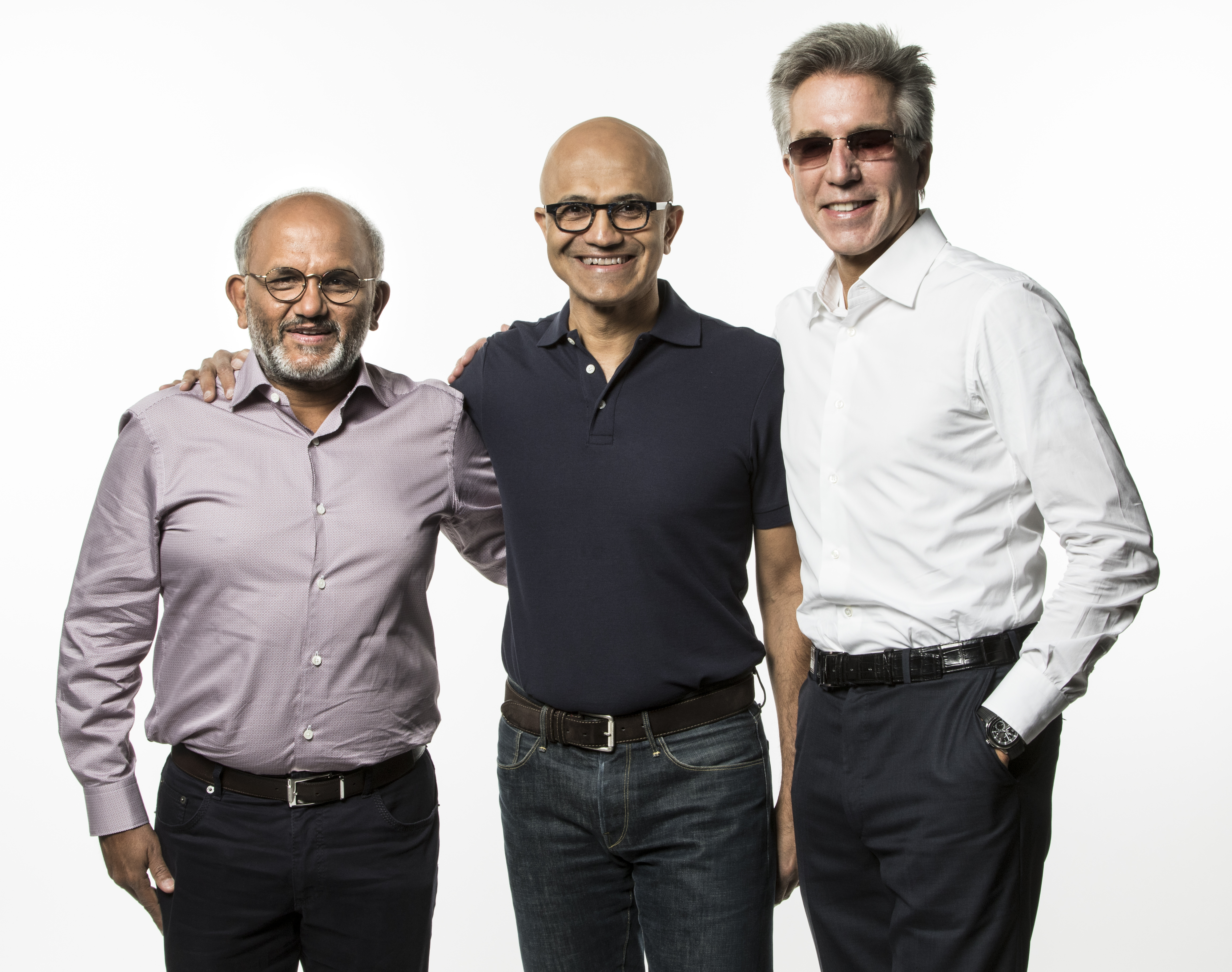
Shantanu Narayen, CEO, Adobe (left), Satya Nadella, CEO of Microsoft (center), and Bill McDermott, CEO of SAP (right), introduced the Open Data Initiative at the Microsoft Ignite conference.
ORLANDO, Fla. — Sept. 24, 2018— On Monday, the CEOs of Adobe (Nasdaq: ADBE), Microsoft (Nasdaq: MSFT) and SAP (NYSE: SAP) introduced the Open Data Initiative at the Microsoft Ignite conference. Together, the three longstanding partners are reimagining customer experience management (CXM) by empowering companies to derive more value from their data and deliver world-class customer experiences in real-time.
In today’s world, data is a company’s most valuable asset. However, many businesses struggle to attain a complete view of their customer interactions and operations, because they are unable to connect information trapped in internal silos. At the same time, important customer information also resides in external silos with intermediary services and third-party providers, limiting a company’s ability to create the right connections, garner intelligence and ultimately extract more value from its own data in real time to better serve customers.
Companies around the world use software and services from Adobe, Microsoft and SAP to run product development, operations, finances, marketing, sales, human resources and more. Today, Adobe, Microsoft and SAP are joining forces to empower their mutual customers with the Open Data Initiative, which is a common approach and set of resources for customers based on three guiding principles:
Every organization owns and maintains complete, direct control of all their data.
Customers can enable AI-driven business processes to derive insights and intelligence from unified behavioral and operational data.
A broad partner ecosystem should be able to easily leverage an open and extensible data model to extend the solution.
Based on these principles, the core focus of the Open Data Initiative is to eliminate data silos and enable a single view of the customer, helping companies to better govern their data and support privacy and security initiatives. With the ability to better connect data across an organization, companies can more easily use AI and advanced analytics for real-time insights, “hydrate” business applications with critical data to make them more effective and deliver a new category of AI-powered services for customers.
“Adobe, Microsoft and SAP are partnering to reimagine the customer experience management category,” said Shantanu Narayen, CEO, Adobe. “Together we will give enterprises the ability to harness and action massive volumes of customer data to deliver personalized, real-time customer experiences at scale.”
“Together with Adobe and SAP we are taking a first, critical step to helping companies achieve a level of customer and business understanding that has never before been possible,” said Satya Nadella, CEO of Microsoft. “Organizations everywhere have a massive opportunity to build AI-powered digital feedback loops for predictive power, automated workflows and, ultimately, improved business outcomes.”
“Microsoft, Adobe and SAP understand the customer experience is no longer a sales management conversation,” said Bill McDermott, CEO of SAP. “CEOs are breaking down the silos of the status quo so they can get all people inside their companies focused on serving people outside their companies. With the Open Data Initiative, we will help businesses run with a true single view of the customer.”
To deliver on the Open Data Initiative, the three partners are enhancing interoperability and data exchange between their applications and platforms — Adobe Experience Cloud and Adobe Experience Platform, Microsoft Dynamics 365, SAP C/4HANA and S/4HANA — through a common data model. The data model will provide for the use of a common data lake service on Microsoft Azure. This unified data store will allow customers their choice of development tools and applications to build and deploy services.
With the Open Data Initiative, companies will be able to:
Unlock and harmonize siloed data to create new value
Bi-directionally move transactional, operational, customer or IoT data to and from the common data lake based on their preference or needs
Create data-powered digital feedback loops for greater business impact, while also helping to enable their security and privacy compliance initiatives
Build and adopt intelligent applications that natively understand data, relationships and metadata spanning multiple services from Adobe, SAP, Microsoft and their partners
Technology leaders at top retail and consumer products companies, such as The Coca-Cola Company, Unilever and Walmart, have expressed support and excitement about the Open Data Initiative.
“This initiative from Adobe, Microsoft and SAP is an important and strategic development for the Coca-Cola System,” said Barry Simpson, chief information officer at the Coca-Cola Company. “Our digital growth plans centered around our customers are fueled by these platforms and open standards. A more unified approach to the management and control of our data strengthens our ability to support our growth agenda and our ability to satisfy security, privacy and GDPR-compliance requirements. The industry needs to follow these leaders.”
“Every day, 2.5 billion people use a Unilever product in over 190 countries around the world,” said Jane Moran, CIO, Unilever. “The Open Data Initiative from Adobe, Microsoft and SAP is an important undertaking that will help us reimagine customer experience management by bringing together data across our entire organization to build more direct, meaningful relationships with consumers in real time.”
“We’re excited about the Open Data Initiative and the value it will unlock for Walmart,” said Clay Johnson, executive vice president and enterprise chief information officer, Walmart Inc. “With greater ability to connect and harness the power of our data, we can enhance the associate experience and create entirely new ways to serve our customers online and in our stores.”
Adobe is changing the world through digital experiences. For more information, visit www.adobe.com.
About Microsoft
Microsoft (Nasdaq “MSFT” @microsoft) enables digital transformation for the era of an intelligent cloud and an intelligent edge. Its mission is to empower every person and every organization on the planet to achieve more.
About SAP
As market leader in enterprise application software, SAP (NYSE: SAP) helps companies of all sizes and industries run better. From back office to boardroom, warehouse to storefront, desktop to mobile device – SAP empowers people and organizations to work together more efficiently and use business insight more effectively to stay ahead of the competition. SAP applications and services enable more than 404,000 business and public sector customers to operate profitably, adapt continuously, and grow sustainably. For more information, visit www.sap.com.
For more information, press only:
Microsoft Media Relations, WE Communications for Microsoft, +1 (425) 638-7777,
rrt@we-worldwide.com
Stefan Offerman, Adobe, (408) 536-4023, sofferma@adobe.com
Note to editors: For more information, news and perspectives from Microsoft, please visit the Microsoft News Center at http://news.microsoft.com. Web links, telephone numbers and titles were correct at time of publication, but may have changed. For additional assistance, journalists and analysts may contact Microsoft’s Rapid Response Team or other appropriate contacts listed at http://news.microsoft.com/microsoft-public-relations-contacts.
A theme park management tycoon game with an aquatic twist. Design your displays, look after your fish, manage your staff and keep your guests happy. It's all in a day's work as the curator of your very own Megaquarium.
Posted by: xSicKxBot - 09-24-2018, 05:49 PM - Forum: Windows
- No Replies
Microsoft releases platform to build company-specific skills for Cortana
In a classic scene from the 1999 cult film Office Space, programmer Peter Gibbons is admonished for attaching the wrong cover sheet to a “TPS” report. Nearly two decades later, Microsoft is unveiling a platform for enterprises to enable the personal intelligent assistant Cortana to complete company-specific tasks, including correctly filing TPS reports.
The Cortana Skills Kit for Enterprise was presented Monday at the Microsoft Ignite conference in Orlando, Florida. The development platform is currently available by invitation only.
“At heart, we are about providing valuable assistance to users throughout their day. That assistance takes different forms depending on where the users are in their day and what they are trying to do,” said Javier Soltero, the Microsoft corporate vice president in charge of Cortana. “It’s important for enterprises to be able to enable their workforces to use Cortana to perform company-specific tasks.”
The development platform is powered by the Azure Bot Service and leverages Language Understanding from Azure Cognitive Services, allowing developers to create company-specific skills for Cortana using known and trusted tools, explained Vivek Goswami, a program manager on Soltero’s team. Additional features include control via Azure Active Directory over when skills are deployed and who can access them.
Soltero said the extension of Cortana skills development to enterprises is the start of a journey into a realm where voice and natural language are the primary means of interacting with technology.
“In the same way you don’t have to go around teaching people how to use a smartphone because they know how to touch and swipe, we have arrived there with voice, we are finally to, ‘Okay, now what can you do?’” he said.
The specific skills that enterprises will create for Cortana remain to be revealed, noted Goswami, who imagined scenarios ranging from human resources to smart building features such as a skill that allows employees to ask the personal intelligent assistant to schedule an office cleaning, saving 20 to 30 minutes of intranet surfing to make the arrangements themselves.
As a proof of concept, IT developers at Microsoft used the enterprise platform to create an IT help desk skill that enables Cortana to file tickets for employees who are having computer problems and connect them to someone who can help.
“One of the things that holds people back from getting better service from a help desk is the often-laborious task of filing the ticket in the first place,” noted Soltero. “You don’t bother because you’re in the middle of something so you restart the app or reboot your computer. You endure pain in different forms instead of actually getting the issue resolved.”
Now, a simple, natural language verbal request to Cortana frees Microsoft employees “to stay in the flow of what they are doing,” he added.
If such experiences prove successful in the workplace, modern workforce employees will be more likely to access Cortana outside of work, too. After all, few people carry two phones – one for work, one for personal use. Instead, they have one phone that’s loaded with both work apps and personal apps, work email and personal email, a work calendar and personal calendar.
“We can enable the blurring of those lines without compromising privacy or enterprise utility and, at the same time, delight the user,” explained Soltero, who led the successful development of the Outlook app for iOS and Android prior to working on Cortana.
Related:
John Roach writes about Microsoft research and innovation. Follow him on Twitter.
At the center of the intersection between globalization, world economic activity, and human and environmental health, are the world’s power systems. LF Energy, a new initiative of The Linux Foundation, provides a neutral, collaborative environment for open source innovation to enable the “electrification of everything to scale.” Our mission is to accelerate and transform the world’s relationship with energy.
This inaugural event will focus on creating a shared vision for LF Energy. By including the perspectives of power systems engineers and executives, and open source developers, we will identify the best path to building a vibrant ecosystem with specific and practical outcomes for next steps and technical groups that companies and individuals can contribute to.
Posted by: xSicKxBot - 09-24-2018, 11:41 AM - Forum: Lounge
- No Replies
New On Netflix: More Anime, Movies, And TV Shows This Week (US)
Netflix gains several more TV series, Originals, and movies this week. Although the number of new things to watch isn't as high as the past two weeks, there are quite a few quality titles in the mix--and if nothing is to your liking, October and its additions are on the horizon.
You can certainly tell that it's almost October, as we're beginning to see more horror and thrillers with every subsequent week. The Witch is already out on Netflix, the 2015 supernatural horror film about a 17th century Puritan family who accidentally moves their home next to a forest that's inhabited by witches. Split's Anya Taylor-Joy stars in The Witch as the eldest daughter in the family, Thomasin, who's transition into womanhood is scarred by the terrors her family must face.
On September 18, another spooky delight, American Horror Story: Cult arrives on Netflix. Cult is the seventh season of American Horror Story, and it dives straight into the political divide that erupted in the United States after the 2016 presidential election. The series stars Ocean's 8's Sarah Paulson, X-Men: Days of Future Past's Evan Peters, 30 Rock's Cheyenne Jackson, Star Wars: The Last Jedi's Billie Lourd, and Scott Pilgrim vs. the World's Alison Phil. Even if it's not scary, it's worth noting that Scott Pilgrim was also added to Netflix.
It's also a very good week if you love animation. On September 21, both Dragon Pilot: Hisone and Masotan and Hilda come to Netflix. Dragon Pilot is an adorably humorous anime that follows the story of a young woman who's chosen to join a secret air force team where pilots train to fly dragons that are disguised as fighter jets. Hilda is an animated series based on the famous Luke Pearson comic of the same name, that's about a small 20th century Scandinavian girl who balances her ordinary responsibilities at home and school with her desire to adventure with the trolls, giants, elves, and spirits that are her friends.
The full list of television series, movies, and Netflix Originals coming to Netflix this week can be found below. You can also check out our list of everything that's coming to Netflix in September.
Netflix U.S. Releases (September 16 - September 22)
Posted by: xSicKxBot - 09-24-2018, 05:33 AM - Forum: Lounge
- No Replies
This Week's Best Buy Video Game Sale (US Only)
Each Sunday, Best Buy releases a new weekly ad that shows what items are on sale through the following Saturday. This week's deals are now live, which means you can save money on a new set of video games, consoles, and accessories both in-store and online. Let's dig in to see what discounts are available between now and September 22.
Anyone who buys an Xbox One can save $20 when adding an extra controller to their purchase. That goes for standard controllers, special editions, and even the Xbox One Elite controller. If you're in the market for a headset, you can also save $20 on the fantastic Turtle Beach Stealth 700 headset. It's a wireless headset with surround sound that links up directly to the console.
PS4 owners can pick up a wired Turtle Beach headset for $45, saving $5. Buying a PS4 lets you save $10 on a 12-month PS Plus membership. If collectible coins are your thing, you're in luck: Not only does pre-ordering Super Smash Bros. Ultimate get you a $10 reward certificate, but you also get an exclusive Smash Bros. coin. You can save $20 on select New Nintendo 2DS XL models this week as well.
In terms of games, a number of excellent ones are marked down this week, including the Call of Duty series, Red Dead Redemption, Dark Souls Remastered, and Monopoly (Switch edition). We have more of this week's game discounts listed below, and you can check out the full ad here.