Welcome to Cosmonious High, an alien high school that's definitely completely free of malfunctions!
After crash-landing your way into a memorable first-day, you'll unlock powers, explore the halls, and discover the source of malfunctions to save the school from cosmic chaos.
Experience the latest level of VR interaction with dynamic characters that respond to natural gestures. High five, fist bump, and converse with a quirky cast from your favorite high school cliques!
Explore the biggest space Owlchemy Labs has ever built! Hang with your friends in the Grand Hall, perform experiments in Chemosophy, and get creative in Visualetics.
Enjoy the vibrant, colorful world of Cosmonious High in an art style as unique and playful as the school!
By Java Magazine Editor Andrew Binstock In our previous issue, we explored the use of lightweight frameworks— Javalin, Micronaut, and Helidon—to create microservices, which typically are deployed in the cloud. In that issue’s article on Helidon, we also showed how to package a service into a Docker ...
Machine Learning Engineer — Income and Opportunity
Before we learn about the money, let’s get this question out of the way:
What Is Machine Learning?
Let’s have a look at the definition:
Machine learning (ML) is a subfield of artificial intelligence (AI) that focuses on the automatic creation of models from training data that predict outcomes accurately. The automatic creation of an ML model based on existing data is called training, whereas the prediction on new input data is called inference.
Due to the great performance of machine learning models on real-world problems such as self-driving cars, robotics, and natural language processing, the “subfield” ML became more and more important in recent years and started to penetrate into all areas of computing and even previously non-computing related fields.
This is an interesting video that explains the core ideas of machine learning in different levels of complexity:
Now that you know about what it is, let’s have a look at what it earns next!
Annual Income
How much does a Machine Learning Engineer make per year?
Figure: Average Machine Learning Engineer Income
The average annual income of a Machine Learning Engineer in the United States is between $112,000 and $157,000 with a median of $131,000 per year according to multiple data sources such as Indeed, Glassdoor, Salary.com, and Payscale.
Here’s a quick overview of the raw income data:
Indeed.com estimates the average annual income of a machine learning engineer to be $117,457 per year in the US.
Salary.com estimates the average annual income of a machine learning engineer to be $145,297 per year in the US.
Sandiego.edu estimates the average annual income of a machine learning engineer to be $146,085 per year in the US.
Glassdoor.com estimates the average annual income of a machine learning engineer to be $131,001 per year in the US.
PayScale.com estimates the average annual income of a machine learning engineer to be $112,266 per year in the US.
Salary.com estimates the average annual income of a machine learning engineer to be $122,817 per year in the US.
Talent.com estimates the average annual income of a machine learning engineer to be $140,000 per year in the US.
ZipRecruiter.com estimates the average annual income of a machine learning engineer to be $157,676 per year in the US.
If you decide to go the route as a freelance Machine Learning Engineer, you can expect to make between $15 and $125 per hour on Upwork (source). Assuming an annual workload of 2000 hours, you can expect to make between $30,000 and $250,000 per year.
Note: Do you want to create your own thriving coding business online? Feel free to check out our freelance developer course — the world’s #1 best-selling freelance developer course that specifically shows you how to succeed on Upwork and Fiverr!
But is there enough demand? Let’s have a look at Google trends to find out how interest evolves over time (source):
Yes indeed! You can build your whole career on Machine Learning based on this data.
Work Description
So, you may wonder: Machine Learning Engineer – what’s the definition?
Machine Learning Engineer Definition: A Machine Learning Engineer creates, edits, analyzes, debugs, models, and supervises the development of machine learning models using programming languages such as Python or C++ and machine learning libraries such as Keras or TensorFlow.
But don’t wait too long to acquire practical experience!
Even if you have little skills, it’s best to get started as a freelance developer and learn as you work on real projects for clients — earning income as you learn and gaining motivation through real-world feedback.
Tip: An excellent start to turbo-charge your freelancing career (earning more in less time) is our Finxter Freelancer Course. The goal of the course is to pay for itself!
Related Video
You can find more job descriptions for coders, programmers, and computer scientists in our detailed overview guide:
The following statistic shows the self-reported income from 9,649 US-based professional developers (source).
The average annual income of professional developers in the US is between $70,000 and $177,500 for various programming languages.
Question: What is your current total compensation (salary, bonuses, and perks, before taxes and deductions)? Please enter a whole number in the box below, without any punctuation. If you are paid hourly, please estimate an equivalent weekly, monthly, or yearly salary. (source)
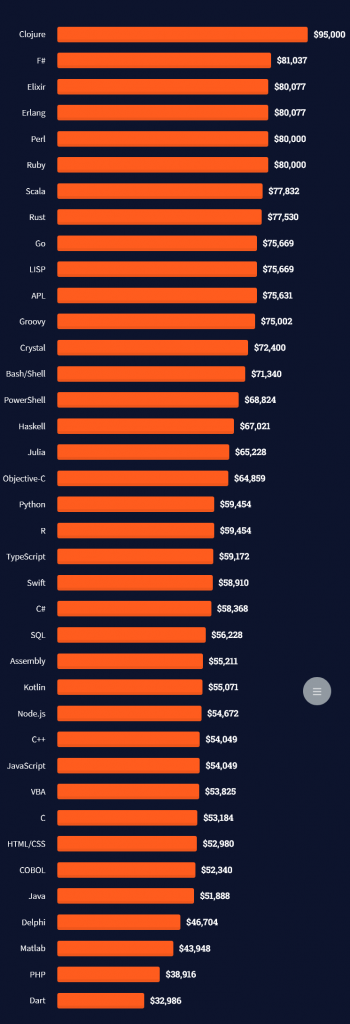
The following statistic compares the self-reported income from 46,693 professional programmers as conducted by StackOverflow.
The average annual income of professional developers worldwide (US and non-US) is between $33,000 and $95,000 for various programming languages.
Here’s a screenshot of a more detailed overview of each programming language considered in the report:
Here’s what different database professionals earn:
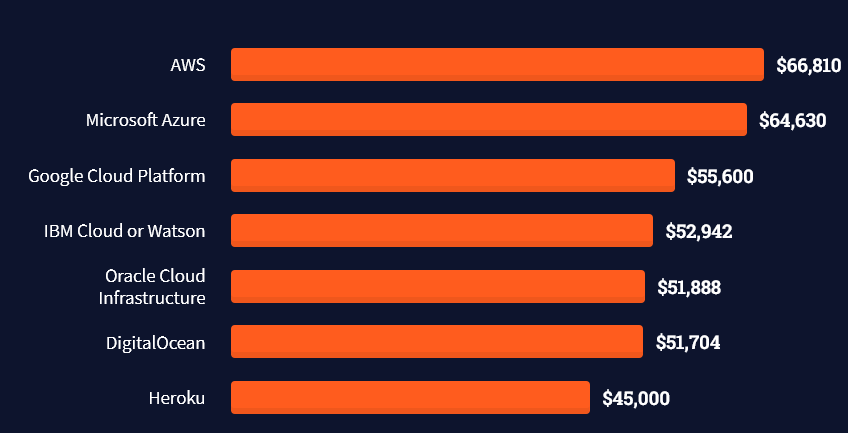
Here’s an overview of different cloud solutions experts:
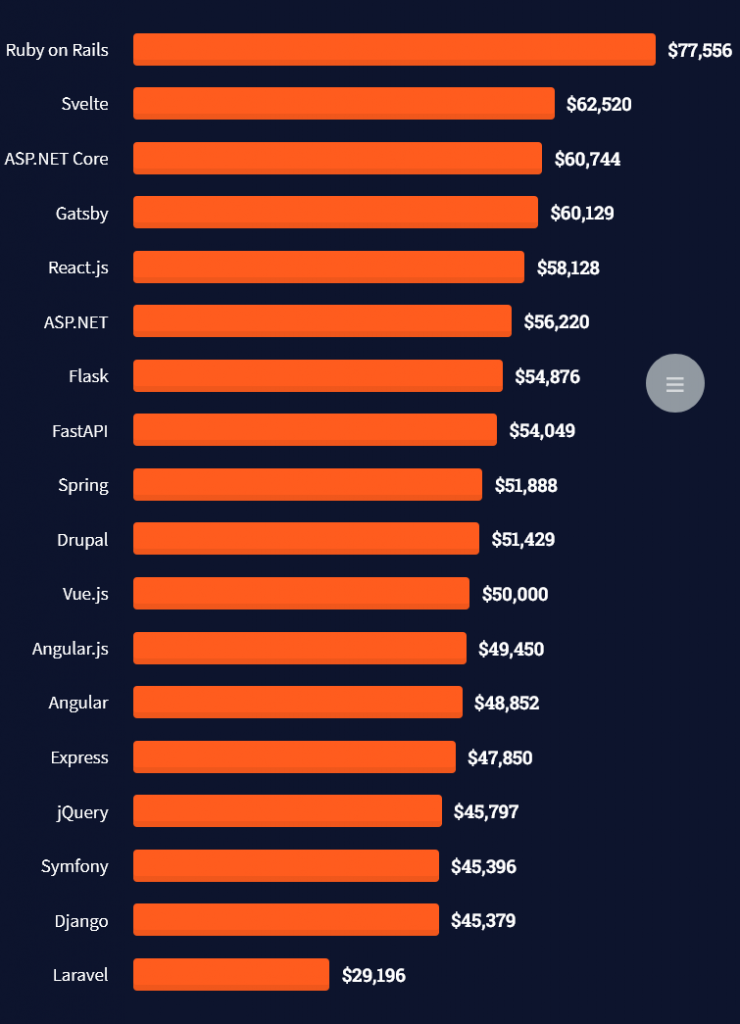
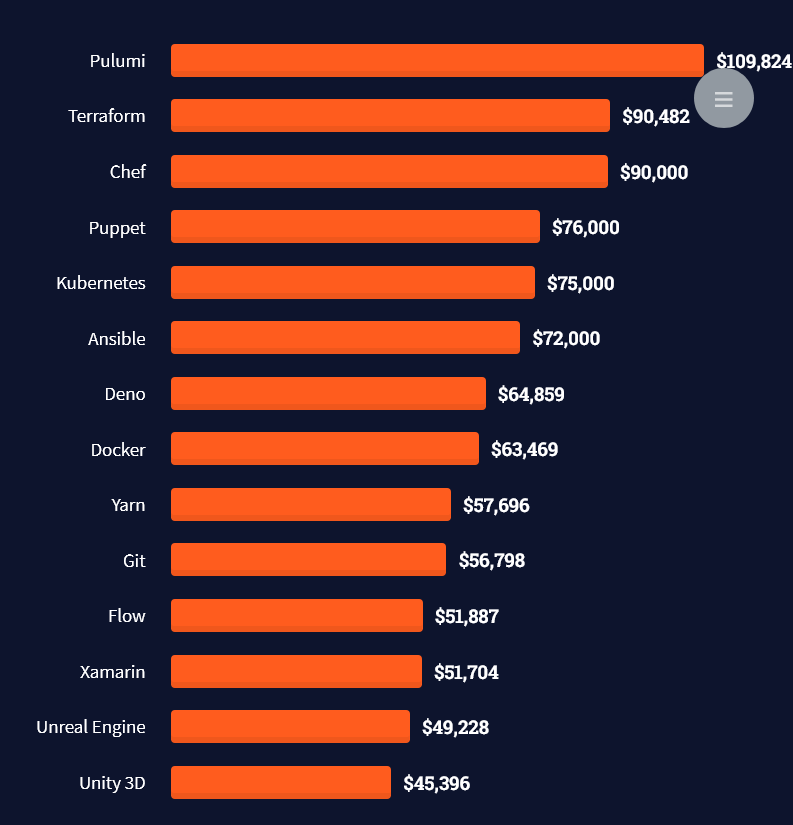
Here’s what professionals in web frameworks earn:
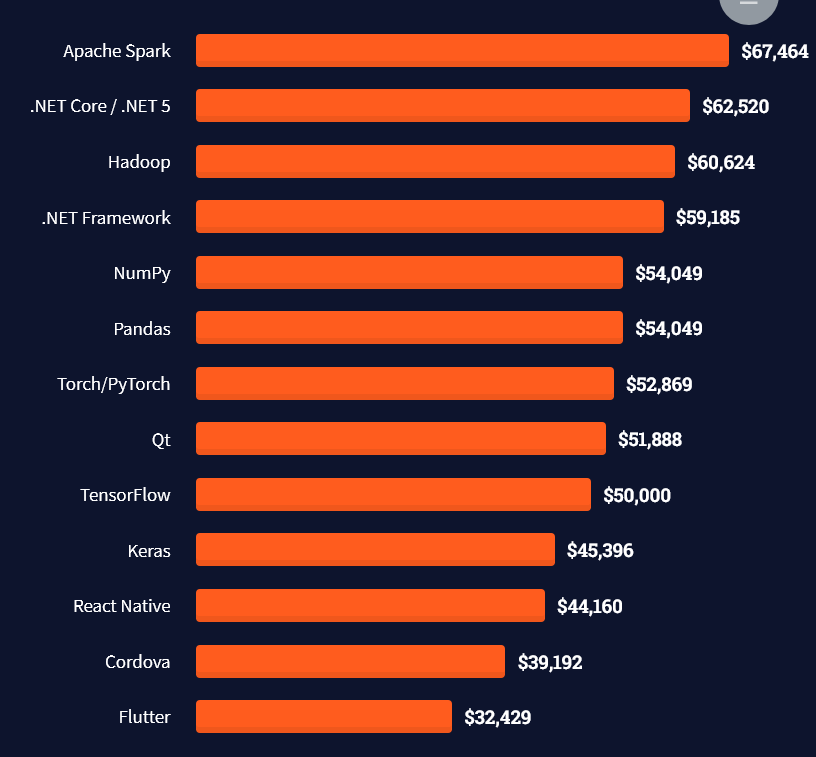
There are many other interesting frameworks—that pay well!
Look at those tools:
Okay, but what do you need to do to get there? What are the skill requirements and qualifications to make you become a professional developer in the area you desire?
Let’s find out next!
General Qualifications of Professionals
StackOverflow performs an annual survey asking professionals, coders, developers, researchers, and engineers various questions about their background and job satisfaction on their website.
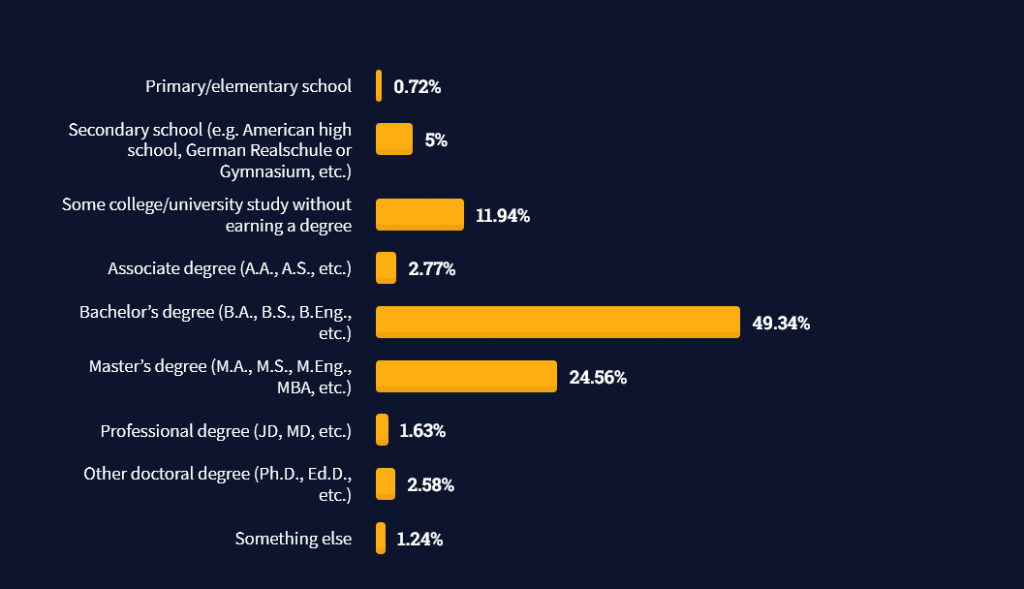
Interestingly, when aggregating the data of the developers’ educational background, a good three quarters have an academic background.
Here’s the question asked by StackOverflow (source):
Which of the following best describes the highest level of formal education that you’ve completed?
However, if you don’t have a formal degree, don’t fear! Many of the respondents with degrees don’t have a degree in their field—so it may not be of much value for their coding careers anyways.
Also, about one out of four don’t have a formal degree and still succeeds in their field! You certainly don’t need a degree if you’re committed to your own success!
Freelancing vs Employment Status
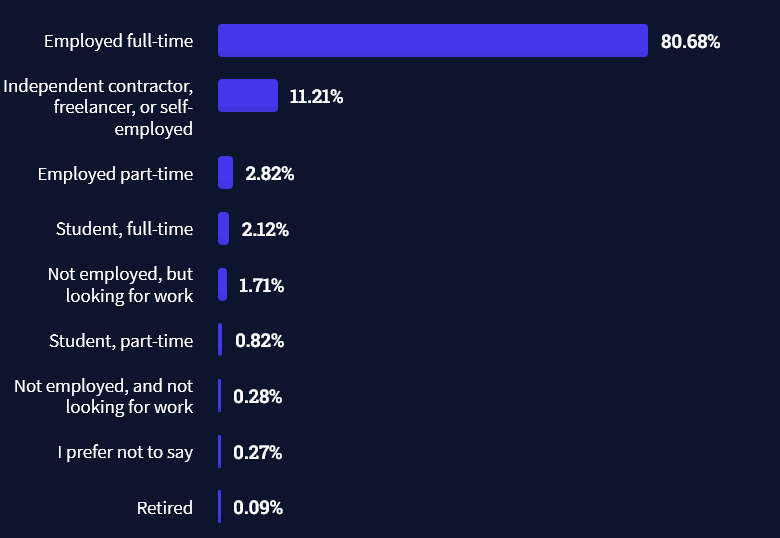
The percentage of freelance developers increases steadily. The fraction of freelance developers has already reached 11.21%!
This indicates that more and more work will be done in a more flexible work environment—and fewer and fewer companies and clients want to hire inflexible talent.
Here are the stats from the StackOverflow developer survey (source):
Do you want to become a professional freelance developer and earn some money on the side or as your primary source of income?
Resource: Check out our freelance developer course—it’s the best freelance developer course in the world with the highest student success rate in the industry!
Other Programming Languages Used by Professional Developers
The StackOverflow developer survey collected 58000 responses about the following question (source):
Which programming, scripting, and markup languages have you done extensive development work in over the past year, and which do you want to work in over the next year?
These are the languages you want to focus on when starting out as a coder:
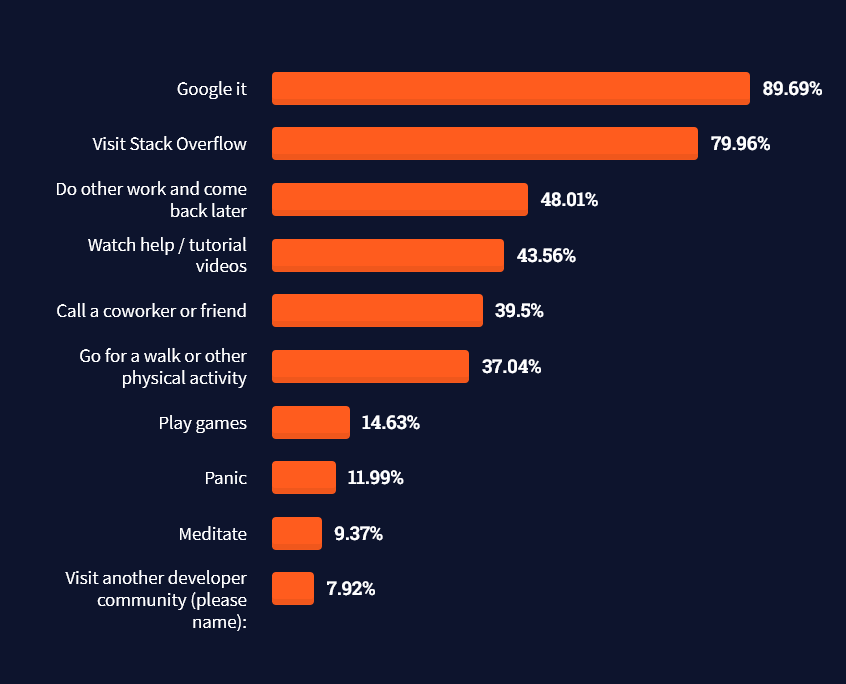
And don’t worry—if you feel stuck or struggle with a nasty bug. We all go through it. Here’s what SO survey respondents and professional developers do when they’re stuck:
What do you do when you get stuck on a problem? Select all that apply. (source)
Related Tutorials
To get started with some of the fundamentals and industry concepts, feel free to check out these articles:
Coders get paid six figures and more because they can solve problems more effectively using machine intelligence and automation.
To become more successful in coding, solve more real problems for real people. That’s how you polish the skills you really need in practice. After all, what’s the use of learning theory that nobody ever needs?
You build high-value coding skills by working on practical coding projects!
Do you want to stop learning with toy projects and focus on practical code projects that earn you money and solve real problems for people?
If your answer is YES!, consider becoming a Python freelance developer! It’s the best way of approaching the task of improving your Python skills—even if you are a complete beginner.
If you just want to learn about the freelancing opportunity, feel free to watch my free webinar “How to Build Your High-Income Skill Python” and learn how I grew my coding business online and how you can, too—from the comfort of your own home.
The game is free to keep until April 22nd 2022 - 21:30 UTC.
- Click on "Go To Giveaway" - Scroll down a bit until you see the banner for the game POSTAL 2. - Its under the "Flash deals" and above "Discover unique indie games"
We are welcoming everyone to join our discord[discord.gg]. We are more active there on finding giveaways, small or large, and there are daily raffles you can participate.
From legendary game creator Hideo Kojima comes a genre-defying experience, now expanded and remastered for the PS5 console in this definitive Director's Cut.
Can you reunite the shattered world, one step at a time?
My Hero Academia's All Might Adorns NZXT's Newest PC Case
NZXT has announced a new CRFT 10 H510i PC case that is themed around My Hero Academia, the popular superhero shonen manga and anime. The case depicts Toshinori Yagi, aka All Might, in both his empowered and true forms.
The case is available right now, with only a limited quantity available. It costs $250 USD.
As detailed in a press release, the CRFT 10 H510i All Might features a "Plus Ultra" puck is attached to the outside for you to hang your headphones from, and an All Might charm decorates the outside of the case. All Might in his empowered form adorns the outside of the case, while his true form is on the inside, allowing you to hide away the superhero's secret.
Problem Statement: How to get a key by its value in a dictionary in Python
Example:
# Given dictionary

employee = {"Sam": 1010, "Bob": 2020, "Rob": 3030} # Some Way to extract the Key 'Bob' using its value 2020
We have a clear idea about the problem now. So without further delay, let us dive into the solutions to our question.
Solution 1:Using dict.items()
Approach: One way to solve our problem and extract the key from a dictionary by its value is to use the dict.items(). The idea here is to create a function that takes the provided value as an input and compares it to all the values present in the dictionary. When we get the matching value, we simply return the key assigned to the value.
Solution:
# Given dictionary

employee = {"Sam": 1010, "Bob": 2020, "Rob": 3030} # Function that fetches key from value

def get_key(v): for key, value in employee.items(): # return the key which matches the given value if v == value: return key return "The provided key is not present in the dictionary" # Passing the keys to the function

print("Employee ID - 2020 \nName - ", get_key(2020))
Output:
Employee ID - 2020 Name - Bob
Note: dict.items() is a dictionary method in Python that returns a view object. The returned view object contains a list of tuples that comprises the key-value pairs in the dictionary. Any changes made to the dictionary will also be reflected in the view object.
Example: The following example demonstrates how the dict.items() method works.
Approach: Another workaround to solve our problem is to extract the keys and values of the dictionary separately in two different lists with the help of the keys() and values() methods. Then find the index/position of the given value from the list that stores the values with the help of the index() method. Once the index is found, you can easily locate the key corresponding to this index from the list that stores all the keys.
Solution: Please follow the comments within the code to get an insight of the solution.
# Given dictionary

employee = {"Sam": 1010, "Bob": 2020, "Rob": 3030}

# store all the keys in a list

key = list(employee.keys())

# store all the values in another list

val = list(employee.values())

# find the index of the given value (2020 in this case)

loc = val.index(2020)

# Use the index to locate the key

print(key[loc])
Output:
Bob
Note:
keys() is a dictionary method that returns a view object that contains the keys of the dictionary in a list.
values() is a dictionary method that returns a view object consisting of the values in the dictionary within a list.
The index() method is used to return the index of the specified item in a list. The method returns only the first occurrence of the matching item.
Example:
employee = {"Sam": 1010, "Bob": 2020, "Rob": 3030}

li = ['Lion', 'Dog', 'Cat', 'Mouse', 'Dog']

key = list(employee.keys())

val = list(employee.values())

loc = li.index('Dog')

print(f"Keys: {key}")

print(f"Values: {val}")

print(f"Index: {loc}")
Approach: The given problem can be resolved using a single line of code. The idea is to use a dictionary comprehension that reverses the keys and values. This means the keys in the original dictionary become the values in the newly created dictionary while the values in the original dictionary become the keys in the newly created dictionary. Once you have interchanged the keys and values, you can simply extract the key by its value.va
Solution:
employee = {"Sam": 1010, "Bob": 2020, "Rob": 3030}

res = dict((val, key) for key, val in employee.items())

print("Original Dictionary: ", employee)

print("Modified Dictionary: ", res)

# using res dictionary to find out the required key from employee dictionary

print(res[2020])
Output:
Original Dictionary: {'Sam': 1010, 'Bob': 2020, 'Rob': 3030}

Modified Dictionary: {1010: 'Sam', 2020: 'Bob', 3030: 'Rob'}

Bob
Explanation:
employee dictionary has Name and Employee ID as Key-Value pairs.
res dictionary interchanges the keys and values of the employee dictionary. Therefore, res now has Employee ID and Name as Key-Value pairs.
Since we need to extract the name corresponding to an Employee ID. We can simply get that from the res dictionary with the help of the key which in this case is the Employee ID.
Solution 4: Using zip()
Considering that the values in the given dictionary are unique, you can solve the problem with a single line of code. The idea is to use the keys() and values() dictionary methods to extract the keys and values from the dictionary and then tie them together with the help of the zip() method to produce a dictionary.
We can also opt to use the Pandas DataFrame to get the key by its value. In this approach, first, we will convert the given dictionary into a data frame. Further, we can name the column with the keys as “key” and the columns with the values as “value“. To get the key by the given value, we have to return the value from the ‘key‘ column from the row where the value of the ‘value‘ column is the required value.
Example:
# Importing the pandas module

import pandas as pd # Given dictionary

employee = {"Sam": 1010, "Bob": 2020, "Rob": 3030}

# list to store the keys from the dictionary

key = list(employee.keys())

# list to store the values from the dictionary

val = list(employee.values())

# Converting the dictionary into a dataframe

df = pd.DataFrame({'key': key, 'value': val})

print("The data frame:")

print(df)

# Given Value

v = 2020

print("The given value is", v)

# Searching for the key by the given value

k = (df.key[df.value == v].unique()[0])

print("The key associated with the given value is:", k)
Output:
The data frame: key value

0 Sam 1010

1 Bob 2020

2 Rob 3030

The given value is 2020

The key associated with the given value is: Bob
Note:df.key[df.value == v].unique()[0]) –> We have to use the unique method in this line to avoid the index from getting printed. While using the panda’s data frame, the output is not in the string format, but it is a pandas series object type. Hence, we need to convert it using the unique or sum() method. Without the unique method, the output will also consider the index of the data frame column.
Conclusion
That’s all about how to get a key by the value in the dictionary. I hope you found it helpful. Please stay tuned and subscribefor more interesting tutorials. Happy Learning!
[www.indiegala.com] Get a powerful game selection, that both in concept and in practice is ready for you to play, including: Dead Event, Suits: Absolute Power, Devious Dungeon 2, Concept Destruction, Mekabolt, Random Heroes: Gold Edition.
Elden Ring's Easy-To-Miss Tutorial Is Now Much More Obvious
Elden Ring's previously easy-to-miss tutorial, the appropriately titled Cave of Knowledge, is now basically impossible to miss.
The change comes as part of Elden Ring patch 1.04, which in addition to balancing a number of weapons, spells, and addressing various bugs, has also added a mandatory prompt towards the beginning of the game to make sure players know about its optional tutorial.
As confirmed by Eurogamer, shortly after dying to (or defeating) the game's first enemy and reawakening in a cave, a prompt appears that reads "Jump into the hole ahead, and you will find the Cave of Knowledge. There, you can learn more about game controls and basic actions, as well as other tips that may be helpful during your adventures in the Lands Between."



 Note: Do you want to create your own thriving coding business online? Feel free to check out our
 Tip: An excellent start to turbo-charge your freelancing career (earning more in less time) is our
  The average annual income of professional developers in the US is between $70,000 and $177,500 for various programming languages.