Microsoft’s game revenue up by $550 million as Xbox readies for Series X debut
While the Xbox One generation is winding down, the Xbox brand is holding strong and is even listed as a driving force behind year-over-year growth in Microsoft’s “more personal computing” segment as a whole.
Revenue for Microsoft’s game business is up 22 percent year-over-year, an increase of $550 million when compared to Q1 FY2020.
This is, according to Microsoft, largely thanks to the strength of Xbox’s content and services dealings which includes Xbox Game Pass subscriptions as well as game sales.
Unfortunately, Microsoft stopped sharing exact subscriber counts for services like Game Pass a while back, but the growth this close to the end of a generation bodes well for Xbox’s plan to push the service as an enticing buy for players regardless of when they plan on making the jump to the next-generation Xbox Series X or Series S.
Xbox content and services revenue alone is up $646 million year-over-year, or 30 percent, thanks to third-party games, Game Pass, and first-party games and helped to offset a 27 percent year-over-year decrease in Xbox hardware revenue due to the rapidly approaching end of the Xbox One generation.
For the entire more personal computing segment, Microsoft says revenue is up 6 percent year-over-year, growth driven by both its video game dealings and its Surface brand.
The PS5 doesn't arrive until November 12, but some players are already getting their hands on accessories. They'll have nearly two weeks of holding a DualSense controller and pretending they're enjoying its haptic feedback and adaptive triggers, and if you placed an order for an extra controller, you can likely pick yours up, too.
Though scheduled to arrive on October 30, according to Sony's website, the DualSense appears to have released even earlier at certain retailers. One member of the GameSpot team had his order delivered by Target the day before, and Best Buy orders are also available for pickup today. We didn't see the controllers on store shelves, but you might be able to find them online.
Oddly, this isn't universal for all retailers, with GameStop still listing them as preorders, and not every accessory released on the same day. The charging station for the DualSense isn't releasing for another week, for instance. Of course, you won't be able to use the controller until November 12, anyway.
Review: Disc Room – A Meat Grinder Of A Game Which Packs A Real Challenge
In 1977, the United States launched the Voyager program, in which NASA launched two probes into deep space as a sort of “bottle into the cosmic ocean”. Aboard these two probes, golden phonograph discs were included bearing images and sounds relevant to all cultures and forms of earthly life, and these were placed aboard as a hopeful gift to any intelligent life that could encounter the probes. Disc Room, the newest release from Devolver Digital, is based on the premise that life did find those probes, and the resulting experience is something to behold. It may be a little bit on the short side, but Disc Room proves to be a thoroughly rewarding game that gets a considerable amount of mileage out of a relatively simple gameplay idea. Through this strong execution, it proves itself to be more than the mere sum of its parts.
Disc Room could be best described as a bullet hell shoot ‘em up, with the little caveat that you have no weapon with which to shoot ‘em up. Each room is a veritable meat grinder of whirling sawblades that only grow in number and speed as time passes, and any mistake you make is met with a swift and bloody end. The question, then, is not if you will die, but when. Such a hopeless sort of game sounds discouraging, but it’s remarkable how effectively Disc Room manages to reward your failures and keep you just interested enough to play another round.
Firstly, the challenges you face in each room – though technically insurmountable – don’t demand too much from the player to progress. More often than not, unlocking the next room is a simple matter of surviving for around ten seconds in the current room. Granted, every second in Disc Room feels like it passes at a glacial speed, but these relatively achievable goals in each room make the allure of subsequent attempts all too easy to fall victim to. After all, if the goal is ten seconds, surely you have time for one more try? Or ten? And when you fail, it’s not like there’s any meaningful sense of punishment; the clock is simply reset and you can jump back in for another go with an instant button press. These factors together – the simplicity of your goals and the ease of chaining multiple attempts together – can make for a wonderfully addictive experience, one that’s raw and continuously demands all your attention.
Then there’s the idea that death itself is included in an overarching, perverse sense of progression, which removes even more of the sting from your failures. As you clear new challenges in Disc Room, you’ll encounter dozens of new sawblade types which are sure to ruin your day. Some are large, some are small. Some are stationary, some hunt you down. Some spawn other discs, and some can phase in and out of existence. It’s positively maddening having to deal with many of the combinations used across rooms, but there’s a collectable aspect to dying to each new sawblade that governs progression. So, if you want to take on the latest ‘boss’ fight, you’ve got to make sure you’ve thoroughly died to as many kinds of blades as you can access.
This is where a light puzzle aspect enters the gameplay, which helps keep things from becoming too rote. Sometimes it takes a set amount of time until a unique sawblade spawns in the room, or you need to fulfil a certain chain of obscure events to get one to appear. Disc Room will occasionally have subtle clues to help guide you towards the answer, but often you simply must intuit these things yourself, which make for some of the most memorable moments. If you do pick up Disc Room, we’d strongly encourage you to resist the temptation of looking up the answers online, as a big part of the fun here is the trial and error that goes into unravelling these enigmas before that cathartic ‘aha!’ moment hits.
Harrowing as it may be, one would expect the simple “dodge everything that moves” idea at the heart of Disc Room would grow stale rather quickly, but the developers manage to keep it fresh by lightly changing the rules depending on where you are on the overall map. One early section, for example, will only run up the clock if you happen to be standing on set portions of the floor. Another section starts the time at a set amount and subtracts a second every time you collect a randomly-spawning ball on the floor. That central idea of avoiding discs never changes, then, but the way in which you’re expected to do so can vary quite a bit, which adds some much-needed gameplay variety.
Another key factor for variety is the handful of unlockable abilities for your character, which greatly increase your odds. These can allow you to do things like dodge rolling, slowing down time, or setting off a concussive blast that knocks away oncoming discs. None of them are game-breaking and you can only have one equipped at a time, but each can be quite effective depending on what discs a room contains. Moreover, the measured rate at which you unlock them grants a nice feeling of progression not unlike a Metroidvania. Our only minor complaint is that some abilities feel a little too situational to be of much use; it would’ve been nice if the balance of abilities was a little more levelled.
Make no mistake, Disc Room is meant to be an extremely difficult game, but we feel special attention needs to be paid to the range of accessibility options that it includes to ensure that players of skill levels can get the most out of it. Through a menu in the settings, you can tweak percentages of factors like disc movement speed or room goal difficulty to customize the experience best to your abilities. What’s nice about this is that there’s not a fixed ‘easy mode’ that can be patronizing to somebody of mid-level skill; you can make a series of minor tweaks to several different parameters until the difficulty feels perfectly matched to your ability. Moreover, if you’re truly a masochist, you can tweak the modifiers the other way and maximize the pain. The point being, Disc Room features a truly modular difficulty level that caters to players of all skill levels without compromising the game design or gating content, and proper execution of such a feature deserves applause. You don’t see that sort of thing too often in games these days, and more games would benefit from approaching difficulty in the way that Disc Room does.
Depending on your tastes, this may come as a positive or a negative, but we feel it bears mentioning that Disc Room is quite a short experience. We managed to clear the first map in a measly two hours, and this was despite taking things slow and getting nearly ninety percent on our profile. The second map (which you unlock after beating the game) acts as a post-game ‘hard mode’, but this is still something which only takes a couple more hours to clear out. If you want to thoroughly rinse Disc Room of every conceivable secret, then maybe you could manage to wring ten hours out of it, but it’s difficult to imagine it taking much more. To be fair, the sort of design at the heart of Disc Room lends itself well to short length – we can’t imagine this constant stop-and-go pace working well as a fifty-hour epic – yet it feels like Disc Room is only just beginning to show off its potential when the credits roll.
Disc Room employs a rather unique presentation style that somewhat echoes comic books, with all elements on screen having nice and thick lines to ensure that readability is maintained in the chaos of having dozens of small moving objects on screen at once. Despite the frequent swarms on screen, we never once lost sight of our character. It is clear, however, that the focus with this art style is more on function than aesthetics, as Disc Room doesn’t really try to wow much with its graphics. Still, what’s on display here is more than satisfying, and above all, the visuals serve to support the gameplay seamlessly.
Conclusion
Like a lot of other releases in the Devolver line up, Disc Room is a wonderfully unique release that stands out well on the eShop. That premise of “a shoot ‘em up without the shooting” seems silly at first, but very quickly shows itself to be an interesting idea that’s taken in plenty of fun directions. Disc Room is tough as nails in all the right ways, and this combined with plenty of secrets, solid accessibility options, and an intriguing premise makes for an experience we can easily recommend. Don’t pass this one up, it’s definitely worth your time.
Posted by: xSicKxBot - 11-01-2020, 09:08 AM - Forum: Lounge
- No Replies
PS5 Accessories Are Arriving Early
The PS5 doesn't arrive until November 12, but some players are already getting their hands on accessories. They'll have nearly two weeks of holding a DualSense controller and pretending they're enjoying its haptic feedback and adaptive triggers, and if you placed an order for an extra controller, you can likely pick yours up, too.
Though scheduled to arrive today, October 30, according to Sony's website, the DualSense appears to have released even earlier at certain retailers. One member of the GameSpot team had his order delivered by Target the day before, and Best Buy orders are also available for pickup today. We didn't see the controllers on store shelves, but you might be able to find them online.
Oddly, this isn't universal for all retailers, with GameStop still listing them as preorders, and not every accessory released on the same day. The charging station for the DualSense isn't releasing for another week, for instance. Of course, you won't be able to use the controller until November 12, anyway.
[freebies.indiegala.com] Dark woods, monsters, paranormal activity, nice puzzles, Octave is a point 'n click horror-adventure game with elements of action.
Halloween Scratchy Sale Day 2
[www.indiegala.com] Spooky scary deals send you free scratchy treats filled with mysterious Steamy sweets! For every purchase...you'll get something special: a BONUS Scratch Card with a secret Steam game in it for every store cart purchase!
Control’s eShop Page Reminds Us About Harsh Realities Of A Cloud-Based Future
Here in the west, it seems cloud gaming is now a thing on Nintendo’s hybrid device. As you might have heard, a cloud version of Control got a surprise release on the Switch eShop this week and more games – like Hitman 3 – are on the way.
While it might be better than nothing, there are admittedly some setbacks and it seems we’re still discovering them by the day. Compared to cloud offerings on other platforms, on the Switch with a game like Control – you’re asked to buy it and well, you’ll never actually have ownership of it, just access to a licence in order to play it.
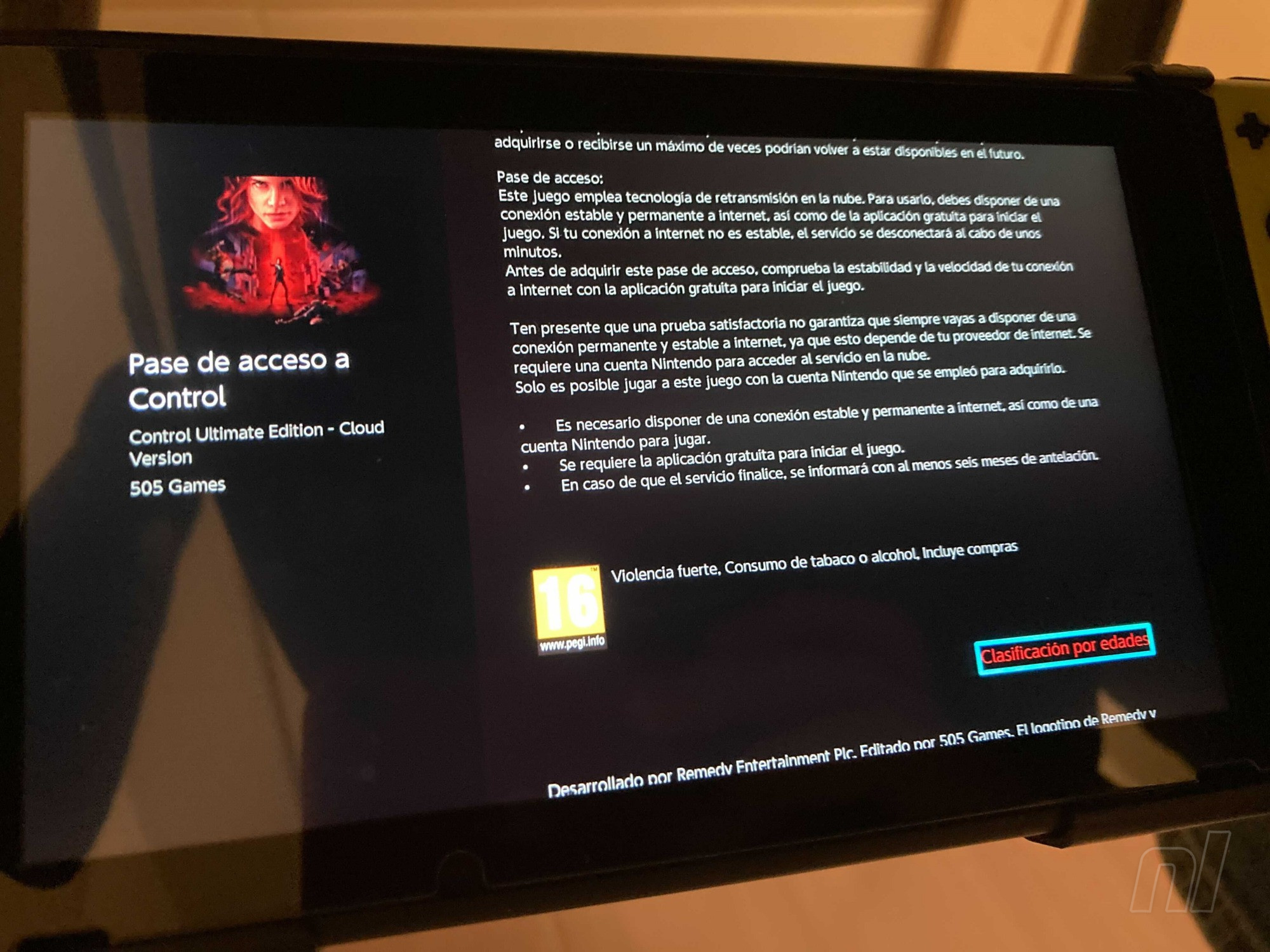
So what happens if the servers go offline? Our very own Gavin Lane couldn’t help but notice some fine print on the game’s page over on the Spanish eShop (the last bullet point in the image below, to be precise). This is also on the screen you get after trying the demo out and before purchasing the game. Here’s what it essentially translates to:
“In the event of the service finishing, we’ll inform you at least six months in advance.”
So, according to this – if Control is going to be pulled from the Switch, you’ll apparently be notified “at least” six months ahead of time. It’s yet another reminder of what you’re locking into if you do purchase the cloud version of Control on Nintendo’s system and likely any other cloud game released on it in the future.
Another setback of cloud gaming, as we highlighted earlier this week, is that it’s not even supported in certain regions around the globe yet – meaning some gamers are locked out completely. In saying this, there are a lot of pros that come with this tech, which you can read more about in our full-length feature.
It’s one thing buying a digital game and losing access to the download, but what are your thoughts about buying a cloud game (rather than say a subscription) and potentially losing access to it altogether? Tell us what you think down below.
Posted by: xSicKxBot - 11-01-2020, 01:58 AM - Forum: Lounge
- No Replies
PS5 Accessories Are Arriving Early
The PS5 doesn't arrive until November 12, but some players are already getting their hands on accessories. They'll have nearly two weeks of holding a DualSense controller and pretending they're enjoying its haptic feedback and adaptive triggers, and if you placed an order for an extra controller, you can likely pick yours up, too.
Though scheduled to arrive today, October 30, according to Sony's website, the DualSense appears to have released even earlier at certain retailers. One member of the GameSpot team had his order delivered by Target the day before, and Best Buy orders are also available for pickup today. We didn't see the controllers on store shelves, but you might be able to find them online.
Oddly, this isn't universal for all retailers, with GameStop still listing them as preorders, and not every accessory released on the same day. The charging station for the DualSense isn't releasing for another week, for instance. Of course, you won't be able to use the controller until November 12, anyway.
Even if you already have the bundle we have you covered as there is a bonus draw containing 5 additional asset packs that are not part of the bundle. Be sure to specify which bundle you are interested in entering for when you enter. On Monday we will randomly select two winners who will receive the highest tier of the Ultimate Fantasy bundle and one winner of the bonus bundle. Good luck!
You can learn more about the Fantasy Bundle here and learn more about the giveaway and see additional bundle assets in action in the video below.
Unified Blazor UI in the Mobile Blazor Bindings Preview 5
Eilon
October 30th, 2020
I’m excited to announce that today we are releasing the Mobile Blazor Bindings Preview 5 update that adds support for sharing UI between web apps and mobile/desktop apps. You can now use a Razor Class Library (RCL) to build your UI and app logic once and use it in a Blazor Web app and in a Mobile Blazor Bindings app. This release also includes many other improvements, such as support for Shell with Blazor @page routing, SkiaSharp for rich graphics, gesture recognizers, and a whole lot more!
You can build one UI using Blazor Web and host it in a Blazor Server or Blazor Web Assembly app and also in a Mobile Blazor Bindings hybrid app to target Android, iOS, macOS, and Windows:
These are the major new features in the 0.5 Preview 5 release:
Build your UI in a Razor Class Library (RCL) and share the same UI between web app and native app, including static assets such as CSS and images (community contribution from Jan-Willem Spuij)
Support for Shell with Routing, including the Razor @page directive (community contribution from Lachlan Gordon
Support for SkiaSharp graphics (community contribution from Lachlan Gordon
To get started building a Blazor Hybrid app with Experimental Mobile Blazor Bindings preview 5, install the .NET Core 3.1 SDK, have Visual Studio with the Mobile development with .NET (Xamarin.Forms) and ASP.NET and web development workloads installed, and then run the following command:
dotnet new -i Microsoft.MobileBlazorBindings.Templates::0.5.50-preview
And then create your first project by running this command:
dotnet new blazorhybrid -o MyHybridApp
Note: For additional information on required software, please check the Getting Started article.
Now open it in Visual Studio and run it on Android, iOS, Windows, or macOS. That’s it! You can find additional docs and tutorials on https://docs.microsoft.com/mobile-blazor-bindings/. We have a new tutorial for building a Razor Class Library and including it in a Blazor Server app as well as targeting Android, iOS, macOS, and Windows platforms.
Razor Class Libraries are a feature of Razor that enable you to package part of your application’s UI and logic into a reusable library. This library can then be reused in multiple web applications. Now in Mobile Blazor Bindings you can use the same library in a Blazor Hybrid application as part of a mobile or desktop app. The web content is hosted in a Web View, just like any hybrid app content, and it can interact with any native parts of the application, and the reverse is true as well. Previous versions included limited support for RCLs, and this version adds improved support for them, particularly support for serving static assets such as CSS and images, as well as support for JSInterop for interop between JavaScript and .NET code.
Shell navigation
To build a great native experience for your app you can use the Shell control that comes from Xamarin.Forms. Starting with Preview 5 you can author native Blazor pages with the @page "/search/{query}" syntax and integrate them with the Shell’s navigation (such as the Back button) and navigate to them using the new NavigationManager.NavigateToAsync($"/search/{query}") API. Pages can use the navigation manager by injecting it from the DI container as in @inject ShellNavigationManager NavigationManager.
SkiaSharp graphics
SkiaSharp is a popular cross-platform graphics library based on Google’s Skia graphics library. In Preview 5 you can directly use SkiaSharp’s Canvas APIs to render rich high-performance graphics directly in your Mobile Blazor Bindings app.
Here’s what a simple canvas might look like:
<ContentView> <StackLayout Padding="20"> <SKCanvasView OnPaintSurface="PaintSurface"/> </StackLayout>
</ContentView> @code
{ void PaintSurface(SKPaintSurfaceEventArgs e) { var canvas = e.Surface.Canvas; canvas.Clear(SKColors.Green); var paint = new SKPaint { Color = SKColors.SkyBlue, }; canvas.DrawLine(0, 0, 200, 200, paint); }
}
And here’s what a more complex canvas might render as:
More information
Thank you to contributors
This release had several major contributions from community contributors:
Jan-Willem Spuij added support for Razor Class Libraries with static assets. He stayed up late (his time) on calls with me several times and I appreciate his hard work!
Lachlan Gordon added support for Shell navigation and SkiaSharp. His patience in playing time-zone ping-pong (Australia vs. USA) is most appreciated and resulted in high quality contributions!
Thanks you to Jan-Willem, Lachlan, and everyone else who contributed to this release!
What’s next? Let us know what you want!
This project relies on your feedback to help shape the future of Blazor for native and hybrid scenarios. Please share your thoughts on this blog post or at the GitHub repo so we can keep the discussion going.
Apple TV+, now one year old, looks poised for growth
Apple TV+ got off to a slow start, but Apple’s position allows for that — and it’s had a great deal to celebrate of late.
When Apple TV officially launched on November 1, 2019, Apple’s long-awaited streaming TV service appeared underwhelming to many observers, a view that stuck well into 2020.
Of the shows that arrived at launch from Apple TV+, none were really cultural breakthroughs, nor were any of the series that followed in the months afterward. Sure, Apple TV+ could point to some creative successes in its first few months, but nothing that really made any real headway.
Nothing Apple put on Apple TV+ made as much of an impact as The Mandalorian, the Star Wars-associated show that Disney+ launched right out of the gate. Competition from new streaming services proliferated throughout the spring and summer of 2020, and when the coronavirus led to millions of households being stuck at home, it was Netflix’s Tiger King that dominated the cultural conversation, not anything on Apple TV+.
However, Apple TV+ has benefited from an impressive hot streak of good news throughout the spring and summer of 2020. It had a couple of series break through, it acquired some impressive movies and shows, and it’s gotten into business with some major talents. And after a pause due to the pandemic, production has resumed on several of the service’s important shows.
Heading into year two, Apple TV+ suddenly looks to be on the upswing.
Jacob and Ted
They may not be Mandalorian-sized hits, but Apple appears to have broken through in 2020 with a pair of shows. Defending Jacob, the mystery and legal procedural starring Captain America actor Chris Evans, was seen as the most popular show for Apple TV+ in the early going.
Chris Evans and Jaeden Martell on “Defending Jacob”
Defending Jacob, unfortunately for Apple, was a limited series, one that ended in such a way that future seasons are practically impossible. However, that’s far from the case with Apple’s other success, Ted Lasso.
Apple TV+, in its first year, got into business with A-list stars, Oscar winners, and creators of great accomplishment. But the show that connected like no other is a half-hour comedy starring a former Saturday Night Live performer and occasional movie actor, about an American football coach leading a soccer club in England.
Ted Lasso, which is based on a series of TV commercials from when NBC started broadcasting the English Premier League in 2013, is undeniably connecting with audiences, due in part to its ethos of unrelenting optimism. Tim Cook said as much, on Apple’s quarterly earnings call on October 29.
“Apple TV+ continues to impress, from fan favorites like Ted Lasso, which has won a worldwide audience with its hopeful tone during challenging times, to critical and award praise, including a Primetime Emmy for Billy Crudup in The Morning Show,” Cook said on the call, which otherwise was light on new information about Apple TV+.
Ted Lasso not only received a second season, but it’s also been renewed for a third, becoming the second Apple TV+ series, after Dickinson, to get a second renewal.
Ratings? What ratings?
The cast of “Mythic Quest: Raven’s Banquet”
As is often the case with measures of streaming TV audiences, there are no “official” figures in terms of viewership for Apple TV+ shows. Apple has never released them — nor has it released any subscriber numbers. There are no neutral arbiters with universally accepted authoritative numbers about the size of such audiences.
Nielsen recently began releasing weekly ratings figures for streaming TV shows, although Apple TV+ has not yet been included in those ratings. There are, however, various third party research firms and other websites that put out such data.
The “streaming TV guide” Realgood, in early October, released a ranking of the most-watched Apple TV+ shows in the third quarter, which listed Ted Lasso as the most watched series on the platform, with 18.4 percent of the total share of streams. The Morning Show was second, with 15.8 percent, and Defending Jacob third with 10.4 percent. They were followed by See, Mythic Quest, Home Before Dark, Servant, For All Mankind, Central Park, and Little America.
Apple rival Disney+ may have had a big hit with The Mandalorian, which returned at the end of October with its second season, but aside from the one-shot movie Hamilton, Disney’s service hasn’t had another original hit since.
Analyst Rich Greenfield of Lightshed Management, who covers the streaming media world extensively, said on Twitter in early October that “Apple TV+ has meaningfully outperformed Disney+ in year one in terms of original programming, [especially] programming for anyone over the age of 10. [Eddy Cue] and the Apple TV Plus team do not get enough credit, [especially] with no catalog or history in content production.”
What’s in the Apple TV+ pipeline?
Jon Stewart and Stephen Colbert
This fall, in addition to its original shows, Apple has released the A24 collaboration On the Rocks, an acclaimed Bill Murray movie from director Sofia Coppola that’s garnered Oscar buzz, and also Bruce Springsteen’s Letter to You, an exceptionally well-mounted making-of documentary about The Boss’ new album. The latter, which had a tie-in with the new Apple Music TV, shows the potential of what Apple TV+ can do with music-oriented programming.
The good news for Apple TV+ has also come from announcements about future projects and talent deals. Throughout the summer and fall, seemingly not a week has gone by without Apple announcing a major deal of some kind.
Apple has acquired some movies that had been slated for theatrical releases pre-pandemic, most notably Tom Hanks’ Greyhound, while it also landed Emancipation, a historical thriller with Will Smith that’s set to arrive in 2021.
Apple landedKillers of the Flower Moon, Martin Scorsese’s next film, back in May, and announced a separate first-look deal with Scorsese’s production company in August.
Leonardo DiCaprio, Martin Scorsese and Robert De Niro, of “Killers of the Flower Moon”
The many-time Emmy winner Julia Louis-Dreyfus, A-list movie star Leonardo DiCaprio, and the acclaimed actor Idris Elba are among other huge names who have signed productions deals with Apple this year. Apple also recently signed up movie stars Seth Rogen and Rose Byrne to star in a comedy series called Platonic.
Then, at the end of October, Apple announced that it will host Jon Stewart’s TV comeback, signing a deal to produce a current events series hosted by the former Daily Show host, as well as other shows Stewart will produce. If Stewart, with his new show, can capture the zeitgeist at anywhere near the level he did back in his Comedy Central days, that’s big news for Apple.
Apple’s penchant for talent-friendliness can have its pitfalls. Its documentary series Dear was essentially about famous people being told by fans how awesome they are, in a way that wasn’t the slightest bit entertaining or illuminating. Some shows, like Amazing Stories with Steven Spielberg and Little Voice with J.J. Abrams, invoked a particular big name in their marketing, while those people ended up having little to do with the series creatively.
But clearly, Apple has money to wave at creators. There’s no reason to think these big-name talent deals won’t continue, and it also appears those creators have gotten some freedom.
There were fears around the time of Apple TV+’s launch that it would avoid controversial or adult content, or amount to an “expensive NBC,” as was reportedly joked about internally.
The shows, so far, have included some amounts of violence and sexuality, and with projects on the way from the likes of Martin Scorsese and Seth Rogen, there’s likely more of that on the way. While a least a couple of shows have seen showrunners replaced, including The Morning Show, there have been no stories reported from behind the scenes suggesting Apple was heavy-handed with its influence in the executive suite when it comes to content.
Filling things out
Apple TV+’s “Long Way Up”
A major knock on Apple TV+ when it launched was that it offered subscribers so much less than its rivals did. While Disney+ had the back catalogs of Disney animation, Pixar, Star Wars, Marvel, and more available at launch, Apple TV+ had only its handful of originals. The newer services, especially HBO Max, have also arrived with massive back catalogs of classic movies.
A year on, that’s started to change. There is, of course, more original content from Apple that’s been added over time. There were also reports in May that Apple had begun talks to add older back catalog content to the service.
There’s been no major move in that regard yet, although when Apple debuted the Ewan McGregor docuseries Long Way Up, it also obtained the rights to the two previous seasons of the series, which had been produced elsewhere. This also happened with Apple’s recent deal for the rights to the Peanuts holiday specials.
The potential for additional catalog content is something to watch for Apple TV+ as it enters Year 2.
Apple doesn’t have to depend on Apple TV+
Disney+
Despite the catalog deficit, there is one big advantage Apple has over several of its streaming counterparts, such as Disney+, HBO Max and Peacock, one that’s become especially clear of late. Apple’s future, as a company, doesn’t depend in any way on its streaming service’s success.
Whether caused by the pandemic or longer-term troubles, many of Apple TV+’s rivals have their core businesses collapsing around them and need to lean on streaming to promise themselves a future.
Disney recently announced a reorganization meant to reorient their entire company around its streaming strategy. AT&T is clearly depending heavily on the success of HBO Max. Comcast, owner of Peacock, is losing cable subscribers at a significant rate.
Apple, on the other hand, has core businesses that are doing much better. It doesn’t own theme parks, a movie studio, a cable or satellite business, or other such declining assets. Therefore, Apple isn’t in a position where it has to use Apple TV+ to paper over failures in other areas of its business.
In addition, as evidenced by that yearlong spree of production deals, Apple doesn’t appear to be holding back on spending when it comes to Apple TV+.
Apple TV+: Year 2
Hailee Steinfeld as Emily Dickinson on Apple TV+’s “Dickinson”
While production was delayed for several months on most Apple TV+ shows, many of them are back before the cameras. Dickinson will debut its second season in January, with The Morning Show and other launch shows likely to return at some point in 2021.
Most of the first batch of shows were renewed by Apple, with other big series, such the high-budget adaption of Isaac Asimov’s Foundation and the Tom Hanks/Steven Spielberg-produced Masters of the Air, are also on the way in year 2, with the latter getting production underway in the spring.
Apple TV+ hasn’t yet matched, say, Netflix when it comes to audience size or cultural ubiquity. But there’s no doubt, after one year, that the service is ahead of where Netflix was a year after it launched its streaming service.
From popular shows to talent deals to a robust pipeline, every indication is that its future is bright. And, even if the near-term is dim, Apple has the patience and wherewithal to wait out the slings and arrows of outrageous fortune.