FREE Theatre of War | Graffiti Rebel Bundle | PUBG Deal
Graffiti Rebel Bundle | 6 Steam Games | 95% OFF
[www.indiegala.com] Days of War, The King's Bird, Joggernauts, Double Cross, Trident's Wake, Mable & The Wood. A one of a kind Graffiti opportunity! Save an extra 30% when using crypto. Make sure you do not miss the special 24h launch price
FREE Theatre of War
[freebies.indiegala.com] With a focus on unit detail and combat realism, the game presents authentic battle scenarios, taken straight from actual World War II records and maps.
NEW STORE DEALS
https://youtu.be/6FAldb21s2E Join our Crypto Sale, and get an EXTRA 30% OFF on all bundles and 15% OFF on all store deals when paying with a supported cryptocurrency!
If we think back to our expectations at the end of 2019, there was plenty to look forward to for gamers across the spectrum. Both Microsoft and Sony had new hardware coming, and despite Nintendo’s slate looking relatively blank (aside from Animal Crossing), there were sure to be some big announcements coming, likely from the inevitable E3 2020 Nintendo Direct.
Except that it wasn’t inevitable. Even before the global pandemic led to E3 2020’s cancellation, it arguably felt like a make-or-break year for the expo. It was set to be rebranded as a “fan, media and influencer festival”, which may have excited some gamers, but left us feeling uneasy over the direction it was heading.
it’s been a challenge to keep track of every stream and broadcast, with announcements spread out across several digital stages
We’ve discussed before how E3 was–and still is–an exciting time of year and how its gradual transformation from an industry-focused event into one of many fan shows arguably diluted its appeal for the vast majority of people who don’t physically attend the show. With organisers who lacked experience putting on fan-focused events, the past few years left many attendees unsatisfied, and plans for “queuetainment” didn’t sound promising this year. Still, it had the potential to be one of the biggest E3 in years (Sony’s no-show notwithstanding).
In its place, numerous online substitutes and events from a host of media outlets and publishers have filled the summer schedule and kept us busy in lockdown. Volume-wise, we probably had around the same amount of gaming news (with Nintendo being the exception), but it’s certainly been a challenge to keep track of every stream and broadcast, with announcements spread out across several digital stages.
That’s not to say we haven’t enjoyed the events that have sprung up in E3’s stead, especially considering the challenging circumstances they’ve been organised around. Several indie events have done a great job of highlighting smaller teams, and Geoff Keighley’s Summer Game Fest has provided a curated platform to highlight new games. Of all the major reveals, Sony’s PS5 reveal presentation seemed to go down the best with fans – ironically the most straightforward, old-school approach of the lot. Billed as ‘The Future of Gaming’, it served up an hour of gameplay trailers, talking heads and teased hardware shots before finishing up with the full PS5 console reveal. Microsoft’s recent Xbox Games Showcase was accompanied by a host of demos made available following the presentation, and gave us a glimpse of what an online version of E3 could be like in the future.
Nintendo’s ‘little-and-often’ approach has been novel, though it hasn’t pleased everyone
However, despite all the alternatives, we have to admit we’ve missed the focus that the lens of E3 brings every year to disparate gaming announcements. The fog of partnerships and semi-affiliated events we’ve seen in 2020 has been a tad overwhelming even for seasoned gamers, let alone casual fans. It’s all been a bit scattershot.
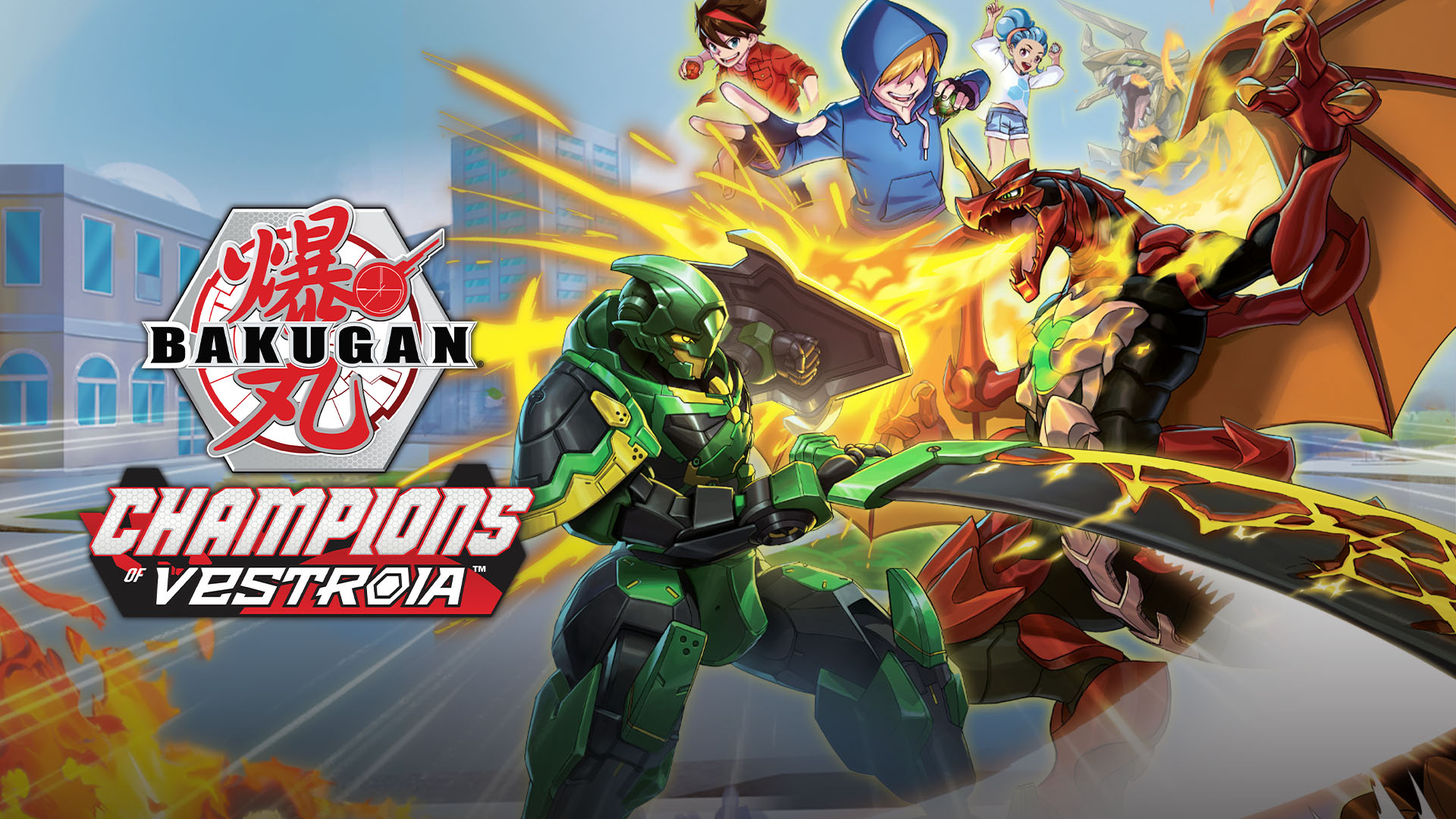
Nintendo’s ‘little-and-often’ approach has been novel, though it hasn’t pleased everyone. The announcement and relatively swift release of Paper Mario: The Origami King went down well, for example; the Bakugan Champions of Vestroia reveal and Nintendo Direct Mini Partner Showcase less so. Nintendo obviously has games up its sleeve for the back half of 2020, but for gamers desperate for an E3-style full-fat Nintendo Direct, these mini-presentations aren’t quite scratching the itch. It’s not a big deal in a bigger broadcast if several announcements don’t do anything for you, but if you’re not into Cadence of Hyrule or Shin Megami Tensei, it’s tough to get excited when they’re the lone stars under the spotlight.
As part of an hour-long Direct, Bakugan Champions of Vestroia’s reveal wouldn’t have frustrated non-fans the way it did.
Admittedly, despite clear messaging, it’s clear that some people simply don’t read – you can’t expect first-party announcements in a Mini Direct clearly labelled ‘Partner Showcase’. However, this disregard for the details is driven by a hunger for substantial news–a big old juicy burger of a blow-out–which this summer’s drip feed of announcements hasn’t satisfied. Whether the adaptive approach taken this summer has been better for publishers isn’t clear, although Ubisoft noted that its Ubisoft Forward presentation “achieved record-high peak concurrent viewership during this event, surpassing our previous E3 conferences“, according to chief financial officer Frédérick Duguet.
In fact, several presentations have ended with the tease of another: the first Pokémon stream teased the second (which ultimately didn’t go down well with fans), Nintendo said there will be future Partner Showcases, and Ubisoft announced another event was on the way. Presumably, this tactic is engineered to keep buzz levels high, but as a viewer you’re left hanging; you’re left with the distinct impression that you’re not getting the full Monty.
But what do you think? Have you missed the blow-out buffet of E3 this year or have you found the more frequent alternative appetisers just as satisfying? Pining for a packed presentation, or placated by a platter of proxies? Let us know by voting in the polls below and share your thoughts in the comments:
Ultra Foodmess Brings Chaotic Multiplayer Shenanigans To Switch Next Month
Launching on Nintendo Switch early next month is Ultra Foodmess, a competitive party game for up to four players.
The title probably gives it away somewhat, but the game has players taking on the roles of a variety of food characters, battling each other in what appears to be a pretty chaotic looking set of game modes. You can see some of the action in the trailer above, complete with lots of pushing, dodging, shooting, swinging, and more.
Here’s a feature list:
Game Features: – LOCAL MULTIPLAYER. 2 to 4 Players on local multiplayer.
– 11 different fast-paced GAME MODES. Choose from a great variety of crazy modes, each of them with their own mechanics.
– A lot of FOOD CHARACTERS. Choose the food that you like the most to defeat the others and prove who is the best!
– It’s very EASY TO PLAY! Anyone can pick up the controller and start having fun!
– Battle against the AI. Prepare yourself and battle against the food bots.
– UNLOCKABLES!. Finish the challenges to earn achievements and unlock new awesome characters!
It’s launching on 6th August and will be priced at just $3.99. Its eShop listing warns that you might just “ruin your friendships” by playing the game – which is exactly what multiplayer titles like this are supposed to do, right?
Feel free to share your thoughts on this one in the comments below.
ROM Hackers Find And Restore Unused Enemy In Super Mario 64
Despite being almost 25 years old, it looks like Super Mario 64 still has some secrets up its sleeve. After a Nintendo leak spilled the Mario 64 source code, fans have found some surprising things hidden in the game--first Luigi, and now a previously unseen enemy.
The new enemy is called "motos" in the game files, similarly to the bullies, who are referred to as "otos" in the source code. With the same big bulbous body as bullies or bob-ombs, the motos is distinguished from both of them by virtue of having hands, or rather claws. It also has a small, robot-like head with glowing eyes, instead of large eyes in the center of its body.
Behavior-wise, the motos has more in common with chuckyas, the boxing-gloved purple enemies with the ability to pick Mario up and throw him. Unlike the chuckyas, however, the motos seems to go out of his way to throw Mario off the edge of the platform.
Posted by: xSicKxBot - 07-28-2020, 10:42 AM - Forum: Python
- No Replies
3 Passive Income Ideas on Upwork or Fiverr
The following three ideas can lead to passive income using Upwork or Fiverr:
Hire experts in their niches on Upwork or Fiverr to create online courses and sell them on Udemy
Hire experts in their niches on Upwork or Fiverr to create ebooks and sell them on Amazon
Hire freelance developers on Upwork or Fiverr to create software products or websites and sell them via the web
You see that you should not only enter these growing freelancing marketplaces as a freelance developer, but also as a client. Essentially, you want to become an arbitrageur of skill and work. This way, you can benefit from the increasing efficiencies of scale offered by these platforms.
[www.indiegala.com] Explore this nightmarish world of twisted religion and discover its many secrets hidden deep inside Blasphemous.
Day 10: Fruitbat Factory Sale, up to -75%
[www.indiegala.com] Join our Crypto Sale, and get an EXTRA 30% OFF on all bundles and 15% OFF on all store deals when paying with a supported cryptocurrency!
There is a new Humble Bundle of interest to game developers, the Humble Book Bundle: Programming Languages by O’Reilly bundle. This is a collection of ebooks covering a variety of programming languages. This bundle includes the following tiers:
1$ Tier
97 Things Every Java Programmer Should Know
Think Julia
Programming Scala
Introducing Go
Learning Perl
8$ Tier
Learning SQL
Programming PHP
R Cookbook
Head First Kotlin
Using Ayncio in Python
15$ Tier
Programming Rust
C# 8 in a Nutshell
Fluent Python
Learning Java
Programming TypeScript
As with all Humbles, you can decide how your money is allocated, between Humble, charity, the publisher and if you so choose (and thanks a ton if you do!) to support GFS by using this link. You can learn more about the bundle in the video below.
Simply click the big green "Install" button at the top right of the page, a dialog box will open asking you to run Steam, click Open Steam Client Bootstrap and wait for Steam to launch and open the game installer, now install the game and it's yours to keep :)
Or you can just type - !addlicense asf 484645 - if you're an ASF user.
We are welcoming everyone to join our discord[discord.gg]. We are more active there on finding giveaways, small or large.
Posted by: xSicKxBot - 07-28-2020, 10:41 AM - Forum: Windows
- No Replies
Microsoft tests hydrogen fuel cells for backup power at datacenters
In a worldwide first that could jumpstart a long-forecast clean energy economy built around the most abundant element in the universe, hydrogen fuel cells have powered a row of datacenter servers for 48 consecutive hours, Microsoft announced Monday.
Diesel fuel accounts for less than 1% of Microsoft’s overall emissions. Its use is primarily confined to Azure datacenters, where, like at most cloud providers around the world, diesel-powered generators support continuous operations in the event of power outages and other service disruptions.
“They are expensive. And they sit around and don’t do anything for more than 99% of their life,” said Mark Monroe, a principle infrastructure engineer on Microsoft’s team for datacenter advanced development.
Lucas Joppa, Microsoft’s chief environmental officer, is Microsoft’s representative on the Hydrogen Council, a global initiative of leading energy, transport and industry companies to spur the hydrogen economy. Credit: Roderigo De Medeiros
In recent years, hydrogen fuel cell costs have plummeted to the point that they are now an economically viable alternative to diesel-powered backup generators.
“And the idea of running them on green hydrogen fits right in with our overall carbon commitments,” Monroe said.
What’s more, he added, an Azure datacenter outfitted with fuel cells, a hydrogen storage tank and an electrolyzer that converts water molecules into hydrogen and oxygen could be integrated with the electric power grid to provide load balancing services.
For example, the electrolyzer could be turned on during periods of excess wind or solar energy production to store the renewable energy as hydrogen. Then, during periods of high demand, Microsoft could start up the hydrogen fuel cells to generate electricity for the grid.
Hydrogen-powered long-haul vehicles could pullup at datacenters to fill their tanks.
“All of that infrastructure represents an opportunity for Microsoft to play a role in what will surely be a more dynamic kind of overall energy optimization framework that the world will be deploying over the coming years,” said Lucas Joppa, Microsoft’s chief environmental officer.
To further explore how Microsoft can leverage its investment in hydrogen fuel cells and related infrastructure, the company today named Joppa as its representative on the Hydrogen Council, a global initiative of leading energy, transport and industry companies to spur the hydrogen economy.
Scientists have already proved that hydrogen fuel cells can be used to generate greenhouse gas-free energy from the most abundant element in the universe, Joppa noted.
“We know how to do it,” he said. “The council exists because we don’t necessarily know how to scale the generation of hydrogen, transportation of hydrogen, supply of hydrogen and then consumption of it in the various ways that we would like to. There’s still tons of work that needs to be done.”
Replacements for diesel
Mark Monroe, a principle infrastructure engineer on Microsoft’s team for datacenter advanced development, is leading a project exploring the potential of hydrogen fuel cells to power backup generators at datacenters. Credit: Mark Monroe/Microsoft.
Microsoft strives to provide Azure datacenter customers “five-nines” of service availability, which means that the datacenter is operational 99.999% of the time. Backup generators are fired up during power grid outages and other service interruptions.
“We don’t use the diesel generators very much,” Monroe said. “We start them up once a month to make sure they run and give them a load test once a year to make sure we can transfer load to them correctly, but on average they cover a power outage less than one time per year.”
Microsoft is researching replacement technologies to diesel that would maintain or improve service availability and sees promise in hydrogen fuel cells and batteries, explained Brian Janous, general manager of Microsoft’s team for datacenter energy and sustainability strategy.
“The work that the team is doing today is really looking at trying to evaluate the feasibility of different solutions,” he said.
Batteries already supply short-term backup power, filling the 30-second gap between an outage on the grid and the time it takes to power up the diesel generators. More advanced batteries have longer durations.
“If you get to a scenario where the durations that you require are of such a length that batteries cease to be effective, that’s when you would spill over into looking at something like fuel cells,” Janous said.
Proof of concept
Power Innovations built a 250-kilowatt fuel cell system to help Microsoft explore the potential of using hydrogen fuel cells for backup power generation at datacenters. In a proof of concept, the system powered a row of datacenter servers for 48 consecutive hours. Credit: Power Innovations.
The seed for using hydrogen fuel cells for backup power was planted in spring 2018, when researchers at the National Renewable Energy Laboratory in Golden, Colorado, powered a rack of computers with a proton exchange membrane, or PEM, hydrogen fuel cell. Monroe and his colleagues were on hand for the demonstration.
“We got intrigued because we knew that they were using an automotive fuel cell,” Monroe said. “An automotive fuel cell has the reaction time like a diesel generator does. It can turn on quickly. It can be ready for a full load within seconds. You can floor it, let it off, let it idle.”
PEM fuel cells combine hydrogen and oxygen in a process that produces water vapor and electricity. Automotive companies are developing the technology to power cars, trucks and other vehicles. After the demonstration, Microsoft started thinking about using fuel cells for backup power at datacenters.
Monroe’s team procured a 250-kilowatt fuel cell system, which is sufficient to power a full row, on the order of 10 racks, of datacenter servers. Tests began at Power Innovations, the system developer, outside Salt Lake City in September 2019. The system passed the 24-hour endurance test that December; the 48-hour test this June.
“It is the largest computer backup power system that we know that is running on hydrogen and it has run the longest continuous test,” Monroe said.
The next step for the team is to procure and test a 3-megawatt fuel cell system, which is on par with the size of diesel-powered backup generators at Azure datacenters.
Fuel cell explorations
Brian Janous is general manager of Microsoft’s team for datacenter energy and sustainability strategy. His team is exploring replacement technologies to diesel powered backup generators. Credit: Scott Eklund/Red Box Pictures.
Even before that 2018 demonstration, Microsoft had been looking at ways to use fuel cells. The company started to explore fuel cell technology in 2013 with the National Fuel Cell Research Center at the University of California, Irvine, where they tested the idea of powering racks of servers with solid oxide fuel cells, or SOFCs, which are fueled by natural gas.
“They have the ability to make their own hydrogen out of the natural gas feed that they get,” Monroe explained. “They take natural gas, a little bit of water, they heat it up to 600 degrees C, which is the temperature of a hot charcoal fire.”
That’s hot enough for a process called steam methane reformation that generates a stream of hydrogen atoms for electricity generation.
Microsoft has continued to explore the potential of SOFC fuel cell technology to provide baseload power, which could free datacenters from the electric power grid while making them 8 to 10 times more energy efficient. For now, though, the technology remains too expensive for widespread deployment.
The SOFC process also produces carbon dioxide, which is another reason that Microsoft is exploring PEM fuel cells, Monroe noted.
In addition, estimated costs for PEM fuel cell systems for backup power generation at datacenters have fallen more than 75% since the demonstration at the National Renewable Energy Laboratory. If the trend continues, in a year or two the capital costs of fuel cell generators could be price competitive with diesel generators.
The increased production of fuel cells to meet the demand from the datacenter industry could potentially further drive down costs, he added.
“We very much see ourselves as a catalyst in this whole hydrogen economy,” Monroe said.
Hydrogen economy
From Microsoft’s perspective, other parts of this economy include infrastructure to procure, store and maintain a sufficient supply of green hydrogen to power the backup generators for 12 to 48 hours, which is standard in the industry to enable those “five nines” of service availability.
For example, for 48 hours of backup power generation, each datacenter would require up to 100,000 kilograms of hydrogen to fuel the backup generators for an extended power outage, Monroe said.
Internal conversations about how to secure this infrastructure have led to discussions about the role Microsoft could play in spurring the hydrogen economy, Janous noted.
“What if you could take all of these assets the datacenter has and integrate them into the grid in a way that helps to further accelerate decarbonization of the grid more broadly rather than just a point solution for the datacenter itself,” he said. “That’s where I think all of this gets interesting.”
Top image: Microsoft used hydrogen stored in tanks on trailers parked outside a lab near Salt Lake City, Utah, to fuel hydrogen fuel cells that powered a row of datacenter servers for 48 consecutive hours. Credit: Power Innovations.
Related:
John Roach writes about Microsoft research and innovation. Follow him on Twitter.
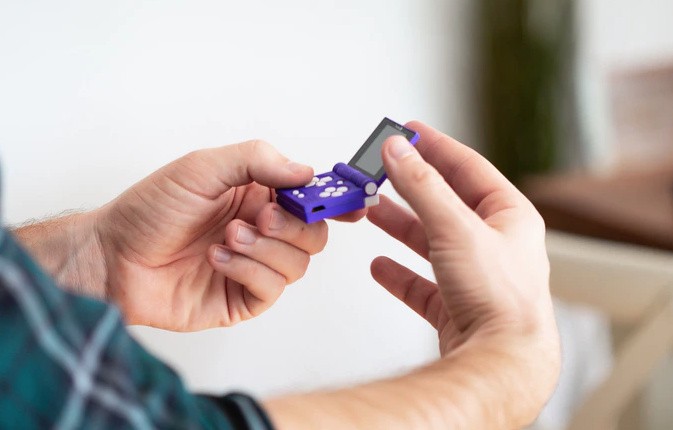
The FunKey S Is A Handheld Console That Fits On Your Keyring
The impossibly dinky retro handheld FunKey S is close to finishing its Kickstarter run, and has raised an impressive £124,000 so far – and it’s easy to see why.
This diminutive handheld system is small enough to fit onto your bunch of keys, yet it runs Game Boy, Game Boy Advance, SNES and even PlayStation titles. It even comes with a sensor which detects when the console is closed so gameplay is automatically suspended and the unit is powered down.
Boasting dimensions of 42.5 x 44.5 x 13.8 mm and powered by an ARM Cortex-A7 running at 1.2 GHz, the FunKey S is built around open-source hardware and software. The campaign has 4 days remaining, during which you can pick one up for the discounted price of £57.
Let us know if you’ve supported this device by posting a comment below.