After a recommendation from the Gamefromscratch discord server, today we take a look at acdsee Video Studio 3 that is available for free until July 29th, if registered with a valid email address. Acdsee Video Studio enables you to capture, edit and produce video in an easy to use way.
Acdsee Video Studio is described as:
With a simple, easy-to-master interface, powerful 64-bit performance, and high res results, ACDSee Video Studio 3 provides value-based video editing without the learning curve. Now featuring higher quality screen recording, support for still images, 3x faster recording save times, 4K rendering, a variety of creative filters, audio effects, flexible tracks that you can layer and blend, and much more, ACDSee Video Studio 3 is versatile content creation in one lean package.
Engaging your audience, students, employees, and customers has never been this painless. ACDSee Video Studio allows for the quick creation of accessible media content and takes the mystery out of distribution with easy sharing solutions.
It’s amazing to see just how much of a copy this program is to Camtasia Studio, as you can see in the video below.
ML-Pack is a small footprint C++ machine learning library that can be easily integrated into other programs. It is an actively developed open source project and released under a BSD-3 license. Machine learning has gained popularity due to the large amount of electronic data that can be collected. Some other popular machine learning frameworks include TensorFlow, MxNet, PyTorch, Chainer and Paddle Paddle, however these are designed for more complex workflows than ML-Pack. On Fedora, ML-Pack is packaged by its lead developer Ryan Curtin. In addition to a command line interface, ML-Pack has bindings for Python and Julia. Here, we will focus on the command line interface since this may be useful for system administrators to integrate into their workflows.
Installation
You can install ML-Pack on the Fedora command line using
$ sudo dnf -y install mlpack mlpack-bin
You can also install the documentation, development headers and Python bindings by using …
though they will not be used in this introduction.
Example
As an example, we will train a machine learning model to classify spam SMS messages. To keep this article brief, linux commands will not be fully explained, but you can find out more about them by using the man command, for example for the command first command used below, wget
$ man wget
will give you information that wget will download files from the web and options you can use for it.
Get a dataset
We will use an example spam dataset in Indonesian provided by Yudi Wibisono
We will try to classify a message as spam or ham by the number of occurrences of a word in a message. We first change the file line endings, remove line 243 which is missing a label and then remove the header from the dataset. Then, we split our data into two files, labels and messages. Since the labels are at the end of the message, the message is reversed and then the label removed and placed in one file. The message is then removed and placed in another file.
Machine learning works on numeric data, so we will use labels of 1 for ham and 0 for spam. The dataset contains three labels, 0, normal sms (ham), 1, fraud (spam), and 2 promotion (spam). We will label all spam as 1, so promotions and fraud will be labelled as 1.
The next step is to convert all text in the messages to lower case and for simplicity remove punctuation and any symbols that are not spaces, line endings or in the range a-z (one would need expand this range of symbols for production use)
We now obtain a sorted list of unique words used (this step may take a few minutes, so use nice to give it a low priority while you continue with other tasks on your computer).
We then create a matrix, where for each message, the frequency of word occurrences is counted (more on this on Wikipedia, here and here). This requires a few lines of code, so the full script, which should be saved as ‘makematrix.sh’ is below
#!/bin/bash

declare -a words=()

declare -a letterstartind=()

declare -a letterstart=()

letter=" "

i=0

lettercount=0

while IFS= read -r line; do labels[$((i))]=$line let "i++"

done < labels.csv

i=0

while IFS= read -r line; do words[$((i))]=$line firstletter="$( echo $line | head -c 1 )" if [ "$firstletter" != "$letter" ] then letterstartind[$((lettercount))]=$((i)) letterstart[$((lettercount))]=$firstletter letter=$firstletter let "lettercount++" fi let "i++"

done < words.txt

letterstartind[$((lettercount))]=$((i))

echo "Created list of letters" touch wordfrequency.txt

rm wordfrequency.txt

touch wordfrequency.txt

messagecount=0

messagenum=0

messages="$( wc -l messages.txt )"

i=0

while IFS= read -r line; do let "messagenum++" declare -a wordcount=() declare -a wordarray=() read -r -a wordarray <<> wordfrequency.txt echo "Processed message ""$messagenum" let "i++"

done < messagesLetters.txt

# Create csv file

tr ' ' ',' data.csv
Since Bash is an interpreted language, this simple implementation can take upto 30 minutes to complete. If using the above Bash script on your primary workstation, run it as a task with low priority so that you can continue with other work while you wait:
$ nice -20 bash makematrix.sh
Once the script has finished running, split the data into testing (30%) and training (70%) sets:
This gives approximately 90% validation rate, similar to that obtained here.
The dataset is composed of approximately 50% spam messages, so the validation rates are quite good without doing much parameter tuning. In typical cases, datasets are unbalanced with many more entries in some categories than in others. In these cases a good validation rate can be obtained by mispredicting the class with a few entries. Thus to better evaluate these models, one can compare the number of misclassifications of spam, and the number of misclassifications of ham. Of particular importance in applications is the number of false positive spam results as these are typically not transmitted. The script below produces a confusion matrix which gives a better indication of misclassification. Save it as ‘confusion.sh’
#!/bin/bash

declare -a labels

declare -a lr

i=0

while IFS= read -r line; do labels[i]=$line let "i++"

done < test.labels.csv

i=0

while IFS= read -r line; do lr[i]=$line let "i++"

done < lr_predictions.csv

TruePositiveLR=0

FalsePositiveLR=0

TrueZerpLR=0

FalseZeroLR=0

Positive=0

Zero=0

for i in "${!labels[@]}"; do if [ "${labels[$i]}" == "1" ] then let "Positive++" if [ "${lr[$i]}" == "1" ] then let "TruePositiveLR++" else let "FalseZeroLR++" fi fi if [ "${labels[$i]}" == "0" ] then let "Zero++" if [ "${lr[$i]}" == "0" ] then let "TrueZeroLR++" else let "FalsePositiveLR++" fi fi done

echo "Logistic Regression"

echo "Total spam" $Positive

echo "Total ham" $Zero

echo "Confusion matrix"

echo " Predicted class"

echo " Ham | Spam "

echo " ---------------"

echo " Actual| Ham | " $TrueZeroLR "|" $FalseZeroLR

echo " class | Spam | " $FalsePositiveLR " |" $TruePositiveLR

echo ""
then run the script
$ bash confusion.sh
You should get output similar to
Logistic Regression Total spam 183 Total ham 159 Confusion matrix
To improve the error rating, you can try other pre-processing methods on the initial data set. Neural networks can give upto 99.95% validation rates, see for example here, here and here. However, using these techniques with ML-Pack cannot be done on the command line interface at present and is best covered in another post.
Described as a direct sequel, Atelier Ryza 2: Lost Legends & the Secret Fairy sees Ryza return as the protagonist, the first character in the history of the long-running RPG Atelier franchise to take on the hero role in two successive titles, according to the official PR for the game. Check out the Japanese trailer above for a look at the battle system, a handful of environments and other details.
While the game didn’t feature in the Western showcases, it was one of a number of games highlighted in the Japanese broadcast, which clocked in at around four minutes longer than the Western equivalent. A teaser site for the game went live during the broadcast is set to reveal more details on the 29th July 2020.
Here are a few screenshots we grabbed from the presentation:
How many of the Atelier games have you got under your belt? Looking forward to this one? Let us know below.
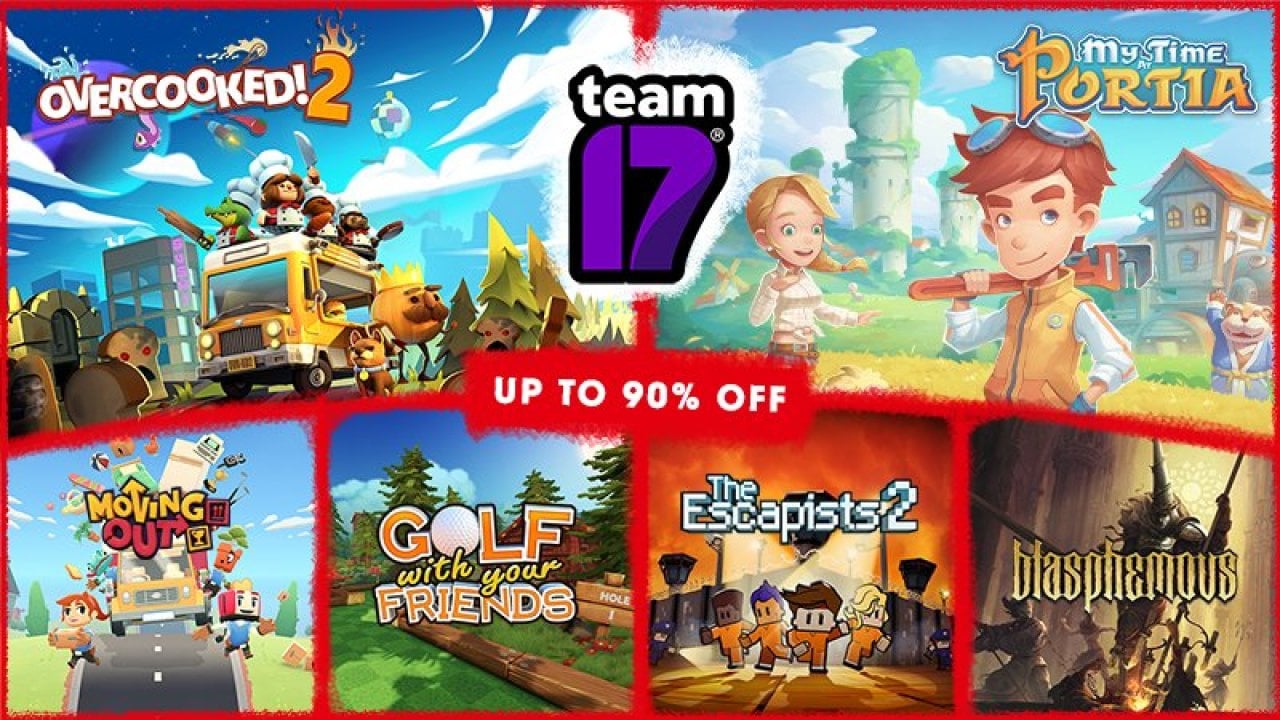
Team17 Kicks Off Summer Switch Sale, Get Up To 90% Off Its Biggest Games
Team17 is hosting a new sale on Nintendo Switch, slashing prices of some of its biggest games by as much as 90%.
That tasty sounding 90% discount is available for Mugsters, and you’ll find other great titles like the Yooka-Laylee games, Moving Out, Overcooked, My Time at Portia and more on sale, too. We have a full list of the discounts available in North America for you below (similar discounts can also be found across Europe):
The sale will remain live until on 26th July – make sure to snap up any deals that take your fancy over the next few days.
Anything in particular catching your eye? Let us know which deals you’re thinking of going for in the comments below.
Posted by: xSicKxBot - 07-21-2020, 09:15 AM - Forum: Lounge
- No Replies
Tenet Has Been Indefinitely Delayed
Director Christopher Nolan's Tent has just been officially delayed again--indefinitely, for now--according to a statement from Warner Bros. Chairman Toby Emmerich. Nolan's latest movie has recently garnered more attention for its release status than its story (which still remains a mystery). The film was originally scheduled to hit theaters on July 17, and was subsequently pushed back twice to August 12 due to concerns over COVID-19 safety and audiences gathering in movie theaters. As of this writing, there is no new tentative release date, but one is forthcoming.
In the statement, Emmerich said, "We are not treating Tenet like a traditional global day-and-date release, and our upcoming marketing and distribution plans will reflect that… We will share a new 2020 release date imminently for Tenet, Christopher Nolan's wholly original and mind-blowing feature. Unfortunately, the pandemic continues to proliferate, causing us to re-evaluate our release dates."
Nolan, a staunch advocate for film as a medium meant to be experienced on the big screen, has not yet released a statement. Variety is speculating that since theaters overseas have already begun to re-open, it is possible the movie could launch internationally before a domestic release.
Posted by: xSicKxBot - 07-20-2020, 11:35 PM - Forum: Windows
- No Replies
Sea of Thieves passes 15 million players since March 2018 launch
Summary
Sea of Thieves has been played by more than fifteen million players since launch in March 2018.
June 2020 was the biggest month so far for Sea of Thieves, with over 3.3 million players setting sail.
Sea of Thieves has sold over 1 million copies to date on Steam since its launch on June 3, 2020.
It’s both thrilling and humbling to share with you that Sea of Thieves has been played by more than fifteen million players since our launch in March 2018.
The way that the game and its community has continued to grow has been amazing to see. It was only in January of this year when we shared that 10 million people had played the game! We’re also humbled that more people have played Sea of Thieves in the first six months of 2020 than who played in the whole of 2019, which was more than 2018.
Last month – June 2020 – was also the biggest month so far for Sea of Thieves in terms of active players, with more than 3.3M players setting sail. A contributing factor to this growth has been our recent launch on Steam. We’ve been blown away by the support we’ve seen from the Steam community, with over 1M copies of the game having been sold so far and the game regularly appearing in the top selling and most played games charts.
On behalf of all of us at Rare, I’d like to say a big thank you to everyone who’s ever played Sea of Thieves for helping to get us this far. It’s a game that we love making, and there’s plenty more to come. See you on the seas.
New to Sea of Thieves? Join the fun with our Maiden Voyage, a narrative-driven tutorial experience separate from Adventure and Arena modes. New Sea of Thieves players will begin their travels within this scenario, which provides guidance and information to fledgling sailors. Learn more about Sea of Thieves at www.xbox.com/seaofthieves, or join the ongoing adventure at www.seaofthieves.com where you can embark on an epic journey with one of gaming’s most welcoming communities!
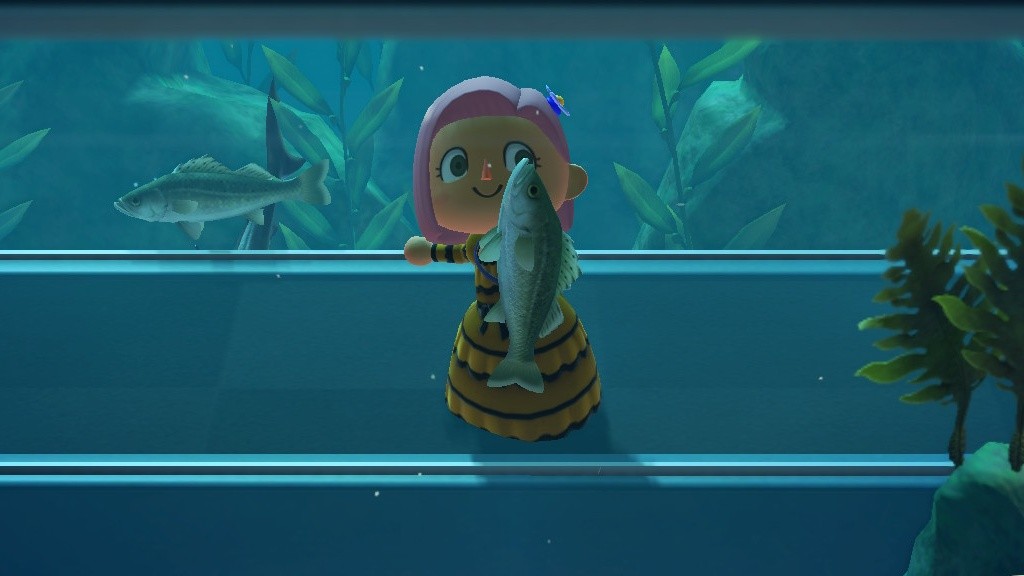
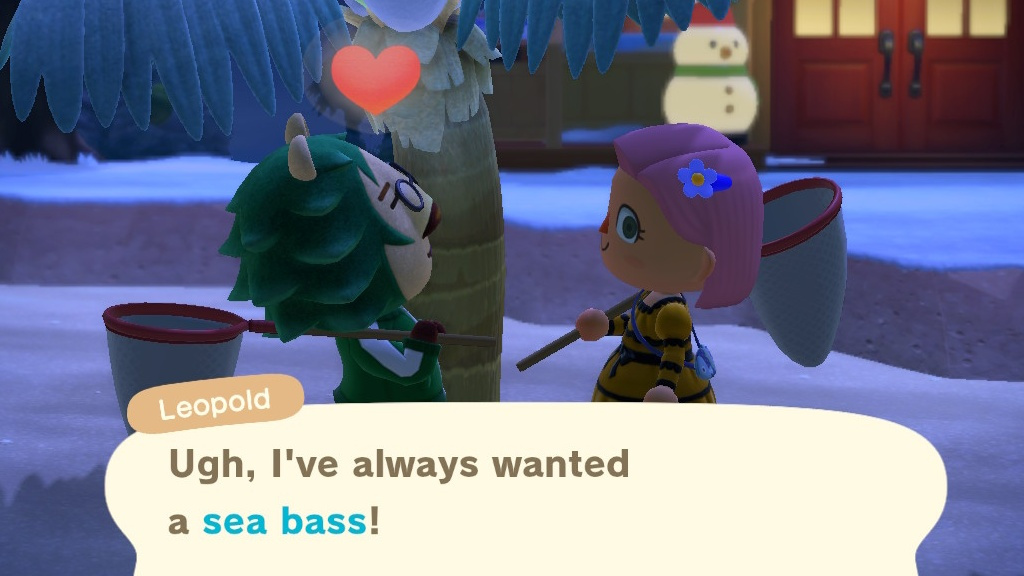
According to a story over on Polygon, it has got to the point where a modder by the name of ‘SmuggestGirl’ has decided to eradicate this sea roach from the game. Their mod, simply titled ‘No Sea Bass’, reduces the spawn rate of this particular fish to zero percent. Here’s some user feedback so far:
“Shucks, now [it’s] all squids, olive flounders, and red snappers”
The same modder has also created the “complete opposite” of this – removing all other varieties of fish from the water but the sea bass. It left one commenter questioning what would happen if they ran both mods at the same time.
While the mod removing this fish from the game is definitely amusing, alternatively you could just learn to live with it occupying the surrounding waters of your tropical paradise. It still sells for 400 Bells!
Nintendo Life
Do you think the amount of sea bass swimming about in New Horizons needs to be reduced? Is there anyone out there who wants to catch more sea bass? Do you want them gone for good? Share your thoughts below.
Feature: 10 Of The Most Blatant Snack Sponsorships In Retro Gaming History
Last month the Philippines arm of KFC grabbed the headlines (well, our headlines at least) when it created its own KFC restaurant in Animal Crossing: New Horizons and invited its Twitter followers to visit its island, with the hope of finding Colonel Sanders and getting a voucher code for free chicken in real life.
While Nintendo obviously had nothing to do with this and the whole thing was just a marketing ploy conjured up by KFC, it’s far from the first time video games have been associated with food brands. In fact, ever since the very early days of home console gaming – we’re talking the Atari 2600 here – there have been games containing product placement for snacks. Some of these are subtle, others have entire games built around them. Here are some of our favourites.
This list is by no means complete: there are plenty of other examples. Honourable mentions go to Death Stranding and its infamous Monster Energy consumables, Pepsiman on the PlayStation, Fight Night Round 3 (which lets you unlock the terrifying Burger King mascot to accompany you to the ring) and the strange Space Invader-style Commodore 64 game Weetabix Versus the Titchies. Two games we haven’t forgotten, though, are the Chester Cheetah games for the SNES and Mega Drive, partly because even though they star the Cheetos mascot, they don’t actually mention Cheetos at any point.
That said: sit back, grab an ice cold refreshing Irn Bru™, and enjoy.
Zool – Chupa Chups
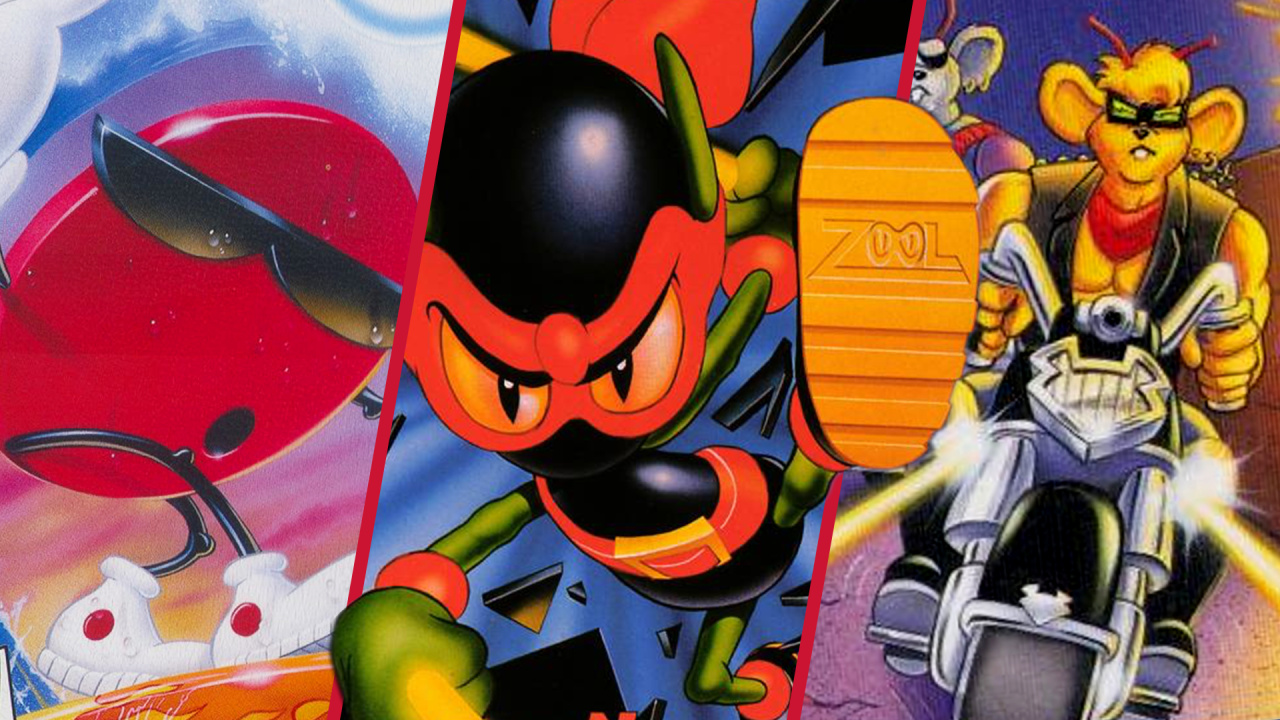
There are two examples of snack food product placement in games that many people cite all the time, so let’s start with those. Probably the most commonly mentioned (especially in Europe) is Zool, the fast-paced platformer starring a ninja from the Nth Dimension which was originally released on the Amiga before coming to a bunch of other systems including the SNES and Mega Drive.
The first world in Zool has a candy theme, and the stage is absolutely packed with cakes, candy games, gingerbread and chocolate as far as the eye can see. Deciding to turn this into a marketing opportunity, publisher Gremlin Graphics arranged a deal with Spanish lollipop company Chupa Chups and slapped its lollies and logo all over the stage,
If you owned Zool on the SNES and are a bit confused about all this, you probably lived in North America. The Chupa Chups sponsorship was removed entirely from NTSC versions of the game, whereas the European PAL SNES version still has its big garish logos proudly beaming out at you.
James Pond 2: Codename Robocod – Penguin
The other instance of snack sponsorship that regularly gets brought up is the presence of Penguin biscuits in Millennium Interactive’s much-loved platformer James Pond 2: Codename Robocod, which starred everyone’s favourite piscine protagonist as he attempts to rescue Santa Claus from the evil Dr Maybe.
For those not familiar with Penguins, they’re a brand of chocolate biscuit that have been a part of British tea-drinking culture since they were first produced in the early 1930s. For a certain generation of Brit the marketing slogan “p-p-pick up a Penguin” is widely recognised, even though most people don’t actually get what that means. In fact, most don’t know why they’re called Penguins in the first place.
Regardless, because Robocod involves finding penguins at various points, large Penguin biscuit wrappers can be found in certain stages in 90s versions of the game (they were removed for the GBA, PlayStation and DS versions released in the 2000s). It’s a pretty tenuous link, but it’s reported that Penguins outsold Kit-Kats in the UK for the first time after Robocod launched. We’re not sure we believe that, mind.
Bubba ‘n’ Stix – Bubbilicious
If you live in North America and are starting to feel a bit left out, here’s one for you. Bubba ‘n’ Stix is a puzzle-platformer that was developed by Core Design. Although Core also published the game in most regions, when it came to the Mega Drive version (or Genesis, if you will) Tengen took over publishing duties in America.
Tengen also negotiated a sponsorship deal with Bubbilicious bubble gum, with a big sticker on the cover telling people they could win a Sega CD console if they bought special packs of Bubbilicious and entered the competition on the wrapper. To make sure the deal went both ways, the game’s bonus stage included large packs of Bubbilicious which could be collected for bonus points.
If you’re sitting in the UK and scratching your head at all this, that’s because none of this happened in Europe. There was no Bibbilicious tie-in in PAL regions, and the Bubbilicious collectibles were nowhere to be found in the bonus stages. It wasn’t any great loss, though, so don’t worry.
Superfrog – Lucozade
This Team17 platformer came to the Amiga in 1993 and told the story of a handsome young prince who’s turned into a frog by a witch, who then kidnaps his girlfriend for good measure. As he sits by the side of the river feeling sorry for himself the frog spots a bottle of (famed UK energy drink) Lucozade floating downstream, so he picks it up and takes a drink and, lo and behold, becomes the heroic Superfrog.
Lucozade doesn’t just feature in the intro sequence: bottles of the stuff can be found dotted around each of the game’s levels and will restore Superfrog’s health when he picks it up. Which makes sense, given that back in the day Lucozade was traditionally what you were supposed to bring as a gift when you were visiting sick people in hospital.
A number of years later Lucozade teamed up with another British gaming icon, and this time it was a biggie: a TV ad campaign saw Lara Croft drinking the stuff, and the drink was renamed Larazade for a limited time. It never actually appeared in any Tomb Raider games, though, which is why we’re going with Superfrog instead.
Pushover – Quavers
It’s becoming pretty clear by now that Britain in the early ‘90s seemingly had some sort of obsession with putting snacks in video games, and Ocean Software’s puzzle game Pushover didn’t really do anything to change that. This time the brand in question was Quavers, the floaty crisp snack that tasted like cheesy air, and also included Quavers’ then mascot Colin Curly.
Colin’s lost his packets of Quavers down a giant anthill so it’s up to a soldier ant called G. I. Ant (hah) to enter said anthill and retrieve said curly potato puffs, which he did by knocking over a bunch of dominos in what’s actually a fiendishly difficult puzzler.
After a stint on the Amiga, Pushover came to the SNES with all the Quavers branding removed. Colin Curly, meanwhile, would go on to star in another Amiga game called One Step Beyond, which was also packed with Quavers branding. Hardly anyone seems to eat Quavers these days, and we’re putting that directly down to the lack of an HD remaster of Pushover.
Cool Spot – 7 Up
Here’s one that’s subtle (at least until you reach its bonus stage). Cool Spot is an entertaining platform game starring – get ready for this – the red dot on the 7 Up logo. Yes, slap a pair of sunglasses and some arms and legs on that dot and you have one of the funkiest mascots in town. Or something.
For the most part, Cool Spot is a fairly innocuous platformer: you have to explore the game’s numerous stages in search of your fellow Spot pals, who’ve been imprisoned in cages, presumably due to their comparative lack of coolness. It isn’t until you reach the bonus stage – where you’re trapped in a giant 7 Up bottle and have to bounce off bubbles to reach the top while spelling out its marketing slogan UNCOLA – that the tie-in reveals its true form.
The European versions of the game had all the 7 Up branding removed (starting to see a theme here?), mainly because 7 Up’s mascot in Europe was another character called Fido Dido and it was decided not to confuse things. In the bonus stages, instead of UNCOLA you had to spell out VIRGIN. Stop laughing, that’s who published it.
M.C. Kids – McDonalds
If you thought McDonald’s wasn’t going to try to get involved in this useful new way to market directly to children, we admire your naïvety, but no. M. C. Kids (known as the slightly less subtle McDonaldland in Europe) was a serviceable platformer that contained more big M’s than Mario’s hatstand.
Ronald McDonald’s magic bag has been stolen, so it’s up to two plucky young tykes called Mick and Mack to enter McDonaldland and try to get it back. Along the way they encounter other characters from the McDonald’s Cinematic Universe™ including Grimace, Birdie and the notorious Hamburglar (who’s the one responsible for stealing the bag in the first place).
Mick and Mack returned in Global Gladiators, an environmentalist Mega Drive game in which they had to use a water gun to clear up slime and various other types of toxic gunk in order to clean the world up. While collecting more golden arches, obviously.
Chase the Chuck Wagon – Purina
If you think snack tie-ins were mainly a ‘90s phenomenon, you’re in for a surprise: in the early ‘80s the humble Atari 2600 had its fair share of sponsored games too. These included strange collect ‘em up Kool-Aid Man and the extremely rare Pepsi Invaders, a Space Invaders clone created by Coca-Cola to be handed out at its 1983 sales convention.
The oddest example of the Atari 2600 era, though, is possibly Chase the Chuck Wagon. If you were an American citizen in the ‘70s and ‘80s you were probably aware of a TV commercial for Purina dog food in which a dog chases a little chuckwagon (it was referenced at the start of This Is Spinal Tap as well, and Family Guy spoofed it at one point because of course it did).
Purina commissioned game publisher Spectravision to make a game based on this commercial, and it was programmed in a mere three days, so yes, it was awful. It was a mail order game, and could only be bought if you sent in proof of purchase labels for Purina dog food products. Which sort of defeats the purpose of the game if people are already buying the stuff.
Biker Mice from Mars – Snickers
The Biker Mice From Mars game is something of a hidden gem on the SNES: it’s an isometric racing game developed by Konami and it’s packed with power-ups and all that good stuff. It’s also notorious, however, for being the only game in this list that’s a TV show tie-in with a snack tie-in included. We believe the phrase is “yo dawg, we heard you liked tie-ins”, or at least it would be if it was 2008.
In fact, not only did the Biker Mice game have a snack sponsorship – in just one region, naturally – it was also a rare case of a sponsorship that actually affected the gameplay. The PAL version of the game had Snickers branding slapped all over it, but you could also pick up a Snickers power-up which was by far the most powerful in the game: it makes you invincible, speeds you up and makes fireworks appear.
In keeping with the general theme of this article, the North American version of the game didn’t have any Snickers sponsorship. This meant that it also didn’t have the power-up, however, making it a slightly harder game as a result. Oh Snickers, you rascals.
Kaettekita Mario Bros. – Nagatanien
Finally, it may shock you to learn that not even our good pal Mario has been able to resist the clutches of snack sponsorship in the past. The culprit in question was Kaettekita Mario Bros., an enhanced port of Mario Bros. for the Famicom Disk System that made some notable improvements including new levels and the ability to change direction in mid-air (which, if you’ve played Mario Bros, you’ll know is a literal game-changer).
However, it also added advertisements in between some of the levels. Some of these ads were for other Nintendo games, most notably Super Mario Bros. 3 (which had just been released on the Famicom a month earlier). Others, however, were for food products created by Nagatanien, a Japanese company who specialised in premixed and instant food (miso soup mix, sushi toppings and the like).
What’s more, it included a special Nagatanien World mode, which adds a slot machine when you get Game Over which gives you the chance to continue playing. If players scored 100,000 or 200,000 points in this mode, they’d also be given a promotional code that they could mail in to Nintendo to try to win a copy of Super Mario Bros. 3 or some playing cards. We’re not angry at you, Mario; we’re just disappointed.
Have these blatant snack sponsorships left you feeling a little peckish? Let us know which other brand deals you’ve noticed in games with a comment below…
Xbox Insider Release Notes – Beta, Delta and Omega (2007.200709-1200)
Hey Xbox Insiders! We have a new Xbox One update preview coming to the Beta, Delta and Omega ring. It’s important we note that some updates made in these preview OS builds include background improvements that ensure a quality and stable build for Xbox One.
We continue to post these release notes, even when the noticeable changes to the UI are minimal, so you’re aware when updates are coming to your device. Details can be found below!
System Update Details:
OS version released: RS_XBOX_RELEASE_2007\19041.3503.200709-1200
Available: 8 p.m. PT – July 10, 2020
Mandatory: 3 a.m. PT – July 11, 2020
Fixes Implemented
Thanks to the hard work of Xbox engineers, we are happy to announce the following fixes have been implemented for this build:
System
Various updates to properly reflect local languages across the console
Note: Users participating in Preview may see “odd” text across the console, for more information go here.
Known Issues
We understand some issues have been listed in previous Xbox Insider Release Notes. These items aren’t being ignored, but it will take Xbox engineers more time to find a solution.
We’re still tracking these known issues:
Audio
Users who have Dolby Atmos enabled and console display settings set to 120hz with 36 bits per pixel (12-bit) are experiencing loss of Dolby Atmos audio in some situations.
Workaround: Disable 120hz or set Video Fidelity to 30 bits per pixel (10-bit) or lower.
Some users have reported that Dolby Atmos for Headphones audio setting changes when the console is rebooted/updated.
Note: If you attempt to set the audio to Dolby Atmos for Headphones and see a message advising you to launch the Dolby Access App, please file feedback before launching the app.
Game DVR
We are aware game clips (non-4K and 4K) are not recording at all or recording the incorrect length with recent updates. We are investigating.
Note: Make sure you report the behavior on the console as soon as you record the clip and notice either behavior.
Workaround: We’ve implemented a fix where clips that do not record in 4K will instead record in 1080p instead.
Guide
When installing or updating a game/app, the installation progress bar may not show progress. The issue is known and being investigated.
We’ve received reports that the Friends tab is not showing the correct status of online/offline friends.
Some users may notice that the Guide has changed appearance and functionality, this is expected behavior as there are certain experiences being flighted among a random subset of users in Preview.
Messages
Users are reporting that Message notifications that have been marked as read are re-appearing as new. We are aware and investigating the behavior.
My Games & Apps
Users have reported seeing black tiles instead of game artwork when browsing their collection.
Note: We are still investigating the issue, please report the issue again from the console if you have done so with a prior update and are still seeing this behavior.
Some titles in collection may appear with a “trial” tag incorrectly in collection.
Profile Color
Sometimes users may encounter the incorrect Profile color when powering on the console.
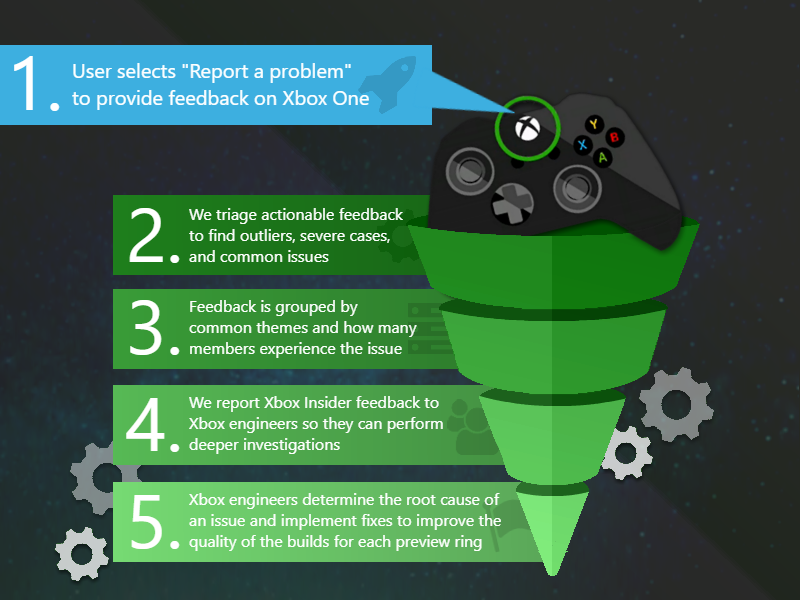
Make sure to use Report a problem to keep us informed of your issue. We may not be able to respond to everyone, but the data we’ll gather is crucial to finding a resolution.
How to Get Xbox Insider Support
If you’re an Xbox Insider looking for support, please reach out to the community subreddit. Official Xbox staff, moderators, and fellow Xbox Insiders are there to help with your concerns.
When posting to the subreddit, please look through most recent posts to see if your issue has already been posted or addressed. We always recommend adding to threads with the same issue before posting a brand new one. This helps us support you the best we can! Don’t forget to use “Report a problem” before posting—the information shared in both places helps us understand your issue better.
Thank you to every Xbox Insider in the subreddit today. We love that it has become such a friendly and community-driven hub of conversation and support.
For more information regarding the Xbox Insider Program follow us on Twitter. Keep an eye on future Xbox Insider Release Notes for more information regarding your Xbox One Update Preview ring!
Smite Adding Tsukuyomi, The Japanese God Of The Moon
Smite, third-person MOBA, has announced the Japanese god of the moon Tsukuyomi will be coming to the game in August 2020. Tsukuyomi is the 111th playable character to be added to the game and the 7th god in the Japanese pantheon.
The trailer announcing Tsukuyomi shows him facing off against his sister Amaterasu, the goddess of the sun. More information about Tsukuyomi will be announced during the Smite Update show on July 22.
Tsukuyomi is a ruthless perfectionist, demanding order and obedience from those who oppose him. His conflict with Amaterasu runs deeper than a grudge, as neither deity is willing to yield to the other.