Large files like logs or source code can run into the thousands of lines. That makes navigating them difficult, particularly from the terminal. Additionally, most terminal emulators have a scrollback buffer of only a few hundred lines. That can make it impossible to browse large files in the terminal using utilities which print to standard output like cat, head and tail. In the early days of computing, programmers solved these problems by developing utilities for displaying text in the form of virtual “pages” — utilities imaginatively described as pagers.
Pagers offer a number of features which make text file navigation much simpler, including scrolling, search functions, and the ability to feature as part of a pipeline of commands. In contrast to most text editors, some terminal pagers do not require loading the entire file for viewing, which makes them faster, especially for very large files.
In the modern era of Linux computing, terminal emulators are more sophisticated than ever. They offer support for a kaleidoscope of colors, terminal resizing, as well as a host of other features to make parsing text on screen easier and more efficient. Terminal pagers have undergone a similar evolution, from extremely simple UNIX utilities like pg and more, to sophisticated programs with a wide range of features, covering any number of use cases. With this in mind, we’ve put together a list of some of the most popular terminal paging utilities — more or less.
More
more is one of the earliest pagers, initially featured in version 3.0 BSD. The first implementation of more was written in 1978 by Daniel Halbert. Since then, more has become a ubiquitous feature of many operating systems, including Windows, OS/2, MacOS and most linux distributions.
more is a very lightweight utility. The version featured in util-linux runs to just under 2100 lines of C. However, this small footprint comes at a price. Most versions of more feature relatively limited functionality, with no support for backwards scroll or search. Commands are similarly stripped back: press enter to scroll one line, or space to scroll one page. Some other useful commands include:
Press v while reading to open the current file in your default terminal editor.
‘/pattern‘ let’s you search for the next occurrence of pattern.
:n and :p will open the next and previous files respectively when more is called with more than one file as arguments
Less
less was initially conceived as a successor to more, addressing some of its limitations. Building on the functionality of more, less adds a number of useful features including backwards scroll, backwards search. It is also more amenable to window resizing.
Navigation in less is similar to more, though less borrows a few useful commands from the vi editor as well. Users can navigate the document using the familiar home row navigational keys. A glance at the man page for less reveals a fairly rich repertoire of available commands. Some particularly useful examples include:
?pattern lets you search backwards in the file for pattern
&pattern shows only lines which feature pattern. This is particularly useful for those who find themselves issuing $ grep pattern | less regularly.
Calling less with the -s (–sqeueeze-blank-lines) flag allows you to view text files with large gaps. Multiple newline characters are reduced to single breaks.
s filename, called from within the program, saves input to filename (if input is a pipe).
Alternatively, calling less with the -o filename flag will save the input of less to filename.
With this enhanced functionality comes a little extra weight. The version of less that ships with Fedora at the time of writing clocks in at around 25000 lines of source code. Granted, for all but the most storage constrained systems, this is a non-issue. Besides, less is more than more.
Most
While less aims to expand on the existing capabilities of more, most takes a different approach. Rather than expanding on the traditional single file view, most gives users the ability to split their view into “windows.” Each window contains different files in different viewing modes. Significantly, most takes into account the width of its input text. The default viewing mode doesn’t wrap text (-S in less), a feature particularly useful when dealing with “wide” files. While these design decisions might represent a significant departure from tradition for some users, the end result is very powerful.
In addition to the navigation commands offered by more, most uses intuitive mnemonics for file navigation. For example, t moves to the top of a file, and b moves to the bottom. As a result, users unfamiliar with vi and its descendants will find most to be refreshingly simple.
The distinguishing feature of most is its ability to split windows and contexts quickly and easily. For example, one could open two distinct text files using the following:
$ most textFile1.txt textFile2.txt
In order to split the screen horizontally, use the key combos Ctrl+x, 2 or Ctrl+w, 2. The command :n will open the next file argument in a given window, offering a split screen view of two files:
If you turn wrap off in one window, it does not affect the behavior of other windows. The \ character indicates a wrap or fold, while the $ character indicates that the file extends past the limitations of the current window.
pspg
Those who work with SQL databases often need to be able to examine the contents of our databases at a glance. The command line interfaces for many popular open source DBMS’s, such as MySQL and PostGreSQL, use the system default pager to view outputs that don’t fit on a single screen. Utilities like more and less are designed around the idea of presenting text files, but for more structured data, leave something to be desired. Naive text paginating programs have no concept of broad, tabular data, which can be frustrating when dealing with large queries.
pspg attempts to address this by offering users the ability to freeze columns while viewing, sort data in situ, and colourize output. While pspg was intended initially to serve as a pager replacement for psql specifically, the program also supports the viewing of CSV data, and is a suitable drop-in replacement for mysql and pgcli.
Vim
In a modern, technicolor terminal, the idea of endless pages of drab grey on black text can feel like something of an anachronism. The syntax highlighting options offered by powerful text editors like vim can be useful for browsing source code. Furthermore, the search functions offered by vim vastly outclass the competition. With this in mind, vim ships with a shell script less.sh that lets vim serve as a replacement for conventional pagers.
To set vim as the default pager for man pages, add the following to your shell’s config (such as ~/.bashrc if using the default bash shell):
Alternatively, to set vim as the default pager system-wide, locate the less.sh script. (You can find it at /usr/share/vim/vim81/macros/ on current Fedora systems.) Export this location as the variable PAGER to set it as default, or under an alias to invoke it explicitly.
Posted by: xSicKxBot - 12-07-2019, 10:43 AM - Forum: Lounge
- No Replies
The Sundial
Some time after the death of Panoptes, Infinite Mind and the City’s venture to the Infinite Forest:
Osiris stepped back to look upon his work. It towered stories above him.
The Sundial was complete, a shining beacon in Mercury’s sky. He needed only to seal the chronometric core, which lay bare at the center of the spire, and activate the Arc conduits that ran for miles under the planet’s surface.
Sagira circled the superstructure, scanning every inch of it.
“I don’t know about this,” she said.
“I have full confidence. It’s your design.”
“That work was theoretical! If the Vanguard find out what you did to build it—“
“If this works, the Vanguard will find out either way.”
Sagira darted down as if to dive bomb her chosen, but stopped just short and met him eye to eyes.
“I know you feel guilty, but there’s no telling what will happen if you turn this thing on.”
“He’s dead because of me. I’ve made every precaution. I’ve had my Echoes check against trillions of disaster scenarios.” He turned to look at the fluctuating glow of the exposed chronometric core. “Mercury is the only planet that will be affected. Because that’s where he died.”
“Where will this stop? Who else will you decide deserves a second chance?”
“You know I can’t make another bargain like this one.”
“I just want to make sure you know that.”
Osiris blinked. She rarely spoke this bluntly, and without irony.
“Hey, hey, hey!” came a far-off, echoing shout. “No! That ain’t right!”
The Drifter came into view from behind one of the Sundial’s auxiliary pylons, pointing a jabbing finger at Osiris’s machine.
Sagira narrowed her eye at the rogue Lightbearer and lowered herself to Osiris’s shoulder. “Why’s he here?” she asked quietly.
“I asked him to consult on the engineering work,” Osiris replied, crossing his arms.
“You sicko,” the other man declared, walking a circle around the Warlock, his eyes darting along every surface of the Sundial around them.
As the Drifter rapped his knuckles on the north pylon, he mumbled, “Ghost, do the numbers.” An armored Ghost with a red eye unfolded out of transmat and began a scan pattern on each Sundial spire.
Drifter walked to the central spire and put his ear up against it. “This core…” he said, leaning close. His eyes darted back to Osiris. “It’s whispering.”
Osiris’s expression didn’t change; his arms didn’t uncross. “We’ll seal the core away. I understand the ramifications.”
“Good luck keeping that contained. Not something I would bargain with, hotshot.” Drifter stood up and beckoned his Ghost with two fingers. It floated earthward and unleashed a holographic array of statistics along the Sundial deck.
The red light reflected off the Drifter’s eyes as he drank the numbers in.
“Your math checks out,” he said, finally, as his Ghost folded away. “It’ll work. But will you find him? At the exact moment that you need? No guarantees.”
“Let me worry about that,” Osiris said.
“Just one more question, then. Why all the fuss?”
“I owe him.”
“I owe a lotta people, Warlock. You’re opening the gates of hell with a Vex key.”
“When the Traveler brought me back, I had no friends. No family—”
“No one had anything in the Dark Age.”
“But Saint was always there. And I saw him grow from neophyte to demigod.”
Drifter shrugged. “We’ve all had to flex a little. Win a gun fight or two. It’s why we’re still here.”
“We all gain strength. But some Lightbearers never grasp a wider view of the world. They’re happy to stick to their ways… languish. When they could be so much more.”
Drifter chuckled and spat, saluting Osiris with a single finger. “I get by.”
“Of course you do. I’m like you.”
Drifter smirked.
“But Saint faced his fears and failure better than any of us, and never strayed from his path. He should get a chance to walk to the end.”
“He already did. But I’ll leave you to your devices. You lunatic.” The Drifter turned, hands in his pockets, to leave. “If you short-circuit the universe, you’re on your own.”
“If I make a mistake here, you might cease to exist,” Osiris replied.
“Maybe that wouldn’t be so bad.”
“We haven’t talked about payment.”
“If you live through this little experiment, you can be sure I’ll be back to collect.”
“Go home. There’s a Guardian you should meet,” Osiris said.
“Yeah, yeah. Hero. Red War. Can’t wait.”
❖❖❖
A dozen Echoes flanked Osiris.
The Sundial spun and sparked above them, around them.
His Echoes vanished in staccato bursts of chronometric Arc, stepping not elsewhere, but elsewhen, as the Sundial fell silent.
Osiris could still see and feel through them as twelve of him walked the corridors of time.
Where those halls were intersected by the Vex network, his Echoes hacked Hobgoblins and Minotaurs apart using Solar Swords powered by sheer will. They hid their shadows and stood still, unblinking, to avoid the Network Minds. Together, they pushed to corners that gave way to the Mercurian Dark Age.
From there, they separated, entering myriad moments of Saint’s visits to Mercury.
An Echo encounters a battle-hardened Saint at the mouth of Caloris Basin. Saint is a member of the Pilgrim Guard, and he and his fireteam descend on batteries of Vex Goblins, the bloom of heavy gunfire leading their way. This Saint is too early. The Echo does not approach.
Neither does the Echo who watches in a dark corner as Saint’s jumpship lands at a Lighthouse at the Caloris Spires. Its interior is cloaked in shadow. The Cult of Osiris’s retrofit of the structure isn’t due for another age. Saint comes here to keep it clear of Vex attempting to reclaim it. He lights the darkness as he tears Minotaurs apart with Solar fists.
An Echo crouches on a cliffside out of sight as, far below, Saint uses his Solar Light to cut through the armor-plated Mercurian soil. Solitary stones line a series of holes that stretch for a dozen meters to either side.
An Echo hides in burning light as Saint works shoulder to shoulder with the Sunbreakers to construct the Burning Forge. Their hammering and soldering with Solar knuckles and sledges draws a silent parade of Vex to the building site. The Sunbreakers take turns stepping away from construction to dismantle the intruders using the same Solar implements.
An Echo spies Saint from a vantage point on the high plains of the Fields of Glass. The Titan fights for his life against purple-bannered Fallen, bearing the same symbol as modern Dusk soldiers. They are the House of Rain, the lowest House. The burning camp around them is curiously absent of bodies—but Osiris has heard Saint tell this story before. One of Saint’s first missions for the Speaker brought him to Mercury in a failed attempt to “re-take” that planet for humanity. They had not known at the time that the Vex had already started to transform the “garden world” into a machine. House Rain followed Saint’s jumpship and waited ’til the expedition had made camp. Then the Fallen annihilated the colonists Saint was charged to protect and beat him to within an inch of his life. The Echo lives that story first-hand now, and finds himself looking away at the terraformed vegetation at his feet instead. It’s already half machine—grass and metal blades growing beside each other under his boots. A Ketch roars down from the sky and rains heavy munitions on the battlefield, and the Echo’s vantage point fills with rolling clouds of dust. The Echo takes his leave. He’s seen enough.
❖❖❖
Osiris’s Echoes scour Saint-14’s timeline on Mercury. But the corridors of time refuse to give way to the moment they need: Saint and the Martyr Mind in the depths of the Infinite Forest. The Echoes work tirelessly for weeks, then months in the space between moments. In desperation, he splits the dozen copies into many thousands more as the work continues fruitlessly.
One Echo stays for years against Osiris’s orders. He has never lost control of one before; he didn’t think that was even possible. He and the Echoes are the same. He feels this aberrant copy lose his sense of self. Another few years in, he feels this Echo press the touch of cold metal to his head.
And then he feels nothing.
Two Echoes wander into the corridors of time with orders not to stop. Brute force has worked for Osiris before. To this day, he can still feel them. Their search continues.
The rest eventually succumb to Vex security measures where the network intersects with the corridors of time. Even Osiris’s Light has limits.
None of the Echoes ever approaches a Saint. They never find the right one.
❖❖❖
Osiris sat quietly at the base of the Sundial. No time had passed since the machine’s activation, but he had just lived a multitude of lives.
Sagira hovered over his shoulder and asked, hopefully, “Did it work?”
The Warlock stood, and made his way to the southern border of the Sundial. “Shut it down. Wrap everything in a stealth skin. Let nothing, no one, find it.”
Void Spirit * Aether Remnant damage reduced from 90/150/210/270 to 80/130/180/230 * Dissimilate damage reduced from 120/200/280/360 to 100/180/260/340 * Resonant Pulse base shield absorption reduced from 50/100/150/200 to 40/80/120/160 * Resonant Pulse damage reduced from 70/130/190/250 to 70/120/170/220
Snapfire * Firesnap Cookie now works on rooted targets
“Around 10 New Games” Will Be Revealed At The Game Awards 2019
The Game Awards 2019 is only a week away, and we now know that “around 10 new games” are set to be revealed during the show.
Geoff Keighley, the show’s creator and host, recently sat down for an ‘Ask Me Anything’ discussion on Reddit. Plenty of non-serious questions came flooding in – “Do you think you could beat [Bethesda’s] Todd Howard in a fight?” was a particular highlight – but other questions got Keighley to spill fresh details about the upcoming show.
Here’s what he said when asked about the number of reveals we can expect this year:
“We have a bunch of brand new games being announced at the show — I think there are around 10 new games/projects being revealed if you want to count the things that no one has heard about yet.”
Should Nintendo fans be excited, then? Well, while we’d expect the majority of these reveals to be titles for other platforms, last year’s awards did bring us the exciting reveal of Switch-exclusive Marvel Ultimate Alliance 3: The Black Order. Even if that particular game isn’t your exact cup of tea, it was certainly a surprise and we’d love to see a similarly intriguing game come out of this year’s event.
Last month, we got our hands on the full list of nominations for the awards themselves, so feel free to check those out right here. The Game Awards 2019 is scheduled to take place on 12th December at 5:30pm PT / 8:30pm ET (so that’s 1:30am GMT the following morning) and will run for around two and a half hours.
Are you hoping for any big Switch reveals during the show? Let us know what you hope to see in the comments below.
Earlier this week, the gaming world was hit by the tragic news that legendary British games journalist and graphic designer Jason Brookes had passed away after a long battle with cancer at the age of 52.
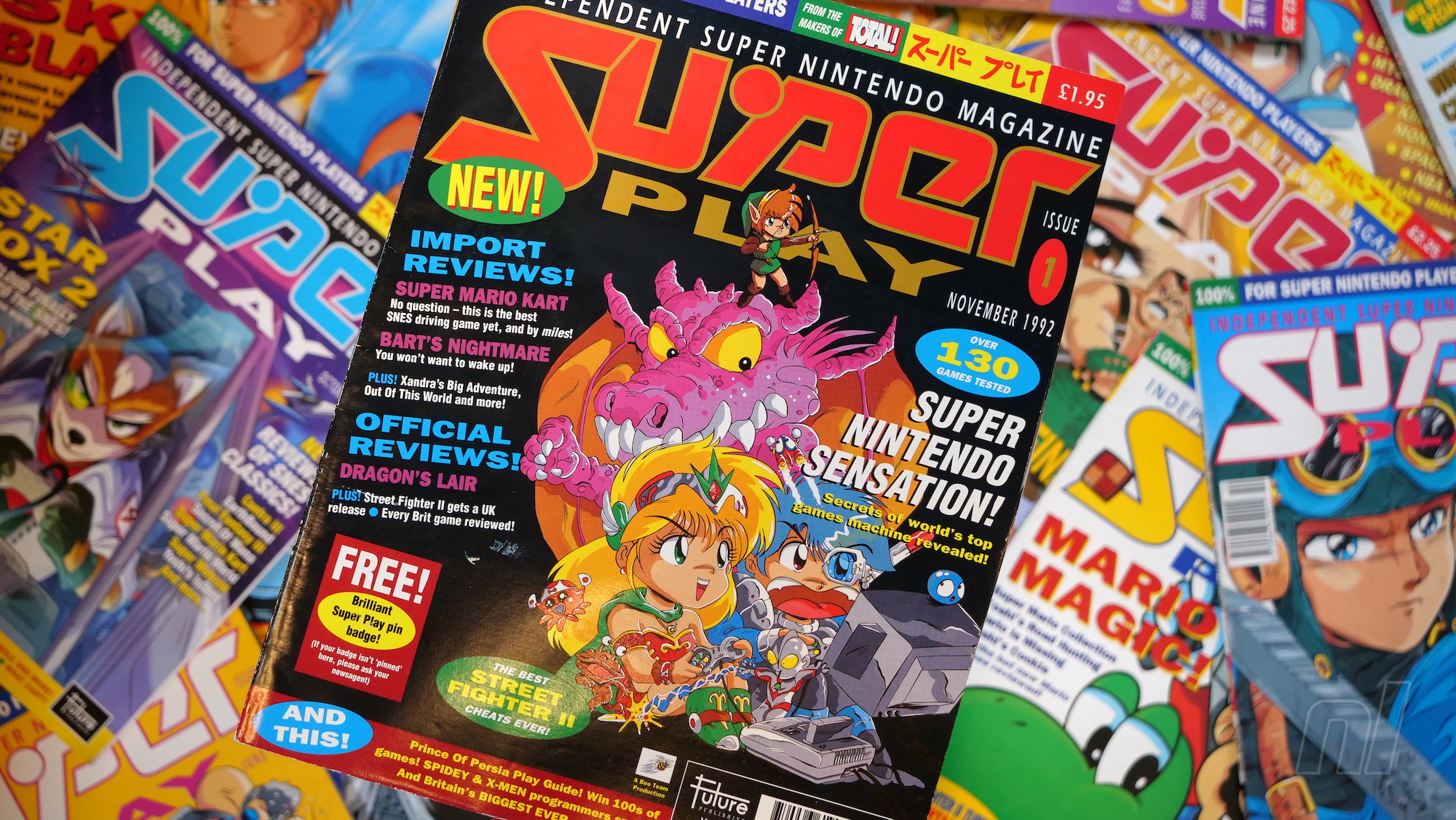
His name might not be instantly familiar to some of our younger readers, but Brookes was involved with some of the most influential gaming magazines of the ’90s and ’00s; Nintendo fans will know his name from Super Play, the UK’s first SNES magazine and a publication which championed import gaming and all facets of Japanese culture.
Starting out with the fanzine Electric Brain, Brookes would join Super Play before moving onto EDGE magazine – which is still in circulation today – where he would eventually become editor, presiding over what was arguably one of the most exciting periods of its history, covering the launches of systems like the PlayStation, Saturn and N64 and interviewing the likes of Shigeru Miyamoto, Howard Lincoln and Gunpei Yokoi.
He would later move to the US as Future’s first American correspondent, as well as working on the likes of Japanese magazine LOGiN and Ziff-Davies’ GMR magazine, amongst others. A massive fan of Japan and Japanese culture, he would later assume the role of Foreign Correspondent for Enterbrain, Inc, the publisher of Weekly Famitsu. He also contributed to Tony Mott’s 2010 book, 1001 Video Games You Must Play Before You Die. Outside of games, he helped launched the dance music magazine Revolution in 1999. More recently, he was working towards a Masters degree in Illustration at the University of Gloucester and was still attending classes until just a week before his passing.
James Mielke – Co-Founder & Creative Director, Tigertron
I’d worked with Jason since the days of GMR magazine. My boss, Simon Cox, always gave him carte blanche on whatever assignments we had for him. Their friendship went back (at least) to their days when they both worked on EDGE.
He was always omnipresent in my early days of games journalism, and over time I learned how easy-going and friendly he was. He went out of his way to send me a private note expressing appreciation for the soundtrack I’d curated for Lumines Electronic Symphony, with him having experienced firsthand the acid house revolution of the early ’90s and sharing a mutual appreciation for electronic music with me.
I didn’t see him often, on average once every other year or so, but when I learned he was ill it was deeply upsetting to discover. Throughout it all he never once complained, never acted the victim, and still maintained his relaxed, generous, kind nature. He introduced me to some developers whose game he really liked and thought that I would also like (it was Demon’s Tilt, and I loved it), and wanted to spread the word about.
To the very end, he was thinking of others, with kindness. If only everyone were so selfless.
Simon Cox – Former Future US Editorial Director / EDGE Deputy Editor
His perfectionism and attention to detail were his absolute superpower and at times – even he would admit – his Achilles’ heel. It was certainly part of what made EDGE the magazine it is today – beautifully designed, but with a velvet rope that only quality games could pass, and with an attention to detail that drove art directors and writers insane while demanding their very best, even as deadlines slipped. The result was that a pat on the back from Jason Brookes meant something. But – and this is important – he wasn’t a tyrant. Far from it.
Jason was a gentle soul, endlessly forgiving and encouraging and effortlessly charming. Everyone who met him, or had any contact with the man, fell a little bit in love with him. He just had this way about him. If I had to liken him to someone everyone might know, I’d pick Paul Newman. He had that same ability to disarm and comfort, no matter the circumstances – and that meant lifelong friendships – including with many industry figures.
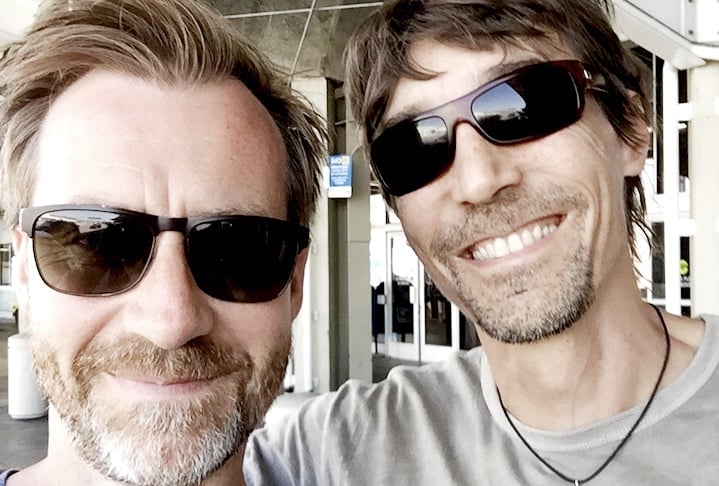
Simon Cox with Jason during a 2016 trip to San Francisco
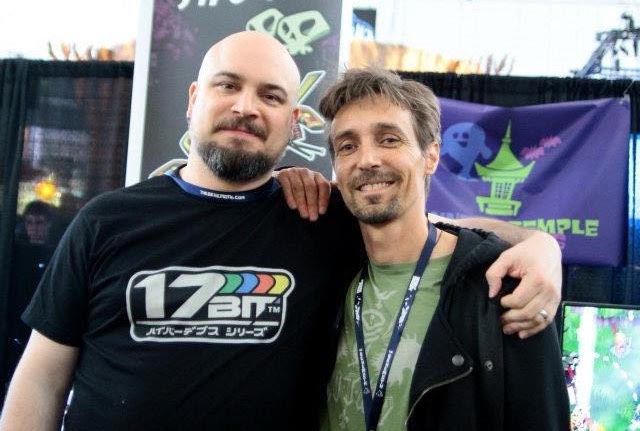
One such figure is Tetsuya Mizuguchi of Sega Rally, Lumines and Rez fame, whom he attended the Burning Man festival with and whose psychedelic, often stunningly beautiful projects were a perfect match for Jason’s twin loves of electronic music and space-age design. Jason always made it a point to visit Mizuguchi-san and 17-Bit Studios boss, Jake Kazdal, whenever he visited Japan and those nights would begin with a meeting of minds at the game studio, and end with hugged goodbyes outside a dance club at 5AM, with everyone the worse for wear.
Along with games and design, dance music was another of Jason’s loves and obsessions, and the EDGE office during his tenure was always bouncing and thumping to the sound of whatever latest Paul Oakenfold or Leftfield CD was parked in the sound system. This, of course, was a perfect match for the new era that PlayStation ushered in, where games for the first time became this nexus of art, music and design that was a part of – not separate from – the wider culture.
You honestly couldn’t have designed a more perfect editor for a magazine like EDGE if you’d tried.
Steve Carey – Publisher, Super Play
What do you mean, he’s gone? Surely that can’t be right. Jason was unfairly attractive. Indeed, he romped home in some kind of contest at Future for being the handsomest bloke, back when it was permitted to admit that not everyone was as beautiful as Jason Brookes. No-one demanded a recount.
There was a gentleness to Jason that was maybe a little unusual for Future folk at the time – it was fairly boisterous and there plenty of healthy egos about. He loved Japanese culture, which was a great asset on EDGE magazine.
Jason Brookes, gone? S**t.
Jake Kazdal – Founder, 17-Bit Games
I first met Jason Brookes while working on Rez with Tetsuya Mizuguchi in Tokyo in the spring of 2001. They were old friends, and Jason and his best friend Simon Cox were in town for Tokyo Game Show and came by to check out what we were working on. Jason was a huge trance music fan – and a huge Sega fan – and was very excited to see this crazy game we were tinkering away on. In fact, Simon came up with the name Rez that very trip! Mizuguchi-san loved it and it was quickly decided we would change the name officially. Jason had written a big expose on Mizuguchi at AM3 in EDGE in early 1998, literally weeks before I had the chance to meet Mizuguchi at E3. By the time I met Mizuguchi-san in person soon after, I had already learned a huge deal about him and was able to connect with him very quickly, and was hired soon after just as he was starting his new CS4/RD9/United Game Artists group.
Jason and I hit it off quickly, and he stayed behind after TGS to explore the city and hang out some. My good friend Takamasa Shichisawa was an art director on the Gran Turismo franchise, and he invited us both to the Gran Turismo 3 launch party not far away from my studio. Takamasa (known to everyone as Nana, which is the other way of saying 7, along with Shichi, part of his surname) was also a huge trance music fan, and the entire party was DJ’d by some of the top psy-trance DJs in Tokyo at the time who had contributed to the Japanese soundtrack, which is very different from the western soundtrack. We had an absolute blast, and the three of us closed out the party with a long walk through a gorgeous Japanese garden the next morning, and became fast friends.
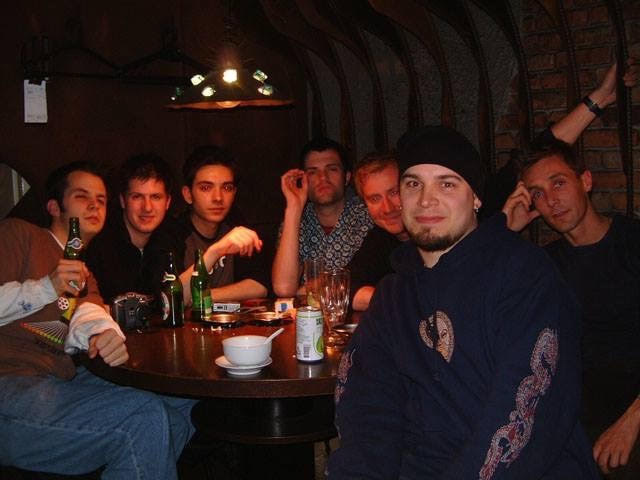
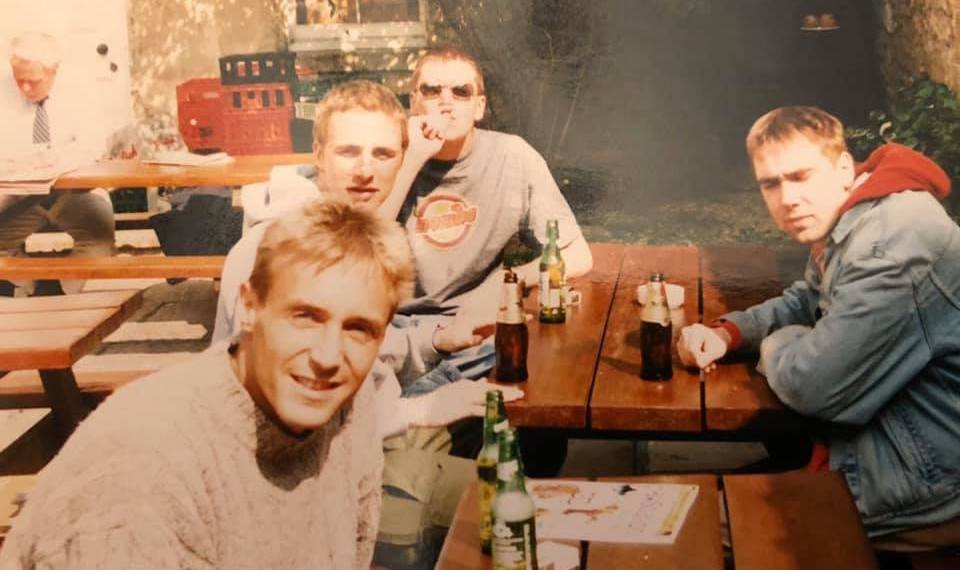
Jake (foreground) around 2000 with John Ricciardi, Simon Cox, Justin Shriram Keeling, Sam Kennedy and Mark MacDonald in Japan. Jason is on the far right of the image
As the years went by, I made a point of seeing Jason every time I visited San Francisco, and he visited me in Tokyo as well. We always hit it off so well, with so much in common in our shared passions. I introduced him to Gio Fazio, aka MAKYO, a club DJ and tribal dub producer who I was (and still am) a huge fan of. Gio did most of the soundtrack for my first indie game Skulls of the Shogun, and Jason went on to design some of his album covers, and the two of them became good friends as well. Jason was so effortless for me to communicate with; a reserved, polite man with an incredible twinkle in his eye, who when in small groups of close friends would become very animated and passionate about his favourite things – music, classic gaming, trance music and dance culture, all these things we shared and could excitedly jabber on about for days in a row when we hung out.
For years after I left Tokyo, I would always spend at least a couple of nights with Jason at his place in the Upper Haight in San Francisco during GDC every year. Mostly we’d just cruise the neighbourhood, excitedly catching up on all things music and games, eating at his favourite restaurants, just constantly grinning and discussing the finer points of our incredibly common interests. We would always spend the Saturday after the show ended doing a marathon hike through Golden Gate Park; he lived next to it almost the whole time he was in SF and knew it like the back of his hand, he loved it there so much. Simon lived close by and the two of them were like brothers, for better and for worse. Hanging out with both of them brought so much happiness to my heart, listening to them squabble was always a great laugh. He missed his family in the UK and France, but truly was a San Franciscan at heart. It became such a tradition I looked forward to it all year. When the Nintendo Switch shipped in the US during GDC, we opened it together at his house and we went into the park and played in the woods at his favourite hidden little hippy shrine; it was one of my favourite days on this planet.
He could dive into the tiniest details on his favourite graphic design, his favourite games from yesteryear, and began to really focus on combining his love of the two. He began studying graphic design constantly, and made his own clothing line, drawing heavy inspiration from both club culture and classic gaming, particularly the 16-bit era of Japanese games. His skill set quickly improved, and his attention to detail he was so well known for during his EDGE years (and before that as well) really began to shine. I was always amazed at his subtle understanding of shape, colour and composition. He would commit entirely to these compositions and designs, sometimes tuning them and experiment with them for weeks, even months. He was such a perfectionist, but it led to simple, stunning works that always impressed completely.
Jason’s long journey towards finding his true happy place in the world was just really coming to a head when he began to feel sick, and by the time he went back to England to spend time with his parents after almost two decades in San Francisco, he was diagnosed with late-stage cancer. We stayed in regular contact, but it didn’t look good. Jason was upbeat and positive as ever, attempting all kinds of bleeding-edge treatment options in Germany and elsewhere. He mentioned coming to Kyoto one last time to visit me and it was then I knew I probably wouldn’t see my dear friend again. We kept in touch, and he was always positive and hopeful, reading constantly about the condition, experimenting with diet and alternative treatments, but it didn’t get any better. His last message on Facebook, the day he died, was to Mizuguchi-san and myself, which I find highly uncanny. Full circle I guess. Simon solemnly informed me he had passed, peacefully, and I’m still spinning days later.
Jason was one of the most beautiful, passionate, particular, intelligent, stubborn, focused, interesting people I have ever met. Every minute I spent with him was always energizing, exciting, inspiring and joyful. Our sparse but intense regular visits were always a highlight of my year; I loved the man like a brother. I still can’t believe he’s gone. He was a passionate, restless creative wanderer, who leaves us far too soon. I’ll miss him like hell. I hope you find the most spiritual psychedelic festival ever, up there in the stars my dear, dear friend.
Goodbye Jason. Thank you.
Keith Stuart – Bestselling Author and Acting Guardian Games Editor / Former EDGE Staff Writer
I am extremely grateful that my first job in journalism was with Jason Brookes. He was very different to most of the other video game writers and editors at the time. Cool, tanned and handsome, he looked decidedly out of place in the ramshackle Future offices of the mid-1990s, where each magazine area resembled a teenage boy’s bedroom. He was fantastically self-assured, but also incredibly knowledgeable and passionate about games, especially Japanese games – he had a way of communicating their qualities that was utterly unique; like a music professor disassembling a Bach concerto. He taught me how to write in a human way about poly counts, texture-mapping and collision detection, and he also taught me how to interrogate the games industry and its sacred figures.
Jason (foreground) with Keith (right) in a photo which also includes Tony Mott and Craig Brooks, taken by EDGE art editor Terry Stokes
Working with him was sometimes exhausting and frustrating, but I learned so much. He expected a lot of his staff and we were desperate to get it right. There were a lot of late nights and chaotic deadlines, but then we’d open the magazine at the end of it and realise what all the effort was for. Even in the midst of sending a week-late magazine to the printers, he was calm. He was always calm. He was calm when he got famously prank-called by Charlie Brooker – a moment that would have humiliated lesser men. He was calm when I wrote an email to him complaining about the endless missed deadlines and late nights, and criticising his management, and then, thanks to a new unfamiliar email app, accidentally sent it to every editor in Future.
I only worked with him for two years, but almost everything I learned about rigorous, interesting, authoritative consumer journalism, I learned in that bright, intense and fascinating period. He was a true one-off.
Zuby Ahmed – Associate Professor in Games Design, Birmingham City University
I’m shocked and devastated by this; Jason had a massive impact on my life as a gamer and also upon my professional career. There are so many memories to pick from, but one of my fondest was the time I met him in Manchester outside the Coin Exchange back in 1991 when I brought his PC Engine CD-ROM drive, and that was the start of our beautiful friendship, where we would contact each other weekly (and sometimes daily) to talk games, from PC Engine to SNES to Saturn, PS1, N64, and then PS2. We would also talk music, from trance to chill-out! He introduced me to some life-long ‘choons’!
There was the time he called me in 1994 and 1996 to get my ass down to EDGE to pick up my PS1 and my N64 respectively (he ran a small import business on the side). The N64 day was awesome as we played Super Mario 64 in the office for ages, just making Mario run and jump into the tree outside Peach’s castle. Then in the evening, we went out and had a big night out to see Paul Oakenfold DJ; can’t remember the name of the club, but what an all-nighter!
Then there was when he Fed-Exed me his roll-o-decks of Game Industry contacts, with the proviso that I send it him back the next day, so I could grab a list of key contacts to hit up for a job in the Games Industry. This lead to my first gig in Game Dev, being offered a job by Martin Kenwright, working at Digital Image Design. The next year, I organised Jason to come up to D.I.D. and he did a whole piece on Martin and the company. Again this was wrapped around a great catch-up night out. I owe Jason my start in dev.
I am truly gutted by the news. I don’t know what else to say.
Matt Bielby – Launch Editor, Super Play
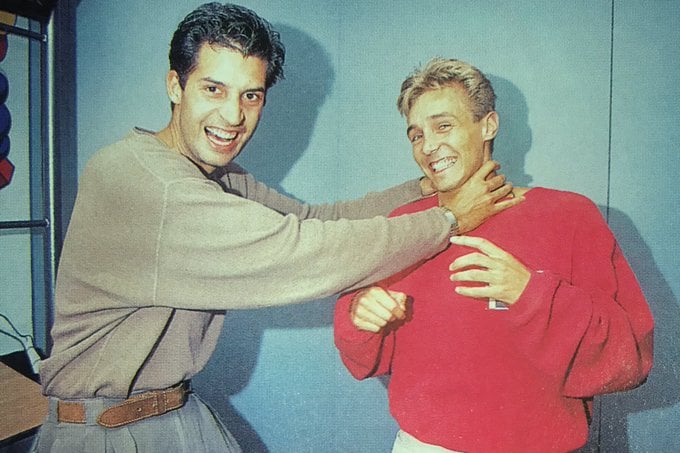
We launched Super Play towards the end of 1992. Many new Future mags had traditionally been staffed, at least in part, by safe pairs of hands who’d worked at the company before, but in the early ’90s we were growing too fast for that, and pretty much the entire launch team were fresh to the company. And on Super Play we really lucked out with Jason – a truly crucial find, and a completely different kind of guy to most of us on the games mags. Lean, quite tall and very good looking, with a healthy tan, spiky blonde hair, orange or pink T-shirts and a love of cut-off denim shorts, he looked like he should be in some surf-themed Australian boy band, not hanging around in a tiny room playing video games with us lot. He gave the impression of someone who should be living in a beach shack, partying all night, sleeping all morning, doing a bit of work in the afternoon with the ocean lapping his feet. He was charming too – the girls loved him – but so nice, we couldn’t resent him for it.
The most striking thing of all about Jason, though, was just how much he knew about and loved Japanese culture – and gaming in particular, and Nintendo especially amongst that. He knew more about all of it than the rest of us put together. One of his big dreams at the time had been, and perhaps still was, to become an air steward for JAL, the Japanese airline. He’d applied to them, I think more than once. And mostly he wanted that job for the free flights to Japan, and the opportunity they would afford him to really immerse himself in Japanese culture.
Jason had actually originally come in for an interview on Mega, but Neil West, that mag’s launch editor, had pushed him towards me instead, saying that his Nintendo love meant he’d be a much better fit for Super Play. I’ve always had Neil to thank for that: the magazine wouldn’t have been half as good as it was without Jason’s enthusiasm, knowledge, contacts in the grey import market, and telling contributions. He’d always push me to leave things as late as possible, so he could squeeze in every piece of breaking news he could.
Super Play was great fun, but stressful as all launches are. There were two major flies in the ointment: 1. A tiny L-shaped garret office, the sort of place where only two of our six-person team could stand up at any one time. At the height of summer it was sort of hellish, but Jason’s relaxed good humour was one of the things that made it tolerable. 2. Getting reliable info on Japanese games, which was a painful, time-consuming business in the pre-internet days, involving late-night phone calls to the other side of the world, local language students doing vaguely comprehensible translations for us from Japanese magazine articles, and all sorts of palaver. Just thinking of the hoops we used to have to jump through to get all the good info we needed still sends me into a cold sweat – but Jason was intrinsic to this, too.
As there were so few SNES games officially released in the UK each month, we got more and more interested in exaggerating the Japanese feel of Super Play by reviewing even the most obscure grey imports – so you’d often find the mag full of one page reviews of utterly baffling strategy games by the likes of Sunsoft or Enix, all heaving with near-untranslatable Japanese text. Even if the average Super Play reader was never going to buy Super Wagan Island or Zan II, the fact that it existed and we could tell people about it added to the unique feel of the magazine. Jason was key to this, as he’d find some sort of pleasure in all sorts of obscure stuff that I, for one, couldn’t get my head around at all. It became his territory in a way, and his enthusiasm made us all consider, if just for a moment, the most oddball releases in a new light.
Many of the very best magazines, to my mind, do more than was expected of them, pursue interesting avenues other magazines might not think of, and provide an individual rather than generic take on whatever it is they’re writing about. With Super Play, Jason’s contribution was crucial to that. He provided a great gateway into Japanese culture – so strange and wonderful-feeling in the early ’90s – for so many people, and went on to have a great career that revolved in part around the twin suns of video games and Japan in the years that followed, both editing a high-end games magazine called EDGE at Future in England and later in America. And throughout he remained as charming, and as good company, as ever.
But the Jason I will always remember and treasure is the one I knew best, the one who came down from rainy Manchester in a battered hatchback full of dodgy knock-off posters (there was probably a chimp sitting on a loo, a shirtless man holding a baby, and that tennis girl) to help us make a remarkable little magazine in Bath, and who brought with him enthusiasm, knowledge and good humour. I always associate Jason with sunshine: not just because of all those years in California, and not entirely because of the bleached blonde hair and the tan, the Miami Vice pastel T-shirts and the beach bum shorts either. But because he was always smiling, always happy, always somehow both laid back and giddy with excitement about something.
We got lucky with Jason. I dare say everyone who knew him felt the same way.
Steve Jarratt – Launch Editor, EDGE
I have very fond memories of Jason, whom I first became aware of when he joined Super Play magazine. I’m not sure when we first met, or how he came to join the launch of EDGE – I think he just applied for the role – it’s all a very long time ago. I do know that he was both a blessing and curse on the mag: his knowledge of the Japanese games market and Far Eastern culture ensured we were always abreast of new games and hardware. But his insistence on waiting until the very last day of production before handing over images of the latest releases (often clipped from Japanese magazines) meant we always skirted close to the deadline – and regularly sailed straight past it.
He drove us all a bit crazy with his casual approach to scheduling, but the magazine would have been so much poorer without his input. The fact that EDGE is still going after all these years (apparently it’s now the longest-running UK games magazine) is due in no small part to his efforts, both during my editorship and his own four-year tenure, when it grew in both sales and stature. I’m very proud of the mag and its legacy – but a lot of the credit has to go to Jason.
I wish I had a clearer memory of our time together. I do recall us both visiting Sony’s HQ in London, when were given an exclusive preview of the original PlayStation. The machine would prove to be a nice little earner for Jason who, very quietly, embarked on a grey import business using his contact in Japan. I had no idea he was doing this until he rocked up at work in a replica Porsche 356 Speedster. (It was actually a Chesil Speedster – a VW-based replica of the 1950s original, which would have cost a small fortune). He was certainly the focus of attention that week. A friend recently told me that Jason loved the car, but wished he’d invested in property instead!
Jason eventually departed Future and headed to the States, at which point we drifted apart. I stupidly missed the chance of catching up with him at a Future Publishing reunion some years back, and it was only recently that I heard about his illness. We reconnected on email a few weeks ago, and planned to meet up when he felt well enough. I hugely regret missing both opportunities – to see my old friend again and find out what he’d been doing, and reminisce about our careers in video gaming and the time we shared on EDGE.
Jason was a lovely guy – annoyingly tall and handsome, effortlessly stylish and permanently tanned, due to his love of dance music and the exotic locations he visited. His passing is painfully sad, and it’s the one deadline I wish he could have sailed straight past… However, I take some solace in the fact that he lived an exciting and eventful life, both here and in San Francisco, and enjoyed himself to the fullest.
Paul Monaghan – Host of Maximum Power Up Podcast
In 2016, I wanted to discuss Super Play for the Maximum Power Up podcast I am part of. Jason was the first person I asked to see if he was interested in sharing some of his memories and experiences from working on the magazine. He answered straight away and was eager to discuss such a fun time of his career.
During our chat, he talked about getting the job at Future, his love of Japanese gaming, artwork and more. He was more than happy to answer any questions I had. Earlier this year I asked him if he would come back on the show to discuss EDGE also; again, he was eager to help.
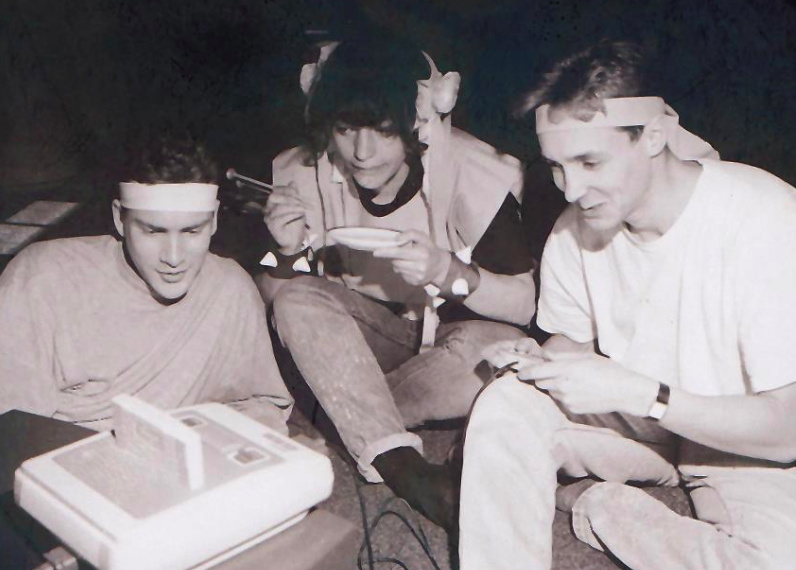
Jason on the right, during his Super Play days
Last year I was having a tough time with my mental health. Several times he messaged me with techniques, tips, websites and podcasts to try and help me. This was someone who I had never met in person yet was concerned with my wellbeing despite the battle he was going through himself.
I wish I could have told him in person how much he helped me personally in health and on the podcast.
R.I.P. Jason; thank you so much for everything you did for me.
Damien McFerran – Editorial Director, Nintendo Life & Push Square
Like so many UK-based gamers in their 40s, I grew up with the likes of Super Play and EDGE; fantastically dense, knowledgeable and enthusiastic publications which did a great deal to shape my view of the games industry as a whole. These magazines are, therefore, directly influential when it comes to the very site you’re reading now.
Jason was a key figure in both of these magazines; as a staff writer on Super Play he had an effortless talent for spotting amazing games as well as explaining precisely why they were amazing in the most accessible way possible. A passionate import gamer, he – like the rest of the mag – would tirelessly celebrate the very best that Japan had to offer, be it games, manga, anime or just amazing gadgets and toys. This was a time when game companies were going out of their way to snub out any trace of Japanese influence from their games (hence the terrible re-drawn western artwork for titles like Street Fighter II), yet here was a magazine that put illustrator Wil Overton’s amazing anime-style characters on each and every cover. Jason was a massive part of the magazine’s drive to celebrate all things Japan via his love of games.
However, it would be his tenure on EDGE that had perhaps the most dramatic impact on me, and the career path I eventually chose. Launched by fellow video game legend Steve Jarratt, EDGE was one of the first magazines to treat gaming seriously and speak to its audience like adults. With a successful launch secured, Jason would step into the editor’s seat fairly early on, and those opening 50-odd issues remain some of the best games journalism I’ve ever encountered – and, again, are a direct influence on the way I approach my work here at Nintendo Life. I can’t pretend that I knew Jason anywhere near as well as some of the people who worked with him over the years, but it felt like I knew him thanks to the fact that I’d hung on his every word in the amazing magazines he made.
In 2017, I was lucky enough to make contact with Jason over email via a mutual acquaintance. I predictably wasted no time in telling him how he had helped form my gaming consciousness many years ago, and upon hearing this news he was both humble and dismissive; he modestly tried to deflect praise for the incredible impact of his body of work yet still couldn’t resist gushing to me about a new game he’d played – some people never change, it seems.
Shiny’s Dave Perry takes his anger out on Jason in the early ’90s. “We gave Earthworm Jim a 7 while everyone gave 9s,” Jason later said. “Virgin was p****d off!”
After exchanging a few emails he opened up about his health issues, but never in a way which tried to elicit sympathy; he was so incredibly positive and optimistic about things that I never for a second thought it would beat him. We shared countless emails and direct messages covering topics such as the Switch, PS Vita, the OSSC, PC Engine, RGB cables, the SNES Mini, Demon’s Tilt (a Devil Crush spiritual successor he simply wouldn’t stop talking about) and he even showed me some designs for a project he was working on called ‘Visions of Video Games’; he saw it as a celebration of gaming, covering written content as well as elements of culture and merchandise, such as T-Shirts and the like. It was, like everything he seemed to turn his hand to, utterly amazing, and I’m saddened that I’ll never get the chance to see the final thing. I’m also ashamed and deeply regretful that I never completed a revised and expanded history of Super Play which he enthusiastically contributed to (his full, unedited replies can be read here). During our email chats, he would periodically ask how it was coming along, and it pains me that he never got to see it finished.
Jason offered to meet up at some point, graciously inviting me down to his parent’s house in the picturesque Cotswolds, where he was staying while he underwent treatment. As a card-carrying Brookes fanboy, I thought I’d struck gold – I actually believed I’d been singled out for some special treatment by one of my heroes. Turns out, I was anything but special – this was just the way Jason was; selfless, accommodating, generous with his time, willing to talk about his passions (which included the environment, alternative medicine and a wide range of music, as well as video games) with anyone who would listen. I’ve come to realise this as I’ve seen the tributes pour onto his Facebook page since the news of his passing; he clearly touched a lot of lives and created an abundance of friends.
My last contact with Jason took place a few weeks ago in October of this year, when I rather naively emailed him to ask if he wanted to write any reviews for Nintendo Life – something that would have been a career highlight for me, personally. Humble as ever, Jason said that anything he could supply would be “rubbish” and that his health was, understandably, his main priority. Even at a time when his prospects were, in his own words, “pretty dire”, he still wrote me a long and rambling email full of life, energy and enthusiasm.
Of his prognosis in October, he said: “Really need a miracle… good job I believe in magic!” Those were the last words he wrote to me, and they sum up a remarkable man pretty well, I think.
Jason, you were magic, and you’ll be sorely missed.
Matthew Brookes – Jason’s Brother
From an early age, his attention to detail was apparent in his drawings; beautiful Boeing 747s, wings, flaps, and, undercarriage drawn in absolute accuracy. He had an acute eye on form, colour, and a capacity to analyse and replicate what he saw.
His first fascination I can remember was Britain’s Farm toys. His Christmas present list was cunningly transposed onto mine, from the age of five onwards, for the greater good of having a full set of working farm implements!
He went through various other obsessions over the early teenage years; canal fishing, racing bikes, Hornby railways, all commanding his absolute attention…. Until the day our Dad bought an Acorn Electron. Despite the basic and utterly unplayable nature of some games, we shared many hours on games such as Starship Command and Twin-Kingdom Valley, through to David Braben’s original Elite – we were literally blown away by what the programmers had achieved. We regularly compared scrolling smoothness, sprites and frame-rate, which all became part of the new obsession to play the latest games. We had friends with commodore 64’s who played Uridium and Way of the Exploding Fist amongst others.
Jason with EDGE photographer Jude Edgington
Meanwhile, there were the earliest ventures between 1982 and 1986 into arcades at our grandmother’s in Southport, on Neville Street, the mecca of arcades in the town. Every holiday we would spend all our pocket money on Scramble, then Commando, and then on to Double Dragon, Tiger Shark, Super Sprint, and Outrun.
And then, in 1987, he came across R-type. And something changed. He loved the passionate attention to detail, the creativity, the graphical capabilities of the machines, the “huge sprites”, the multi-layered parallax, the colours, and even the superlative collision detection that was at the time unparalleled. I’m not sure how long he must have spent trying and eventually completing the game; Jason was surely an excellent gamer, but no champion.
So, while following a course at Bristol University in Estate Management – a subject which he finally admitted he had no interest in whatsoever – his passion was sharing and wanting to play video games. When the Commodore Amiga came out in 1985, he was definitely amongst the first people to have got one; he’d saved up the near £500 to buy the machine, the Quickshot joystick, and we were set to go.
We revelled in the graphical quality of Cinemaware releases like Defender of the Crown, and secretly played the computer which was supposed to appear as a Christmas present a few weeks later, but we found a way through desperation and impatience before December 25th. There was, of course, the arrival of the Neo Geo, which he ordered directly from Japan, a rarety in the UK at the time, but he had to have it.
I can’t quite remember when he did the first mock-up game review, but he painstakingly put it together (before Photoshop of-course); he cut out the silhouettes, he hand-wrote the review and did an A3 page full of passion and love of the gameplay. He posted it to Super Play, and was asked down for an interview soon after.
We’d like to give a massive thank you to Keith Stuart for assisting with some of these interviews. If you’d like to make a donation to Prostate Cancer UK in Jason’s memory, you can do so here.
If you knew or worked with Jason in the past and would like to have your own memories added to this tribute, please drop us a line.
The Design Process Behind Story of a Gladiator, Available Now on Xbox One
Summary
The very first idea of the game was to make a simple 1v1 icon game with some turn-based combat
We kept adding more characters and races in the arena, so it resembles more closely gladiatorial times in ancient Rome
The design process was long, and we had to change direction multiple times in order to deliver the final version
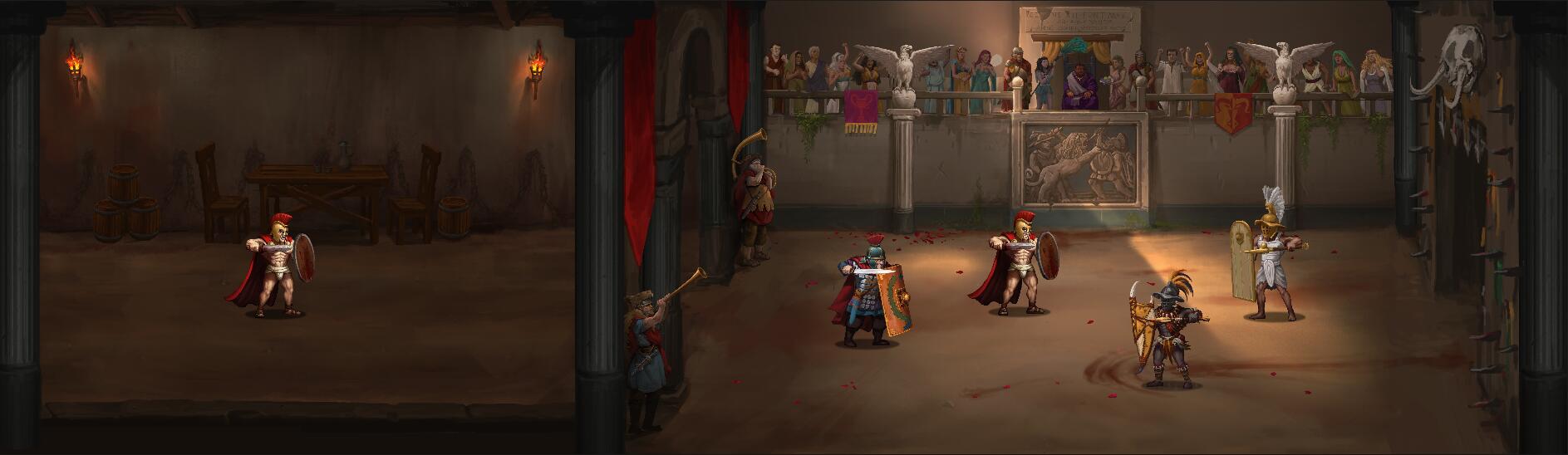
Story of a Gladiator is an arena beat ’em up where you take the role of a man in search of his destiny, only to find it in the sands of the colosseum.
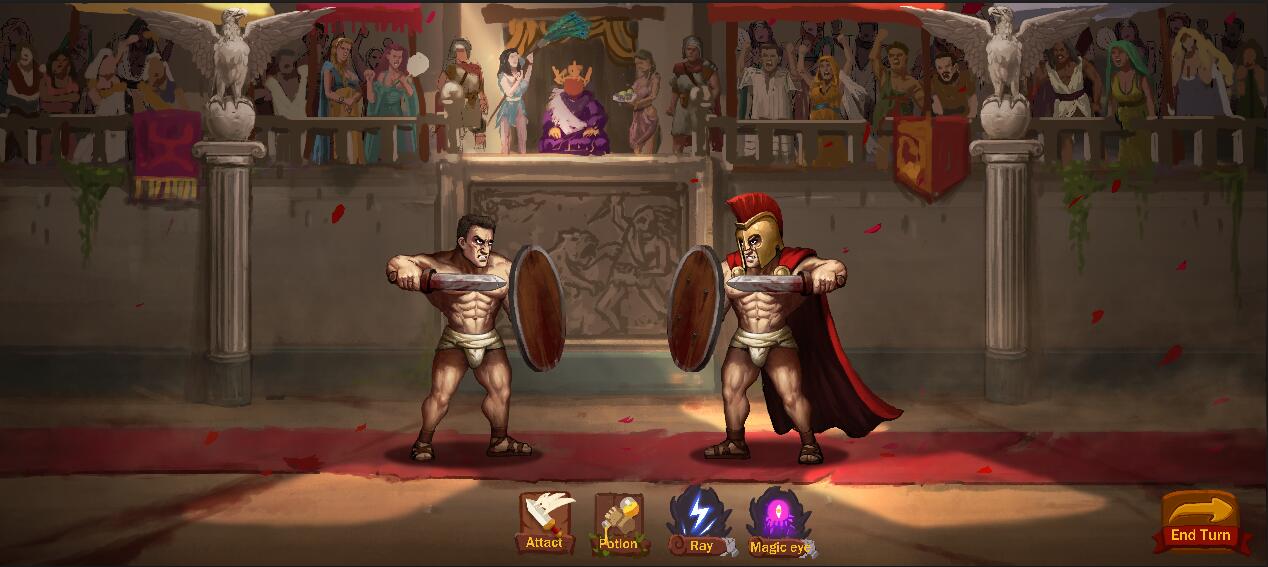
The very first idea of the game was to make a simple 1v1 icon game with some turn-based combat. It was a simple screen of two characters taking turns at attacking each other. After further thinking, we realized that the game would look a lot better if it had some real characters instead of icons — along with some background arena — which lead to the concept of a gladiator arena game.
Once we had some characters and background it was easier to do some turn-based combat simulation. Each team would select a character to make an action and then it would carry on until all characters made an action before a turn was completed.
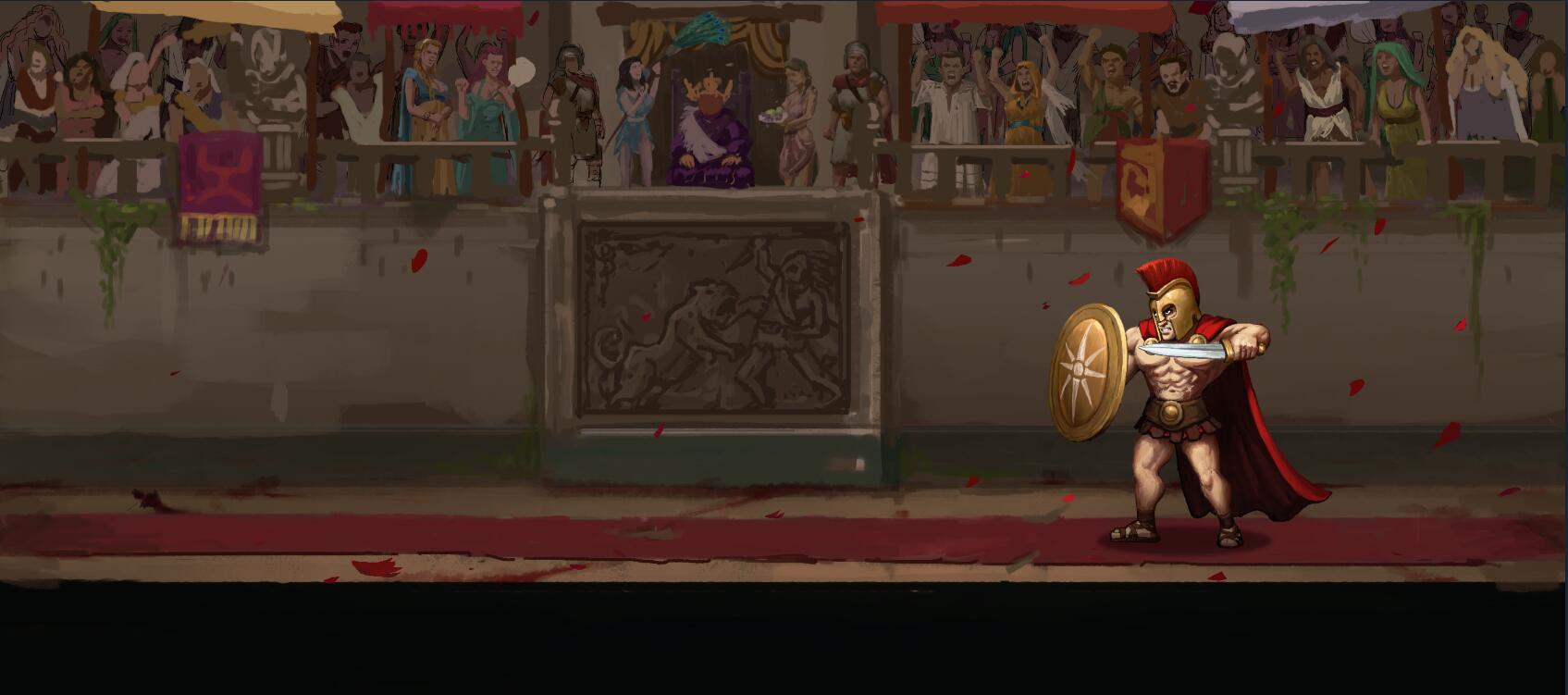
A new arena concept was created again to better resemble the roman times with a single character, a crowd and the local magistrate watching.
The turn-based combat system was very basic, so we decided to improve it and add more skills and abilities for each character giving them more options each turn.
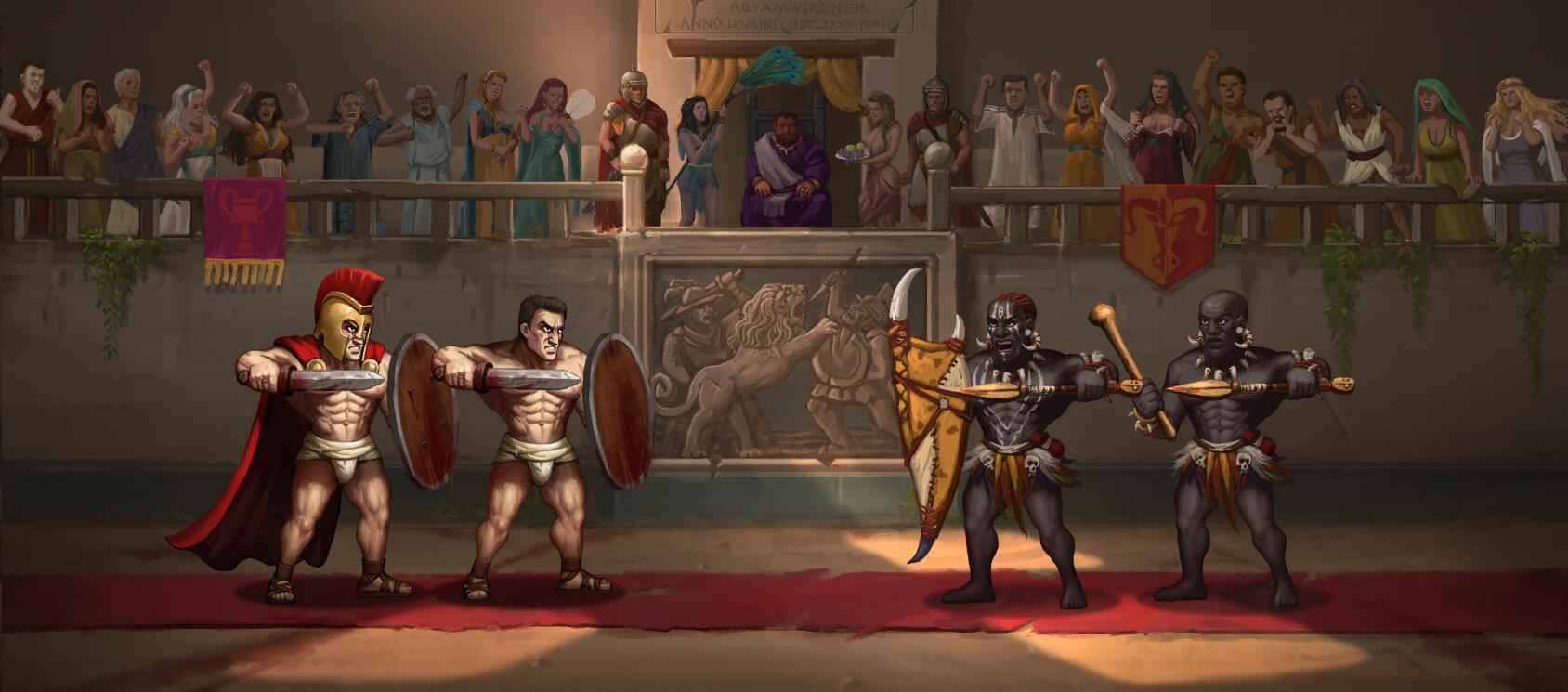
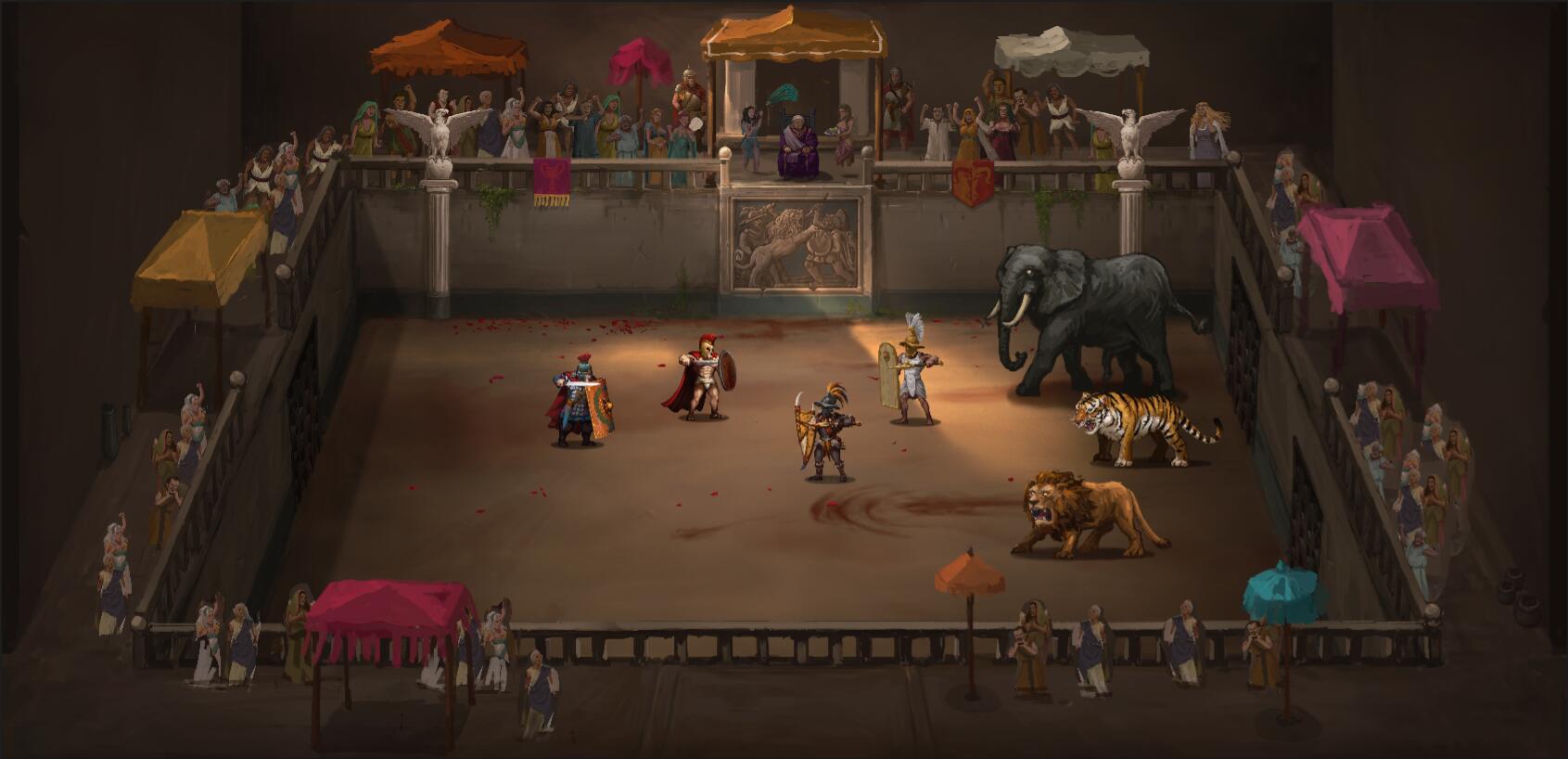
We kept adding more characters and races in the arena, so it resembles more closely gladiatorial times in ancient Rome. However somewhere around there we realized that the characters felt a little strange not moving. It felt like they could so much more but instead they were stuck in this turn-based system.
The arena only had a horizontal axis of movement. This meant that to if we were to make an action game out of it, it would have to be something like a 1v1 brawler. In a gladiator arena you would expect multiples gladiators fighting around so we decided to add a vertical axis instead that was a bit like the older beat ’em ups like Double Dragon and Streets of Rage. We made a quick test to see how this would play out.
It was quickly realized this was the way forward. The
characters could finally use their legs and move around instead of being rooted
in their turn-based positions. This also meant from controlling a group of turn
based gladiators you are now controlling 1 gladiator. The game felt exciting, easier
to play and more fluid even with just a simple hit and move combat system. It
was exactly how you would want to fight as a gladiator in an arena.
Now that we had an arena with 2 axis, we needed to bring back some ideas from the previous concepts such as the crowd and the walls. We also decided to add a small battle intro where your gladiator would enter the arena from the left in the cheer of the crowd and sound of trumpets.
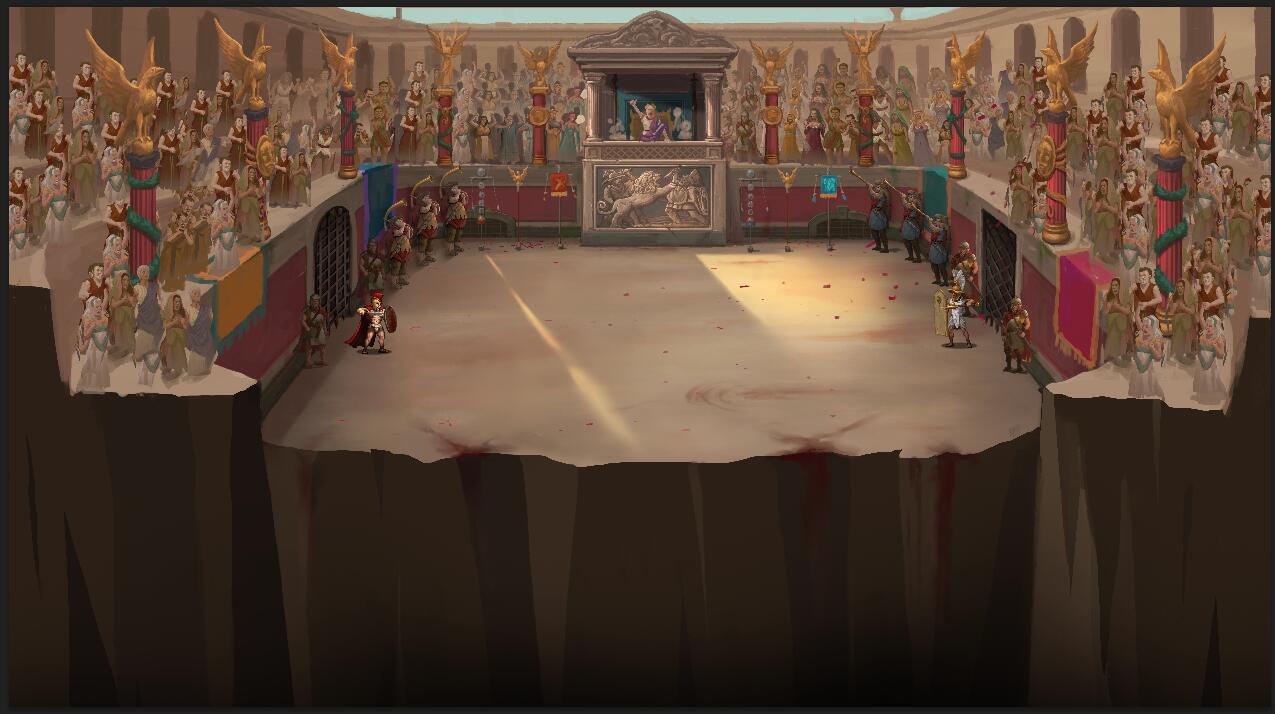
We wanted a crowd from all directions including the bottom so that it feels like you in the center of attention. Some new things were also added like bazar feeling as this was a small arena in a province where the streets, market and arena were a bit mixed.
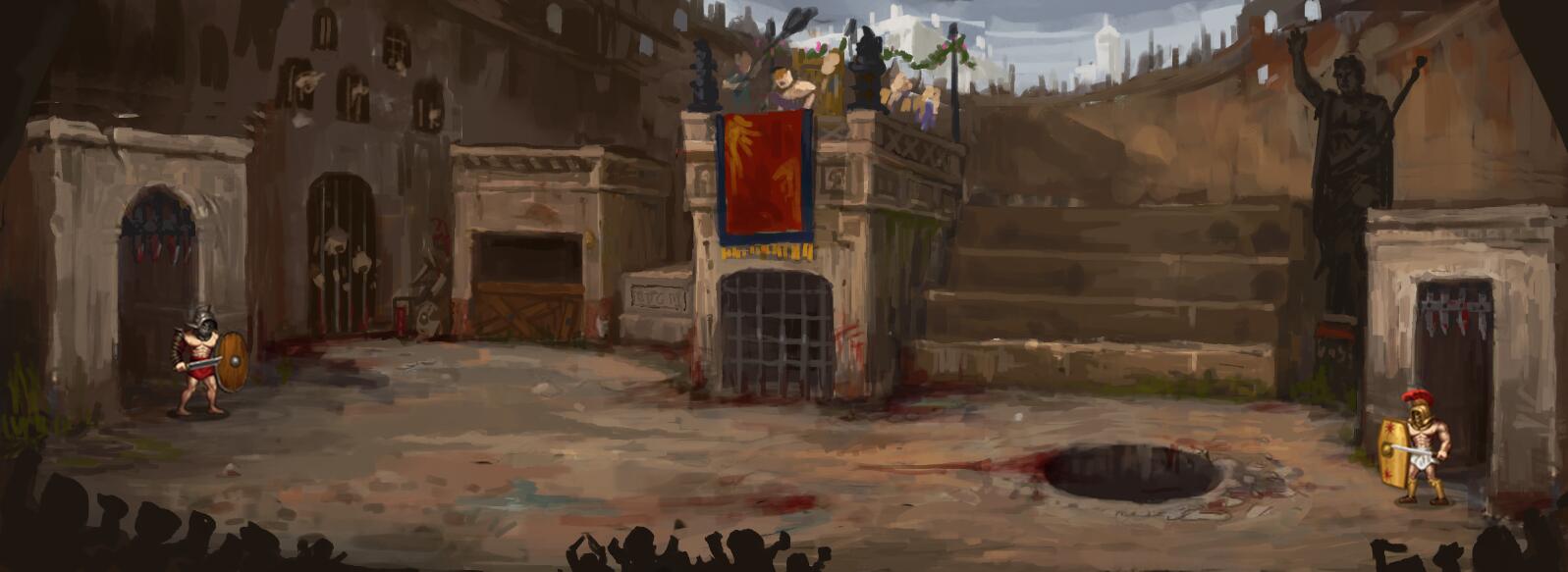
We kept working on several revisions of the arena in order to give it a more natural look with better depth and angles and one of the last concepts was the following arena.
It lacked something that we couldn’t conceptualize at the time. We took a break from designing arenas and focused on creating more characters instead. That helped refresh as our mind as a few weeks later we came back and designed from scratch an entirely new arena which made it to the final version of the game.
At this stage the game direction seemed very clear as what
the final version would be like like. We now had everything we needed to finish
the game.
Overall, we are very pleased with how the game turned out.
It is realistic, physical, tactical and has lots of action. It has all the
elements you would expect from a gladiator arena game.
The design process was long, and we had to change direction
multiple times in order to deliver the final version. Now pick up your sword
and shield and enter the arena to become champion!
Posted by: xSicKxBot - 12-07-2019, 10:42 AM - Forum: Lounge
- No Replies
Riot Games opens publishing label for League of Legends games from other devs
Riot Games is building on its own internal efforts to crank out more games in the League of Legends universe by starting up a new publishing label that encourages smaller studios to do the same.
That new publishing arm Riot Forge is set to be headed up by Riot Labs head Leanne Loombe and, as she tells The Verge, wants external development teams to bring their own style and feel to the world, characters, and stories Riot has built up through a decade of its free-to-play MOBA League of Legends.
While Riot itself will ultimately help developers it partners with navigate those years of League of Legends lore for their own creations, the company plans to function as a watchful publisher and not as a hands-on development partner, largely leaving devs “the freedom to make their own stylistic and gameplay decisions,” in Loombe’s words.
Riot Games was, for the longest time, a single-game studio seemingly focused primarily on keeping League of Legends alive and well. That changed this October when Riot all at once announced several games across multiple platforms and genres, some of which are still known only by codenames.
While the company has now done its part to make League of Legends a more robust franchise, Loombe tells The Verge that the publishing arm is Riot’s way of further expanding the property into genres and business models it itself isn’t familiar with.
“Making live service, competitive games requires a certain skillset which Riot is an expert in,” Loombe says. “Those types of games are fundamentally different to the completable games that Riot Forge is focused on. Riot doesn’t have a ton of traditional experience making completable games, so we’re working with studios who do have that experience and unique style to bring a new look to League of Legends.”
Posted by: xSicKxBot - 12-07-2019, 10:42 AM - Forum: Lounge
- No Replies
Review aggregator site GameRankings is shutting down
GameRankings is closing down for good, ending the site’s 20-year run as a review score aggregator for video game reviews published across print and online publications.
Starting December 9, the GameRankings website will instead redirect to fellow review aggregator Metacritic, a sister site alongside the likes of GameSpot and GameFAQs under parent company CBS Interactive. Following that, the entirety of the GameRankings team is set to continue on over on Metacritic as well.
“As one of the oldest gaming sites online, we thank you for supporting GameRankings over the past 20 years, and we look forward to conquering new gaming worlds with you for years to come,” reads a joint statement from GameRankings lead Allen Tyner and Metacritic co-founder Marc Doyle.
Posted by: xSicKxBot - 12-07-2019, 10:42 AM - Forum: Lounge
- No Replies
Halo: Reach Was Nearly Just Called Reach, But Microsoft Objected
Halo: Reach has just released on PC for the first time as part of the Master Chief Collection, bringing the beloved game to the system nine years after it released for Xbox 360. The game, which was brought to Xbox One as well and is available on both systems through Xbox Game Pass, was the final Halo game made by original developer Bungie before they moved onto Destiny. Many of the folks who worked on the game are reminiscing about it on Twitter using the hashtag #reachmemory, and some interesting information has come out about the game's name.
David Candland, who designed much of the game's user interface, says that the original intention was to just call the game "Reach", without a "Halo" attached to it. Microsoft objected, insisting that the game be called Halo: Reach, for "brand recognition." As Halo was and remains a major flagship of the Xbox brand, this makes sense--but as Candland's tweet points out, they retained their simpler name on the game's title screen.
We’d been calling the game “Reach” for a while before MS insisted we call it “Halo Reach” for brand recognition. I remember discussing the title screen with @game_fabricator. We concurred, let’s call it what we want. They’ve bought the game at this point. #REACHmemorypic.twitter.com/msCKV5IIR4
As Candland told USGamer, this was probably, ultimately, the right decision. "I'll bet it did impact sales. It also made googling the game much easier." He also reveals that the cumbersome "Combat Evolved" subtitle on the original Halo was added by Microsoft, which is why it's not on the title screen of the original game.
You also may have noticed there’s no “combat evolved” on the original Halo title screen. That was tacked onto the box logo because the MS marketing team feared some people wouldn’t know “Halo” would be a combat game otherwise.
Elsewhere on the hashtag, Bungie art director Jason Sussman revealed that the game's iconic finale (which we won't explain here to avoid spoilers) was nearly cut for time, but that "everyone knew it needed to be part of the game," and they managed to fit it in.
The original Halo is returning to PC soon too as The Master Chief Collection continues to roll out.
Birds Of Prey's Opening Scene Debuts At Brazil Comic Con
New posters and the first scene from Warner Bros.' upcoming Harley Quinn movie--full title Birds of Prey (and the Fantabulous Emancipation of One Harley Quinn)--has made its official debut, according to reports out of Comic Con Experience in Brazil. Beyond the Birds of Prey trailer that debuted back in October, and the short teaser that preceded it, this is the first public footage that's been seen of the movie--and unfortunately, it doesn't look like WB will be releasing it online right away, so we'll have to rely on the accounts of Brazil Comic Con attendees to find out what happened in it.
The scene features Harley Quinn explaining the status of her relationship with the Joker, The Wrap reports. “We broke up,” Quinn says. “Mr. J was super broke up about it.” She adds that she has a new place that's all her own, where she can reflect on her past mistakes--presumably indicating she regrets shacking up with "Mr. J" in the first place. The title of the movie has the word "emancipation" in it, after all, which is not a term you'd generally use for an amicable breakup.
During the panel, star Margot Robbie reportedly revealed that she initially pitched the idea for Birds of Prey while filming Suicide Squad because she "wanted to see more female ensembles onscreen."
Speaking of Suicide Squad, let's not forget that there's a new one in the works--though whatever you do, don't call it Suicide Squad 2.
Birds of Prey (and the Fantabulous Emancipation of One Harley Quinn) sees Harley Quinn (Robbie) team up with GCPD detective Renee Montoya (Rosie Perez), Huntress (Mary Elizabeth Winstead), Black Canary (Jurnee Smollett-Bell), and Cassandra Cain (Ella Jay Basco). It features the villains Black Mask (Ewan McGregor) and Victor Zsasz (Chris Messina), and it's directed by Cathy Yan, whose previous directing credits include 2018's Dead Pigs and various short films. Birds of Prey hits theaters February 7 2020. Until then, we'll be looking out for any new information that arises.