Hands On: Overland Is A Game Where You Can’t Always Save The Dog
Overland has been in development for a long time now.
While Overland has been worked on, publisher Finji put out games like Canabalt (one of the very first endless runners) and Night in the Woods. In recent times, they’ve made press for games like Wilmot’s Warehouse and Tunic, one game about basically just a square and the other, an epic about an adventuring fox. Yet all the while, Overland remained in the background, tinkered, toiled, and iterated. It became a highlighted game for Apple Arcade, it laboured into almost 600 development builds (according to their Twitter), and after five calendar years, it’s finally putting all pre-release builds in the rearview mirror. Here it finally is: Overland 1.0.
It’s worth a mention that during that long stretch of development time, the themes and pieces that make up Overland are far more commonplace in the gaming industry: its a post-apocalyptic, gridded strategy game, not unlike seemingly a dozen games a year. You may or may not be able to pet the dog. And please, oh please, autocorrect… stop trying to autofill these impressions with “Overwatch” or “Borderlands”.
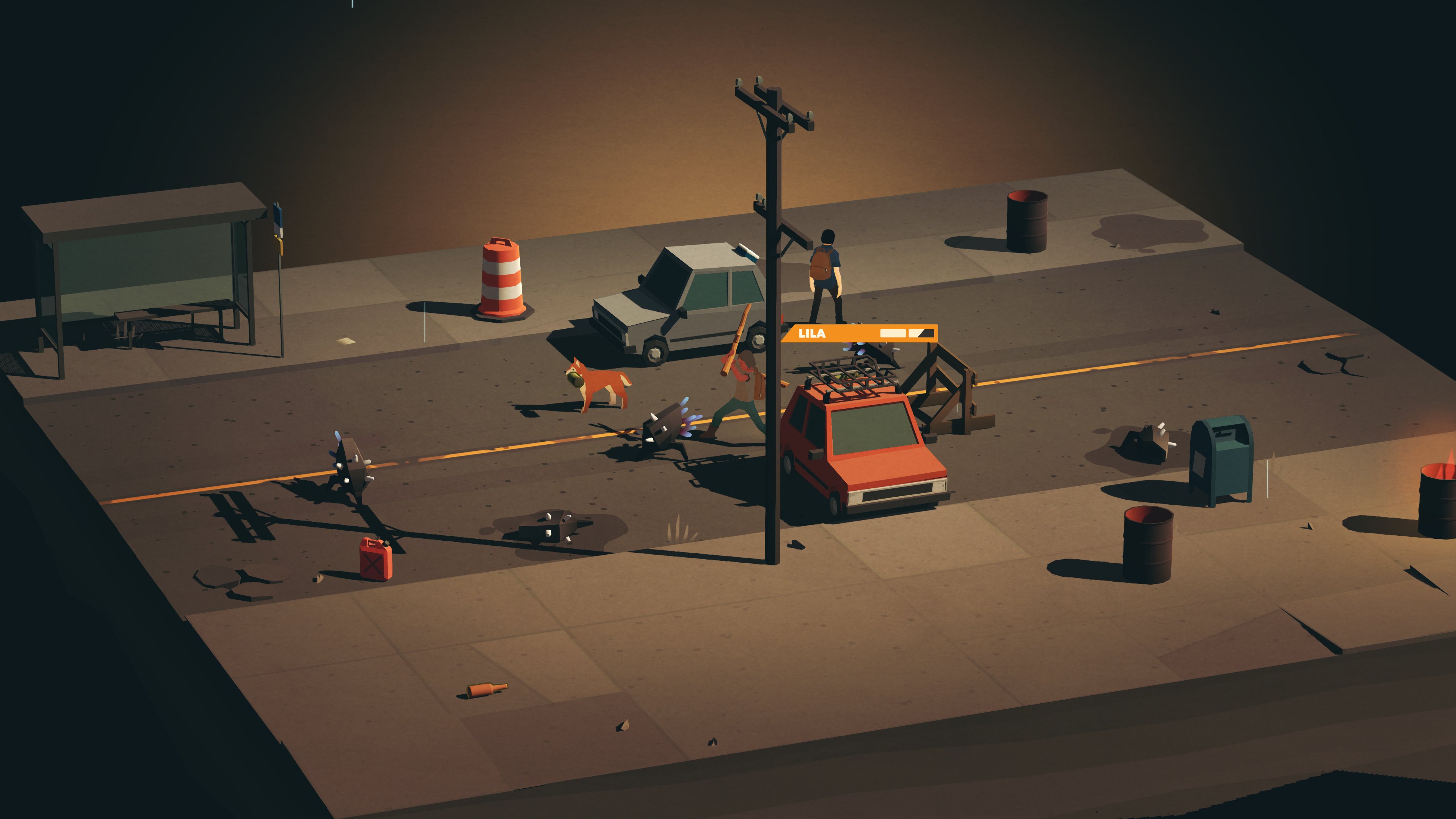
But what Overland has going for it – and this is clear in even just half an hour with the game – is fantastic production values and gameplay that’s been heavily user-tested. You like your X-COM baddies looking sharp and with a dash of character? Do your procedurally generated games feel a little too random, not methodical enough? From the second you pick up the controller, Overland feels crisp, well written, and difficult, but fair.
Here’s all Overland wants you to do: get to the west coast of the United States any way you can. The problem is that you start off on the east coast, moments after hijacking a stray car and zooming away from your friend who gave his life to afford you a few extra seconds to escape an attack. Enter: the map.
Having a car is the (mostly) mandatory bit of the game, as it helps you to travel from grid to grid. You stay on each grid as long as you want (or can), with an exit available on the map’s edge, provided you can get to it. Your vehicle has a gas meter, and the further up and down the map you want to travel to, the more gas it’ll take. Each node along your path gives minimally two options with hints to what’s hidden there, again, provided you have enough gas to get to them.
Explore the unknown at your own risk, because running out of gas drops you in an enemy-infested grid with gas canisters scattered everywhere, but with hardly any options open to you but brute force.
The other mandatory win condition is that you must have at least one living party member at all times (yep, even a dog counts). Each person you find along the way comes with their own written backstory, skills, and all kinds of potential. We quickly met a girl with a flashlight, which definitely helped. Why? Well, time is a thing in Overland, and it gets dark, which drastically affects your field of view. Turns out, being able to see is important in a turn-based strategy game.
To that end, items like the aforementioned flashlight are the other things you’ll discover besides gas; useful items are tucked away in alleyways, dumpsters, boxes, near explosive generators, and much more. We found a big, wooden plank, which we strapped to one of our character’s backs and it absorbed two hits from one of those gross monster things. We dropped a teddy bear because we could only hold one item, despite its promise as a good thing to barter later on. A stick as a weapon was also in our path, which we picked up in order to avoid the pyrrhic victory we’d get from chasing the sturdier axe in the corner that was guarded by way too many bad guys.
That’s how Overland bills itself: a game of “hard choices”. And it’s true. In this way, permadeath isn’t a thing to avoid as much as it’s Overland’s currency. Who will you sacrifice to get at least one person through the grid? Given how valuable each item is, how critical gasoline is, and how detailed all the characters are, this game wants to give you an aneurysm. But a good one, if such a thing can exist.
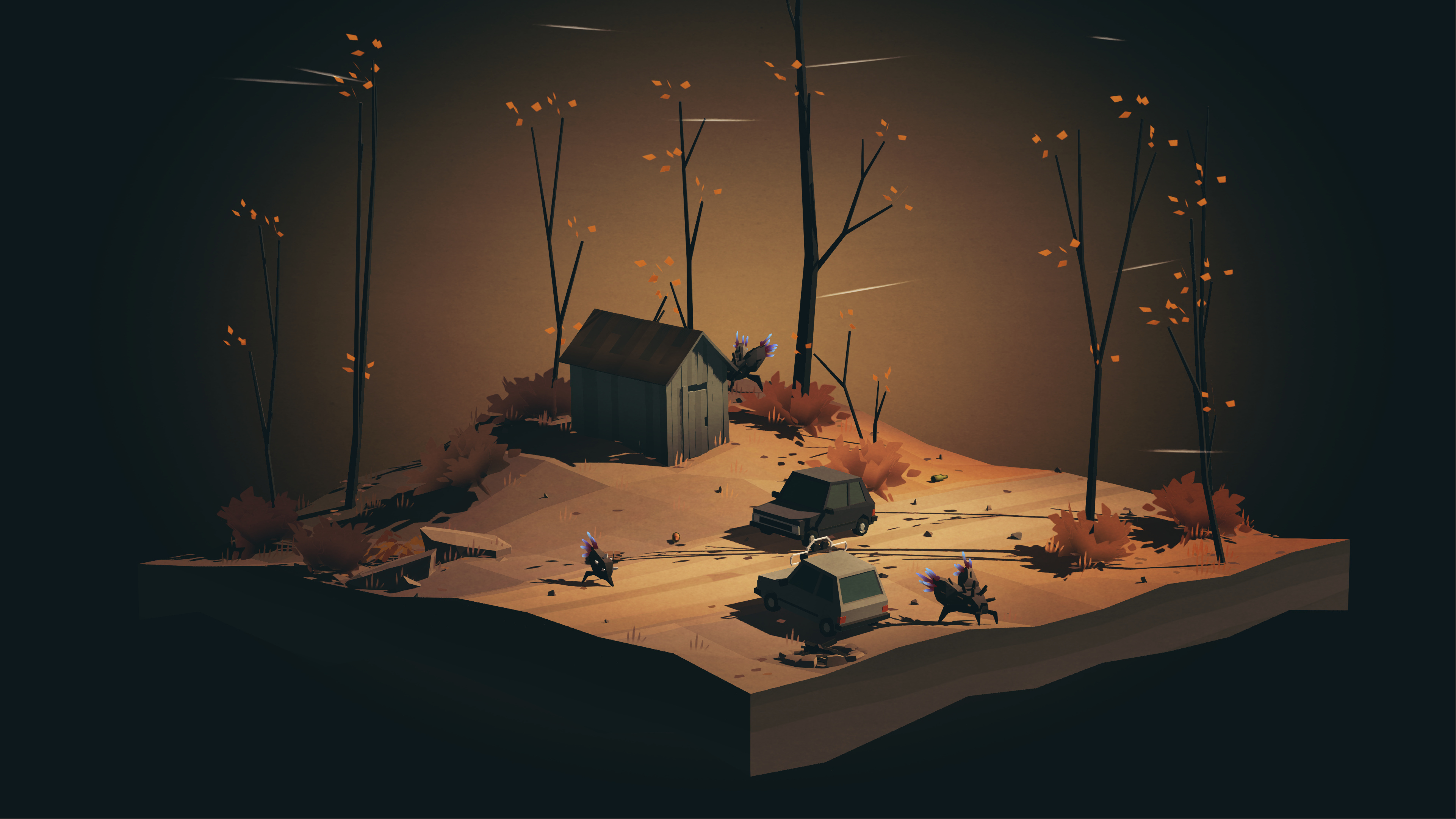
At least the grids where you’ll be making all these tough decisions are beautiful. The game allows you to rotate each screen ever-so-slightly, but you’re mostly confined to an isometric view of wasteland America, displayed by Polly Pocket-slices of dilapidated towns, scary wooded areas, and rural, destroyed countryside. Everything in this game is made out of large polygons, giving the destruction a sleek, “video-game-y” feel, but the colour palettes are warm and muted to keep things bleak. It’s a nice way to take in the end of the world.
The levels are randomly generated, but there is a narrative story. Finji tells us you can beat the entire game in about four hours… but you won’t. That is, Overland is tough as nails. It takes a few, quick play-throughs to get your bearings, some more to build up strategy, then a few more on top of that to get lucky. A game over screen features a post-mortem and stats for every member of your party that went along for the ride, and works as motivation to get back up and try again. If there weren’t so many pre-booked appointments at PAX, we might have even tried again after our party perished.
If you’re a fan of FTL and Into the Breach, or other similarly-minded stat-driven, hard choice strategy games, Overland will absolutely keep your attention. If anything else, it might be the first video game ever made where players actually choose to sacrifice the dog. Listen, it’s the only way.
New Resident Evil Game, Project Resistance, Gets First Trailer
Capcom has officially revealed a new Resident Evil game called "Project Resistance." Its existence has been known for some time now, with leaks indicating that it would be a multiplayer experience of some sort. The official trailer, released as part of the Tokyo Game Show, confirms this to be true.
Four characters are shown fighting their way through an office building-like setting, using guns and melee weapons to take out zombies and work their way through a series of sticky situations. Interestingly, another figure is shown to be orchestrating everything from the comfort of what looks to be an Umbrella lab; the shadowy organization no doubt has a big part to play in events, as is usually the case with Resident Evil games.
Alongside the classic shambling undead, Project Resistance will be pulling from the Resident Evil franchise's more iconic enemies. The trailer ends with the Tyrant appearing and the mysterious figure pulling strings behind the scenes assuming control, hinting that a player will be able to take control of enemies in the game. All of this gives it a definite Left 4 Dead feeling.
Project Resistance looks to be a four-versus-one asynchronous online multiplayer game. It's developed on the same engine powering the Resident Evil 2 remake. As of yet, there hasn't been any details on when the game will be released and, given the title, it may be some time before the final version is launched.
From September 12 through September 19, Xbox One and PS4 owners in Japan that are interested in the game can sign up for a chance to be invited into a closed beta for Project Resistance. The beta will take place from October 4 to October 7. Details on a beta outside of Japan have not been revealed yet.
Those at Tokyo Game Show, meanwhile, can get their hands-on with the title but need to have registered in advance to do so. Project Resistance will have a booth at TGS where attendees can watch members of the development team show off gameplay for the first time. Capcom has not indicated whether this footage will be released for those not in attendance to see.
The last Resident Evil game to be released was the remake of Resident Evil 2, which GameSpot awarded a 9/10. "Resident Evil 2 is not only a stellar remake of the original, but it's also simply a strong horror game that delivers anxiety-inducing and grotesque situations, topping some of the series' finest entries," said Alessandro Fillari. "But above all, the remake is an impressive game for the fact that it goes all-in on the pure survival horror experience, confidently embracing its horrifying tone and rarely letting up until the story's conclusion. Though Resident Evil 2 has its roots firmly in the past, it reworks the familiar horrors into something that feels brand new and all its own." You can read the full Resident Evil 2 Remake review for a more thorough analysis of the game.
CloudBees And Google Cloud Partner To Accelerate Application Development On Anthos
CloudBees and Google Cloud are collaborating to deliver a modern DevOps platform based on open source technologies powered by Google Cloud’s Anthos. The companies are using transformational technologies like Jenkins X, Kubernetes and Tekton to create a unified, end-to-end software delivery system. CloudBees provides companies large and small with Jenkins-based continuous delivery solutions that are secure, open toolchain-enabled and scalable to transform software delivery processes across hybrid computing environments. Google Cloud is delivering to enterprises a secure, open, intelligent and transformative enterprise cloud platform. Anthos, a hybrid and multi-cloud platform, is built on open source technologies pioneered by Google Cloud and enables consistency between on-premise and cloud environments. (Source: Press Release)
Announced a few months back at SIGRAPH, Maxon have finally released Cinema 4D Release 21. Perhaps the biggest and most contraversial new feature of this release is the change to a single SKU, combined with a new subscription based licensing model.
Maxon, the leading developer of professional 3D modeling, animation and rendering solutions, today announced the availability of Cinema 4D Release 21 (R21). The next generation of the professional 3D application features a completely new Caps and Bevel system, new Field Force dynamics, interface speed enhancements, and numerous rendering, workflow and core performance improvements. With Release 21, Maxon initiates a new singular version of Cinema 4D and new low-cost subscription pricing plans to ensure easy access to creatives.
“Release 21 delivers innovations and efficiencies that extend our objective to help customers meet the shifting needs of the competitive content creation industry,” said Maxon CEO Dave McGavran. “Simplified access to Cinema 4D and low-entry pricing allow artists to focus less on budget and more on the creative process.”
You can learn more about Cinema4D r21 here with the full release notes available here. Check out the video below to learn more about the new purchasing options and subscriptions available.
If you start talking to people about Battle Chasers, you’ll find that just about everyone had their own approach to the game. That’s a mark of a complex and well-designed system. None of the six characters can be absolutely pigeonholed into traditional RPG roles, and the many ways that they can buff, debuff, heal, and damage will result in individual approaches across the board.
So experiment! Look for synergies within character’s attacks and abilities, and across characters. It’s tough to build a character totally wrong if you’re keeping mind of their natural advantages. That said, here are some general tips for getting the most out of the game…
Tips & Tricks
The Attack modifier affects all of your combat abilities, including defensive and healing abilities! Boosting your Attack is the fastest way to use more effective moves in combat. Because Attack even affects your characters’ defensive and healing moves, it is usually a better choice to buff Attack rather than Defense when you find you are taking too much damage.
Your characters’ level also makes a huge difference in terms of their strength–all the attributes in the game are scaled according to level. If you’re having trouble on a boss, grinding out a single level will probably make up the difference. The Arena is a great place to quickly nab some experience.
One unique feature in Battle Chasers is the Haste system. In addition to the initiative scores that determine who goes first, faster characters also get their attacks off faster. An attack that is too slow may allow an enemy to slip in their own attack before you finish! Abilities that add Haste can make Very Fast abilities instantaneous, giving you more control over the pace of the battle and more attacks compared to your opponents.
While initially it seems like Overcharge is a kind of bonus mana, it’s actually a much more powerful replacement for mana. Once you have the ability to quickly build up your Overcharge, there’s no need to keep a reserve of mana–in fact, it can be to your detriment. Some perks gain big bonuses if you have a large reserve of Overcharge, but having full mana limits your potential Overcharge pool. Drain your mana in some easy fights if you need to, so you can save space for a big Overcharge bonus.
Some final tips:
Don’t forget to equip your perks, and switch them around when you need to try something different.
Dungeon skills are also a big help if you’re struggling with a fight.
Debuffing the enemy before the battle will give you a huge advantage.
Don’t neglect to eat.: There’s a lot going on in this game, but food can give you big bonuses that you will especially appreciate before a boss fight.
Character Notes
Garrison
With Overcharge being such a key mechanic of Battle Chasers, Garrison is the DPS-generating heart of any solid team. He has a larger Overcharge pool and Overcharge-generating attacks and abilities. His Warblade ability will quickly become one of the strongest attacks in the game once you master building his Overcharge pool. At the beginning of the game, his Rally Strike is a useful first cast that will boost your whole team’s Haste. You can also go with attacks that cause bleeding and use Siphon to heal.
Gully
Gully is a versatile character that can serve as a tank or a defensive caster, but also hits hard enough to help in dealing damage. Her Taunt ability is key for tanking, and will keep the bad guys off of your more vulnerable characters, while Defend makes her nigh-invincible. Gully is always a good choice for a dungeon crawl, since she can smash her way through secret passages–look for the dust coming out of the wall.
Calibretto
This giant war golem has an interesting mix of healing and damaging abilities, making him a great addition to any party. At the beginning, you’ll definitely want him on healing duty, but consider branching out to DPS. His Sundering abilities are big damage boosters, especially combined with Gut Punch II that also builds Overcharge.
Knolan
Knolan is a tougher character to use, since he builds Overcharge much more slowly and relies on his mana pool far more than other characters. However, his spells are great for crowd control and debuffing your targets. You’ll be relying on Calibretto for healing by the time you get Knolan, but Knolan can also work well as a healer.
Monika
Red Monika is also a great damage-dealer, so you should probably choose between her and Garrison. She relies on building up her critical hit chance for doing huge amounts of damage. Another option is to use her as an evasion tank with her Camouflage abilities.
Alumon
Alumon comes in later in the game, but will become a part of many parties thanks to his jack-of-all-trades skill set. He is also a great healer. He may even be a better choice than Calibretto because his overheals can become shields with his Grim Covenant ability.
Do you have any tips or tricks of your own? Let us know in the comments!
Since we GA’ed Azure SignalR Service in last September, serverless has become a very popular use case in Azure SignalR Service and is used by many customers. Unlike the traditional SignalR application which requires a server to host the hub, in serverless scenario no server is needed, instead you can directly send messages to clients through REST APIs or our management SDK which can easily be used in serverless code like Azure Functions.
Though there is a huge benefit which saves you the cost of maintaining the app server, the feature set in serverless scenario is limited. Since there is no real hub, it’s not possible to respond to client activities like client invocations or connection events. Without client events serverless use cases will be limited and we hear a lot of customers asking about this support. Today we’re excited to announce a new feature that enables Azure SignalR Service to publish client events to Azure Event Grid so that you can subscribe and respond to them.
How does it work?
Let’s first revisit how serverless scenario in Azure SignalR Service works.
In serverless scenario, even you don’t have an app server, you still need to have a negotiate API so SignalR client can do the negotiation to get the url to SignalR service and a corresponding access token. Usually this can be done using an Azure Function.
Client will then use the url and access token to connect to SignalR service.
After clients are connected, you can send message to clients using REST APIs or service management SDK. If you are using Azure Functions, our SignalR Service binding does the work for you so you only need to return the messages as an output binding.
This flow is illustrated as step 1-3 in the diagram below:
What’s missing here is that there is no equivalent of OnConnected() and OnDisconnected() in serverless APIs so there is no way for the Azure function to know whether a client is connected or disconnected.
Now with Event Grid you’ll be able to get such events through an Event Grid subscription (as step 4 and 5 in the above diagram):
When a client is connected/disconnected to SignalR service, service will publish this event to Event Grid.
In Azure function you can have an Event Grid trigger and subscribe to such events, then Event Grid will send those events to the function (through a webhook).
How to use it?
It’s very simple to make your serverless application subscribe to SignalR connection events. Let’s use Azure function as an example.
First you need to make sure your SignalR Service instance is in serverless mode. (Create a SignalR Service instance if you haven’t done so.)
Create an Event Grid trigger in your function app.
In the Event Grid trigger, add an Event Grid subscription.
Then select your SignalR Service instance.
Now you’re all set! Your function app is now able to get connection events from SignalR Service.
To test it, you just need to open a SignalR connection to the service. You can use the SignalR client in our sample repo, which contains a simple negotiate API implementation.
Hands on: Sonos Move fits in the home as well as outdoors
Sonos has just made its new portable Wi-Fi and Bluetooth speaker official with the announcement of the Sonos Move, alongside the Port and the One SL. AppleInsider was in New York City with Sonos to try the speakers.
Introducing Sonos Move —The first portable speaker for Sonos
Recently, Sonos held a press event in New York’s legendary Milk studio, where its CEO unveiled a trio of new devices to a mass of onlooking journalists. AppleInsider was in attendance and got the opportunity to try out the new devices, including the Move —Sonos’s first portable speaker.
Today, the Sonos Move, Port, and One SL are official, ending a long trickle of high-profile leaks.
The first Sonos portable speaker
The most exciting of the new products is the Sonos Move. Sonos Move is, as the company describes, a culmination of all its work to date. Outdoor speakers, especially Wi-Fi connected ones, are much more difficult than indoor speakers to execute well, and the company thinks that it has it all figured out.
Sonos Move works just as well in the home as outside the home
Outdoor speakers need to be durable, have long-lasting batteries, good connectivity, and loud. That is exactly what Sonos has done with the Move.
The Sonos Move is weighty —over six pounds —and had a solid, premium feel to it when we hoisted it. Compared to other portable speakers, Move seemed to be on the large size but once we heard the sound it was capable of, and its list of features we understood.
The Sonos Move isn’t a mass-appeal Bluetooth speaker that can be clipped to a backpack. Instead, it is marketed as a home speaker that can also be taken outside the home.
Sonos can stream over Wi-Fi and group with other Sonos speakers. Even works with AirPlay 2 and HomeKit
To that end, Move can operate entirely the same as any other Sonos speaker. It can connect over Wi-Fi, be grouped with others in the home, and even work with AirPlay 2. A simple dock gives it a place to rest when in your home, whether in the kitchen or on a desk.
What separates Move, is that it can then be picked up, separated from the dock, and taken anywhere, wire-free. If near your home —say out on the patio —the speaker can continue to stream over Wi-Fi. If away from the home, a button press on the back switches the speaker to Bluetooth mode.
Wirelessly, Move can jam on for ten hours. It can also be recharged on the go with a USB-C battery pack. Unfortunately, there is no USB output for charger other devices from the Move.
A button on the back toggles between Wi-Fi and Bluetooth
Sonos also touts Move as the most impressive wireless performance of any of its devices. It supports 802.11b/g/n at 2.4 and 5GHz and Bluetooth version 4.2. We will have to test the wireless range for ourselves, but Sonos assures us we will be impressed with the range.
One thing we were particularly impressed by with the Move was standby mode. After a period of inactivity, Move drops into a low-power suspend mode to conserve battery. Even while in this mode, it is instantly reachable whenever playback is to resume, including over AirPlay 2.
Sonos says that standby mode can be maintained for 120 hours on one charge.
Controls are familar on top of Sonos Move
On top of the Move are four far-field microphones. They are used for a user’s assistant of choice —either Amazon Alexa or Google Assistant, no Siri here. A chime alerts users when the assistant is listening and it can also be muted.
Those microphones also serve another purpose. Sonos has adapted its Trueplay tuning technology to happen on-device.
With other Sonos speakers, to use Trueplay, users must walk around the room moving their iPhone around. With Move, since it isn’t always guaranteed to be in one place, it needed to be able to tune itself.
A gyroscope is inside Move so that whenever it is relocated, it will use the four microphones to automatically adjust playback to its new location. This is very similar to how Apple tunes HomePod. Sonos said it was able to crowdsource a significant amount of data from users’ manual tuning to allow Move to do it on its own.
Outdoor sound
Sonos Move is rugged for outdoors adventures
Taking an indoor speaker outside is usually not a worthy endeavor. The speakers aren’t loud enough and have narrow sound spaces. Move, is designed to be outdoors, and is much more powerful. We listened to Move —however briefly —indoors and outdoors and came away impressed with how loud the Move could get. It easily will fill small to medium gatherings.
Sonos did, purposefully, design the Move with directional sound, rather than omnidirectional like the Libratone Zipp 2 or HomePod. They met in the middle by creating a very wide soundstage, so even though it only comes out one side, it is enough to cast a wall of sound. This is something we will continue to test in our full review.
There was a substantial amount of bass with the Sonos Move, something Sonos also focused heavily on with countless iterations on the cabinet design, many of which were on display at its press event.
The little things
There were two clear messages out of our time with the Sonos team. Sonos says that this speaker is multi-purpose for in and outside the home, and they claim to have focused on the fine details that make or break a product.
The battery should be replaced after about three years of use
We heard many, many times how the speaker is designed to last, so Sonos engineered a battery that could be swapped after around three years of use and software updates. We heard how Sonos worked on powerful antennas to keep Wi-Fi reliable. We heard about the iterations of colors until they found one that had the most appeal, could withstand UV rays, and wouldn’t look dirty.
The Sonos Move dock charges the speaker and gives it a place to live inside the Home
That includes the dock itself which is used to charge the Move. Sonos said without a dock, users would set the speaker down right next to the charger but wouldn’t go the extra step of plugging it in unless necessary. The dock was also designed to automatically align the speaker so that when it was placed, even haphazardly, it would settle correctly and charge.
Sonos also spent substantial time on protecting the Move. During the demo, journalists were invited to torture several different Moves with various scenarios such as a dust chamber, a water chamber, and a drop test. As far as ratings go, the Move has earned an IP56 designation which means it can keep out most dust and can withstand water jets from any direction though it can’t be submerged underwater.
Sonos Move
We were told that users could inadvertently leave Move outside overnight in the rain and it would still be undamaged by morning.
Sonos Move is a big step for the speaker maker, finally venturing outside the home. It has built upon its roots and expertise creating a powerful, portable speaker. We are eager to further test the Move for ourselves in our environment, but what we saw —and heard —left us eager to listen more.
Sonos Port
The second product announced is the new Sonos Port, the successor to the Sonos Connect.
Sonos Port
It was upgraded with AirPlay 2 support and will allow users to play their favorite audio to their existing amplified audio equipment.
There is line-in to connect CD or vinyl players to the Sonos system as well. The new design allows it to be rack-mounted, beneficial for commercial installations. An added 12V trigger can also be used to turn on an external amplifier.
Sonos One SL
Sonos One SL has no microphones
Lastly, we have the Sonos One SL. It looks and sounds exactly like the Sonos One, just without the array of microphones on top. There are no microphones on this device, which also means no smart assistant. For privacy-focused individuals, this is an option that gives you Sonos sound without the compromise.
Otherwise, it is the same as the Sonos One with dual class-D amps, a tweeter, and a mid-range woofer. Controls are on the top and a 10/100 ethernet port is around back.
Availabiilty
Sonos Move will be available starting September 24 for $399. Sonos One SL is available starting September 12 for $179, and Sonos Port is available September 12 for $399.
Command line quick tips: Using pipes to connect tools
One of the most powerful concepts of Linux is carried on from its predecessor, UNIX. Your Fedora system has a bunch of useful, single-purpose utilities available for all sorts of simple operations. Like building blocks, you can attach them in creative and complex ways. Pipes are key to this concept.
Before you hear about pipes, though, it’s helpful to know the basic concept of input and output. Many utilities in your Fedora system can operate against files. But they can often take input not stored on a disk. You can think of input flowing freely into a process such as a utility as its standard input (also sometimes called stdin).
Similarly, a tool or process can display information to the screen by default. This is often because its default output is connected to the terminal. You can think of the free-flowing output of a process as its standard output (or stdout — go figure!).
Examples of standard input and output
Often when you run a tool, it outputs to the terminal. Take for instance this simple sequence command using the seq tool:
$ seq 1 6

1

2

3

4

5

6
The output, which is simply to count integers up from 1 to 6, one number per line, comes to the screen. But you could also send it to a file using the > character. The shell interpreter uses this character to mean “redirect standard output to a file whose name follows.” So as you can guess, this command puts the output into a file called six.txt:
$ seq 1 6 > six.txt
Notice nothing comes to the screen. You’ve sent the ouptut into a file instead. If you run the command cat six.txt you can verify that.
You probably remember the simple use of the grep command from a previous article. You could ask grep to search for a pattern in a file by simply declaring the file name. But that’s simply a convenience feature in grep. Technically it’s built to take standard input, and search that.
The shell uses the < character similarly to mean “redirect standard input from a file whose name follows.” So you could just as well search for the number 4 in the file six.txt this way:
$ grep 4 < six.txt

4
Of course the output here is, by default, the content of any line with a match. So grep finds the digit 4 in the file and outputs that line to standard output.
Introducing pipes
Now imagine: what if you took the standard output of one tool, and instead of sending it to the terminal, you sent it into another tool’s standard input? This is the essence of the pipe.
Your shell uses the vertical bar character | to represent a pipe between two commands. You can find it on most keyboard above the backslash \ character. It’s used like this:
$ command1 | command2
For most simple utilities, you wouldn’t use an output filename option on command1, nor an input file option on command2. (You might use other options, though.) Instead of using files, you’re sending the output of command1 directly into command2. You can use as many pipes in a row as needed, creating complex pipelines of several commands in a row.
This (relatively useless) example combines the commands above:
$ seq 1 6 | grep 4

4
What happened here? The seq command outputs the integers 1 through 6, one line at a time. The grep command processes that output line by line, searching for a match on the digit 4, and outputs any matching line.
Here’s a slightly more useful example. Let’s say you want to find out if TCP port 22, the ssh port, is open on your system. You could find this out using the ss command* by looking through its copious output. Or you could figure out its filter language and use that. Or you could use pipes. For example, pipe it through grep looking for the ssh port label:
GRID Autosport Speeds Onto Switch On September 19th
It feels like almost every game under the sun is launching on Switch in September, but now we have another one with a confirmed date. Yes, AAA racer GRID Autosport zooms onto the Switch scene on the 19th.
The news comes alongside confirmation that the game will initially be a single-player experience on Switch, with a free, future multiplayer update already being worked on by the development team. The game will be priced at $34.99 / £29.99 / €34.99 and is already available to pre-purchase from the eShop.
If you’ve missed our previous coverage on this one – such as the recent confirmation that the game will support GameCube controllers – feel free to check out this official description below:
Originally developed and published by Codemasters for consoles and Windows, and later brought to iPhone and iPad by Feral Interactive, GRID Autosport will be the first full-on racing simulator to come to Nintendo Switch.
GRID Autosport challenges players to become pro-racers, mastering motorsport’s most exciting cars on the world’s most thrilling circuits, from the Indianapolis Motor Speedway to the city streets of Barcelona. With customisable difficulty, an extensive range of control options and a wide variety of driving disciplines, GRID Autosport delivers an irresistible mix of realistic handling and high-speed thrills, at home or on the move.
Poll: So, Which SNES Games Have You Been Playing On Nintendo Switch?
Last week, Nintendo Switch Online subscribers were treated to a whole new bunch of retro delights in the form of the new SNES app. Available to download as we speak, the new collection lets players jump into 20 classic games on the go, and we’re sure plenty of you have been enjoying your time with them.
As such, we thought it’d be a good idea to see which games are the most popular amongst our lovely community. Are you all replaying the big name games like Super Mario World and The Legend of Zelda: A Link to the Past for the umpteenth time, or are you perhaps using this as an opportunity to check out games you might not be quite as familiar with like Joe & Mac 2: Lost in the Tropics and Demon’s Crest?
Have your say below.
If you’re not sure where to begin, why not check out our ranked list of all 20 games? Hopefully you’ll find the perfect game for you somewhere in the bunch.