Play from the POV of one of eight protagonists in each chapter and explore the dungeons, towers, and islands to uncover the deadly sins of the protagonists' pasts. Hunt for materials & food while fending off monsters in real-time battle environments; but don't forget to eat, sleep, & go to the bathroom (seriously, it's bad for your health & fatal for your party). With every life cycle lasting only 13 days, each clone?s stats, abilities, and capabilities differ as they grow from youths to old age.
Super Smash Bros. Ultimate For Switch Might Be Adding Stage Builder Mode
It appears Super Smash Bros. Ultimate is adding a new stage-builder mode. A new commercial for the game released by Nintendo shows what appears to be the new Stage Builder mode from the main menu. You can see this for yourself at 0:02 in the video below.
Super Smash Bros. Brawl for Wii and Super Smash Bros. for Wii U also featured stage-builder modes, so it's not a big surprise that it could be added to Ultimate. What's more, the stage-builder mode was already leaked thanks to a data-mine. Another new mode, Home Run Contest, is also reportedly coming to Ultimate, according to Source Gaming.
A Nintendo Direct briefing is reportedly coming on Thursday, April 11, so it might be there that Nintendo officially announces new modes for Ultimate. Nothing is confirmed at this stage, however, so for now consider this a rumour.
Switch's Second Tetris 99 Tournament Taking Place This Weekend
Nintendo is holding another tournament in Switch's battle royale-inspired Tetris game, Tetris 99. The second Maximus Cup runs this weekend from April 12-14, with another $10 worth of My Nintendo Gold points at stake. And this time around, you don't need to be a Tetris master to have a shot at winning.
Unlike the first Maximus Cup, which ranked participants by the number of first-place wins they racked up during the tournament, all players will receive a different amount of points depending on what place they finish during this weekend's competition. Every 100 points you amass will count as one "Tetris Maximus"--equivalent to a first-place win. You can see the full point breakdown below.
1st Place -- 100 points
2nd Place -- 50 points
3rd Place -- 30 points
4th - 10th Place -- 20 points
11th - 30th Place -- 10 points
31st - 50th Place -- 5 points
51st - 80th Place -- 2 points
81st - 99th Place -- 0 points
As before, the top 999 players with the most points during the Maximus Cup will receive 999 My Nintendo Gold points, which can be redeemed for specific rewards on the My Nintendo website--such as discounts on select 3DS or Wii U games--or used to purchase games and DLC from the Switch Eshop. Gold points can typically only be earned by buying Switch titles, so if you fancy yourself a good Tetris player, this is a good chance to earn some free Eshop credit.
The second Maximus Cup begins at 6 AM PT / 9 AM ET on April 12 and runs through 11:59 PM PT on April 14 (2:59 AM ET on April 15). Nintendo will notify the winning players via the week of April 28. You can read the full rules on the official Tetris 99 website.
Tetris 99 is free to download, but only for players who subscribe to the Nintendo Switch Online service. Memberships cost $4 USD per month, $8 USD for three months, and $20 USD for 12 months. Nintendo also offers a $35 annual Family Membership that can be shared between eight Nintendo Accounts across multiple Switch consoles.
Video: See Brawlhalla’s Hellboy Characters In Action, Available From Tomorrow
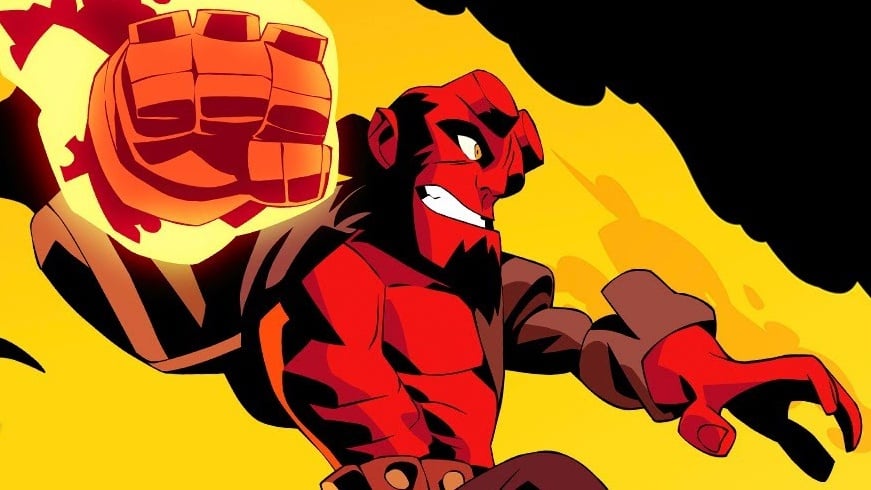
You may remember that just a few weeks ago, we shared the news that Hellboy movie characters were coming to free-to-play fighter Brawlhalla on Switch. Well, Ubisoft has now confirmed that the characters will be available from tomorrow, 10th April, and a new trailer has been released to celebrate.
A press release for the announcement tells you everything you need to know:
Fournew Hellboy (2019) skins – Hellboy – as a Cross Epic Crossover Skin – “Beast of the Apocalypse or lawful King of England? His destiny awaits.” – Nimue – as a Dusk Epic Crossover Skin – “This queen will create a new world.” – Gruagach – as a Teros Crossover Skin – “Seeking revenge on Hellboy, he’ll stop at nothing to regain his full powers.” – Daimio – as a Mordex Epic Crossover Skin – “A curse or a powerful blessing?”
Hellboy, Nimue, and Ben Daimio skins will be priced at 300 Mammoth coins each, while Gruagach is available for 240 Mammoth coins. The Hellboy (2019) skins will continue to be offered in store after the event.
Horde: the new Hellboy-themed game mode Players will team up in a group of four to defend the gates of the Great Hall against an army of demons, holding off as many waves as possible. Horde mode will be available as a custom game mode option after the two-week Hellboy event ends.
More epic Hellboy additions – A Hellboy-themed map, Apocalypse – Daily login bonus of 250 Gold – Two-week Hellboy UI Takeover – Hellboy avatar available for 60 Mammoth coins – Hellboy “Beast of Apocalypse” podium available for 240 Mammoth coins
Do you regularly play Brawlhalla? If you want to learn more about it, make sure to check out our full review right here.
Review: Nuclear Throne – Fans Of Enter The Gungeon Should Check This One Out
One of the top ten best-selling indie releases on the eShop to date is that of Enter the Gungeon, a super-tough twin-stick roguelike that’s great for local co-op sessions. However, those of you that regularly play on the PC may be aware that Gungeon was actually not the first notable game to execute the concept of a twin-stick roguelike; that honour belongs to Nuclear Throne, which has now made its way onto the Switch. Though lacking in its presentation, Nuclear Throne proves that it knows what ingredients are needed to make a compelling roguelike adventure; it’s a wildly fun game to play both alone and with a friend.
Nuclear Throne takes place in the distant post-apocalyptic future, a time where humans have long since died off and the world is overrun by insane mutants that vie for control of the coveted Nuclear Throne. You take control of one of twelve (unlockable) mutants, each with different strengths and weaknesses, in your bid for glory, shooting your way through the countless bandits, mutants, and derelicts that stand between you and your goal. Should you fail on your quest – and let’s be real, you’re going to fail way more often than not – you’ve got to start over from square one and work your way back up. It’s harrowing, difficult, and seemingly impossible, but Nuclear Throne is the kind of game that’s excessively difficult to put down once it has its hooks in you.
See, every run that you make for the throne is randomly generated; each ‘world’ still retains consistent theming and enemy types, but the arrangement of each level is entirely fresh every time you play it. This goes, too, for the weapons that you come across, which are randomly dropped via a couple of chests that appear at some point in each level, forcing you to become familiar and comfortable with a diverse lineup of firepower if you want a realistic shot at winning. Weapons aren’t everything, however, as every killed enemy drops ‘Rads’ that act as experience points; once you collect enough of these, your character will mutate and you can pick from a randomized selection of buffs before entering the next level.
What’s immediately striking about Nuclear Throne is how ‘arcade-y’ it feels in nearly every aspect, in the sense that this is the kind of game that will quickly put you in the ground if you make the barest mistake. Levels generally feel quite claustrophobic in nature, and given that many of the mutants don’t have viable escape options, it can be exceedingly easy to get cornered and subsequently torched. Or, in the rare cases where you find yourself in a wide-open area of a level, it’s all too common to be surrounded on all sides by a silly amount of enemies that waste no time in trying to end your run. Though it certainly has a high skill ceiling, Nuclear Throne is very much a luck-based affair at its core and the hard truth is that you can often find yourself in scenarios where it’s not about how you can win, but how you can best minimize your loss.
For example, ammo is excessively scarce, which basically forces you to continuously be dropping weapons in favour of new ones, even if the new weapons are a ‘downgrade’. You can only carry two weapons at a time, and you just might be content with the two that you’ve got on you, but if both of them are out of ammo, you have to drop one so you can finish clearing out the enemies and keep moving. Luckily, the weapon variety is deep – there’s everything from ordinary shotguns to guns that shoot spinning blades that can bounce off walls – and there are very few that don’t feel viable, but it’s inevitable that certain types will jive better with your particular playstyle.
Similarly, the mutations system pushes you to make tough decisions, as most of the four buffs offered to you after each level up are sure to make a notable difference in your survival. Do you take the mutation that gives you back some ammo after every kill, or do you go with the one that adds four points to your max health? What about the one that increases the drop rate of medkits? As with the rest of the game, there aren’t strictly any wrong answers here – which is why Nuclear Throne can be so rewarding to continuously replay – but nonetheless, the decisions you make both in the short term and long term directly correlate with whether or not you succeed.
You only have access to a couple of mutants at first, with later ones being unlocked after reaching certain milestones and finding secrets, and we found it admirable how the developers have made each one play so distinct from the next. One of the earlier mutants, Crystal, is fit for more defensive players, as it has an unusually large health pool and an ability that grants it temporarily invincibility. On the other hand, Melting is more geared towards the offensively-minded players, as it gets more rads from kills and can blow up enemy corpses, but at the cost of a paltry 2 HP health bar. Regardless of playstyle, there’s sure to be something here for everyone, and we appreciated how the different mutant kits can make subsequent runs feel entirely different, cutting back significantly on any grindiness.
Though online isn’t featured here – other than daily and weekly runs that offer the community one shot at a set challenge – local co-op is present and correct, adding an extra layer of complexity to an already difficult game. You and your partner don’t share guns or ammo, so there’s less for you both, but you have to ensure that you keep each other alive. If one of you goes down, the other one only has a few seconds to run over and revive; if the survivor doesn’t make it there in time, their health depletes rapidly until they join their fallen comrade in death. If the survivor does make it there in time, half their health is automatically drained to revive their partner. It’s gruelling, to say the least, but having the extra firepower offered by a friend certainly does help, especially in later levels. All the same, we’d recommend you play this one with a friend who’s similarly skilled in playing twitchy shooters, as you can’t really ‘carry’ someone to the end.
Unfortunately, adding a friend to the mix causes a notable issue with overall readability that hinders how much fun you can have. Nuclear Throne features a letterboxed view and the camera is already fairly zoomed in, so throwing another player into the fray can make for a chaotic and messy screen in which its difficult to track who’s who and what’s going on. It’s not deal-breaking, and disabled screen shake in the settings helps to mitigate this, but after seeing how well the co-op works in Enter the Gungeon, it can be hard to put up with the sub-par co-op offering found in Nuclear Throne. Your mileage may vary.
From a presentation perspective, Nuclear Throne manages to satisfy, if not impress, going for a goofy, pixelated wasteland vibe that’s nice to look at but not particularly memorable. All the pixel art and animations are fine and adequately convey the information they need to, but we were hard pressed to find any ‘wow’ moments here that show any meaningful ambition; it’s clear that the focus was placed more on gameplay than visuals, which is a fine, though disappointing, decision. Similarly, the next to non-existent soundtrack seldom adds much to your experience, although the random screams, squeals, and other mutant noises do help to instil the moment-to-moment action with some much-needed charm.
Conclusion
Nuclear Throne proves to be an enjoyable and devilishly challenging roguelike shooter that no fans of the genre will want to miss out on, even if it does tend to become more frustrating if you add in a second player. Though the visuals and music are rather disappointing, the core gameplay of Nuclear Throne more than makes up for any deficiencies through its variety and feedback loops; it’s the kind of game that’s so easy to jump into, you just can’t refuse having ‘one more go’. If you’re a fan of Enter the Gungeon, roguelikes, or difficult games in general, Nuclear Throne is going to be right up your alley; we’d give this one a high recommendation.
Sucker Punch is looking for a Narrative Writer to help create engaging narrative content for our upcoming project, Ghost of Tsushima. Daily tasks will include story development, game dialogue, and general narrative contribution. The ideal candidate will have previous success as a game writer, outstanding dialogue skills, an excellent understanding of story and game structure, experience in a writers’ room setting, and a passion to tell great stories in an open-world game.
Responsibilities
Write high quality dialogue under tight deadlines for a diverse cast of characters who live in the world of 13th century Japan.
Work closely with content designers to write missions for an open-world game.
Contribute to other creative areas of the narrative including secondary game content, dialogue barks, and writing content for marketing materials.
Requirements
A minimum of 3 years’ of industry or related-industry experience as a game writer or screenwriter.
Ability to pitch, write, iterate, and revise work under tight deadlines.
Able to brainstorm, collaborate with a team, and generate constructive feedback on narrative and design content.
Successfully produced writing work, preferably in genre content.
Thorough knowledge of the story and game development process.
Solid understanding of story and game structure and how they can integrate successfully.
Vast knowledge of successful intellectual properties in today’s popular culture.
Excellent organizational skills and ability to produce writing without constant supervision.
Eager to write content that takes place in 13th century Japan.
Deep understanding of open-world narrative and the current generation of open-world games.
Pluses
Experience playing open-world games.
Knowledge of medieval Japanese history.
Bachelor’s degree or equivalent experience.
This is a full-time, contract position located onsite in Bellevue, WA
Whether you’re just starting out, looking for something new, or just seeing what’s out there, the Gamasutra Job Board is the place where game developers move ahead in their careers.
Gamasutra’s Job Board is the most diverse, most active, and most established board of its kind in the video game industry, serving companies of all sizes, from indie to triple-A.
Don’t Miss: Creating believable crowds in Planet Coaster
Deep Dive is an ongoing Gamasutra series with the goal of shedding light on specific design, art, or technical features within a video game, in order to show how seemingly simple, fundamental design decisions aren’t really that simple at all.
My name is Owen Mc Carthy. I am a principal programmer for Frontier. I studied Computer Science and Theoretical Physics at University and did an MSc in Game Development at the University of Hull before joining Frontier nine years ago. I usually end up working on something physics or simulation related.
I worked on reactive water simulation and the physics in Kinectimals. I’ve worked with some really fun signal processing on Kinect Disneyland Adventures so we could map the player’s movements to their in-game avatar with as little jitter and lag as possible. I then worked on building destruction and ragdolls for Screamride.
Most recently I worked on the crowd simulation in Planet Coaster. I really love building believable worlds, and game development is definitely the place to be to make that happen.
For Planet Coaster, we wanted to make the best-ever crowds in the SIM genre. That meant huge numbers, few intersections, and novel approaches to sound, art and animation.
In Planet Coaster’s voxel-based sandbox we wanted to simulate 10,000 park guests at once and we wanted them to look like a real crowd. We also wanted them to be able to handle curved paths, which had proven a challenging task in crowd simulations from our previous games but something we considered essential to Planet Coaster.
Traditional pathfinding methods aren’t suitable for simulating huge numbers of characters in real time. Usually each agent would compute a path separately and then move along it, but this tends to be very expensive and doesn’t scale well. Trying to add collision avoidance afterward becomes a mess of edge case handling.
We use potential/flow fields to simulate the crowd in Planet Coaster. We have parallelized the computation across CPU cores and frame boundaries to minimize impact on the frame rate. We also had to implement non-standard approaches for sound, art and animation systems.
At the beginning of Planet Coaster’s development we knew we wanted to move the genre forward. One thing I was particularly invested in was bringing the atmosphere of a real crowd into our virtual world, and in making each park guest aware of their surroundings. I wanted to capture little moments like walking by an entertainer doing silly things and seeing other guests watching and reacting.
We reviewed the state of the art in relation to crowd simulation and navigation. That involved reading lots of research papers, studying techniques and analyzing the feasibility of each one, taking into account scalability, memory usage and CPU performance. We watched hours of footage of crowds moving around theme parks, and we captured footage of our own.
10,000 guests was the number that we targeted right from the beginning, and simulating each one individually seemed like a real challenge, so we focused on a smaller number. There are fewer goals in a theme park than guests; rides, coasters, shops and facilities are all goals. This was where the technique of using flow/potential fields became very appealing.
Instead of computing a path from A to B for each person, a path from each goal to all possible positions is computed. The question was, ‘can we simulate a few hundred goals in a flow simulation more cheaply than we could simulate 10,000 individual paths with something like the A* algorithm?’
Crowd flow
We had prototypes of several different Planet Coaster technologies in development in parallel. We started development on a voxel based landscape system, and we really wanted to break out of the traditional grid-based path system. Ultimately the crowd system would need to be integrated with the voxel terrain and path systems, but early in development they were still unknowns so the crowd system had to be robust enough to fit whatever these systems became. It was easier to develop this crowd prototype in isolation, but to be constantly aware of making it amenable to changes elsewhere.
The crowd system was much more robust as a result of this separation. Requests for changes to the path system throughout development were little to no work to integrate with the crowd system. The crowd system just deals with shapes to add to its flow simulation and it doesn’t really can about the source of them. For example: During the first alpha we could only have straight elevating paths. It would have been possible to exploit this fact for ease of implementation of overlapping paths, but later on the designers wanted to have curving elevating paths and they implemented them they just worked fine with the crowd system and became a feature for the second alpha release!
I started creating a flow simulation on a flat grid-based system to begin with, but flow fields for each goal don’t interact with each other directly. The interaction happens indirectly by resolving around a density and velocity field generated from all of the guests in the simulation. These flow fields exhibit many of the properties found in high density real crowds. They interact with each other and flow around each other and form emergent structures like lanes and congestion, and they allow agents to flow around congestion.
I think the best way to imagine how a flow simulation works is to picture a table with raised edges. Inside this table is your park and its network of paths, and each goal point has a different water tap connected to it. Scattered across the table are marbles which will flow with the water. When you want to solve a particular goal, you turn on that tap and watch the water flow through the path network and push the marbles around. Each tap can only move its set of marbles and other taps’ marbles are frozen in place as obstacles.
We record the velocity of the ‘water’ every time it flows into a new cell on the table. Once the entire table is filled with water, you’ve effectively ‘solved’ the flow field away from that goal. Now you can reverse the direction of the flow, pick any point on that table and inspect the velocity of it, and it is now directing the particle to the goal!
You can now put as many agents as you like anywhere on that grid and you instantly know which way they need to move to get to that goal. You can keep this velocity field in memory until a new one is computed and continue to flow agents on the existing data.
Figure 1: In essence, you’re propagating a wave through a grid and recording the velocity of a wave the first time it enters every cell.
When this prototype was up and running with really simple debug rendering and spheres for each guest, we needed to test the CPU and memory performance to see if this technique was viable at the scale we were aiming for. We built a stress test map with the same dimensions as the target map size. This map had a few hundred goals and about 10,000 agents on it. While memory usage was a little bit over budget, we were confident that eventually we could drastically reduce it. The CPU usage was heavy but the system was single-threaded at this point. We already had a vision to parallelize the simulation so that it wouldn’t be a limiting factor.
Figure 2
[embedded content]
Animation
It was now time to get rid of the debug rendering. The art team had already started taking the concept art and turning it into models we could use. Each guest was planned to have interchangeable body parts with lots of texture and skintone variation. We have a great animation team at Frontier, with lots of experience making quality animations, but due to the number of guests we needed to limit the animation blending that could take place.
Front-facing characters in game animations typically use bone space blending with many layered animations, which makes it expensive to compute the non linear final bone transformation. Instead of this we store the bone transformations from every frame (not keyframe) of the animation in memory and use a simple linear interpolation of the nearest two frames. This leads to simpler-looking animations, but we felt we could do better and still be efficient with clever authoring and cross-fading.
Crossfading is a much cheaper model-space linear blend between two different transforms, but can cause skeleton constraints to be broken, so we have to be very careful when we cross fade. We authored a lot of the animations with the legs in lockstep with each other so the upper body was free to do other things, and we could crossfade at any point in the walk cycle animation to another reaction animation without the legs crossing, losing momentum or sliding. This allowed us to benefit from bone-space blending quality transitions, without all the computation expense that goes with it.
We also wanted to have lots of variation in the animations and didn’t want the guests to look repetitive, which is harder to do when blending is limited. The animators were already busy recording footage of how people move as individuals and in groups, so we analyzed this footage and were able to break down the animation cycle into a very modular system. We settled for four or five variants of the base walk cycle, each under two seconds long. Every time one of these animations was finished, we were able to transition to another without blending, and build up a very dynamic and long walk cycle.
We also had a suite of animations for awareness, needs and feelings – tired, fed up, pointing, laughing, needing the toilet etcetera – that we could plug into the animation timeline when the guests are reacting to things in the park. By the time Planet Coaster shipped I think we had upwards of eight minutes of animations per skeleton type we could plug into this system.
Figure 3:
[embedded content]
We also spent some time looking at how the guests would behave in a group or family. Due to the nature of flow fields, you can’t easily ensure different particles will stay together even if they are going to the same goal, as the flow dictates where each individual particle moves. The solution was to put groups into a single particle in the simulation and move them as one unit. Each group has a radius within which members can move without affecting the flow simulation. Originally the family members were locked in formation but this looked very odd, especially when they turned corners, so we programmed in more freedom so they could rotate individually inside the particle so the relative positions of family members would move and shift over time for a more convincing look.
At this point we could see our prototype was going to be the way forward. The large number of guests was becoming a reality so we had to think about how things were going to sound. Traditionally with video game sounds, you usually put a sound emitter on each object/guest that would make a sound, but with 10,000 guests it would sound chaotic and would be prohibitively expensive.
We wanted to get a very accurate representation of the crowd ambience, and Frontier’s sound designers were already thinking of building a coarse representation of the density of a crowd and their emotions for this purpose. With the flow simulation we already had crowd density data available for the general crowd ambiance. We could then layer ‘fine detail’ audio on top of the crowd ambience so the members of the crowd nearest to the camera would have distinct sounds and conversations, which really brought the guests to life.
Further challenges
By this time the path system prototype’s development had finished and we had chosen a crowd system to go with. The next big challenge was how this crowd prototype would work with the voxel-based terrain and the curved/elevated paths instead of a traditional heightmap. With Planet Coaster’s voxel terrain and free path system, you can overlap paths and terrain on top of one another, making it more complicated than the simple ‘table’ prototype.
To combat this we decided to break up the grids into much smaller chunks and connect them with virtual connections. The large grid in the prototype image in Figure 2 would be broken up into smaller 4m x 4m grids. To make the entire terrain traversable would require enormous amounts of memory as each distinct goal needs a persistent record of the velocities of each cell, but by only allowing guests to navigate paths we only need smaller grid segments to exist when there is a path in that area, keeping memory usage down.
Each path section would be rasterized to these smaller grid segments, activating cells in them and creating new segments when necessary. When a cell is activated the height of the path is also computed at that point, so each grid also has a heightmap. This meant that when we needed to set the height of the particles it was a quick lookup into the heightmap, instead of raycasting into the voxel terrain. Doing 10,000 raycasts every frame into the voxel terrain to determine the height of each guest was something we wanted to avoid!
The connections between grid segments were very hard to visualize when dealing with overlapping paths, but hopefully you can understand it after looking at the picture below which shows the debug rendering of the grid segments and virtual connections.
Figure 4: The red lines are connections between cells, and the inactive cells in the grid segments have slashes through them. Each grid segment is a 4×4 block of cells
The connections were probably the most difficult part of the simulation to get right as it adds a lot of overhead to the data structures that has to be precisely maintained when paths are added and removed. The ‘Undo’ and ‘Redo’ feature of Planet Coaster is something often taken for granted, but in this game it was something we really thought would improve the user experience. This most intuitive feature for players required a massive development effort to implement into Planet Coaster’s freeform sandbox. All the game systems had to work with Undo / Redo from the beginning. The crowd system’s add/remove path operations had to be well defined and processed so that adding and removing the same piece of path would leave the crowd system’s data structures in the same state as before, adding further complexity to the maintenance of the virtual connections between the grids.
Scaling up
Now we were at the point where we could build path networks in the game, it was time to scale up the simulation. We needed to optimize! Usually optimization happens near the end of a project, but with a system as intensive as ours we needed to tackle it much earlier. The three important points about flow fields that enabled us to optimize them for very little impact on the framerate are:
Flow fields don’t need to be updated every frame. Particles continue to flow on the front buffer of the velocity field until a new flow field is generated on the back buffer, and when it is finished computing the buffers are swapped.
Each flow field update is independent of the other updates. This means we can run different ones at the same time, and we don’t rely on locking any data structures or complicated synchronization behavior.
The updates are not tied to the frame boundaries and can run across them. The tasks can also yield and let higher priority work execute.
This created some confusion in the player community during our Alpha period, as players would see their CPU usage get close to 100 percent on all cores in task manager and think that the game demanded a better CPU, but the reality was that the crowd system was scaling to take full advantage of idle CPU time to update the flow fields faster, which leads to higher fidelity for collisions between particles. On a slower system it would just take a few more frames to do a full update of all the goals. We even discovered that some users were using systems where their CPU cooling wasn’t actually sufficient to run the CPU under a constant full load.
Figure 5:
[embedded content]
Some of the major technical difficulties we overcame were caused by gridlock. When you have thousands of guests walking on paths and they want to go in opposite directions, lanes will usually form. Unfortunately, lanes sometimes won’t have enough time to form and gridlock will develop. When this happens during events in major cities, nobody is able to move until a police officer or another influencer directs some people to move and others to stay still. It’s realistic but it’s not fun, so we implemented a novel solution to combat gridlock. The longer guests are in head-on collisions with other guests, the smaller their collision radius would become until they could fit through the gaps. This meant that the guests would clip more often, but it stopped the gridlock problem and limited clipping only to areas of very high congestion.
Even now, there are still areas for improvement – for example ‘dead zones’. It’s possible with potential fields to have areas of the field where the velocity is precisely zero. This manifested as a problem with Janitors cleaning up trash. All of the trash pieces would be part of the same goal and were only one flow computation, but this easily led to situations where a janitor could be caught between two pieces of trash. To work around this, each janitor would only activate the nearest piece of trash to them, and only the active pieces of trash were part of the goal in the flow computation.
Entertainers simply create goals when they are entertaining so guests can go towards and watch them. Bins create goals when they are empty and remove them when they are full. For incidental goals like this as an optimization we were able to limit how far the wave can propagate. This limitation saved lots of memory as we only needed to store a much smaller velocity field.
We were now at the point where we could have hundreds of goals and thousands of guests walking around, all avoiding each other and moving in a manner close to the final fluid and dynamic result you can see in the game.
There are several other systems and techniques we used that are beyond the scope of this article and I could probably write a full feature on each of them but I really hope this article gives you a good insight as to how we went about designing and implementing this system at Frontier for Planet Coaster. More than anything, I really hope it makes people smile when they play the game at home and realize that their park guests are having as much fun in the park as the player has making it, and I hope players enjoy all the new gameplay opportunities that realistic crowd flow and congestion play in the design of their parks.
Starlight Shell (Dreaming City Ghost Shell): 2% → 20%
Silver Tercel (Dreaming City Sparrow): 5% → 20%
Increased drop rate of Lore Books
Cayde’s Stash Lore
Cayde treasure map chests: 40% → 100%
Planetary chests: 4% → 50%
Dreaming City Lore
Public event completed: 2.5% → 50%
Ascendant challenge completed: 2.5% → 100%
Blind Well completed (Tier 1–3): 5% → 50%
Lost Sector completed: 1.25% → 100%
The Marasenna lore book was missing two entries: Revanche I and Palingenesis III; these entries now unlock after you unlock all other entries.
Tangled Shore Lore
While Tangled Shore is the Flashpoint
Public event completed: 6.5% → 50%
Heroic adventure completed: 16% → 50%
Lost Sector completed: 3% → 50%
Gunsmith reputation packages now only reward Gunsmith Weapons
Four new Exotic weapon catalysts are now available to drop in Nightfall, strikes, and the Crucible
Prospector (Nightfall, strikes)
Rat King (Nightfall, strikes)
Hard Light (Nightfall, strikes)
SUROS Regime (Crucible)
Xûr’s inventory now offers random rolled perks for armor
Fated Engrams from Xûr now have the chance to reward Forsaken Exotics
Added ability to preview Ghost projections when inspecting Ghosts
Quests/Bounties
Power Surge Bounties that have expired or been deleted are now available on the Drifter, though each bounty can still be completed only once per character
Power Surge Bounties now specify “Requires Annual Pass and Level 50” if either requirement is not met
Reaping in the Wilds Gambit Prime bounty now progresses from all high-value targets in free roam
Players who sided with the Vanguard on the Allegiance quest can now also bank Motes in normal Gambit to progress on the Prime Research quest step
Quest progress for the Survival Guide or Hidden Messages quest steps will now re-initialize properly; if you are stuck on these quest steps, you should abandon them and pick them up again from the Drifter to update the “tapes discovered” count
The weekly lockout reset for Invitations of the Nine has been moved to Thursday Reset (1700 UTC); players will now have two extra days to complete them before being locked out of a new Invitation the following Friday
Lost Sector Gambit Prime bounty now progresses from all Lost Sectors
All four weekly role bounties for Gambit Prime now grant powerful head rewards
Yes Sir, I’m A Closer weekly Gambit Prime bounty now awards 4 points for a win and 2 points for a loss, with a completion value of 20 points
Pursuits
Ada-1 will now offer all seven weapon frames each week
Players can still complete only two powerful frames each week, at which point remaining frames are removed until weekly reset
Fixed an issue where players could acquire pinnacle weapons once per character; pinnacle weapons are meant to be acquired only once per account
Drifter’s weekly role bounties will now properly count Motes wagered in the Reckoning when the Mote is a lower tier than the activity itself
Gambit Prime now counts to unlock the weekly Gambit clan engram
When recycling Synths at the Drifter, the error “Your Glimmer is full” will now be properly displayed on all four Synths
Fixed an issue with the Sentry emblem where killing Giant Blockers wasn’t incrementing the “Blockers killed” stat
Fixed an issue where the Gambit Prime weekly challenge didn’t display completion in the UI
Triumphs
Fixed an issue where Triumphs from previous seasons were counting Glory Win Streaks in the current season
Fixed an issue where the Triumph “The Best Offense” was not giving credit for all orbs generated
The Haul Triumphs “Greater Powers” and “IX” can now be completed and will initialize for players who have already completed them as soon as they enter Orbit
General
Arsenic Bite now drops with random rolls; removed Vestian Dynasty from the general loot pool
Fixed an issue where the BrayTech RWP Mk. II could not be infused above 600
Increased drop rate of Polestar II Ghost Shell from 1% to 4%
Fixed an issue where Obsidian Crystal would sometimes not drop from the Unidentified Frame quest step
Activities
Reckoning
Reckoning Tier 2 and Tier 3 boss kills now always have a chance to award a Gambit Prime weapon
Chances for weapon rewards increase each time a boss is killed without a weapon drop
Players near the bank should no longer be able to see waypoints until they jump through the portal
When players jump through the portal, they should be placed in one of three active locations:
Anytime before players begin capturing the bridge: over the horde mode area
Anytime after players begin capturing the bridge, before they fully capture the bridge: at the beginning of the bridge
After players fully capture the bridge and begin the boss fight: at the end of the bridge
Fixed an issue where the Tier 1 Deceived Nokris was not summoning its Taken Warbeasts
Gambit Prime
Some Reckoning weapons now have a chance to drop as match completion rewards from Gambit Prime
Chances increase after each Gambit Prime match without a weapon drop
An invasion kill now heals 8% of the Primeval’s health, down from 12%
The invasion portal cooldown time during the Primeval phase has been increased to 40 seconds, up from 30 seconds
This cooldown triggers after a player has been killed or successfully returns from an invasion
Fixed an issue where all Gambit medals that shipped in Forsaken were not displaying in the HUD when players earned them in Prime
Fixed an issue where the Primeval Hobgoblin was not functioning properly in Gambit Prime
Boss reintroduced to Gambit Prime
Fixed an issue where killing players in subsequent Wells of Light would unintentionally count towards earning the “Well Well Well” medal
Fixed on issue on Deep Six and New Arcadia where the Ascendant Primeval Servitor wasn’t summoning Immunity Blights
The Burrow front on Deep Six had some minor adjustments to reduce combatant/environment collisions
Gambit
High-value targets now have a chance to spawn during the first round of a Gambit match; the chance for the HVT to spawn in the second round has been increased
Private Matches: Sudden Death can now be enabled or disabled via the Rounds to Win options
Fixed an issue where the “Open 24/7” medal could be acquired during a Sudden Death round of Gambit
Fixed an issue where the “Rainmaker” medal could be acquired during a Sudden Death round of Gambit
Gambit intro cinematics now run at unlocked framerates on PC
Fixed an issue where Scorn Captain’s immunity totems were not properly shielding combatants
Fixed an issue where Drifter was announcing “Portal’s Up” after the round had ended
Reduced the number of required Blockers to send for the Taken Herder, Shepard, and Whisperer Triumphs
Reduced the number of required number of Motes to bank in order to achieve the Protect the Runner Triumphs
Fixed an issue where players who are restricted from the Crucible/Gambit due to poor network quality were unable to launch Gambit Private Matches
Fixed an issue where Infamy ranks could be repeatedly reset without needing to progress through the ranks between each reset
Strikes
Fixed an issue where the gravlift would sometimes be missing in the Warden of Nothing strike
Nightfall tickets now have min/max and +-25 for incrementing power reduction; this will allow players to get to the +100 power reduction easier to increase the score multiplier
Crucible
Competitive
Fixed an issue where players who are disconnected from Destiny servers could not rejoin games in the Competitive Crucible playlist.
Iron Banner
The curated roll “Wizened Rebuke” Fusion Rifle awarded from completing the “Atlas, Unbound” Triumph will now appear in Lord Saladin’s inventory so that players can inspect it prior to acquisition
Once earned, the weapon may be viewed in Collections
The curated roll “Wizened Rebuke” Fusion Rifle can now be reacquired from Collections for the same cost as other Masterworked, curated roll weapons
The Heavy as Iron emblem may be earned when securing 2500 kills under the effects of the Iron Burden
Removed ship “Volk-CER” from Collections due to an issue impacting the ship
Expect this to return in a future Season
Patrols
Fixed an issue where the architects would sometimes kill Guardians for absolutely no reason in a very specific area of the Dreaming City
Combatants
General
Fixed an issue where the Taken Hydra rotating shield would flicker when shielded by Taken Goblins
Fixed an issue where the Ultra Taken Hobgoblin was using the Swarm attack more frequently than intended
UI
General
Player will now always see equipped titles when inspecting another player
The weapon ornament “Powerful Statement” is no longer visible in the socket preview for Loaded Question before being obtained
Postmaster “open bundle confirmation” dialogue now shows appropriate strings when it pops up; would previously cause occasional crashes
Material cost no longer appears red on vendor tooltips if the item is not purchasable, but you have enough material
Fixed the description on some bounties to correctly read ” ability kills” instead of ” kills”
Added ability to inspect gear for other classes
PC
General
Fixed an issue where performance on PC would slowly degrade over time
Vaporum is a grid-based dungeon crawler RPG in an original steampunk setting, inspired by old-school classics of the genre. Stranded in the middle of an ocean, in front of a gigantic tower, the hero has to find out what the place is, what happened there, and most importantly, who he is.
Falcon Age is a first-person, single-player action adventure. As Ara, learn to hunt, gather, and fight to reclaim her cultural legacy in the lost art of falcon hunting against a force of automated colonizers. Bond with a baby falcon and go on an adventure.






 The connections between grid segments were very hard to visualize when dealing with overlapping paths, but hopefully you can understand it after looking at the picture below which shows the debug rendering of the grid segments and virtual connections.
 Figure 4: The red lines are connections between cells, and the inactive cells in the grid segments have slashes through them. Each grid segment is a 4×4 block of cells