Warcraft Arclight Rumble Is Classic Warcraft Made Bite-Sized
Since 2004, World of Warcraft has defined the Warcraft name, becoming one of the most famous video games on the planet. It's easy to forget, then, that this franchise started as a real-time strategy game before jumping into the MMO realm. Warcraft Arclight Rumble, the franchise's debut on mobile devices, is Blizzard's attempt to bring the Warcraft name back to those strategic roots.
I've had access to a preview build of the game over the last few days, and it's very apparent that Arclight Rumble intends to remind us where Warcraft started--to resurrect Warcraft's past all while mixing familiar gameplay with characters and lands built by the MMO's lore to create an all-new experience.
The premise of Warcraft Arclight Rumble sees coin-operated machines appearing in taverns throughout Warcraft's setting of Azeroth, where patrons can use miniature figurines of creatures and heroes to battle against one another in a simplified real-time strategy game. Players will collect minis, create armies, and use them in both story battles against the AI and multiplayer matches against other players. It's a similar approach to how Hearthstone uses the tavern as its setting, only exchanging cards for minis.
Travel to the sleepy village of Caterwaul Way and rebuild your grandmother's cat cafe. Renovate your restaurant, befriend the local cats and townsfolk, forge lasting friendships, unravel catty mysteries, and build a home for dozens of unique felines!
Java Heap Sizing in a Container: Quickly and Easily
In the previous blog, We have seen that Java has made improvements to identify the memory based on a running environment i.e. either a physical machine or a Container (docker). The initial problem with java was that It wasn't able to figure out that it was running in a container and It used to captu...
Note that writing a single tuple to a CSV is a subproblem of writing multiple tuples to a CSV that can be easily solved by passing a list with a single tuple as an input to any function we’ll discuss in the article.
Solution: There are four simple ways to convert a list of tuples to a CSV file in Python.
CSV: Import the csvmodule in Python, create a csv writer object, and write the list of tuples to the file in using the writerows() method on the writer object.
Pandas: Import the pandas library, create a Pandas DataFrame, and write the DataFrame to a file using the DataFrame method DataFrame.to_csv('file.csv').
NumPy: Import the NumPy library, create a NumPy array, and write the output to a CSV file using the numpy.savetxt('file.csv', array, delimiter=',') method.
Python: Use a pure Python implementation that doesn’t require any library by using the Python file I/O functionality.
My preference is method 2 (Pandas) because it’s simplest to use and most robust for different input types (numerical or textual).
Try It Yourself: Before we dive into these methods in more detail, feel free to play with them in our interactive code shell. Simply click the “Run” button and find the generated CSV files in the “Files” tab.
Try It Yourself: Click to run in interactive shell!
Do you want to develop the skills of a well-rounded Python professional—while getting paid in the process? Become a Python freelancer and order your book Leaving the Rat Race with Python on Amazon (Kindle/Print)!
Method 1: Python’s CSV Module
You can convert a list of tuples to a CSV file in Python easily—by using the csv library. This is the most customizable of all four methods.
In the code, you first open the file using Python’s standard open() command. Now, you can write content to the file object f.
Next, you pass this file object to the constructor of the CSV writer that implements some additional helper method—and effectively wraps the file object providing you with new CSV-specific functionality such as the writerows() method.
You now pass a list of tuples to the writerows() method of the CSV writer that takes care of converting the list of tuples to a CSV format.
You can customize the CSV writer in its constructor (e.g., by modifying the delimiter from a comma ',' to a whitespace ' ' character). Have a look at the specification to learn about advanced modifications.
Method 2: Pandas DataFrame to_csv()
You can convert a tuple or list of tuples to a Pandas DataFrame that provides you with powerful capabilities such as the to_csv() method. This is the easiest method and it allows you to avoid importing yet another library (I use Pandas in many Python projects anyways).
You create a Pandas DataFrame—which is Python’s default representation of tabular data. Think of it as an Excel spreadsheet within your code (with rows and columns).
The DataFrame is a very powerful data structure that allows you to perform various methods. One of those is the to_csv() method that allows you to write its contents into a CSV file.
You set the index and header arguments of the to_csv() method to False because Pandas, per default, adds integer row and column indices 0, 1, 2, ….
Again, think of them as the row and column indices in your Excel spreadsheet. You don’t want them to appear in the CSV file so you set the arguments to False.
If you want to customize the CSV output, you’ve got a lot of special arguments to play with. Check out this article for a comprehensive list of all arguments.
NumPy is at the core of Python’s data science and machine learning functionality. Even Pandas uses NumPy arrays to implement critical functionality.
You can convert a list of tuples to a CSV file by using NumPy’s savetext() function and passing the NumPy array as an argument that arises from the conversion of the list of tuples.
This method is best if you have numerical data only—otherwise, it’ll lead to complicated data type conversions which are not recommended.
a = [(1, 2, 3), (4, 5, 6), (7, 8, 9)] # Method 3

import numpy as np

a = np.array(a)

np.savetxt('file3.csv', a, delimiter=',')
The output doesn’t look pretty: it stores the values as floats. But no worries, you can reformat the output using the format argument fmt of the savetxt() method (more here). However, I’d recommend you stick to method 2 (Pandas) to avoid unnecessary complexity in your code.
Method 4: Pure Python Without External Dependencies
If you don’t want to import any library and still convert a list of tuples into a CSV file, you can use standard Python implementation as well: it’s not complicated and efficient. However, if possible you should rely on libraries that do the job for you.
This method is best if you won’t or cannot use external dependencies.
salary = [('Alice', 'Data Scientist', 122000), ('Bob', 'Engineer', 77000), ('Ann', 'Manager', 119000)] # Method 4

with open('file4.csv','w') as f: for row in salary: for x in row: f.write(str(x) + ',') f.write('\n')
In the code, you first open the file object f. Then you iterate over each row and each element in the row and write the element to the file—one by one. After each element, you place the comma to generate the CSV file format. After each row, you place the newline character '\n'.
Note: to get rid of the trailing comma, you can check if the element x is the last element in the row within the loop body and skip writing the comma if it is.
The following video shows how to convert a list of lists to a CSV in Python, converting a tuple or list of tuples will be similar:
Where to Go From Here?
Enough theory. Let’s get some practice!
Coders get paid six figures and more because they can solve problems more effectively using machine intelligence and automation.
To become more successful in coding, solve more real problems for real people. That’s how you polish the skills you really need in practice. After all, what’s the use of learning theory that nobody ever needs?
You build high-value coding skills by working on practical coding projects!
Do you want to stop learning with toy projects and focus on practical code projects that earn you money and solve real problems for people?
If your answer is YES!, consider becoming a Python freelance developer! It’s the best way of approaching the task of improving your Python skills—even if you are a complete beginner.
If you just want to learn about the freelancing opportunity, feel free to watch my free webinar “How to Build Your High-Income Skill Python” and learn how I grew my coding business online and how you can, too—from the comfort of your own home.
[www.indiegala.com] The Crypto Sale has returned! Save an EXTRA 30% for every bundle & an extra 15% for every store purchase when paying with any supported crypto
CHRONO CROSS: THE RADICAL DREAMERS EDITION is a remaster of "CHRONO CROSS". The 3D models have been upgraded to HD, new illustrations have added, and all kinds of new features are now included. Additionally, the game that formed the bedrock of the story, "RADICAL DREAMERS - Le Trésor Interdit -", is included in this edition. CHRONO CROSS is an RPG that transcends time and space, unfolding across two interlinked parallel worlds. With over 40 party members to meet, people and dimensions will intertwine in this epic drama about the planet itself.
New Features in the Remastered Edition
・3D models converted to HD
・Refined character illustrations
・Higher-quality background music
・Switch enemy encounters on or off
・Background filter feature
・Battle enhancement features to make combat easier
・Auto-battle function
・Switch between imitation pixel font and HD font
・Change screen resolution
Clash Of Clans Adds New Social Hub With Clan Capitals
Players looking for a new way to enjoy Clash of Clans with their friends are in luck. Supercell has announced a major addition to the game ahead of its 10th anniversary: Clan Capitals, a brand-new social experience that is now available in-game.
Clan Capitals are strongholds in the sky that clans can create and customize as they please. The social areas can add new districts by upgrading the Capital Hall, while Capital Gold can be forged to purchase new buildings, defenses, and weaponry for the clan.
The new Clan Capitals also introduce the first-ever weekly raid objective in the game's history, as players can link up with clanmates and invade other Clan Capitals once per week. Damage inflicted by teammates will show on each screen in real time, allowing players to focus on certain areas when taking on an opposing clan's capital. Successful raids will earn each player rewards to strengthen their Clan Capital, home village, and builder base.
Before we learn about the money, let’s get this question out of the way:
What Does a Product Manager Do?
A product manager (PM) identifies customer needs and communicates “success metrics” with the internal team building the product. By understanding the customer needs and what a successful product looks like, the product manager is an integral part of driving the project forward and turning a vision into reality.
In particular, PMs drive the physical or digital product strategy including requirements engineering and feature release management (see agile development).
For organizational and individual success, ownership, accountability, and responsibility are crucial. That’s why great PMs are in demand and highly paid (see later).
You can watch this video as you scan over the post:
This excellent graphic also shows the intersection of business, tech, and UX that is the world of a product manager:
Product managers traditionally resided in the marketing organizations of technology companies. But in recent years, the role has become much more in demand and PMs now work in a wide variety of companies and different departments in engineering, marketing, and software development. (source)
Here are some companies where you can work as a PM:
Amazon
Google
Magic Lab
HSBC
PayPal
Uber
Salesforce
Microsoft
Basically, all major companies have lots of work for a PM one way or the other.
What Are Responsibilities of Product Managers?
As a product manager, you need to fulfill the following responsibilities:
Understand customer or user needs
Communicate and represent these needs to the team and the company
Analyze the existing products in the market.
Perform a competitive analysis (traditional: marketing and product ideation)
Find possible features and prioritize them by using your excellent understanding of customer needs
Define, align, and articulate the vision of a product and/or product lines
Quantify priority of product features
Define the roadmap and strategy to implement the product
Manage the product creation phase orchestrating teams in engineering, sales, marketing, and legal departments.
Take on the role of a customer so that customers have an advocate in your organization and the product development cycle remains focused and on track to maximize customer value.
Empower decision making by making yourself superfluous — the ultimate goal of any leader.
Annual Income
How much does a Product Manager make per year?
Figure: Average Income of a Product Manager in the US by Source. [1]
The average annual income of a Product Manager in the United States is between $100,827 and $133,593 with an average of $113,277 and a median of $113,277 per year.
This data is based on our meta-study of eight salary aggregators sources such as Glassdoor, ZipRecruiter, and PayScale.
If you decide to go the route as a freelance Product Manager, you can expect to make between $60 and $300 per hour on Upwork (source). Assuming an annual workload of 2000 hours, you can expect to make between $120,000 and $600,000 (!) per year.
Seriously!
Note: Do you want to create your own thriving coding business online? Feel free to check out our freelance developer course — the world’s #1 best-selling freelance developer course that specifically shows you how to succeed on Upwork and Fiverr!
But is there enough demand? Let’s have a look at Google trends to find out how interest evolves over time (source):
Interestingly, the demand for “hire product manager” grows even faster in recent years (source):
So, becoming a PM may be one of the best career choices for ambitious product people that want to maximize their earnings and value creation potential.
Learning Path, Skills, and Education Requirements
Do you want to become a Product Manager? Here’s a step-by-step learning path I’d propose to get started:
But don’t wait too long to acquire practical experience!
Even if you have few skills, it’s best to get started as a freelance developer and learn as you work on real projects for clients — earning income as you learn and gaining motivation through real-world feedback.
Tip: An excellent start to turbo-charge your freelancing career (earning more in less time) is our Finxter Freelancer Course. The goal of the course is to pay for itself!
21 Best Tips for Product Managers
Study the platform and architecture.
Call a few meetings with the team and figure out who your stakeholders are.
Build relationships with the developers and designers. Take them to lunch. Buy them a few beers.
Dig through the data. Start looking at what analytics are in place.
Talk to your best customers and ask them about what they like about the product.
Trust your soft skills and intuition.
Manage your own career and never stop learning.
Embrace visual roadmaps.
Don’t settle for a stale prioritization framework.
Be interesting and address things your customers care about.
Be a story teller.
Create meaning and move the business towards quantifiable goals.
Aim to provide real value to customers and your shareholders alike. Prioritize customers if you need to decide.
People create the product and people consume the product. Be mindful about social factors such as emotions and leave nobody behind!
Find actionable steps that really can be implemented adhering to budgets, timelines, and resource limits.
Be clear in what you want to achieve. Ask yourself whether a child can understand your strategy and product roadmap.
Never forget to test — spend lots of effort designing tests to catch all flaws before shipping the product.
Understand how your customers measure value — and use it to guide your product design. Because if the customer perceives success after using your product, your company will get the credit and reach success too!
Focus on customer delight, not customer satisfaction.
Meet with your team regularly and repeat the vision and your goals. Repeat. Repeat. REPEAT!
Be collaborative. The most important tip of all!
I compiled these tips from my own experience creating products in a role similar to that of a PM, and mixed my own tips with those published by various experts in the field. Feel free to study those excellent resources as well!
The following statistic shows the self-reported income from 9,649 US-based professional developers (source).
The average annual income of professional developers in the US is between $70,000 and $177,500 for various programming languages.
Question: What is your current total compensation (salary, bonuses, and perks, before taxes and deductions)? Please enter a whole number in the box below, without any punctuation. If you are paid hourly, please estimate an equivalent weekly, monthly, or yearly salary. (source)
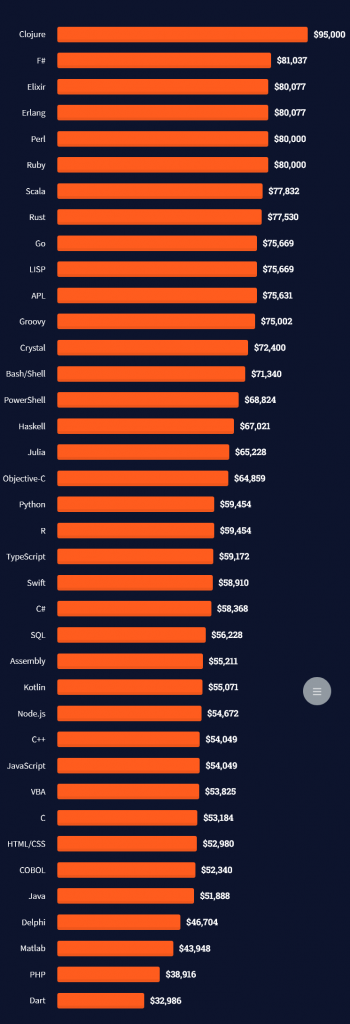
The following statistic compares the self-reported income from 46,693 professional programmers as conducted by StackOverflow.
The average annual income of professional developers worldwide (US and non-US) is between $33,000 and $95,000 for various programming languages.
Here’s a screenshot of a more detailed overview of each programming language considered in the report:
Here’s what different database professionals earn:
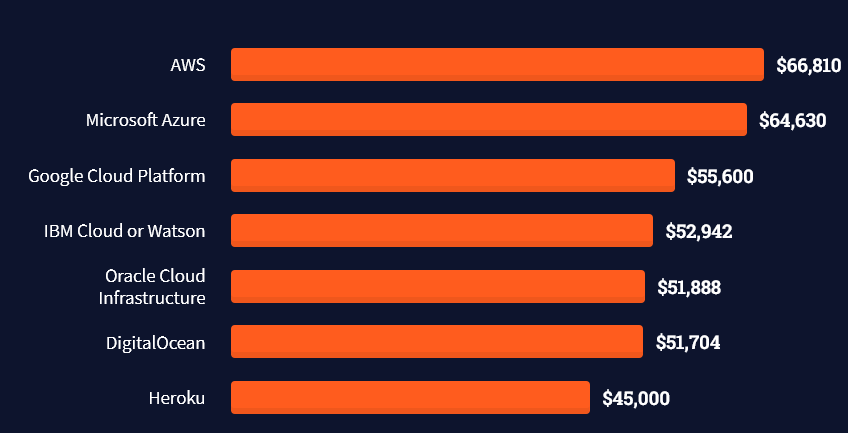
Here’s an overview of different cloud solutions experts:
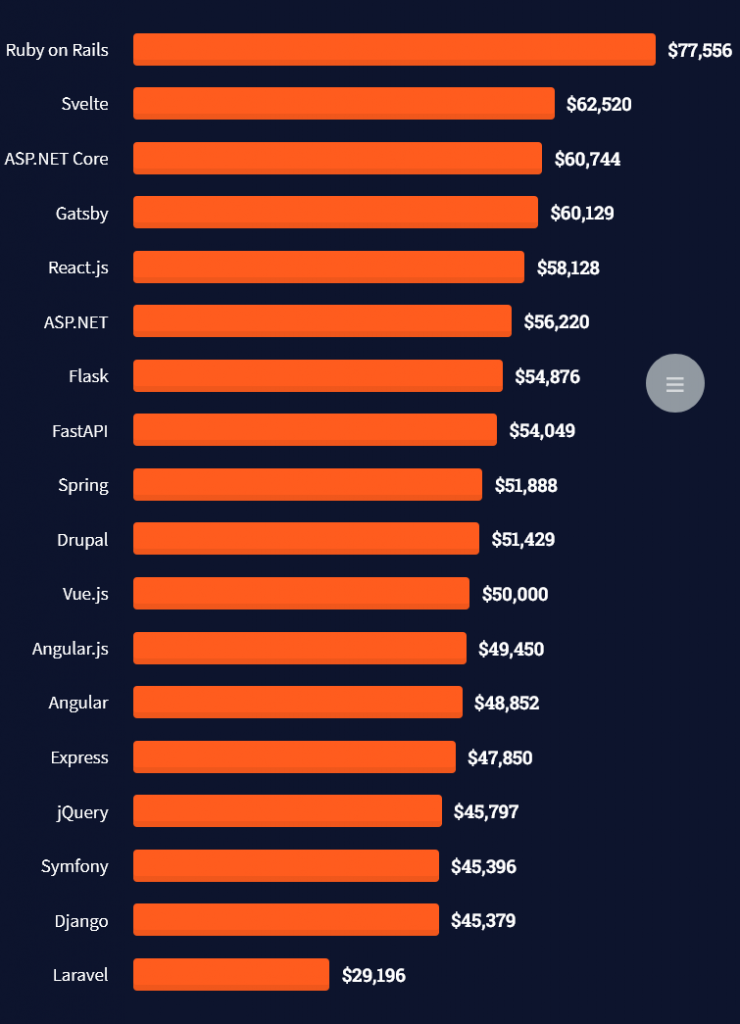
Here’s what professionals in web frameworks earn:
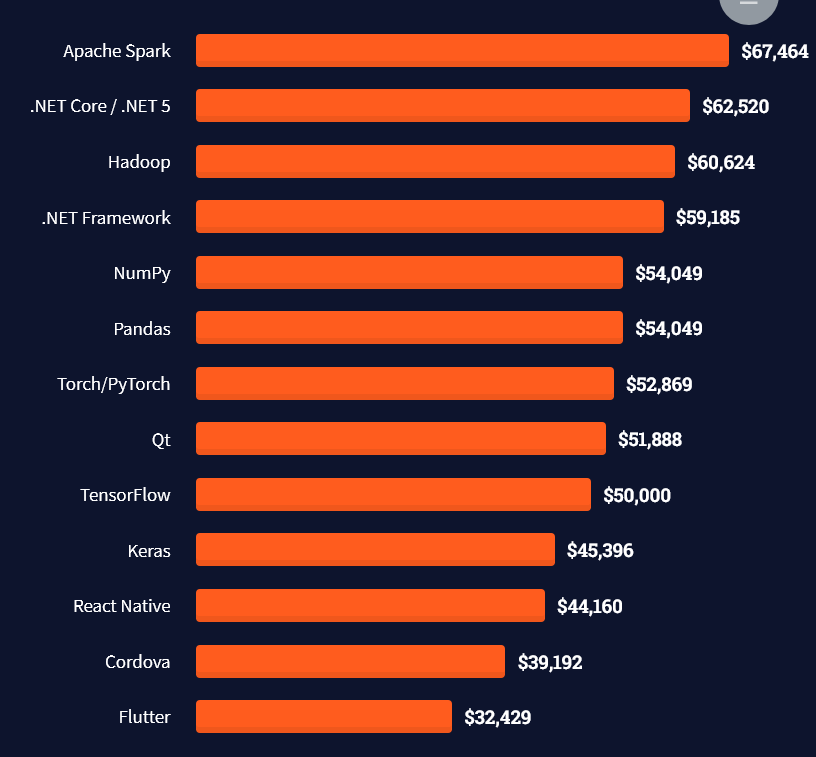
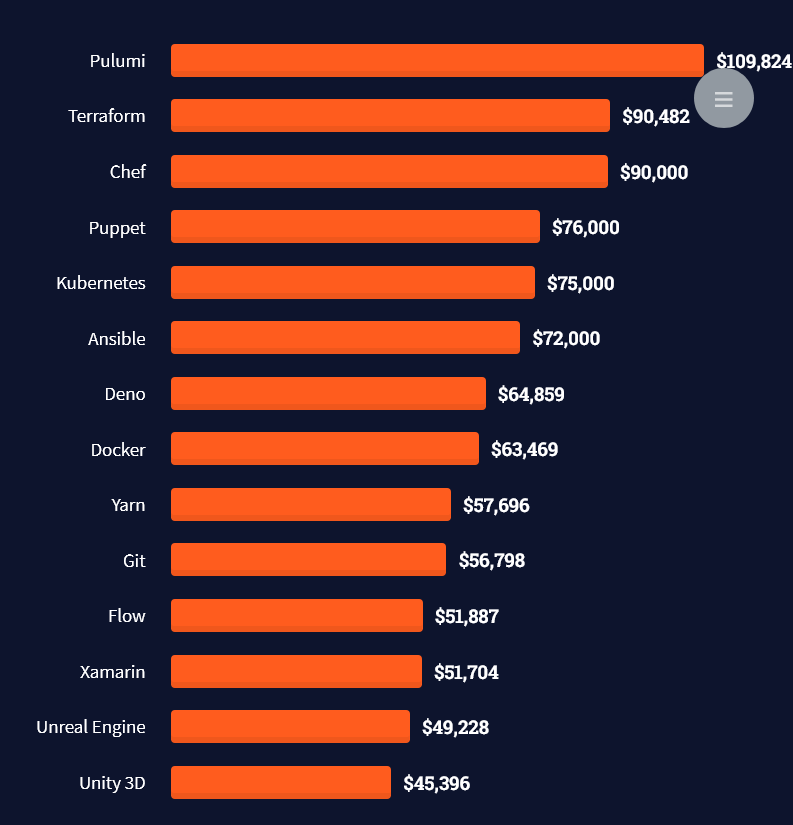
There are many other interesting frameworks—that pay well!
Look at those tools:
Okay, but what do you need to do to get there? What are the skill requirements and qualifications to make you become a professional developer in the area you desire?
Let’s find out next!
General Qualifications of Professionals
StackOverflow performs an annual survey asking professionals, coders, developers, researchers, and engineers various questions about their background and job satisfaction on their website.
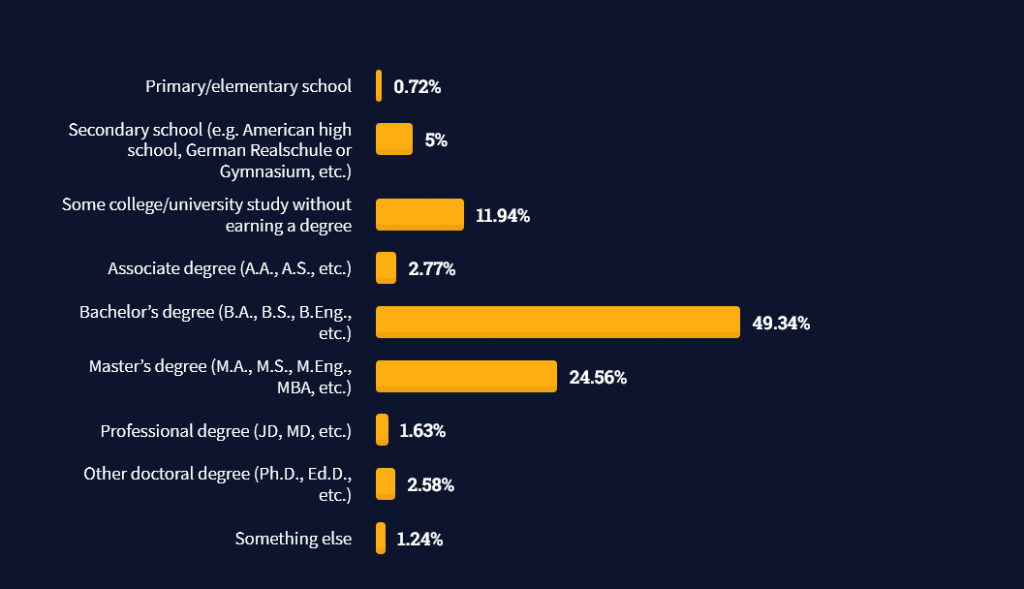
Interestingly, when aggregating the data of the developers’ educational background, a good three quarters have an academic background.
Here’s the question asked by StackOverflow (source):
Which of the following best describes the highest level of formal education that you’ve completed?
However, if you don’t have a formal degree, don’t fear! Many of the respondents with degrees don’t have a degree in their field—so it may not be of much value for their coding careers anyways.
Also, about one out of four don’t have a formal degree and still succeeds in their field! You certainly don’t need a degree if you’re committed to your own success!
Freelancing vs Employment Status
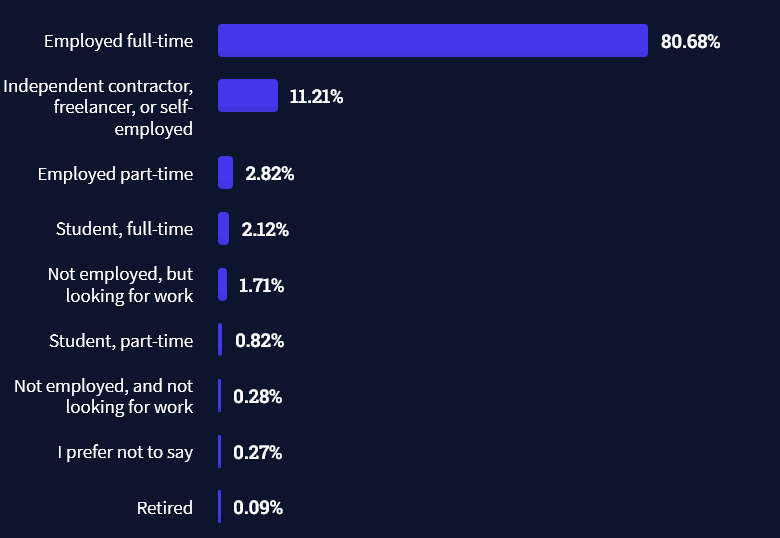
The percentage of freelance developers increases steadily. The fraction of freelance developers has already reached 11.21%!
This indicates that more and more work will be done in a more flexible work environment—and fewer and fewer companies and clients want to hire inflexible talent.
Here are the stats from the StackOverflow developer survey (source):
Do you want to become a professional freelance developer and earn some money on the side or as your primary source of income?
Resource: Check out our freelance developer course—it’s the best freelance developer course in the world with the highest student success rate in the industry!
Other Programming Languages Used by Professional Developers
The StackOverflow developer survey collected 58000 responses about the following question (source):
Which programming, scripting, and markup languages have you done extensive development work in over the past year, and which do you want to work in over the next year?
These are the languages you want to focus on when starting out as a coder:
And don’t worry—if you feel stuck or struggle with a nasty bug. We all go through it. Here’s what SO survey respondents and professional developers do when they’re stuck:
What do you do when you get stuck on a problem? Select all that apply. (source)
Related Tutorials
To get started with some of the fundamentals and industry concepts, feel free to check out these articles:
Coders get paid six figures and more because they can solve problems more effectively using machine intelligence and automation.
To become more successful in coding, solve more real problems for real people. That’s how you polish the skills you really need in practice. After all, what’s the use of learning theory that nobody ever needs?
You build high-value coding skills by working on practical coding projects!
Do you want to stop learning with toy projects and focus on practical code projects that earn you money and solve real problems for people?
If your answer is YES!, consider becoming a Python freelance developer! It’s the best way of approaching the task of improving your Python skills—even if you are a complete beginner.
If you just want to learn about the freelancing opportunity, feel free to watch my free webinar “How to Build Your High-Income Skill Python” and learn how I grew my coding business online and how you can, too—from the comfort of your own home.
The Advanced Management Console (AMC) 2.15 release is now available!
AMC 2.15 offers system administrators greater and easier control in managing Java version compatibility and security updates for desktops within their enterprise and for ISVs with Java-based applications and solutions. Key benefits of using AMC include: Usage Tracking: The Advanced Management Consol...



 Try It Yourself: Before we dive into these


 If your answer is YES!, consider becoming a


 Note: Do you want to create your own thriving coding business online? Feel free to check out our


 The average annual income of professional developers in the US is between $70,000 and $177,500 for various programming languages.