Nintendo Direct To Air Tomorrow, Wednesday 13th February
Nintendo has revealed that a brand new Nintendo Direct will air tomorrow, and the internet can finally calm down for a few days.
The show will be approximately 35 minutes long and will focus on upcoming Nintendo Switch games, including Fire Emblem: Three Houses. Fire Emblem is currently slated for a spring 2019 release, so hopefully we’ll get a proper release date.
The Direct will be streamed live at 11pm CET tomorrow (so that’s 10pm GMT / 2pm PST / 5pm EST).
As always, we’ll be covering the entire thing right here on Nintendo Life, so make sure to get your excited selves back here at that time.
Right, go on then… What do you expect to see? Comment away!
Whether you’re a contributor or committer building the platform, or you’re using the platform to attain your business goals, Cloud Foundry North America Summit is where developers, operators, CIOs and other IT professionals go to share best practices and innovate together.
Hyper Jam is a neon-soaked arena brawler with a dynamic perk drafting system that makes each match different from the last. The fusion of lethal weapons, stackable perks, furious combat, and a killer synthwave soundtrack will keep you coming back for more.
Roguelike RPG Alchemic Dungeons DX Gets Revamped Release On Switch This Week
Flyhigh Works has revealed that Alchemic Dungeons DX will be its next game headed to Nintendo Switch, and it’s set to launch on the system later this week.
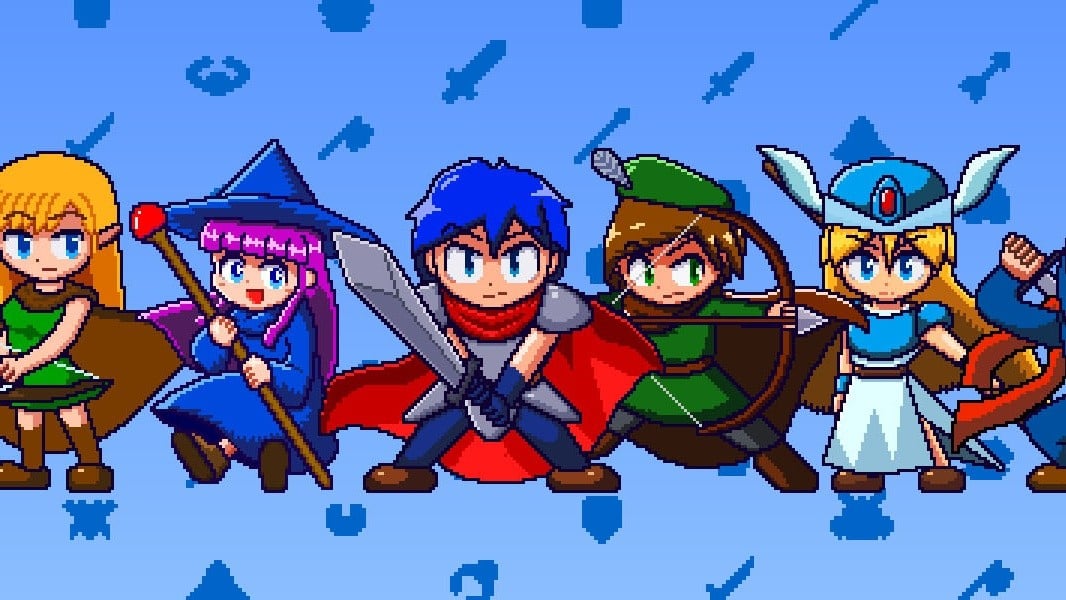
Originally launching on 3DS as just Alchemic Dungeons, this updated Switch version has been revamped with new content and updated aesthetics. The new edition includes new characters, items, and dungeons, as well as enhanced background music and visuals (although it still keeps its original retro feel throughout).
If you missed this one on 3DS, the game blends roguelike mechanics with item crafting, taking place in randomly generated dungeons where you must progress by taking on turn-based battles. We’ve got a collection of screenshots for you to check out below.
Alchemic Dungeons DX launches worldwide on Nintendo Switch on 14th February. Pricing will be set at $7.99 / €7,99.
Does this look like your kind of thing? Will you be enjoying your Valentine’s Day in the company of retro monsters? Let us know in the comments.
Posted by: xSicKxBot - 02-12-2019, 11:17 AM - Forum: Windows
- No Replies
Email overload: Using machine learning to manage messages, commitments
As email continues to be not only an important means of communication but also an official record of information and a tool for managing tasks, schedules, and collaborations, making sense of everything moving in and out of our inboxes will only get more difficult. The good news is there’s a method to the madness of staying on top of your email, and Microsoft researchers are drawing on this behavior to create tools to support users. Two teams working in the space will be presenting papers at this year’s ACM International Conference on Web Search and Data Mining February 11–15 in Melbourne, Australia.
“Identifying the emails you need to pay attention to is a challenging task,” says Partner Researcher and Research Manager Ryen White of Microsoft Research, who manages a team of about a dozen scientists and engineers and typically receives 100 to 200 emails a day. “Right now, we end up doing a lot of that on our own.”
“We’re trying to bring in machine learning to make sense of a huge amount of data to make you more productive and efficient in your work,” says Senior Researcher and Research Manager Ahmed Hassan Awadallah. “Efficiency could come from a better ability to handle email, getting back to people faster, not missing things you would have missed otherwise. If we’re able to save some of that time so you could use it for your actual work function, that would be great.”
Email deferral: Deciding now or later
Awadallah has been studying the relationship between individuals and their email for years, exploring how machine learning can better support users in their email responses and help make information in inboxes more accessible. During these studies, he and fellow researchers began noticing varying behavior among users. Some tackled email-related tasks immediately, while others returned to messages multiple times before acting. The observations led them to wonder: How do users manage their messages, and how can we help them make the process more efficient?
“There’s this term called ‘email overload,’ where you have a lot of information flowing into your inbox and you are struggling to keep up with all the incoming messages,” explains Awadallah, “and different people come up with different strategies to cope.”
In “Characterizing and Predicting Email Deferral Behavior,” Awadallah and his coauthors reveal the inner workings of one such common strategy: email deferral, which they define as seeing an email but waiting until a later time to address it.
The team’s goal was twofold: to gain a deep understanding of deferral behavior and to build a predictive model that could help users in their deferral decisions and follow-up responses. The team—a collaboration between Microsoft Research’s Awadallah, Susan Dumais, and Bahareh Sarrafzadeh, lead author on the paper and an intern at the time, and Christopher Lin, Chia-Jung Lee, and Milad Shokouhi of the Microsoft Search, Assistant and Intelligence group—dedicated a significant amount of resources to the former.
“AI and machine learning should be inspired by the behavior people are doing right now,” says Awadallah.
The probability of deferring an email based on the workload of the user as measured by the number of unhandled emails. The number of unhandled emails is one of many features Awadallah and his coauthors used in training their deferral prediction model.
The team interviewed 15 subjects and analyzed the email logs of 40,000 anonymous users, finding that people defer for several reasons: They need more time and resources to respond than they have in that moment, or they’re juggling more immediate tasks. They also factor in who the sender is and how many others have been copied. They found some of the more interesting reasons revolved around perception and boundaries, delaying or not to set expectations on how quickly they respond to messages.
The researchers used this information to create a dataset of features—such as the message length, the number of unanswered emails in an inbox, and whether a message was human- or machine-generated—to train a model to predict whether a message is deferred. The model has the potential to significantly improve the email experience, says Awadallah. For example, email clients could use such a model to remind users about emails they’ve deferred or even forgotten about, saving them the effort they would have spent searching for those emails and reducing the likelihood of missing important ones.
“If you have decided to leave an email for later, in many cases, you either just rely on memory or more primitive controls that your mail client provides like flagging your message or marking the message unread, and while these are useful strategies, we found that they do not provide enough support for users,” says Awadallah.
Commitment detection: A promise is a promise
Among the deluge of incoming emails are outgoing messages containing promises we make—promises to provide information, set up meetings, or follow up with coworkers—and losing track of them has ramifications.
“Meeting your commitments is incredibly important in collaborative settings and helps build your reputation and establish trust,” says Ryen White.
Researcher access is generally limited to public corpora, which tend to be specific to the industry they’re from. In this case, the team used public datasets of email from the energy company Enron and an unspecified tech startup referred to as “Avocado.” They found a significant disparity between models trained and evaluated on the same collection of emails and models trained on one collection and applied to another; the latter model failed to perform as well.
“We want to learn transferable models,” explains White. “That’s the goal—to learn algorithms that can be applied to problems, scenarios, and corpora that are related but different to those used during training.”
To accomplish this, the group turned to transfer learning, which has been effective in other scenarios where datasets aren’t representative of the environments in which they’ll ultimately be deployed. In their paper, the researchers train their models to remove bias by identifying and devaluing certain information using three approaches: feature-level adaptation, sample-level adaptation, and an adversarial deep learning approach that uses an autoencoder.
Emails contain a variety and number of words and phrases, some more likely to be related to a commitment—“I will,” “I shall,” “let you know”—than others. In the Enron corpus, domain-specific words like “Enron,” “gas,” and “energy” may be overweighted in any model trained from it. Feature-level adaptation attempts to replace or transform these domain-specific terms, or features, with similar domain-specific features in the target domain, explains Sim. For instance, “Enron” might be replaced with “Avocado,” and “energy forecast” might be replaced with a relevant tech industry term. The sample level, meanwhile, aims to elevate emails in the training dataset that resemble emails in the target domain, downgrading those that aren’t very similar. So if an Enron email is “Avocado-like,” the researchers will give it more weight while training.
General schema of the proposed neural autoencoder model used for commitment detection.
The most novel—and successful—of the three techniques is the adversarial deep learning approach, which in addition to training the model to recognize commitments also trains the model to perform poorly at distinguishing between the emails it’s being trained on and the emails it will evaluate; this is the adversarial aspect. Essentially, the network receives negative feedback when it indicates an email source, training it to be bad at recognizing which domain a particular email comes from. This has the effect of minimizing or removing domain-specific features from the model.
“There’s something counterintuitive to trying to train the network to be really bad at a classification problem, but it’s actually the nudge that helps steer the network to do the right thing for our main classification task, which is, is this a commitment or not,” says Sim.
Empowering users to do more
The two papers are aligned with the greater Microsoft goal of empowering individuals to do more, tapping into an ability to be more productive in a space full of opportunity for increased efficiency.
Reflecting on his own email usage, which finds him interacting with his email frequently throughout the day, White questions the cost-benefit of some of the behavior.
“If you think about it rationally, it’s like, ‘Wow, this is a thing that occupies a lot of our time and attention. Do we really get the return on that investment?’” he says.
He and other Microsoft researchers are confident they can help users feel better about the answer with the continued exploration of the tools needed to support them.
Posted by: xSicKxBot - 02-12-2019, 11:10 AM - Forum: Lounge
- No Replies
Monster Hunter Movie From Resident Evil Veterans Arrives In 2020
The Monster Hunter movie from the star and creative team of the Resident Evil film franchise now has a release date. The film will land on September 4, 2020, film studio Sony has announced, according to Deadline.
The movie stars Resident Evil's Mila Jovovich in a lead role, and the film is directed by her husband, Paul W.S. Anderson, who directed the Resident Evil movies. Jovovich plays a monster hunter, Lt. Artemis, who fights together with a mysterious character played by martial arts actor Tony Jaa.
Here is the official description of the untitled film (via Deadline): "Behind our world, there is another--a world of dangerous and powerful monsters that rule their domain with deadly ferocity. When Lt. Artemis (Jovovich) and her loyal soldiers are transported from our world to the new world, the unflappable lieutenant receives the shock of her life. In her desperate battle for survival against enormous enemies with incredible powers and unstoppable, terrifying attacks, Artemis will team up with a mysterious man (Tony Jaa) who has found a way to fight back."
Sons of Anarchy star Ron Perlman and rapper-turned-actor T.I. Harris also star in the film.
The six Resident Evil movies from Jovovich and Anderson made more than $1 billion at the box office, and the team will surely be looking to replicate that success with the Monster Hunter film.
While Jovovich and Anderson may be finished with Resident Evil movies, a reboot of the franchise is in the works and is said to be a "priority" for development.
As for the Monster Hunter video game series, the latest instalment, Monster Hunter World, recently crossed a massive 11 million copies sold.
At Sundown: Shots in the Dark is a stealth-driven, top-down multiplayer shooter in which up to four players compete in both online and local deathmatch. Only the best will dominate each round and survive the ultimate challenge to rise to the top at sundown.
Welcome to a feel-good FPS. A colorful adventure combining action, negotiation and rogue-lite elements. Befriend and play a large variety of quirky characters, all against the backdrop of the anime-themed soundtrack by Kazuhiko Naruse.
Posted by: xSicKxBot - 02-12-2019, 06:30 AM - Forum: Lounge
- No Replies
Weekly Jobs Roundup: PlayStation, FoxNext Games, and more are hiring now!
Whether you’re just starting out, looking for something new, or just seeing what’s out there, the Gamasutra Job Board is the place where game developers move ahead in their careers.
Gamasutra’s Job Board is the most diverse, most active, and most established board of its kind in the video game industry, serving companies of all sizes, from indie to triple-A.
Here are just some of the many, many positions being advertised right now. If you’re a recruiter looking for talent, you can also post jobs here.
Location: San Rafael, California
Ascendant Studios is looking for an animator to help bring our first title to life. This is a full time, on site position at our office in San Rafael, California. Our ideal applicant has a solid animation background paired with strong technical ability and pipeline knowledge. Prior work in games is required, and experience with Unreal Engine would be a big plus.
Location: San Mateo, California
The Sr. Program Manager reports into the Platform Planning & Management (PPM) department’s Business Operations team and is primarily focused on “Go to Market” and in-life project management, communications & operations around the launch & updates of platform products and features. These programs are typically platform initiatives which vary in scope and subject matter, ranging from incremental feature planning through to new hardware and software releases.
The PPM team works with a broad global set of internal and external teams responsible for all aspects of product planning and development in the PlayStation family. As such, the ideal candidate has direct experience of platform planning and/or managing projects in a global digital media entertainment environment (gaming experience/interest strongly desired).
Location: Austin, Texas
FoxNext’s Cold Iron Studios is seeking an experienced Sr. Narrative Designer to join our world class team in creating a shooter set in the Alien universe for consoles and PC! Are you passionate about creating a game where people feel engaged with the world and characters? Do you revel in turning visions and ideas into playable events? Are you excited about adding to the stories within one of the most beloved science fiction franchises of all time? Awesome. Come join our creative, collaborative studio and add stories to the Alien universe with a tight, integrated team of game developers.
Location: Broadway, New South Wales, Australia
The Software Engineer is responsible for owning the implementation and support of features for games, the creation of games, and game services. This includes working with Art, Design, and Production to fully understand the requirements of each feature and working with a team of engineers to ensure a quality and timely delivery.
Location: Marina Del Rey, California
Skydance Interactive known for Archangel, a futuristic mech combat game in virtual reality and PWND, a high-flying, pulse-pounding, multiplayer rocket arena shooter is looking for a talented Senior Character Artist to join our small knit studio. Our ideal candidate will be well-versed in all aspects of character modeling development and will serve as a mentor to other artists. We believe that a small, focused, and dedicated team of talented people can create exceptional games.
Posted by: xSicKxBot - 02-12-2019, 06:30 AM - Forum: Lounge
- No Replies
Don’t Miss: How devs design the Lego games to appeal to all ages
Creating a game that’s entertaining for all ages is extremely challenging, but there’s one studio that seems to hit the mark every time.
TT Games seems an expert at making experiences for both younger and older players. It accomplishes this by sticking to the studio’s core principles of fun and authenticity, but also through ensuring there’s enough variety in the humor and the stage design.
Lego Marvel Super Heroes 2, the latest in the Lego franchise, is a great example. The game asks players to control a collection of popular Marvel heroes on a mission to defeat an evil time-traveling villain named Kang the Conqueror. Along the way you explore Chronopolis, the central hub world, completing missions, and building and destroying the Lego environments.
Appealing to fans with in-jokes
Like many of the other Lego projects TT Games undertakes, Lego Marvel Super Heroes 2 follows a particular formula to ensure it appeals to as broad an audience as possible.
Arthur Parsons, the head of design at TT Games, says the Lego games stick to two core principles in order to ensure they’re broadly appealing.
“Ultimately, fun is number one. Fun, funny, humorous. Everything has to be enjoyable,” he comments. “But then the second one – and I think this is where we probably manage to appeal to older gamers – is authenticity. And that’s authenticity to whatever the source material is.”
Parsons points to the humor in Lego Marvel Super Heroes 2 to highlight this point. In the game, there’s plenty of slapstick humor for children, but there’s also tons of complex in-jokes and references to appeal to long-term fans. For instance, the game features humorous cameos from minor characters from the Marvel extended universe, like J Jonah Jameson and Giant Man, which may go over the head of those who haven’t seen the Sam Raimi films or read the older comics.
“You have that in-your-face humor,” Parson says. “That sort of ‘someone has a ladder on their shoulder and they’re turning around and someone has to duck out of the way’ slapstick. But then we also go onto another level where we do our best to add humor that’s very relevant to the IP. If people analyse the games, they’ll see the various influences [we draw from].”
The golden rule
The game’s art direction is another factor that contributes to the franchise’s broad appeal.
“Usually in our games, we have a very clear rule of you have environmental art and you have you’ve got Lego. A lot of people very quickly understand that anything made out of Lego is interactive and everything else isn’t,” says Parsons. “It’s really nice because that’s just something that happens naturally when people play.”
This approach ensures that no matter what your age is, you can understand the environment and what options you have available. It’s a subtle bit of direction, but it’s one that’s been implemented in almost all the Lego games, including Lego Marvel Super Heroes 2, to help players navigate the map and find key items within the stage.
Introducing new challenges or distractions
As for the older and more experienced players, most Lego titles are full of additional challenges to cater to people looking for a greater challenge.
In Lego Marvel Super Heroes 2, specifically, you have tons of extra objectives you can complete, such as finding collectibles, locating ‘Easter Eggs’, or finishing additional objectives.
“We put a lot of Lego and interactive Lego into our levels, because we’ll have our core story path, but along the way we like to fill the level with a lot of peripheral content. A lot of the time that is just hidden free play or extra collectibles,” explains Parsons.
“Sometimes it’s just stuff for fun. So it might be some little ride-on vehicle that you can have a lot of fun with, or just some bits and pieces that can be interacted with for fun. It’s creating something where there isn’t that one route start to finish. You want people to have a different experience. It may be that someone goes in and they just really want to go through the story straight through the level. Then there’s some people who really do just enjoy mooching around, exploring every nook and cranny, and seeing what every bit of different Lego does.”
Focus testing and playtesting
Playtesting and focus testing are key to balancing these aspects and ensuring that a Lego game remains accessible for all ages.
For instance, the team on Lego Marvel Super Heroes 2 team put together a “first playable” build very early on in the development of the game to focus test it with a group, including younger players and experienced gamers. This helped them to see how players respond to certain obstacles, whether they are engaged, and where they might need help.
Parsons gives the example of Doctor Strange’s rune-tracing ability as something that was changed as a result of focus testing. This ability requires players to draw runes by tracing a line around a shape without overlapping.
“That was something we did focus test. And based off of those findings, we actually put something in where if people actually fail a rune-tracing I think three times, the rune fades and then comes back, but it actually goes back to the next level of difficulty,” he recalls. “So as you progress through the game, the runes get more and more difficult, but if it’s something where people actually get blocked it will actually do a slightly easier one. They’ll never notice, hopefully.”
Lego Marvel Super Heroes 2 seems to be well in line with TT Games’ tradition of making games not only suitable for all ages, but enjoyable for them as well. The team accomplished this by identifying areas they could improve throughout development, and by sticking to the core principles they’d developed over years of working on the Lego games.
To end the interview, I asked Parsons for any advice he’d give to a developer trying to make games for the all ages market.
“It’s a bit like asking the Colonel for his special recipe. I think any developer will openly state that the success of their game is down to their people,” he said, with a laugh. “If you’ve got a great development team that really buy into what they’re making, then you can’t help but making something fun and engaging and rewarding. We do look at our games and we do try and have fun while making our games, because that’s how the fun is going to come out. We encourage creativity. We encourage people on our team to add to that mix.”