Posted by: xSicKxBot - 11-08-2020, 01:36 AM - Forum: Python
- No Replies
How to Fix “ImportError: No module named pandas” [Mac/Linux/Windows/PyCharm]
Quick Fix: Python throws the “ImportError: No module named pandas” when it cannot find the Pandas installation. The most frequent source of this error is that you haven’t installed Pandas explicitly with pip install pandas. Alternatively, you may have different Python versions on your computer and Pandas is not installed for the particular version you’re using. To fix it, run pip install pandas in your Linux/MacOS/Windows terminal.
Problem: You’ve just learned about the awesome capabilities of the Pandas library and you want to try it out, so you start with the following import statement you found on the web:
import pandas as pd
This is supposed to import the Pandas library into your (virtual) environment. However, it only throws the following import error: no module named pandas!
>>> import pandas as pd

ImportError: No module named pandas on line 1 in main.py
You can reproduce this error in the following interactive Python shell:
Why did this error occur?
The reason is that Python doesn’t provide Pandas in its standard library. You need to install Python first!
Before being able to import the Pandas module, you need to install it using Python’s package manager pip. You can run the following command in your Windows shell:
$ pip install pandas
Here’s the screenshot on my Windows machine:
This simple command installs Pandas in your virtual environment on Windows, Linux, and MacOS. It assumes that you know that your pip version is updated. If it isn’t, use the following two commands (there’s no harm in doing it anyways):
How to Fix “ImportError: No module named pandas” in PyCharm
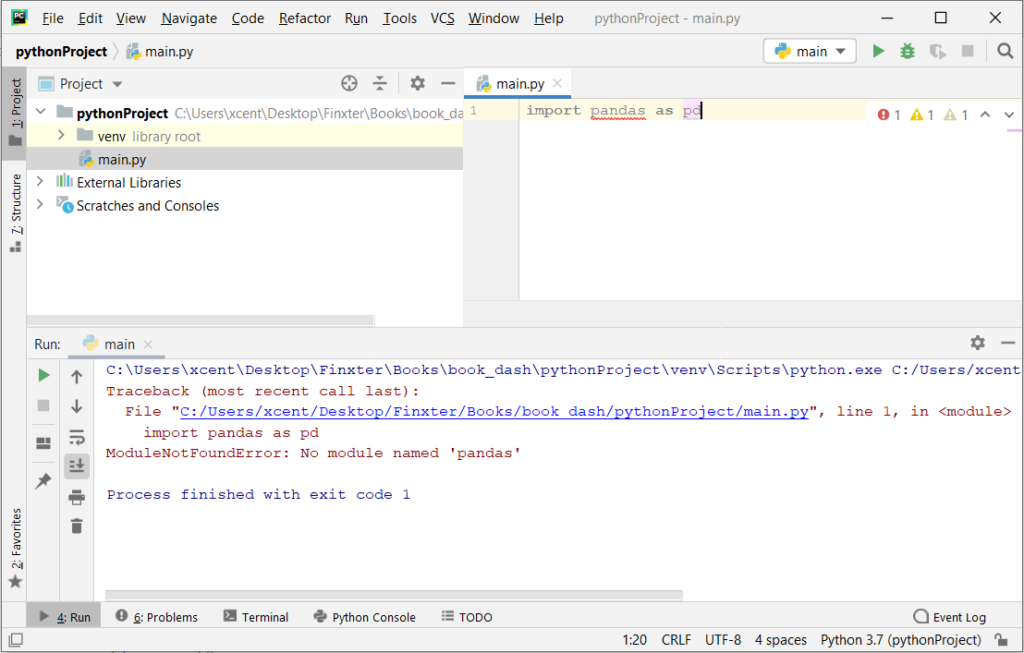
If you create a new Python project in PyCharm and try to import the Pandas library, it’ll throw the following error:
Traceback (most recent call last): File "C:/Users/xcent/Desktop/Finxter/Books/book_dash/pythonProject/main.py", line 1, in <module> import pandas as pd

ModuleNotFoundError: No module named 'pandas' Process finished with exit code 1
The reason is that each PyCharm project, per default, creates a virtual environment in which you can install custom Python modules. But the virtual environment is initially empty—even if you’ve already installed Pandas on your computer!
Here’s a screenshot:
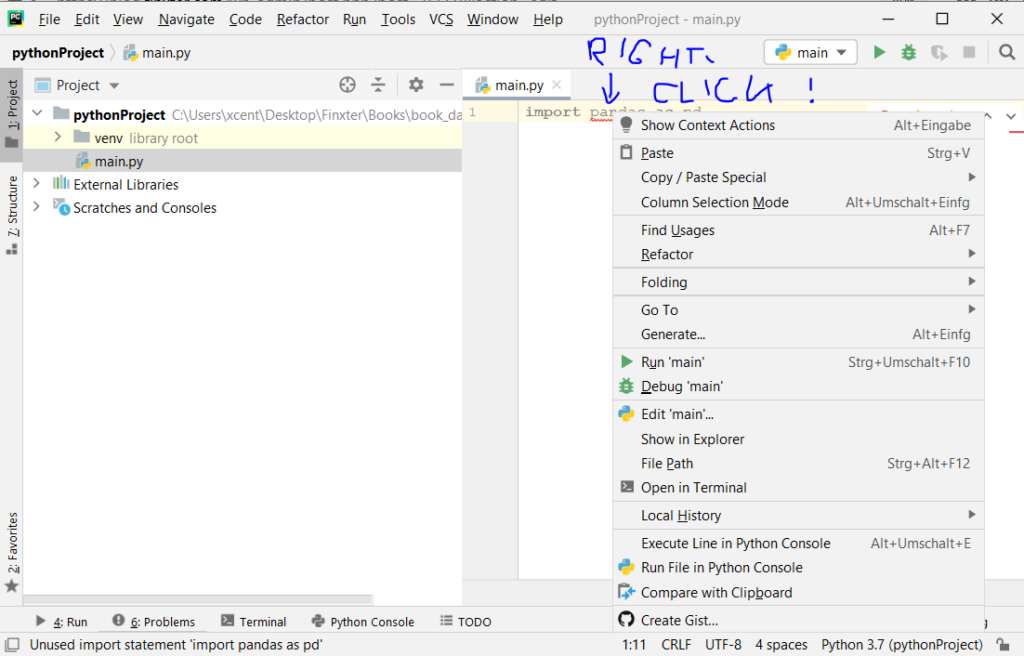
The fix is simple: Use the PyCharm installation tooltips to install Pandas in your virtual environment—two clicks and you’re good to go!
First, right-click on the pandas text in your editor:
Second, click “Show Context Actions” in your context menu. In the new menu that arises, click “Install Pandas” and wait for PyCharm to finish the installation.
The code will run after your installation completes successfully.
Spooky Bloodlines Bundle | 8 Steam Games | 93% OFF
[www.indiegala.com] ? Infernal Witches, Spooky Static, Ectoplasmic Gunk will haunt you with a bloody good deal! This Halloween you have one extra reason to stay inside: the Spooky Bloodlines Bundle, a bundle so scary, that even the price was so terrified it shrank in fear.
BIGGER, BETTER & BLOODIER THAN EXPECTED
[freebies.indiegala.com]
Day 8: Konami Publisher Sale, up to -85%
[www.indiegala.com] Today is the big day! Don't forget that these scary deals will also gift you free scratchy cards filled with mysterious Steam keys! To be more exact, for every purchase...you'll get something special: a BONUS Scratch Card with a secret Steam title in it for every store cart purchase! Booooo!
Nintendo’s latest sales data reveals Fire Emblem: Three Houses has now shifted 3.02 million units worldwide.
This makes it the best-selling entry in the entireFire Emblem series as of June this year. It’s taken the crown from Fire Emblem Fates on the 3DS.
Yesterday, it was also revealed how Paper Mario: The Origami King for Switch had become the fastest-selling entry in the Paper Mario series. It seems there’s a bit of a trend with all major IP on the hybrid system.
When Three Houses was released in July last year, we awarded it nine out of ten stars and said it set a new standard for strategy RPG games. Have you bought Fire Emblem: Three Houses on the Switch yet? Tell us below.
Random: Ball Guy Is Getting His Very Own Pokémon Trading Card
Ball Guy as seen in Pokémon Sword and Shield (2019)
One of the most memorable characters in Pokémon Sword and Shield is Ball Guy – a mascot for the Galar region Pokémon League. Each time you meet up with him throughout your journey, he gives you a different type of Poké Ball.
It seems he’ll be going beyond the video game very soon, as he’s making an appearance in the upcoming Pokémon Trading Card Game set, “Shiny Star V” – launching in Japan later this month on 20th November. Here’s a look, courtesy of Serebii.net webmaster and Nintendo Life contributor, Joe Merrick:
Many fans of Ball Guy are already requesting a “full art” version of him, and who knows what could happen now that he’s got his own trainer card. What do you think of this new card yourself? Do you collect Pokémon cards yourself? Comment down below.
Posted by: xSicKxBot - 11-08-2020, 12:18 AM - Forum: Lounge
- No Replies
Marvel's Spider-Man: Miles Morales Review Roundup
Ahead of the launch of the PlayStation 5 next week, reviews for Marvel's Spider-Man: Miles Morales have gone live. One of the launch games for Sony's next-gen console, developer Insomniac's return to New York City stars a younger and less experienced hero in the form of Miles Morales.
It's this youthful energy and optimism that critics have praised, with many reviewers noting that while this game isn't too mechanically different from 2018's Marvel's Spider-Man, it's still a great showcase for what the PlayStation 5 is capable of while telling a gripping tale of a young hero finding his own path in life.
In GameSpot's Marvel's Spider-Man: Miles Morales review, we scored it a 7/10. Critic Jordan Ramée said that "It's a bit of a bummer to see Marvel's Spider-Man: Miles Morales trip up at certain points, but thankfully, that doesn't happen often."
GIMP, or GNU Image Manipulation Program, just released version 2.99.2 beta, a giant step toward the upcoming 3.0 release. The heart of this update is the move to the GTK 3 UI toolkit from the existing GTK2 version. This has many advantages, especially when it comes to increasingly common HiDPI devices.
GTK3 based user interface, with native support for Wayland and HiDPI displays.
Major refactoring and cleanup
New plug-in API
Plugins now possible with Python 3, JavaScript, Lua, and Vala
More (color) space invasion
Render caching available for better performance
Be sure to check the complete release notes for further details on this release. You can also learn more about the 2.99.2 release and see GIMP in action in the video below.
How Apple Silicon Macs can supercharge computing in the 2020s
Before this year ends and the decade of the 2020s gets underway, Apple is poised to unveil a dramatic new architecture for its venerable Macintosh computing platform. Here’s why new Apple Silicon hardware is an important step in the future of the Mac.
Why Apple is moving to new silicon
Across the last four decades, Apple has uniquely made a series of radical moves to shift its Mac hardware to entirely new and materially different chip architectures.
No other computing platform has successfully performed such a complex undertaking on a similar scale even once, let alone attempting the three major platform shifts Apple has made on the Mac, from Motorola’s 68000 in the 1980s to PowerPC in the 90s and then to Intel x86 in the 2000s.
Each migration involved massive efforts to not only deliver new hardware, but also transform vast software platforms and create new development tools to minimize the transition pain of users and developers. When Apple migrated to PowerPC in the early 90s, other platforms of the day were supposed to complete parallel transitions of their own, including Microsoft’s Windows NT, IBM’s OS/2, the Commodore Amiga, and many others.
Apple’s unique ability to successfully complete the shift to PowerPC was complicated by other firms’ failing to do the same, resulting in Apple eventually ending up the only major PowerPC user. The difficulty of that transition and its unexpected result might suggest that in hindsight, it was ultimately a mistake to have attempted such a complex and risky task.
On the other hand, Apple’s migration to Intel Macs about a decade later was hailed as a masterful strategic move, enabling Apple to enter new markets and eventually expand its Mac platform dramatically. Yet Apple’s move to Intel’s chips starting in 2006 was largely enabled by the company’s previous PowerPC experience in learning how to execute such a transition.
An Apple Silicon transition that’s been underway for a decade
It’s useful to examine what benefit there is for Apple to again shift to an all-new chip architecture this year, this time using a custom silicon architecture of its own design rather than buying off-the-shelf chips available to any PC maker.
In a variety of ways, the Mac-maker’s move to new “Apple Silicon” isn’t entirely new. The company has been developing customized “System on a Chip” silicon since 2008, an effort which resulted in the A4 chip that powered iPhone 4, the original iPad, and the first iOS-based Apple TV.
Starting in 2016, Apple began shipping Macs equipped with T1, a custom SoC designed to handle Touch ID security and to provide the System Management Controller features that differentiated Apple’s Intel Macs from commodity Intel PCs. Even before the T1, Apple’s custom SMC microcontroller managed Macs’ power management, battery charging, sleep and hibernation, video display modes, and other features that customized and enhanced the Mac experience.
Apple’s T2 SoC
Since 2017, new Macs have included an even more advanced T2 SoC. This 64-bit chip handles everything from disk encryption to image processing, and enabled features ranging from iPad Sidecar to Hey Siri. The last few years of T2 Macs have effectively been Apple Silicon Macs with an Intel processor providing native x86 software compatibility!
How Macs got hooked on Intel chips
Apple’s Intel Macs currently use the same Intel x86 architecture as industry-standard PCs running Windows or Linux. In fact, the Intel chips in today’s Macs are inherently what made it so easy for Macs to run Windows software or run an instance of a Linux server.
That commonality and compatibility were originally touted as a major reason for Apple moving to Intel chips back in 2006.
Before that shift, Apple’s Macs used PowerPC chips that could boast a number of technical advantages over x86 chips. However, PowerPC increasingly struggled to keep up with the pace of Intel’s competitive x86 developments simply due to economic factors.
By 2004, Apple was the only significant vendor left using PowerPC chips. The rest of the desktop computing world had largely converged on x86 chips from Intel, creating vast economies of scale that supported Intel’s continued investment in future generations of its x86 chips.
With sales of Macs only growing incrementally and no remaining prospects for expanding the demand for PowerPC chips, the manufacturing partners behind the PowerPC architecture lacked any similarly secure financial backing needed to maintain parity with Intel’s relentless pace of ongoing silicon development.
Developing new generations of chips is vastly expensive work that simply couldn’t be competitively financed by a single PC maker shipping only around 3.3 million Macs per year. In 2004, Windows PCs were outselling Macs by a factor of 56. PC makers collectively sold 182.5 million units that year, creating a massive gulf between the PowerPC Mac platform and the Intel PC platform.
Apple’s jump from PowerPC to Intel erased that chasm and brought Intel’s economies of scale to the Mac, making it dramatically easier for Apple to not only keep up with its hardware rivals, but to innovate in other ways that contributed to Macs being more valuable than a bog-standard PC. Apple’s macOS itself was a major example of that, adding unique value to Apple’s platform in usability, security, and attractiveness.
In 2012, Horace Dediu described for Asymco how Apple turned around Microsoft’s dominant position in PCs, detailing how its differentiated Intel Macs rapidly shifted the ratio of Macs to PCs sold.
Windows units sold as a multiple of Apple devices. Source: Horace Dediu
Apple built a new non-Intel platform larger than the Mac
Another very significant shift began to occur immediately after Steve Jobs first debuted Apple’s initial Intel Macs back in 2006. The next year, Apple launched the iPhone, followed by its iOS-based iPad tablet in 2010.
Over the next decade, Apple’s new iOS mobile software platform (based on macOS) becomes at least as large and arguably an even more influential software and development platform than Windows, Linux, ChromeOS, or anything else— certainly within the emerging explosion of the mobile market.
Importantly, that new Apple platform didn’t need Intel chips. Rapidly expanding iPad sales drove Apple into the role of the world’s leading personal computing maker, even as an army of industry marketing groups desperately tried to portray iPad as nothing more than a “media consumption device.”
The reality was that iPads and iPhones were commonly replacing the historical roles of PCs while creating new markets for mobile computing that Intel-based PCs couldn’t match. It was a case of classic disruption: an innovative new product that could effectively compete against an existing, more complex, and expensive alternative that was “over-serving” the market.
Despite Microsoft’s various efforts to make its own “mobile Windows;” Intel’s various attempts to drive sales of its mobile x86 chips by Linux and Android makers; and Google’s efforts to copy Apple’s iPad using Android and also counter it with its own web-based “Chrome” PCs or netbooks, no other company has been able to develop a mobile computing apps platform capable of commercially rivaling Apple’s iOS and iPad OS on a similar scale, and with similar commercial results.
Rival mobile platforms supported the economies of scale that benefitted iOS
In fact, no one else has been able to achieve Apple’s success because nobody actually copied what Apple was doing. ChromeOS came closest: like Intel Macs, it launched a unique OS on relatively standard hardware.
Google just failed to gain any adoption for ChromeOS outside of U.S. schools looking for very cheap hardware.
Android licensees have collectively shipped lots of smartphones, but the value of the Android platform has splintered between app stores and hardware platforms. Rather than driving economies of scale that Apple couldn’t match, the commonality of Android licensees has largely just supported a more important industry-standard: ARM architecture hardware.
Because Apple was also using ARM chips in its iOS devices, it benefitted tremendously from the industry’s common use of the ARM architecture, including all the collective efforts poured into ARM silicon development and ARM architecture software tools, compilers, and other efforts.
So while Macs were leveraging Intel’s PC commonality to advance the unique value in macOS over Windows or Linux, Apple’s mobile device sales were leveraging the ARM architecture to support iOS and iPadOS as superior alternatives to Android.
But there was also a difference: while Intel’s desktop x86 represented a proprietary processor platform, the mobile ARM architecture was a technology Apple could license and independently develop on its own, adding unique value on the silicon level in the same way it had been doing in software with macOS, iOS and iPadOS.
Apple’s A4 leveraged ARM’s economies of scale while adding additional custom value
Embrace, extend, extinguish
By moving future generations of its Macs to its own uniquely enhanced silicon, Apple is again able to benefit from both common economies of scale and proprietary advancements that add unique value. It’s noteworthy that other competitors in the PC and mobile space have tried but failed to similarly do this.
Both Samsung and LG have attempted to acquire and develop their own unique software development platforms with Tizen and webOS. Yet outside of the smaller markets for smart TVs and watches, Android has effectively blocked their ability to drive volume sales of differentiated software on standard hardware, whether in phones or tablets or notebooks.
Huawei has similarly claimed that it is close to introducing its own internal OS platform out of necessity after the U.S. blocked it from using Google’s Android. But this has been merely disruptive to Huawei’s sales, because existing Android buyers don’t want a non-standard, non-compatible Android alternative.
Android was supposed to unite the industry against Apple. Instead, it has locked its licensees into a dependence upon Google and its policies, while effectively preventing those licensees from freely innovating on their own with their own software platforms.
In the other direction, Microsoft has made multiple attempts to shift Windows PCs and mobile devices from Intel to ARM, leveraging the mobile advantages of the ARM architecture. But Microsoft lacks Apple’s ability to decisively shift its entire platform to a new chip architecture because the majority of Microsoft’s Windows platform is delivered by PC licensees.
The minority of Windows-on-ARM devices that Microsoft and its partners ship simply splinters the Windows platform without offering significant added value. Unlike Apple, Microsoft also has no silicon expertise of its own, simply leaving it newly dependent on Qualcomm rather than Intel, and straddling both chip architectures the same way that Google’s support for both ARM and Intel in Android was a splintering liability rather than a real advantage.
Apple Silicon gives Macs a new platform advantage
In shifting from Intel x86 chips to its own Apple Silicon SoCs, Macs will lose some of the hardware compatibility they gained back in 2006. However, two things have changed since then.
First, the need to run Windows has fallen dramatically for many people for whom it was once very important. Secondly, Microsoft itself has developed the native ability to run Windows on ARM.
In parallel, Apple Silicon Macs will gain the ability to natively run ARM software developed for iOS. That not only means it will be a bit easier to develop for iOS on Macs and to migrate iOS apps to run on Macs, but also that it will be easier for both Apple and third-party developers to develop software tools and specialized code that uses not just ARM Architecture CPUs, but also the other silicon engines Apple has developed, including its custom Apple GPU, the Neural Engine, and features like its AMX machine learning accelerators.
For most users, these new advantages from Apple Silicon will be far more valuable than running the x86 version of Windows natively.
Note also that all of these custom silicon processor engines, each tuned to specific types of operations, are only a few years old. Driven by continued sales of iPhones, iPad, and Apple Silicon Macs, future development of Apple Silicon SoCs can adapt to handle specialized new functions that evolve in the near future.
By using its own silicon designs everywhere, Apple can not only enhance the Mac but also more rapidly bring advanced new technologies to other new products ranging from new types of wearables to home devices.
Rather than being stuck with the basic Intel x86 architecture that is optimized to deliver a classic PC experience, Apple can enhance its Apple Silicon Macs to deliver notebook and desktop machines that share more of its own vision for devices that don’t just calculate but blur the line between hardware and software in the model of Apple Watch, and seamlessly integrate with other devices in the model of Continuity.
T2 Apple Silicon
Apple has already pursued these goals by integrating large parts of its existing A-series chips into recent Macs by way of the T2, which brought Apple’s custom codecs, storage controllers, and security features such as the Secure Enclave to Macs.
In going one step further to replace Intel’s CPU, its integrated GPU, and other features currently handled by an x86 chip and the supporting hardware developed around Intel’s x86 architecture, Apple can radically take future Macs in a new direction that will leave behind standard PCs the same way that iPad has left simpler Android tablets in the dust, or the way iPhone silicon has rapidly advanced beyond what is even available in an Android phone.
Custom T2 Apple Silicon has already brought differentiating features to Intel Macs, including Touch ID, SideCar, Touch Bar and Hey Siri
Over the past ten years, Macs have increasingly been held back by Intel’s x86 architecture more than they have benefitted from its economies of scale. It’s now the perfect time to shift mobile Macs to the much more power-efficient, graphically powerful, and broadly sophisticated imaging and machine learning silicon that shares economies of scale with Apple’s own iOS hardware.
Additionally, Apple will gain another major benefit: leveraging the advanced 5nm silicon manufacturing technology of TSMC that is far ahead of Intel’s current 10nm chip manufacturing capacity in its tenth generation Ice Lake x86 chips.
This is also a big loss for Intel, as Apple represents one of its most valuable and technologically demanding clients. With Microsoft and other PC makers also shifting some of their production to various alternative chip makers, the Intel x86 platform will suffer a major weakening of its economies of scale, something that will also detriment every PC maker relying on Intel to help them keep parity with Apple.
Recall that it was Intel that drove industry-wide efforts to get PC makers to deliver ultralight notebooks that could compete with Apple’s MacBook Air.
With Intel increasing unable to help PC competitors copy Apple’s work, we’re likely to see Macs peel ahead of commodity PCs at a pace closer to iPads advancing beyond other tablets, or Apple Watch leaving behind other smartwatches, or iPhones advancing while Android phones scale back their ambitions to instead reach lower price points.
That will be an important development because PCs under the control of Intel have not previously advanced as fast as mobile devices have. It’s also a development that could spur other companies to try new approaches rather than just cranking out more generic PC boxes wrapped around an Intel platform and running a Microsoft OS.
If they are unable to compete, we’re likely to see a major new bloom in Mac sales that brings more advanced, connected, and broadly powerful computing to creative users, to businesses, to education, and elsewhere, driving similar advancements in desktop computing as we’ve already seen in phones and tablets.
And if anyone else is able to complete, we’ll see even broader technical advancements driving the state of the art even faster.
Feature: Best Point And Click Adventure Games For Nintendo Switch
In the years since launch, Nintendo Switch has hosted games from across the genres, including an array of old-school point and click adventure games — a genre which flourished on PCs in the old days and one which Nintendo’s hybrid console offers a convenient way to play. The system’s touchscreen makes it an ideal match for games which would have traditionally been best paired with a mouse, but many adventure games these days function just as well whether you’re playing docked to your TV with a pad or you’re out and about with your Switch in handheld mode.
Below you’ll find our recommendations — in no particular order — for the best adventure games on Switch; games less swashbuckling and more navigating conversation trees and tapping verbs and objects. Of course, some of the very best point and clicks ever made are swashbuckling adventures, although the infamous Mr Guybrush Threepwood hasn’t swung to Switch in a Monkey Island port just yet. It’s only a matter of time, surely?
If you prefer first-person narrative games, we’ve got another list of the best Switch ‘walking simulators’ and environmental narrative adventure games for you to peruse, and we’ll cover visual novels at some point in the future, too. Due to the large Venn diagram of adventure game types, you’ll find a few edge cases in the list below but we wanted to cast our net wide, even if that means stretching the definition in order to get more quality games under your nose — games which otherwise might not sit comfortably on any of our Switch essentials genre collections.
So, sit back and prepare to scroll through the best point and click adventure games on Switch.
Point-and-click beginners may struggle with the myriad puzzles Thimbleweed Park lays across its curiosity-piquing plot, but its developers have rightfully made it possible to get ahead even when all you see are dead ends, with the inclusion of the tips line. This is a love letter to the LucasArts adventure games of old, updated to be as convenient as possible without stripping away the challenge or the charm. These updates mean that what would have been an essential only for a very specific audience is, with no explicit fail states, easy for anyone to not just enjoy, but actually finish. And going around for a second time is still a treat, much as Monkey Island et al were, as you can clearly see all the pieces of the grander picture coming together to comprise a fascinating whole, climaxing with one of gaming’s better twists.
Bulb Boy won’t stay in your memories forever; it is a relatively small game that shouldn’t take too long to complete, but whilst it lasts it offers nicely designed puzzles and an underlying humour that offers a different experience. It is clearly lovingly put-together and refreshingly manages to make horror cute and fun, rather than taking itself seriously. Bulb Boy appeal comes in the form of its characters, craziness and toilet humour – a deadly combination that deserves to be played.
2064: Read Only Memories INTEGRAL takes the classic point-and-click genre of old, strips out many of the annoyingly exacting puzzle systems, and injects a refreshingly positive and progressive outlook. A cast of memorable characters and some spot-on retro presentation should seal the deal for fans of a good story and snappy dialogue.
Publisher: Headup Games / Developer: Studio Fizbin
Release Date: 3rd Aug 2018 (USA) / 3rd Aug 2018 (UK/EU)
The first Inner World introduced the entertaining, eccentric world of Asposia and the naïve flute-nose Robert, but its lack of touchscreen support left us feeling frustrated. This sequel, however, addressed our primary issue with the original and improved things no-end, making The Last Wind Monk a much easier recommendation. Experimentation is a breeze with touch controls and the expanded possibilities offered by character-switching mean puzzles feel more varied. It maintains the original’s great writing and presentation, but offers a far better all-round experience, making it the best entry point for Switch owners. We’ve still got our fingers crossed for a part three.
Publisher: Another Indie Studio / Developer: HomeBear Studio
Release Date: 29th Nov 2018 (USA) / 29th Nov 2018 (UK/EU)
There’s a good chance you’ve probably never heard of NAIRI: Tower of Shirin, but that doesn’t mean this hidden gem should pass you buy. Sure, it doesn’t have the pedigree of a Double Fine game or the licence exposure of something from TellTale’s back catalogue, but it still offers up a safe and engaging world full of quirky characters, challenging puzzles and all the screen-tapping backgrounds you could ask for. It’s no great reimagining of the genre, but it’s still a curio worth playing nonetheless.
Publisher: Night School Studio / Developer: Night School Studio
Release Date: 6th Oct 2017 (USA) / 6th Oct 2017 (UK/EU)
A genuinely creepy creation, Oxenfree combines a clever story and smart dialogue mechanics with superbly sinister music to leave a deep and lasting impression on the player, one that should encourage an all-important second playthrough. Fans of Stranger Things and Poltergeist will love the direction this game takes – if not to hell and back, exactly, then absolutely to some other place where horrors abound, just waiting for an invitation into our world. It’s yet another Switch essential, and playing with a touchscreen gives it a more point-and-click flavour.
Release Date: 28th Jan 2020 (USA) / 28th Jan 2020 (UK/EU)
Kentucky Route Zero: TV Edition is the full and complete Kentucky Route Zero experience. A magical realist point-and-click adventure that takes you on a beguiling journey to a place that exists both below and beyond. It’s a trip to be savoured, ruminated on; no need to rush. Each act here brings with it some new perspective, new places and people to forge deep connections with. You may be confused, even bewildered by your initial steps down into the subterranea that exists somewhere beneath this version of Kentucky but, by the end of your journey, you’ll have made friends and memories and been escorted through a rich and beautiful experience that will stay with you much longer than you may expect.
Release Date: 29th Aug 2019 (USA) / 29th Aug 2019 (UK/EU)
A point-and-click aventure game with a cool ’60s styling and an intriguing story, we missed out on reviewing Agent A: A Puzzle in Disguise, although Nintendo Life readers brought it to our attention. It’s a stylish little adventure and well worth investigation if you’re a fan of non-serious secret agent puzzling with the classic (or should that be cla-shic) James Bond flavour.
GTA 5, Red Dead Redemption 2 PS5 And Xbox Series X Compatibility Detailed
Rockstar Games has detailed how some of its big games, including Grand Theft Auto 5 and Red Dead Redemption 2, will work on the new PS5, Xbox Series X, and Series S. Those games will be backward compatible on both next-gen consoles upon launch next week. This also includes the most recent version of LA Noire, and the PlayStation VR La Noire: The VR Case Files.
The backwards compatibility includes cross-saves, so you can pick up right where you left off by transferring your save file or downloading from the cloud. All of your online progress in GTA Online or Red Dead Online will come across too, as long as you're using the same account information that's linked to your game profiles.
Rockstar also noted that all the previous Xbox One backward compatible games would continue to work on Series X and Series S, and compatible PS2 games will be playable on PS5: