Black Desert Mobile Is the Best Place to Play Flappy Bird
By Joe Robinson21 Jan 2020
Do you guys remember Flappy Bird? Now that was definitely a craze… I only dabbled in it a bit, but you could see what made it a weird success – simple controls, high skill barriers but low barrier for entry. Getting attention from popular YouTubers helped, of course, but it’s often the simpler titles that are most susceptible to that kind of attention.
I remember when Flappy Bird was pulled from the app store, people were selling their phones and other devices that had the game installed still. Crazy stuff.
If you’re pining for those halcyon days, I’ve got some great news for you – the spirit of Flappy Bird is alive and well within Black Desert Mobile.
Whenever the game needs to download an additional update, you get presented with this screen:
Tapping the button will send you to a download screen with a mini-game embedded within it. You have to guide the Black Spirit through the side-scrolling environment, avoiding obstacles as you go. Hitting certain distance milestones nets you some minor in-game rewards, and if you managed to collect enough gems you gain extra lives. Naturally, the further you go, the quicker the game gets.
I’ve tried a number of control tactics – constant presses, tapping, a mix of both… but I’m as good at this mini-game as I was the original Flappy Bird (that is, not great).
You get to play this mini-game every time there’s an update, and judging by the email I just got another sizable one has just landed. This latest update adds Siege Wars for guilds (a new type of PvP activity), as well as the Asura’s Den mini-game. A new class called the Sorceress is also on her way.
Now, that’s not to detract from the fact that BDM is also a pretty impressive mobile MMORPG in its own right, but there are worse reasons to try it out than just because there’s also an addictive mini-game embedded in the download screen.
Apple to launch new affordable iPhone model in March
By Mikey Campbell Tuesday, January 21, 2020, 05:31 pm PT (08:31 pm ET)
Adding to a raft of rumors surrounding a low-cost iPhone model tentatively dubbed “iPhone SE 2,” a report on Tuesday claims the hotly anticipated iPhone SE-tier follow-up is going into production next month.
Citing sources familiar with the matter, Bloomberg reports Apple suppliers are slated to begin manufacturing the as-yet-unannounced affordable iPhone variant in February ahead of a public debut in March.
Apple last launched a handset aimed at the mass-market with the iPhone SE in March 2016. That model borrowed a design from iPhone 5s, which was two years old at the time, and packed it with then-current tech including an A9 processor and a 12-megapixel camera. The model was priced at $399.
The tech giant is expected to follow a similar strategy with “iPhone SE 2.” According to analyst predictions, the upcoming handset is anticipated to share an external design with iPhone 8, currently the cheapest iPhone offering at $449. A 4.7-inch screen is also expected, as is the inclusion of a Touch ID home button for biometric authentication and user interface navigation.
Like iPhone SE, the next-generation low-cost iPhone is rumored to boast Apple’s latest processor technology, the A13 Bionic, as well as current-generation camera technology.
A number of trade industry publications have speculated on Apple’s 2020 iPhone roadmap, with some claiming the company might launch two low-cost models in 2020. Noted analyst Ming-Chi Kuo suggested Apple is indeed developing a larger-screened “iPhone SE 2,” but intends to release the handset in 2021. Other rumblings suggest Apple is working on an “SE 2” variant with full-face display and Face ID, though the validity of those assertions are shaky at best due to prohibitive production costs.
Hon Hai, Pegatron and Wistron have been tapped to assemble the next-generation affordable iPhone, according to today’s report.
The PIRATE WARRIORS series has successfully combined the popular anime ONE PIECE with the thrilling action of the WARRIORS series to create a worldwide phenomenon selling more than four million copies! Based on the concept of “fighting hordes of enemies while adventuring with trusted allies,” experience awesome ONE PIECE action lifted straight from the anime!
Xbox Insider Release Notes – Alpha Skip Ahead Ring (2004.200111-0000)
Hey Alpha Skip-Ahead ring users! Today’s Xbox Insider Release Notes highlight the latest fixes, known issues, and features coming to your console. Starting at 2 p.m. PT today, users will receive the latest 2004 Xbox One system update (build: RS_XBOX_RELEASE_2004\19041.1381.200111-0000). Keep reading for more details.
System Update Details:
OS version released: RS_XBOX_RELEASE_2004\19041.1381.200111-0000
Available: 2 p.m. PT – January 13, 2020
Mandatory: 3 a.m. PT – January 14, 2020
Fixes for Alpha Skip-Ahead
We’ve heard your feedback, and we’re happy to announce the following fixes have been implemented for this 2004 build:
Audio
Users should no longer see their headphones change to Windows Sonic from Dolby Atmos when console is restarted.
System
Various updates to properly reflect local languages across the console.
Known Issues for Alpha Skip Ahead
We understand some issues have been listed in previous Xbox Insider Release Notes. These issues aren’t being ignored, but it will take Xbox engineers more time to find a solution. We appreciate your patience at this time!
Audio
Users who have Dolby Atmos enabled and console display settings set to 120hz with 36 bits per pixel (12-bit) are experiencing loss of Dolby Atmos audio in some situations.
Workaround: Disable 120hz or set Video Fidelity to 30 bits per pixel (10-bit) or lower.
Home (Experiment)
Users may see the images for ads on the dashboard looking cropped or cutoff.
Messaging
Users are reporting being unable to send a voice messages while in Parties.
Workaround: Send the message while not currently in party chat.
My Games & Apps
Users’ tile size choices in collection will revert to large in some sections.
Settings
Some users have reported that 3D display mode is not working with supported content.
Profile Color
Sometimes users may encounter the incorrect Profile color when powering on the console.
Are you not seeing your issue listed above? Make sure to use Report a problem to keep us informed of your issue. We may not be able to respond to everyone, but the data we’ll gather is crucial to finding a resolution.
Learn more about feedback and how each ring is differentiated in the following links:
For more information regarding the Xbox Insider Program follow us on Twitter and join the community subreddit for support and updates. Keep an eye on future Xbox Insider Release Notes for more information regarding your Xbox One Update Preview ring!
Posted by: xSicKxBot - 01-22-2020, 07:34 AM - Forum: Lounge
- No Replies
Report: TikTok owner ByteDance planning big push into mobile games
TikTok owner ByteDance has been quietly building an internal game division so it can break into the lucrative mobile games market.
According to Bloomberg, the Chinese internet company has already purchased a number of development studios and exclusive distribution rights, and is preparing to releases its first two titles later this spring.
“People familiar with the matter” claim the company is specifically targeting the both the local and overseas non-casual market, and has been filling its ranks with “top talent” from rival game companies.
Although ByteDance has already produced a number of casual games that pulled in ad-based revenue, the company is reportedly keen to make a larger strategic shift so it can begin targeting big-spending ‘hardcore’ players.
As such, its current game pipeline will include massively multiplayer online games with “Chinese fantasy elements,” which will be built by newly acquired studios with plenty of experience in the genre.
Of course, in order to make any real headway ByteDance will need to challenge the dominance of Tencent — and that’s no easy feat. Aside from being the biggest player in the Chinese mobile games market, Tencent also has stakes in a number of Western companies including Riot Games, Supercell and Epic Games.
It’s a situation that means, while ByteDance might be able to disrupt the status quo established by Tencent, it’ll struggle (for the time being, at least) to pose a real threat to its Chinese rival.
“[ByteDance’s] massive global user base and investment in gaming could make it a big disruptor in the gaming space this year,” said Niko Partners analyst Daniel Ahmad, speaking to Bloomberg.
“[However,] while they may be able to develop a number of hit titles in the China market, we believe it will still be difficult for them to truly challenge Tencent.”
Posted by: xSicKxBot - 01-22-2020, 07:34 AM - Forum: Lounge
- No Replies
Wherever you are in your game design career, come advance it at GDC!
Game Developers Conference organizers are dedicated to cultivating space for attendees of all stripes and skill levels to grow their game industry careers, and today we wanted to highlight some of the unique opportunities game designers will find at GDC 2020 in March!
Most game designers will want to pay special attention to the Design track at GDC 2020, which will continue to be updated with GDC 2020 talks aimed at helping you discover ideas for new games, learn tips to push your project forward, and master the use and tuning of an ever-increasing number of tools, systems, and techniques required to design great games.
To quickly get up to speed on some of the latest game design techniques, check out some of the many game-specific Design sessions available to GDC 2020 attendees. “Curiosity-Driven Exploration: The Design of ‘Outer Wilds’“, for example, will give you an hour with the co-creative leads on 2019 hit Outer Wilds as they share techniques for inspiring and rewarding player curiosity, surmounting the challenges of communicating an unconventional game structure, and how curiosity-driven exploration fits into the broader landscape of open-world game design!
And in “Becoming a Jedi: Gameplay in ‘Jedi: Fallen Order‘” Respawn’s Justin Perez will give you an inside look at specific gameplay design decisions made during the development of Jedi: Fallen Order, including changes and cuts made along the way. Come spend an hour in an air-conditioned conference room and learn everything about the design of a game set in a popular galaxy far, far away.
Riot has been responsible for some of the grabbiest game design in the business, so don’t overlook your opportunity to learn more about the League of Legends studio’s learnings while making its hit new game Teamfight Tactics! In ‘Teamfight Tactics‘ Design Lessons at GDC 2020, game designers will learn how to characterize an audience and use that characterization to make design decisions, and how to lead teams to take real design risks and make necessary pivots — even when deadlines loom!
Working in the ever-expanding business of free-to-play games requires a fundamental shift in the way we think about game design, and you can get some great insight into that shift in a special GDC 2020 talk on “Blockers: Analyzing Difficulty Drivers in Candy Crush Games“; King’s Lucien (Yen-Chu) Chen will showcase a new method of analyzing “blockers” in F2P which creates a common language for designers. Expect to use this analysis to understand how a game “feels” based on the blockers it uses, and recognize what types of blockers are missing in your game.
“Rules of the Game 2020: Five Unique Techniques from Distinguished Designers” is a great GDC 2020 talk that should be helpful for game designers of all skill levels, as it features five accomplished game designers sharing their very specific, practical, unique, and personal game design rules. Expect to leave with an interesting new set of design principles to try out on your own projects!
Next year GDC 2020 runs from Monday, March 16th through Friday, March 20th. This will be the 34th edition of GDC, and now that registration is officially open, you’ll want to take a look at the (ever-expanding) session schedule and your GDC pass options — register early to lock in the best price!
Posted by: xSicKxBot - 01-22-2020, 07:34 AM - Forum: Lounge
- No Replies
The Matrix 4 Will Miss One Key Cast Member From The Original Movies
The upcoming fourth movie in The Matrix series has been gathering an impressive cast list over the past few months, including original stars Keanu Reeves and Carrie-Ann Moss. But The Matrix 4 will sadly won't feature one key actor from the first three films. It has been confirmed that Hugo Weaving isn't returning to reprise his villainous role as Agent Smith.
In an interview with Time Out, Weaving reveals that he was approached by director Lana Wachowski to appear in The Matrix 4, but a scheduling conflict with his role in the stage play The Visit in London made it impossible. "It's unfortunate but actually I had this offer [for The Visit] and then the offer came from The Matrix," he explained. "So I knew it was happening but I didn't have dates. I thought I could do both and it took eight weeks to work out that the dates would work--I held off on accepting [a role in The Visit]. I was in touch with Lana Wachowski, but in the end she decided that the dates weren't going to work. So we'd sorted the dates and then she sort of changed her mind. They're pushing on ahead without me."
While this is disappointing news for fans, the cast list for The Matrix 4 so far is still very exciting. Reeves and Moss will return as Neo and Trinity, with Jada Pinkett Smith also reprising her role as Niobe. The new cast members include Yahya Abdul-Mateen II (Aquaman), Neil Patrick Harris (How I Met Your Mother), and Jessica Henwick (Iron Fist). The movie hit theaters on May 21, 2021--which is also the release date for another Reeves-starring action sequel, John Wick: Chapter 4.
Wachowski helmed the previous three Matrix movies with sister Lilly. The first Matrix movie brought in $463.5 million worldwide, and it spawned two sequels: 2003's Matrix Reloaded--grossing $742.1 million worldwide--and Matrix Revolutions--taking in $427.3 million worldwide. For more, check out The Matrix Sequels' 34 Dumbest Moments to relive the weirdness.
How Quarkus brings imperative and reactive programming together
The supersonic subatomic Java singularity has expanded!
42 releases, 8 months of community participation, and 177 amazing contributors led up to the release of Quarkus 1.0. This release is a significant milestone with a lot of cool features behind it. You can read more in the release announcement.
Building on that awesome news, we want to delve into how Quarkus unifies both imperative and reactive programming models and its reactive core. We’ll start with a brief history and then take a deep dive into what makes up this dual-faceted reactive core and how Java developers can take advantage of it.
Microservices, event-driven architectures, and serverless functions are on the rise. Creating a cloud-native architecture has become more accessible in the recent past; however, challenges remain, especially for Java developers. Serverless functions and microservices need faster startup times, consume less memory, and above all offer developer joy. Java, in that regard, has just in recent years done some improvements (e.g., ergonomics enhancements for containers, etc.). However, to have a performing container-native Java, it hasn’t been easy. Let’s first take a look at some of the inherent issues for developing container-native Java applications.
Let’s start with a bit of history.
Threads and containers
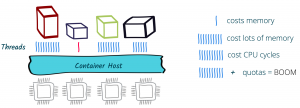
As of version 8u131, Java is more container-aware, due to the ergonomics enhancements. So now, the JVM knows the number of cores it’s running on and can customize thread pools accordingly — typically the fork/join pool. That’s all great, but let’s say we have a traditional web application that uses HTTP servlets or similar on Tomcat, Jetty, or the like. In effect, this application gives a thread to each request allowing it to block this thread when waiting for IO to occur, such as accessing databases, files, or other services. The sizing for such an application depends on the number of concurrent requests rather than the number of available cores; this also means quota or limits in Kubernetes on the number of cores will not be of great help and eventually will result in throttling.
Memory exhaustion
Threads also cost memory. Memory constraints inside a container do not necessarily help. Spreading that over multiple applications and threading to a large extent will cause more switching and, in some cases, performance degradation. Also, if an application uses traditional microservices frameworks, creates database connections, uses caching, and perhaps needs some more memory, then straightaway one would also need to look into the JVM memory management so that it’s not getting killed (e.g., XX:+UseCGroupMemoryLimitForHeap). Even though JVM can understand cgroups as of Java 9 and adapt memory accordingly, it can still get quite complex to manage and size the memory.
Quotas and limits
With Java 11, we now have the support for CPU quotas (e.g., PreferContainerQuotaForCPUCount). Kubernetes also provides support for limits and quotas. This could make sense; however, if the application uses more than the quota again, we end up with sizing based on cores, which in the case of traditional Java applications, using one thread per request, is not helpful at all.
Also, if we were to use quotas and limits or the scale-out feature of the underlying Kubernetes platform, the problem wouldn’t solve itself; we would be throwing more capacity at the underlying issue or end up over-committing resources. And if we were running this on a high load in a public cloud, certainly we would end up using more resources than necessary.
What can solve this?
A straightforward solution to these problems would be to use asynchronous and non-blocking IO libraries and frameworks like Netty, Vert.x, or Akka. They are more useful in containers due to their reactive nature. By embracing non-blocking IO, the same thread can handle multiple concurrent requests. While a request processing is waiting for some IO, the thread is released and so can be used to handle another request. When the IO response required by the first request is finally received, processing of the first request can continue. Interleaving request processing using the same thread reduces the number of threads drastically and also resources to handle the load.
With non-blocking IO, the number of cores becomes the essential setting as it defines the number of IO threads you can run in parallel. Used properly, it efficient dispatches the load on the different cores, handling more with fewer resources.
Is that all?
And, there’s more. Reactive programming improves resource usage but does not come for free. It requires that the application code embrace non-blocking and avoid blocking the IO thread. This is a different development and execution model. Although there are many libraries to help you do this, it’s still a mind-shift.
First, you need to learn how to write code executed asynchronously because, as soon as you start using non-blocking IOs, you need to express what is going to happen once the response is received. You cannot wait and block anymore. To do this, you can pass callbacks, use reactive programming, or continuation. But, that’s not all, you need to use non-blocking IOs and so have access to non-blocking servers and clients for everything you need. HTTP is the simple case, but think about database access, file systems, and so on.
Although end-to-end reactive provides the best efficiency, the shift can be hard to comprehend. Having the ability to mix both reactive and imperative code is becoming essential to:
Use efficiently the resources on hot paths, and
Provide a simpler code style for the rest of the application.
Enter Quarkus
This is what Quarkus is all about: unifying reactive and imperative in a single runtime.
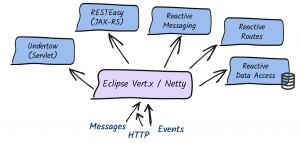
Quarkus uses Vert.x and Netty at its core. And, it uses a bunch of reactive frameworks and extensions on top to help developers. Quarkus is not just for HTTP microservices, but also for event-driven architecture. Its reactive nature makes it very efficient when dealing with messages (e.g., Apache Kafka or AMQP).
The secret behind this is to use a single reactive engine for both imperative and reactive code.
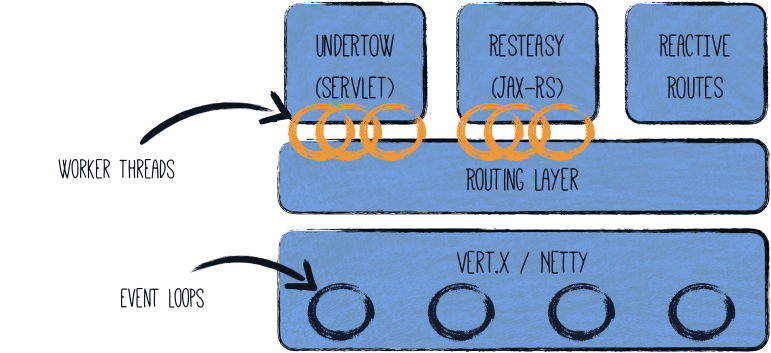
Quarkus does this quite brilliantly. Between imperative and reactive, the obvious choice is to have a reactive core. What that helps with is a fast non-blocking code that handles almost everything going via the event-loop thread (IO thread). But, if you were creating a typical REST application or a client-side application, Quarkus also gives you the imperative programming model. For example, Quarkus HTTP support is based on a non-blocking and reactive engine (Eclipse Vert.x and Netty). All the HTTP requests your application receive are handled by event loops (IO Thread) and then are routed towards the code that manages the request. Depending on the destination, it can invoke the code managing the request on a worker thread (servlet, Jax-RS) or use the IO was thread (reactive route).
For messaging connectors, non-blocking clients are used and run on top of the Vert.x engine. So, you can efficiently send, receive, and process messages from various messaging middleware.
To help you get started with reactive on Quarkus, there are some well-articulated guides on Quarkus.io:
There are also reactive demo scenarios that you can try online; you don’t need a computer or an IDE, just give it a go in your browser. You can try them out here.
The Java Platform Module System (JPMS) main goal is to make it easier to construct and maintain Java libraries and large applications. You will also experience improved application performance by scaling down the Java SE platform and JDK.
In a series of five tutorials, Deepak Vohra explains how to use the module system in your applications. He walks you through setting up your environment, creating classes within modules, configuring VM Args for your module path and running your application.
Your application will be portable when you use a module as a JAR file. Deepak explains how to create and export a Java project as a JAR file using Eclipse IDE. The tutorial is a step-by-step guide from setting up your environment to running your application.
With the JPMS, you still need to manage your application dependencies, including third-party application dependencies. The last two tutorials detail how to create a module which depends on another module’s dependencies. To use multiple modules, you need to create multiple Java projects in Eclipse because Eclipse does not allow creating multiple modules in one project. The last article describes how to configure the two Java projects and run the main module application to demonstrate module dependency.
Best Gifts For Gamers 2020: Nintendo Switch, PS4, Xbox One, And PC
It can be hard to find the right gift for a gamer. If you don't play games yourself but have a gamer on your shopping list for a birthday or holiday, you probably have a lot of questions--what are the most popular games right now? How do you pick between Xbox, PlayStation, and Switch? What about PC games? What's the difference between a Switch and a Switch Lite? Do gamers play tabletop/board games too? Virtual reality--do gamers care? Then there's the endless amount of gaming tech, peripherals, and merchandise. Where do you even start?
Whether you’re shopping for a birthday, specific holiday, or just want to surprise them with something nice, no need to worry--we have gift buying guides for every kind of gamer and every kind of budget. From games and consoles to accessories and merchandise, here are the best gifts for gamers for any occasion.
Best Video Game Gifts By Platform
If you know what system your loved one likes to play games on, the easiest solution is to pick up a new game for their library. A new game always makes a great gift, and there are plenty to choose from! Here are some of our personal top picks from recent years.
A Plague Tale: Innocence
Best PS4 Gift Ideas
GameSpot's best PlayStation games of 2019 included Resident Evil 2, Sekiro: Shadows Die Twice, and Control. The latest in popular first-person shooter series Call of Duty, the new Star Wars game, and sports games like Madden would make great gifts too. Want more options? Check out the list below or browse our list of the best PS4 games of all time.
Some great Xbox titles include role-playing game The Outer Worlds and stealth adventure game A Plague Tale: Innocence (both of which made our Best Games of 2019 list) as well as third-person shooter Gears 5. Want more options? Check out the list below or browse our list of the best Xbox One games of all time.
Pokemon Sword and Shield was one of our top picks for best Switch games to buy during the holidays and one of the best Switch games of 2019. It remains popular, especially with the recently announced expansions on the way. There's also Luigi's Mansion 3, Fire Emblem: Three Houses, and Assassin's Creed: The Rebel Collection. Want more options? Check out the list below or browse our list of the best Nintendo Switch games of all time.
There's only one thing better than a video game when it comes to game-related gifts, and that's a brand-new console or console-related accessories.
If you're going to buy a new console, we have a list of the current best deals you can get on the PS4, Xbox One, and Switch, including the relatively new Switch Lite. We also have a separate buying guide for the Nintendo Switch since there are a few different versions and controller options to choose from. You can also grab the Sega Genesis Mini, which was a popular retro console that was released in 2019, based on the classic Sega Genesis from 1989. Adding in an extra controller or a headset is always a good idea too. It's also worth noting that a new wave of next-gen consoles, the PlayStation 5 and Xbox Series X, are slated to launch this holiday season, but pre-orders are not yet available.
With the exception of controllers, most great gaming accessories are just optional luxuries, so they make great gifts. Headphones, charging stations, carrying cases, storage devices, and more--treat someone with the best accessories from our console gaming gift guides below.
Virtual reality has garnered a bit more interest in the last couple months with the reveal of a highly-anticipated Half-Life sequel called Half-Life: Alyx, so a VR headset would make a perfect gift if you're willing to spend big.
The best VR headset to get depends a lot on what kind of gaming PC or console the gift-receiver has. The best VR headsets for gamers with VR gaming-ready PCs include the Oculus Rift S, the Valve Index, and the HTC Vive. PlayStation VR is perfect for PS4 owners who don't have a gaming PC but still want to experience VR. Other VR headset options for people who don't have a gaming PC are the Oculus Quest, a standalone VR headset, the Oculus Go, and--for mobile-compatible VR--the Samsung Gear VR or Google Daydream View.
PC gamers can be a bit harder to shop for because most PC games are purchased digitally and the hardware can be a lot pricier. There are so many brands at so many different price points--Alienware, Razer, ASUS, Logitech, Corsair, and more--and they're all popular for very specific reasons. We've broken down some of the major PC gaming categories in the gift guides below.
If you don't have the time, expertise, or budget to get a gaming console or fancy headset for the gaming fan in your life, and you're not sure which of the popular games they've played already, there's still a number of cool gifts for you to choose from, including fun services and more traditional games the whole family can play.
Best Subscription Services For Gamers
Subscription services like PlayStation Plus and Xbox Game Pass, which can be purchased on a monthly or yearly basis, give gamers access to tons of additional games, online services, and bonuses. Year-long subs usually cost less in the long run, but can still get super pricey, so they make really excellent gifts--especially if you're not sure what game to get someone.
Amiibo and Funko Pop figures are two of the most popular gaming-related collectibles because they're affordable and feature a wide variety of fan-favorite characters from franchises across gaming, movies, comics, and TV. You can find a few great Amiibo in our Switch accessories gift guide, plus a breakdown of some of the most popular Funko Pop figures in our Funko Pop gift guide. These make cool gifts on their own, but they can also act as a stocking stuffer for the holidays or an added bonus to turn a great gift into a perfect gift set.
If the gamer you're shopping for is all Fortnite, all the time, check out our Fortnite gift guide for the best gifts related to the hit battle royale game.
Board and card games are accessible to people of all ages. They make great gifts for gamers and families who like to game, even if it's not in front of the TV. Browse our tabletop games guide below for some good ideas that fit any budget range.