Posted on Leave a comment

Employees at India’s largest bank embrace citizen developer revolution with Microsoft Power Apps

When B. Ramkumar was tasked with preparing daily reports on marketing leads from hundreds of Microsoft Excel sheets for his managers, he figured there had to be a more efficient way to get the task done.

Ramkumar’s team collates all the reports that each of the nearly 1,500 offices under their jurisdiction send them. These reports, created by multiple teams within each office, contain potential leads for the sales teams to follow and are an important tool for the management to identify new business opportunities for the bank. Except the reports wouldn’t always get uploaded correctly and multiple users working on live data would cause significant data loss.

“While we could collect all this information from various sources, there was no centralized location to store and follow up on them. I wanted us to do more at a local level, so we could track these better,” says R. Radhakrishna, chief general manager of State Bank of India’s Chennai local head office.

SBI is the country’s largest bank with over 450 million customers and more than 250,000 employees. Today, all SBI’s employees have Office 365 and use services, such as OneDrive, Teams, SharePoint Online and Power Apps, as part of a digital transformation that the 220-year-old bank underwent in 2017.

At a time where there’s an app for almost everything, Ramkumar, a manager in the digital and transaction banking unit at SBI’s Chennai office, toyed with the idea of creating an app that could automate the data collation process and present the data visually.

“I thought, why not convert the Excel sheet we send out into an app that would be user friendly—not just for the people in the branches, but also for the back offices that were monitoring the data? Which is how we came up with the idea of the Digi Toolkit app,” he says.

But Ramkumar, who is blind, had no educational background or professional experience in programming. He hadn’t learned basic computer skills in school, unlike his peers, because accessibility in computer technology was still a few decades away.

a photo of the Digi Toolkit app's login screen on a smartphone display
Built using Microsoft Power Apps, Digi Toolkit enables employees to fill customer details easily on their smartphones or PC. The information is stored in a central database, which provides more accurate information and better insights. Photo by Sri Loganathan Velmurugan for Microsoft.

Enter Microsoft Power Apps, the low-code app development platform that empowers people with little or no coding experience to build apps to improve business processes.

With Digi Toolkit, employees can input the data into the app where the collation process is automated. In the backend, Digi Toolkit is also able to deliver far more accurate data. Since users only have access to the data they input (versus an entire shared sheet) this avoids intentional or unintentional tampering, and every piece of data can be traced back to who entered it.

This data is relayed back to the branch managers, who now have a singular view of all the products their customers are interested in. Before, each team would pursue that customer lead independently.

With Digi Toolkit, the branch manager now knows all the products that an individual customer has expressed an interest in and is able to brief them over a single call instead of multiple calls from different teams.

For Radhakrishna, the app provides a consolidated view of the performance of every branch in an easy to consume fashion rather than having to pore over Excel sheets.

“We are now able to capture leads more effectively and also track and follow up on them,” he says.

a group of people sitting around a coffee table in an office
From left to right: B. Ramkumar, who came up with the Digi Toolkit app; R. Radhakrishna, chief general manager of SBI’s Chennai local head office; Praveen Kumar T., who worked on Power Automate features for the app; and Bharathram S., who tested the user interface for the app. Photo by Sri Loganathan Velmurugan for Microsoft.

Digi Toolkit was Kumar’s second outing with Power Apps. But to fully execute his ideas, he realized he needed help, as this project was much larger in scope than anything he’d built earlier.

“We happened to meet when I was presenting a complaint escalation tool I’d built using Power Apps for the digital and transaction banking unit,” said Praveen Kumar, an assistant manager overseeing home loans for SBI in Chennai circle. “Even though I don’t have any coding experience, I realized he was struggling with Power Automate as it wasn’t completely accessible, so I teamed up with him.”

Another colleague jumped in to test the user interface elements when Ramkumar was done creating the app.

“In 2020, when I first started using it, Power Apps wasn’t as accessible as it is now. So, I was only able to generate ideas but was not able to contribute anything to designing the interface or coding. But, over time, Power Apps has become a lot more accessible,” he said. “I’m eagerly waiting for the next opportunity where I can chip in to create yet another app. And to think I don’t even know how to code!”

a woman wearing a purple sari with a blue blouse looking at the camera
Vidya Krishnan, SBI’s deputy managing director for IT, finds Power Apps to be a “powerful and flexible” platform. Photo by Soumik Kar for Microsoft.

Vidya Krishnan, SBI’s deputy managing director for IT, finds Power Apps to be a “powerful and flexible” platform that’s enabling the bank’s staff to build custom business solutions that are tailored to their specific needs.

“The adoption of new technologies can lead to culture changes within an organization. For example, the introduction of new collaboration tools could change the way that teams communicate and work together, and the adoption of new productivity tools could change the way that work is organized and managed,” she says.

Fathima Syed is another employee who’s using Power Apps. But unlike Ramkumar, who had no IT background, Syed is an engineer. She works at SBI’s Hyderabad office, where her team handles and maintains servers.

She struggled to provide solutions for software development requests that came her way.

“We don’t have a lot of product development happening,” she said. “This is obviously not feasible every time because not all requests warrant hardcore programming. For these, we use Power Apps,” she says.

Syed discovered Power Apps quite by chance. While responding to a request from one of her colleagues at the branch level, she suggested using Microsoft Forms to lodge a complaint. Her colleague recommended that Syed use Power Apps instead, so it could be a two-way communication where complainants could also track the status of their request.

a woman wearing a maroon dress with a green shawl looking at the camera
Fathima Syed, an engineer and pro-developer working at SBI’s Hyderabad office, uses Power Apps to create solutions for colleagues that don’t require hardcore programming. Photo by Arut Karan for Microsoft.

Over time, she has developed half-a-dozen apps. Some solve a one-time problem like collating data of all hardware connected to a bank branch’s network for inventory purposes, while others address ongoing issues like logging office maintenance complaints or collecting photos of server racks from various branches to ensure they’re well maintained.

One app that’s currently live uses the Power Automate feature in Power Apps to add a flow to emails that have tasks for branches in them. The emails could be as simple as announcing the start and end day for sales and marketing campaigns.

The Power Automate flow automatically adds the task to the recipient’s Outlook calendar as a reminder. The app is currently live for more than 100 branches that fall under the Hyderabad local head office and will be rolled out to nearly 1,300 branches.

“This saves a lot of time as no one has to call every branch and remind them of upcoming deadlines to meet,” Syed says.

Syed likes that she’s able to provide solutions for her colleagues without having to devote a lot of time or requests for precious IT resources.

Power Apps is being leveraged to develop several solutions across SBI offices around the country. From capturing attendance to conducting quizzes at staff training centers to ensuring ATMs are accessible for people with disabilities, there are Power Apps in place.

The adoption of Power Apps has taken off with more than 300 apps in regular use and more than 1,400 apps developed.

For Radhakrishna, the chief general manager of SBI’s local head office in Chennai, Power Apps has become a canvas for new innovations. Recently, his team launched QR codes that SBI’s customers can scan to enter their requirements.

“Now we can have customers fill their details themselves and the leads get collated into the Digi Toolkit system automatically. This wouldn’t have been possible without Power Apps,” he says.

The banking behemoth is in the process of setting up a Centre of Excellence for Power Apps that won’t just drive adoption, but also will find ways to scale up some of the apps at an organizational level while also adding a governance layer to the entire exercise.

“SBI and Microsoft could collaborate and explore for setting up of a joint Centre of Excellence, to offer hands-on training and brainstorming to innovate, digitize and automate the routine business processes,” says Krishnan.

Top photo: B. Ramkumar, a manager in the digital and transaction banking unit at SBI’s Chennai office, developer the Digi Toolkit app using Microsoft Power Apps. Photo by Sri Loganathan Velmurugan for Microsoft.

Abhishek Mande Bhot is an independent writer and editor covering news, lifestyle, and luxury for publications in India and the US.

Posted on Leave a comment

Taste of success: FoodCloud uses technology to get surplus food to nonprofits more efficiently

Since 2013, FoodCloud has redistributed nearly 180 million meals across their two solutions in Ireland, the U.K. and parts of Europe, estimating it has kept more than 75,000 tons of food from going to waste and into landfills.

Tesco, the U.K.’s largest supermarket chain, decided to partner with FoodCloud in a pilot program with Tesco’s 146 stores in Ireland. The 2013 partnership was so successful, Tesco expanded it to its more than 3,000 stores in the U.K. The bulk of Tesco’s surplus food includes fresh fruit, vegetables and bakery products.

FoodCloud continued to refine its technology platform, Foodiverse, so that it was simple for both supermarkets and nonprofits to use, a huge plus for Tesco.

“Where they started from technology-wise to where they are now is light years apart,” says Lorraine Shiels, Tesco Ireland head of corporate social responsibility and internal communications. “They developed a solution that we saw could work and could integrate within our technology,” and it was something that any Tesco employee could easily use.

Scanning onions
A Tesco worker scans potential surplus food for donation. Photo by Tesco.

“Simplicity in retail, as in any business, is incredibly important for any sort of sustainability of process,” she says. “And the fact that the app they had developed was incredibly simple but achieved an end goal was really, really important to us.”

Foodiverse is hosted on Azure. Power BI also plays a key role in much of the internal reporting developed by FoodCloud. Now, the nonprofit is also incorporating Dynamics 365 Business Central to unlock other insights, including conducting stock counts and movements live on the floors of FoodCloud’s three hubs, and enabling prompts to highlight where there may be issues to resolve.

Dynamics 365 sped up FoodCloud’s processes significantly and so far has helped contribute to an 11% increase in surplus food redistribution, year over year

FoodCloud is fully integrated into Tesco’s technology systems in stores, Shiels says. “We can look to absolutely every item of food that we scan through in the evening to donate is trackable and traceable, so that we’re fully able to measure end-to-end our donations – the amount of meals that we donate, the kilos, broken down by store, the carbon footprint associated with it. There’s a great level of insight and reporting behind it from a business perspective.”

FoodCloud is also now working with Tesco in central Europe, including the Czech Republic and in Slovakia. It also has partnerships with other supermarket chains including Aldi, Dunnes Stores, Lidl, Musgrave MarketPlace and Waitrose, and international food companies including Kellogg’s.

Kellogg’s began working with FoodCloud in Ireland in 2020, donating surplus breakfast cereals and breakfast bars. The company has a long history of donating food to families and to schools’ “breakfast clubs” in both Ireland and the U.K.

Men loading a truck
Deliveries are loaded onto a FoodCloud truck at its Dublin warehouse, or hub. Photo by Chris Welsch for Microsoft.

“We know our food is very popular amongst FoodCloud’s beneficiary organizations,” says Kate Prince, senior ESG (environmental, social and governance) manager for Kellogg Europe. “For many families, obviously it’s a very convenient and quick breakfast.”

And it doesn’t require heat to eat, which is becoming more and more important now. “Many people are struggling with rising energy costs, and so for those families, breakfast cereal is a good option,” she says.

Kellogg’s is also doing a “significant rethink” of how to “overcome the challenges facing today’s food system,” Nigel Hughes, Kellogg senior vice president of Global R&D and Innovation, wrote in a recent blog post. “We must move from a linear approach to a circular one that prioritizes regenerative production, reduces resource inputs and aims to ensure recovery for future uses and minimize wastage.”

In the U.K., FoodCloud works with FareShare, the national network for charitable food redistributors. FareShare sorts surplus food in regional warehouses, then distributes it through a network of over 9,000 nonprofits. FareShare has been working with FoodCloud since 2013 when they developed the Tesco back-of-store solution together.

“We have formed an incredibly impactful solution for the U.K. working together to redistribute food from across the retail, wholesale and food service industry,” says Li Brookman, head of FareShare Go, which provides charities and community groups with direct access to surplus food local supermarkets, wholesalers and restaurants.

Aidan McNamara says having FoodCloud’s technology app on his phone makes it easy for him to know when and what food will be on its way to Rosepark Independent Living in Dublin, where he is the manager. Sixteen residents, ranging in age from 64 to 95, live at the nonprofit facility.

McNamara is also the Sunday chef at Rosepark, where fresh meals are prepared daily, including three-course lunches.

Plate of vegetables
Donated vegetables and some yummy menus by the staff mean nutritious meals for residents at Rosepark residential center in Blackrock, a suburb of Dublin. Photo by Chris Welsch for Microsoft.
Posted on Leave a comment

Aleksey Fedorov channels his passions for technology and creating more equal societies to energize Pride at Microsoft

A bright student fascinated by political movements, Aleksey studied international relations at Saint Petersburg State University with the goal of applying his education to effect change. But he became disillusioned with the nonprofit sector and started seeing the business world as a more powerful force for impacting society. He headed off to business school and discovered a passion for marketing and branding, disciplines he believed could help make a difference in people’s lives by conveying the good work businesses were doing.

Aleksey was part of a student team that won a Microsoft business competition, and soon after completing a master’s degree in international business in 2011 he was offered a job at Microsoft’s Moscow office. The position, which would be the first of 11 at Microsoft in as many years, involved generating fans and brand love for Windows. Aleksey helped create Windows collaborations with large companies including Disney and Starbucks and drove marketing for Windows apps in Russia.

“Microsoft was kind of a merger of passions for me—for technology and for doing something amazing for the public good with technology,” Aleksey says. “I was always drawn to Microsoft because I feel like the company is fundamentally standing up for the right things.”

Life was going well. Aleksey’s career was flourishing, and he was dating a man, Nikolay, who would later become their husband. They met during the 2011 protests around Russia’s elections and some of their first dates were on the streets of Moscow at demonstrations. When Russia invaded and subsequently annexed Crimea in 2014, they took to the streets again.

But that year, the Russian government passed a law criminalizing protests, and one day Nikolay was arrested and fined. If that happened again, Aleksey knew Nikolay could face a criminal sentence and possible prison time. Staying in Russia was becoming too dangerous. So, Aleksey decided to apply for a job at Microsoft in the United States.

“I really loved my work at Microsoft in Russia, but I wanted to have more impact on the strategy and work—not just in the go-to-market aspect, but the idea behind what we’re doing and why we’re doing it,” he says. “And so these two forces, there was a confluence of them.”

Aleksey was offered a marketing position with Windows Store at Microsoft’s headquarters in Redmond, Washington, and moved with Nikolay, a visual artist, to Seattle in 2015. A few weeks later, the couple went to Seattle’s Pride parade. It turned out to be a pivotal moment for Aleksey personally and professionally.

Aleksey standing in front of a purple Windows background

At the time, Aleksey says, they didn’t perceive Pride as being very visible at Microsoft’s headquarters. The company had long supported LGBTQIA+ rights and was sponsoring Pride efforts in cities around the world, but Aleksey believed Microsoft had an opportunity to be even more vocal about its values. He envisioned a campaign that would use Microsoft’s platform to amplify LGBTQIA+ voices and create a movement that could engage with customers, with the goal of driving societal change.

Aleksey was elected as Microsoft’s worldwide Pride campaign co-chair in 2017, helping lead a team of more than 200 volunteers working on events in 60 cities around the world. The following year, the team interviewed LGBTQIA+ employees across the company and featured their stories on a new website and on social media.

In 2019, the 50th anniversary of the Stonewall uprising, Microsoft Pride took a significant step forward. Aleksey worked with Microsoft’s industrial design team to develop a Pride Surface type cover and skin, as well as Windows wallpapers and other Pride-related products, to promote inclusion for the LGBTQIA+ community.

As Aleksey saw it, “We have these tremendous products which have millions of customer touch points every single day, and that’s the best channel we have. If we release something for Pride—for Surface or for Office or for Xbox—we will reach millions of people.

“We know that proximity drives empathy,” they say, “and when people are exposed to these messages, they’re more likely to change their minds or act in support of the community.”

That year, Aleksey—who by then had moved from head of brand strategy for Microsoft Store to head of executive communications for Microsoft Gaming—received a company award for their work in promoting diversity and inclusion efforts and revamping brand and design guidelines for Microsoft Store.

Accepting the award, Aleksey was quick to credit their community. “This is about all of us, because every day we make choices (about) who we include and who we do not include,” they said, addressing the audience at the awards ceremony. “This is for all of us making the change in this company and beyond.

Still, Aleksey has been instrumental in driving the vision around Microsoft’s Pride campaign and determining how to build upon it year after year, says Eileen Mikloiche, one of three global Pride co-chairs, along with Aleksey and iAsia Brown in 2022. Since 2021, Aleksey has been the worldwide membership cochair for GLEAM, Microsoft’s employee resource group for the LGBTQIA+ community, one of nine such groups that reflect Microsoft’s diverse employee base. His work with GLEAM, combined with his position in Microsoft branding, gives him a unique perspective on both the internal and external aspects of Microsoft’s Pride campaign, Eileen says.

Aleksey has a clear vision of what he wants to achieve, she says, and doesn’t take no for an answer when he’s passionate about something, which is often.

“You just feel his passion because it’s authentic. It comes from his heart,” she says. “He inspires people to want to be part of something bigger and to see what they can contribute to bring it to life. When you encounter someone like that, the passion is contagious. The excitement is contagious.”

Posted on Leave a comment

Two NHS surgeons are using Azure AI to spot patients facing increased risks during surgery

“Some of the Microsoft tools around responsible AI are really good and show where those biases are,” Green says. “Those dashboards are fantastic.”

Reed agrees and adds that having “explainable AI” is critical for a healthcare organisation.

He also says that even after many decades of experience in orthopedics, he was surprised by some findings that the Responsible AI dashboard helped him spot.

“I was looking at what the AI model looks for to predict a risk of a ‘moderately severe’ complication. The dominant one was age, which was pretty obvious, followed by high blood pressure, which also made sense. The third one was the number of platelets.” These are cells in the blood that help clotting.

Reed was surprised to see that platelets carry such a significant weight in determining the outcome from surgery when compared to the other factors, and it may lead to new areas of research. That finding would have to be validated with different approaches, but it shows how technology is helping medical professionals to think differently about care.

NHS teams building their own AI models – as Green and Reed have done – are becoming increasingly common, as the healthcare sector tries to manage increasing workloads and provide cutting-edge care to millions of people.

Earlier this year, Health Education England, which supports the delivery of healthcare to the public, published its first roadmap to the use of AI in the NHS, which showed that the healthcare sector “recognizes the power and potential for AI to increase resilience, productivity, growth, and innovation.”

A total of 60 technologies are expected to be ready for large-scale deployment in England’s healthcare sector within a year. There are plans to roll out these and other digital tools across 67 clinical areas, including radiology, cardiology and general practice.

Patients might not notice the changes when they visit a hospital or their GP, but they could soon be benefitting from a more personalized and informative care experience.

Top image: Orthopedic surgeons Justin Green and Mike Reed from the Northumbria Healthcare NHS Foundation Trust look at Microsoft’s Responsible AI Dashboard (Photo credit: Jonathan Banks)

Posted on Leave a comment

How twin brothers use Windows 11 in their mission to diversify STEM education

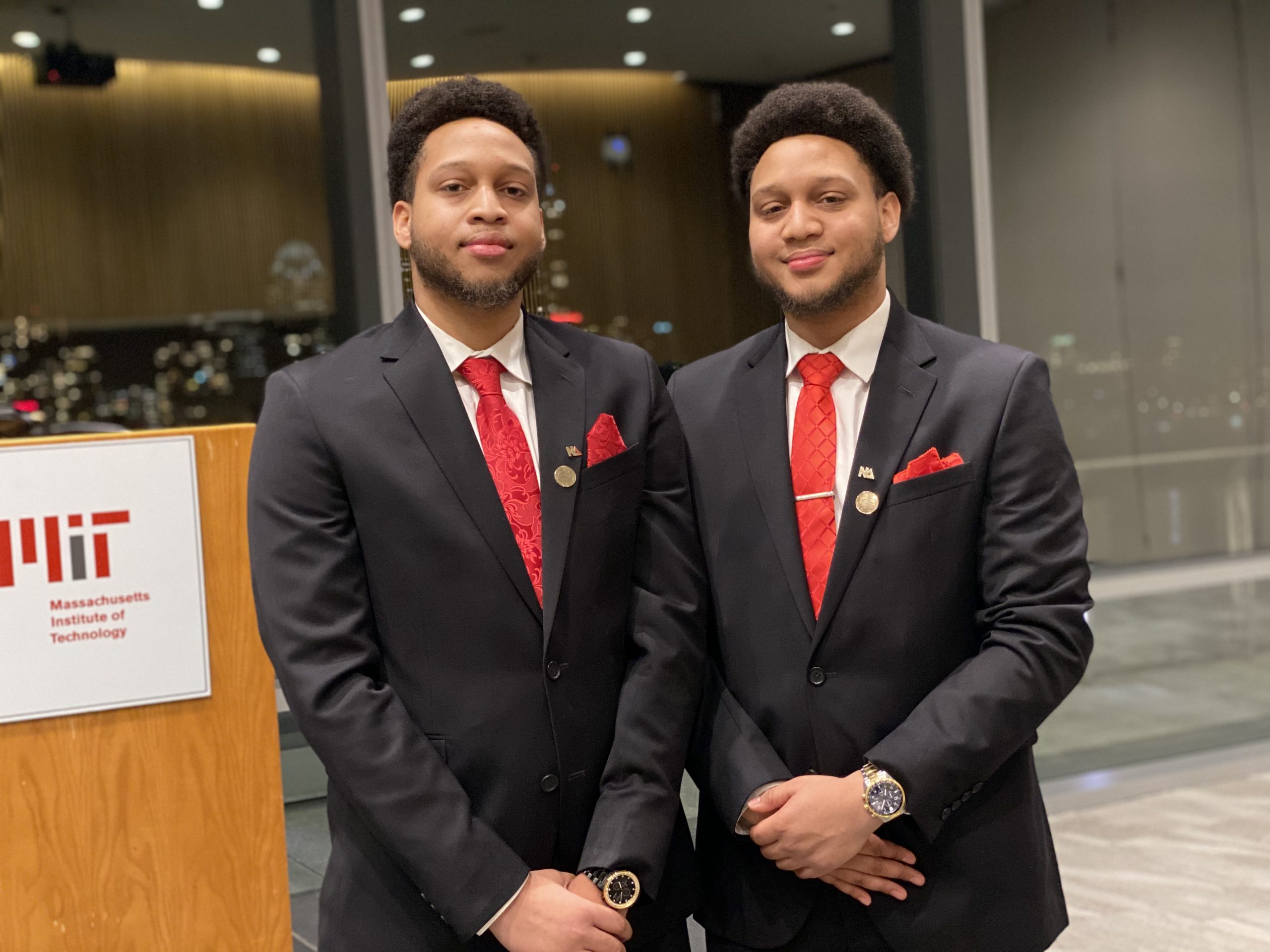
Twins Miles and Malik George are almost always in sync.

They graduated at the top of their high school class as co-valedictorians.

At MIT, these bioengineering students embraced and expanded upon their love of science. They were also in multiple diverse groups on campus such as Nu Delta Fraternity, The Standard, and Laureates and Leaders.

This last program is dedicated to helping under-represented students get Ph.D.s or M.D./Ph.D.s and has a selective entry process. The two fondly remembered the program as instrumental in shaping their academic careers.

They worked with MIT Admissions as Admissions Ambassadors to increase the number of underrepresented students that apply to and attend the university. On campus and virtually, they worked in several biological engineering labs. They’re about to graduate and will be pursuing Ph.D.s in Biological Engineering at MIT.

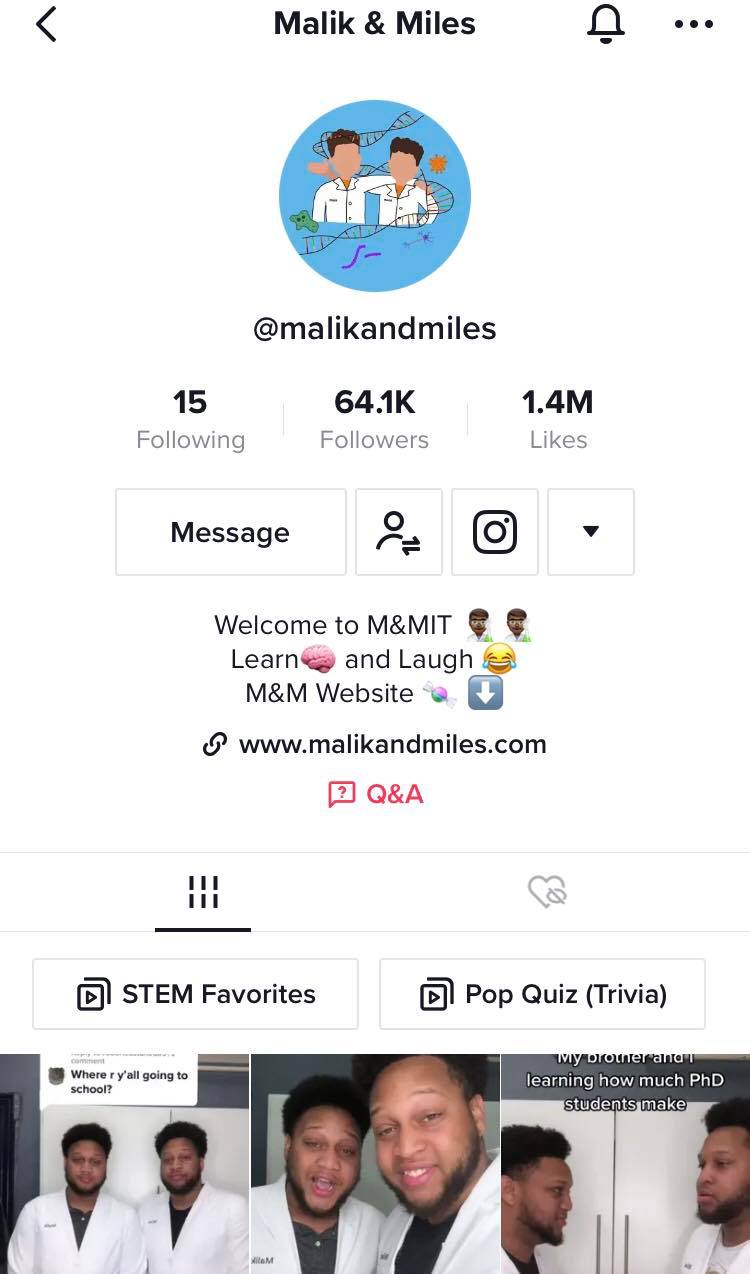
They’re both passionate about bringing STEM (science, technology, engineering and math) to under-served communities through hundreds of funny and informative lessons posted to TikTok and other social media. Their mix of memes, dances and trivia reach all kinds of audiences. They teach what they find exciting about science.

“The more curious you are about one subject, the more you learn about that subject, the more curious you become about everything else,” Miles says. “Curiosity is the reason why people keep innovating. And so as long as people are curious, people will keep learning.”

“Curiosity leads to solutions, you know?” Malik adds.

Tik Tok profile page

The brothers will host a private virtual education event for students May 17 in partnership with Microsoft Stores. This session will reach 10,000 students and will feature an inspirational fireside chat, STEM demonstration and interactive Q&A.

The twins strive to be role models for the next generation, to inspire them to follow their dreams.

“In high school we did a lot of science fairs. Being able to count on your hand how many people look like you in a room of over a hundred people, it’s pretty sad,” Malik says. “As we became involved in science ourselves, we wanted to make sure that people saw there are people that look like us in the field and that they can and should feel welcome to do so as well.”

They’re both PC gamers who enjoy comic book universes and socializing with their many friends.

They are part of a tight-knit family, helping their parents with gardening and jigsaw puzzles, watching movies together and doting on the senior Shih-tzu (who is the fifth member of their household).

Two men in lab coats peering through a microscope

But they are also individuals.

Malik is the “explainer.” As his brother shares, “He’s going make sure that if he’s telling you about something, you know everything that there is about the topic and he’s going make sure you understand it at the end of the day.”

“If I’m the explainer, then Miles is the convincer,” says Malik. “You know, he can summarize any topic – no matter how advanced – in a couple sentences to any age group and they’ll understand it.”

Two men in suits next to each other

This works well when they’re doing presentations, which have reached more than 1,000 students remotely (ranging in age from late elementary school to high school seniors) since January 2021. They’ve been getting more interest about K-12 presentations and plan to continue those.

“I’ll do the intro. He does methods and results. I do the conclusion. He gives you the scientific know-how, how to learn. Then I bring it back at the end,” Miles says.

They also have different work styles – though both are also lifetime PC users. For as long as they can remember, they’ve always been on Windows, starting from their childhood.

“If you were to look at my desktop, you will see at least three applications open at once. If you look at Miles’ desktop, you’ll see one application open, but he’ll have three desktops that he’ll switch between,” Malik says.

Multiple desktops are one of Miles’ favorite Windows 11 features.

“I have one program that I’m focused on. When I’m done focusing on it, I’ll switch to another desktop and that’s what I’m working on then,” he says. “Each assignment gets its own desktop, and I will get to it when I get to it.”

Two men in lab coats sitting next to each other outside

They’ve discovered other Windows 11 features that make them even more efficient.

“As a student, I am constantly searching through emails, especially through keyword search,” Malik says. “I globally search by who sent it or a keyword and it will just show up right there. And I can read it or I can click it and reply from the same place. Windows 11 really takes away flipping back and forth between things. And then anything that you don’t have open, you can also just go through the Start menu.”

They also make great use of Snap Assist.

“I can have an essay snap to the right on Word. I can have some internet research article on the left,” Malik says. “And then if I need to check my email, it would just pop up in the center and I don’t have to cover what I was already working on.”

They like that they can tailor Windows 11 to what works best for each of them.

“It really feels like a personalized experience when I’m online. And it really visually is a much better experience than what I’m used to,” Miles says. “As a researcher, I’m used to a lot of diagrams, a lot of graphs. It really combines multitasking with this beautiful element of note taking and annotating directly on the screen.”

Posted on Leave a comment

How tech opportunities are energizing towns across the US

In the combined TechSpark region of El Paso, Texas, and Ciudad Juárez, Mexico, manufacturing dominates the economy through assembly plants and low-wage jobs. The region’s distance from tech-rich cities and the global headquarters of companies that own the plants makes it tough for startups to claim a larger part of the massive manufacturing market.

But the Bridge Accelerator, a partnership between TechSpark and Technology HUB, a binational business incubator, is making inroads. More than 20 companies have gone through the program and learned how to think globally.

Man stands in front of sign that says
Ricardo Mora (photo courtesy of Mora)

“A lot of them are doing amazing work, but they’re only selling locally,” says Ricardo Mora, CEO of Technology HUB, which is based in both Juárez and El Paso. “We’re saying, ‘Listen guys, we’re going to train you, and you’re going to learn how to sell to global companies.’”

The region’s cross-border identity is a source of strength, with a young, largely Hispanic population of people who understand cultural differences, are often dual citizens and “want to make better opportunities for themselves every day,” says J.J. Childress, Microsoft TechSpark manager in El Paso.

“This is truly a binational effort,” he says of the Bridge Accelerator. “How do we create a soft landing for companies that want to access Latin American markets? How do we take the innovation from Mexican companies and give them access to North America?”

The training helped Rene Pons, an entrepreneur in Chihuahua, Mexico, meet a community of like-minded businesspeople and learn how to approach global companies.

“For a startup, a really huge problem is connecting with a big corporation and having them trust you,” says Pons, who co-founded PPAP Manager, maker of a digital solution that helps streamline automotive supply chains. He says establishing trust with global customers is even harder for companies in Mexico, which isn’t known for digital innovation.

“The Bridge Accelerator is opening the door to start conversations and getting an opportunity to be trusted,” Pons says.

Southern Virginia

Row of historic buildings in a small town
South Boston, Virginia (photo by Brian Smale)

The tiny town of South Boston, Virginia, hasn’t seen new construction in nearly 40 years, so the rise of a new building where tobacco warehouses once stood is exciting news.

Even better is that it will house the SOVA Innovation Hub, a partnership between TechSpark and Mid-Atlantic Broadband Communities, whose open-access fiber networks have provided broadband access to help bridge the digital divide in southern Virginia. The building will house the nonprofit’s headquarters, a Microsoft experience center and space to help digital skilling nonprofits. That’s good news for an economy built on manufacturing and still struggling with the loss of tobacco and textile industries.

“Job stability is very difficult. Internet access is difficult. There’s a tremendous amount of poverty,” says Paul Nichols, superintendent of Mecklenburg County Public Schools.

The majority of his students qualify for a free or reduced lunch, and while fiber networks have changed the commercial landscape, many residents still don’t have broadband.

A female teacher stands in front of a colorful board in a classroom
Krystal Patton teaches programming and Microsoft Office Specialist (MOS) certification courses in Mecklenburg County with the support of TEALS. (Photo courtesy of Paul Nichols)

“It’s like years ago when we had the same issue with electricity in rural areas,” Nichols says.

He’s looking forward to the economic investment and is grateful he’s been able to offer high school computer science classes with the support of Microsoft’s TEALS program. The classes help students think creatively to solve problems in all subjects, not just computer science.

“It’s challenged students to think and learn in a new way,” Nichols says. “With technology being foundational for all careers, we’re now looking at how to make computational thinking a part of all of our classes.”

Posted on Leave a comment

Urgent tech overhaul speeds efforts to get surplus food to millions of people who need it

“Everything happened in the first month” of the pandemic, says Nikkel. She more than doubled the FoodRescue.ca team to 14 as the crisis worsened, and created a national task force to connect industry leaders, nonprofits, indigenous communities and others to figure out where the surplus and the needs were and match them through the FoodRescue.ca platform.

“The whole country got behind this thing,” Nikkel says. “This was the one place where people across Canada could access food, groceries and money, and that had a huge impact on how Canada managed COVID-19. And that’s because of RedBit.”

Five people sort food
RedBit developers sorted food for Second Harvest last year to see what challenges were being faced before working on the organization’s tech platform. That helped them pivot quickly when the pandemic hit.

The software consultancy was able to respond so quickly in part because it already had experience developing with the right tools in Azure. The data collected by FoodRescue.ca goes into a model-driven app in Power Platform, Dynamics 365 is used to manage the system, and everything is based on Azure, Arteaga says.

But just as important was the company’s process of connecting with its customers and learning the specifics of their needs, he says. RedBit developers had spent time working with Second Harvest employees, donors and agencies, including sorting food and going on truck runs with delivery workers to see what challenges were being faced at every level.

With the new platform, a food donor — a restaurant, grocery store or any other food business — can create a donation listing, and then an agency — a food bank or any nonprofit that works with people in need — can claim it. Listings on a recent day included 5,600 pounds of crackers, cereals, meat, fish and nuts; 13,800 pounds of perishable prepared food; 3,700 pounds of baked goods and snacks such as cashews, cookies, noodles, candy, oatmeal and bottled water; and 2,500 pounds of bread.

hand holding phone
RedBit created a mobile app so Second Harvest could offer easier access to food donors and nonprofit workers suddenly having to work remotely.

“And that’s just today,” Arteaga says. “All this food would have gone into landfills if it weren’t donated, which is crazy. We saw tomato sauce and baby formula that was going to the trash because of packaging imperfections, if it wasn’t rescued.”

Arteaga, who has been involved in technology since he was 14 years old, started RedBit in 2003 and began expanding it in earnest about five years ago, with 21 fulltime employees and seven active projects now.

With Second Harvest, “you’re saving people and saving the earth,” Arteaga says. “We’re finally getting to use technology to make a difference in the world. We build systems all the time — saving money, making money, automating processes — but this brings fulfillment, when you’re in the warehouse and see the amount of waste there is and know there doesn’t need to be that waste. So that’s why I’m fully invested in this as a human being to use technology for good.”

Nikkel says RedBit’s team worked so closely with hers that she considers them part of her organization.

“I almost don’t want to know about the tech,” she says, “and that’s what’s great — I don’t have to worry about it. I just know it will work so we can keep making sure people can eat and the food’s not going to the landfill.”

Lead image: A Second Harvest driver delivers food to a charity in Toronto.
Photos of Lori Nikkel, the RedBit team, the mobile app and food donation efforts were provided by RedBit and Second Harvest.

Posted on Leave a comment

News reporting grantee winner shines a light on the power of data to improve children’s health

Verah Okeyo’s father earned about $30 a month as a supervisor at a flower farm near Lake Naivasha in Kenya. Her mother was a midwife whose work included educating expectant and new mothers about health and sanitation. The family were provided their own house. The flower farm’s owners made sure Verah and her three siblings were provided with education and healthcare.

Okeyo lost her parents when she was 16 years old – her mother from an illness, her father not long after, from the heartbreak of his wife’s passing. Despite that, looking back, 15 years later, Okeyo realizes she had a relatively privileged life growing up compared to many children in Kenya who have much less – especially when it comes to healthcare.

So when Okeyo became one of the data journalism grantees winners in the Microsoft News grant program in collaboration with the International Center for Journalists (ICFJ), she used the opportunity to learn more about child mortality rates in Kenya. It is a topic she often covers as a health care reporter for The Nation, the largest daily independent newspaper in Kenya, and part of the Nation Media Group, which operates in East and Central Africa. She wanted to know why, over time, mortality rates have declined in some of Kenya’s 47 counties but increased in others.

“In Kenya, if you belong to the have-nots, which is more than 70% of the population, your rights, particularly for health, are going to be trampled on a lot,” she says. “I grew up without much, but I was never denied health care, and health care with dignity.”

She learned that early on when, as a student journalist in college, she went to report a story at a maternity ward in a public hospital.

“I remember seeing three women in a bed, so I told the nurse, ‘Those three women must be very good friends for them to stay in one bed like that.’ The nurse looked at me and she rolled her eyes, and she said those three women were in that bed because there were no other beds. And that they had just had surgery. And I found that so appalling. Everybody was looking at me, as if ‘Why are you surprised? This is how public health in Kenya works.’”

It was her “aha” moment.

“People sleep on the floor sometimes in public hospitals, they share beds sometimes, there’s no running water in some hospitals,” she says.

Part of Okeyo’s project involved digging through demographic data going back to 1965, two years after Kenya won its independence from Britain. She learned that pneumonia is a primary cause of death for children in remote areas of the country, and diseases such as rabies, kala azar (transmitted by the bite of a female sand fly) and African sleeping sickness are often the leading causes of mortality in children ages 5 and younger.

Those diseases are part of a health classification known as “neglected tropical diseases” because they are exactly that – ignored in terms of education and attention around the world, yet they can also be fatal if they go untreated.

“Neglected tropical diseases are not only neglected by funding organizations, but by health care workers who do not even know about some of them,” Okeyo says. “You find these diseases among the poorest of the poor, because many of the diseases are brought about by not having proper food, access to clean water and to sanitation. These diseases kill people.”

Her work in public health follows in the footsteps of her mother. “She used to go to very, very difficult-to-reach areas, and tell them things like if they wash their hands, they will not get diarrhea. For me, this is continuing the work my mother had started.”

To tell the story, Okeyo used Power BI to visualize the data, county by county. During the process, the data led her to poor and remote areas of the country, something Okeyo felt was important for the investigative team to do to interview people beyond “the usual counties” near Nairobi.

Posted on Leave a comment

How AI and Teams are benefitting the littlest of patients

Smiling woman with arms raised surrounded by people
Felicitas Hanne raises her arms in delight, surrounded by some of the members of the Microsoft Germany team that developed solutions for Kinderhaus AtemReich. Photo: Microsoft

So last summer, when Hanne attended Microsoft Germany’s #Hackfest2018 in Munich, a two-day Microsoft employee hackathon to help customers, partners and nonprofit organizations, she wasn’t sure what to expect.

At that time, “It was my great hope that Microsoft would help me to expand and improve my work with Microsoft Access database,” she says.

But as Hanne spoke to the Microsoft employees about Kinderhaus AtemReich, “We listened really carefully to what she was saying about the children, and I think half of our colleagues had tears in their eyes,” says Volker Strasser, a Microsoft digital adviser who normally works with large companies. Moved by the children’s challenges and those faced by Kinderhaus AtemReich, he became the project lead for the effort.

Andre Kiehne, executive sponsor of the project and a member of the Microsoft Germany leadership team, also remembers talking to Hanne that first time. It was an “emotional moment,” he says. His twin daughters were born 13 years ago in the same children’s hospital where the idea for Kinderhaus AtemReich was raised, and around the same time. His girls were premature babies and faced some medical problems in their first weeks – “they are completely healthy now,” he says – but the worry he faced remains a fresh memory.

The night the hackfest ended, Strasser remembers being unable to sleep “as thoughts circled my mind as to how we’d help Kinderhaus succeed, how we could bring these ideas to life, and how we’d scale those ideas more broadly” for other potential and much-needed Kinderhaus AtemReichs in his country.

Mug shot of Volker Strasser
Volker Strasser

At 3 a.m., he got out of bed and started drafting a plan that would ultimately include bringing machine learning, artificial intelligence (AI), Microsoft Teams and a modern recruiting strategy to Kinderhaus AtemReich.

For the next year, the team met for a project call every Monday at 8 a.m. – “We put that meeting on Monday at that time because we wanted to start the week with the most important thing, Kinderhaus AtemReich,” Strasser says.

Hanne had no idea she would wind up with a dedicated army of 50 Microsoft volunteers and partners who, over the past year, have not only provided Kinderhaus AtemReich with a digital transformation, but who also spend their own time at the facility, about 5 miles from Microsoft’s Munich office, doing everything from helping clean out the cellar to tending the garden.

The technology solutions being put into place fit “the needs of AtemReich to get closer to the goal of more staff time with the children,” and less on paperwork, says Hanne. “That is what touches me most of all. This incredible combination of Microsoft and partner team members’ empathy, passion, know-how and time for our children can hardly be put into words because it is so great.”

Among the changes that have come to Kinderhaus AtemReich: shifting from a laborious, often manual, medical record-keeping system that only kept track of a child’s vital signs to a system that compiles information – such as heart rate, oxygen, breathing rhythm, blood pressure – from the children’s medical devices and uses machine learning, AI, IoT and Azure tools to produce data and analysis to see if there are safety or medically related problems or trends that should be addressed.

“Before, we just copied the data from the monitors onto paper. But we were not able to evaluate or compare the incredible amounts of data provided by our devices,” Hanne says. “Now we can evaluate and analyze data. This allows us to discover patterns in children and makes it possible to react faster than we could before.”

Posted on Leave a comment

Ever-changing music shaped by skies above NYC hotel

Barwick composed five movements within an overall soundscape that reflect the constantly changing nature of the sky throughout the day, each with its own background of bass, synthesizer and vocal lines that weave in and out. For each “event,” identified by Microsoft AI, she then created six synthesized and six vocal sounds for the generative audio program to choose from – for example, 60 different musical options a day for every time an airplane passes above. The sounds are an expression of Barwick’s emotions in response to each stimulus.

“I didn’t want it to be too literal,” she says. “I could have made it sound ‘raindroppy,’ but it’s more about the attitude of the event. An airplane is a lot different than the moon, so it has more of a metallic sound than a warm sun sound or a quiet ‘moony’ kind of feeling. I wanted people who listen to it to be curious and wonder what that sound meant, what’s going across the sky right now.”

Barwick has never been afraid of technology, even if she didn’t have access to it. She recorded her first album in 2007 using a guitar pedal to form vocal loops on a cassette tape. “I didn’t even have a computer then,” she remembers. “I took my bag of tapes in somewhere to get mastered to produce the CD.”

Now she relies on technology to compose, record and perform her multilayered, ambient music. She uses effects on everything, including her voice. There’s no such thing as an unplugged Julianna Barwick set. Still, she says, “Before I was approached to do this project, the only thing I knew about artificial intelligence was from the movies. I’d never seen an application of it in my daily life.”

So as she began exploring sounds, Barwick grappled not only with what AI was and could do, but also with what her role would be in comparison to its. Who was the actual composer – she or the program? Was AI a partner or a tool?

“I contemplated how the project would play out in my absence and realized that I can make all the sounds, but I’m not going to be there to detect all the events — you have to rely on the AI to do that,” Barwick says. “And that’s such an important part of the score; it’s almost like it’s a 50-50 deal. And that’s what makes this project interesting. It almost brings in another collaborator, and the possibilities are endless. It’s opened up a new world of thinking and approaching future compositions and scores.”

a woman composes music on a laptop
A camera sends live images to a Microsoft Azure computer vision tool, which assigns tags such as “clouds” or “sun.” Those are fed into the system that technologists programmed after analyzing Barwick’s compositions and distilling them into an algorithm, which then chooses which tracks to play together.