Posted on Leave a comment

Microsoft announces new AI solutions for Microsoft Cloud for Nonprofit: a game-changer for fundraising and volunteer engagement

REDMOND, Wash. — May 15, 2023 Microsoft Corp. on Monday is announcing a suite of new AI solutions and improvements to Microsoft Cloud for Nonprofit that are designed to transform the nonprofit industry and how fundraisers engage with donors, manage campaigns and optimize operations. In addition, the company announced a limited private preview for nonprofits to experience a new AI-powered fundraising propensity model. Within the preview, participating nonprofits will be able to test new AI tools that give fundraisers the power to do predictive forecasting of fundraising goals with data modeling and identify donors most likely to donate to a campaign, cause or major gift.

“Simply put, AI can and will be a game-changer for nonprofits and fundraisers,” said Justin Spelhaug, Vice President and Global Head, Tech for Social Impact at Microsoft. “With these new AI solutions, we aim to empower nonprofits and fundraisers to achieve more and to create a more positive and rewarding experience for donors.”

In today’s economic environment, nonprofits are consistently challenged to make budgets go further and do more with fewer resources. Since 2020, many fundraisers have seen an ongoing decline in the overall number of donors giving to causes. And although data can help nonprofits identify and prioritize the most promising prospects, predict donor behavior and measure fundraising outcomes, access to data and the ability to form actionable insights based on fundraising analytics is a major roadblock for many organizations. According to one study from the National Council of Nonprofits, barely 18% of nonprofits reported having all the data they need and using it in nearly every decision they make.

Microsoft Cloud for industries offers powerful, integrated and uniquely tailored industry solutions and workflows designed to allow organizations to realize breakthrough value and more easily achieve success, enabling them to unleash value quickly, build for the future and exceed expectations. And now, with AI as a copilot, Microsoft Cloud for Nonprofit is delivering new capabilities to help fundraisers leverage data in a powerful way to attract, retain and grow their donor base.

New tools include:

  • New Fundraising dashboard. To optimize fundraising and help nonprofit leaders understand performance and to quickly respond to a changing environment for charitable giving, Microsoft is introducing a new Fundraising performance dashboard. The dashboard uses real-time data to deliver interactive views of campaign performance, donor conversion and other fundraising analytics, all built on Power BI’s industry-leading data visualization platform.
  • Dynamics 365 Marketing joins Microsoft Cloud for Nonprofit. Dynamics 365 Marketing streamlines the generation of communications for donors and volunteers, including newsletters, program information and other communications. Because it takes advantage of the Nonprofit Common Data Model, integration of data to help drive more personalized engagement is seamless and easy.
  • Microsoft Viva Sales AI Copilot and Microsoft Teams Premium. AI capabilities are now included in the Fundraising and Engagement tools of Microsoft Cloud for Nonprofit.
    • Viva Sales will help nonprofits personalize, stay on top of and deepen engagement with donors by providing AI capabilities that assist in crafting email responses based on customer relationship management (CRM) data, update CRM records, summarize Teams calls and more.
    • We’ve also integrated AI-based capabilities of Teams Premium into Fundraising and Engagement that will help nonprofits improve productivity and make sure donors, constituents and staff get the greatest benefit from meetings.

With these new tools, Microsoft is delivering a robust set of solutions for end-to-end fundraising — from fundraising strategy and planning, fundraising campaign execution and measurement, gift processing and reconciliation, all the way through to gift acknowledgement.

New fundraising modeling

In addition to the AI new capabilities in Microsoft Cloud for Nonprofit, Microsoft is developing an AI-based donor propensity model to help nonprofits identify constituents most likely to donate or engage with a campaign or cause based on predictive donor behavior. Interested nonprofits can sign up to participate in this private preview and participating nonprofits will help improve the model through contributions of anonymized data and testing. This solution is intended to be generally available later this year.

Microsoft Cloud for Nonprofit is tailored specifically for the nonprofit sector, designed to reduce the time nonprofit groups spend managing overhead and delivering automation and efficiency on common and critical workflows. These new AI solutions are designed to help nonprofits focus on mission-critical activities and are built on Microsoft’s trusted cloud platform, Azure, which offers enhanced security, scalability and reliability. They are also integrated with Microsoft’s existing solutions for nonprofits, such as Microsoft 365 — Outlook, SharePoint and Teams — as well as Power Platform, Microsoft Dynamics 365 and LinkedIn.

To learn more about them and sign up for updates, visit https://www.microsoft.com/en-us/nonprofits/ai-solutions.

Microsoft (Nasdaq “MSFT” @microsoft) enables digital transformation for the era of an intelligent cloud and an intelligent edge. Its mission is to empower every person and every organization on the planet to achieve more.

For more information, press only:

Microsoft Media Relations, WE Communications, (425) 638-7777, [email protected]

Note to editors: For more information, news and perspectives from Microsoft, please visit the Microsoft News Center at http://news.microsoft.com. Web links, telephone numbers and titles were correct at time of publication but may have changed. For additional assistance, journalists and analysts may contact Microsoft’s Rapid Response Team or other appropriate contacts listed at https://news.microsoft.com/microsoft-public-relations-contacts.


Posted on Leave a comment

Microsoft expands nonprofit discounts and grants to public libraries and public museums

A volunteer talks to visitors on the USS Midway, a floating museum in San Diego, Calif. Photograph: The Midway Museum

On an idyllic, bluebird day in downtown San Diego, visitors to the USS Midway Museum come aboard the historic aircraft carrier to learn about its 47 years of service history in the United States Navy. At any given time, 50 or so volunteers are welcoming and hosting museum visitors as they experience the ship’s mission: “That freedom is worth defending and preserving at home and far out at sea.”

“Volunteers are the lifeblood of our organization,” says Midway Foundation president Laura White. “We have over 700 active volunteers that make our mission come to life. They are basically another set of our employees, and we wouldn’t be able to do the work we do without them.”

But the museum had two separate IT systems and processes: one for managing volunteers and another for managing monetary donors. “A patron would give us a cash gift and I would pull up a record and have no idea the relationship they had with our organization. Yes, maybe they gave a $5,000 cash donation, but they’ve also been volunteering every Saturday for the last 18 years. It was just impossible to know.”

During the Covid pandemic, the USS Midway expanded their virtual programming to individuals across all 50 states in the United States. However, as the USS Midway Museum prepares to celebrate their 20th anniversary in 2024 and embarks on their largest capital campaign in their history, they knew it was more critical than ever to modernize their systems and processes.

Globally, libraries and museums – like the USS Midway – play a critical role in the preservation and enrichment of cultural heritage around the world. They also provide critical social infrastructure services like job search assistance, children’s programming and internet access in the communities where they operate. These organizations need affordable, modern technology and consistent licensing. And, like most organizations, they are being asked to do more with less.

Known for their physical locations and often hands-on experiences, museums and libraries have been hit hard during the pandemic era, with even more economic headwinds to come. According to UNESCO, museum revenues dropped 80% from 2019 to 2021. And the American Alliance of Museums states that 56% of US museums had to lay off staff, and 60% of museums said operating performance had fallen 40% or more during the pandemic. We saw similar trends when libraries had to close their doors during the pandemic, resulting in staff lay-offs and a shift to more digital services for their patrons.

We believe technology can help.

Aligned to our mission to empower every person and organization on the planet to achieve more, Microsoft provided over $3.2 billion in technology discounts and grants to more than 300,000 nonprofit organizations globally in our fiscal year 2022. But we can do more, and Microsoft is recommitted to doubling the number of nonprofits we serve over the next five years.

In line with that goal, Microsoft is excited to expand its nonprofit technology offers to public libraries and public museums around the world. Building upon our long history of supporting nonprofit museums, these newly eligible organizations, including over 2 million libraries across 99 countries, can further their mission by allowing technology to do more with less, to extend their reach, increase their engagement and leverage efficiencies in their workflow. Eligible organizations can get discounts for products like Microsoft 365 that includes Teams, Outlook, Excel and PowerPoint; as well as Azure, Dynamics 365, Power Apps and even Surface devices. Libraries and museums will also be eligible for our industry-leading grants that encompass Microsoft 365, Azure and Dynamics. And to help all nonprofits reach new visitors, donors and volunteers, Microsoft Advertising is offering a $3,000 monthly grant on its owned-and-operated digital search and native advertising platforms like Bing.

In addition, we now have solutions built specifically for the nonprofit sector in Microsoft Cloud for Nonprofit, including Fundraising and Engagement, Volunteer Management, and Volunteer Engagement, with new features released earlier this month.

Public libraries and public museums will also have access to on-premises licenses for computer labs and other public access devices. Grants of Microsoft Office Standard, Windows Professional, Project Standard, Publisher, Visio Standard and Visual Studio Pro are offered for shared-device scenarios (computer training labs, for example) and available only from TechSoup, an international network of 65 partner organizations that facilitates software grants for nonprofits, charities and NGOs in 236 countries and territories.

White says the USS Midway Museum is looking for a “fresh start,” which is why they have recently chosen the Microsoft platform and Microsoft Cloud for Nonprofit for their donor and volunteer management needs. With Fundraising and Engagement built on Dynamics 365 Sales, together with Volunteer Management and Volunteer Engagement, the organization can work off a common platform instead of multiple solutions.

“It’s kind of a dream for fundraisers and for those of us that are building different relationships throughout the ship to be able to know that a person is a member, a donor, a prospect for a campaign, a volunteer AND an original board member. All of a sudden, these dots are all coming together!”

White also noted that since the museum was already using other Microsoft applications – like Outlook – the staff and volunteers with varied technology backgrounds were able to feel a familiarity between existing Microsoft cloud products and new solutions, providing a sense of comfort with the programs with which they work.

With Microsoft Partner MISSION CRM, the selection committee at USS Midway quickly realized how the technology can be an extension of their staff. “We can set up campaigns and business processes, and the technology is like an additional staff person. This is really like having more hands in the department. And every nonprofit needs that,” says White.

“We want to be America’s living symbol of freedom. The best way to do that is to stay relevant – use technology like Microsoft Dynamics 365 to bring our data together, allowing us to stay connected to all of our constituents.”

Learn more about nonprofit offers from Microsoft and get started today: aka.ms/nonprofits

Tags: , , , , ,

Posted on Leave a comment

Now available: New tools for deployment, data connection, donation import and marketing in Microsoft Cloud for Nonprofit

At Microsoft, we believe technology is a powerful force for empowering people and organizations. And we believe the benefits of world-class technology should be both accessible and relevant for nonprofits and international development organizations. Serving the needs of mission-based organizations is critical to how we at Microsoft achieve our mission as a company, and those needs have rapidly evolved over the past few years: a historic health and economic crisis, persistent issues of systemic racial injustice and inequity, and rising food insecurity. Climate change is having devastating effects all over the world, a situation felt acutely as communities in the southeastern US and Atlantic basin emerge from Hurricane Ian and begin the road to recovery.  

Organizations are having to shift, expand, and add programs and services to meet the needs of the communities and individuals they serve. This keeps fundraising at the forefront of nonprofit priorities, and although donors are giving more than ever, it’s not keeping pace with inflation. The fundraising landscape is undergoing significant change. Donor numbers and retention rates are down. Younger generations are challenging the traditional conception of philanthropy, with a desire to engage across donations, advocacy, and volunteering.  And the pandemic accelerated adoption of digital channels–online giving has increased 42% since 2019 and engagement via mobile devices is on the rise (Blackbaud).  

So what’s needed? Fundraising teams are having to strengthen their digital engagement strategies to meet donors’ evolving preferences and expectations. With Giving Tuesday and year-end campaigns just around the corner, now is the time to evaluate approaches and tools to both maintain current supporters and reach new audiences.  

This is exactly why we created Microsoft Cloud for Nonprofit. We want to equip the nonprofit sector with affordable, accessible, secure technology to meet these evolving trends head-on. Microsoft Cloud for Nonprofit harnesses the power of Microsoft Dynamics 365, Microsoft Power Platform, Microsoft 365, Microsoft Azure, and LinkedIn all brought together by the Nonprofit Common Data Model and built on a platform that provides best-in-class security and compliance. It is a suite of modular applications that provide nonprofits a holistic, connected platform, empowering staff with the latest tools to fundraise, work with networks of volunteers, and deliver impactful programs. Today, thousands of nonprofit organizations take advantage of the platform in over 30 countries. 

With our latest release of Microsoft Cloud for Nonprofit, available today, we’ve delivered Marketing insights capabilities, resource guides for Fundraising and Engagement and Volunteer Management, redesigned donation import functionality, a new first-party installation service to automate deployment of Fundraising and Engagement, and much more: 

  1. Nonprofits can activate Fundraising and Engagement faster and easier with the new Microsoft Cloud for Nonprofit installer. This allows organizations to quickly set up Azure services to realize the value of their data. 
  2. We recognize that nonprofits use many tools on multiple platforms. We at Microsoft embrace and encourage interoperability across systems. It’s critical that nonprofits not be constrained in where and how to derive insights on data. That means being able to use their data regardless of where it lives by leveraging the tools and services they want. We make a range of data connectors available to make this possible, and I’m pleased to announce our Salesforce connector allows Salesforce clients with NPSP data to use Microsoft’s deep analytics capabilities in Azure and PowerBI.    
  3. If you’ve ever wondered how well your marketing campaign performed to bring in major donors, Marketing insights lets marketing and fundraising staff see in real time how and where constituents engaged. With the new Marketing insights tab in Fundraising and Engagement, nonprofits can gain more comprehensive constituent profiles and enable better collaboration between development and marketing departments.  
  4. If you ever found technology set up to be cumbersome and clunky or found user adoption difficult, this new release addresses just that. We’ve added interactive adoption and training for simpler onboarding and connections to your existing platform. The new Resource pages in Fundraising and Engagement and Volunteer Management help staff get set up quickly and easily access training, documentation, and support resources to make onboarding and adoption easier. 
  5. The new guided donation import process provides lightweight data validation that aggregates data in an intuitive user interface. This will enable organizations to import and validate massive donation datasets in a straightforward way, and to get a more holistic view of their donors.  

I’d like to introduce you to an organization using Microsoft Cloud for Nonprofit to improve collaboration and efficiency across departments. As Canada’s leading first aid charity, St. John Ambulance empowers all Canadians to save lives by providing first aid training, supplies, and courses to communities across the country. Today, in 300+ communities across Canada, 10,000+ St. John Ambulance volunteers provide over one million hours of community service each year. It’s imperative that the organization efficiently build volunteer capacity and streamline organizational processes to make for great volunteer experiences. MISSION CRM, a Microsoft partner based in Toronto, implemented Microsoft’s Volunteer Management and Volunteer Engagement products for St. John Ambulance’s National Office and all their Councils across Canada. St. John Ambulance selected Microsoft Cloud for Nonprofit partly because they had already adopted Microsoft Dynamics 365 and wanted to easily extend their use of that platform. 

By replacing disparate solutions across the country, the organization will move forward with a unified approach to the management and deployment of volunteers. There are five different volunteer profiles which are accommodated within the solution and aggregate into a national database of thousands of volunteers which can be mobilized at any time. St. John Ambulance will also be implementing Fundraising and Engagement to create a full 360-degree view of all their volunteers and supporters in one place. 

I can’t wait to see how this implementation will further the great work that St. John Ambulance is driving across Canada. 

I recently visited India where Microsoft works in partnership with many nonprofits and international development organizations like UNICEF to support their work with the largest generation of young people in history to strengthen education and skills, and connect them with socioeconomic opportunities. I find myself reflecting on the role digital technology has to play in solving systemic problems. It’s one piece of a complex puzzle. But our belief is that as organizations change, Microsoft Cloud for Nonprofit is an important tool for nonprofit staff, supporters, and stakeholders to drive operational efficiency and programmatic efficacy, and to engage new communities of donors.  

Visit our website to learn more about Microsoft Cloud for Nonprofit and other nonprofit offers from Microsoft.  

Posted on Leave a comment

New tech benefits for nonprofits announced on International Volunteer Day

In our nearly 40 years of supporting philanthropic partnerships with nonprofits, and with the 2017 launch of the Tech for Social Impact team, Microsoft has worked closely with nonprofits and partners to develop new products and resources tailored to nonprofits and their very specific technology needs.

We’re constantly engaged with nonprofits to listen and learn about ways to further meet the needs of nonprofits, both big and small. Through conversations with our network, we realized organizations – especially those who rely on and deploy more than one billion volunteers around the world – need solutions that equip their volunteers with the same quality technology solutions that their full-time employees rely on.

In the spirit of International Volunteer Day, a global observance by the United Nations General Assembly for nearly 35 years to celebrate local, national and international volunteerism, we recognize the importance of nonprofit volunteers. Volunteers are the heartbeat of so many organizations. They are in the field, working with beneficiaries, coordinating and executing programs, engaging donors, and reporting impact. That’s why we must go further and equip more nonprofit volunteers with best-in-class productivity tools to promote seamless collaboration and access to content in the field, built on a platform of security features that ensure sensitive constituent data is securely transferred and responsibly managed.

As it stands today, while many nonprofits have digitally transformed thanks to solutions like Azure and Microsoft 365, their volunteers still use unmanaged solutions, which limits the ability of the nonprofit to manage information, protect sensitive data, and make full use of integrated collaboration tools that can increase productivity.

We want to change that.

Today, we’re announcing our first step by providing enterprise-sized customers with a new Volunteer Use Benefit. Starting January 1, 2020, for each licensed Microsoft 365 E3 or E5 seat, nonprofit customers with Enterprise Agreements will receive 10 additional Office 365 F1 seats for their volunteers to utilize. That means that an organization that has licensed 250 Microsoft 365 E3/E5 seats for their fulltime staff will have access to 2,500 Office 365 F1 licenses for volunteers to use at no additional charge. Office 365 F1 brings together the best of Microsoft’s cloud productivity experience including familiar applications for email, calendars, team collaboration, file storage and sharing. This Volunteer Use Benefit will allow organizations to equip millions of volunteers with the tools they need to have an even greater impact on the missions they serve.

This offer will be made available via our Cloud Solution Provider Channel in Spring 2020.

 “Through our recent deployment of Microsoft 365, we’re using tools like SharePoint, Teams and Exchange to drive increased collaboration, cost efficiencies, and security across our organization. In turn, we can devote more resources to driving mission impact.”, said Craig Tucker National Chief Information Officer of Salvation Army Australia. “Central to the success of our organization are the 8,500 frontline workers and volunteers who execute our mission in the field, engage beneficiaries, and manage important information. If we are able to equip our volunteers with the same high quality, secure and collaborative tech solutions that we rely on across Salvation Army it would allow us to fully realize the benefits of digital transformation for organizational success.”

Developing technology solutions for nonprofits strikes at the heart of Microsoft’s mission to empower every person and organization on the planet to achieve more. In the last year, we’ve rolled out solutions like the Dynamics 365 Nonprofit Accelerator, which is helping larger nonprofits drive greater insights and operational efficiencies, as well as a Microsoft 365 Business for Nonprofits offer that arms smaller nonprofits with collaboration tools with advanced security and device management capabilities. Not only are we creating solutions, but we’re also supporting nonprofits with digital literacy to improve adoption and usage through digital skills trainings with resources specific to the sector’s unique challenges and needs. With this announcement, we’re excited to extend support to nonprofits’ volunteers. 

In 2020, Microsoft will work with partners to support the roll out of the implementation of the Volunteer Use Benefit which will make all nonprofits more secure and effective, build trust with their funders and beneficiaries, and continue their digital transformation journey. To learn more and be the first to hear when the Volunteer Use Benefit is live, sign up here.

We’re truly grateful and inspired by volunteers across the globe who give their time and effort to help those in need. Their commitment to the world’s most important causes does not go unnoticed.

Published By

Justin Spelhaug

Justin Spelhaug

Global Head – Tech for Social Impact, Microsoft Philanthropies

Posted on Leave a comment

Beyond overhead: What drives donor support for nonprofits in the digital era

One of the greatest challenges to running a successful nonprofit organization has always been that donors look at nonprofits’ stewardship of funds as a primary way to assess impact. While there is no doubt that nonprofits must use donor funds responsibly, tracking to see if a nonprofit maintains the highest possible ratio of spending on programs-to spending on overhead is a poor proxy for understanding how effective a nonprofit truly is. In fact, the imperative to limit overhead has forced many organizations to underinvest in efforts to improve efficiency. Ironically, this has long prevented nonprofits from utilizing innovative digital technologies that could help them be more efficient and effective.

Now more than ever, cloud-based technology can have a transformative effect on how nonprofit organizations increase impact and reduce costs. The same technologies that give for-profit businesses insights about customers and markets, create operational efficiencies and speed up innovation can also help nonprofits target donors and raise funds more strategically, design and deliver programming more efficiently, and connect field teams with headquarters more effectively. This means smart investments in digital tools are essential to every nonprofit’s ability to make progress toward its mission.

The good news is that a major shift is underway. As part of our work at Microsoft Tech for Social Impact to understand how nonprofits can use technology to drive progress and demonstrate impact, we recently surveyed 2,200 donors, volunteers and funding decision-makers to learn how they decide which organizations to support, what their expectations are for efficiency and effectiveness, and how they feel about funding technology infrastructure at the nonprofits they support.

The results, which we published recently in the white paper “Beyond overhead: Donor expectations for driving impact with technology,” make clear that people donate to organizations they trust and that donors are increasingly looking at data beyond the ratio of program spending to overhead spending to measure impact. We also found that those who support nonprofits now overwhelmingly recognize the critical role technology plays in driving impact and delivering value. Nearly four out of five supporters (which includes both donors and volunteers) and more than nine out of 10 funding decision-makers told us they support directing donations to improve technology at a nonprofit. An overwhelming majority — 85 percent of supporters and 95 percent of funding decision-makers — are more likely to contribute to organizations that can show that they are using technology to improve how it runs programs.

At the same time, the survey found that most people expect organizations to use donations more efficiently and to advance the causes they work for more effectively than in the past. Among supporters, for example, 79 percent believe nonprofits should be better at maximizing funding than they were 10 years ago. Just over 80 percent of funding decision-makers believe nonprofits should be more effective at achieving their goals and advancing the causes they work for now than in the past.

To give you a better sense of what potential donors are looking for as they consider where to target their nonprofit contributions and how much they weigh technology into their thinking, we have developed a tool using Power BI so you can look at the data in greater detail. Within the tool, you can see how people responded to questions about overall effectiveness and efficiency, the importance of technology as a driver of success, how likely they are to support organizations that use technology to demonstrate impact, and their willingness to fund technology improvements at the nonprofits they support.

To make the tool as useful as possible for your organization, you can sort the data by supporters and funding decision-makers, and you can explore how responses varied by region. As you move through the data, you will see how these critical groups of supporters and funders think about these important questions in the region where your organization operates:

The ultimate goal of this survey was to get a clearer picture of what motivates people to contribute to an organization and how technology can help nonprofits meet supporters’ expectations. Overall, I believe our research provides some important insights that can help any organization be more successful. Fundamentally, we found that people donate to organizations that are perceived to be trustworthy, and that trust is achieved though operational transparency and effective communications. More than ever before, donors recognize that using data to measure and demonstrate impact is the foundation for trust.

I encourage you to read the full report and learn more about Microsoft’s commitment to support nonprofits.

Posted on Leave a comment

Mud, debris and technology: Working side by side with Team Rubicon

Last week, I had the opportunity to serve on the frontlines with Team Rubicon to support their Midwest flood operations. Team Rubicon, a disaster relief organization comprised mostly of veterans and first-responders, is one nonprofit that Microsoft’s Tech for Social Impact team partners with to support communities in need around the world. My experience reinforced my conviction in the social business model we’re building here at Microsoft to serve nonprofits. This model is not principally about top line revenue or profit optimization, it’s about building a scalable and sustainable way to move nonprofit missions forward through the power of technology – reinvesting any incremental profits back into philanthropy and the community at large. Here’s why I believe in this model:

The site of our work was Pacific Junction, a small community south east of Omaha, Nebraska, just across the Iowa border. Pacific Junction is one of the communities that fell victim to record-setting flooding that recently devastated the Midwest. Flood water surged throughout the town, reaching the roofs of many single-story homes and bringing damaging water currents and mud that destroyed and defaced the homesteads throughout the town. Many residents have been unable to reach their homes for weeks, allowing mold to set in, making homes utterly uninhabitable. While some had flood insurance, many did not. For many, their homes represented a lifetime of hard work and savings now lost in a blink of the eye. With a mission to rebuild communities and lives, Team Rubicon has already deployed over 312 volunteers in Operation Heartlander to provide flood response and recovery support. 

We spent the first day in the field focused on assessing damage. On its face, damage assessment is a fairly mechanical process. First, assess the house for visual damage and potential dangers for the first responder team, and then enter the observations into a system to activate “strike teams” for help. However, I quickly learned that the assessment involves far more than creating a work order to activate strike teams: in many cases, it’s the point of first contact with residents who are in one of the hardest and most vulnerable moments of their life. In fact, one of the homeowners we helped was unable to contain their emotion when they learned that Team Rubicon would support them. The assessment process is about showing empathy and taking the time to hear the resident’s story and concerns. It’s about showing respect, as you, essentially a stranger, sludge through a person’s house and life which has been turned upside down. It’s about the deep human connection that is at the heart of Team Rubicon’s work, and so many of our humanitarian partners around the world.      

On the second day, I had the opportunity to go out to the field with two strike teams of Team Rubicon volunteers. We went to a house that had its 1,200 square foot basement destroyed by water, mud, silt and debris. The situation looked overwhelming and desperate. 

We started by bringing in sleds to haul mud, shovels to scrape, saws to break down debris, hammers and crow bars to peel off molding drywall and ceiling material. We then began clearing large debris – what Team Rubicon lovingly calls “mucking” – shoveling sled-load after sled-load of mud, and hauling it out of the house. Once clear, we began removing drywall and ceiling material to clear the house of mold. At each stage of work, the homeowner worked side-by-side with us, deeply thankful to have the support. After a solid eight hours, the mud was clear, mold removed, and the house was set to dry so that the rebuilding could begin. 

I flew home thinking about the experience, and I felt the immense responsibility we have in the technology industry to deliver affordable solutions that work well and work every time. 

Technology for many nonprofits is what undergirds and supports the work that happens in places like Pacific Junction. Behind the scenes and often invisible to the work on the ground, it’s the technology that my team is responsible for providing which helps organizations like Team Rubicon. Team Rubicon depends on technology to mobilize volunteers, plan missions, and route strike teams. Any glitches mean that the Team Rubicon volunteers are not able to fully support communities. 

I feel energized about my experience with Team Rubicon and more committed than ever to build solutions that truly live up to the demanding environments that so many nonprofits operate in. At Microsoft, we are committed to learning how to better serve this sector each day and evolving our social business model to help move nonprofit missions forward.

I want to thank the Team Rubicon team and all of the first responder organizations working in the Midwest. Microsoft is proud to “step into the arena” with you and be a small part of your mission.

Posted on Leave a comment

Dynamics 365 Nonprofit Accelerator: a community solution to drive social impact

In a world where nonprofit organizations are chronically underfunded, every dollar counts. Technology is often viewed as an overhead expense rather than an area that can help programs innovate. Microsoft’s Tech for Social Impact is designed to bridge this gap by creating solutions and offers with the specific needs of nonprofits in mind. It’s our mission. It’s our passion.

At the core of any nonprofit are fundraising and operations. So last November we launched the Dynamics 365 Nonprofit Accelerator, a suite of solutions designed to drive deeper programmatic engagement and help nonprofits achieve greater impact. Last week at the Microsoft Nonprofit CXO Summit, we announced the next chapter of this platform: the Dynamics 365 Nonprofit Accelerator v2, created in collaboration with nonprofits, partners, and sector experts worldwide.

For v2, we’ve dramatically enhanced the Nonprofit Accelerator itself and the underlying Common Data Model (CDM) to unleash a wealth of new capabilities and standards for nonprofits and the growing ecosystem of partners who serve them.

Screenshot of Dynamics 365 nonprofit acceslerator V2

Building out the Common Data Model

Central to our approach is our commitment to building a CDM, publishing that openly, and working across platforms. This enables powerful interoperability to fuel greater insights and efficacy, while also providing true data transparency. Microsoft has long been committed to open data, and we believe this approach is key to driving innovation in the sector.

The v2 doubles the size of the CDM. Last year we delivered 35 different entities with about 700 attributes. With v2, we’ve grown the model to 75 entities with 1,400 attributes. These entities and attributes represent sector-specific data elements, relationships, and best practices as defined by Microsoft, our partners, and a group of nonprofit experts.

The CDM also includes the International Aid Transparency Initiative (IATI) Organization and Activity standards, which we have made available via GitHub. Not all nonprofits subscribe to IATI, but for many organizations working with institutional donors or government agencies, it’s a requirement. Recognizing this, we made the IATI modeling available as an add-on so organizations have the freedom to choose whether to add it to their solutions.

Deeper functionality with Dynamics 365 Nonprofit Accelerator v2

Microsoft is the first and biggest consumer of the CDM and has incorporated all the best practices the CDM represents into Dynamics 365 through the Dynamics 365 Nonprofit Accelerator. We are committed to helping nonprofits around the world implement these best practices consistently and efficiently. By incorporating the CDM into the Accelerator, what once required customization is standard today, with the schema included in your Dynamics 365 subscription.

The driving principle behind the nonprofit sector is trust. The Accelerator is designed to help organizations build that trust, communicating their stewardship of donations and grants and demonstrating their impact. With v2, nonprofits have access to a robust set of new features designed to support their most important business needs, including:

  • Aligning funds to the results framework. Organizations can draw a thread across their operations and tie funds from donations and awards directly to programmatic activities and outcomes by leveraging a new link between Fundraising Designations and Program Delivery Frameworks and Budgets.
  • Connecting beneficiaries and program delivery. Nonprofits can track the outcomes and impact of program delivery with specific beneficiaries through a new link between Delivery Framework, Indicator Value, and Constituent.
  • Volunteer coordination. New functionality optimizes volunteer management, capturing preferences, skills, certifications, availability, scheduling, and projects leveraging Dynamics 365 Project Service Automation. (Watch this video to see the functionality in action.)
  • Membership management. Nonprofits can establish membership programs and engage constituents throughout their membership lifecycle through a single contact record that can be used across multiple roles, including support for membership and benefit levels.
  • Best practices and resources. To support nonprofits as they work on their own implementations, we’ve expanded the platform’s how-to guides and released new purpose-built nonprofit data schemas, templates, and sample applications that are optimized for interoperability.

A growing partner ecosystem

The interoperability afforded by the CDM is also driving an ecosystem of partner solutions. Since launch, we’ve grown from 14 to 40 global partners, including companies such as Avanade and Blackbaud, and new start-ups like threshold.world, that are committed to contributing to the CDM and creating purpose-built solutions on Dynamics 365 to spur innovation, interoperability, and impact.

The list of partners includes global solutions integrators like Ernst & Young that have helped create some of the sample applications. And we’ve seen a new wave of partners that are not only consuming the model but that are also committed to improving it, including partners that haven’t been closely associated with the Microsoft ecosystem in the past, like Blackbaud, Classy, Fluxx, and Jackson River.

To facilitate this interoperability, we’ve invested in mapping templates to make it easy for partners to map their own data schemas to the CDM. Many partners already have done this and are invested in aligning to this standard including Blackbaud’s Luminate Online, Classy’s fundraising suite, Fluxx’s grant management suite, Jackson River’s Springboard platform, and Volunteer Match’s recruiting solutions. In addition, to help organizations quickly get started putting their data to use across platforms, Microsoft has invested in mapping the CDM to the Salesforce Nonprofit Success Pack.

We are committed to this as a sector-wide standard, so it’s encouraging to see a broad range of solutions partners adopt the CDM and Accelerator, such as AKA Enterprise Solutions, Flores.nl, lfunds, m-hance, MISSION CRM, QUANTIQ,  StratusLive, VolunteerMatch, Wipfli, and others that have already engaged nonprofits to implement the solution.

A true community effort

We think the groundswell of support we’ve seen since our initial launch just a few short months ago speaks to the power of the platform, as well as customers like International Rescue Committee, Leonard Cheshire, SOS Children’s Villages, Team Rubicon and many others that have made the decision to adopt the Dynamics 365 Nonprofit Accelerator.

We want to go beyond building new technology. Tapping the experiences, expertise, and needs of thousands of nonprofits around the world, we aim to optimize best practices and implementation, and help them unlock the richness of their data as quickly as possible.

In the coming months, we’ll have more updates to the platform. Working with partners, we are committed to helping nonprofits with legacy Microsoft Dynamics implementations, as well as building out both the Dynamics functionality and the underlying CDM with updates coming out quarterly.

Customers and partners can download the Dynamics 365 Nonprofit Accelerator via AppSource. Take it for a test drive—and then let us know what you think. Members of the nonprofit community can contribute to the offering via the Dynamics 365 Insider Program.

Posted on Leave a comment

New Dynamics 365 Nonprofit Accelerator supports organizations with end-to-end solutions

Over the past year, Microsoft’s Tech for Social Impact team has worked to deliver innovation to help advance the missions and impact of nonprofits around the world.  While we’ve made progress, too many nonprofits are struggling to efficiently deliver their mission and to measure and communicate their impact. This is a critical challenge in an era of unprecedented humanitarian need.  From delivering aid to some of the 108 million people living with severe food insecurity each day, to providing access to basic services such as education for 68 million refugees and displaced people globally, to combatting the alarming decline in species and biomass around the world – the issues that nonprofits are tackling have never been more critical.

In context of these incredible challenges, the organizations Microsoft partners with are asking for better systems to help them deliver their mission and scale their impact. Systems that are rooted in program delivery and impact measurement. Systems that embrace common data models and leverage shared and open standards so that data and insights can be easily shared within and across organizations. Perhaps most importantly, we hear that these systems need to be designed collaboratively with the nonprofit sector, including large and small organizations as well as institutional and private donors.

In response to this feedback, we are announcing the Dynamics 365 Nonprofit Accelerator which brings together solutions for nonprofits through our world-class partner ecosystem to help nonprofits improve end-to-end mission delivery and insights. These solutions will power core nonprofit processes like program delivery, constituent management, fundraising, volunteer management, impact measurement, and more. An example is the work that we’ve done with the U.S.-based consulting firm Wipfli which worked with Team Rubicon to build a volunteer management system by tapping into the power of Dynamics 365 to help organize its army of more than 80,000 volunteers. The new volunteer management system helps Team Rubicon more effectively leverage the skills of military veteran volunteers to help communities prepare for and respond to natural disasters. It will enable Team Rubicon’s leaders to see which volunteers are available at any given time and to more efficiently deploy those volunteers to impacted communities, as well as manage operations, training, equipment, donors and more. Initially developed specifically for Team Rubicon, a community version of this app will be made available in spring 2019 to nonprofits worldwide.

YouTube Video

Microsoft’s Dynamics 365 Nonprofit strategy specifically brings together three important elements:

  1. Microsoft Common Data Model for Nonprofits, the first common data standard built specifically with and for the nonprofit sector, is now openly available on GitHub. The Microsoft Common Data Model for Nonprofits is built on the Dynamics 365 Common Data Model. It is a unique solution, built from the ground up with program delivery and impact measurement in mind. It includes direct input from the world’s leading nonprofits, institutional donors and private foundations such as International Rescue Committee, Oxfam, SOS Children’s Villages, Ballmer Group and the Bill and Melinda Gates Foundation, to name a few. Critical to this effort is directly aligning this data model with the International Aid Transparency Initiative standard, which improves the transparency of development and humanitarian data. This unprecedented step for the nonprofit sector encourages interoperability across platforms, and helps nonprofits share data and work seamlessly across solutions, starting today.
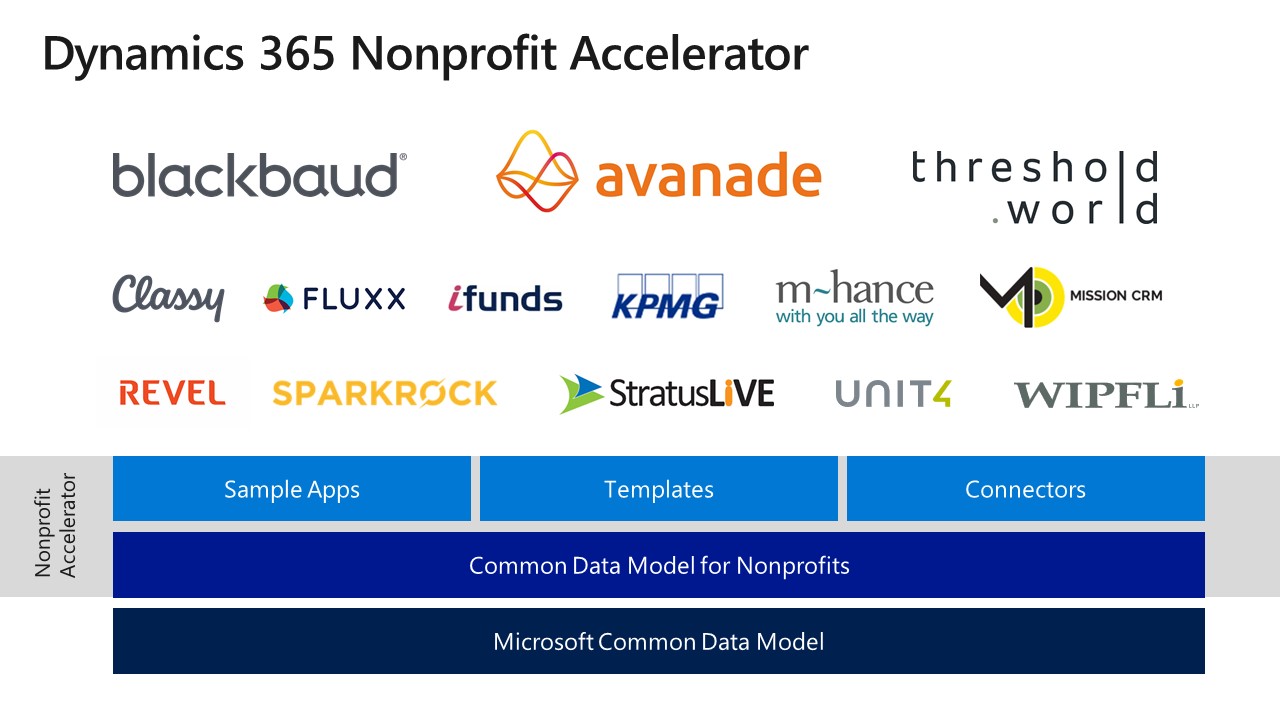
  2. Dynamics 365 Nonprofit Accelerator: The Dynamics 365 Nonprofit Accelerator is a suite of sample apps, templates, and connectors specifically designed to solve the most pressing scenarios nonprofits face when delivering their programs and measuring their impact. The accelerators are meant for partners to use in their development of solutions to help reduce the cost to develop, and thus allow for more solutions to be built and available to nonprofits. To begin, we are releasing accelerators that support impact measurement and constituent management with more components available over time. These solutions help nonprofits better connect their impact to their fundraising strategies by creating opportunities for interoperability and data transparency across platforms. These solutions will be pre-mapped on the Microsoft Common Data Model for Nonprofits, enabling partners and the nonprofits they work with to rapidly create and implement new applications and solutions that help to drive their mission.
  3. Dynamics 365 Nonprofit Partners: Bringing these capabilities to life requires a range of innovative partners who are committed to delivering end-to-end solutions for nonprofits on the Nonprofit Accelerator. These partners include:
  • Blackbaud, the world’s leading cloud software company powering social good, announced the Integrated Cloud Initiative for Nonprofits™ with Microsoft earlier this fall. Blackbaud’s founding partnership is instrumental in shaping the Common Data Model for Nonprofits to ensure that it is relevant and based on proven taxonomy and data structures. In addition, Nonprofit Resource Management™ is the first jointly developed solution of its kind that leverages the Microsoft Common Data Model for Nonprofits.  This is yet another compelling example of how the Common Data Model for Nonprofits will be leveraged to bring more value to nonprofit organizations.
  • Avanade is a global leader in delivering innovative digital and cloud services, business solutions and design-led experiences through the power of people and the Microsoft ecosystem. Avanade has 34,000 digitally connected people across 24 countries, bringing clients the best thinking through a collaborative culture that honors diversity and reflects the communities in which they operate.  This month, Avanade is launching Technology for Social Good to serve the nonprofit sector and will be developing an end-to-end, native Dynamics 365 solution on the Microsoft Common Data Model for Nonprofits. This comprehensive suite of solutions will be designed and delivered specifically to address the needs of the sector, enabling organizations to connect core processes and deliver mission impact and insights.
  • threshold.world is a new company launched by Dan Lammot, the co-founder and former CEO of roundCorner – an organization that pioneered development of enterprise fundraising and grant management solutions on the Salesforce platform.  threshold.world will both participate in the design of the Dynamics Nonprofit Accelerator and serve as a catalyst to help partners worldwide design finished nonprofit solutions exclusively on the Dynamics platform.

In addition, we have a range of partners committed to building on the Nonprofit Accelerator from integrations with born-in-the-cloud fundraising partners like Classy (helping to power Team Rubicon’s online fundraising efforts), to partners with world-class delivery capacity such as Revel and Wipfli.  Other key partnerships include Fluxx, Ifunds, KPMG Denmark, m-hance, MISSION CRM, Sparkrock StratusLIVE, and Unit4.

Dynamics 365 Nonprofit Accelerator logos

Going forward here’s what you can expect:

  • Microsoft Common Data Model for Nonprofits: This is now available on GitHub and we will continue to iterate based on community feedback.
  • Nonprofit Accelerators: For the first phase of this effort we will be building capabilities in six main areas – (1) constituent management (2) fundraising (3) donation management (4) program delivery (5) volunteer management (6) grant and award management.  Constituent management is now available and will be followed by the Program Management Accelerator in February.
  • Partners: Partners will ultimately finish and deliver these accelerators and the partners mentioned above are ready now to engage you. We will maintain a list of quality partners for your reference.
  • Nonprofit Early Adopter Success Credit:  To help ensure successful deployment, we will invest in an Early Adopter Success Program which will provide design and deployment support and incentives.  The aim of this program is to help ensure success for each organization while also capturing key learnings and feedback to incorporate into the design of the Microsoft Nonprofit Common Data Model and Accelerators.  The full details of this program will be released shortly at www.microsoft.com/nonprofits.
  • Ongoing updates and technical information: Additional updates and a deeper technical drill down will be available on Erik Arnold’s blog.

This is not a point-in-time release of a single new product, rather a long-term investment and commitment to the sector to truly unlock new capabilities for nonprofits and improve end-to-end mission delivery. Working with our partners, Microsoft is incredibly optimistic about the potential for digital technology to help transform large and small nonprofits. We’ve seen the potential of digital transformation with Team Rubicon and our aspiration is to ensure technology fulfills its promise to address the world’s biggest challenges. We can empower everyone to achieve more.

Tags: , ,