Posted on Leave a comment

Microsoft and the Open Data Institute announce an Education Open Data Challenge to help close the digital divide

LONDON, UK and REDMOND, Wash. — Nov. 10, 2020  Microsoft and the Open Data Institute (ODI) on Tuesday announced the launch of an Education Open Data Challenge to shine light on the relationship between broadband access and K-12 (ages 5 to 18 years old) education outcomes. In the wake of the COVID-19 pandemic, the Education Open Data Challenge will help educators and research organizations better understand the potential long-term impact the ongoing disruption to traditional learning will have on the world’s most vulnerable learners.

Microsoft and the ODI are encouraging teams that wish to participate in the challenge to help generate innovative solutions to close the digital divide in K-12 education to go here to learn more. The winning team will be invited to elect a non-profit organization of their choice to receive a £50,000 award, with the runners-up electing non-profit organizations of their choice to receive £30,000 and £20,000 awards. The challenge is open to teams and individuals based globally.

“As students around the world increasingly rely on technology and connectivity to succeed in school, we must find ways to allow every student, everywhere, to succeed. Combining datasets in new ways can help unlock solutions to expand equitable and robust access to broadband,” said Jennifer Yokoyama, Microsoft Vice President and Chief IP Counsel. “We’re excited to join in the launch of this Education Open Data Challenge to help close the digital divide and level the playing field for students around the world.”

Participants will receive access to tools and resources from Microsoft, the ODI, and BroadbandNow, as well as data made available for the first time as part of this challenge:

  • Participants will have access to a more granular version of Microsoft’s U.S. broadband usage data, this time with differential privacy applied. Microsoft will make available documentation that demonstrates the impact that applying differential privacy has had on the data.
  • The ODI will provide access to several eLearning modules on Open Data Essentials, Finding Stories in Data, Guidance for data users on data licensing and How to anonymize datasets for participants who wish to contribute their own data, as well as mentorship. Participants are also able to access free MS Learn training resources and training modules.
  • From BroadbandNow, participants will be able to access U.S. broadband terrestrial provider data.

The use of privacy-preserving technologies will become more prevalent as organizations seek to collaborate across the spectrum of data. The datasets that will be made openly available with the challenge will help participants to assess and understand the effect that technologies such as differential privacy can have on data insights and analysis.

“Organizations like Microsoft and BroadbandNow possess a wealth of interesting data that can be used to provide insights and support decision-makers in the education sector and beyond, especially as they face unprecedented challenges. This Challenge will stimulate the exploration of innovative uses for this data, outside the boundaries of the organizations that hold it,” said Jeni Tennison, Vice President & Chief Strategy Adviser of the ODI. “The ODI is here to help organizations that want to ensure the data they hold brings the most value to the sectors, communities and societies they work in.”

The COVID-19 pandemic has disrupted learning for more than 1.6 billion children and youth worldwide, as governments across the globe have closed educational institutions to stop the spread of the virus. In response, schools and teachers have made an unprecedented effort to reach students remotely through distance learning tools and platforms.

As the digital divide is expanded by the abrupt global transition to remote learning, understanding how and where the digital divide affects communities will be critical for managing the short-term delivery of education and ensuring a sustainable, equitable economic recovery.

“We are thrilled to participate in providing data for the Open Data Challenge and look forward to discoveries made by the participants,” said John Busby, Managing Director of BroadbandNow. “Access to affordable broadband internet is crucial to education and digital equity.”

Participating teams will be asked to identify gaps in digital infrastructure that affect the delivery of education services online, pinpoint potential impacts on learning outcomes, and suggest innovative and realistic solutions to address these gaps in a cost-efficient way. Some of the questions the challenge seeks to answer include:

  • How do students access remote learning, especially those who may not have easy access to digital infrastructure (e.g., technology and internet connectivity)?
  • What level of digital access to learning do students from disadvantaged groups have, relative to more advantaged groups?
  • What is the relationship between levels of digital skills and learning outcomes for different demographics?

Participants will have four months to complete the challenge from the opening date. Individuals and teams interested in participating in the challenge can learn more and register interest here. Once registered, individuals will be invited to attend dedicated activities to preview the data, learn more about it from the involved partners, and get equipped on how to best use it ahead of the public release on December 10, 2020.

###

About Microsoft

Microsoft (Nasdaq “MSFT” @microsoft) enables digital transformation for the era of an intelligent cloud and an intelligent edge. Its mission is to empower every person and every organization on the planet to achieve more.

About the Open Data Institute

The ODI was co-founded in 2012 by the inventor of the web Sir Tim Berners-Lee and artificial intelligence expert Sir Nigel Shadbolt to show the value of data, and to advocate for the innovative use of data to affect positive change across the globe. We’re an independent, non-profit, non-partisan company headquartered in London, with an international reach. We work with companies and governments to build an open, trustworthy data ecosystem, where people can make better decisions using data and manage any harmful impacts.

For more information, contact:

Microsoft Media Relations, WE Communications for Microsoft
(425) 638-7777
[email protected]

Posted on Leave a comment

Microsoft and Open Data Institute join to launch Peer Learning Network for Data Collaborations

Today, in partnership with the Open Data Institute (ODI), we are delighted to announce an open call for participation in a new Peer Learning Network for Data Collaborations. Peer learning networks are an important tool to foster the exchange of knowledge and help participants learn from one another so they can more effectively address the challenges they face.

In April, with the launch of Microsoft’s Open Data Campaign, we committed to putting open and shared data into practice by addressing specific challenges through data collaborations. For a data collaboration to achieve its goals, there are many factors that must come together successfully. Oftentimes, this process can be incredibly challenging. From aligning on key outcomes and data use agreements to preparing datasets for use and analysis, these considerations require time and extensive coordination.

Drawing from the legal expertise of our team and the technical expertise of our colleagues, we want to share some of these learnings and best practices to help other collaborations succeed.

The Peer Learning Network for Data Collaborations will be comprised of up to five existing or recently established data collaborations that are interested in exploring facets of trust, including how to manage different trust environments and issues associated with trust and trustworthiness. For example, where privacy considerations are critical to sharing data, what are the governance and technology mechanisms that can be most effective? Or where the data collaboration is working with less sensitive datasets, what principles can apply to foster data accessibility? The Peer Learning Network will explore these types of questions and more.

Awardees will have the opportunity to:

  • receive up to £20,000 for their time over the six months of the peer learning network
  • learn about and receive guidance from the ODI and Microsoft on different technical approaches, governance mechanisms, and other means for managing data collaborations
  • connect with peers also working on these challenges

For the purpose of the Peer Learning Network, data collaborations are defined as:

  • involving a collaboration of companies, research institutions, non-profits, and/or government entities
  • addressing a clear societal or business-related challenge
  • are working to make their data as open as possible in the context of the collaboration (collaborations working with restrictions related to privacy or commercial sensitivity are encouraged to apply)
  • ultimately demonstrate increased access to, and/or meaningful use of, data in reaching the specific goal

To learn more about the Peer Learning Network and to participate in an informational webinar on October 29, 2020, please sign up here.

We’re excited about this new initiative and look forward to sharing learnings so other data collaborations can benefit and accelerate their work.

Tags: , ,

Posted on Leave a comment

Open Data Campaign: exploring the power of open data

In April, we announced the launch of the Open Data Campaign to close the “data divide” and ensure that organizations of all sizes have access to the data they need to innovate with artificial intelligence (AI). To demonstrate the importance of being more open with data and the need to share data to address pressing issues, we committed to the development of 20 data collaborations by 2022. Through these collaborations, we will work with partners to address issues that are “top of mind” and require urgent action. One thing remains true in these uncertain times: To tackle the pressing societal issues we face today – everything from climate change to COVID-19, justice reform to digital access – people and organizations need access to the data that can help unlock the power of innovation and technology.

The past several months have accelerated this work in many ways, and we are learning a lot. The campaign launched just as the world was grappling with the COVID-19 pandemic, and the value of being more open with data become clear in new, undeniable ways. For example, The Alan Turing Institute had been leading an air quality project, with the support of Microsoft’s AI for Earth program, collecting data from across London to understand air pollution. As the summer progressed, however, the institute discovered that analysis of these same data streams could also be used to understand London’s “busyness” as COVID-19 restrictions were eased. It’s just one example of how open data and data collaboration can provide valuable insights beyond their initial focus.

When armed with the right data, organizations are empowered to make decisions that positively impact their employees, customers and the communities they serve. In many ways, data is taking center stage in the response from governments and companies to fuel promising solutions and ideas.

Since launching the campaign, we have moved forward in forging strong data collaborations with partners – focusing our efforts on issues that require commitment, collaboration and urgent action to address:

  • Climate change: On September 1, Microsoft joined with Allianz, Amazon and S&P Global to announce plans to launch the Climate Finance Foundation, led by the Linux Foundation. Climate change is one of the most pressing challenges of the 21st century, and we are committed to being a part of the solution. The ability to leverage high-quality, open, corporate sustainability data will be critical for enabling the investment community to make informed decisions based on accurate and reliable economic models around corporate climate-related risk and opportunity. Microsoft is investing heavily in sustainability, and we have made a commitment to share relevant sustainability data to the open Data Commons supported by this effort.
  • COVID-19: The Alan Turing Institute partnered with the Greater London Authority, supported by Microsoft and the London Data Commission, to demonstrate the value of data sharing to help support London’s response and recovery to COVID-19. This pilot is looks at London’s “busyness” – or movement around the city – through multiple data sources as COVID-19 restrictions are relaxed to monitor how people are responding to the changes. Microsoft provided Azure AI and cloud infrastructure and services to support the COVID-19 pilot. Transport for London is already operationalizing the outputs from this pilot.
  • Digital access and education: When we launched the Open Data Campaign in April, one of our first announcements was that we would be working with the Open Data Institute and BroadbandNow to help address the issue of broadband availability. With COVID-19 taking a significant toll on students’ ability to access face-to-face education, we know that this need is more urgent than ever. As governments, policymakers, nonprofits, and organizations around the world are looking at ways to target resources that serve students more effectively, we are excited to share that we’ll be launching an Open Data Challenge in October to look at the impact of digital access and COVID-19 on young students’ education. We look forward to sharing more details on this collaboration in the coming weeks.

So where do we go from here? We take seriously our commitment to make data sharing easier, safer and more efficient, and we will continue to work with a range of stakeholders to develop new data collaborations that address the challenges of today. We will also focus on developing the tools and governance frameworks necessary to make data sharing easier for organizations of all sizes.

While the progress we’ve made in five short months has been encouraging, we recognize that there is more work to do. We hope you’ll follow our progress at news.microsoft.com/opendata.

Together, we can empower the world to share and use data more effectively.

Tags: , , , , , ,

Posted on Leave a comment

Closing the data divide: the need for open data

Today, Microsoft is launching an Open Data Campaign to help address the looming “data divide” and help organizations of all sizes to realize the benefits of data and the new technologies it powers. We believe everyone can benefit from opening, sharing and collaborating around data to make better decisions, improve efficiency and even help tackle some of the world’s most pressing societal challenges.

The goal of our campaign is to advance a much-needed discussion about how the world uses and shares data. To start, today we’re announcing three steps:

  • First, we’re publishing new principles that will guide how Microsoft itself approaches sharing our data with others.
  • Second, we’re committing to take action by developing 20 new collaborations built around shared data by 2022. This includes work with leading organizations in the open data movement like the Open Data Institute and The Governance Lab (GovLab) at the New York University Tandon School of Engineering. And we’ll seek to lead by example by making our Microsoft social impact initiatives “open by default,” beginning with sharing data on broadband access from our Airband initiative and combining it with data from others to help accelerate improvements in broadband connectivity.
  • Finally, we’ll invest in the essential assets that will make data sharing easier, including the required tools, frameworks and templates.

In recent months, we’ve again seen the benefits that better data sharing can bring not just for companies and other organizations, but also in tackling the world’s biggest challenges. From climate change to the COVID-19 pandemic, it is clear that data plays a critical role in helping us understand these challenges and in addressing them. To fully realize the benefit of data, we need to develop the ability to share data across organizational boundaries in a way that is safe and secure, and allows the data to be used effectively.  If ever there was a time to accelerate the world’s efforts around open data, it is now. We hope our steps today can contribute to these efforts. We’re committed to the cause, and to learning from and working with others.

YouTube Video

What do we mean by the “data divide” and why now?

Despite the enormous growth in data and AI, both are increasingly concentrated in the hands of a small number of companies. Indeed, fewer than 100 companies now collect more than 50% of the data generated by online interactions (based on analysis of similarweb.com, appfigures.com and alexa.com) and around half of all people with technical AI skills work in the technology sector (according to figures from LinkedIn). Not surprisingly, these businesses are then able to reap the enormous benefits of data and AI while others are left at a disadvantage. This data divide poses a serious challenge for society and, if left unaddressed, could lead to huge economic power flowing to just a few countries and companies. Based on current trends, for example, PWC predicts that around 70% of the economic value generated by AI will accrue to just two countries: the USA and China. But we do not believe that an ever-growing data divide is inevitable. By doing more to open up and share data, organizations can unlock value, share expertise and make data more useful for all, allowing everyone to benefit in ways they are not able to by going it alone. By acting now and joining together, more civil society organizations, governments and businesses of all sizes will be able to realize the full value of data.

Charting a principled course

To help guide our own efforts on open data, we are adopting a set of principles to inform how we at Microsoft open and share data in a responsible way. We’ve learned through our work on protecting privacy, responsible AI and sustainability that it is valuable to define a clear set of principles when engaging with important and complex societal issues. We hope these principles will inform the broader conversation on open data and that others can build on and improve them. The five principles that will guide our contributions to trusted data collaboration are:

  • Open – We will work to make data that is relevant to important social problems as open as possible, including by contributing open data ourselves
  • Usable – We will invest in creating new technologies and tools, governance mechanisms and policies to make data more usable for everyone
  • Empowering – We will help organizations generate value from their data according to their choices, and develop their AI talent to use data effectively and independently
  • Secure – We will employ security controls to ensure data collaboration is operationally secure where it is desired
  • Private – We will help organizations to protect individuals’ privacy in data-sharing collaborations that involve personally identifiable information

Each of these principles is important. However, as has become clear to us in our work in this area, one stands out as the most challenging but vital key to success: the need to make data more usable. Unless organizations are able to collect and categorize data in a standardized way, they will not be able to aggregate and analyze it in a manner that produces the transformative insights that shared data has the potential to unlock.

Committing to new collaborations

In addition to charting a principled course, we believe success will depend on building deep collaborations with others from across industry, government and civil society around the world. We want to try and lead by example and do more to learn firsthand about the challenges and solutions around open data. To this end, Microsoft is committing to launching 20 data collaborations by 2022, building partnerships to tackle the major challenges of our time. To help seed these collaborations, Microsoft will make its social impact initiatives “open by default” and explore whether our data related to initiatives such as Airband, AI for Good and our work on sustainability and accessibility might be able to be opened up and built on to help solve major challenges. We are excited to be partnering with the Open Data Institute in this effort, working together to develop our initial collaborations and share the lessons we learn with others so that they may also benefit. Our initial work will focus on:

  • Tackling connectivity challenges: Microsoft is publishing under open agreement on GitHub a small, but important, dataset around broadband usage in the United States, gathered as part of our Airband Initiative. We will be working with the Open Data Institute and BroadbandNow, a company that help consumers find broadband access in the U.S. to add to this dataset to help improve broadband availability. The BroadbandNow dataset provides county-level pricing and competition data.
  • Addressing COVID-19: As one of the most pressing challenges today, we will contribute to the work being done to use data to address the COVID-19 crisis. This includes expanding work Microsoft is doing with partner Adaptive Biotechnologies to decode how the immune system responds to COVID-19 and share research findings via an open data access portal for any researcher to use in the fight against the pandemic. More broadly, Microsoft has also built a COVID-19 tracker on our Bing search engine and is releasing aggregated data to those in academia and research. We are also working with GitHub, which is hosting a range of collaborative COVID-19 projects, including open source software, hardware designs, models and many leading COVID-19 datasets.
  • Helping cities collaborate around data: Microsoft will partner with Arup and the Oliver Wyman Forum on the London Data Commission, an open data initiative run by London First working with the Greater London Authority and others, to lead a data collaboration project around city-based data that can help address social and economic challenges in London. 
  • Helping governments collaborate around data: To help governments better open up and collaborate around data, we will co-launch the Open Data Policy Lab with The GovLab at NYU. The Lab will provide a live repository of best practices and resources with a focus on: 1) analysis, in the form of comparative research of data initiatives that contribute to economic development; 2) guidance, to include toolkits, frameworks and best practices to support data sharing and data-driven decision-making; 3) community, of data stewards and other data stakeholders within the public and private sectors; and 4) action, to implement proof-of-concept initiatives.
  • Advancing data-driven healthcare: This work will enable the first global data collaborative to improve cardiovascular health, bringing together data from a range of sources to help address one of the world’s leading causes of death. Microsoft is working with the Novartis Foundation, Apollo Hospitals in India and Coala Life in Sweden to consolidate their respective cardiovascular datasets from hospitals and primary-care centers around the world. The collaborative aims to further develop and use the leading cardiovascular AI tool – AICVD Risk Score, created by Apollo Hospitals – to accelerate the use of data-driven decisions in tackling cardiovascular disease and informing the direction of health policy.

YouTube Video

Making data sharing easier and safer

If data is open and available but unusable, it serves little to no purpose. We are therefore committing to helping tackle the problems created by the lack of easy-to-use tools and frameworks for sharing data to ensure that we are able to help make data more usable. One big challenge we have seen in our work on data sharing and the analysis we’ve been doing to help fight the COVID-19 crisis is the difficulty around inconsistent data collection. Currently, data is collected in a variety of different formats and document types – some in Word documents, some in PDFs, some in spreadsheets, some still on paper. This makes it all but impossible to share and aggregate data in a way that is valuable and provides a huge barrier to collaboration. The campaign will work to address this challenge and also continue our work to develop scalable tools that any organization can utilize, reducing the friction around sharing.

In this work, there are valuable lessons to be taken from the world of open source software. While there are important differences between data and code, particularly around the steps needed to address privacy and security considerations when dealing with data, our experience with open source provides us with insights for enabling successful collaboration. A priority will be continuing our work on open data use agreements, providing templates that anyone can use to easily share data and continue to build on the governance, licensing and legal tools provided on the Open Data Campaign microsite. We will also continue to advance our work on differential privacy with Harvard’s IQSS, providing tools to allow people to extract useful insights from datasets in a way that safeguards the privacy of individuals.

Closing the data divide is a big challenge. But the benefits for organizations of all sizes, and the broader community are significant if we can work together to make progress on open data. We’re committed to making our contribution, and we look forward to working with, and learning from, others so that everyone can realize the benefits of data.

Tags: , , , , ,

Posted on Leave a comment

Adobe, Microsoft and SAP announce new Open Data Initiative details

Global industry partners join effort to connect data and gather powerful insights fueled by AI and intelligent services

LAS VEGAS — March 27, 2019 Wednesday at Adobe Summit, the industry’s leading customer experience conference, Adobe (Nasdaq: ADBE) CEO Shantanu Narayen and Microsoft (Nasdaq “MSFT” @microsoft) CEO Satya Nadella revealed additional details about the Open Data Initiative (ODI). As originally announced last September, Adobe, Microsoft and SAP (NYSE: SAP) have embarked on a new approach to business data that will help companies transform their customer experiences through real-time insights delivered from the cloud.

The three partners outlined a common approach and set of resources for customers in an initial announcement last September, with the ambition of helping customers create new connections across previously siloed data, more seamlessly garner intelligence, and ultimately better serve brands with an improved view of their customer interactions.

From the beginning, the ODI has been focused on enhancing interoperability between the applications and platforms of the three partners through a common data model with data stored in a customer-chosen data lake. This unified data lake is intended to allow customers their choice of development tools and applications to build and deploy services.

To improve that process, the three companies plan to deliver in the coming months a new approach for publishing, enriching and ingesting initial data feeds from Adobe Experience Platform, activated through Adobe Experience Cloud, Microsoft Dynamics 365, and Office 365 and SAP C/4HANA, into a customer’s data lake. This will enable a new level of AI and machine learning enrichment to garner new insights and better serve customers.

Unilever, a mutual customer and one of the early global brands to express support and excitement about the ODI, today announced its intention to simplify a previously complex business outcome based on these data connections. At Adobe Summit, Unilever is demonstrating how it plans to bring together disparate customer, product and resource data and use AI-driven insights to help reduce its plastic packaging and encourage consumer recycling. By eliminating the silos of data, Unilever will be able to tie inventory and plastics data into Adobe data to enhance customer experiences and encourage participation.

To accelerate development of the initiative, Adobe, Microsoft and SAP also announced today plans to convene a Partner Advisory Council consisting of over a dozen companies including Accenture, Amadeus, Capgemini, Change Healthcare, Cognizant, EY, Finastra, Genesys, Hootsuite, Inmobi, Sprinklr, and WPP. These organizations span myriad industries and customer segments and believe there is significant opportunity in the ODI for them to drive net- new value to their customers.

“Our customers are all trying to integrate behavioral, CRM, ERP and other internal data sets to have a comprehensive understanding of each consumer, and they’re struggling with the challenges of integrating this data,” said Stephan Pretorius, CTO of WPP. “We’re excited about the initiative Adobe, Microsoft and SAP have taken in this area, and we see a lot of opportunity to contribute to the development of ODI.”

About Adobe
Adobe is changing the world through digital experiences. For more information, visit www.adobe.com.

About SAP
As market leader in enterprise application software, SAP (NYSE: SAP) helps companies of all sizes and industries run better. From back office to boardroom, warehouse to storefront, desktop to mobile device – SAP empowers people and organizations to work together more efficiently and use business insight more effectively to stay ahead of the competition. SAP applications and services enable more than 404,000 business and public sector customers to operate profitably, adapt continuously, and grow sustainably. For more information, visit www.sap.com.

About Microsoft
Microsoft (Nasdaq “MSFT” @microsoft) enables digital transformation for the era of an intelligent cloud and an intelligent edge. Its mission is to empower every person and every organization on the planet to achieve more.

For more information, press only:

Microsoft Media Relations, WE Communications for Microsoft, (425) 638-7777, [email protected]

Stefan Offermann, Adobe, (408) 536-4023, [email protected]

Stacey Hoskin, SAP, (816) 337-7476, [email protected]

Note to editors: For more information, news and perspectives from Microsoft, please visit the Microsoft News Center at http://news.microsoft.com. Web links, telephone numbers and titles were correct at time of publication but may have changed. For additional assistance, journalists and analysts may contact Microsoft’s Rapid Response Team or other appropriate contacts listed at http://news.microsoft.com/microsoft-public-relations-contacts.

Posted on Leave a comment

Adobe, Microsoft and SAP announce the Open Data Initiative

Industry leaders team up to help customers connect data across their organizations, find powerful insights and deliver intelligent services with AI

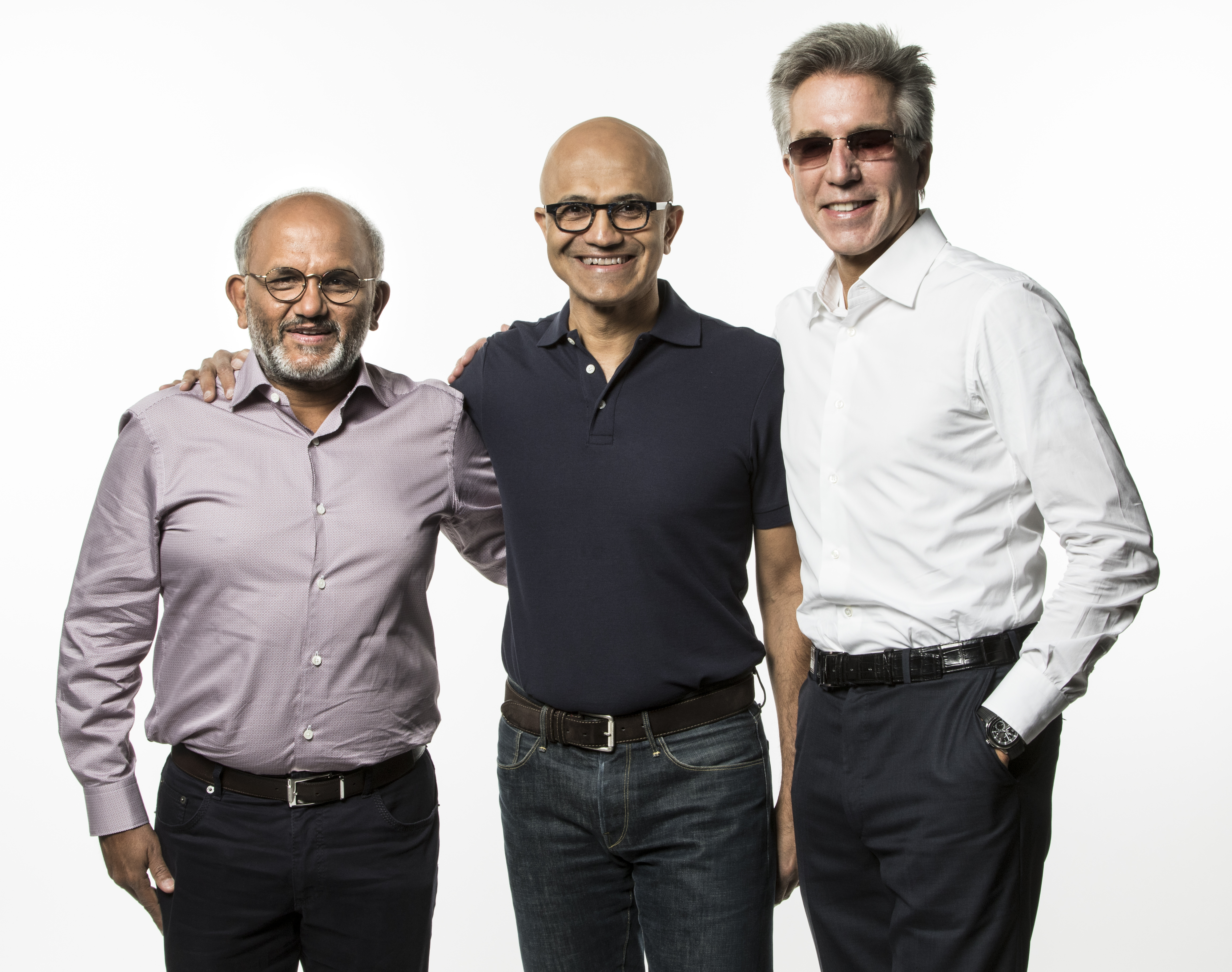
Shantanu Narayen, CEO, Adobe, Satya Nadella, CEO of Microsoft, and Bill McDermott, CEO of SAP
Shantanu Narayen, CEO, Adobe (left), Satya Nadella, CEO of Microsoft (center), and Bill McDermott, CEO of SAP (right), introduced the Open Data Initiative at the Microsoft Ignite conference.

ORLANDO, Fla. — Sept. 24, 2018 On Monday, the CEOs of Adobe (Nasdaq: ADBE), Microsoft (Nasdaq: MSFT) and SAP (NYSE: SAP) introduced the Open Data Initiative at the Microsoft Ignite conference. Together, the three longstanding partners are reimagining customer experience management (CXM) by empowering companies to derive more value from their data and deliver world-class customer experiences in real-time.

In today’s world, data is a company’s most valuable asset. However, many businesses struggle to attain a complete view of their customer interactions and operations, because they are unable to connect information trapped in internal silos. At the same time, important customer information also resides in external silos with intermediary services and third-party providers, limiting a company’s ability to create the right connections, garner intelligence and ultimately extract more value from its own data in real time to better serve customers.

Companies around the world use software and services from Adobe, Microsoft and SAP to run product development, operations, finances, marketing, sales, human resources and more. Today, Adobe, Microsoft and SAP are joining forces to empower their mutual customers with the Open Data Initiative, which is a common approach and set of resources for customers based on three guiding principles:

  • Every organization owns and maintains complete, direct control of all their data.
  • Customers can enable AI-driven business processes to derive insights and intelligence from unified behavioral and operational data.
  • A broad partner ecosystem should be able to easily leverage an open and extensible data model to extend the solution.

Based on these principles, the core focus of the Open Data Initiative is to eliminate data silos and enable a single view of the customer, helping companies to better govern their data and support privacy and security initiatives. With the ability to better connect data across an organization, companies can more easily use AI and advanced analytics for real-time insights, “hydrate” business applications with critical data to make them more effective and deliver a new category of AI-powered services for customers.

“Adobe, Microsoft and SAP are partnering to reimagine the customer experience management category,” said Shantanu Narayen, CEO, Adobe. “Together we will give enterprises the ability to harness and action massive volumes of customer data to deliver personalized, real-time customer experiences at scale.”

“Together with Adobe and SAP we are taking a first, critical step to helping companies achieve a level of customer and business understanding that has never before been possible,” said Satya Nadella, CEO of Microsoft. “Organizations everywhere have a massive opportunity to build AI-powered digital feedback loops for predictive power, automated workflows and, ultimately, improved business outcomes.”

“Microsoft, Adobe and SAP understand the customer experience is no longer a sales management conversation,” said Bill McDermott, CEO of SAP. “CEOs are breaking down the silos of the status quo so they can get all people inside their companies focused on serving people outside their companies. With the Open Data Initiative, we will help businesses run with a true single view of the customer.”

To deliver on the Open Data Initiative, the three partners are enhancing interoperability and data exchange between their applications and platforms — Adobe Experience Cloud and Adobe Experience Platform, Microsoft Dynamics 365, SAP C/4HANA and S/4HANA — through a common data model. The data model will provide for the use of a common data lake service on Microsoft Azure. This unified data store will allow customers their choice of development tools and applications to build and deploy services.

With the Open Data Initiative, companies will be able to:

  • Unlock and harmonize siloed data to create new value
  • Bi-directionally move transactional, operational, customer or IoT data to and from the common data lake based on their preference or needs
  • Create data-powered digital feedback loops for greater business impact, while also helping to enable their security and privacy compliance initiatives
  • Build and adopt intelligent applications that natively understand data, relationships and metadata spanning multiple services from Adobe, SAP, Microsoft and their partners

Technology leaders at top retail and consumer products companies, such as The Coca-Cola Company, Unilever and Walmart, have expressed support and excitement about the Open Data Initiative.

“This initiative from Adobe, Microsoft and SAP is an important and strategic development for the Coca-Cola System,” said Barry Simpson, chief information officer at the Coca-Cola Company. “Our digital growth plans centered around our customers are fueled by these platforms and open standards. A more unified approach to the management and control of our data strengthens our ability to support our growth agenda and our ability to satisfy security, privacy and GDPR-compliance requirements. The industry needs to follow these leaders.”

“Every day, 2.5 billion people use a Unilever product in over 190 countries around the world,” said Jane Moran, CIO, Unilever. “The Open Data Initiative from Adobe, Microsoft and SAP is an important undertaking that will help us reimagine customer experience management by bringing together data across our entire organization to build more direct, meaningful relationships with consumers in real time.”

“We’re excited about the Open Data Initiative and the value it will unlock for Walmart,” said Clay Johnson, executive vice president and enterprise chief information officer, Walmart Inc. “With greater ability to connect and harness the power of our data, we can enhance the associate experience and create entirely new ways to serve our customers online and in our stores.”

More information is available at https://www.microsoft.com/opendatainitiative, https://www.adobe.com/experience-platform/open-data-initiative.html and http://www.sap.com/opendatainitiative.

About Adobe

Adobe is changing the world through digital experiences. For more information, visit www.adobe.com.

About Microsoft

Microsoft (Nasdaq “MSFT” @microsoft) enables digital transformation for the era of an intelligent cloud and an intelligent edge. Its mission is to empower every person and every organization on the planet to achieve more.

About SAP

As market leader in enterprise application software, SAP (NYSE: SAP) helps companies of all sizes and industries run better. From back office to boardroom, warehouse to storefront, desktop to mobile device – SAP empowers people and organizations to work together more efficiently and use business insight more effectively to stay ahead of the competition. SAP applications and services enable more than 404,000 business and public sector customers to operate profitably, adapt continuously, and grow sustainably. For more information, visit www.sap.com.

For more information, press only:

Microsoft Media Relations, WE Communications for Microsoft, +1 (425) 638-7777,

[email protected]

Stefan Offerman, Adobe, (408) 536-4023, [email protected]

Rajiv Sekhri, SAP, +49 6227 7-74871, [email protected]

Note to editors: For more information, news and perspectives from Microsoft, please visit the Microsoft News Center at http://news.microsoft.com. Web links, telephone numbers and titles were correct at time of publication, but may have changed. For additional assistance, journalists and analysts may contact Microsoft’s Rapid Response Team or other appropriate contacts listed at http://news.microsoft.com/microsoft-public-relations-contacts.