Posted on Leave a comment

Best 10 Smoothies for Coders — Boost Your Brainpower in a Sip

5/5 – (1 vote)

As a coder, you’re probably spending long hours in front of your computer screen, solving complex problems and developing cutting-edge software. During those intense periods, it’s important to keep your energy levels up and your brain fueled with the right nutrients. 🍇🍍🍉 Smoothies can be a perfect way to achieve that, and they also serve as a delicious break from your routine.

We’ve compiled the 10 best smoothies specifically designed for hardworking coders like you.

These nutrient-packed drinks not only boost your energy but also provide essential vitamins and minerals to keep your cognition sharp. Incorporating these smoothies into your daily routine can make a significant impact on your overall health, mood, and productivity.

Choosing the Right Tools

So, you’re a coder looking for the perfect smoothie to fuel your brain and satisfy your taste buds. The first step towards crafting these delicious beverages is choosing the right tools. Don’t worry, we’ve got you covered.

A quality blender is essential for making great smoothies. Some of the top blenders you can choose from include the Blendtec Classic 575, the Vitamix Pro 750, and the Nutribullet Pro. Each of these models offers excellent blending capabilities, ensuring that your smoothie ingredients are perfectly combined and smooth.

🍉 Recommended: Ninja Blender Under $100: Top Affordable Picks

When it comes to choosing your ingredients, there is a vast array to pick from. Here are some options to consider for your smoothies:

  • Liquid base: water, milk, almond milk, coconut milk, or yogurt
  • Fruits: bananas, berries, mango, or pineapple
  • Vegetables: spinach, kale, or carrots
  • Protein: protein powder, Greek yogurt, or almond butter
  • Healthy fats: avocado, flaxseed, or chia seeds
  • Sweeteners: honey, maple syrup, or stevia (optional)

Equipped with a quality blender and the right ingredients, you’ll be ready to make fantastic smoothies that will keep your mind sharp and your taste buds happy throughout your coding sessions.

Go ahead and experiment with different combinations of ingredients to find your perfect blend. Enjoy your delicious concoctions and happy coding!

The Importance of Ingredients

When whipping up the perfect smoothie for coders, the ingredients you choose are vital. We know you need the right energy and focus-boosting nutrients to tackle those coding challenges. So, let’s talk about what should go into your blender.

First off, incorporating a variety of fruits and vegetables like bananas, berries, spinach, and kale ensures you’re getting a ton of vitamins, antioxidants, and fiber to keep your brain working at its best. You could even add in some not-so-common ingredients like cauliflower or beet for added nutrients and a fun twist.

When it comes to the liquid base, the options are endless. You can choose from various types of milk (cow, almond, coconut milk), or go with coconut water or fruit juices for a tropical vibe. Just keep an eye on the sugar content, especially in juices, to avoid energy crashes.

Pair your fruits and veggies with a protein source to stay full and focused. Greek yogurt, nut butters (peanut, almond, or tahini), or even seeds (chia, hemp) make great protein-packed additions to any smoothie. Don’t forget to toss in some oats or nuts for extra satiety!

Sweetening your smoothie just right will make all the difference in taste. Options like honey, maple syrup, or dates can add natural sweetness without overloading on refined sugars. You can also spice things up with cinnamon, ginger, or even a dash of cocoa powder for a chocolatey treat.

To give your smoothie an extra health boost and indulgent feel, consider adding superfood ingredients such as avocado, matcha, or even refreshing herbs like mint. Plus, don’t be afraid to get experimental – blending in a hint of coffee or green tea can offer a caffeine kick to help you power through a long coding session.

Remember, it’s all about balancing taste, nutrition, and convenience when crafting the perfect coder smoothie. Now, go ahead and mix up these ingredients to create your go-to breakfast or snack that will keep you focused and energized for your coding adventures.

Smoothies for Energy Boost

Hey there, coders! Are you in need of a quick pick-me-up to get through those long coding sessions? Well, you’re in luck. Here are a few energy-boosting smoothie ideas that’ll keep your brain and body energized.

First up is the classic protein-packed smoothie. A blend of banana, peanut butter, and your choice of milk, this smoothie will provide a sustained energy boost. Throw in some protein powder and flax seeds to really pump up the protein levels.

Another great option for a caffeinated kick is the coffee smoothie. Try combining cold brew with banana, ice, and a splash of your preferred milk. You can even add a spoonful of chocolate protein powder for a delicious mocha twist.

For those in search of fruity flavors, the strawberry banana smoothie is always a winner. Just blend together fresh strawberries, a ripe banana, and some yogurt or milk, and you’ve got a sweet energy booster. You can also toss in some spinach or kale for added nutrients without compromising taste.

Love greens? Then the kale smoothie is for you. Combine kale with mangoes, bananas, and a green apple for a sweet, tangy, and nutritious pick-me-up.

A few more smoothie recipes that we recommend are:

  • Berry smoothie: a blend of your favorite frozen berries, banana, milk, and a dollop of yogurt. If you’re bold, you could even try the strawberry tomato smoothie! 🍅🍓
  • Tropical delight: combine pineapple, mango, banana, and coconut milk for a vacation-like experience
  • Apple pie smoothie: blend apple, banana, oats, cinnamon, and milk for a dessert-like treat
  • Choco avocado smoothie: mix avocado, banana, cocoa powder, and almond milk for a creamy, chocolaty sensation
  • The ultimate green smoothie: grab spinach, cucumber, green apple, lemon juice, and a hint of ginger for a refreshing earthy taste

These smoothie ideas will undoubtedly help you power through those coding sessions without feeling sluggish. Bonus: they’re not only energizing but also delicious and nutritious. Remember to experiment and find your favorite combinations. Happy blending, and keep on coding!

Healthy Green Smoothies

As a fellow coder, you may be looking to stay energized and healthy while hacking away at your keyboard. Green smoothies are a fantastic option. They’re tasty, easy to make, and packed with nutrients. Here are some amazing green smoothie recipes that you should try.

First up, the classic spinach, peanut butter, and banana smoothie – It’s a timeless favorite. It combines the power of leafy greens like spinach with the natural sweetness of bananas and the richness of peanut butter. The result is a smooth, creamy, and deliciously satisfying drink.

Next, the kale & spinach powerhouse, made popular by Jason Mraz’s Avocado Green Smoothie. This recipe takes it up a notch with nutrient-dense kale, avocado for creaminess, and a sprinkle of chia seeds for an added boost. Trust us, you won’t even taste the kale.

If you’re feeling fancy, give the Pineapple-Grapefruit Detox Smoothie a try. Bursting with fruity flavors – pineapple, grapefruit and a hint of lime mixed with spinach creates a tropical island getaway feel. This citrus-infused concoction will keep you refreshed all day long.

For those who enjoy a hint of mint, check out this mango and mint green smoothie. It blends frozen mango, fresh mint leaves, kale, and your choice of plant-based milk for a cool and refreshing smoothie. Oh, and don’t forget a scoop of hemp hearts for an added protein punch.

Last but not least, the Avocado, Kale, Pineapple, and Coconut Smoothie – this tropical delight is an absolute winner. Creamy avocado, tangy pineapple, and hydrating coconut water come together with the nutrition of kale, making it an irresistible treat.

There you have it, the perfect green smoothies to keep you fueled throughout your coding sessions. Remember, taking care of your health while grinding out those lines of code is essential. So, go ahead and blend up some green goodness!

🍓 Recommended: Are Fruit Smoothies Unhealthy Due to Fructose? A Comprehensive Analysis

Protein-Rich Smoothies

Hey, you busy coder! Looking for a quick and delicious way to fuel your day? Protein-rich smoothies are perfect for keeping your brain sharp and your energy high. Let’s dive into some tasty options.

First up, let’s talk about the classic option: using protein powder. It’s an excellent way to boost the protein content in your smoothie without changing the flavor too much. Simply add a scoop of your favorite protein powder to any smoothie recipe, and you’re good to go. There are tons of great options, like this Raspberry Banana Protein Smoothie.

Another amazing ingredient to include in your smoothies is Greek yogurt. It’s not only packed with protein, but it also adds a creamy texture to your drink. Plus, it’s a great source of probiotics, which can be beneficial for your gut health. Check out this Strawberry-Banana Protein Smoothie recipe that uses Greek yogurt for an extra protein kick.

Adding nuts (or nut butters) to your smoothies is another fantastic way to boost their protein content. Almond butter, peanut butter, or even cashew butter can be easily mixed in to give your drink a nutty flavor while ramping up the protein. Give this Almond Butter & Banana Protein Smoothie a try.

Here’s a quick list of ingredients you can toss into your smoothies to make them protein powerhouses:

  • Protein powder (whey, plant-based, etc.)
  • Greek yogurt
  • Nuts or nut butters (almond, peanut, cashew, etc.)
  • Chia seeds or flaxseeds

Remember, you can mix and match these ingredients to create your own custom protein-rich smoothie. So, go ahead and get creative with your concoctions! And, most importantly, enjoy the energy-boosting benefits while you’re cranking out that code.

Fruit-Loaded Smoothies

Are you in need of a delicious and nutritious pick-me-up during your coding sessions? Say no more. Here are some fruit-loaded smoothies that’ll give you the energy and brain power to tackle your next coding project!

The Berry Blast smoothie is a perfect combination of berries, including strawberries, blueberries, and raspberries. This colorful mix is not only tasty but also packed with antioxidants that can help keep your mind sharp.

🍓 Recommended: Easy Blueberry Raspberry Strawberry Smoothie For Gourmets

Another great option is the Tropical Tango. Take your taste buds on a vacation with a mix of pineapple, mango, and kiwi. The blend of these tropical fruits provides a refreshing taste and a natural dose of vitamins to keep you energized.

When you’re craving something sweet and creamy, go for the Banana Nut Delight. Combine banana, almond milk, and a touch of peanut butter. This smoothie is not only delicious but also packed with protein and potassium, essential for keeping you alert and focused.

For a tangy twist, the Citrus Burst is the way to go. Mix grapefruit, orange, and lime for a citrus-packed smoothie that’ll kickstart your day and give you the vitamin C boost your body craves.

Don’t forget the greens! The Green Machine includes a mix of spinach, apple, and peach – a perfect way to sneak in some veggies while still enjoying a fruity smoothie.

🍑 Recommended: Nutritious Apple Peach Spinach Smoothie (100% Vegan)

Craving something a bit more refreshing? The Watermelon Crush is perfect for those hot summer days. Blend watermelon, strawberries, and a splash of coconut water for a hydrating smoothie that’ll keep you refreshed and focused.

For cherry lovers, the Cherry-Berry Bliss is a must-try. Combine cherries, blueberries, and a bit of banana for a smoothie that’s the perfect balance of tartness and sweetness.

Last but not least, the Energizing Kiwi-Apple smoothie combines kiwi, apple, and a bit of lime to create a zesty and energizing drink. This blend is sure to give you the kick you need to power through your coding tasks.

Now, it’s time to whip up one of these fruit-loaded smoothies and enjoy the coding boost they provide. Cheers!

Refreshing Summer Smoothies

Looking for the perfect way to cool down after a long coding session? You’ve come to the right place! These refreshing summer smoothies are just what you need to quench your thirst and regain your energy. Forget about caffeine highs and sugar crashes; these nutritious drinks will help you stay focused and refreshed all day long.

First up, tantalize your taste buds with a Tropical Watermelon Gin Slushie. This delightful concoction combines the refreshing flavors of watermelon, lime, and mint to create a truly invigorating drink. Enjoy the benefits of hydration and a natural energy boost from this vibrant and tasty smoothie.

If you’re in the mood for something fruity and sweet, try a classic Strawberry Banana Smoothie. This velvety mix of strawberries, bananas, and your choice of milk starts your day right with a burst of essential vitamins and minerals. Plus, it’s quick and easy to make, so you can get back to coding in no time.

🍓🍌 Recommended: Healthy Banana Strawberry Smoothie (Pick Me Up!)

For the berry lovers out there, a Raspberry Peach Green Tea Smoothie is the way to go. Fresh raspberries and tart peaches blend seamlessly with antioxidant-rich green tea to create a drink that’s both delicious and beneficial for your mind and body.

Don’t forget about melons! A Tropical Melon Smoothie featuring cantaloupe, papaya, and mango will transport you straight to an island paradise. The naturally sweet flavors and silky texture make this smoothie a refreshing and guilt-free treat.

Lastly, if you’re searching for an innovative twist on a classic drink, give the Lemon Strawberry Smoothie a try. It’s like a creamier, richer version of strawberry lemonade. The citrusy punch of lemon combined with sweet, fresh strawberries creates a mouthwatering harmony that leaves you craving more.

Whether you’re a coding novice or a seasoned programmer, taking a break with one of these uplifting summer smoothies is the perfect way to recharge your mind and body. So, go ahead and treat yourself – you deserve it!

Tropical Escape Smoothies

Are you a coder looking for a tasty, tropical beverage to power you through those long coding sessions? Look no further than these Tropical Escape Smoothies! Packed with delicious ingredients like coconut, mango, and pineapple, these smoothies blend together flavors that will transport your taste buds straight to the tropics.

One option is a Coconut Mango Delight. This smoothie features a delightful mix of freshly cut mangoes, creamy coconut milk, and a dash of honey. Blend your favorite tropical fruit, like pineapple, papaya, or passion fruit, for an additional tropical twist. When you’re sipping this delicious concoction, you’ll almost feel that tropical breeze on your face during those long coding sessions. Here’s a simple recipe you can try:

  • 1 cup fresh mango, diced
  • 1 cup coconut milk
  • 1 tablespoon honey
  • Optional: additional tropical fruit
  • Ice

Blend all the ingredients until smooth and enjoy!

Another tropical smoothie perfect for coders is a refreshing Pineapple Blueberry Bliss. This smoothie combines sweet pineapple with antioxidant-rich blueberries and a splash of coconut water for a hydrating and nourishing beverage. Plus, it’s a great way to sneak in some extra nutrients!

Here’s how to make it:

  • 1 cup pineapple chunks
  • 1/2 cup blueberries
  • 1 cup coconut water
  • 1 bananame
  • Ice

Blend everything together and sip on this fruity, tropical treat while you conquer that tricky piece of code.

Still haven’t found your perfect tropical smoothie? Why not create your own Coder’s Custom Tropical Escape? Just choose your favorite tropical fruits, like mango, pineapple, or even kiwi, and combine them with coconut milk, yogurt, or even almond milk for a delightful tropical escape in a glass. Experiment with different fruits, sweeteners, and liquids to create your own signature tropical smoothie that’ll keep you refreshed and focused on your code.

So, next time you find yourself craving a taste of the tropics to power through your coding work, whip up one of these refreshing and revitalizing Tropical Escape Smoothies. Cheers to your productivity and a little tropical paradise at your desk!

Dessert-Like Smoothies

🧑‍💻 Are you tired of drinking the same old boring smoothies while busting out code? Fear not! We’ve got some scrumptious dessert-like smoothies that’ll make your coding sessions a lot more enjoyable while keeping it healthy. Just what you need for those intensive programming marathons!

First up, let’s talk about that sweet treat you’re craving – chocolate. Combining the irresistible flavors of cocoa powder with a protein-rich base like Greek yogurt, almond milk, or your favorite nut butter creates a delightful chocolate smoothie that’s both indulgent and healthy. Toss in some frozen berries – like strawberries, cherries, or raspberries – and you’ll add a refreshing fruity twist to this classic combo.

But hey, we can’t forget about the ever-popular vanilla! Raise the bar with a heavenly vanilla smoothie that’ll remind you of your favorite ice cream. Simply blend up some frozen banana slices, Greek yogurt, and vanilla extract for a velvety smoothie that’ll keep you satisfied during your coding sessions. Pro tip: add a touch of cinnamon for a warm, comforting taste.

If you’re looking for more fruity options, you absolutely need to try a mixed berry extravaganza. Combine frozen blueberries, blackberries, and raspberries with a splash of almond milk and Greek yogurt, and you’ll be sipping on pure bliss. The abundance of berries in this smoothie packs a punch of antioxidants and nutrients to keep your brain sharp and focused – perfect for handling those complex coding tasks!

In conclusion, dessert-like smoothies can be game-changers for your coding routine. Not only do they taste amazing, but they’re packed with essential nutrients to keep you energized and focused throughout the day. Try these delicious smoothie ideas and watch your productivity soar as you indulge in these tasty treats. Cheers to coding and sipping on dessert-inspired smoothies!

Bonus: Smoothies for Kids

Between all those code sprints and debugging, you definitely deserve a delicious smoothie break. But let’s not forget the little ones! Did you know that you can whip up some fantastic kid-friendly smoothies that are both healthy and delicious? Here are some smoothie ideas that your kids will love and will give them the energy they need to keep up with their daily activities.

First up, we have the refreshing Berry Banana Delight. This smoothie combines the flavors of mixed berries and ripe bananas, creating the perfect blend that kids adore. For this smoothie, simply blend 1 cup of mixed berries (strawberries, blueberries, raspberries), 1 ripe banana, 1 cup of yogurt, and a tablespoon of honey for a little sweetness. This drink is not only packed with vitamins and antioxidants, but it’s also incredibly easy to make!

Another great option is the Tropical Twist. This smoothie brings the taste of the tropics right to your kitchen. Combine 1 cup of pineapple chunks, 1 cup of mango chunks, 1 ripe banana, and 1 cup of coconut milk. If your kids are feeling adventurous, you can even throw in a handful of spinach for extra nutrients. Give it a good blend, and your kids will be transported to a mini island getaway with every sip.

Lastly, let’s talk about the Creamy Chocolate Adventure. Yes, you read that right – a healthy chocolate smoothie! In a blender, combine 1 ripe banana, 1/2 cup of almond milk, 1/2 cup of plain Greek yogurt, 1 tablespoon of unsweetened cocoa powder, and 1 tablespoon of honey. This smoothie is not only a fantastic treat, but it also contains essential nutrients like potassium and calcium. Trust us; your kids will be asking for this smoothie over and over!

In a nutshell, you now have an arsenal of kid-friendly smoothie ideas that are both delicious and nutritious. Time to put on those aprons and start blending! Your kids (and maybe even you) will thank you!

Frequently Asked Questions

What are some easy smoothie recipes for busy coders?

For busy coders, quick and easy smoothie recipes are essential. One simple recipe is the classic Strawberry Banana Smoothie, which only requires strawberries, bananas, yogurt, and a splash of milk. Another easy option is the Green Smoothie, made with spinach, banana, almond milk, and a spoonful of almond butter. You can also experiment with different ingredients to find the perfect combo that fuels your coding sessions.

Which smoothie ingredients help boost productivity?

Adding certain ingredients to your smoothies can help boost your productivity. For instance, incorporating greens like spinach or kale provides essential vitamins and minerals to keep your energy levels up. Berries, such as blueberries and strawberries, are rich in antioxidants that support brain health. Finally, adding seeds like chia or flax can provide a good source of Omega-3 fatty acids which are important for cognitive function.

What fruits pair well for tasty coding smoothies?

For delicious coding smoothies, try combining fruits like bananas, strawberries, mangoes, or pineapples. Bananas are great for sweetening smoothies and providing a creamy texture. Mixing berries like strawberries or blueberries can create a flavorful and antioxidant-rich drink. Tropical fruits like mangoes and pineapples add a pleasant sweetness and create a refreshing flavor profile.

Are there any healthy smoothies to fuel a coding session?

Definitely! A healthy smoothie can be the perfect fuel for a coding session. To create a balanced and nutritious drink, include a variety of fruits and vegetables, a protein source such as Greek yogurt or a scoop of protein powder, and healthy fats like avocado or almond butter. Don’t forget to add some ice or frozen fruit for a thick, satisfying texture.

How can I make a quick energy-boosting smoothie for coding?

To make a quick energy-boosting smoothie, start by selecting fruits with natural sugars, like bananas, mangoes, or apples. Add leafy greens, such as spinach or kale, for a dose of vitamins and minerals. Then mix in a protein source, like Greek yogurt or a scoop of your favorite protein powder, to keep you full and focused. Finally, add a liquid base like almond milk or water, and blend everything until smooth.

Are there any smoothie recipes to help with focus during programming?

Absolutely! Smoothie recipes that incorporate ingredients known to support focus and brain function can be helpful during programming. Try a blueberry avocado smoothie, which combines blueberries for their antioxidant properties, avocado for healthy fats, and spinach for added vitamins and minerals. Another option is a chocolate almond smoothie, with cocoa powder, almond butter, and your choice of milk. This recipe includes stimulants like caffeine and theobromine found in cocoa, which can help maintain focus during long coding sessions.

🍌🍓🍅 Recommended: 5-Minute Banana Strawberry Tomato Smoothie

The post Best 10 Smoothies for Coders — Boost Your Brainpower in a Sip appeared first on Be on the Right Side of Change.

Posted on Leave a comment

Fine-Tuning GPT-3.5 Turbo – How to Craft Your Own Proprietary LLM

5/5 – (1 vote)

The much-awaited feature for GPT-3.5 Turbo is here: fine-tuning. And guess what? GPT-4 is next in line this autumn. Dive in to discover how this can revolutionize your applications and user experiences.

What’s New?

OpenAI now empowers you to tailor GPT-3.5 Turbo with your data, ensuring the model aligns perfectly with your specific needs. Preliminary results? A fine-tuned GPT-3.5 Turbo can rival, and sometimes even surpass, the base GPT-4 in specialized tasks. And here’s a cherry on top: the data you use remains yours. OpenAI respects your privacy and won’t use it for other model training.

Why Fine-Tune?

Ever since GPT-3.5 Turbo hit the scene, there’s been a clamor for a more personalized touch. Here’s what fine-tuning brings to the table:

  1. Steerability Boost: Want the model to follow instructions to the T? Fine-tuning is your answer. For instance, if you need the model to always reply in German, fine-tuning ensures it does just that.
  2. Consistent Formatting: If you’re into tasks like code completion or API call composition, fine-tuning ensures the model’s responses are formatted just the way you want. Imagine converting user prompts into precise JSON snippets seamlessly.
  3. Customized Tone: Every brand has its voice. With fine-tuning, GPT-3.5 Turbo can echo the unique tone of your brand, ensuring consistency across interactions.

Added Bonuses

  • Shorter Prompts, Same Performance: Fine-tuning means you can trim your prompts and still get top-notch results.
  • More Tokens: GPT-3.5 Turbo, when fine-tuned, can now manage 4k tokens, a whopping double from before. Some early birds have even slashed their prompt sizes by up to 90%, making API calls faster and more cost-effective.

Maximizing Fine-Tuning: The real magic happens when you blend fine-tuning with techniques like prompt engineering, information retrieval, and function calling. Hungry for more insights? OpenAI’s fine-tuning guide is your go-to resource.

You can stay updated on new developments by subscribing to our tech newsletter by downloading the following Python cheat sheet:

Step-by-Step Guide to Fine-Tuning GPT-3.5 Turbo

Step 1: Data Preparation

Before you start, you need to prepare your data in a specific format. This data will guide the model on how to behave. For instance, if you want the model to act as an assistant that occasionally misspells words, your data would look like this:

{ "messages": [ { "role": "system", "content": "You are an assistant that occasionally misspells words" }, { "role": "user", "content": "Tell me a story." }, { "role": "assistant", "content": "One day a student went to schoool." } ]
}

Here, the system instructs the assistant’s behavior, the user provides a prompt, and the assistant responds accordingly.

Step 2: Uploading Your Data

Once your data is ready, you need to upload it to OpenAI. Use the following curl command:

curl https://api.openai.com/v1/files \ -H "Authorization: Bearer $OPENAI_API_KEY" \ -F "purpose=fine-tune" \ -F "file=@path_to_your_file"

Replace path_to_your_file with the path to your prepared data file. Ensure your OpenAI API key is correctly set in the $OPENAI_API_KEY environment variable.

💡 Recommended: OpenAI Python API – A Helpful Illustrated Guide in 5 Steps

Step 3: Initiating the Fine-Tuning Job

With your data uploaded, it’s time to create a fine-tuning job. Use this curl command:

curl https://api.openai.com/v1/fine_tuning/jobs \
-H "Content-Type: application/json" \
-H "Authorization: Bearer $OPENAI_API_KEY" \
-d '{ "training_file": "TRAINING_FILE_ID", "model": "gpt-3.5-turbo-0613"
}'

Replace TRAINING_FILE_ID with the ID you received after uploading your data in Step 2.

Once the model completes the fine-tuning, it’s ready for production use. It will have the same rate limits as the base model.

Step 4: Deploying the Fine-Tuned Model

To use your freshly fine-tuned model, employ the following curl command:

curl https://api.openai.com/v1/chat/completions \
-H "Content-Type: application/json" \
-H "Authorization: Bearer $OPENAI_API_KEY" \
-d '{ "model": "ft:gpt-3.5-turbo:org_id", "messages": [ { "role": "system", "content": "You are an assistant that occasionally misspells words" }, { "role": "user", "content": "Hello! What is fine-tuning?" } ]
}'

Replace org_id with your organization’s ID.

Pricing

Pricing Breakdown:

Fine-tuning costs are categorized into training and usage:

  • Training: $0.008 per 1K Tokens
  • Usage Input: $0.012 per 1K Tokens
  • Usage Output: $0.016 per 1K Tokens

To illustrate, a gpt-3.5-turbo fine-tuning job with a 100,000 tokens training file, trained over 3 epochs, would cost approximately $2.40.


Updates on GPT-3 Models:

In July, OpenAI revealed that the original GPT-3 models (ada, babbage, curie, and davinci) would be phased out by January 4th, 2024. However, the good news is that babbage-002 and davinci-002 are now available as replacements. You can access these models via the Completions API.

Furthermore, these models can be fine-tuned using the new API endpoint /v1/fine_tuning/jobs. This endpoint is more versatile, supporting the API’s future growth. Transitioning from the old /v1/fine-tunes to the new endpoint is a breeze. More details are available in the updated fine-tuning guide.

☠ Note: The old /v1/fine-tunes endpoint will be discontinued on January 4th, 2024.

The pricing for both base and fine-tuned GPT-3 models will be provided subsequently.

Source: https://openai.com/blog/gpt-3-5-turbo-fine-tuning-and-api-updates

Coming Soon: OpenAI is gearing up to launch a user-friendly fine-tuning UI. This will offer developers a more intuitive way to monitor ongoing fine-tuning tasks, access completed model versions, and much more. Stay tuned!

With these steps, you’re well on your way to customizing GPT-3.5 Turbo to your unique requirements. Happy fine-tuning!

Learn More 🪄

💡 Recommended: 6 Easiest Ways to Get Started with Llama2: Meta’s Open AI Model

The post Fine-Tuning GPT-3.5 Turbo – How to Craft Your Own Proprietary LLM appeared first on Be on the Right Side of Change.

Posted on Leave a comment

Prompt Engineers Use This ChatGPT Prompting Formula

5/5 – (1 vote)

In this article, we will delve into the art of crafting effective queries (i.e., prompts) for AI language models like ChatGPT, Bard, and Bing.

A well-formed prompt can make a significant difference in the quality of the responses you receive, saving you time and effort in refining your questions. We will unveil a simple, adaptable formula applicable to various situations, ensuring that you maximize the benefits of these incredible language technologies — and stay on the right side of change.

After grasping the underlying principles of prompt engineering and exploring real-life examples, you’ll be able to harness the full potential of AI-supported language systems.

7 General Prompting Tips

Before giving you the perfect prompting formula, let’s recap some basic prompting tips you may have already considered, but that may not be on your mind. 👇

  1. Be specific: Offer as much detail as possible to ensure the answer is relevant and tailored to your needs. Sounds simple but many people actually skip this step. It’s like talking to your friend; if you don’t share the details of your problems, you’ll get generic “fluff” advice.
  2. State your intentions: Clarifying your intentions helps the AI tailor its response to your specific requirements. For example, if you’re helping a child with homework, specify the need for a simple explanation suitable for their age.
  3. Ensure correct spelling and grammar: Though the AI might figure out most mistakes, addressing any errors in your prompt steers it in the right direction.
  4. Direct the output format: For instance, asking the AI to provide information as a numbered list or a paragraph helps you receive answers in the desired layout.
  5. Follow up with questions: Sometimes, even the perfect prompt might need clarification or additional input to achieve the desired results. Iterative prompting is a powerful technique and many beginners stop the iterative refinement too early.
  6. Experiment with phrasing: If the AI doesn’t understand your query, change or rephrase your prompt for better comprehension. Sometimes a single word can make all the difference. Here’s where prompting is more an art than a science.
  7. Fact-check when necessary: Feed the AI’s output back into the system to verify statements and ensure accuracy. You can even ask ChatGPT to grade its own output and edit or rewrite according to its own grading.

With this out of the way, here’s …

The Perfect Prompting Formula 🧚‍♂️🪄

The formula to achieve this is Context + Specific Information + Intent + Response Format. Use this formula, adapt it to fit your unique inquiries, and you’ll receive valuable results from your AI tools.

Here’s an example prompt that adheres to this formula:

🧑‍💻 Prompt Example: "I'm a teacher preparing a lesson on the solar system for my 5th-grade students. I want to focus on the planet Mars. Can you provide a brief overview? Please present it in a simple, bullet-point format suitable for 10-year-olds."

Let’s examine how this prompt adheres to our perfect prompting formula:

  • Context: “I’m a teacher preparing a lesson on the solar system for my 5th-grade students.”
  • Specific Information: “I want to focus on the planet Mars.”
  • Intent: “Can you provide a brief overview?”
  • Response Format: “Please present it in a simple, bullet-point format suitable for 10-year-olds.”

It provides a beautiful output that can be used right away:

So remember the perfect 4-step prompting formula:

  1. Context
  2. Specific Information
  3. Intent
  4. Response Format

Deep Dive Into the Four Steps and Examples

(1) Context

When using AI platforms like ChatGPT, Bard, or Bing, providing the proper context is crucial. By introducing yourself or your specific situation, you help the AI better understand your needs and deliver a more relevant answer.

Examples:

  1. Medical Research Context: “I’m a medical researcher studying the effects of prolonged screen time on children’s eyesight. Given the rise in virtual learning and increased screen usage, I’m keen to understand the long-term implications.”
  2. Historical Analysis Context: “I’m a history teacher preparing a lesson on the Renaissance period for high school students. I want to emphasize the influence of this era on modern art, science, and philosophy.”
  3. Entrepreneurial Context: “I’m an entrepreneur in the early stages of developing a sustainable fashion brand. With the growing concern about fast fashion’s environmental impact, I’m looking for insights into sustainable materials and ethical manufacturing processes.”

(2) Specific Information

Be as precise as possible in your request to receive more relevant answers. Instead of simply asking about different dog breeds, for example, narrow down the focus by asking about small breeds suitable for apartment living.

Examples:

  1. Medical Research Specific Information: “I’m focusing on children in the age range of 6-12 years old and the effects of screen exposure on their eyesight.”
  2. Historical Analysis Specific Information: “I’m particularly interested in Leonardo da Vinci’s contributions during the Renaissance, especially his innovations in both art and science.”
  3. Entrepreneurial Specific Information: “I’m considering organic cotton and recycled polyester as potential materials for my fashion brand.”

(3) Intent

Always make your goals clear in the prompt. This could involve explaining the purpose behind your request, such as needing a simple explanation of quantum physics for your son’s science homework. With your intention clearly stated, the AI will generate a response tailored to your needs.

Examples:

  1. Medical Research Intent: “I want to understand the recommended guidelines for screen time for this age group to ensure their eye health.”
  2. Historical Analysis Intent: “I aim to create a lesson plan that highlights da Vinci’s influence on modern disciplines. Can you help me outline his major achievements?”
  3. Entrepreneurial Intent: “I’m looking to make an informed decision on which material to prioritize for my brand. Can you provide insights on their sustainability and market demand?”

(4) Response Format

Guide the output format to receive the information the way you want it. For instance, if you need a step-by-step guide, ask for a list of steps. If you prefer a concise explanation, request that the information be provided in a paragraph. By specifying the format, you ensure that the AI’s response is organized and easy to comprehend.

Examples:

  1. Medical Research Response Format: “Please provide the guidelines in a bullet-point list so I can easily share them with parents.”
  2. Historical Analysis Response Format: “Could you present da Vinci’s achievements in a timeline format, highlighting the years and his corresponding innovations?”
  3. Entrepreneurial Response Format: “I’d appreciate a side-by-side comparison table of the two materials, detailing their sustainability metrics and market demand.”

Let’s try these three full prompts to check the quality of the output with GPT-4 (ChatGPT):

Practical Examples

Example 1: Medical Research Prompt

🧑‍💻 Prompt Example: "I'm a medical researcher studying the effects of prolonged screen time on children's eyesight, focusing on children in the age range of 6-12 years old and the effects of screen exposure on their eyesight. I want to understand the recommended guidelines for screen time for this age group to ensure their eye health. Please provide the guidelines in a bullet-point list so I can easily share them with parents."

Example 2: Historical Analysis Prompt

🧑‍💻 Prompt Example: "I'm a history teacher preparing a lesson on the Renaissance period for high school students. I'm particularly interested in Leonardo da Vinci's contributions during the Renaissance, especially his innovations in both art and science. I aim to create a lesson plan that highlights da Vinci's influence on modern disciplines. Could you present da Vinci's achievements in a timeline format, highlighting the years and his corresponding innovations?"

Example 3: Entrepreneurial Prompt

🧑‍💻 Prompt Example: "I'm an entrepreneur in the early stages of developing a sustainable fashion brand. I'm considering organic cotton and recycled polyester as potential materials for my fashion brand. I'm looking to make an informed decision on which material to prioritize for my brand. Can you provide insights on their sustainability and market demand? I'd appreciate a side-by-side comparison table of the two materials, detailing their sustainability metrics and market demand."

Bonus Example: Python Developer

🧑‍💻 Prompt Example: "I'm a Python developer working on a web application using the Flask framework. I've encountered an issue where my application isn't connecting to my PostgreSQL database correctly. I need help troubleshooting this connection problem. Could you provide a step-by-step guide to ensure proper database connectivity using Flask and PostgreSQL?"

TLDR & Next Steps

Let’s recap our simple formula: The perfect prompting formula consists of

  • context,
  • specific information,
  • intent, and
  • response format.

Applying this approach to ChatGPT, Bard, and Bing will significantly improve your results and save time.

Feel free to check out our other Finxter article on Alien technology, aka LLMs, and how they work: 👇

🪄 Recommended: Alien Technology: Catching Up on LLMs, Prompting, ChatGPT Plugins & Embeddings

Prompt Engineering with Python and OpenAI

You can check out the whole course on OpenAI Prompt Engineering using Python on the Finxter academy. We cover topics such as:

  • Embeddings
  • Semantic search
  • Web scraping
  • Query embeddings
  • Movie recommendation
  • Sentiment analysis

👨‍💻 Academy: Prompt Engineering with Python and OpenAI

The post Prompt Engineers Use This ChatGPT Prompting Formula appeared first on Be on the Right Side of Change.

Posted on Leave a comment

Use enumerate() and zip() Together in Python

5/5 – (1 vote)

Understanding enumerate() in Python

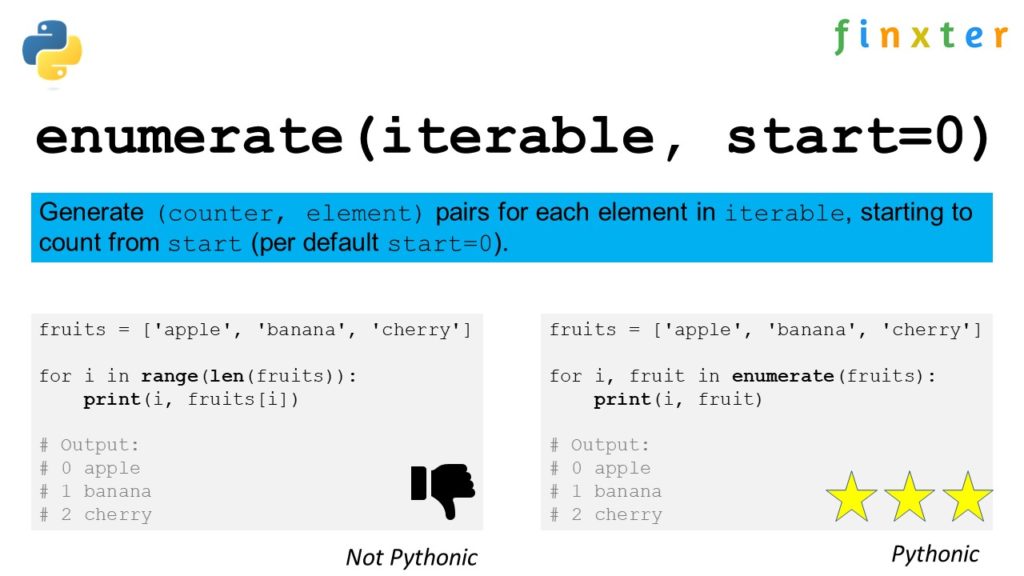
enumerate() is a built-in Python function that allows you to iterate over an iterable (such as a list, tuple, or string) while also accessing the index of each element. In other words, it provides a counter alongside the elements of the iterable, making it possible to keep track of both the index and the value simultaneously.

Here’s a basic example of how the enumerate() function works:

fruits = ['apple', 'banana', 'cherry']
for index, value in enumerate(fruits): print(index, value)

This will output:

0 apple
1 banana
2 cherry

In the example above, the enumerate() function accepts the fruits list as input and returns a tuple containing the index and its corresponding value. The for loop then iterates through these tuples, unpacking them into the variables index and value.

By default, the enumerate() function starts counting the indices from 0. However, you can also specify an optional start argument to change the starting point. For instance, if you want to start counting from 1, you can use the following code:

fruits = ['apple', 'banana', 'cherry']
for index, value in enumerate(fruits, start=1): print(index, value)

This will result in:

1 apple
2 banana
3 cherry

The enumerate() function is particularly useful when you need to modify elements in-place or when working with data that requires you to track the index of elements. It offers a more Pythonic approach to iteration, allowing for cleaner and more concise code compared to using a manual counter variable.

Exploring zip() in Python

The zip() function in Python is a powerful tool for parallel iteration. It takes two or more iterables as arguments and returns an iterator of tuples, each containing elements from the input iterables that share the same index. The size of the resulting zip object depends on the shortest of the input iterables.

Let’s dive into the workings of this useful function. To begin with, consider the following example:

names = ['Alice', 'Bob', 'Charlie']
ages = [25, 30, 35] zipped = zip(names, ages)
print(list(zipped))

The output will be:

[('Alice', 25), ('Bob', 30), ('Charlie', 35)]

Here, the zip() function combines the given lists names and ages element-wise, with the elements retaining their corresponding positions, creating an iterator of tuples.

Another useful feature of zip() is the ability to unpack the zipped iterator back into the original iterables using the asterisk * operator. For instance:

unzipped = zip(*zipped)
names, ages = unzipped

Keep in mind that zip() works with any iterable, not just lists. This includes tuples, strings, and dictionaries (although the latter requires some additional handling).

Use zip() and enumerate() Together

When combining zip() with enumerate(), you can iterate through multiple lists and access both index and value pairs.

The following code snippet demonstrates this usage:

for index, (name, age) in enumerate(zip(names, ages)): print(f"{index}: {name} is {age} years old.")

This results in the output:

0: Alice is 25 years old.
1: Bob is 30 years old.
2: Charlie is 35 years old.

In this example, the enumerate() function wraps around the zip() function, providing the index as well as the tuple containing the elements from the zipped iterator. This makes it easier to loop through and process the data simultaneously from multiple iterables.

To summarize, the zip() function in Python enables you to efficiently iterate through multiple iterables in parallel, creating a zip object of tuples. When used alongside enumerate(), it provides both index and value pairs, making it an invaluable tool for handling complex data structures.

Using For Loops with Enumerate

In Python, you often encounter situations where you’d like to iterate over a list, tuple, or other iterable objects and at the same time, keep track of the index of the current item in the loop. This can be easily achieved by using the enumerate() function in combination with a for loop.

The enumerate() function takes an iterable as its input and returns an iterator that produces pairs of the form (index, element) for each item in the list. By default, it starts counting the index from 0, but you can also specify a different starting index using the optional start parameter.

Here’s a simple example demonstrating the use of enumerate() with a for loop:

fruits = ['apple', 'banana', 'cherry']
for index, fruit in enumerate(fruits): print(f"{index}: {fruit}")

In the code above, the enumerate(fruits) function creates a list of tuples, where each tuple contains the index and the corresponding element from the fruits list. The for loop iterates through the output of enumerate(), allowing you to access the index and element simultaneously.

The output would be:

0: apple
1: banana
2: cherry

The use of enumerate() can be extended to cases when you want to iterate over multiple lists in parallel. One way to achieve this is by using the zip() function. The zip() function combines multiple iterables (like lists or tuples) element-wise and returns a new iterator that produces tuples containing the corresponding elements from all input iterables.

Here’s an example showing how to use enumerate() and zip() together:

fruits = ['apple', 'banana', 'cherry']
prices = [1.2, 0.5, 2.5] for index, (fruit, price) in enumerate(zip(fruits, prices)): print(f"{index}: {fruit} - ${price}")

In this code snippet, the zip(fruits, prices) function creates a new iterable containing tuples with corresponding elements from the fruits and prices lists. The enumerate() function is then used to generate index-element tuples, where the element is now a tuple itself, consisting of a fruit and its price.

The output of the code would be:

0: apple - $1.2
1: banana - $0.5
2: cherry - $2.5

Combining enumerate() and zip()

In Python, both enumerate() and zip() are built-in functions that can be used to work with iterables, such as lists or tuples. Combining them allows you to iterate over multiple iterables simultaneously while keeping track of the index for each element. This can be quite useful when you need to process data from multiple sources or maintain the element’s order across different data structures.

The enumerate() function attaches an index to each item in an iterable, starting from 0 by default, or from a specified starting number. Its syntax is as follows:

enumerate(iterable, start=0)

On the other hand, the zip() function merges multiple iterables together by pairing their respective elements based on their positions. Here is the syntax for zip():

zip(iterable1, iterable2, ...)

To combine enumerate() and zip() in Python, you need to enclose the elements of zip() in parentheses and iterate over them using enumerate(). The following code snippet demonstrates how to do this:

list1 = [1, 2, 3]
list2 = ['a', 'b', 'c'] for index, (value1, value2) in enumerate(zip(list1, list2)): print(index, value1, value2)

The output will be:

0 1 a
1 2 b
2 3 c

In this example, zip() pairs the elements from list1 and list2, while enumerate() adds an index to each pair. This enables you to access both the index and the corresponding elements from the two lists simultaneously, making it easier to manipulate or compare the data.

You can also work with more than two iterables by adding them as arguments to the zip() function. Make sure to add extra variables in the loop to accommodate these additional values:

list1 = [1, 2, 3]
list2 = ['a', 'b', 'c']
list3 = [10, 20, 30] for index, (value1, value2, value3) in enumerate(zip(list1, list2, list3)): print(index, value1, value2, value3)

The output will be:

0 1 a 10
1 2 b 20
2 3 c 30

In conclusion, combining enumerate() and zip() in Python provides a powerful way to iterate over multiple iterables while maintaining the index of each element. This technique can be beneficial when working with complex data structures or when order and positionality are essential.

Iterating Through Multiple Iterables

When working with Python, it is common to encounter situations where you need to iterate through multiple iterables simultaneously. Two essential tools to accomplish this task efficiently are the enumerate() and zip() functions.

To iterate through multiple iterables using both enumerate() and zip() at the same time, you can use the following syntax:

list1 = [1, 2, 3]
list2 = ['a', 'b', 'c']
for index, (elem1, elem2) in enumerate(zip(list1, list2)): print(index, elem1, elem2)

In this example, the zip() function creates tuples of corresponding elements from list1 and list2. The enumerate() function then adds the index to each tuple, allowing you to efficiently loop through both lists while keeping track of the current iteration.

Using enumerate() and zip() together, you can confidently and clearly write concise Python code to iterate through multiple iterables in parallel, making your programming tasks more efficient and readable.

Mapping by Index Using enumerate() and zip()

In Python, enumerate() and zip() are powerful functions that can be used together to iterate over multiple lists while keeping track of the index positions of the items. This can be particularly useful when you need to process and map related data like names and ages in separate lists.

enumerate() is a built-in function in Python that allows you to iterate through a list while generating an index number for each element. The function takes an iterable and an optional start parameter for the index, returning pairs of index and value:

names = ['Alice', 'Bob', 'Charlie']
for index, name in enumerate(names): print(index, name)

Output:

0 Alice
1 Bob
2 Charlie

On the other hand, zip() is used to combine multiple iterables. It returns an iterator that generates tuples containing elements from the input iterables, where the first elements in each iterable form the first tuple, followed by the second elements forming the second tuple, and so on:

names = ['Alice', 'Bob', 'Charlie']
ages = [30, 25, 35]
for name, age in zip(names, ages): print(name, age)

Output:

Alice 30
Bob 25
Charlie 35

By using both enumerate() and zip() together, we can efficiently map and process data from multiple lists based on their index positions. Here’s an example that demonstrates how to use them in combination:

names = ['Alice', 'Bob', 'Charlie']
ages = [30, 25, 35] for index, (name, age) in enumerate(zip(names, ages)): print(index, name, age)

Output:

0 Alice 30
1 Bob 25
2 Charlie 35

In this example, we’ve combined enumerate() with zip() to iterate through both the names and ages lists simultaneously, capturing the index, name, and age in variables. This flexible approach allows you to process and map data from multiple lists based on index positions efficiently, using a clear and concise syntax.

Error Handling and Edge Cases

When using enumerate() and zip() together in Python, it’s essential to be aware of error handling and possible edge cases. Both functions provide a way to iterate over multiple iterables, with enumerate() attaching an index to each item and zip() combining the elements of the iterables. However, issues may arise when not used appropriately.

One common issue when using zip() is mismatched iterable lengths. If you try to zip two lists with different lengths, zip() will truncate the output to the shortest list, potentially leading to unintended results:

list1 = [1, 2, 3]
list2 = ['a', 'b']
zipped = list(zip(list1, list2))
print(zipped)
# Output: [(1, 'a'), (2, 'b')]

To avoid this issue, you can use the itertools.zip_longest() function, which fills the missing elements with a specified value:

import itertools list1 = [1, 2, 3]
list2 = ['a', 'b']
zipped_longest = list(itertools.zip_longest(list1, list2, fillvalue=None))
print(zipped_longest)
# Output: [(1, 'a'), (2, 'b'), (3, None)]

In the case of enumerate(), it’s essential to ensure that the function is used with parentheses when combining with zip(). This is because enumerate() returns a tuple with the index first and the element second, as shown in this example:

list1 = ['a', 'b', 'c']
enumerated = list(enumerate(list1))
print(enumerated)
# Output: [(0, 'a'), (1, 'b'), (2, 'c')]

When combining enumerate() and zip(), proper use of parentheses ensures correct functionality:

list1 = [1, 2, 3]
list2 = ['a', 'b', 'c']
combined = [(i, *t) for i, t in enumerate(zip(list1, list2))]
print(combined)
# Output: [(0, 1, 'a'), (1, 2, 'b'), (2, 3, 'c')]

Frequently Asked Questions

How to use enumerate() and zip() together for iterating multiple lists in Python?

You can use enumerate() and zip() together in Python by combining them within a for loop. enumerate() adds an index to each item, while zip() merges the iterables together by pairing items from each list. Here’s an example:

list1 = [1, 2, 3]
list2 = [4, 5, 6] for i, (a, b) in enumerate(zip(list1, list2)): print(i, a, b)

What is the difference between using enumerate() and zip() individually and together?

enumerate() is designed to add an index to the items in an iterable, while zip() is intended to combine items from two or more iterables. When used together, they allow you to access the index, as well as elements from multiple lists simultaneously. You can achieve this by using them in a for loop.

How can I access both index and elements of two lists simultaneously using enumerate() and zip()?

By combining enumerate() and zip() in a for loop, you can access the index, as well as elements from both lists simultaneously. Here’s an example:

list1 = [1, 2, 3]
list2 = [4, 5, 6] for i, (a, b) in enumerate(zip(list1, list2)): print(i, a, b)

Is there any alternative way to use enumerate() and zip() together?

Yes, you may use a different looping structure, like a list comprehension, to use enumerate() and zip() together:

list1 = [1, 2, 3]
list2 = [4, 5, 6] combined = [(i, a, b) for i, (a, b) in enumerate(zip(list1, list2))]
print(combined)

How can I customize the starting index when using enumerate() and zip() together in Python?

You can customize the starting index in enumerate() by using the start parameter. For example:

list1 = [1, 2, 3]
list2 = [4, 5, 6] for i, (a, b) in enumerate(zip(list1, list2), start=1): print(i, a, b)

What are the performance implications of using enumerate() and zip() together?

Using enumerate() and zip() together is generally efficient, as both functions are built-in and designed for performance. However, for large data sets or nested loops, you may experience some performance reduction. It is essential to consider the performance implications based on your specific use case and the size of the data being processed.

🔗 Recommended: From AI Scaling to Mechanistic Interpretability

The post Use enumerate() and zip() Together in Python appeared first on Be on the Right Side of Change.

Posted on Leave a comment

Boolean Operators in Python (and, or, not): Mastering Logical Expressions

5/5 – (1 vote)

Understanding Boolean Operators

Boolean operators in Python help you create conditional statements to control the flow of your program. Python provides three basic Boolean operators: and, or, and not. These operators help you construct sophisticated expressions to evaluate the truth or falsity of different conditions.

And Operator

The and operator returns True if both of its operands are true, and False otherwise. You can use it to check multiple conditions at once.

Here is a simple example involving the and operator:

age = 25
income = 50000 if age >= 18 and income >= 30000: print("Eligible for loan")
else: print("Not eligible for loan")

In this example, the condition age >= 18 and income >= 30000 must be True for the program to print "Eligible for loan". If either age is less than 18 or income is less than 30,000, the condition evaluates to False, and the program will print "Not eligible for loan".

Or Operator

The or operator returns True as long as at least one of its operands is true. You can use it to specify alternatives in your code.

Here’s an example of how to use the or operator:

student_score = 80
extra_credit = 5 if student_score >= 90 or extra_credit >= 10: print("Student grade: A")
else: print("Student grade: B")

In this case, if the student_score is 90 or higher, or if the student has completed 10 or more extra credit, the program will print “Student grade: A”. Otherwise, it will print "Student grade: B".

Not Operator

The not operator inverts the truth value of the expression that follows it. It takes only one operand and returns True if the operand is False, and vice versa. The not operator can be used to check if a certain condition is not met.

Here is an example:

message = "Hello, World!" if not message.startswith("Hi"): print("Message does not start with 'Hi'")
else: print("Message starts with 'Hi'")

In this example, the program checks whether the message does not start with the string "Hi". If it doesn’t, the condition not message.startswith("Hi") evaluates to True, and the program prints "Message does not start with 'Hi'". If the condition is False, the program prints "Message starts with 'Hi'".

Boolean Values in Python

In Python, Boolean values represent one of two states: True or False. These values are essential for making decisions and controlling the flow of your program. This section covers the basics of Boolean values, the None value, and how to convert different data types into Boolean values.

True and False Values

Boolean values in Python can be represented using the keywords True and False. They are instances of the bool class and can be used with various types of operators such as logical, comparison, and equality operators.

Here’s an example using Boolean values with the logical and operator:

x = True
y = False
result = x and y
print(result) # Output: False

None Value

In addition to True and False, Python provides a special value called None. None is used to represent the absence of a value or a null value. While it’s not a Boolean value, it is considered falsy when used in a Boolean context:

if None: print("This won't be printed.")

Converting to Boolean Type

In Python, various data types such as numbers, strings, sets, lists, and tuples can also be converted to Boolean values using the bool() function. When converted, these data types will yield a Truthy or Falsy value:

  • Numbers: Any non-zero number will be True, whereas 0 will be False.
  • Strings: Non-empty strings will be True, and an empty string '' will be False.
  • Sets, Lists, and Tuples: Non-empty collections will be True, and empty collections will be False.

Here are a few examples of converting different data types into Boolean values:

# Converting numbers
print(bool(10)) # Output: True
print(bool(0)) # Output: False # Converting strings
print(bool("Hello")) # Output: True
print(bool("")) # Output: False # Converting lists
print(bool([1, 2, 3])) # Output: True
print(bool([])) # Output: False

🔗 Recommended: How to Check If a Python List is Empty?

Working with Boolean Expressions

In Python, Boolean operators (and, or, not) allow you to create and manipulate Boolean expressions to control the flow of your code. This section will cover creating Boolean expressions and using them in if statements.

Creating Boolean Expressions

A Boolean expression is a statement that yields a truth value, either True or False. You can create Boolean expressions by combining conditions using the and, or, and not operators, along with comparison operators such as ==, !=, >, <, >=, and <=.

Here are some examples:

a = 10
b = 20 # Expression with "and" operator
expr1 = a > 5 and b > 30 # Expression with "or" operator
expr2 = a > 5 or b > 15 # Expression with "not" operator
expr3 = not (a == b)

In the above code snippet, expr1 evaluates to True, expr2 evaluates to True, and expr3 evaluates to True. You can also create complex expressions by combining multiple operators:

expr4 = (a > 5 and b < 30) or not (a == b)

This expression yields True, since both (a > 5 and b < 30) and not (a == b) evaluate to True.

Using Boolean Expressions in If Statements

Boolean expressions are commonly used in if statements to control the execution path of your code. You can use a single expression or combine multiple expressions to check various conditions before executing a particular block of code.

Here’s an example:

x = 10
y = 20 if x > 5 and y > 30: print("Both conditions are met.")
elif x > 5 or y > 15: print("At least one condition is met.")
else: print("Neither condition is met.")

In this example, the if statement checks if both conditions are met (x > 5 and y < 30); if true, it prints "Both conditions are met". If that expression is false, it checks the elif statement (x > 5 or y > 15); if true, it prints "At least one condition is met." If both expressions are false, it prints "Neither condition is met."

Logical Operators and Precedence

In Python, there are three main logical operators: and, or, and not. These operators are used to perform logical operations, such as comparing values and testing conditions in your code.

Operator Precedence

YouTube Video

Operator precedence determines the order in which these logical operators are evaluated in a complex expression. Python follows a specific order for logical operators:

  1. not
  2. and
  3. or

Here is an example to illustrate precedence:

result = True and False or True

In this case, and has a higher precedence than or, so it is evaluated first. The result would be:

result = (True and False) or True

After the and operation, it becomes:

result = False or True

Finally, the result will be True after evaluating the or operation.

Applying Parentheses

You can use parentheses to change the order of evaluation or make your expressions more readable. When using parentheses, operations enclosed within them are evaluated first, regardless of precedence rules.

Let’s modify our previous example:

result = True and (False or True)

Now the or operation is performed first, resulting in:

result = True and True

And the final result is True.

Truthy and Falsy Values

💡 Tip: In Python, values can be considered either “truthy” or “falsy” when they are used in a boolean context, such as in an if statement or a while loop. Truthy values evaluate to True, while falsy values evaluate to False. Various data types, like numerics, strings, lists, tuples, dictionaries, sets, and other sequences, can have truthy or falsy values.

Determining Truthy and Falsy Values

When determining the truth value of an object in Python, the following rules apply:

  • Numeric types (int, float, complex): Zero values are falsy, while non-zero values are truthy.
  • Strings: Empty strings are falsy, whereas non-empty strings are truthy.
  • Lists, tuples, dictionaries, sets, and other sequences: Empty sequences are falsy, while non-empty sequences are truthy.

Here are some examples:

if 42: # truthy (non-zero integer) pass if "hello": # truthy (non-empty string) pass if [1, 2, 3]: # truthy (non-empty list) pass if (None,): # truthy (non-empty tuple) pass if {}: # falsy (empty dictionary) pass

Using __bool__() and __len__()

Python classes can control their truth value by implementing the __bool__() or __len__() methods.

👩‍💻 Expert Knowledge: If a class defines the __bool__() method, it should return a boolean value representing the object’s truth value. If the class does not define __bool__(), Python uses the __len__() method to determine the truth value: if the length of an object is nonzero, the object is truthy; otherwise, it is falsy.

Here’s an example of a custom class implementing both __bool__() and __len__():

class CustomClass: def __init__(self, data): self.data = data def __bool__(self): return bool(self.data) # custom truth value based on data def __len__(self): return len(self.data) # custom length based on data custom_obj = CustomClass([1, 2, 3]) if custom_obj: # truthy because custom_obj.data is a non-empty list pass

Comparisons and Boolean Expressions

In Python, boolean expressions are formed using comparison operators such as greater than, less than, and equality. Understanding these operators can help you write more efficient and logical code. In this section, we will dive into the different comparison operators and how they work with various expressions in Python.

Combining Comparisons

Some common comparison operators in Python include:

  • >: Greater than
  • <: Less than
  • >=: Greater than or equal to
  • <=: Less than or equal to
  • ==: Equality
  • !=: Inequality

To combine multiple comparisons, you can use logical operators like and, or, and not. These operators can be used to create more complex conditions with multiple operands.

Here’s an example:

x = 5
y = 10
z = 15 if x > y and y < z: print("All conditions are true")

In this example, the and operator checks if both conditions are True. If so, it prints the message. We can also use the or operator, which checks if any one of the conditions is True:

if x > y or y < z: print("At least one condition is true")

Short-Circuit Evaluation

YouTube Video

Python uses short-circuit evaluation for boolean expressions, meaning that it will stop evaluating further expressions as soon as it finds one that determines the final result. This can help improve the efficiency of your code.

For instance, when using the and operator, if the first operand is False, Python will not evaluate the second operand, because it knows the entire condition will be False:

if False and expensive_function(): # This won't execute because the first operand is False pass

Similarly, when using the or operator, if the first operand is True, Python will not evaluate the second operand because it knows the entire condition will be True:

if True or expensive_function(): # This will execute because the first operand is True pass

Common Applications of Boolean Operations

In Python, Boolean operations are an essential part of programming, with and, or, not being the most common operators. They play a crucial role in decision-making processes like determining the execution paths that your program will follow. In this section, we will explore two major applications of Boolean operations – Conditional Statements and While Loops.

Conditional Statements

Conditional statements in Python, like if, elif, and else, are often used along with Boolean operators to compare values and determine which block of code will be executed. For example:

x = 5
y = 10 if x > 0 and y > 0: print("Both x and y are positive")
elif x < 0 or y < 0: print("Either x or y is negative (or both)")
else: print("Both x and y are zero or one is positive and the other is negative")

Here, the and operator checks if both x and y are positive, while the or operator checks if either x or y is negative. These operations allow your code to make complex decisions based on multiple conditions.

While Loops

While loops in Python are often paired with Boolean operations to carry out a specific task until a condition is met. The loop continues as long as the test condition remains True. For example:

count = 0 while count < 10: if count % 2 == 0: print(f"{count} is an even number") else: print(f"{count} is an odd number") count += 1

In this case, the while loop iterates through the numbers 0 to 9, using the not operator to check if the number is even or odd. The loop stops when the variable count reaches 10.

Frequently Asked Questions

How do you use ‘and’, ‘or’, ‘not’ in Python boolean expressions?

In Python, and, or, and not are used to combine or modify boolean expressions.

  • and: Returns True if both operands are True, otherwise returns False.
  • or: Returns True if at least one of the operands is True, otherwise returns False.
  • not: Negates the boolean value.

Example:

a = True
b = False print(a and b) # False
print(a or b) # True
print(not a) # False

How are boolean values assigned in Python?

In Python, boolean values can be assigned using the keywords True and False. They are both instances of the bool type. For example:

is_true = True
is_false = False

What are the differences between ‘and’, ‘or’, and ‘and-not’ operators in Python?

and and or are both binary operators that work with two boolean expressions, while and-not is not a single operator but a combination of and and not. Examples:

a = True
b = False print(a and b) # False
print(a or b) # True
print(a and not b) # True (since 'not b' is True)

How do I use the ‘not equal’ relational operator in Python?

In Python, the not equal relational operator is represented by the symbol !=. It returns True if the two operands are different and False if they are equal. Example:

x = 5
y = 7 print(x != y) # True

What are the common mistakes with Python’s boolean and operator usage?

Common mistakes include misunderstanding operator precedence and mixing and, or, and not without proper grouping using parentheses.

Example:

a = True
b = False
c = True print(a and b or c) # True (because 'and' is evaluated before 'or')
print(a and (b or c)) # False (using parentheses to change precedence)

How is the ‘//’ floor division operator related to boolean operators in Python?

The // floor division operator is not directly related to boolean operators. It’s an arithmetic operator that performs division and rounds the result down to the nearest integer. However, you can use it in boolean expressions as part of a condition, like any other operator.

Example:

x = 9
y = 4 is_divisible = x // y == 2
print(is_divisible) # True

The post Boolean Operators in Python (and, or, not): Mastering Logical Expressions appeared first on Be on the Right Side of Change.

Posted on Leave a comment

AI Scaling Laws – A Short Primer

5/5 – (1 vote)

The AI scaling laws could be the biggest finding in computer science since Moore’s Law was introduced. 📈 In my opinion, these laws haven’t gotten the attention they deserve (yet), even though they could show a clear way to make considerable improvements in artificial intelligence. This could change every industry in the world, and it’s a big deal.

ChatGPT Is Only The Beginning

In recent years, AI research has focused on increasing compute power, which has led to impressive improvements in model performance. In 2020, OpenAI demonstrated that bigger models with more parameters could yield better returns than simply adding more data with their paper on Scaling Laws for Neural Language Models.

This research paper explores how the performance of language models changes as we increase the model’s size, the amount of data used to train it, and the computing power used in training.

The authors found that the performance of these models, measured by their ability to predict the next word in a sentence, improves in a predictable way as we increase these factors, with some trends continuing over a wide range of values.

🧑‍💻 For example, a model that’s 10 times larger or trained on 10 times more data will perform better, but the exact improvement can be predicted by a simple formula.

Interestingly, other factors like how many layers the model has or how wide each layer is don’t have a big impact within a certain range. The paper also provides guidelines for training these models efficiently.

For instance, it’s often better to train a very large model on a moderate amount of data and stop before it fully adapts to the data, rather than using a smaller model or more data.

In fact, I’d argue that transformers, the technology behind large language models are the real deal as they just don’t converge:

This development sparked a race among companies to create models with more and more parameters, such as GPT-3 with its astonishing 175 billion parameters. Microsoft even released DeepSpeed, a tool designed to handle (in theory) trillions of parameters!

🧑‍💻 Recommended: Transformer vs LSTM: A Helpful Illustrated Guide

Model Size! (… and Training Data)

However, findings from DeepMind’s 2022 paper Training Compute – Optimal Large Language Models indicate that it’s not just about model size – the number of training tokens (data) also plays a crucial role. Until recently, many large models were trained using about 300 billion tokens, mainly because that’s what GPT-3 used.

DeepMind decided to experiment with a more balanced approach and created Chinchilla, a Large Language Model (LLM) with fewer parameters—only 70 billion—but a much larger dataset of 1.4 trillion training tokens. Surprisingly, Chinchilla outperformed other models trained on only 300 billion tokens, regardless of their parameter count (whether 300 billion, 500 billion, or 1 trillion).

What Does This Mean for You?

First, it means that AI models are likely to significantly improve as we throw more data and more compute on them. We are nowhere near the upper ceiling of AI performance by simply scaling up the training process without needing to invent anything new.

This is a simple and straightforward exercise and it will happen quickly and help scale these models to incredible performance levels.

Soon we’ll see significant improvements of the already impressive AI models.

How the AI Scaling Laws May Be as Important as Moore’s Law

Accelerating Technological Advancements: Just as Moore’s Law predicted a rapid increase in the power and efficiency of computer chips, the scaling laws in AI could lead to a similar acceleration in the development of AI technologies. As AI models become larger and more powerful, they could enable breakthroughs in fields such as natural language processing, computer vision, and robotics. This could lead to the creation of more advanced and capable AI systems, which could in turn drive further technological advancements.

Economic Growth and Disruption: Moore’s Law has been a key driver of economic growth and innovation in the tech industry. Similarly, the scaling laws in AI could lead to significant economic growth and disruption across various industries. As AI technologies become more powerful and efficient, they could be used to automate tasks, optimize processes, and create new business models. This could lead to increased productivity, reduced costs, and the creation of new markets and industries.

Societal Impact: Moore’s Law has had a profound impact on society, enabling the development of technologies such as smartphones, the internet, and social media. The scaling laws in AI could have a similar societal impact, as AI technologies become more integrated into our daily lives. AI systems could be used to improve healthcare, education, transportation, and other areas of society. This could lead to improved quality of life, increased access to resources, and new opportunities for individuals and communities.

Frequently Asked Questions

How can neural language models benefit from scaling laws?

Scaling laws can help predict the performance of neural language models based on their size, training data, and computational resources. By understanding these relationships, you can optimize model training and improve overall efficiency.

What’s the connection between DeepMind’s work and scaling laws?

DeepMind has conducted extensive research on scaling laws, particularly in the context of artificial intelligence and deep learning. Their findings have contributed to a better understanding of how model performance scales with various factors, such as size and computational resources. OpenAI has then pushed the boundary and scaled aggressively to reach significant performance improvements with GPT-3.5 and GPT-4.

How do autoregressive generative models follow scaling laws?

Autoregressive generative models, like other neural networks, can exhibit scaling laws in their performance. For example, as these models grow in size or are trained on more data, their ability to generate high-quality output may improve in a predictable way based on scaling laws.

Can you explain the mathematical representation of scaling laws in deep learning?

A scaling law in deep learning typically takes the form of a power-law relationship, where one variable (e.g., model performance) is proportional to another variable (e.g., model size) raised to a certain power. This can be represented as: Y = K * X^a, where Y is the dependent variable, K is a constant, X is the independent variable, and a is the scaling exponent.

Which publication first discussed neural scaling laws in detail?

The concept of neural scaling laws was first introduced and explored in depth by researchers at OpenAI in a paper titled “Language Models are Few-Shot Learners”. This publication has been instrumental in guiding further research on scaling laws in AI.

Here’s a short excerpt from the paper:

🧑‍💻 OpenAI Paper:

“Here we show that scaling up language models greatly improves task-agnostic, few-shot performance, sometimes even reaching competitiveness with prior state-of-the-art fine-tuning approaches.

Specifically, we train GPT-3, an autoregressive language model with 175 billion parameters, 10x more than any previous non-sparse language model, and test its performance in the few-shot setting.

[…]

GPT-3 achieves strong performance on many NLP datasets, including translation, question-answering, and cloze tasks, as well as several tasks that require on-the-fly reasoning or domain adaptation, such as unscrambling words, using a novel word in a sentence, or performing 3-digit arithmetic.”

Is there an example of a neural scaling law that doesn’t hold true?

While scaling laws can often provide valuable insights into AI model performance, they are not always universally applicable. For instance, if a model’s architecture or training methodology differs substantially from others in its class, the scaling relationship may break down, and predictions based on scaling laws might not hold true.

💡 Recommended: 6 New AI Projects Based on LLMs and OpenAI

The post AI Scaling Laws – A Short Primer appeared first on Be on the Right Side of Change.

Posted on Leave a comment

Python zip(): Get Elements from Multiple Lists

5/5 – (1 vote)

Understanding zip() Function

The zip() function in Python is a built-in function that provides an efficient way to iterate over multiple lists simultaneously. As this is a built-in function, you don’t need to import any external libraries to use it.

The zip() function takes two or more iterable objects, such as lists or tuples, and combines each element from the input iterables into a tuple. These tuples are then aggregated into an iterator, which can be looped over to access the individual tuples.

Here is a simple example of how the zip() function can be used:

list1 = [1, 2, 3]
list2 = ['a', 'b', 'c']
zipped = zip(list1, list2) for item1, item2 in zipped: print(item1, item2)

Output:

1 a
2 b
3 c

The function also works with more than two input iterables:

list1 = [1, 2, 3]
list2 = ['a', 'b', 'c']
list3 = [10, 20, 30] zipped = zip(list1, list2, list3) for item1, item2, item3 in zipped: print(item1, item2, item3)

Output:

1 a 10
2 b 20
3 c 30

Keep in mind that the zip() function operates on the shortest input iterable. If any of the input iterables are shorter than the others, the extra elements will be ignored. This behavior ensures that all created tuples have the same length as the number of input iterables.

list1 = [1, 2, 3]
list2 = ['a', 'b'] zipped = zip(list1, list2) for item1, item2 in zipped: print(item1, item2)

Output:

1 a
2 b

To store the result of the zip() function in a list or other data structure, you can convert the returned iterator using functions like list(), tuple(), or dict().

list1 = [1, 2, 3]
list2 = ['a', 'b', 'c']
zipped = zip(list1, list2) zipped_list = list(zipped)
print(zipped_list)

Output:

[(1, 'a'), (2, 'b'), (3, 'c')]

Feel free to improve your Python skills by watching my explainer video on the zip() function:

YouTube Video

Working with Multiple Lists

Working with multiple lists in Python can be simplified by using the zip() function. This built-in function enables you to iterate over several lists simultaneously, while pairing their corresponding elements as tuples.

For instance, imagine you have two lists of the same length:

list1 = [1, 2, 3]
list2 = ['a', 'b', 'c']

You can combine these lists using zip() like this:

combined = zip(list1, list2)

The combined variable would now contain the following tuples: (1, 'a'), (2, 'b'), and (3, 'c').

To work with multiple lists effectively, it’s essential to understand how to get specific elements from a list. This knowledge allows you to extract the required data from each list element and perform calculations or transformations as needed.

In some cases, you might need to find an element in a list. Python offers built-in list methods, such as index(), to help you search for elements and return their indexes. This method is particularly useful when you need to locate a specific value and process the corresponding elements from other lists.

As you work with multiple lists, you may also need to extract elements from Python lists based on their index, value, or condition. Utilizing various techniques for this purpose, such as list comprehensions or slices, can be extremely beneficial in managing and processing your data effectively.

multipled = [a * b for a, b in zip(list1, list2)]

The above example demonstrates a list comprehension that multiplies corresponding elements from list1 and list2 and stores the results in a new list, multipled.

In summary, the zip() function proves to be a powerful tool for combining and working with multiple lists in Python. It facilitates easy iteration over several lists, offering versatile options to process and manipulate data based on specific requirements.

Creating Tuples

The zip() function in Python allows you to create tuples by combining elements from multiple lists. This built-in function can be quite useful when working with parallel lists that share a common relationship. When using zip(), the resulting iterator contains tuples with elements from the input lists.

To demonstrate once again, consider the following two lists:

names = ["Alice", "Bob", "Charlie"]
ages = [25, 30, 35]

By using zip(), you can create a list of tuples that pair each name with its corresponding age like this:

combined = zip(names, ages)

The combined variable now contains an iterator, and to display the list of tuples, you can use the list() function:

print(list(combined))

The output would be:

[('Alice', 25), ('Bob', 30), ('Charlie', 35)]

Zip More Than Two Lists

The zip() function can also work with more than two lists. For example, if you have three lists and want to create tuples that contain elements from all of them, simply pass all the lists as arguments to zip():

names = ["Alice", "Bob", "Charlie"]
ages = [25, 30, 35]
scores = [89, 76, 95] combined = zip(names, ages, scores)
print(list(combined))

The resulting output would be a list of tuples, each containing elements from the three input lists:

[('Alice', 25, 89), ('Bob', 30, 76), ('Charlie', 35, 95)]

💡 Note: When dealing with an uneven number of elements in the input lists, zip() will truncate the resulting tuples to match the length of the shortest list. This ensures that no elements are left unmatched.

Use zip() when you need to create tuples from multiple lists, as it is a powerful and efficient tool for handling parallel iteration in Python.

Working with Iterables

A useful function for handling multiple iterables is zip(). This built-in function creates an iterator that aggregates elements from two or more iterables, allowing you to work with several iterables simultaneously.

Using zip(), you can map similar indices of multiple containers, such as lists and tuples. For example, consider the following lists:

list1 = [1, 2, 3]
list2 = ['a', 'b', 'c']

You can use the zip() function to combine their elements into pairs, like this:

zipped = zip(list1, list2)

The zipped variable will now contain an iterator with the following element pairs: (1, 'a'), (2, 'b'), and (3, 'c').

It is also possible to work with an unknown number of iterables using the unpacking operator (*).

Suppose you have a list of iterables:

iterables = [[1, 2, 3], "abc", [True, False, None]]

You can use zip() along with the unpacking operator to combine their corresponding elements:

zipped = zip(*iterables)

The result will be: (1, 'a', True), (2, 'b', False), and (3, 'c', None).

💡 Note: If you need to filter a list based on specific conditions, there are other useful tools like the filter() function. Using filter() in combination with iterable handling techniques can optimize your code, making it more efficient and readable.

Using For Loops

The zip() function in Python enables you to iterate through multiple lists simultaneously. In combination with a for loop, it offers a powerful tool for handling elements from multiple lists. To understand how this works, let’s delve into some examples.

Suppose you have two lists, letters and numbers, and you want to loop through both of them. You can employ a for loop with two variables:

letters = ['a', 'b', 'c']
numbers = [1, 2, 3]
for letter, number in zip(letters, numbers): print(letter, number)

This code will output:

a 1
b 2
c 3

Notice how zip() combines the elements of each list into tuples, which are then iterated over by the for loop. The loop variables letter and number capture the respective elements from both lists at once, making it easier to process them.

If you have more than two lists, you can also employ the same approach. Let’s say you want to loop through three lists, letters, numbers, and symbols:

letters = ['a', 'b', 'c']
numbers = [1, 2, 3]
symbols = ['@', '#', '$']
for letter, number, symbol in zip(letters, numbers, symbols): print(letter, number, symbol)

The output will be:

a 1 @
b 2 #
c 3 $

Unzipping Elements

In this section, we will discuss how the zip() function works and see examples of how to use it for unpacking elements from lists. For example, if you have two lists list1 and list2, you can use zip() to combine their elements:

list1 = [1, 2, 3]
list2 = ['a', 'b', 'c']
zipped = zip(list1, list2)

The result of this operation, zipped, is an iterable containing tuples of elements from list1 and list2. To see the output, you can convert it to a list:

zipped_list = list(zipped) # [(1, 'a'), (2, 'b'), (3, 'c')]

Now, let’s talk about unpacking elements using the zip() function. Unpacking is the process of dividing a collection of elements into individual variables. In Python, you can use the asterisk * operator to unpack elements. If we have a zipped list of tuples, we can use the * operator together with the zip() function to separate the original lists:

unzipped = zip(*zipped_list)
list1_unpacked, list2_unpacked = list(unzipped)

In this example, unzipped will be an iterable containing the original lists, which can be converted back to individual lists using the list() function:

list1_result = list(list1_unpacked) # [1, 2, 3]
list2_result = list(list2_unpacked) # ['a', 'b', 'c']

The above code demonstrates the power and flexibility of the zip() function when it comes to combining and unpacking elements from multiple lists. Remember, you can also use zip() with more than two lists, just ensure that you unpack the same number of lists during the unzipping process.

Working with Dictionaries

Python’s zip() function is a fantastic tool for working with dictionaries, as it allows you to combine elements from multiple lists to create key-value pairs. For instance, if you have two lists that represent keys and values, you can use the zip() function to create a dictionary with matching key-value pairs.

keys = ['a', 'b', 'c']
values = [1, 2, 3]
new_dict = dict(zip(keys, values))

The new_dict object would now be {'a': 1, 'b': 2, 'c': 3}. This method is particularly useful when you need to convert CSV to Dictionary in Python, as it can read data from a CSV file and map column headers to row values.

Sometimes, you may encounter situations where you need to add multiple values to a key in a Python dictionary. In such cases, you can combine the zip() function with a nested list comprehension or use a default dictionary to store the values.

keys = ['a', 'b', 'c']
values1 = [1, 2, 3]
values2 = [4, 5, 6] nested_dict = {key: [value1, value2] for key, value1, value2 in zip(keys, values1, values2)}

Now, the nested_dict object would be {'a': [1, 4], 'b': [2, 5], 'c': [3, 6]}.

Itertools.zip_longest()

When you have uneven lists and still want to zip them together without missing any elements, then itertools.zip_longest() comes into play. It provides a similar functionality to zip(), but fills in the gaps with a specified value for the shorter iterable.

from itertools import zip_longest list1 = [1, 2, 3, 4]
list2 = ['a', 'b', 'c']
zipped = list(zip_longest(list1, list2, fillvalue=None))
print(zipped)

Output:

[(1, 'a'), (2, 'b'), (3, 'c'), (4, None)]

Error Handling and Empty Iterators

When using the zip() function in Python, it’s important to handle errors correctly and account for empty iterators. Python provides extensive support for exceptions and exception handling, including cases like IndexError, ValueError, and TypeError.

An empty iterator might arise when one or more of the input iterables provided to zip() are empty. To check for empty iterators, you can use the all() function and check if iterables have at least one element. For example:

def zip_with_error_handling(*iterables): if not all(len(iterable) > 0 for iterable in iterables): raise ValueError("One or more input iterables are empty") return zip(*iterables)

To handle exceptions when using zip(), you can use a tryexcept block. This approach allows you to catch and print exception messages for debugging purposes while preventing your program from crashing. Here’s an example:

try: zipped_data = zip_with_error_handling(list1, list2)
except ValueError as e: print(e)

In this example, the function zip_with_error_handling() checks if any of the input iterables provided are empty. If they are, a ValueError is raised with a descriptive error message. The tryexcept block then catches this error and prints the message without causing the program to terminate.

By handling errors and accounting for empty iterators, you can ensure that your program runs smoothly when using the zip() function to get elements from multiple lists. Remember to use the proper exception handling techniques and always check for empty input iterables to minimize errors and maximize the efficiency of your Python code.

Using Range() with Zip()

Using the range() function in combination with the zip() function can be a powerful technique for iterating over multiple lists and their indices in Python. This allows you to access the elements of multiple lists simultaneously while also keeping track of their positions in the lists.

One way to use range(len()) with zip() is to create a nested loop. First, create a loop that iterates over the range of the length of one of the lists, and then inside that loop, use zip() to retrieve the corresponding elements from the other lists.

For example, let’s assume you have three lists containing different attributes of products, such as names, prices, and quantities.

names = ["apple", "banana", "orange"]
prices = [1.99, 0.99, 1.49]
quantities = [10, 15, 20]

To iterate over these lists and their indices using range(len()) and zip(), you can write the following code:

for i in range(len(names)): for name, price, quantity in zip(names, prices, quantities): print(f"Index: {i}, Name: {name}, Price: {price}, Quantity: {quantity}")

This code will output the index, name, price, and quantity for each product in the lists. The range(len()) construct generates a range object that corresponds to the indices of the list, allowing you to access the current index in the loop.

Frequently Asked Questions

How to use zip with a for loop in Python?

Using zip with a for loop allows you to iterate through multiple lists simultaneously. Here’s an example:

list1 = [1, 2, 3]
list2 = ['a', 'b', 'c'] for num, letter in zip(list1, list2): print(num, letter) # Output:
# 1 a
# 2 b
# 3 c

Can you zip lists of different lengths in Python?

Yes, but zip will truncate the output to the length of the shortest list. Consider this example:

list1 = [1, 2, 3]
list2 = ['a', 'b'] for num, letter in zip(list1, list2): print(num, letter) # Output:
# 1 a
# 2 b

What is the process to zip three lists into a dictionary?

To create a dictionary from three lists using zip, follow these steps:

keys = ['a', 'b', 'c']
values1 = [1, 2, 3]
values2 = [4, 5, 6] zipped = dict(zip(keys, zip(values1, values2)))
print(zipped) # Output:
# {'a': (1, 4), 'b': (2, 5), 'c': (3, 6)}

Is there a way to zip multiple lists in Python?

Yes, you can use the zip function to handle multiple lists. Simply provide multiple lists as arguments:

list1 = [1, 2, 3]
list2 = ['a', 'b', 'c']
list3 = [4, 5, 6] for num, letter, value in zip(list1, list2, list3): print(num, letter, value) # Output:
# 1 a 4
# 2 b 5
# 3 c 6

How to handle uneven lists when using zip?

If you want to keep all elements from the longest list, you can use itertools.zip_longest:

from itertools import zip_longest list1 = [1, 2, 3]
list2 = ['a', 'b'] for num, letter in zip_longest(list1, list2, fillvalue=None): print(num, letter) # Output:
# 1 a
# 2 b
# 3 None

Where can I find the zip function in Python’s documentation?

The zip function is part of Python’s built-in functions, and its official documentation can be found on the Python website.

💡 Recommended: 26 Freelance Developer Tips to Double, Triple, Even Quadruple Your Income

The post Python zip(): Get Elements from Multiple Lists appeared first on Be on the Right Side of Change.

Posted on Leave a comment

Bitcoin Is Not Bad For the Environment

5/5 – (2 votes)

🟠 Story: Alice has just been orange-pilled and decides to spend a few hours reading Bitcoin articles.

She lands on a mainstream media article on “Bitcoin’s high energy consumption” proposing alternative (centralized) “green coins” that supposedly solve the problem of high energy consumption.

Alice gets distracted and invests in green tokens, effectively buying the bags of marketers promoting green crypto.

After losing 99% of her money, she’s disappointed by the whole industry and concludes that Bitcoin is not for her because the industry is too complex and full of scammers.

Here’s one of those articles recommending five centralized shitcoins:

Here’s another article with shallow content and no unique thought:

In this article, I’ll address Bitcoin’s energy “concern” quickly and efficiently. Let’s get started! 👇👇👇

Bitcoin Is Eco #1: Inbuilt Incentive to Use Renewable Energy Sources

Miners, who are responsible for validating transactions and securing the network, are driven by profit. Consequently, Bitcoin’s decentralized nature and proof-of-work consensus mechanism have an inbuilt incentive to use renewable energy sources where they are cheapest.

🌞 Renewable energy often provides a more cost-effective solution, leading miners to gravitate towards these sources naturally:

Source: Wikipedia

This non-competition with other energy consumers ensures that Bitcoin’s energy consumption is sustainable and environmentally friendly.

💡 Renewable energy (specifically: solar energy) offers the lowest-cost energy sources. Fossil-powered miners operate at lower profitability and tend to lose market share compared to renewable-powered miners.

Consider these statistics:

☀ The Bitcoin Mining Council (BMC), a global forum of mining companies that represents 48.4% of the worldwide bitcoin mining network, estimated that in Q4 2022, renewable energy sources accounted for 58.9% of the electricity used to mine bitcoin, a significant improvement compared to 36.8% estimated in Q1 2021 (source).

In the first half of 2023, the members are utilizing electricity with a sustainable power mix of 63.1%, thereby contributing to a slight improvement in the global Bitcoin mining industry’s sustainable electricity mix to 59.9% (source).

Bitcoin is one of the greenest industries on the planet; year after year, it becomes greener!

Bitcoin Is Eco #2: Monetizing Stranded Energy

  • Bitcoin’s energy consumption provides a way to use excess energy that would otherwise go to waste.
  • For example, solar panels often generate more energy than needed, especially during peak hours.
  • Batteries are still expensive and not easily accessible everywhere. Also, they don’t solve the fundamental problem of excess energy — they only buffer it.
  • Bitcoin mining can consume this excess energy, ensuring that it is not wasted and contributing to the overall efficiency of the energy system.

Bitcoin’s role as an energy consumer of last resort is an innovative solution to a modern problem. By tapping into excess energy from renewable sources like solar, wind, and hydroelectric power, Bitcoin mining ensures that energy that would otherwise go to waste is put to productive use.

This is called stranded energy, and energy insiders already propose to use Bitcoin as a solution to utilize stranded energy in economically and ecologically viable ways:

🌳 Bitcoin’s energy consumption is not merely a drain on resources but a strategic tool for enhancing the energy system’s efficiency and sustainability.

By acting as a consumer of last resort, Bitcoin mining transforms a potential waste into a valuable asset, fostering economic development, encouraging renewable energy, and offering a flexible solution to energy grid stabilization.

Bitcoin Is Eco #3: Incentivizing Renewable Energy Development

TL;DR: According to Wright’s Law, technological innovation leads to a reduction in costs over time. Bitcoin’s demand for energy incentivizes developing and deploying renewable energy sources, such as solar and wind power, which, in turn, helps to reduce the cost per kilowatt-hour, making renewable energy more accessible and appealing to other industries as well.

Being able to monetize stranded energy (see previous point #2) not only contributes to the overall efficiency of the energy system but also encourages further investments in renewable energy sources, driving innovation in energy-efficient technologies.

And with more investments in solar energy, the price per kWh continues to drop due to Wrights Law accelerating the renewable energy transition.

🥜 In a Nutshell: More Bitcoin Mining --> More Solar Energy --> Lower Cost per kwh --> More Solar Energy

What sets Bitcoin mining apart is its geographical flexibility and ability to turn on and off like a battery for the energy grid. Mining operations can be strategically located near renewable energy sources, consuming excess energy when available and pausing when needed elsewhere.

This unique characteristic allows Bitcoin mining to act as a stabilizing force in the energy grid, reducing the need for energy storage or wasteful dissipation of excess stranded energy and providing economic incentives for both energy producers and local communities.

Bitcoin Is Eco #4: No It Won’t Consume All the World’s Energy

Contrary to popular belief, Bitcoin’s energy consumption does not grow linearly with Bitcoin adoption and price. Instead, it grows logarithmically with the Bitcoin price, meaning it will likely never exceed 1-2% of the Earth’s total energy consumption.

And even if it were to exceed a few percentage points, it’ll use mostly stranded energy (see previous points #2 and #3) and won’t be able to compete with other energy consumers such as:

  1. Data Centers: High energy for cooling and uninterrupted operation.
  2. Hospitals: Continuous power for life-saving equipment and systems.
  3. Manufacturing Facilities: Energy for uninterrupted production processes.

These will always be able to pay a higher price for energy than Bitcoin.

Bitcoin’s energy consumption isn’t a big deal, even without considering its ecological benefits (see point #5).

Bitcoin Is Eco #5: Bitcoin’s Utility Overcompensates For Its Energy Use

Like everything else, Bitcoin has not only costs but also benefits. The main argument of Bitcoiners is, of course, the high utility the new system provides.

Bitcoin’s decentralized financial system reduces the need for the traditional financial sector’s overhead, such as large buildings, millions of employees, and other expenses related to gold extraction and banking operations. Bitcoin is the superior and more efficient technology that will more than half the energy costs of the financial system.

Source: Nasdaq

For example, this finding shows that both the traditional banking sector and gold need more energy than Bitcoin.

“A 2021 study by Galaxy Digital provided similar findings. It stated that Bitcoin consumed 113.89 terawatt hours (TWh) per year, while the banking sector consumed 263.72 TWh per year.

[…] According to the CBECI, the annual power consumption of gold mining stands at 131 TWh of electricity per year. That’s 10 percent more than Bitcoin’s 120 TWh. This further builds the case for Bitcoin as an emerging digital gold.” (CNBC)

And this doesn’t include the energy benefits that could accrue to Bitcoin when replacing much of the monetary premium in real estate:

💡 Recommended: 30 Reasons Bitcoin Is Superior to Real Estate

Bitcoin Is Eco #6: Deflationary Benefits to the Economy

TL;DR: Bitcoin’s deflationary nature encourages saving rather than spending. A Bitcoin standard will lead to a reduction in overall consumption, which has significant ecological benefits.

Bitcoin, a deflationary currency with a capped supply, may offer environmental benefits by reducing consumption. Traditional economies, driven by inflation, encourage spending, often resulting in overconsumption and waste.

For instance, wars are usually funded more by inflation rather than taxation. Millions of people buy cars and houses they can’t afford with debt, the source of all inflation.

In contrast, Bitcoin’s deflationary nature incentivizes saving, leading to decreased and highly rational consumption. Because BTC money cannot be printed, the economy would have much lower debt levels, so excess consumption is far less common in deflationary environments.

Reduced consumption can benefit the environment in several ways. Lower demand for goods means fewer greenhouse gas emissions from manufacturing and transportation. It also means less pollution from resource extraction and waste.

All technological progress is deflationary, i.e., goods become cheaper and not more expensive with technological progress. A deflationary economy promotes sustainable businesses that deliver true value without excess overhead making the economic machine much more efficient and benefitting all of us.

Mainstream Keynesian economists do not share the view that deflation is good for the economy, so I added this summary of an essay from the Mises Institute: 👇

“Deflation Is Always Good for the Economy” (Mises Institute)

Main Thesis: Deflation, defined as a general decline in prices of goods and services, is always good for the economy, contrary to the popular belief that it leads to economic slumps. The real problem is not deflation itself, but policies aimed at countering it.

Supporting Arguments:

  1. Misunderstanding of Deflation: Most experts believe that deflation generates expectations for further price declines, causing consumers to postpone purchases, which weakens the economy. However, this view is based on a misunderstanding of deflation and inflation.
  2. Inflation is Not Essentially a Rise in Prices: Inflation is not about general price increases, but about the increase in the money supply. Price increases are often a result of an increase in the money supply, but not always. Prices can fall even with an increase in the money supply if the supply of goods increases at a faster rate.
  3. Rising Prices Aren’t the Problem with Inflation: Inflation is harmful not because of price increases, but because of the damage it inflicts on the wealth-formation process. Money created out of thin air (e.g., by counterfeiting or loose monetary policies) diverts real wealth toward the holders of new money, leaving less real wealth to fund wealth-generating activities. This weakens economic growth.
  4. Easy-Money Policies Divert Resources to Non-Productive Activities: Increases in the money supply give rise to non-productive activities, or “bubble activities,” which cannot stand on their own and require the diversion of wealth from wealth generators. Loose monetary policies aimed at fighting deflation support these non-productive activities, weakening the foundation of the economy.
  5. Allowing Non-Productive Activities to Fail: Once non-productive activities are allowed to fail and the sources of the increase in the money supply are sealed off, a genuine, real-wealth expansion can ensue. With the expansion of real wealth for a constant stock of money, prices will fall, which is always good news.

Facts and Stats:

  1. Inflation Target: Mainstream thinkers view an inflation rate of 2% as not harmful to economic growth, and the Federal Reserve’s inflation target is 2%.
  2. Example of Inflation: If the money supply increases by 5% and the quantity of goods increases by 10%, prices will fall by 5%, ceteris paribus, despite the fact that there is an inflation of 5% due to the increase in the money supply.
  3. Example of Company Departments: In a company with 10 departments, if 8 departments are making profits and 2 are making losses, a responsible CEO will shut down or restructure the loss-making departments. Failing to do so diverts funding from wealth generators to loss-making departments, weakening the foundation of the entire company.

🧑‍💻 To summarize, Bitcoin has the potential to gradually shift our inflationary, high-consumption economy to a deflationary rational consumption economy while providing a more efficient and greener digital financial system that doesn’t rely on centralized parties and has built-in trust and robustness unmatched by any other financial institution.

The myth of Bitcoin’s high energy consumption is rooted in misunderstandings and oversimplifications. When examined closely, the cryptocurrency’s energy usage reveals a complex interplay of incentives, efficiencies, and innovations that not only mitigate its environmental impact but also contribute positively to global energy dynamics.

Bitcoin’s alignment with renewable energy, utilization of excess energy, incentivization of renewable energy development, logarithmic growth of energy consumption, and deflationary nature all point to a more sustainable and ecologically beneficial system.

As the world continues to grapple with environmental challenges, it is essential to approach the subject of Bitcoin’s energy consumption with an open mind and a willingness to engage with the facts. The evidence suggests that Bitcoin is not the environmental villain it is often portrayed to be, but rather a part of the solution to a more sustainable future.

💡 Recommended: Are Energy Costs and CapEx Invested in Bitcoin Worth It?

The post Bitcoin Is Not Bad For the Environment appeared first on Be on the Right Side of Change.

Posted on Leave a comment

Check Python Version from Command Line and in Script

5/5 – (1 vote)

Check Python Version from Command Line

Knowing your Python version is vital for running programs that may be incompatible with a certain version. Checking the Python version from the command line is simple and can be done using your operating system’s built-in tools.

Windows Command Prompt

In Windows, you can use PowerShell to check your Python version. Open PowerShell by pressing Win+R, typing powershell, and then pressing Enter. Once PowerShell is open, type the following command:

python --version

This command will return the Python version installed on your Windows system. If you have both Python 2 and Python 3 installed, you can use the following command to check the Python 3 version:

python3 --version

macOS Terminal

To check the Python version in macOS, open the Terminal by going to Finder, clicking on Applications, and then navigating to Utilities > Terminal. Once the Terminal is open, type the following command to check your Python version:

python --version

Alternatively, if you have Python 3 installed, use the following command to check the Python 3 version:

python3 --version

Linux Terminal

In Linux, open a terminal window and type the following command to check your Python version:

python --version

For Python 3, use the following command:

python3 --version

It is also possible to check the Python version within a script using the sys module:

import sys
print(sys.version)

This code snippet will print the Python version currently being used to run the script. It can be helpful in identifying version-related issues when debugging your code.

Check Python Version in Script

Using Sys Module

The sys module allows you to access your Python version within a script. To obtain the version, simply import the sys module and use the sys.version_info attribute. This attribute returns a tuple containing the major, minor, and micro version numbers, as well as the release level and serial number.

Here is a quick example:

import sys
version_info = sys.version_info
print(f"Python version: {version_info.major}.{version_info.minor}.{version_info.micro}")
# Output: Python version: 3.9.5

You can also use sys.version to get the Python version as a string, which includes additional information about the build. For example:

import sys
version = sys.version
print(f"Python version: {version.split()[0]}")

These methods work for both Python 2 and Python 3.

Using Platform Module

Another way to check the Python version in a script is using the platform module. The platform.python_version() function returns the version as a string, while platform.python_version_tuple() returns it as a tuple.

Here’s an example of how to use these functions:

import platform
version = platform.python_version()
version_tuple = platform.python_version_tuple()
print(f"Python version: {version}")
print(f"Python version (tuple): {version_tuple}")

Both the sys and platform methods allow you to easily check your python version in your scripts. By utilizing these modules, you can ensure that your script is running on the correct version of Python, or even tailor your script to work with multiple versions.

Python Version Components

Python versions are composed of several components that help developers understand the evolution of the language and maintain their projects accordingly. In this section, we will explore the major components, including Major Version, Minor Version, and Micro Version.

Major Version

The Major Version denotes the most significant changes in the language, often introducing new features or language elements that are not backwards compatible. Python currently has two major versions in widespread use: Python 2 and Python 3. The transition from Python 2 to Python 3 was a significant change, with many libraries and applications needing updates to ensure compatibility.

For example, to check the major version of your Python interpreter, you can use the following code snippet:

import sys
print(sys.version_info.major)

Minor Version

The Minor Version represents smaller updates and improvements to the language. These changes are typically backwards compatible, and they introduce bug fixes, performance enhancements, and minor features. For example, Python 3.6 introduced formatted string literals (f-strings) to improve string manipulation, while Python 3.7 enhanced asynchronous functionality with the asyncio module.

You can check the minor version of your Python interpreter with this code snippet:

import sys
print(sys.version_info.minor)

Micro Version

The Micro Version is the smallest level of changes, focused on addressing specific bugs, security vulnerabilities, or minor refinements. These updates should be fully backwards compatible, ensuring that your code continues to work as expected. The micro version is useful for package maintainers and developers who need precise control over their dependencies.

To find out the micro version of your Python interpreter, use the following code snippet:

import sys
print(sys.version_info.micro)

In summary, Python versions are a combination of major, minor, and micro components that provide insight into the evolution of the language. The version number is available as both a tuple and a string, representing release levels and serial versions, respectively.

Working with Multiple Python Versions

Working with multiple Python versions on different operating systems like mac, Windows, and Linux is often required when developing applications or scripts. Knowing how to select a specific Python interpreter and check the version of Python in use is essential for ensuring compatibility and preventing errors.

Selecting a Specific Python Interpreter

In order to select a specific Python interpreter, you can use the command line or terminal on your operating system. For instance, on Windows, you can start the Anaconda Prompt by searching for it in the Start menu, and on Linux or macOS, simply open the terminal or shell.

Once you have the terminal or command prompt open, you can use the python command followed by the specific version number you want to use, such as python2 or python3. For example, if you want to run a script named example_script.py with Python 3, you would enter python3 example_script.py in the terminal.

Note: Make sure you have the desired Python version installed on your system before attempting to select a specific interpreter.

To determine which Python version is currently running your script, you can use the sys module. In your script, you will need to import sys and then use the sys.version attribute to obtain information about the currently active Python interpreter.

Here’s an example that shows the Python version in use:

import sys
print("Python version in use:", sys.version.split()[0])

For a more platform-independent way to obtain the Python version, you can use the platform module. First, import platform, and then use the platform.python_version() function, like this:

import platform
print("Python version in use:", platform.python_version())

In conclusion, managing multiple Python versions can be straightforward when you know how to select a specific interpreter and obtain the currently active Python version. This knowledge is crucial for ensuring compatibility and preventing errors in your development process.

🐍 Recommended: How To Run Multiple Python Versions On Windows?

Python Version Compatibility

Python, one of the most widely-used programming languages, has two major versions: Python2 and Python3. Understanding and checking their compatibility ensures that your code runs as intended across different environments.

To check the Python version via the command line, open the terminal (Linux, Ubuntu) or command prompt (Windows), and run the following command:

python --version

Alternatively, you can use the shorthand:

python -V

For checking the Python version within a script, you can use the sys module. In the following example, the major and minor version numbers are obtained using sys.version_info:

import sys
version_info = sys.version_info
print(f"Python {version_info.major}.{version_info.minor} is running this script.")

Compatibility between Python2 and Python3 is essential for maintaining codebases and leveraging pre-existing libraries. The 2to3 tool checks for compatibility by identifying the necessary transitions from Python2 to Python3 syntax.

To determine if a piece of code is Python3-compatible, run the following command:

2to3 your_python_file.py

Python packages typically declare their compatibility with specific Python versions. Reviewing the package documentation or its setup.py file provides insight into supported Python versions. To determine if a package is compatible with your Python environment, you can check the package’s release history on its project page and verify the meta-information for different versions.

When using Ubuntu or other Linux distributions, Python is often pre-installed. To ensure compatibility between different software components and programming languages (like gcc), regularly verify and update your installed Python versions.

Comparing Python Versions

When working with Python, it’s essential to know which version you are using. Different versions can have different syntax and functionality. You can compare the Python version numbers using the command line or within a script.

To check your Python version from the command line, you can run the command python --version or python3 --version. This will display the version number of the Python interpreter installed on your system.

In case you are working with multiple Python versions, it’s important to compare them to ensure compatibility. You can use the sys.version_info tuple, which contains the major, minor, and micro version numbers of your Python interpreter. Here’s an example:

import sys if sys.version_info &#x3C; (3, 0, 0): print("You are using Python 2.x")
else: print("You are using Python 3.x or higher")

This code snippet compares the current Python version to a specific one (3.0.0) and prints a message to the shell depending on the outcome of the comparison.

In addition to Python, other programming languages like C++ can also have different versions. It’s important to be aware of the version number, as it affects the language’s features and compatibility.

Remember to always verify and compare Python version numbers before executing complex scripts or installing libraries, since a mismatch can lead to errors and unexpected behavior. By using the command line or programmatically checking the version in your script, you can ensure smooth and error-free development.

Frequently Asked Questions

How to find Python version in command line?

You can find the Python version in the command line by running the following command:

python --version

Or:

python -V

This command will display the Python version installed on your system.

How to check for Python version in a script?

To check for the Python version in a script, you can use the sys module. Here’s an example:

import sys
print("Python version")
print(sys.version)
print("Version info.")
print(sys.version_info)

This code will print the Python version and version information when you run the script.

Ways to determine Python version in prompt?

As mentioned earlier, you can use the python --version or python -V command in the command prompt to determine the Python version. Additionally, you can run:

python -c "import sys; print(sys.version)"

This will run a one-liner that imports the sys module and prints the Python version.

Is Python installed? How to verify from command line?

To verify if Python is installed on your system, simply run the python --version or python -V command in the command prompt. If Python is installed, it will display the version number. If it’s not installed, you will receive an error message or a command not found message.

Verifying Python version in Anaconda environment?

To verify the Python version in an Anaconda environment, first activate the environment with conda activate <environment_name>. Next, run the python --version or python -V command as mentioned earlier.

Determining Python version programmatically?

Determining the Python version programmatically can be done using the sys module. As shown in the second question, you can use the following code snippet:

import sys
print("Python version: ", sys.version)
print("Version info: ", sys.version_info)

This code will print the Python version and version information when executed.

🐍 Recommended: HOW TO CHECK YOUR PYTHON VERSION

The post Check Python Version from Command Line and in Script appeared first on Be on the Right Side of Change.

Posted on Leave a comment

List Comprehension in Python

5/5 – (2 votes)

Understanding List Comprehension

List comprehension is a concise way to create lists in Python. They offer a shorter syntax to achieve the same result as using a traditional for loop and a conditional statement. List comprehensions make your code more readable and efficient by condensing multiple lines of code into a single line.

The basic syntax for a list comprehension is:

new_list = [expression for element in iterable if condition]

Here, the expression is applied to each element in the iterable (e.g., a list or a range), and the result is appended to the new_list if the optional condition is True. If the condition is not provided, all elements will be included in the new list.

Let’s look at an example. Suppose you want to create a list of squares for all even numbers between 0 and 10. Using a list comprehension, you can write:

squares = [x**2 for x in range(11) if x % 2 == 0]

This single line of code generates the list of squares, [0, 4, 16, 36, 64, 100]. It’s more concise and easier to read compared to using a traditional for loop:

squares = []
for x in range(11): if x % 2 == 0: squares.append(x**2)

You can watch my explainer video on list comprehension here:

YouTube Video

List comprehensions can also include multiple conditions and nested loops.

For example, you can create a list of all numbers divisible by both 3 and 5 between 1 and 100 with the following code:

divisible = [num for num in range(1, 101) if num % 3 == 0 and num % 5 == 0]

In this case, the resulting list will be [15, 30, 45, 60, 75, 90].

One more advanced feature of Python list comprehensions is the ability to include conditional expressions directly in the expression part, rather than just in the condition.

For example, you can create a list of “even” and “odd” strings based on a range of numbers like this:

even_odd = ["even" if x % 2 == 0 else "odd" for x in range(6)]

This code generates the list ["even", "odd", "even", "odd", "even", "odd"].

If you want to learn to write more concise Python code, check out my book: 👇

Check out my new Python book Python One-Liners (Amazon Link).

If you like one-liners, you’ll LOVE the book. It’ll teach you everything there is to know about a single line of Python code. But it’s also an introduction to computer science, data science, machine learning, and algorithms. The universe in a single line of Python!

The book was released in 2020 with the world-class programming book publisher NoStarch Press (San Francisco).

Publisher Link: https://nostarch.com/pythononeliners

Creating New Lists

List comprehensions provide a concise way to make new lists by iterating through an existing list or other iterable object. They are more time and space-efficient than traditional for loops and offer a cleaner syntax.

A basic example of list comprehension is creating a list of even numbers:

even_numbers = [x*2 for x in range(5)] # Output: [0, 2, 4, 6, 8]

This creates a new list by multiplying each element within the range(5) function by 2. This compact syntax allows you to define a new list in a single line, making your code cleaner and easier to read.

You can also include a conditional statement within the list comprehension:

even_squares = [x**2 for x in range(10) if x % 2 == 0] # Output: [0, 4, 16, 36, 64]

This example creates a new list of even squares from 0 to 64 by using an if statement to filter out the odd numbers. List comprehensions can also be used to create lists from other iterable objects like strings, tuples, or arrays.

For example, extracting vowels from a string:

text = "List comprehensions in Python"
vowels = [c for c in text if c.lower() in 'aeiou'] # Output: ['i', 'o', 'e', 'e', 'o', 'i', 'o', 'i', 'o']

To create a Python list of a specific size, you can use the multiplication approach within your list comprehension:

placeholder_list = [None] * 5 # Output: [None, None, None, None, None]

This will create a list with five None elements. You can then replace them as needed, like placeholder_list[2] = 42, resulting in [None, None, 42, None, None].

Filtering and Transforming Lists

List comprehensions in Python provide a concise way to filter and transform values within an existing list.

Filtering a list involves selecting items that meet a certain condition. You can achieve this using list comprehensions by specifying a condition at the end of the expression.

For example, to create a new list containing only even numbers from an existing list, you would write:

numbers = [1, 2, 3, 4, 5, 6, 7, 8, 9]
even_numbers = [num for num in numbers if num % 2 == 0]

In this case, the condition is num % 2 == 0. The list comprehension iterates over each item in the numbers list and only includes items where the condition is true.

You can watch my video on filtering lists here:

YouTube Video

Aside from filtering, list comprehensions can also transform items in a list. You can achieve this by altering the expression at the beginning of the list comprehension.

For example, to create a list of squares from an existing list, you can use the following code:

squares = [num ** 2 for num in numbers]

Here, the expression num ** 2 transforms each item in the list by squaring it. The squares list will now contain the squared values of the original numbers list.

By combining filtering and transformation, you can achieve even more powerful results in a single, concise statement.

For instance, to create a new list containing the squares of only the even numbers from an existing list, you can write:

even_squares = [num ** 2 for num in numbers if num % 2 == 0]

In this example, we simultaneously filter out odd numbers and square the remaining even numbers.

To further explore list comprehensions, check out these resources on

Code Optimization and Readability

List comprehensions in Python provide a way to create a new list by filtering and transforming elements of an existing list while significantly enhancing code readability. They enable you to create powerful functionality within a single line of code. Compared to traditional for loops, list comprehensions are more concise and generally preferred in terms of readability.

Here’s an example of using a list comprehension to create a list containing the squares of even numbers in a given range:

even_squares = [x ** 2 for x in range(10) if x % 2 == 0]

This single line of code replaces a multiline for loop as shown below:

even_squares = []
for x in range(10): if x % 2 == 0: even_squares.append(x ** 2)

As you can see, the list comprehension is more compact and easier to understand. In addition, it often results in improved performance. List comprehensions are also useful for tasks such as filtering elements, transforming data, and nesting loops.

Here’s another example – creating a matrix transpose using nested list comprehensions:

matrix = [[1, 2, 3], [4, 5, 6], [7, 8, 9]]
transpose = [[row[i] for row in matrix] for i in range(len(matrix[0]))]

This code snippet is equivalent to the nested for loop version:

transpose = []
for i in range(len(matrix[0])): row_list = [] for row in matrix: row_list.append(row[i]) transpose.append(row_list)

While using list comprehensions, be mindful of possible downsides, including loss of readability if the expression becomes too complex. To maintain code clarity, it is crucial to strike the right balance between brevity and simplicity.

List Comprehensions with Different Data Types

List comprehensions work with various data types, such as strings, tuples, dictionaries, and sets.

For example, you can use list comprehensions to perform mathematical operations on list elements. Given a list of integers, you can easily square each element using a single line of code:

num_list = [2, 4, 6]
squared_list = [x**2 for x in num_list]

Handling strings is also possible with list comprehensions. When you want to create a list of the first letters of a list of words, use the following syntax:

words = ["apple", "banana", "cherry"]
first_letters = [word[0] for word in words]

Working with tuples is very similar to lists. You can extract specific elements from a list of tuples, like this:

tuple_list = [(1, 2), (3, 4), (5, 6)]
first_elements = [t[0] for t in tuple_list]

Additionally, you can use list comprehensions with dictionaries. If you have a dictionary and want to create a new one where the keys are the original keys and the values are the squared values from the original dictionary, use the following code:

input_dict = {"a": 1, "b": 2, "c": 3}
squared_dict = {key: value**2 for key, value in input_dict.items()}
YouTube Video

💡 Recommended:

Lastly, list comprehensions support sets as well. When you need to create a set with the squared elements from another set, apply the following code:

input_set = {1, 2, 3, 4}
squared_set = {x**2 for x in input_set}

💡 Recommended: Python Generator Expressions

Using Functions and Variables in List Comprehensions

List comprehensions in Python are a concise and powerful way to create new lists by iterating over existing ones. They provide a more readable alternative to using for loops and can easily add multiple values to specific keys in a dictionary.

When it comes to using functions and variables in list comprehensions, it’s important to keep the code clear and efficient. Let’s see how to incorporate functions, variables, and other elements mentioned earlier:

Using Functions in List Comprehensions You can apply a function to each item in the list using a comprehension. Here’s an example with the upper() method:

letters = ['a', 'b', 'c', 'd']
upper_letters = [x.upper() for x in letters]

This comprehension will return a new list containing the uppercase versions of each letter. Any valid function can replace x.upper() to apply different effects on the input list.

Utilizing Variables in List Comprehensions With variables, you can use them as a counter or a condition. For example, a list comprehension with a counter:

squares = [i**2 for i in range(1, 6)]

This comprehension creates a list of squared numbers from 1 to 5. The variable i is a counter that iterates through the range() function.

For a more complex example, let’s say we want to filter out odd numbers from a list using the modulo % operator:

numbers = [1, 2, 3, 4, 5, 6, 7, 8, 9]
even_numbers = [x for x in numbers if x % 2 == 0]

In this case, the variable x represents the current element being manipulated during the iteration, and it is used in the condition x % 2 == 0 to ensure we only keep even numbers.

Working with Nested List Comprehensions

Nested list comprehensions in Python are a versatile and powerful feature that allows you to create new lists by applying an expression to an existing list of lists. This is particularly useful for updating or traversing nested sequences in a concise and readable manner.

I created a video on nested list comprehensions here: 👇

YouTube Video

A nested list comprehension consists of a list comprehension inside another list comprehension, much like how nested loops work. It enables you to iterate over nested sequences and apply operations to each element.

For example, consider a matrix represented as a list of lists:

matrix = [ [1, 2, 3], [4, 5, 6], [7, 8, 9]
]

To calculate the square of each element in the matrix using nested list comprehensions, you can write:

squared_matrix = [[x**2 for x in row] for row in matrix]

This code is equivalent to the following nested for loop:

squared_matrix = []
for row in matrix: squared_row = [] for x in row: squared_row.append(x**2) squared_matrix.append(squared_row)

As you can see, the nested list comprehension version is much more concise and easier to read.

Python supports various sequences like lists, tuples, and dictionaries. You can use nested list comprehensions to create different data structures by combining them. For instance, you can convert the matrix above into a dictionary where keys are the original numbers and values are their squares:

matrix_dict = {x: x**2 for row in matrix for x in row}

This generates a dictionary that looks like:

{1: 1, 2: 4, 3: 9, 4: 16, 5: 25, 6: 36, 7: 49, 8: 64, 9: 81}

Advanced List Comprehension Techniques

List comprehension is a powerful feature in Python that allows you to quickly create new lists based on existing iterables. They provide a concise and efficient way of creating new lists with a few lines of code.

The first advanced technique to consider is using range() with index. By utilizing the range(len(...)) function, you can iterate over all the items in a given iterable.

numbers = [1, 2, 3, 4, 5]
squares = [number ** 2 for number in numbers]

In addition to creating new lists, you can also use conditional statements in list comprehensions for more control over the output.

For example, if you want to create a new list with only the even numbers from an existing list, you can use a condition like this:

numbers = [1, 2, 3, 4, 5, 6]
even_numbers = [num for num in numbers if num % 2 == 0]

Another useful feature is the access of elements in an iterable using their index. This method enables you to modify the output based on the position of the elements:

words = ["apple", "banana", "cherry", "date"]
capitals = [word.capitalize() if i % 2 == 0 else word for i, word in enumerate(words)]

In this example, the enumerate() function is used to get both the index (i) and the element (word). The even-indexed words are capitalized, and the others remain unchanged.

Moreover, you can combine multiple iterables using the zip() function. This technique allows you to access elements from different lists simultaneously, creating new lists based on matched pairs.

x = [1, 2, 3]
y = [4, 5, 6]
combined = [a + b for a, b in zip(x, y)]

Frequently Asked Questions

What is the syntax for list comprehensions with if-else statements?

List comprehensions allow you to build lists in a concise way. To include an if-else statement while constructing a list, use the following syntax:

new_list = [expression_if_true if condition else expression_if_false for item in iterable]

For example, if you want to create a list of numbers, where even numbers are squared and odd numbers remain unchanged:

numbers = [1, 2, 3, 4, 5]
new_list = [number ** 2 if number % 2 == 0 else number for number in numbers]

How do you create a dictionary using list comprehension?

You can create a dictionary using a dict comprehension, which is similar to a list comprehension. The syntax is:

new_dict = {key_expression: value_expression for item in iterable}

For example, creating a dictionary with square values as keys and their roots as values:

squares = {num ** 2: num for num in range(1, 6)}

How can you filter a list using list comprehensions?

Filtering a list using list comprehensions involves combining the basic syntax with a condition. The syntax is:

filtered_list = [expression for item in iterable if condition]

For example, filtering out even numbers from a given list:

numbers = [1, 2, 3, 4, 5]
even_numbers = [number for number in numbers if number % 2 == 0]

What is the method to use list comprehension with strings?

List comprehensions can be used with any iterable, including strings. To create a list of characters from a string using list comprehension:

text = "Hello, World!"
char_list = [char for char in text]

How do you combine two lists using list comprehensions?

To combine two lists using list comprehensions, use a nested loop. Here’s the syntax:

combined_list = [expression for item1 in list1 for item2 in list2]

For example, combining two lists containing names and ages:

names = ["Alice", "Bob", "Charlie"]
ages = [25, 30, 35]
combined = [f"{name} is {age} years old" for name in names for age in ages]

What are the multiple conditions in a list comprehension?

When using multiple conditions in a list comprehension, you can have multiple if statements after the expression. The syntax is:

new_list = [expression for item in iterable if condition1 if condition2]

For example, creating a list of even numbers greater than 10:

numbers = list(range(1, 20))
result = [number for number in numbers if number % 2 == 0 if number > 10]

💡 Recommended: List Comprehension in Python — A Helpful Illustrated Guide

Python One-Liners Book: Master the Single Line First!

Python programmers will improve their computer science skills with these useful one-liners.

Python One-Liners

Python One-Liners will teach you how to read and write “one-liners”: concise statements of useful functionality packed into a single line of code. You’ll learn how to systematically unpack and understand any line of Python code, and write eloquent, powerfully compressed Python like an expert.

The book’s five chapters cover (1) tips and tricks, (2) regular expressions, (3) machine learning, (4) core data science topics, and (5) useful algorithms.

Detailed explanations of one-liners introduce key computer science concepts and boost your coding and analytical skills. You’ll learn about advanced Python features such as list comprehension, slicing, lambda functions, regular expressions, map and reduce functions, and slice assignments.

You’ll also learn how to:

  • Leverage data structures to solve real-world problems, like using Boolean indexing to find cities with above-average pollution
  • Use NumPy basics such as array, shape, axis, type, broadcasting, advanced indexing, slicing, sorting, searching, aggregating, and statistics
  • Calculate basic statistics of multidimensional data arrays and the K-Means algorithms for unsupervised learning
  • Create more advanced regular expressions using grouping and named groups, negative lookaheads, escaped characters, whitespaces, character sets (and negative characters sets), and greedy/nongreedy operators
  • Understand a wide range of computer science topics, including anagrams, palindromes, supersets, permutations, factorials, prime numbers, Fibonacci numbers, obfuscation, searching, and algorithmic sorting

By the end of the book, you’ll know how to write Python at its most refined, and create concise, beautiful pieces of “Python art” in merely a single line.

Get your Python One-Liners on Amazon!!

The post List Comprehension in Python appeared first on Be on the Right Side of Change.