Posted on Leave a comment

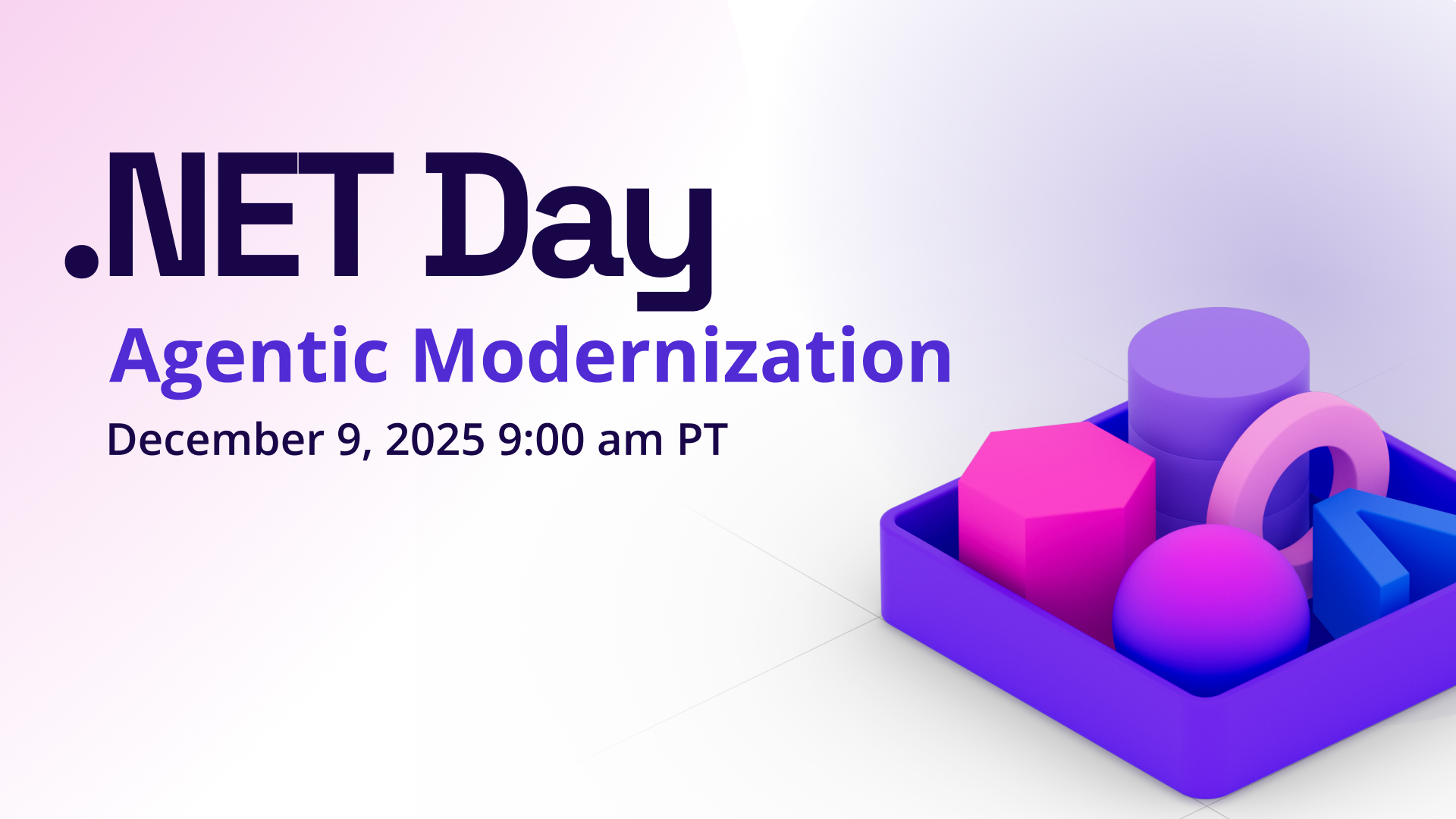
.NET Day on Agentic Modernization Coming Soon

Join us on December 9, 2025 between 9AM-1PM Pacific for .NET Day of Agentic Modernization! This is a free, one-day virtual event focused on the latest tooling, techniques, and guidance for modernizing your .NET applications. Whether you’re upgrading legacy code, preparing for cloud workloads, or exploring how AI and agentic patterns fit into your architecture, this event will show you what’s possible with today’s tooling while keeping reliability, security, and developer control front and center. Buckle up because we’ll be demo heavy and you can get your questions answered live!

.NET Day on Agentic Modernization event banner

Agenda

We have 8 great sessions throughout the event that will be broadcast live. Tune in and get your questions answered from the presenters!

🚀 Choose Your Modernization Adventure with GitHub Copilot with Brady Gaster – See how GitHub Copilot and Visual Studio speed app modernization- upgrading code, fixing dependencies, and guiding secure, cloud-ready migrations into Azure.

⚙️ Agentic DevOps: Enhancing .NET Web Apps with Azure MCP with Yun Jung Choi – Learn how AI-powered tooling and Azure MCP streamline .NET app development-code, storage, SQL, and IaC workflows-with faster, smarter Azure-ready delivery.

🛡️ Fix It Before They Feel It: Proactive .NET Reliability with Azure SRE Agent with Deepthi Chelupati and Shamir Abdul Aziz – See how Azure SRE Agent and App Insights detect .NET regressions, automate rollbacks, and streamline incident prevention with custom agents and health checks.

☁️ No‑Code Modernization for ASP.NET with Managed Instance on Azure App Service with Andrew Westgarth and Gaurav Seth – See how Azure App Service Managed Instance removes ASP.NET migration blockers-enabling fast modernization, better performance, lower TCO, and integration with modern agentic workflows.

🤖 Modernization Made Simple: Building Agentic Solutions in .NET with Bruno Capuano – Learn how to add the Agent Framework to existing .NET apps – unlocking multi-agent collaboration, memory, and tool orchestration with practical, fast-start guidance.

💪 Bulletproof Agents with the Durable Task Extension for Microsoft Agent Framework with Chris Gillum and Thiago Almeida – See how the Durable Extension for the Microsoft Agent Framework brings durable, distributed, deterministic, and debuggable AI agents to Azure—enabling reliable, scalable, production-ready agentic workflows.

🔐 Securely Unleash AI Agents on Azure SQL and SQL Server with Davide Mauri – Learn how to let AI agents work safely with Azure SQL – enforcing strict security, least-privilege access, and schema-aware techniques that prevent data leaks and query errors.

Secure and Smart AI Agents Powered by Azure Redis with Catherine Wang – See how Azure Redis powers secure, streamlined data access for .NET agentic apps – using MCP, Redis-backed tools, and modern security patterns to simplify development.

Tune in

Don’t miss this opportunity to get practical, real-world guidance on modernizing .NET applications for Azure, AI, and agentic patterns. Mark your calendars and get ready for .NET Day on Agentic Modernization!

Posted on Leave a comment

Mayo Clinic to deploy and test Microsoft generative AI tools

ROCHESTER, Minn., and REDMOND, Wash. — Sept. 28, 2023 — Mayo Clinic, a world leader in healthcare known for its commitment to innovation, is among the first healthcare organizations to deploy Microsoft 365 Copilot. This new generative AI service combines the power of large language models (LLMs) with organizational data from Microsoft 365 to enable new levels of productivity in the enterprise.

Mayo Clinic is testing the Microsoft 365 Copilot Early Access Program with hundreds of its clinical staff, doctors and healthcare workers.

“Microsoft 365 Copilot has the ability to transform work across virtually every industry so people can focus on the most important work and help move their organizations forward,” said Colette Stallbaumer, general manager, Microsoft 365. “We’re excited to be helping customers like Mayo Clinic achieve their goals.”

Generative AI has the potential to support Mayo Clinic’s vision to transform healthcare. For example, generative AI can help doctors automate form-filling tasks. Administrative demands continue to burden healthcare providers, taking up valuable time that could be used to provide more focused care to patients. Microsoft 365 Copilot has the potential to give healthcare providers valuable time back by automating tasks.

Mayo Clinic is one of the first to start working with Copilot tools to enable staff experience across apps like Microsoft Outlook, Word, Excel and more. Microsoft 365 Copilot combines the power of LLMs with data in the Microsoft 365 apps, including calendars, emails, chats, documents and meeting transcripts, to turn words into a powerful productivity tool.

“Privacy, ethics and safety are at the forefront of Mayo Clinic’s work with generative AI and large language models,” said Cris Ross, chief information officer at Mayo Clinic. “Using AI-powered tech will enhance Mayo Clinic’s ability to lead the transformation of healthcare while focusing on what matters most — providing the best possible care to our patients.”

As a leader in healthcare, Mayo Clinic is always looking for new ways to improve patient care. By using generative AI and LLMs, Mayo Clinic will be able to offer its teams new timesaving tools to help them succeed.

About Mayo Clinic

Mayo Clinic is a nonprofit organization committed to innovation in clinical practice, education and research, and providing compassion, expertise and answers to everyone who needs healing. Visit the Mayo Clinic News Network for additional Mayo Clinic news.

About Microsoft

Microsoft (Nasdaq “MSFT” @microsoft) enables digital transformation for the era of an intelligent cloud and an intelligent edge. Its mission is to empower every person and every organization on the planet to achieve more.

For more information, press only:

Microsoft Media Relations, WE Communications for Microsoft, (425) 638-7777, [email protected]

Samiha Khanna, Mayo Clinic, (507) 266-2624, [email protected]

Note to editors: For more information, news and perspectives from Microsoft, please visit the Microsoft News Center at http://news.microsoft.com. Web links, telephone numbers and titles were correct at time of publication but may have changed. For additional assistance, journalists and analysts may contact Microsoft’s Rapid Response Team or other appropriate contacts listed at https://news.microsoft.com/microsoft-public-relations-contacts.

Posted on Leave a comment

Microsoft and Mercy collaborate to empower clinicians to transform patient care with generative AI

Multiyear alliance creates foundation for innovation and deeper insights with data

Mercy and Microsoft logos

REDMOND, Wash., and ST. LOUIS — Sept. 27, 2023 Microsoft Corp. and Mercy are forging a long-term collaboration using generative AI and other digital technologies to give physicians, advance practice providers and nurses more time to care for patients and improve the patient experience. This work represents what’s next in healthcare for applying advanced digital technologies to the delivery of care to consumers.

“With the latest advances in generative AI, this moment marks a true phase change where emerging capabilities can help health care organizations address some of their most pressing challenges, create needed efficiency and transform care,” said Peter Lee, corporate vice president of research and incubations at Microsoft. “Mercy has a reputation for ongoing innovation and — through our years working together — has been a leader in the industry in creating an intelligent data platform on which to launch this kind of transformation. This is just the beginning, and it’s inspiring to see Mercy’s leadership adopting these tools to empower physicians, providers, nurses and all clinicians to improve patient care.”

Mercy plans to use Microsoft Azure OpenAI Service to improve care in several immediate new ways:

  • Patients will have the information to better understand their lab results and engage in more informed discussions about their health with their provider through the help of generative AI-assisted communication. Patients will be empowered to get answers in simple, conversational language.
  • Mercy will apply generative AI when taking patient calls for actions like scheduling appointments. Beyond the initial call, the AI solution will provide recommendations for additional follow-up actions to make sure all the patient’s needs are met during a single interaction, limiting the need for follow-up calls.
  • A chatbot for Mercy co-workers will help quickly find important information about Mercy policies and procedures, and locate HR-related answers such as information on benefits or leave requirements. By helping nurses and co-workers find the information they need more quickly, they can spend more time on patient care.

“Because of all the investments we have made together with Microsoft in the past few years, including the use of Microsoft’s secure cloud, we are better positioned to perform real-time clinical decision-making that ultimately improves patient care,” said Joe Kelly, Mercy’s executive vice president of transformation and business development officer. “With Microsoft, we are exploring more than four dozen uses of AI and will launch multiple new AI use cases by the middle of next year to transform care and experiences for patients and co-workers. This is predictive, proactive and personalized care at its best.”

As Mercy’s preferred platform for ongoing innovation, the Microsoft Cloud provides the health system with a trusted and comprehensive platform to improve efficiency, connect and govern data, impact patient and co-worker experience, reach new communities, and build a foundation for ongoing innovation. By securely centralizing and organizing data in an AI-powered intelligent data platform built on Azure, Mercy is uniquely positioned to deliver on evolving clinician and patient expectations more quickly. For example, Mercy can tap into secure data insights to reduce many unnecessary patient days in the hospital by giving care teams smart dashboards and better visibility into the factors that impact how soon patients can return home. Additionally, Microsoft’s modern work solutions will help Mercy co-workers improve productivity and communication so they can spend more time improving patient care and experience.

“Mercy and Microsoft are creating a new path for health systems in which we are working shoulder to shoulder to combine our 200-year heritage in health care and Microsoft’s extensive expertise in cloud and AI to enhance care for the patients we serve and improve the working experience for our physicians, advanced providers, nurses and all co-workers,” said Steve Mackin, Mercy’s president and CEO. “By using technology in new and secure ways, we innovate better health care for all.”

The organizations recently brought together Mercy’s engineering teams and senior leaders with Microsoft leaders, engineers and industry experts for a hackathon to co-imagine and begin to co-innovate around the generative AI use cases in development. Additionally, Microsoft and Mercy are working together to showcase Mercy’s solutions in the Microsoft Technology Center (MTC) in Chicago in 2024. The showcase will highlight transformational clinical experiences and demonstrate what the future of health care could look like using Microsoft technology.

About Mercy

Mercy, one of the 20 largest U.S. health systems and named the top large system in the U.S. for excellent patient experience by NRC Health, serves millions annually with nationally recognized quality care and one of the nation’s largest Accountable Care Organizations. Mercy is a highly integrated, multi-state health care system including more than 40 acute care, managed and specialty (heart, children’s, orthopedic and rehab) hospitals, convenient and urgent care locations, imaging centers and pharmacies. Mercy has 900 physician practices and outpatient facilities, more than 4,000 physicians and advanced practitioners and more than 45,000 co-workers serving patients and families across Arkansas, Kansas, Missouri and Oklahoma. Mercy also has clinics, outpatient services and outreach ministries in Arkansas, Louisiana, Mississippi and Texas.

About Microsoft

Microsoft (Nasdaq “MSFT” @Microsoft) enables digital transformation for the era of an intelligent cloud and an intelligent edge. Its mission is to empower every person and every organization on the planet to achieve more.

For more information, press only:

Microsoft Media Relations, WE Communications for Microsoft, (425) 638-7777, [email protected]

Bethany Pope, Mercy, (314) 251-4472 office, [email protected]

Joe Poelker, Mercy, (314) 525-4005 office, (314) 724-6095 mobile, [email protected]

Note to editors: For more information, news and perspectives from Microsoft, please visit the Microsoft News Center at http://news.microsoft.com. Web links, telephone numbers and titles were correct at time of publication but may have changed. For additional assistance, journalists and analysts may contact Microsoft’s Rapid Response Team or other appropriate contacts listed at https://news.microsoft.com/microsoft-public-relations-contacts.

Posted on Leave a comment

Lumen Technologies dives into Microsoft 365 Copilot to help enhance employee efficiency and customer relationships

Generative AI tool shows early signs of helping Lumen innovate for growth

DENVER, Colo., and REDMOND, Wash. — Aug. 30, 2023 — Lumen Technologies Inc. (NYSE: LUMN), a multinational technology company, is working with Microsoft Corp. (Nasdaq: MSFT) to deploy Microsoft 365 Copilot to empower its approximately 30,000 employees. Lumen is beta-testing Microsoft 365 Copilot as a part of the Early Access Program (EAP). The company has already seen the benefits of equipping some of its teams with Microsoft’s large language model (LLM) AI solutions, with plans to deploy the tech more broadly in the future.

“We are thrilled to be leading the early deployment of Microsoft 365 Copilot at Lumen Technologies,” said Kate Johnson, president and CEO, Lumen Technologies Inc. “Giving our workforce the digital tools they need to deliver dramatically improved customer experiences with greater ease is an essential part of our company transformation. Our people are seeing immediate productivity improvements with Copilot, allowing them to focus on more value-added activities each day.”

Microsoft 365 Copilot can disrupt the telecommunications industry by providing employees with a tool to help enhance creativity, productivity and skills with real-time intelligent assistance. It has the potential to significantly improve employee productivity by automating tedious tasks and providing powerful tools for data analysis and decision-making. With features such as meeting summaries in Microsoft Teams and Copilot enhancements across Outlook, PowerPoint and other Microsoft 365 apps, employees can get back important time to deliver on strategic priorities.

Customer service teams at Lumen are using Copilot to surface relevant policies, summarize tickets or easily access step-by-step repair instructions from manuals. Sales and customer experience teams are using Copilot to add depth and context to customer communications and summarize actions and next steps. Across the board, teams are using Copilot to quickly create presentations, and for new business proposal and statement-of-work creation to deliver a consistent Lumen message and experience.

Lumen is among the first companies to start working with Microsoft 365 Copilot as one of the EAP adopters. Microsoft 365 Copilot combines the power of LLMs with data in the Microsoft Graph — calendar, emails, chats, documents, meetings and more — and the Microsoft 365 apps to turn words into a powerful productivity tool.

“Microsoft 365 Copilot has the power to revolutionize the way we work, enabling people to focus on what truly matters and drive their organizations forward,” said Deb Cupp, president, Americas Microsoft. “We are thrilled to be delivering this technology to innovative companies like Lumen to help them achieve their goals.”

As a pioneer in the telecommunications industry, Lumen is pushing the envelope when it comes to enhancing the customer experience. By harnessing the power of advanced AI technologies such as generative AI and AI language models through tools like Microsoft 365 Copilot, Lumen can provide their teams with the cutting-edge tools they need to succeed and drive their business forward.

About Lumen Technologies

Lumen connects the world. We are dedicated to furthering human progress through technology by connecting people, data, and applications – quickly, securely, and effortlessly. Everything we do at Lumen takes advantage of our network strength. From metro connectivity to long-haul data transport to our edge cloud, security, and managed service capabilities, we meet our customers’ needs today and as they build for tomorrow. For news and insights visit news.lumen.com, LinkedIn: /lumentechnologies, Twitter: @lumentechco, Facebook: /lumentechnologies, Instagram: @lumentechnologies, and YouTube: /lumentechnologies.

About Microsoft

Microsoft (Nasdaq “MSFT” @Microsoft) enables digital transformation for the era of an intelligent cloud and an intelligent edge. Its mission is to empower every person and every organization on the planet to achieve more.

For more information, press only:

Microsoft Media Relations, WE Communications for Microsoft, (425) 638-7777, [email protected]

Danielle Spears, Corporate Communications for Lumen, (407) 961-3838, [email protected]

Posted on Leave a comment

Introducing the Microsoft 365 Copilot Early Access Program and the 2023 Work Trend Index

Microsoft is bringing Microsoft 365 Copilot to more customers and releasing new research that shows how AI will change the way we work

REDMOND, Wash. — May 9, 2023 — Earlier this year, Microsoft Corp. introduced Microsoft 365 Copilot, which will bring powerful new generative AI capabilities to apps millions of people use every day like Microsoft Word, Excel, PowerPoint, Outlook, Microsoft Teams and more.

On Tuesday, the company announced it is expanding access to the Microsoft 365 Copilot preview and introducing new features. The company also released new data and insights from its 2023 Work Trend Index report: “Will AI Fix Work?

The data shows that the pace of work has accelerated faster than humans can keep up, and it’s impacting innovation. Next-generation AI will lift the weight of work. Organizations that move first to embrace AI will break the cycle — increasing creativity and productivity for everyone.

“This new generation of AI will remove the drudgery of work and unleash creativity,” said Satya Nadella, chairman and CEO, Microsoft. “There’s an enormous opportunity for AI-powered tools to help alleviate digital debt, build AI aptitude and empower employees.”

The report shares three key insights for business leaders as they look to understand and responsibly adopt AI for their organization:

  1. Digital debt is costing us innovation: We’re all carrying digital debt: The volume of data, emails and chats has outpaced our ability to process it all. There is an opportunity to make our existing communications more productive. Every minute spent managing this digital debt is a minute not spent on creative work. Sixty-four percent of employees don’t have enough time and energy to get their work done and those employees are 3.5x more likely to say they struggle with being innovative or thinking strategically. Of time spent in Microsoft 365, the average person spends 57% communicating and only 43% creating.
  2. There’s a new AI-employee alliance: For employees, the promise of relief outweighs job loss fears and managers are looking to empower employees with AI, not replace. Forty-nine percent of people say they’re worried AI will replace their jobs, but even more — 70% — would delegate as much work as possible to AI in order to lessen their workloads. In fact, leaders are 2x more likely to say that AI would be most valuable in their workplace by boosting productivity rather than cutting headcount.
  3. Every employee needs AI aptitude: Every employee, not just AI experts, will need new core competencies such as prompt engineering in their day to day. Eighty-two percent of leaders anticipate employees will need new skills in the AI era, and as of March 2023, jobs on LinkedIn in the U.S. mentioning GPT have increased by 79% year over year. This new, in-demand and AI-centric skillset will have ripple effects across everything from resumes to job postings.

“The pace and volume of work have increased exponentially and are outpacing humans’ ability to keep up,” said Jared Spataro, CVP, Modern Work and Business Applications. “In a world where creativity is the new productivity, digital debt is more than an inconvenience — it’s a threat to innovation. Next-generation AI will lift the weight of work and free us all to focus on the work that matters.”

To empower businesses in the AI era, Microsoft is introducing the Microsoft 365 Copilot Early Access Program with an initial wave of 600 enterprise customers worldwide in an invitation-only paid preview program. In addition, the following new capabilities will be added to Microsoft 365 Copilot and Microsoft Viva:

  • Copilot in Whiteboard will make Microsoft Teams meetings and brainstorms more creative and effective. Using natural language, you can ask Copilot to generate ideas, organize ideas into themes, create designs that bring ideas to life, and summarize Whiteboard content.
  • By integrating DALL-E, OpenAI’s image generator, into Copilot in PowerPoint, users will be able to ask Copilot to create custom images to support their content.
  • Copilot in Outlook will offer coaching tips and suggestions on clarity, sentiment and tone to help users write more effective emails and communicate more confidently.
  • Copilot in OneNote will use prompts to draft plans, generate ideas, create lists and organize information to help customers find what they need easily.
  • Copilot in Viva Learning will use a natural language chat interface to help users create a personalized learning journey including designing upskilling paths, discovering relevant learning resources and scheduling time for assigned trainings.

To help every customer get AI-ready, Microsoft is also introducing the Semantic Index for Copilot, a new capability we’re starting to roll out to all Microsoft 365 E3 and E5 customers.

To learn more, visit the Official Microsoft Blog, Microsoft 365 Blog and the new Work Trend Index.

Microsoft (Nasdaq “MSFT” @microsoft) enables digital transformation for the era of an intelligent cloud and an intelligent edge. Its mission is to empower every person and every organization on the planet to achieve more.

For more information, press only:

Microsoft Media Relations, WE Communications, (425) 638-7777, [email protected]

Note to editors: For more information, news and perspectives from Microsoft, please visit the Microsoft News Center at http://news.microsoft.com. Web links, telephone numbers and titles were correct at time of publication but may have changed. For additional assistance, journalists and analysts may contact Microsoft’s Rapid Response Team or other appropriate contacts listed at https://news.microsoft.com/microsoft-public-relations-contacts.

Posted on Leave a comment

Industry leaders in tech, education and financial services join together in new national council to activate AI for the greater good

Coalition established to identify and solve significant societal and industry barriers through the adoption of AI

REDMOND, Wash. — Dec. 11, 2020 — On Friday, leading organizations across the U.S. financial services, technology and academic industries announced the formation of a new National Council for Artificial Intelligence (NCAI). The council brings together the Brookings Institution, CUNY, the Federal Reserve Bank of New York, Mastercard, Microsoft, Nasdaq, Plug and Play, SUNY, University of Central Florida, and Visa with the goal of maximizing technology to jointly solve specific issues of interest to the industry.

“The goal of the newly created NCAI is to establish a pragmatic coalition with public-private partnerships in the financial services sector to identify and address significant societal and industry barriers,” said Gretchen O’Hara, vice president of AI and sustainability strategy, Microsoft U.S. “I am excited about the launch of our distinguished board, and the continued momentum to work with the members of this coalition to better serve the needs of our stakeholders and communities through AI innovation.”

The NCAI board, composed of volunteer senior executives acting as advisors to the council on behalf of their company or organization, will work to co-create AI solutions for positive societal and financial impact, identify and set the AI strategy and vision for a wide range of projects, and track AI adoption progress. Each member organization has nominated its own AI ambassadors to serve as regional leads and drive programs. All members have an equal voice in the way it operates and is governed.

The council intends to apply AI to resolve significant challenges in business such as:

  • General economic and industrial challenges – including research transfer, industry standards and funding instruments
  • Digital skills and employability – including organizational and cultural challenges, and labor policies
  • Data privacy – including data access and shared innovation

“Although there are many councils focusing on resolving technology challenges, I appreciate NCAI’s charter to figure out how AI can deliver deeper societal impact,” said Ed Fandrey, vice president of Financial Services, Microsoft U.S. “The NCAI coalition brings partners together across the industry to ensure AI and the technologies underpinning it are transparent and safe for not only financial services customers but throughout the regulated industry.”

Overall, the objective of the collaboration is to accelerate AI innovation and adoption by:

  • Lowering the risk of AI adoption and bias
  • Lowering the barrier of entry to innovate
  • Defining the educational journey for the AI talent of the future and equipping workers facing AI displacement with the right skills to maintain career momentum
  • Serving as an advisor of vision, information and multidisciplinary partnership with a focus on AI policy

To achieve these goals, the NCAI will deliver a robust curriculum for AI education and skilling, and will engage with the community through research white papers, new tools and programs, hosted events, and social media outreach to make AI more applicable and impactful. The council also plans to host quarterly meetings and public events to transparently communicate the resolution and progress of key challenges through AI adoption.

Initial work from the council will focus on reskilling and upskilling of the current workforce and business leaders. More details about the coalition’s programs and its impacts will be available in early 2021.

Microsoft (Nasdaq “MSFT” @microsoft) enables digital transformation for the era of an intelligent cloud and an intelligent edge. Its mission is to empower every person and every organization on the planet to achieve more.

For more information, press only:
Microsoft Media Relations, WE Communications for Microsoft, (425) 638-7777, [email protected]

Note to editors: For more information, news and perspectives from Microsoft, please visit the Microsoft News Center at http://news.microsoft.com. Web links, telephone numbers and titles were correct at time of publication, but may have changed. For additional assistance, journalists and analysts may contact Microsoft’s Rapid Response Team or other appropriate contacts listed at https://news.microsoft.com/microsoft-public-relations-contacts.

Perspectives from NCAI member organizations

“Mastercard has been pioneering the use of AI, applying it across our business to help keep the digital ecosystem safe for governments, banks, merchants and consumers,” said Rohit Chauhan, executive vice president, Artificial Intelligence, Mastercard. “It has enabled us to provide quicker, easier and safer ways to transact and interact. As AI’s role and influence continues to expand, partnership, knowledge-sharing and best practices are needed to help accelerate the adoption in a responsible, secure and human-centric manner. Our work with the council is just beginning and we’re eager to collaborate and innovate with this group of industry leaders.”

“At Nasdaq, we are leveraging AI to solve challenges for the capital markets and beyond, with an aim to make markets safer, smarter and stronger,” said Michael O’Rourke, senior vice president and head of Artificial Intelligence and Investment Intelligence Technology, Nasdaq and NCAI council member. “We enthusiastically support the formation of the NCAI to progress these values and to use AI for the greater good for the investing public in the U.S. and worldwide.”

“Brookings Institution aims to advance effective and inclusive governance of transformative new technologies,” said Dr. Nicol Turner Lee, director of the Center for Technology Innovation, the Brookings Institution. “While artificial intelligence is generating benefits, difficult questions surface in terms of bias and discrimination. I am excited to join the National Council for Artificial Intelligence together with Microsoft and the other member organizations to work together to drive major solutions and policies that govern innovation, and drive the advancement of digital equity and inclusion for historically disadvantaged populations.”

“SUNY’s inclusion in the National Council for Artificial Intelligence shows our system’s dedication to partnering with fellow institutions of higher education and industry leaders in artificial intelligence — a field that is ever-growing and in need of diverse perspectives to serve businesses and organizations throughout the country,” said Chris Ellis, deputy chief of staff, SUNY. “We are proud to be a member of the council and look forward to working with the other members to influence artificial intelligence innovation of tomorrow and shaping educational programs involving AI.”

“It is incumbent upon leaders from the public and private sectors to ensure that our shared values of accountability, transparency and civic-mindedness guide us as AI becomes more prevalent in our everyday lives,” said Félix V. Matos Rodríguez, chancellor, CUNY. “AI promises many hopeful rewards, but it also presents a host of new and ever-evolving challenges. One thing is certain: CUNY is committed to educating and training students, as well as upskilling displaced workers for the ever-shifting 21st century labor market. We thank our partners in the National Council for Artificial Intelligence for the opportunity to ensure that the future remains bright and promising for all.”

“We are thrilled to participate on this board and have ambition to form an AI-focused innovation platform and accelerator,” said Michael Olmstead, chief revenue officer, Plug and Play. “With participation from the fellow board members, we will use this platform as a potential investment vehicle and sandbox to test different policies and ideas this group is looking to create.”

Posted on Leave a comment

C3.ai, Microsoft, and Adobe combine forces to re-invent CRM with AI

C3 AI CRM enables a new category of customer-focused industry AI use cases and a new ecosystem

REDWOOD CITY, CA, REDMOND, WA, and SAN JOSE, CA – October 26, 2020 – C3.ai, Microsoft Corp. (NASDAQ:MSFT), and Adobe Inc. (NASDAQ:ADBE) today announced the launch of C3 AI® CRM powered by Microsoft Dynamics 365. The first enterprise-class, AI-first customer relationship management solution is purpose-built for industries, integrates with Adobe Experience Cloud, and drives customer-facing operations with predictive business insights.

The partners have agreed to:

  • Integrate Microsoft Dynamics 365, Adobe Experience Cloud (including Adobe Experience Platform), and C3.ai’s industry-specific data models, connectors, and AI models, in a joint go-to-market offering designed to provide an integrated suite of industry-specific AI-enabled CRM solutions including marketing, sales, and customer service.
  • Sell the industry-specific AI CRM offering through dedicated sales teams to target enterprise accounts across multiple industries globally, as well as through agents and industry partners.
  • Target industry vertical markets initially including financial services, oil and gas, utilities, manufacturing, telecommunications, public sector, healthcare, defense, intelligence, automotive, and aerospace
  • Market the jointly branded offering globally, supported by the companies’ commitment to customer success

C3 AI logo“Microsoft, Adobe, and C3.ai are reinventing a market that Siebel Systems invented more than 25 years ago,” said Thomas M. Siebel, CEO of C3.ai. “The dynamics of the market and the mandates of digital transformation have dramatically changed CRM market requirements.  A general-purpose CRM system of record is no longer sufficient.  Customers today demand industry-specific, fully AI-enabled solutions that provide AI-enabled revenue forecasting, product forecasting, customer churn, next-best product, next-best offer, and predisposition to buy.”

“This year has made clear that businesses fortified by digital technology are more resilient and more capable of transforming when faced with sweeping changes like those we are experiencing,” said Satya Nadella, CEO, Microsoft. “Together with C3.ai and Adobe, we are bringing to market a new class of industry-specific AI solutions, powered by Dynamics 365, to help organizations digitize their operations and unlock real-time insights across their business.”

“We’re proud to partner with C3.ai and Microsoft to advance the imperative for digital customer engagement,” said Shantanu Narayen, president and CEO of Adobe. “The unique combination of Adobe Experience Cloud, the industry-leading solution for customer experiences, together with the C3 AI Suite and Microsoft Dynamics 365, will enable brands to deliver rich experiences that drive business growth.”

Adobe logo“This is an exciting development in the advancement of Enterprise AI,” said Lorenzo Simonelli, chairman and CEO of Baker Hughes. “This partnership between C3.ai, Microsoft, and Adobe will bring a unique and powerful new CRM offering to the market. We are adopting AI in multiple applications internally and in new products and services for our customers through our C3.ai partnership. We look forward to offering C3 AI CRM to our customers and benefitting from the capabilities internally.”

Combining the market-leading Microsoft Dynamics 365 CRM software with Adobe’s leading suite of customer experience management solutions alongside C3.ai’s enterprise AI capabilities, C3 AI CRM is the world’s first AI-driven, industry-specific CRM built with a modern AI-first architecture. C3 AI CRM integrates and unifies vast amounts of structured and unstructured data from enterprise and extraprise sources into a unified, federated image to drive real-time predictive insights across the entire revenue supply chain, from contact to cash. With embedded AI-driven, industry-specific workflows, C3 AI CRM helps teams:

  • Accurately forecast revenue
  • Accurately predict product demand
  • Identify and reduce customer churn
  • Identify highly-qualified prospects
  • Next-best offer, next-best product
  • AI-driven segmentation, marketing, and targeting

C3 AI CRM enables brands to take advantage of their real-time customer profiles for cross-channel journey orchestration. The joint solution offers an integrated ecosystem that empowers customers to take advantage of leading CRM capabilities along with an integrated ecosystem with Azure, Microsoft 365, and the Microsoft Power Platform. C3 AI CRM is pre-built and configured for industries – financial services, healthcare, telecommunications, oil and gas, manufacturing, utilities, aerospace, automotive, public sector, defense, and intelligence – enabling customers to deploy and operate C3 AI CRM and its industry-specific machine learning models quickly. In addition, C3 AI CRM leverages the common data model of the Open Data Initiative (ODI), making it easier to bring together disparate customer data from across the enterprise.

C3 AI CRM is immediately available, with Adobe Experience Cloud sold separately. C3 AI CRM powered by Dynamics 365 will be available from C3.ai, Adobe, Microsoft and through the Microsoft Dynamics 365 Marketplace. Please contact [email protected] to learn more.

###
About C3.ai

C3.ai is a leading enterprise AI software provider for accelerating digital transformation. C3.ai delivers the C3 AI Suite for developing, deploying, and operating large-scale AI, predictive analytics, and IoT applications in addition to an increasingly broad portfolio of turn-key AI applications. The core of the C3.ai offering is a revolutionary, model-driven AI architecture that dramatically enhances data science and application development.

About Microsoft

Microsoft (Nasdaq “MSFT” @microsoft) enables digital transformation for the era of an intelligent cloud and an intelligent edge. Its mission is to empower every person and every organization on the planet to achieve more.

About Adobe

Adobe is changing the world through digital experiences. For more information, visit  www.adobe.com.

For more information, contact:

C3.ai Public Relations:
April Marks

(917) 574-5512
[email protected]

Microsoft Media Relations:

WE Communications for Microsoft

(425) 638-7777

[email protected]

Adobe Comms:

Ashley Levine

(408) 666-5888

[email protected]


Posted on Leave a comment

Demonstrating Perl with Tic-Tac-Toe, Part 4

This is the final article to the series demonstrating Perl with Tic-Tac-Toe. This article provides a module that can compute better game moves than the previously presented modules. For fun, the modules chip1.pm through chip3.pm can be incrementally moved out of the hal subdirectory in reverse order. With each chip that is removed, the game will become easier to play. The game must be restarted each time a chip is removed.

An example Perl program

Copy and paste the below code into a plain text file and use the same one-liner that was provided in the the first article of this series to strip the leading numbers. Name the version without the line numbers chip3.pm and move it into the hal subdirectory. Use the version of the game that was provided in the second article so that the below chip will automatically load when placed in the hal subdirectory. Be sure to also include both chip1.pm and chip2.pm from the second and third articles, respectively, in the hal subdirectory.

00 # artificial intelligence chip
01 02 package chip3;
03 require chip2;
04 require chip1;
05 06 use strict;
07 use warnings;
08 09 sub moverama {
10 my $game = shift;
11 my @nums = $game =~ /[1-9]/g;
12 my $rama = qr/[1973]/;
13 my %best;
14 15 for (@nums) {
16 my $ra = $_;
17 next unless $ra =~ $rama;
18 $best{$ra} = 0;
19 for (@nums) {
20 my $ma = $_;
21 next unless $ma =~ $rama;
22 if (($ra-$ma)*(10-$ra-$ma)) {
23 $best{$ra} += 1;
24 }
25 }
26 }
27 28 @nums = sort { $best{$b} <=> $best{$a} } keys %best;
29 30 return $nums[0];
31 }
32 33 sub hal_move {
34 my $game = shift;
35 my $mark = shift;
36 my @mark = @{ shift; };
37 my $move;
38 39 $move = chip2::win_move $game, $mark, \@mark;
40 41 if (not defined $move) {
42 $mark = ($mark eq $mark[0]) ? $mark[1] : $mark[0];
43 $move = chip2::win_move $game, $mark, \@mark;
44 }
45 46 if (not defined $move) {
47 $move = moverama $game;
48 }
49 50 if (not defined $move) {
51 $move = chip1::hal_move $game;
52 }
53 54 return $move;
55 }
56 57 sub complain {
58 print 'Just what do you think you\'re doing, ',
59 ((getpwnam($ENV{'USER'}))[6]||$ENV{'USER'}) =~ s! .*!!r, "?\n";
60 }
61 62 sub import {
63 no strict;
64 no warnings;
65 66 my $p = __PACKAGE__;
67 my $c = caller;
68 69 *{ $c . '::hal_move' } = \&{ $p . '::hal_move' };
70 *{ $c . '::complain' } = \&{ $p . '::complain' };
71 72 if (&::MARKS->[0] ne &::HAL9K) {
73 @{ &::MARKS } = reverse @{ &::MARKS };
74 }
75 }
76 77 1;

How it works

Rather than making a random move or making a move based on probability, this final module to the Perl Tic-Tac-Toe game uses a more deterministic algorithm to calculate the best move.

The big takeaway from this Perl module is that it is yet another example of how references can be misused or abused, and as a consequence lead to unexpected program behavior. With the addition of this chip, the computer learns to cheat. Can you figure out how it is cheating? Hints:

  1. Constants are implemented as subroutines.
  2. References allow data to be modified out of scope.

Final notes

Line 12 demonstrates that a regular expression can be pre-compiled and stored in a scalar for later use. This is useful as performance optimization when you intend to re-use the same regular expression many times over.

Line 59 demonstrates that some system library calls are available directly in Perl’s built-in core functionality. Using the built-in functions alleviates some overhead that would otherwise be required to launch an external program and setup the I/O channels to communicate with it.

Lines 72 and 73 demonstrate the use of &:: as a shorthand for &main::.

The full source code for this Perl game can be cloned from the git repository available here: https://pagure.io/tic-tac-toe.git

Posted on Leave a comment

Demonstrating Perl with Tic-Tac-Toe, Part 3

The articles in this series have mainly focused on Perl’s ability to manipulate text. Perl was designed to manipulate and analyze text. But Perl is capable of much more. More complex problems often require working with sets of data objects and indexing and comparing them in elaborate ways to compute some desired result.

For working with sets of data objects, Perl provides arrays and hashes. Hashes are also known as associative arrays or dictionaries. This article will prefer the term hash because it is shorter.

The remainder of this article builds on the previous articles in this series by demonstrating basic use of arrays and hashes in Perl.

An example Perl program

Copy and paste the below code into a plain text file and use the same one-liner that was provided in the the first article of this series to strip the leading numbers. Name the version without the line numbers chip2.pm and move it into the hal subdirectory. Use the version of the game that was provided in the second article so that the below chip will automatically load when placed in the hal subdirectory.

00 # advanced operations chip
01 02 package chip2;
03 require chip1;
04 05 use strict;
06 use warnings;
07 08 use constant SCORE=>'
09 ┌───┬───┬───┐
10 │ 3 │ 2 │ 3 │
11 ├───┼───┼───┤
12 │ 2 │ 4 │ 2 │
13 ├───┼───┼───┤
14 │ 3 │ 2 │ 3 │
15 └───┴───┴───┘
16 ';
17 18 sub get_prob {
19 my $game = shift;
20 my @nums;
21 my %odds;
22 23 while ($game =~ /[1-9]/g) {
24 $odds{$&} = substr(SCORE, $-[0], 1);
25 }
26 27 @nums = sort { $odds{$b} <=> $odds{$a} } keys %odds;
28 29 return $nums[0];
30 }
31 32 sub win_move {
33 my $game = shift;
34 my $mark = shift;
35 my $tkns = shift;
36 my @nums = $game =~ /[1-9]/g;
37 my $move;
38 39 TRY: for (@nums) {
40 my $num = $_;
41 my $try = $game =~ s/$num/$mark/r;
42 my $vic = chip1::get_victor $try, $tkns;
43 44 if (defined $vic) {
45 $move = $num;
46 last TRY;
47 }
48 }
49 50 return $move;
51 }
52 53 sub hal_move {
54 my $game = shift;
55 my $mark = shift;
56 my @mark = @{ shift; };
57 my $move;
58 59 $move = win_move $game, $mark, \@mark;
60 61 if (not defined $move) {
62 $mark = ($mark eq $mark[0]) ? $mark[1] : $mark[0];
63 $move = win_move $game, $mark, \@mark;
64 }
65 66 if (not defined $move) {
67 $move = get_prob $game;
68 }
69 70 return $move;
71 }
72 73 sub complain {
74 print "My mind is going. I can feel it.\n";
75 }
76 77 sub import {
78 no strict;
79 no warnings;
80 81 my $p = __PACKAGE__;
82 my $c = caller;
83 84 *{ $c . '::hal_move' } = \&{ $p . '::hal_move' };
85 *{ $c . '::complain' } = \&{ $p . '::complain' };
86 }
87 88 1;

How it works

In the above example Perl module, each position on the Tic-Tac-Toe board is assigned a score based on the number of winning combinations that intersect it. The center square is crossed by four winning combinations – one horizontal, one vertical, and two diagonal. The corner squares each intersect one horizontal, one vertical, and one diagonal combination. The side squares each intersect one horizontal and one vertical combination.

The get_prob subroutine creates a hash named odds (line 21) and uses it to map the numbers on the current game board to their score (line 24). The keys of the hash are then sorted by their score and the resulting list is copied to the nums array (line 27). The get_prob subroutine then returns the first element of the nums array ($nums[0]) which is the number from the original game board that has the highest score.

The algorithm described above is an example of what is called a heuristic in artificial intelligence programming. With the addition of this module, the Tic-Tac-Toe game can be considered a very rudimentary artificial intelligence program. It is really just playing the odds though and it is quite beatable. The next module (chip3.pm) will provide an algorithm that actually calculates the best possible move based on the opponent’s counter moves.

The win_move subroutine simply tries placing the provided mark in each available position and passing the resulting game board to chip1’s get_victor subroutine to see if it contains a winning combination. Notice that the r flag is being passed to the substitution operation (s/$num/$mark/r) on line 41 so that, rather than modifying the original game board, a new copy of the board containing the substitution is created and returned.

Arrays

It was mentioned in part one that arrays are variables whose names are prefixed with an at symbol (@) when they are created. In Perl, these prefixed symbols are called sigils.

Context

In Perl, many things return a different value depending on the context in which they are accessed. The two contexts to be aware of are called scalar context and list context. In the following example, $value1 and $value2 are different because @nums is accessed first in scalar context and then in list context.

$value1 = @nums;
($value2) = @nums;

In the above example, it might seem like @nums should return the same value each time it is accessed, but it doesn’t because what is accessing it (the context) is different. $value1 is a scalar, so it receives the scalar value of @nums which is its length. ($value2) is a list, so it receives the list value of @nums. In the above example, $value2 will receive the value of the first element of the nums array.

In part one, the below statement from the get_mark subroutine copied the numbers from the current Tic-Tac-Toe board into an array named nums.

@nums = $game =~ /[1-9]/g

Since the nums array in the above statement receives one copy of each board number in each of its elements, the count of the board numbers is equal to the length of the array. In Perl, the length of an array is obtained by accessing it in scalar context.

Next, the following formula was used to compute which mark should be placed on the Tic-Tac-Toe board in the next turn.

$indx = (@nums+1) % 2;

Because the plus operator requires a single value (a scalar) on its left hand side, not a list of values, the nums array evaluates to its length, not the list of its values. The parenthesis, in the above example, are just being used to set the order of operations so that the addition (+) will happen before the modulo (%).

Copying

In Perl you can create a list for immediate use by surrounding the list values with parenthesis and separating them with commas. The following example creates a three-element list and copies its values to an array.

@nums = (4, 5, 6);

As long as the elements of the list are variables and not constants, you can also copy the elements of an array to a list:

($four, $five, $six) = @nums;

If there were more elements in the array than the list in the above example, the extra elements would simply be discarded.

Different from lists in scalar context

Be aware that lists and arrays are different things in Perl. A list accessed in scalar context returns its last value, not its length. In the following example, $value3 receives 3 (the length of @nums) while $value4 receives 6 (the last element of the list).

$value3 = @nums;
$value4 = (4, 5, 6);

Indexing

To access an individual element of an array or list, suffix it with the desired index in square brackets as shown on line 29 of the above example Perl module.

Notice that the nums array on line 29 is prefixed with the dollar sigil ($) rather than the at sigil (@). This is done because the get_prob subroutine is supposed to return a single value, not a list. If @nums[0] were used instead of $nums[0], the subroutine would return a one-element list. Since a list evaluates to its last element in scalar context, this program would probably work if I had used @nums[0], but if you mean to retrieve a single element from an array, be sure to use the dollar sigil ($), not the at sigil (@).

It is possible to retrieve a subset from an array (or a list) rather than just one value in which case you would use the at sigil and you would provide a series of indexes or a range instead of a single index. This is what is known in Perl as a list slice.

Hashes

Hashes are variables whose names are prefixed with the percent sigil (%) when they are created. They are subscripted with curly brackets ({}) when accessing individual elements or subsets of elements (hash slices). Like arrays, hashes are variables that can hold multiple discrete data elements. They differ from arrays in the following ways:

  1. Hashes are indexed by strings (or anything that can be converted to a string), not numbers.
  2. Hashes are unordered. If you retrieve a list of their keys, values or key-value pairs, the order of the listing will be random.
  3. The number of elements in the hash will be equal to the number of keys that have been assigned values. If a value is assigned to index 99 of an array that has only three elements (indexes 0-2), the array will grow to a length of 100 elements (indexes 0-99). If a value is assigned to a new key in a hash that has only three elements, the hash will grow by only one element.

As with arrays, if you mean to access (or assign to) a single element of a hash, you should prefix it with the dollar sigil ($). When accessing a single element, Perl will go by the type of the subscript to determine the type of variable being accessed – curly brackets ({}) for hashes or square brackets ([]) for arrays. The get_prob subroutine in the above Perl module demonstrates assigning to and accessing individual elements of a hash.

Perl has two special built-in functions for working with hashes – keys and values. The keys function, when provided a hash, returns a list of all the hash’s keys (indexes). Similarly, the values function will return a list of all the hash’s values. Remember though that the order in which the list is returned is random. This randomness can be seen when playing the Tic-Tac-Toe game. If there is more than one move available with the highest score, the computer will chose one at random because the keys function returns the available moves from the odds hash in random order.

On line 27 of the above example Perl module, the keys function is being used to retrieve the list of keys from the odds hash. The keys of the odds hash are the numbers that were found on the current game board. The values of the odds hash are the corresponding probabilities that were retrieved from the SCORE constant on line 24.

Admittedly, this example could have used an array instead of a string to store and retrieve the scores. I chose to use a string simply because I think it presents the layout of the board a little nicer. An array would likely perform better, but with such a small data set, the difference is probably too small to measure.

Sort

On line 27, the list of keys from the odds hash is being feed to Perl’s built-in sort function. Beware that Perl’s sort function sorts lexicographically by default, not numerically. For example, provided the list (10, 9, 8, 1), Perl’s sort function will return the list (1, 10, 8, 9).

The behavior of Perl’s sort function can be modified by providing it a code block as its first parameter as demonstrated on line 27. The result of the last statement in the code block should be a number less-than, equal-to, or greater-than zero depending on whether element $a should be placed before, concurrent-with, or after element $b in the resulting list respectively. $a and $b are pairs of elements from the provided list. The code in the block is executed repeatedly with $a and $b set to different pairs of elements from the original list until all the pairs have been compared and sorted.

The <=> operator is a special Perl operator that returns -1, 0, or 1 depending on whether the left argument is numerically less-than, equal-to, or greater-than the right argument respectively. By using the <=> operator in the code block of the sort function, Perl’s sort function can be made to sort numerically rather than lexicographically.

Notice that rather than comparing $a and $b directly, they are first being passed through the odds hash. Since the values of the odds hash are the probabilities that were retrieved from the SCORE constant, what is being compared is actually the score of $a versus the score of $b. Consequently, the numbers from the original game board are being sorted by their score, not their value. Numbers with an equal score are left in the same random order that the keys function returned them.

Notice also that I have reversed the typical order of the parameters to <=> in the code block of the sort function ($b on the left and $a on the right). By switching their order in this way, I have caused the sort function to return the elements in reverse order – from greatest to least – so that the number(s) with the highest score will be first in the list.

References

References provide an indirect means of accessing a variable. They are often used when making copies of the variable is either undesirable or impractical. References are a sort of short cut that allows you to skip performing the copy and instead provide access to the original variable.

Why to use references

There is a cost in time and memory associated with making copies of variables. References are sometimes used as a means of reducing that cost. Be aware, however, that recent versions of Perl implement a technology called copy-on-write that greatly reduces the cost of copying variables. This new optimization should work transparently. You don’t have to do anything special to enable the copy-on-write optimization.

Why not to use references

References violate the action-at-a-distance principle that was mentioned in part one of this series. References are just as bad as global variables in terms of their tendency to trip up programmers by allowing data to be modified outside the local scope. You should generally try to avoid using references. But there are times when they are necessary.

How to create references

An example of passing a reference is provided on line 59 of the above Perl module. Rather than placing the mark array directly in the list of parameters to the win_move subroutine, a reference to the array is provided instead by prefixing the variable’s sigil with a backslash (\).

It is necessary to use a reference (\@mark) on line 59 because if the array were placed directly on the list, it would expand such that the first element of the mark array would become the third parameter to the win_move function, the second element of the mark array would become the fourth parameter to the win_move function, and so on for as many elements as the mark array has. Whereas an array will expand in list context, a reference will not. If the array were passed in expanded form, the receiving subroutine would need to call shift once for each element of the array. Also, the receiving function would not be able to tell how long the original array was.

Three ways to dereference references

In the receiving subroutine, the reference has to be dereferenced to get at the original values. An example of dereferencing an array reference is provided on line 56. On line 56, the shift statement has been enclosed in curly brackets and the opening bracket has been prefixed with the array sigil (@).

There is also a shorter form for dereferencing an array reference that is demonstrated on line 43 of the chip1.pm module. The short form allows you to omit the curly brackets and instead place the array sigil directly in front of the sigil of the scalar that holds the array reference. The short form only works when you have an array reference stored in a scalar. When the array reference is coming from a function, as it is on line 56 of the above Perl module, the long form must be used.

There is yet a third way of dereferencing an array reference that is demonstrated on line 29 of the game script. Line 29 shows the MARKS array reference being dereferenced with the arrow operator (->) and an index enclosed in square brackets. The MARKS array reference is missing its sigil because it is a constant. You can tell that what is being dereferenced is an array reference because the arrow operator is followed by square brackets ([]). Had the MARKS constant been a hash reference, the arrow operator would have been followed by curly brackets ({}).

There are also corresponding long and short forms for dereferencing hash references that use the hash sigil (%) instead of the array sigil. Note also that hashes, just like arrays, need to be passed by reference to subroutines unless you want them to expand into their constituent elements. The latter is sometimes done in Perl as a clever way of emulating named parameters.

A word of caution about references

It was stated earlier that references allow data to be modified outside of their declared scope and, just as with global variables, this non-local manipulation of the data can be confusing to the programmer(s) and thereby lead to unintended bugs. This is an important point to emphasize and explain.

On line 35 of the win_move subroutine, you can see that I did not dereference the provided array reference (\@mark) but rather I chose to store the reference in a scalar named tkns. I did this because I do not need to access the individual elements of the provided array in the win_move subroutine. I only need to pass the reference on to the get_victor subroutine. Not making a local copy of the array is a short cut, but it is dangerous. Because $tkns is only a copy of the reference, not a copy of the original data being referred to, if I or a later program developer were to write something like $tkns->[0] = ‘Y’ in the win_move subroutine, it would actually modify the value of the mark array in the hal_move subroutine. By passing a reference to its mark array (\@mark) to the win_move subroutine, the hal_move subroutine has granted access to modify its local copy of @mark. In this case, it would probably be better to make a local copy of the mark array in the win_move subroutine using syntax similar to what is shown on line 56 rather than preserving the reference as I have done for the purpose of demonstration on line 35.

Aliases

In addition to references, there is another way that a local variable created with the my or state keyword can leak into the scope of a called subroutine. The list of parameters that you provide to a subroutine is directly accessible in the @_ array.

To demonstrate, the following example script prints b, not a, because the inc subroutine accesses the first element of @_ directly rather than first making a local copy of the parameter.

#!/usr/bin/perl sub inc { $_[0]++;
} MAIN: { my $var = 'a'; inc $var; print "$var\n";
}

Aliases are different from references in that you don’t have to dereference them to get at their values. They really are just alternative names for the same variable. Be aware that aliases occur in a few other places as well. One such place is the list returned from the sort function – if you were to modify an element of the returned list directly, without first copying it to another variable, you would actually be modifying the element in the original list that was provided to the sort function. Other places where aliases occur include the code blocks of functions like grep and map. The grep and map functions are not covered in this series of articles. See the provided links if you want to know more about them.

Final notes

Many of Perl’s built-in functions will operate on the default scalar ($_) or default array (@_) if they are not explicitly provided a variable to read from or write to. Line 40 of the above Perl module provides an example. The numbers from the nums array are sequentially aliased to $_ by the for keyword. If you chose to use these variables, in most cases you will probably want to retrieve your data from $_ or @_ fairly quickly to prevent it being accidentally overwritten by a subsequent command.

The substitution command (s/…/…/), for example, will manipulate the data stored in $_ if it is not explicitly bound to another variable by one of the =~ or !~ operators. Likewise, the shift function operates on @_ (or @ARGV if called in the global scope) if it is not explicitly provided an array to operate on. There is no obvious rule to which functions support this shortcut. You will have to consult the documentation for the command you are interested in to see if it will operate on a default variable when not provided one explicitly.

As demonstrated on lines 55 and 56, the same name can be reused for variables of different types. Reusing variable names generally makes the code harder to follow. It is probably better for the sake of readability to avoid variable name reuse.

Beware that making copies of arrays or hashes in Perl (as demonstrated on line 56) is shallow by default. If any of the elements of the array or hash are references, the corresponding elements in the duplicated array or hash will be references to the same original data. To make deep copies of data structures, use one of the Clone or Storable Perl modules. An alternative workaround that may work in the case of multi-dimensional arrays is to emulate them with a one-dimensional hash.

Similar in form to Perl’s syntax for creating lists – (1, 2, 3) – unnamed array references and unnamed hash references can be constructed on the fly by bounding a comma-separated set of elements in square brackets ([]) or curly brackets ({}) respectively. Line 07 of the game script demonstrates an unnamed (anonymous) array reference being constructed and assigned to the MARKS constant.

Notice that the import subroutine at the end of the above Perl module (chip2.pm) is assigning to some of the same names in the calling namespace as the previous module (chip1.pm). This is intentional. The hal_move and complain aliases created by chip1’s import subroutine will simply be overridden by the identically named aliases created by chip2’s import subroutine (assuming chip2.pm is loaded after chip1.pm in the calling namespace). Only the aliases are updated/overridden. The original subroutines from chip1 will still exist and can still be called with their full names – chip1::hal_move and chip1::complain.

Posted on Leave a comment

C3.ai, Microsoft, and leading universities launch C3.ai Digital Transformation Institute

C3.ai, Microsoft, the University of Illinois at Urbana-Champaign; the University of California, Berkeley; Princeton University; the University of Chicago; the Massachusetts Institute of Technology; and Carnegie Mellon University form the new C3.ai Digital Transformation Institute

First call for proposals published – AI Techniques to Mitigate Pandemic

Institute to accelerate AI innovation among scientific communities to bring greater advocacy, invention, collaboration, and academic rigor to scaling digital transformation

Redwood City, CA; Redmond, WA; Urbana-Champaign, IL; Berkeley, CA; Princeton, NJ; Chicago, IL, Cambridge, MA; and Pittsburgh, PA. —(BUSINESS WIRE)— March 26, 2020 – C3.ai, Microsoft Corp., the University of Illinois at Urbana-Champaign (UIUC), the University of California, Berkeley, Princeton University, the University of Chicago, the Massachusetts Institute of Technology, Carnegie Mellon University, Lawrence Berkeley National Laboratory, and the National Center for Supercomputing Applications at UIUC announced two major initiatives:

  • C3.ai Digital Transformation Institute (C3.ai DTI), a research consortium dedicated to accelerating the application of artificial intelligence to speed the pace of digital transformation in business, government, and society. Jointly managed by UC Berkeley and UIUC, C3.ai DTI will sponsor and fund world-leading scientists in a coordinated effort to advance the digital transformation of business, government, and society.
  • C3.ai DTI First Call for Research Proposals: C3.ai DTI invites scholars, developers, and researchers, to embrace the challenge of abating COVID-19 and advance the knowledge, science, and technologies for mitigating future pandemics using AI. This is the first in what will be a series of bi-annual calls for Digital Transformation research proposals.

“The C3.ai Digital Transformation Institute is a consortium of leading scientists, researchers, innovators, and executives from academia and industry, joining forces to accelerate the social and economic benefits of digital transformation,” said Thomas M. Siebel, CEO of C3.ai. “We have the opportunity through public-private partnership to change the course of a global pandemic,” Siebel continued. “I cannot imagine a more important use of AI.”

Immediate Call for Proposals: AI Techniques to Mitigate Pandemic

 Topics for Research Awards may include but are not limited to the following:

  1. Applying machine learning and other AI methods to mitigate the spread of the COVID-19 pandemic
  2. Genome-specific COVID-19 medical protocols, including precision medicine of host responses
  3. Biomedical informatics methods for drug design and repurposing
  4. Design and sharing of clinical trials for collecting data on medications, therapies, and interventions
  5. Modeling, simulation, and prediction for understanding COVID-19 propagation and efficacy of interventions
  6. Logistics and optimization analysis for design of public health strategies and interventions
  7. Rigorous approaches to designing sampling and testing strategies
  8. Data analytics for COVID-19 research harnessing private and sensitive data
  9. Improving societal resilience in response to the spread of the COVID-19 pandemic
  10. Broader efforts in biomedicine, infectious disease modeling, response logistics and optimization, public health efforts, tools, and methodologies around the containment of rising infectious diseases and response to pandemics, so as to be better prepared for future infectious diseases

The first call for proposals is open now, with a deadline of May 1, 2020. Researchers are invited to learn more about C3.ai DTI and how to submit their proposals for consideration at C3DTI.ai. Selected proposals will be announced by June 1, 2020.

Up to $5.8 million in awards will be funded from this first call, ranging from $100,000 to $500,000 each. In addition to cash awards, C3.aiDTI recipients will be provided with significant cloud computing, supercomputing, data access, and AI software resources and technical support provided by Microsoft and C3.ai. This will include unlimited use of the C3 AI Suite and access to the Microsoft Azure cloud platform, and access to the Blue Waters supercomputer at the National Center for Super Computing Applications (NCSA) at UIUC and the NERSC Perlmutter supercomputer at Lawrence Berkeley Lab.

“We are collecting a massive amount of data about MERS, SARS, and now COVID-19,” said Condoleezza Rice, former US Secretary of State. “We have a unique opportunity before us to apply the new sciences of AI and digital transformation to learn from these data how we can better manage these phenomena and avert the worst outcomes for humanity,” Rice continued. “I can think of no work more important and no response more cogent and timely than this important public-private partnership.”

“We’re excited about the C3.ai Digital Transformation Institute and are happy to join on a shared mission to accelerate research at these eminent research institutions,” said Eric Horvitz, Chief Scientist at Microsoft and C3.ai DTI Advisory Board Member. “As we launch this exciting private-public partnership, we’re enthusiastic about aiming the broader goals of the Institute at urgent challenges with the COVID-19 pandemic, as well as on longer-term research that could help minimize future pandemics.”

“At UC Berkeley, we are thrilled to help co-lead this important endeavor to establish and advance the science of digital transformation at the nexus of machine learning, IoT, and cloud computing,” said Carol Christ, Chancellor, UC Berkeley. “We believe this Institute has the potential to make tremendous contributions by including ethics, new business models, and public policy to the technologies for transforming societal scale systems globally.”

“The C3.ai Digital Transformation Institute, with its vision of cross-institutional and multi-disciplinary collaboration, represents an exciting model to help accelerate innovation in this important new field of study,” said Robert J. Jones, Chancellor of the University of Illinois at Urbana-Champaign. “At this time of a global health crisis, the Institute’s initial research focus will be on applying AI to mitigate the COVID-19 pandemic and to learn from it how to protect the world from future pandemics. C3.ai DTI is an important addition to the world’s fight against this disease and a powerful new resource in developing solutions to all societal challenges.”

“Together with the other C3.ai Digital Transformation Institute partners, we look forward to creating a powerful ecosystem of scholars and educators committed to applying 21st century technologies to the benefit of all,” said Chris Eisgruber, President of Princeton University. “This public-private partnership with innovators like C3.ai and Microsoft, providing support to world-class researchers across a range of disciplines, promises to bring rapid innovation to an exciting new frontier.”

“By strongly supporting multidisciplinary research and multi-institution projects, the C3.ai DTI represents a new avenue to develop breakthrough scientific results with a positive impact on society at a time of great need,” said Robert Zimmer, President of the University of Chicago: “I’m very pleased that the University of Chicago is part of this formidable collaboration between academia and industry to lead crucial innovation with great purpose and urgency.”

“The vision of C3.ai DTI is driven by the recognition of digital transformation as both a science as well as a scientific imperative for this pivotal time, applicable to every sector of our economy across the public and private sectors, including in healthcare, education, and public health,” said Farnam Jahanian, President of Carnegie Mellon University. “We are excited to participate in building out the Institute’s structure, program and further alliances. This is just the beginning of an ambitious journey that can have enormous positive impact on the world.”

“At MIT, we share the commitment of C3.ai DTI to advancing the frontiers of AI, cybersecurity and related fields while building into every inquiry a deep concern for ethics, privacy, equity and the public interest,” said Rafael Reif, President of the Massachusetts Institute of Technology. “At this moment of national emergency, we are proud to be part of this intensive effort to apply these sophisticated tools to better analyze the COVID-19 epidemic and devise effective ways to stop it. We look forward to accelerating this work both by collaborating with the companies and institutions in the initiative, and by drawing on the frontline experience and clinical data of our colleagues in Boston’s world-class hospitals.”

Building Community
At the heart of C3.ai DTI will be the constant flow of new ideas and expertise provided by ongoing research, visiting professors and research scholars, and faculty and scholars in residence, many of whom will come from beyond the member institutions. This rich ecosystem will form the foundational structure of a new Science of Digital Transformation.

“This is about global innovation based on multinational collaboration to accelerate the positive impact of AI by providing researchers access to real world data and to massive resources,” said Jim Snabe, Chairman, Siemens. “This is exactly the kind of multinational public-private partnership that is required to address this critical issue.”

“I could not be more proud of our association with C3.ai and Microsoft,” said Lorenzo Simonelli, CEO of Baker Hughes. “This is exactly the kind of leadership that is required to bring together the best of us to address this critical need.”

“We are at war and we must win it! Using all means,” said Jacques Attali, French statesman. “This great project will organize global scientific collaboration for accelerating the social impact of AI, and help to win this war, using new weapons, for the best of mankind.”

“In these difficult times, we need – now more than ever – to join our forces with scholars, innovators, and industry experts to propose solutions to complex problems. I am convinced that digital, data science and AI are a key answer,” said Gwenaëlle Avice-Huet, Executive Vice President of ENGIE. “The C3.ai Digital Transformation Institute is a perfect example of what we can do together to make the world better.”

Establishing the New Science of Digital Transformation
C3.ai DTI will focus its research on AI, Machine Learning, IoT, Big Data Analytics, human factors, organizational behavior, ethics, and public policy. The Institute will support the development of ML algorithms, data security, and cybersecurity techniques. C3.ai DTI research will analyze new business operation models, develop methods of implementing organizational change management and protecting privacy, and amplify the dialogue around the ethics and public policy of AI.

C3.ai Digital Transformation Institute is a Research Initiative that Includes:

  • Research Awards: Up to 26 cash awards annually, ranging from $100,000 to $500,000 each
  • Computing Resources: Access to free Azure Cloud and C3 AI Suite resources
  • Visiting Professors & Research Scientists: $750,000 per year to support C3.ai DTI Visiting Scholars
  • Curriculum Development: Annual awards to faculty at member institutions to develop curricula that teach the emerging field of Digital Transformation Science
  • Data Analytics Platform: ai DTI will host an elastic cloud, big data, development, and operating platform, including the C3 AI Suite hosted on Microsoft Azure for the purpose of supporting C3.ai DTI research, curriculum development, and teaching
  • Educational Program: $750,000 a year to support an annual conference, annual report, newsletters, published research, and website
  • Industry Alignment: C3DTI Industry Partners will be established to assure the institute’s operations are aligned to the needs of the private sector.
  • Open Source: ai DTI will strongly favor proposals that promise to publish their research in the public domain.

To support the Institute, C3.ai will provide C3.ai DTI $57,250,000 in cash contributions over the first five years of operation. C3.ai and Microsoft will contribute an additional $310 million in-kind, including use of the C3 AI Suite and Microsoft Azure computing, storage, and technical resources to support C3.ai DTI research.

To learn more about C3.ai DTI’s program, award opportunities, and call for proposals, please visit C3DTI.ai.

###

About C3.ai Digital Transformation Institute
C3.ai Digital Transformation Institute represents an innovative vision to take AI, ML, IoT, and big data research in a consortium model to a level that cannot be achieved at any one institution alone. Jointly managed and hosted by the University of California, Berkeley and the University of Illinois at Urbana-Champaign, C3.ai DTI will attract the world’s leading scientists to join in a coordinated and innovative effort to advance the digital transformation of business, government, and society, and establish the new Science of the Digital Transformation of Societal Systems.

About C3.ai
C3.ai is a leading AI software provider for accelerating digital transformation. C3.ai delivers the C3 AI Suite for developing, deploying, and operating large-scale AI, predictive analytics, and IoT applications in addition to an increasingly broad portfolio of turn-key AI applications. The core of the C3.ai offering is a revolutionary, model-driven AI architecture that dramatically enhances data science and application development. Learn more at: www.c3.ai.

C3.ai Contact:
April Marks
Director of Public Relations
917-574-5512
[email protected]

About Microsoft
Microsoft (Nasdaq “MSFT” @microsoft) enables digital transformation for the era of an intelligent cloud and an intelligent edge. Its mission is to empower every person and every organization on the planet to achieve more.

Microsoft Contact
Microsoft Media Relations:
WE Communications for Microsoft
425-638-7777
[email protected]

About University of Illinois at Urbana-Champaign
The University of Illinois at Urbana-Champaign is a public land-grant research university founded in 1867 and dedicated to building upon a tradition of excellence in education, research, public engagement and economic development. The university pioneers innovative research that tackles global problems and expands the human experience. Illinois faculty, staff and alumni have been leading the way in digital transformation from the invention of the transistor to the birth of the graphical internet browser to high performance computing to the new revolution in data sciences and analytics.

UIUC Contact:
Robin Kale
Associate Chancellor for Public Affairs
[email protected]
217-333-5050

About University of California, Berkeley
The University of California, Berkeley is a public research university. Founded in 1868, UC Berkeley is a place where the brightest minds from across the globe come together to explore, ask questions and improve the world.

University of California, Berkeley Contact:
Sarah Yang
Assistant Dean, Marketing & Communications
Berkeley Engineering
[email protected]

About Princeton University
Princeton University is a vibrant community of teaching and research that stands in the nation’s service and the service of humanity. Chartered in 1746, Princeton is the fourth-oldest college in the United States. Princeton is an independent, coeducational, nondenominational institution that provides undergraduate and graduate instruction in the arts and humanities, social sciences, natural sciences, and engineering.

Princeton University Contact:
Ben Chang, Deputy Vice President, Communications
[email protected]

About University of Chicago
The University of Chicago is a leading academic and research institution that has driven new ways of thinking since its founding in 1890. As an intellectual destination, the University draws scholars and students from around the world to its campuses and centers around the globe. The University provides a distinctive educational experience and research environment, empowering individuals to challenge conventional thinking and pursue field-defining research that produces new understanding and breakthroughs with global impact.

University of Chicago Contact:
Rob Mitchum
Associate Director of Communications for Data Science and Computing
University of Chicago
[email protected]
773-484-9890

About Massachusetts Institute of Technology
The Massachusetts Institute of Technology (MIT) is a private research university located in Cambridge, Massachusetts. MIT is devoted to the advancement of knowledge and education of students in areas that contribute to or prosper in an environment of science and technology.

MIT Contact:
Anne Stuart
Communications Officer in Electrical Engineering and Computer Science
[email protected]

About Carnegie Mellon University
Carnegie Mellon (cmu.edu) is a private, internationally ranked research university with programs in areas ranging from science, technology and business, to public policy, the humanities and the arts. More than 14,000 students in the university’s seven schools and colleges benefit from a small student-to-faculty ratio and an education characterized by its focus on creating and implementing solutions for real problems, interdisciplinary collaboration and innovation.

Carnegie Mellon University Contact:
Jason Maderer
Sr. Director, Media Relations
412.268.1151
[email protected]