Posted on Leave a comment

Two iPhones and iPad used for NBC ‘Today Show’ outside broadcast


The iPhone has shown its usefulness in one unusual work-from-home situation, with NBC Today Show host Al Roker revealing the use of two iPhones and an iPad as part of his remote broadcasting setup.

Al Roker's iPhone setup for outside broadcasts (via @alroker/Twitter)

Al Roker’s iPhone setup for outside broadcasts (via @alroker/Twitter)

The coronavirus has forced many businesses and organizations to keep their employees at home where possible, with those affected being set up to do their jobs remotely. While many office-based roles can easily traverse to home-working environments, broadcasters are having to work out alternate ways to get their stars on-air, and sometimes broadcasting live.

In a Twitter post on Friday, Al Roker revealed his setup to broadcast for NBC’s “The Today Show,” filming live from outside his home. Roker appeared on-air live during the show, which appeared to operate as a typical outside broadcast to onlookers, but the tweet showed it was not a normal setup.

Roker advised he used a pair of iPhones to film his segments, with one iPhone 11 Pro used as the main camera while the other was a “return.” Using applications such as LiveU, the live feed from the iPhone’s camera was sent directly to NBC’s server, with the return iPhone showing selected video streams and clips provided by production, allowing Roker to have visual contact with other members of the team.

As well as the dual iPhones, pictured on stands, Roker also used an iPad as a prompter, an LED light panel, and a combination of a Sennheiser microphone and iRig hardware to provide audio.

LiveU is a live video transmission and streaming platform, one that NBC has extensive experience using. After becoming a shareholder of Euronews in 2017, NBC News and Euronews discovered they both used LiveU systems, and have since started to share video files between the organizations on the platform.

Given the video quality afforded by the iPhone’s camera, as well as services like LiveU, it is probable that NBC has used similar iOS-based setups for outside broadcasts in the past, or at the very least, will consider doing so in the future.

As for home users who may live-stream on services like Twitch or film vlogs for YouTube, the tweet demonstrates that a relatively small collection of consumer-grade hardware can achieve high video production values.

Posted on Leave a comment

ITC to investigate Apple, other handset makers over claimed touchscreen patent violations


The U.S. International Trade Commission on Monday said it plans to probe a number of tech companies, including Apple, on patent infringement claims involving touchscreen smartphones, computers and other devices.

Today’s decision arrives a month after Irish non-practicing entity Neodron filed a Section 337 complaint with the ITC alleging Apple, Amazon and a number of other tech firms infringe on four patents relating to touchscreen technology.

As part of the complaint, Neodron seeks cease and desist orders against the accused violators.

The Irish entity in February lodged a series of lawsuits against Apple, Amazon, Asus, LG, Microsoft, Motorola, Samsung and Sony seeking royalties on device sales. In addition to smartphones, the various cases target tablets and laptop computers that incorporate touchscreen control technology allegedly in infringement of owned intellectual property.

In its case against Apple, Neodron claims products including iPhone 11 and the third-generation 12.9-inch iPad Pro are in infringement of four patents describing touchscreen keyboards and touch sensor technology.

Neodron acquired its clutch of touchscreen patents from Silicon Valley-based firm Atmel in 2018 and subsequently weaponized the cache to sue large industry players.

Reuters reported on the ITC’s decision earlier today.

This year’s legal volley follows a separate battle involving four similar patents leveraged in federal court against Amazon, Dell, HP, Lenovo, Microsoft, Motorola and Samsung. Like the current action, Neodron successfully petitioned for an ITC investigation into each company under Section 337 of the Tariff Act of 1930.

The ITC will set a target date for completion of the investigation involving Apple within the next 45 days.

Posted on Leave a comment

Apple trims estimated payments for iPhone trade-ins


Apple has updated its trade-in program webpage with new estimated payment values for a customer’s iPhone, iPad, Mac, Apple Watch, and other products, a change indicating consumers will receive less for their trade-ins now than one week ago.

The Apple Trade-In program encourages customers to hand in their older iPhones, iPads, and other Apple products, in exchange for credit towards the cost of a new device. The program gives customers a way to gain value from their old models, by using them to reduce what needs to be paid for newer models.

Spotted by BGR, Apple has recently updated the trade-in site to alter the “estimated trade-in value” for a number of products. Research by AppleInsider indicates the change took place overnight on January 9, with the updated values offered from January 10.

Estimated trade-in values for iPhones from January 9 (left), January 10 (right)

Estimated trade-in values for iPhones from January 9 (left), January 10 (right)

The main changes relate to iPhone values, with the biggest drop occurring for the iPhone XS Max, which went from $600 to $500. The iPhone XS moved from an estimate of up to $500 to one of up to $420, and the iPhone XR from $370 to $300. On the other end of the scale, the iPhone 6s and iPhone 6s Plus both were cut by $20, dropping to $80 and $100 respectively.

Changes were also made to the iPad listings, with iPad Pro owners now receiving “up to $220” for their device, down from $290. The iPad, iPad Air, and iPad mini also see reductions to their estimates, bringing them to $100, $70, and $80 respectively.

Few changes were made to Macs, with the MacBook Air seeing a drop of just $10, the MacBook by $20, the iMac by $60, and the iMac Pro by $90 to a new estimated trade-in value of $4,150. The Mac Pro and Mac mini remain at $1,700 and $230 each.

In the Apple Watch list, the Apple Watch Series 4 was the only model to be reduced, down $10 to $100, with all other models maintaining their values.

Apple’s Trade-In program is one of a number of different avenues for consumers to gain value from their old devices. Depending on the outlet, it is possible to secure higher values via a third-party than from Apple directly.

AppleInsider’s Price Guide lists expected values for device trade-ins from services including BuyBackWorld, Gazelle, Decluttr, and MyPhones Unlimited, as well as a collection of bonuses to enhance the value of the offers.

Posted on Leave a comment

$73K in Apple products stolen from Target, iPad thief chased by 71-year-old on the Apple Crime Blotter

Investigation opened into Apple Store employee accused of sending nudes to himself, a bagel buffet iPhone theft, and more from the Apple crime blotter.

The Marlborough, Mass., Apple Store

The Marlborough, Mass., Apple Store

The latest in an occasional AppleInsider series, looking at the world of Apple-related crime.

71-year-old florist tracks down iPad thief

A septuagenarian British woman who owns a flower shop arrived one morning to find her store ransacked, and later that day decided to track down her stolen iPad, using the Find My iPhone app.

According to The Lancashire Post, the expedition led her to the door of the suspect’s apartment, at which point he brandished a knife, however, police soon arrived and arrested the man.

iPad stolen at swordpoint

A 40-year-old man in Florida has been charged with using a sword to rob a salesman of his iPad. Bradenton.com reports a home-alarm salesman was going door-to-door when the accused perpetrator grabbed the salesman’s iPad. Shortly afterwards, the perpetrator produced a sword, which he brandished in “a threatening manner.”

The man was soon arrested, and charged with armed robbery.

Police investigating ex-Apple Store employee who emailed customer’s intimate photos to himself

We told you last time about an incident in Bakersfield, Calif., in which a young woman who brought her iPhone to an Apple Store discovered that an employee of the store had emailed an intimate photo of the customer to himself from the phone. Now, per KRON, police have opened a criminal investigation into the matter.

The employee in question was fired following the initial discovery.

Seattle man tracked stolen iPad, leading to arrests

A man in Seattle whose iPad and laptop were stolen got his items back by tracking them to a fast-food restaurant parking lot in the city’s Capitol Hill section, leading to three arrests. Reported by Key News Network, police tracked the signal to a car —which had also been reported stolen —and found the trio of accused perpetrators.

Men charged with stealing $73,000 of Apple products from Target

Police in Delaware arrested three New York men, stating that they had stolen more than $70,000 worth of Apple products from a secured case at a Dover-area Target. According to WBOC, police say the men also attempted a similar theft at a Target elsewhere in Delaware.

iPhones and iPad seized from indicted Giuliani associate

It was a frequent occurrence during Robert Mueller’s investigation into Russian interference for large numbers of iPhones, iPods and other devices to be seized from such targets of the probe as Paul Manafort and Roger Stone. Now, that’s happened in the Ukraine investigation as well.

The Washington Post writes Lev Parnas, the associate of presidential attorney Rudy Giuliani who was charged with campaign finance violations, had numerous devices, including “two iPhones, a Samsung device, an iPad and another cellphone,” seized when he was arrested in October at Dulles International Airport in Virginia.

Parnas’ attorney asked the judge to turn over the devices, which are in federal custody, in order to comply with a Congressional subpoena.

Apple Watch ping leads to arrests

Two California men were arrested, police say, after they were found with a stolen Apple Watch that was pinged by its owner. According to Fox 40, police were searching the motorhome with he two suspects inside it when the Watch made a sound, indicating that it was on the premises.

Both men were arrested and charged with possession of stolen property and possession of a controlled substance.

Congressman accused of improper Apple Store purchases pleads guilty

Rep. Duncan Hunter of California, who was indicted last year on charges that he directed more than $250,00 in campaign funds towards his personal use, changed his plea to guilty, NBC News reported.

The indictment against Hunter, which had also named his wife, alleged that the Congressman’s improper spending including two visits to the Apple Store, which included the purchase of a $1,199 Mac computer in 2010.

iPhone stolen at Bagel Buffet

An iPhone 10 was stolen last week at a Bagel Buffet location in Secaucus, N.J. The owner of the phone had arranged to meet at the location in order to sell the device to a buyer they had met on Craigslist. However, a co-conspirator of the “buyer” showed up, grabbed the phone, and ran, per Patch. The man who took the phone was apprehended and charged with theft and conspiracy to commit theft, and was also held on an outstanding warrant.

Nationwide locker theft ring spent big on Apple products

Police in the Chicago area say a nationwide ring that steals credit cards from gym lockers has recently been active in the area. According to NBC Chicago, the ring has hit five different gyms in the Chicago suburbs, and has gone on to spend “approximately $30,000 on Apple products and high-end jewelry” at a local high-end mall.

The crew is said to consist of more than 20 people, who are described as “Eastern Europeans.”

“Thousands” in Apple Watches taken from Apple Store in Boston area

Police are looking for three men who they say stole 15 Apple Watches from an Apple Store in Marlborough, Mass. WCVB reports two of the men acted as lookouts while the third took the items, which are valued at a total of about $8,000.

Have an Apple crime story for us? Email AppleInsider and tell us about it.

Posted on Leave a comment

Editorial: How Apple beat Samsung in the 2010 global ARM race

Apple hasn’t been outpacing Samsung in mobile Application Processor design over the past decade simply due to a first-mover advantage or by just having smarter people designing its silicon. Here’s a look at how Apple first snuck past a larger and more entrenched silicon rival to gain its lead in advanced mobile chips, and why it matters to the future of tech.

Apple started a silicon revolution with A4

Apple’s lost and found ARM

Long ago, Apple worked with British PC maker Acorn to deliver the original mobile ARM architecture in the early 1990s. But after sales of its ARM-powered Newton Message Pads failed to materialize, it liquidated its internal custom silicon design team as it limped through the end of the decade. By 2001, Apple was entirely reliant upon others to deliver the ARM chips powering its iPods.

By 2010, the iPod had solidly turned around Apple’s fortunes. Sales of new mobile devices also helped the company identify silicon mobile processors as a key technology it needed to develop and maintain on its own to be competitive. It acquired chip design teams and partnered with Samsung to deliver a new, much more powerful “Hummingbird” core it used its A4 chip, which it paired with the best mobile GPU available, Imagination Technologies’ PowerVR.

Samsung also used the Hummingbird core and PowerVR GPU in its chip, which was later branded as “Exynos 3.” But rather than seeking to relentlessly advance its custom chip design technology in the pattern of Apple, Samsung initially took the more comfortable and affordable route of relying on ARM to deliver its Cortex-A CPU and Mali GPU designs. That didn’t work out well.

Even within 2010—when both companies had equal access to the fast new Hummingbird silicon that Apple had envisioned, developed, and funded in its partnership with Samsung—Apple managed to stage a coup that dramatically repositioned everyone in the consumer technology space.

Apple iPad mocked at launch as Android phones draw attention

The tech media had largely doubted that Apple’s newly-unveiled iPad would find an audience when it first arrived early 2010. Instead, there was more attention being devoted to all of the smartphone competitors that had arrived to take on iPhone after its first three years of radically changing the mobile market.

Most journalsits failed to grasp the potential of iPad at its launch

That included Google’s new late-2009 partnership with Motorola to deliver the Droid phone, powered by a Texas Instruments OMAP chip. Droid wasn’t just another phone, it was seen as a strategic weapon wielded by Verizon, the largest U.S. carrier, as a replacement to battle Apple’s iPhone exclusive to AT&T after RIM’s Blackberry had proven to be unfit for the task.

A few months later, Google introduced the HTC-built Nexus One using a Qualcomm Snapdragon chip. Nvidia had also just demonstrated Android running on its Tegra 2 chipset. With so many chip architectures and hardware manufacturers on board with Google’s Android in phones, it seemed impossible for many journalists to think that Apple—still a minority player in smartphones behind Nokia’s Symbian and RIM’s Blackberry—could stay alive in phones, let alone in the Microsoft-dominated tablet market it was now entering.

It didn’t seem important to many tech journalists that Apple was generating far more profits from its sales of iPhones than the phone industry’s unit sales leaders were from all of their shipments of handsets.

Apple was not leading smartphone unit sales when it launched iPad

It was also well known that tablets had gone nowhere over the previous decade of Bill Gates’ attempts to deliver Tablet PC starting in 2000, or in the decade before that when Apple was trying to sell John Sculley’s vision of the Newton tablet across the 1990s. But by 2010, smartphones were recognized to be an important, high growth market with vast potential.

Apple’s A4 work powers the competition: 2010

Further complicating Apple’s prospects for iPhone and iPad was the fact that Samsung—its close partner in chips and other components—had started copying the surface of Apple’s user interface and the outline of its product designs. A few months after the iPad appeared, Samsung delivered its first Galaxy S, which was styled to look like Apple’s latest iPhone 3GS. It introduced its Galaxy Tab later in the fall, following the design of the iPad. Both products also used the same A4 chip design that Apple had co-developed with Samsung.

Samsung rapidly dropped its own designs to copy Apple’s

In addition to using the “Hummingbird” Exynos 3 in its own new Galaxy Android devices, Samsung was also keeping its options open by using the same chip to also power its Wave smartphones running its internal Linux-based Bada OS in competition with Android. By the end of 2010, Samsung was also using the Hummingbird chip to power its Nexus S sold by Google as its official “how to do Android right” flagship. Samsung also began selling the chip to Chinese Windows CE maker Meizu for use in the M9, its first Android phone, in early 2011.

So the “A4” silicon technology Apple had assembled and funded to power a new generation of more powerful iOS mobile devices in 2010 was now also being made available to Samsung’s own internal platform, to Samsung’s own “Galaxy” branded copies of Apple’s iPhone and iPad, to Google’s Nexus brand seeking to compete with iPhone, and to Chinese cloners making modified versions of Android phones without Google’s official blessing.

This wasn’t widely reported at the time. Most contemporary accounts refer to all of these devices using “Hummingbird” chips from Samsung without any explanation of where for the powerful new class of ARM chips originated or what had financed it. The importance of this new technology that Apple had developed and financed from its massive, profitable sales of iPhone only started to become apparent as Apple continued to pursue independent silicon development more ambitiously than Samsung in the following year.

Leveraging A4 to deliver strategic apps for iPad

Across 2010, Apple didn’t merely rely on A4 silicon to sell its new iPad and iPhone 4. It also immediately pursued establishing a software market for apps customized for iPad’s larger display, leveraging the existing interest in the iPhone App Store. Neither Google nor any of its hardware makers saw any point in doing this, imagining that developers could account for scaling up and down apps on their own, without any centralized regulation guiding the development of app sales. This ended up being a tremendous mistake.

Apple had originally launched the iPhone without an App Store; it didn’t even announce one until the spring of 2009, after Apple had sold over 3.7 million iPhones. Members of the media roughly criticized Apple for being so dumb as to think that “web apps” would be sufficient on iPhone, but nobody seemed to consider the fact that Apple was both ambitiously racing to get iPhone to market, and that it had already laid the groundwork in selling content in iTunes—including paid iPod games.

iPod Games quietly paved a foundation for the App Store

Apple had prioritized its iPhone hardware sales in part because there would be far greater return from iPhone sales than from any cut taken from App Store software sales. A functional App Store would also need a certain critical mass of sales to be able to capture and retain the interest of third-party developers. By the start of 2009, Apple had created an installed base of 3.7 million iPhone buyers who were excited to buy new apps for their phones.

A year later, Apple didn’t have to wait a year for iPad buyers to reach a similar critical mass. In part, that’s because iPhone had already established iOS as a platform and had created an audience of third party developers who were familiar with iOS. But on top of that, Apple also immediately sold iPad 3.3 million iPads in its first quarter of sales, establishing a second critical mass capable of supporting real tablet-optimized apps, not just stretched-out phone apps that could run on a tablet.

Across the September quarter of 2010, Apple sold 4.2 million more iPads, and that holiday quarter it sold another 7.3 million, resulting in first-year (nine months) of sales of 14.8 million iPads—a far faster start than even iPhone sales had experienced, and greater tablet volumes than all of Microsoft’s Tablet PC partners had collectively shipped over the previous decade of trying.

The tech media incrementally began to grasp that their nearly unanimous dismissal of iPad earlier that year had been tremendously mistaken. But they steadfastly refused to consider that Apple might know what it was doing with its new App Stores built on a decade of leadership in content sales in iTunes.

Almost unanimously, bloggers kept disparaging everything about the App Store, from Apple’s cut of revenues, to its curation “censorship” of porn and other content it didn’t want to carry, to its “Walled Garden” refusal to support the side-loading of apps from other sources.

PC media pretends iPad isn’t a thing

Almost as unanimously, tech bloggers also seemed to think that despite achieving unprecedented results in phones and then tablets, Apple’s accomplishments up into 2010 would be easy for the losers in phones and tablets to catch up with and beat. Much of this thinking appeared to be rooted in the idea that consortiums of hardware and software vendors could deliver innovation faster than the vertically integrated Apple. That would also prove to be tremendously mistaken.

Apple’s competitors also took notice of what the company was achieving and similarly seemed to think that, despite Apple’s incredible launch of iPhone and iPad, competing with Apple would be rather easy.

For example, despite having witnessed the Windows Mobile smartphone platform being crushed by iPhone sales within just a couple years, Microsoft and its largest PC partner HP had attempted to derail interest in Apple’s iPad by rushing out a prototype of Slate PC at CES just before Apple’s iPad announcement. Their joint product looked terrible after iPod was announced, and even worse after it eventually shipped, achieving sales of just 9,000 units.

In fact, the appearance of iPad—and its radical departure from what Microsoft had been pursuing with its x86-based Tablet PC partners including Samsung and HP—pretty clearly motivated HP to immediately rush out and acquire the struggling Palm for its webOS—a new platform that appeared capable of powering phones and tablets using similar hardware to what Apple was delivering.

Samsung similarly set out to build an Android tablet that same year, abandoning its Windows Tablet history with Microsoft that had produced the thick Samsung Q1 “Origami” UMPC pictured above.

Yet despite Microsoft’s largest tablet partners scrambling for the exits, the PC tech media couldn’t quite admit reality. The clearly awful HP Slate didn’t stop Tony Bradley of PC World from making excuses for the terrible product, insisting that the still undelivered Slate PC “is everything the iPad isn’t–USB ports, expandable memory with SD card slots, support for Adobe Flash, able to run all of the software normally run on a Windows desktop PC. It’s a ‘real’ computer.”

The idea that iPad wasn’t a “real computer” became a talking point that media research groups used to silo iPad sales away from Tablet PC sales, to help avoid any ugly comparisons of unit sales and market share, now that these figures were no longer flattering Microsoft or its Windows licensees.

As excited as Windows bloggers pretended to be about Slate, they were even more excited about a purely “non-real” tablet computer: Microsoft’s entirely vaporware Courier, which never even existed outside of renderings that portrayed it to be two iPads hinged together.

Microsoft’s phony mockup of two iPads drew more applause from the tech media than the real iPad

Microsoft officially announced that Courier was being canceled just as iPad began selling in the spring of 2010, which should have been understood to be an admission that Courier was not anywhere near to being a real product. Instead, it was portrayed as being incredible magic that Microsoft simply lacked the courage to ship. Even a decade later, a variety of journalists keep holding up Courier as if it were a genius concept that is ready to take off as soon as Microsoft gets around to shipping it next year, running a completely different operating system.

Headless chicken strategies for iPad competitors

Since the early 2000s, Microsoft had pioneered early smartphone ideas with Windows Mobile in parallel to its decade of development on Windows Tablet PC. Apple had managed to rapidly crush any interest in either with the launch of the iPhone and then iPad. Unable to take on both at once, Microsoft effectively backed away from tablets in 2010 as its new Slate PC partnership with HP quickly fizzled and shifted into an adversarial one, with HP now pushing the idea of selling webOS phones, and soon, webOS tablets.

Microsoft decided to focus on the larger opportunity in smartphones, announcing a radical overhaul of its increasingly irrelevant Windows Mobile under the new name Windows Phone at the spring Mobile World Conference. Microsoft appeared so confident that its new Windows Phone 7 platform could finally stop Apple’s advancement of iPhone that it staged a mock funeral for iPhone in the fall of 2010, before WP7 phones even arrived for sale.

Certainly, if Microsoft was arrogant enough to think people would dump iPhones to buy its new WP7 phones, it didn’t lack any courage in deciding that Courier was unshippable vaporware that was completely unable to challenge iPad sales that were just getting started.

Incredibly, one of Microsoft’s largest WP7 partners was Samsung, which had suffered along as a Windows Mobile partner alongside HTC. Even more astonishingly, Microsoft’s reference platform forced Samsung to use Qualcomm’s Snapdragon chips to power its new WP7 phones.

So despite having access to the new Apple-funded A4 “Hummingbird” chip, Samsung was paying its primary chip competitor Qualcomm, just to play both sides of the Android and WP7 platform war, even while trying to introduce its own Bada phone platform. And for good measure, it would also literally begin arming its competition in China with Hummingbird chips a few months later. Samsung’s strategy appeared to be operating without any strategy.

Apple’s iPad, and its jaw-dropping success at launch that just kept building throughout 2010, also prompted Google to radically rethink its own mobile strategy. Just three years earlier, the arrival of the iPhone had embarrassed the work Google had been internally doing to deliver a Java-based button phone. The company rapidly switched from copying Blackberry to turning Android into a copy of the iPhone, and by 2010 had achieved significant progress in establishing phone partnerships.

Google dropped everything to copy iPhone, then dropped that to copy iPad

But rather than focusing its efforts on phones as Microsoft had, Google slammed the brakes on Android phone development to radically pivot its attention exclusively to the development of new Android tablets it thought could stop the growth of iPad starting as soon as 2011.

Samsung, by far the largest Android licensee, independently rushed even faster to deliver its first Galaxy Tab, a smaller “tweenter” sized-tablet that not only borrowed Apple’s iPad design but could also use the same co-developed A4 chip Apple had developed for iPad and iPhone 4.

Samsung was using Android 2.2 “Froyo” to power it, but that went against Google’s wishes, as Google wanted to take on iPad in 2011 with an industry-wide blitz harmoniously using its new Android 3.0 Honeycomb designed specifically for tablets.

Themes that would continue throughout the 2010s

The media narrative that insisted that Windows or Android consortium partners would all march in lockstep to defeat Apple turned out to be entirely false. Within just 2010, Microsoft’s stumble with Slate PC sent its two largest partners out on their own to work in direct competition with Windows, while Google’s largest partner flipped it the bird on tablets simply because Samsung thought it could beat Honeycomb partners to market.

In reality, Apple wasn’t competing with Android and Windows, it was competing against a series of the same companies that had failed to rival iPods, were failing to sell real iPhone competitors and were unable to deliver something competitive with iPad. Yet rather than admitting this, the tech media has consistently just parroted off wild claims by executives at Microsoft, Google, and their licensees that insisted that there was no possible way Apple could compete against their tightly cohesive, global partnerships.

From 2004 to 2007, Apple’s annual gross profits increased 350% from $2.4 billion to $8.5 billion, then ballooned more than another 300% to reach $26.7 billion in 2010. Yet Apple was still being characterized as a minor player trying to compete in a world supposedly dominated by Microsoft or Google.

Within just 2010—the first year of Apple’s ambitiously new A4 silicon—the company managed to flatten the playing field in tablets and establish iPad as a viable tablet-optimized app platform with the largest installed base of tablet users. It also demonstrated that it could radically innovate in hardware with the new iPhone 4, which was so successful as a product that it killed Verizon’s hopes of exclusively using Android and convinced it to become an iPhone carrier subject to Apple’s rules by the spring of 2011.

But more importantly, Apple’s profits from 2010 were aggressively invested it making better products, crucially including new A-series silicon. Microsoft hoped to ride Qualcomm Snapdragon to success in phones using WP7, and later added support for Nvidia’s Tegra. Google similarly delegated silicon to its hardware partners, hoping that between TI, Nvidia, Samsung, and Qualcomm, somebody would figure out how to deliver faster and more powerful chips than Apple. That turned out to be disastrously wrong, as the next segment will detail.

Posted on Leave a comment

Sabih Khan promoted to Apple’s senior vice president of operations


In a move late on Thursday afternoon, Apple announced that long-time executive Sabih Khan has been promoted to the company’s executive team as senior vice president of operations.

Sabih Khan, Apple's new senior vice president of operations

Sabih Khan, Apple’s new senior vice president of operations

Khan earned bachelor’s degrees in Economics and Mechanical Engineering from Tufts University and a master’s degree in Mechanical Engineering from Rensselaer Polytechnic Institute. He worked as an applications development engineer and key account technical leader at GE Plastics, prior to joining Apple in 1995.

“Sabih leads our Ops team with heart,” said Apple CEO Tim Cook regarding the move. “He and his entire worldwide team are committed to delivering unmatched experiences to our customers, treating workers everywhere with dignity and respect, and protecting the environment for future generations.”

Apple notes that Khan is in charge of the team that developed a new alloy that enables the use of 100% recycled aluminum in the MacBook Air and Mac mini. Furthermore, the operations department is the division spearheading supplier partnerships for “green” manufacturing.

According to Apple, Khan is responsible for “ensuring product quality and overseeing planning, procurement, manufacturing, logistics and product fulfillment functions.” Khan’s role is most similar to Tim Cook’s role, prior to Cook’s ascendance to Apple’s CEO.

Khan continues to report to Jeff Williams, Apple’s chief operating officer.

“I’ve been privileged to work with Sabih for more than 20 years, and you won’t find a more talented operations executive anywhere on the planet,” said Williams. “He is a world-class leader and collaborator, and I have no doubt that he will be the best leader of the Ops team in Apple’s history.”

Posted on Leave a comment

‘Executive review board’ has final say on controversial App Store titles


Each week, an “executive review board” led by Apple marketing chief Phil Schiller meets to decide the fate of controversial App Store submissions, a report revealed on Friday.

The now-defunct Infowars app.

The now-defunct Infowars app.

The ERB establishes policy for Apple’s Worldwide Developer Relations division, often dubbed App Review for short, CNBC said. In the case of apps on the edge of rejection, the ERB is the end of the line for decision making. Normally appeals must pass through the regular App Review Board before getting that far.

It was reportedly Schiller and the ERB that banned Alex Jones’ Infowars from the App Store. While Infowars is infamous for things like calling the Sandy Hook school massacre a hoax, Apple used threats against a reporter as its reasoning. The company had taken some flak for pulling Infowars podcasts but leaving the app intact.

To support a growing workforce, new App Review offices recently arose in Cork, Ireland and Shanghai, China, an anonymous source said. The division is believed to have over 300 reviewers in all, and while it’s headquartered in Sunnyvale, Calif., teams are often fluent and/or specialized in non-English languages.

Schiller “rarely if ever” visits the offices where app reviews take place, CNBC continued. Day-to-day affairs are said to belong to VP Ron Okamoto, as well as an unnamed director who joined Apple after its TestFlight takeover in 2015.

The review process begins with reviewers “claiming” a group of apps through a Web portal called App Claim. Those apps are often tested on an iPad, even if it’s an iPhone app, though there are dedicated stations for testing Apple Watch and Apple TV apps as needed.

Beyond screening for bugs or illegal content, the reviewers check against the latest App Store guidelines and decide whether to accept, reject, or hold a submission. The whole procedure can take just a few minutes, since most apps are simple, multiple sources indicated.

Reviewers are allegedly under the gun to meet quotas between 50 and 100 apps per day, something tracked by an app called Watchtower. They can also be called to task for other criteria, such as whether decisions are later overruled, and whether they meet SLA (service-level agreement) goals of reviewing 50% of apps within 24 to 48 hours.

On July 30, 2018, the SLA rate fell to 6%, at which point App Review management announced it was “opening up” 12-hour days.

“Please note that you should not work over 12 hours in one day,” an internal email cautioned.

Posted on Leave a comment

Apple spent $60 billion with 9,000 American manufacturers in 2018 alone


Apple is heralding its commitment to American companies, and has detailed its involvement with manufacturers, plus its role in expanding businesses that supply components for the iPhone and Mac.

Finisar's manufacturing plant in Texas

Finisar’s manufacturing plant in Texas

Apple noted on Monday that its $390 million investment from Apple’s Advanced Manufacturing Fund allowed component manufacturer Finisar to turn an unoccupied building in Sherman, Texas into “a bustling operation full of people who will supply that future business.” Finisar makes the vertical-cavity surface-emitting laser, or VCSEL, part of the TrueDepth camera system, crucial for Face ID in the iPhone X and later.

“VCSEL wafers are nearly as thin as a human hair and contain hundreds of layers measuring only a few atoms in thickness,” said Apple. “They require a highly advanced and precise manufacturing operation, as well as skilled technicians with specialized training.”

Since 2011, the total number of jobs created and supported by Apple in the United States has more than tripled —from almost 600,000 to 2 million across all 50 states. Beyond Apple’s noting the $60 billion spent in the year from the Advanced Manufacturing Fund, Apple’s 2018 expansion supports more than 450,000 jobs on its own.

Apple notes that the touch sensitive glass for iPhone and iPad is made by Corning at a 65-year-old facility in Harrodsburg, Kentucky. Cincinnati Test Systems in Ohio designed a first-of-its-kind equipment to ensure iPhone is water resistant.

Other electronics manufacturers cited by Apple include Broadcom in Fort Collins, Colorado, Qorvo in Hillsboro, Oregon and Skyworks in Woburn, Massachusetts. All three make wireless networking and communications components for Apple.

The Advanced Manufacturing Fund is geared toward supporting U.S. manufacturing. Apple’s first investment took place in May 2017, when it spent $200 million on Corning —the company that makes the Gorilla Glass used in many Apple devices.

“We’re really proud to do it,” Apple CEO Tim Cook said when the fund was announced. “By doing that we can be the ripple in the pond, because if we can create many manufacturing jobs, those manufacturing jobs create more jobs around them.”

The Advanced Manufacturing Fund goes beyond Apple’s $1 billion investment in SoftBank’s Vision Fund, a $100 billion resource created to accelerate the development of technology around the world. Some $50 billion of the Vision Fund will be directed toward U.S. endeavors.

Posted on Leave a comment

Best Buy ‘Mission: Impossible’, music festival iPhone thefts, World Cup warning and more on the Apple crime blotter

Stealing $100,000 of product via rappelling, mass iPhone theft at the Firefly festival, and a warning about Russian hackers. The latest in an occasional AppleInsider feature: A look at Apple-related crime.

Apple crime

Best Buy theft involves sophisticated rappelling

In a crime seemingly inspired by Tom Cruise in the first “Mission: Impossible” movie, burglars executed a theft at a Georgia Best Buy that involved stealing more than $100,000 in Apple products by rappelling from the ceiling.

According to WSB-TV, the thieves entered through a hole in the ceiling, burrowed into a storage room, and stole iPhones, iPads and MacBooks. Police suspect the theft may be related to similar crimes in Texas and Florida.

Man arrested for stealing 27 iPhones at Firefly Music Festival

The Find My iPhone feature led to the recovery of an iPhone stolen from an attendee of the Firefly Music Festival in Delaware- leading to the arrest of a man in possession of 27 stolen iPhones as fruit of a festival pickpocketing ring. According to the Associated Press, the 34-year-old man has been charged with multiple theft counts.

And in other Find my iPhone news:

World Cup attendees warned about device hacking

Americans traveling to Russia for the World Cup have been warned by a cybersecurity expert not to bring electronic devices because of the likelihood that the devices would be hacked by “criminals or the Russian government.”

William Evanina, an FBI agent and director of the U.S. National Counterintelligence and Security Center, told Reuters that while corporate and government officials are more likely to be targeted, anyone else could be as well.

ID theft case leads to delivery of iPhone X

This feature regularly tells you about stolen iPhones, but one recent story involved the unauthorized delivery of one. According to the Bismark Tribune, five recent identity theft cases in the Bismark, N.D., area have resulted in the unauthorized creation of Verizon Wireless accounts without users’ knowledge, with one of them receiving an iPhone X in the mail that she had not ordered.

The iPhone came with a bill including $1,320 in unauthorized Verizon service charges. The woman hadn’t previously been a customer of Verizon.

iPhone thieves dressed up for thefts, were “really bold”

Three thieves have been caught on camera stealing iPhones from a T-Mobile store in Mississippi, and then a AT&T store next door 30 minutes later. According to Local Memphis, one thief was dressed as a construction worker, another wore a security shirt, they left in a Jaguar, and “they were really bold about it,” the T-Mobile district manager said.

iPhone texts detail South Florida rental car theft scam

A Florida theft ring that entailed stealing rental cars by enlisting “homeless people or drug addicts to rent vehicles using stolen ID’s and credit cards,” and later flipping the cars at auctions was busted. An iPhone found in one of the cars included text messages that spelled out “shopping lists” of cars to steal, and instructions for how to flip VIN numbers.

According to the News Press, four were arrested for their parts in the scheme, and face charges including conspiracy, grand theft of a vehicle, possessing stolen credit cards, and multiple drug charges.

Man made $4,000 Apple Store purchase with stolen card

A man who police say sued a stolen credit card for a $4,000 purchase at the Apple Store in Santa Barbara, Calif., was caught on security footage. According to a photo published in The Independent, the accused thief is a stocky man in a Hawaiian shirt, khakis a cap and a large smartphone indentation in his left pants pocket.

Apple Store thieves cleared table

A group of burglars stole “a whole table’s worth of merchandise” in the middle of the day from a crowded Apple Store in San Luis Obispo, Calif. According to KSBY, the thieves stole the merchandise and ran out of the store, escaping in a Chevy Malibu with tape over the rear license plat.

Kid left in car catches thieves

A couple who stole an iPad and other items from a parked van at a Kroger location in Ohio were caught- after the 11-year-old boy waiting in that same car identified them. According to the Herald Star the boy, who had elected to stay in the car while his parents shopped, was able to both identify the thieves and note that they had gotten on a city bus. Both were later arrested.

Have an Apple-related crime story for AppleInsider? Send us an email.
Posted on Leave a comment

Testing the speed of iOS 11 versus iOS 12 on the iPhone 6 and iPad Mini 2

Apple made some big speed improvement claims regarding iOS 12 on older devices, like as some apps launching twice as fast, and CPU ramp-speed increasing across not just older devices, but also newer ones as well. AppleInsider puts the claims to the test.

[embedded content]

If your device supports iOS 11 that means you’ll be able to run iOS 12. That means that if you have devices like the iPhone 5s and iPad mini 2 reaching back to September 2013, you’re set!

We already pitted Apple’s flagship iPhone X running iOS 11 against one running the first developer beta of iOS 12, but for this one, we wanted to see how much of an improvement we’ll get with older devices.

For our iPhone test we used the iPhone 6, along with the oldest tablet to support iOS 12, the iPad Mini 2. The iPad Mini 2 uses the same A7 processor as the iPhone 5s so there are performance parallels.

iOS 12 benchmarks

Starting from completely shutdown, iOS 12 launches about two seconds quicker on the iPad mini 2 than on iOS 11. Moving around on the home screen it’s also much smoother and more responsive.

Last year’s iOS 11 is almost unbearable to use with consistent stuttering and slowdowns. Opening up the camera app the launch speeds are similar between the two operating systems.

We launched Geekbench 4, and the CPU test finished with a similar score of 1295 single core and 2179 multi-core in iOS 11.4 and 1293 single core, 2203 multi-core in the iOS 12 beta.

iPad mini 2 benchmarks

The GPU compute benchmark finished with slightly higher score of 591 in iOS 12 vs. 588 in iOS 11.4. Our iPhone X running iOS 12 scored 17,198, over 20% faster than 14,314 in iOS 11.4.

We tested three games starting with “Angry Birds 2” which took 19 seconds to launch in iOS 12 and 31 seconds running iOS 11.4. Next was “Pokemon Go” which took 39 seconds to launch with either OS. Asphalt 8 was the last game we tested, taking 32 seconds with both versions of iOS.

At this time we started to notice a trend where the Apps starts to launch quicker on iOS 12, almost instantly after we tap on it, where it takes a few moments longer with iOS 11.4. This could be a result of the faster CPU step-up Craig Federighi mentioned in his presentation.

We see this once more moving on to the native news app, iOS 12 is more responsive but oddly news loads faster under iOS 11 taking 8 seconds vs 12.

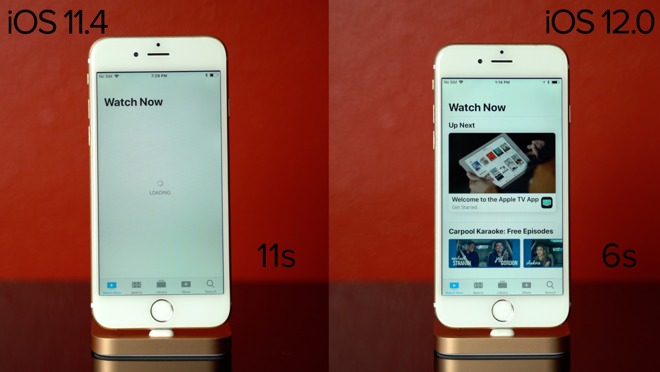
The next 5 apps, iBooks and Books, the Appleinsider app, Amazon Prime Video, Google Drive, and YouTube all launch about one second faster under iOS 12. Finishing off with “TV,” iOS 11.4 takes 5 seconds longer to launch versus iOS 12 —11 seconds vs 6.

TV app launch times on iPad mini 2

We then wanted to see if iOS 12 had an improvement in RAM management, which could result in more apps staying opened in the background.

We ran through all the apps once more. Both OS versions managed to keep each app open until we go back to “Pokemon Go” which had to be reloaded under both OS.

iPhone 6

Moving onto our iPhone 6, iOS 11.4 managed to launch 6 seconds quicker. The newer iOS 12 was slightly smoother and more responsive, but nowhere near the subjective difference we saw with the less powerful iPad mini 2.

iPhone 6 boot times on iOS 12

Apple’s Camera app opened slightly quicker in iOS 12.

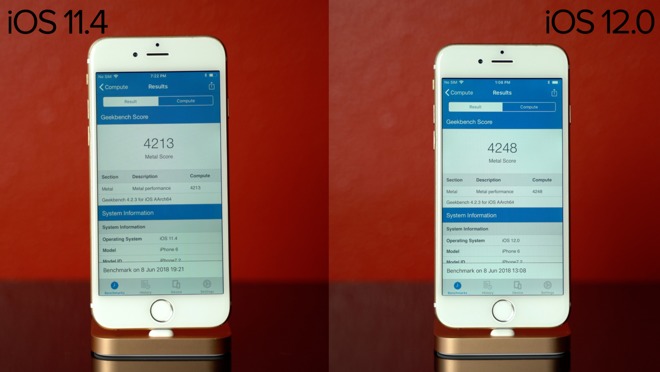
Once again, our Geekbench 4 CPU and GPU scores were almost the same under both versions of iOS. The CPU test resulted in 1560 Single core and 2686 multi-core in iOS 11.4, 1545 single core and 2722 multi-core in iOS 12. GPU results were 4213 in iOS 11.4 and 4248 in iOS 12.

iPhone 6 benchmarks on iOS 12

“Angry Birds” once again launched much quicker under iOS 12, taking 40 seconds compared to 41. iOS 11 launched “Pokemon Go” about 1 second faster, and launched “Asphalt 8” about 4 seconds faster. The iOS 12 beta also managed to launch News, Books, and the Appleinsider app slightly faster.

Amazon Prime Video, Google Drive, and the YouTube app were a bit faster under iOS 12, where the App Store took two seconds longer to launch with the latest OS. And to finish off, the TV app once again took 5 seconds longer using iOS 11.4.

TV app launch times on iPhone 6

To check RAM management, once again we re-launched each app and the results were the same, both keeping all apps but just one game open in the background.

This first iOS 12 beta breathed new life into our iPad mini 2, which was almost unbearable to use under OS 11. If you’re someone with an older iOS device the ultimate release of iOS 12 is great news, and we applaud Apple for their focus on performance and not dropping compatibility for older devices.

The results were a bit mixed with our iPhone 6 but very impressive with our iPad mini 2. Keep in mind this is the first beta release, and performance typically improves leading up to the official release.