Posted on Leave a comment

Apple to enable new iPhone eSIMs via software update, iPhone XS boasts faster wireless charging


With the big announcements out of the way, we take a closer look at a couple of less-prominent features coming to the iPhone XS — dual SIM support and faster wireless charging.

Dual SIM

Apple touted the iPhone XS’ ability to support dual SIM cards during its announcement event, sharing a few details in passing.

First, the solution will require one SIM card slot, with users inserting a physical SIM that is to be accompanied by Apple’s eSIM technology. The company currently uses eSIM tech in both the iPad and the Apple Watch, and is bringing it to iPhone for the first time.

Dual SIM

As predicted by analyst Ming-Chi Kuo, the iPhone XS supports Dual SIM Dual Standby (DSDS), wherein the phone automatically activates a particular SIM card as a call comes in. The active line will even be denoted below in the incoming number. DSDS technology provides a number of benefits to end users, the most obvious being the ability to travel across borders or coverage zones without swapping SIM cards.

Users in China will have to use two physical SIM cards — one inserted on each side of iPhone’s SIM card slot — as Apple does not have approval to launch its eSIM in the country.

Unfortunately for those looking forward to the dual SIM capabilities, a small footnote on Apple’s site reveals eSIM functionality will be disabled at launch. The company says it will activate the feature through a future iOS 12 software update, but fails to provide a specific timeline for release.

Wireless charging

On an unrelated note, the new iPhone XS and XS Max will be capable of charging at faster rates than iPhone X when paired with compatible wireless chargers. The exact increase in power is still unknown, but could likely be 9W or 10W, both of which are common output levels for Qi chargers.

Apple didn’t mention the speed increase — or wireless charging at all — on stage during the event, likely due to what is presumes to be problems getting its AirPower mat to market. The device, which was announced at last year’s iPhone event, but has yet to see release, was completely scrubbed from Apple’s website post-event.

Keep up with AppleInsider by downloading the AppleInsider app for iOS, and follow us on YouTube, Twitter @appleinsider and Facebook for live, late-breaking coverage. You can also check out our official Instagram account for exclusive photos.

Posted on Leave a comment

Tesla to restock sold-out wireless phone charger, cut price by $16


After quickly selling out of a sleek but underpowered wireless smartphone charger in late August, Tesla this week informed customers that the device will soon be back in stock at a roughly $16 discount.

Tesla Wireless Charger

Tesla is in the process of emailing customers who purchased the eponymous charger last month for $65, saying new shipments of the product are coming in and will be sold for $49 on the company’s online store, reports The Verge.

According to the email, copies of which were posted to social media on Monday, the $16 price drop is thanks to a higher quantity second production run. Customers who bought the Tesla Wireless Charger when it first went on sale last month will be refunded the $16 difference for being “early adopters.”

Tesla quietly introduced its Qi-compatible wireless charging device at the end of August. Described as a charging pad that “features the same design language used in our energy products, like Powerwall,” the charger sold out within a matter of hours.

Along with inductive charging, the device integrates a USB-C plug for compatible phones, while a USB-A cable provides a means to recharge the pack. With a 6,000mAh battery cell and wireless module that outputs 5W of power, the Tesla Wireless Charger is easily outperformed by cheaper, more capable products. As AppleInsider noted last month, RAVPower’s HyperAir battery pack boasts a 10,400mAh cell and 7.5W wireless charging capabilities for $50.

Still, Tesla’s brand appeal is sure to give the wireless charger a boost when it goes back up for sale in the near future. The company did not specify a restock timeline, but the recent emails suggest that date is soon approaching.

Posted on Leave a comment

Apple supplier’s sales forecast suggests holiday iPhone shipments on pace to meet 2017 levels


Apple supplier Broadcom on Thursday said it expects strong seasonal sales to drive a 25 percent sequential rise in wireless revenue for the fourth quarter of 2018, echoing statements made during the lead up to last year’s iPhone 8 and iPhone X launch.

iPhone X

Speaking with analysts in a post-earnings conference call covering the third quarter of 2018, Broadcom CEO Hock Tan said he expects a “seasonal uptick” in wireless parts orders to drive current quarter revenue forecasts, reports Broadcom.

The 25 percent boost is in large part thanks to a ramp in manufacturing at a “North American customer,” believed by analysts to be Apple. Broadcom supplies a number of components used in iPhone devices, including the touchscreen and wireless charging controllers found in iPhone 8 and iPhone X.

While wireless revenue is expected to jump on a sequential basis, the forecast is down in single-digit percentage from a year ago, the report said.

Tan offered a nearly identical outlook in the second quarter of 2017, saying at the time that wireless revenues were expected to increase in the “mid-20 percent” range as Broadcom’s North American customer ramped up production of its next-generation phone.

If Apple is relying on Broadcom to supply similar components for this year’s iPhone lineup, today’s forecast suggests Apple is expecting demand for this year’s slate of iPhone products to be largely on par with that of iPhone 8 and iPhone X.

Though iPhone shipments were down on a year-over-year basis during the 2017 holiday quarter, Apple managed to sell 77.3 million units at a record average selling price of approximately $796.42. The performance netted the company its best quarter ever in terms of revenue, which hit $88.3 billion.

Apple is set to debut a refreshed iPhone lineup at a special event next week. In addition to an iPhone X successor, the company is widely rumored to launch a larger OLED variant of its popular handset, as well as a mid-tier 6.1-inch LCD model with Face ID. New Apple Watch models are also anticipated for unveiling.

AppleInsider will be covering the event live on Sept. 12.

Posted on Leave a comment

Apple begins logic board replacements for iPhone 8, claiming ‘very small percentage’ of defects


Apple on Friday initiated a free logic board replacement program for some owners of the iPhone 8, admitting that “a very small percentage” of units were shipped out with a manufacturing defect.

Apple iPhone 8

Impacted devices were sold between September and March in Australia, China (including Hong Kong and Macau), India, Japan, New Zealand, and the U.S. The company has put up a search tool through which people can screen their phone’s serial number.

The issue doesn’t affect the iPhone 8 Plus, Apple noted.

Assuming an iPhone is listed as affected, people must then make an appointment at an Apple store or authorized service provider. Alternately owners can contact Apple support directly and arrange for a mail-in, but all three methods involve iPhones being sent to a distant repair center. It’s critical to backup a device to iCloud or iTunes before handing it over.

iPhones with the faulty boards may freeze, reboot, or outright fail to turn on.

Posted on Leave a comment

Judge dismisses motion to halt Qualcomm’s potential iPhone import ban


Plaintiffs in a class action lawsuit against Qualcomm had sought to stop the chipmaker from getting a theoretical import ban on Intel-equipped iPhones, but perennial Apple judge Lucy Koh has denied the motion.

Qualcomm

Judge Koh on Wednesday denied a motion by plaintiffs in a class action suit to prevent Qualcomm from obtaining a U.S. International Trade Commission exclusion order that would affect the import of iPhones with Intel modems, reports FOSS Patents.

“At bottom, Plaintiffs cannot sustain their request for a preliminary injunction because their asserted harm relies on a speculative and attenuated inferential chain, which centrally includes intervening decisions by multiple independent decisionmakers,” Judge Koh wrote.

The motion was dismissed “without prejudice,” meaning that it can be brought again in the future.

The plaintiffs, who are suing Qualcomm for antitrust violations, filed the motion in June concerning Qualcomm’s separate proceeding before the ITC, in which Qualcomm seeks to “prevent importation of certain Apple devices into the United States.” The issue Koh ruled on this week was the plaintiffs’ motion for a preliminary injunction, which sought to “enjoin Qualcomm from enforcing any exclusion or cease-and-desist order that the ITC may issue in that action.”

The motion was brought by plaintiffs who believe that Qualcomm’s ITC complaint represents an anti-competitive action.

Judge Koh, for jurisdictional reasons, often presides over cases related to Apple and other Silicon Valley-based companies, including the recent trial between Apple and Samsung.

Posted on Leave a comment

Huawei again estimated to have overtaken Apple as world’s No. 2 smartphone vendor


New market research further solidifies previous estimates that Apple has ceded its spot as the world’s second-largest smartphone vendor to Chinese upstart Huawei, at least for now.

Huawei

According to the latest numbers from Gartner, Huawei ended the second quarter of 2018 with 49.8 million devices sold, good enough for a 13.3 percent share of the global smartphone market, reports TechCrunch. Huawei’s numbers are up from the year-ago quarter, which saw the firm ship about 36 million units for a 9.8 percent marketshare.

The performance lands the Chinese smartphone maker ahead of Apple, which sold 41.3 million iPhones during the same period of 2018. Gartner places Apple’s marketshare at 11.9 percent, a dip from 12.1 percent recorded during the same time last year.

“Huawei continues to bring innovative features into its smartphones and expand its smartphone portfolio to cover larger consumer segments,” said Gartner research director Anshul Gupta. “Its investment into channels, brand building and positioning of the Honor devices helped drive sales. Huawei is shipping its Honor smartphones into 70 markets worldwide and is emerging as Huawei’s key growth driver.”

Samsung topped the chart with 72.3 million smartphones shipped in quarter two, but also saw a decline in year-over-year performance. The Korean tech giant’s marketshare dipped from 22.6 percent in 2017 to 19.3 percent during the most recent quarter.

Two more Chinese brands, Xiaomi and Oppo, finished fourth and fifth, respectively. Xiaomi, a blatant Apple ripoff artist, shipped 32.8 million units for an 8.8 percent marketshare, while Oppo managed 28.5 million shipments for a 7.6 percent slice of the pie.

Gartner’s figures align with findings from market research firms IDC, Canalys and IHS Markit, all of which saw Huawei outperform Apple in the second quarter. Previous estimates were less conservative, putting Huawei’s shipments closer to 54 million units for the three-month period.

Gupta warned of soft iPhone X demand, an oft-repeated analyst worry that Apple has continuously refuted.

“Demand for the iPhone X has started to slow down much earlier than when other new models were introduced,” Gupta said.

Apple last month reported its best June quarter ever, recording $53.3 billion in revenue on the back of largely flat iPhone sales. Despite slowing sales, Apple’s iPhone revenue surged 20 percent year-over-year on a stronger mix of premium priced handsets like iPhone X. Indeed, it was Apple’s most expensive phone that maintained its position as the company’s best performer, helping drive average selling price to $724, up from $606 a year ago.

The top-five vendor list is likely to reshuffle at the end of the year. Apple is widely expected to release a trio of new iPhones in September that will undoubtedly result in a sales spike during the last calendar quarter. The company is anticipated to launch two high-end OLED models and a mid-tier LCD version that could be priced between $600 and $700.

Posted on Leave a comment

Apple & US carriers partner on 200GB iCloud promo ahead of new iPhones


Apple and the four major U.S. carriers are offering two free months of iCloud’s 200-gigabyte tier to some people looking to upgrade their iPhone this fall.

iCloud on iPhone X, iPad, and MacBook Pro

The promo, noticed on Reddit, is only available to new (paid) iCloud customers, and is nominally meant to ensure they “have enough space to safely back up all the important things on your iPhone, like photos, videos, files, and apps” so the data can be restored once a new phone arrives. The link above mentions Sprint in the URL but should also work for AT&T, T-Mobile, and Verizon.

Apple has actually been offering 30-day trials of its paid tiers since May, so in reality the new promotion is simply an extra month on top of that. People who sign up will also be charged $2.99 per month after the deal expires, unless they cancel.

iCloud only includes 5 gigabytes of data for free, which for many people is just enough for a single device backup. In the U.S. Apple charges 99 cents per month for 50 gigabytes, $2.99 for 200 gigabytes, and $9.99 for 2 terabytes.

The company is expected to reveal three new iPhones next month at its usual September press event. These include 5.8- and 6.5-inch OLED models, and a less expensive 6.1-inch LCD device. It’s possible that Apple could once again bump up maximum local storage to 512 gigabytes, which would keep iPhones competitive with Samsung’s Galaxy Note 9.

Posted on Leave a comment

Flaws in Apple & Asurion websites expose PINs of millions of iPhone users


Although already fixed, security vulnerabilites at Apple’s online store and the website for Asurion, a phone insurance firm, recently exposed the PINs of millions of mobile accounts, a report revealed on Friday.

Hacked

The Apple vulnerability exposed the PINs of “over 72 million” T-Mobile subscribers, BuzzFeed News claimed. Asurion is noted to have had a separate flaw, affecting the PINs of AT&T customers.

Both Apple and Asurion remedied the situation after BuzzFeed shared findings from security researchers “Phobia” and Nicholas “Convict” Ceraolo. In Apple’s case, an account validation page that asked for a T-Mobile cell number and a PIN or Social Security number would potentially let hackers try an infinite amount of attempts — unlike forms for the other three major U.S. carriers, which were already protected by rate limiters.

The problem may have been an engineering mistake made when linking a T-Mobile API to Apple’s website, Ceraolo said.

The Asurion vulnerability let people who knew an AT&T user’s phone number obtain access to another form asking for their PIN, which like Apple’s page lacked a rate limiter.

The Apple flaw is unrelated to a T-Mobile server breach which exposed some of the personal information of about 3 percent of the carrier’s subscribers. That attack took place on Aug. 20.

Posted on Leave a comment

Review: Audio-Technica’s ANC700BT headphones sound great, but are marred by odd controls

Audio-Technica’s QuietPoint ATH-ANC700BT tries to bridge the gap between performance and cost, and mostly succeeds except for awkward and unnecessary touch controls.

Audio-Technica QuietPoint ATH-ANC700BT

On the surface there’s nothing remarkable about the 700BT. There’s one color option, matte black, and nothing ostentatious about its design. It looks fine, just nothing to write home about. Bundled accessories are limited to a pouch, a micro USB charging cable, and a 3.5mm headphone jack if you want or need to skip Bluetooth.

As it turns out, you might have to if you’re a Mac or Windows user. Macs may not take kindly to this sort of Bluetooth headset, and out of curiosity, we tried pairing the headphones with a Windows 10 PC — for whatever reason, the computer would only register them as a mic input. Pairing with an iPhone 6s Plus, conversely, was quick and painless. These are obviously mobile-first.

Ergonomically the 700BT manages to be light and extremely comfortable, such that these are some of the few headphones we’ve ever been able to wear all day. They’d be great at the gym too if they were waterproof.

They sound amazing, which is probably to be expected from a company like Audio-Technica and a rated frequency response between 5 and 40,000 hertz. Audio from iTunes, Overcast, or Spotify’s high-quality feed was crisp and clear, with punchy bass lacking any sign of distortion or drowning out highs and mids. You can find better-sounding headphones, but only if you’re willing to spring for something substantially more expensive, at which point there are diminishing returns.

Noise cancellation seems to work well too. When activated in our testing, it effectively killed any sound from our office fan and AC, and even made it difficult to hear other people, much to their frustration. Normally cancellation only drowns out repetitive ambient sound, though of course the 700BT uses an over-the-ear design that further improves isolation.

There’s just one potential dealbreaker for the 700BT, and that’s its on-cup control scheme. Apart from an on/off/pairing switch, everything is controlled either in-app or via a touch-sensitive surface on the left earcup — turning on noise cancellation, for example, requires covering the whole surface with your palm. In our testing this never worked consistently.

Audio-Technica QuietPoint ATH-ANC700BT

We even found it hard to change tracks or volume on occasion, which shouldn’t be the case on any headphones, much less a pair from Audio-Technica. There’s no reason the company couldn’t have implemented dedicated buttons or an inline remote.

Conclusions

If you absolutely depend on headphone-mounted controls, you should skip the 700BT. There are comparable options which will better suit your needs.

If you depend more on Siri or app-based controls, there’s a little more flexibility. Vendors like Amazon are selling them for just $169, and even at full price, they’re $199. That’s a pretty good value if your priorities are comfort and sound quality.

These sound better than the vast majority of Apple/Beats headphones, so if you can pick them up at a discount, they may be worth a go.

Where to buy

Audio-Technica’s QuietPoint ATH-ANC700BT headphones retail for $199, but are currently on sale for $169 at B&H Photo.

B&H is also including free expedited shipping within the contiguous U.S. for fast delivery to your doorstep (typically within one to three business days). The Audio-Technica authorized dealer also will not collect sales tax on orders shipped outside New York and New Jersey*.

Posted on Leave a comment

Hands-On: Ring’s iPhone-ready, self-running Spotlight Cam Solar


Hands-On

Amazon’s Ring is omnipresent in smarthome security, and the Spotlight Cam Solar is an attempt to further cement that position among picky iOS and Android users.

Ring Spotlight Cam Solar

As it turns out, the Solar is essentially Ring’s existing Spotlight Cam Battery, but bundled (at a discount) with a solar panel accessory that fixes the original’s main weakness: maintenance.

On its own the Battery needs to have its DSLR-style battery pack periodically recharged. This isn’t just an inconvenience — you may temporarily lose coverage unless you have a spare battery, and in any circumstance you’ll have to mount the camera in a reasonably accessible place, making it more vulnerable to tampering. Because the Solar recharges its battery pack independently, you can put it anywhere your initial installation allows, then forget about it.

Ring Spotlight Cam Solar

The installation process takes about an hour, but is relatively straightforward thanks to video-enhanced guidance provided on Ring’s YouTube channel and in an official iPhone and iPad app. The company supplies all of the necessary tools including bits and screwdrivers, though you might still want to bust out a power drill, especially if you’re working with anything tougher than wood.

The iOS app is, as it turns out, a highlight of the Ring package. It’s extremely well-organized, making it very easy to toggle settings and track alerts and power status. There’s even built-in access to Ring’s Neighbors platform, where individuals and police share footage of suspicious incidents. Some posts tend to be a little paranoid, but it’s at least good to be aware.

One thing we had to do right away was narrow the focus of the Solar’s motion zones. The camera has a wide field of view, and by default triggers push notifications for a good portion of that. Even with a narrower cone, detection seems sensitive — we would get notifications and scan footage only to discover that it had been set off by something like a distant bird.

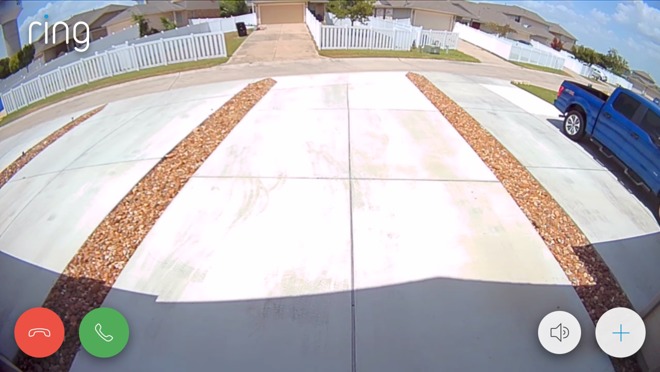
Ring iPhone app

Saved footage (or the lack thereof) is one of several issues we’ll go into later, but right now we should note that the camera does not support Apple HomeKit. You’ll be relying primarily on first-party notifications, since there isn’t even a Web portal for viewing video.

The camera does of course support Amazon Alexa, meaning that if you have an Echo Show or Echo Spot, you can ask Alexa to show you a live feed at any time. Just be warned that the camera’s namesake spotlight comes on if you watch at night, which could be annoying to neighbors.

Keep following AppleInsider for a full review later this month.